Samboleap Tol: Caring for past, present and future
What do our ancestors tell us, and what do we ourselves wish to pass on to future generations? These are the questions that occupy the artist Samboleap Tol (b. 1990, the Netherlands) and that materialise within her visual practice. She is one of the 92 emerging artists who recently received an artist start grant from the Mondriaan Fund, and also received a residency grant. With this support, she developed Dharma Songs (2023), Cosmic Tortoise (2024) and Starlight (2025). This latest work, a new kinetic sculpture that builds on her research into ancestral veneration, is presented in the Prospects section of Art Rotterdam 2026.
Samboleap grew up in the Netherlands with Cambodian parents who lived through the genocide under the Khmer Rouge. Her family history is at once deeply rooted in the broader history of the Cambodian community, marked by untold stories and unresolved trauma. She experienced how this background shaped her own life and noticed that peers from various communities across the Global South struggled with similar unanswered questions.
Her artistic practice departs from the community and ultimately returns to it. Through extensive conversations with people, she gathers insights into shared rituals, cultural customs and mythological origins that have gradually faded into the background. She then unravels these references in kinetic sculptures.
“I think that as a child, I mainly encountered art through the community,” Samboleap explains. “Uncles and aunts putting on costumes and, through dance or theatre, telling a mythological story. I do not associate art so much with objects in a sterile, static museum with a single grand author and one-way communication. In my experience, art is alive. It has a rhythm, a narrative. And that narrative adapts to where we are.”
This sense of vitality is also reflected formally. In addition to being interactive and communicative, her sculptures are often mechanical and musical. She draws inspiration from her father, an engineer whose inventions filled the living space, and from music, which during her formative years took her by the hand like a companion.
In that same spirit, Samboleap Tol describes how celebrations and commemorations within her community were a natural part of her life from an early age and now permeate her work. For instance, the dead are remembered by preparing food for them, and temples are honoured by placing flowers there. At the same time, there was an underlying awareness that these rituals were not always explained and that traumatic histories were not addressed. “As a child, your parents are a reflection of yourself. You use them very much as a mirror. But if you only receive part of the story, that is harmful to your health.”
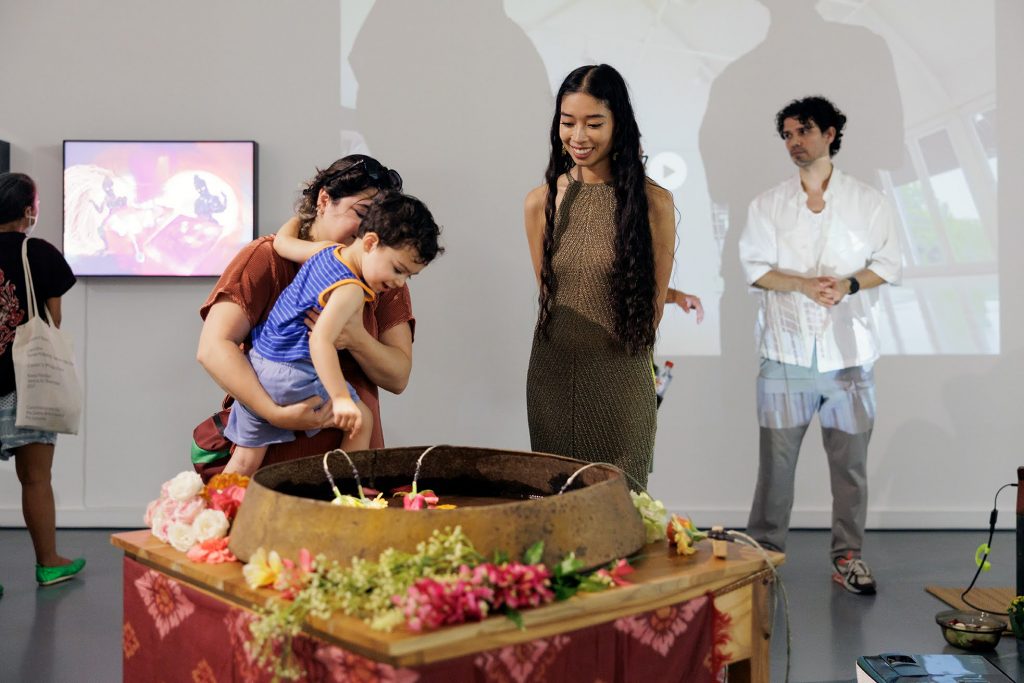
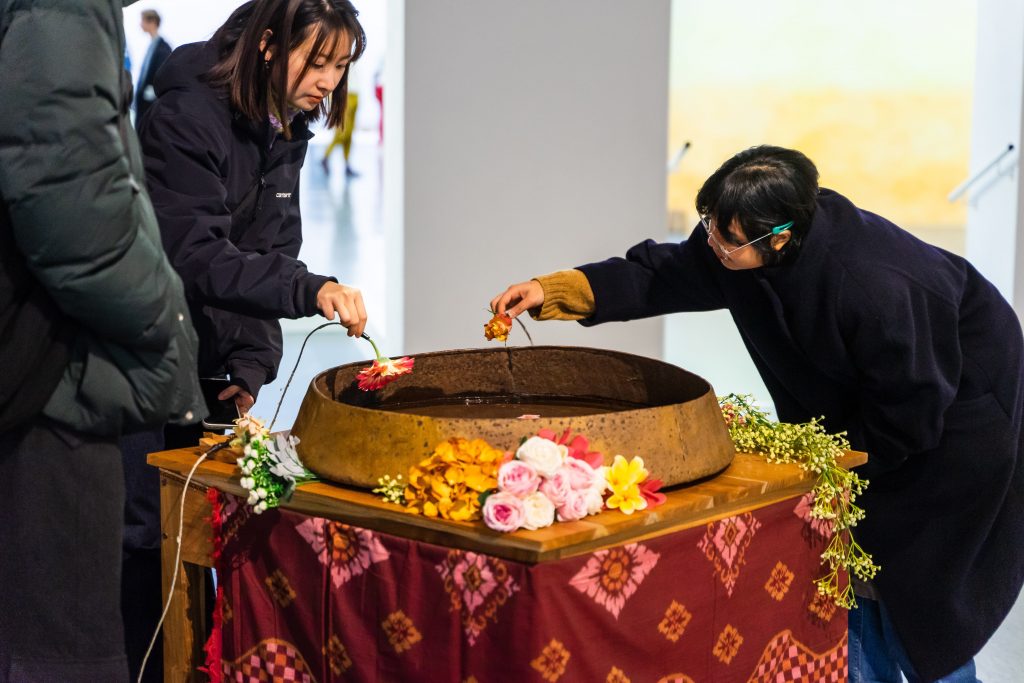
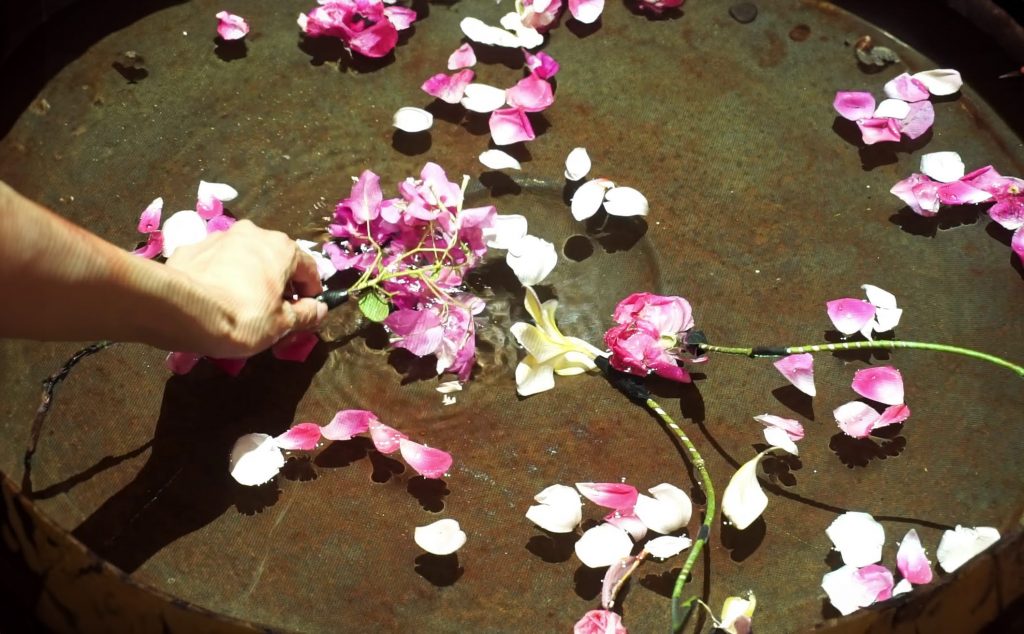
This absence was gradually, in part, filled by friends and mentors who had grown up with similar silences. From that search emerged Dharma Songs (2023), a series of interactive sound installations. “You are invited to place flowers in the water. At that moment, voices begin to speak from a hidden loudspeaker. I asked close friends and family members from diverse cultural backgrounds to respond to a question: if you could ask or tell your ancestors one last thing, what would it be?” The sculpture draws on a shared cultural heritage of ancestral veneration and offers space for the generational lack of connection with ancestors.
Thanks to the support of the Mondriaan Fund, Samboleap was given the opportunity to further explore her roots and to broaden her practice geographically and historically. She explains how she has always strongly associated herself with the Indonesian diasporas in the Netherlands, which felt to her like a parallel world. This led her to Yogyakarta, where conversations with historians increasingly clarified how closely the historical lines between Java and Cambodia are intertwined. “They refer to this as Purāṇic motifs, derived from the Purāṇas, ancient Indian mythological texts. From around the 5th to the 15th century, India exerted a tremendous influence on both Java and Cambodia, which remains visible in temples and palpable in cultural practices, despite the fact that neither place has practised Hinduism for over 500 years. We are both proud of the great temples in our back gardens, yet we actually know too little about their origins and motifs,” she explains. Samboleap now shares this accumulated knowledge through lecture performances, research articles and her visual work.
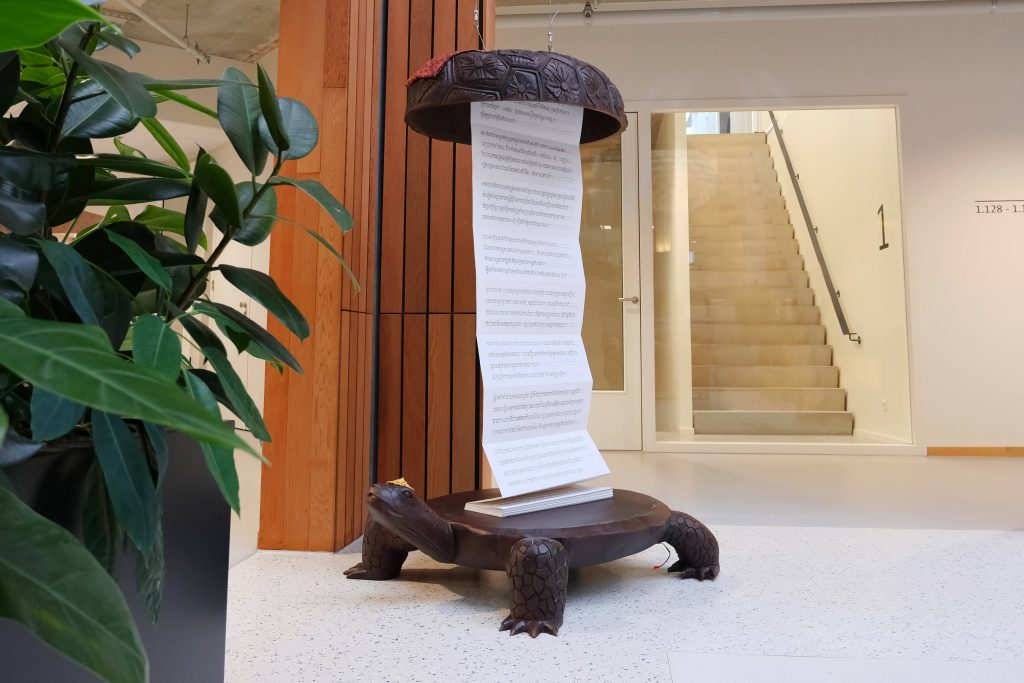
In Cosmic Tortoise (2024), Samboleap Tol returns to a myth in which the divine figure Vishnu assumes the form of a tortoise. The sculpture was created in collaboration with a large network of makers and cultural researchers with whom she has continued to work since her stay in Yogyakarta. “There were around forty people involved. I speak little Indonesian, and they often do not speak English. So it was often a matter of explaining things with hands and feet,” she laughs. The result is a mechanically moving tortoise made of teak wood. “When you press a button, the shell lifts up and a book appears that opens along a vertical line, while a voice begins to sing. I wrote the text for the book myself and had it translated by translators in Cambodia, into Khmer.”
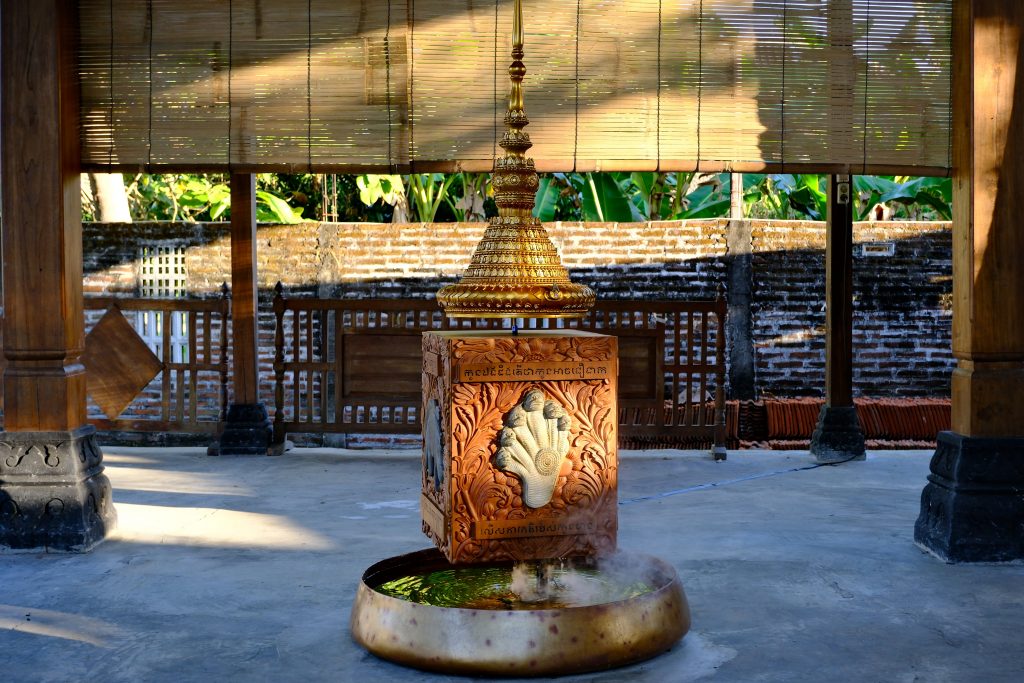
In the Prospects section of Art Rotterdam, Samboleap Tol presents her latest work Starlight (2025), which likewise emerged from an intensive collaborative process involving dozens of skilled practitioners. The central element of the kinetic sculpture consists of wood engravings, made in collaboration with a teak wood carver from Jepara, North Java, a city with a long tradition of woodcarving shaped by Indianisation, Islamisation and also Dutch influence.
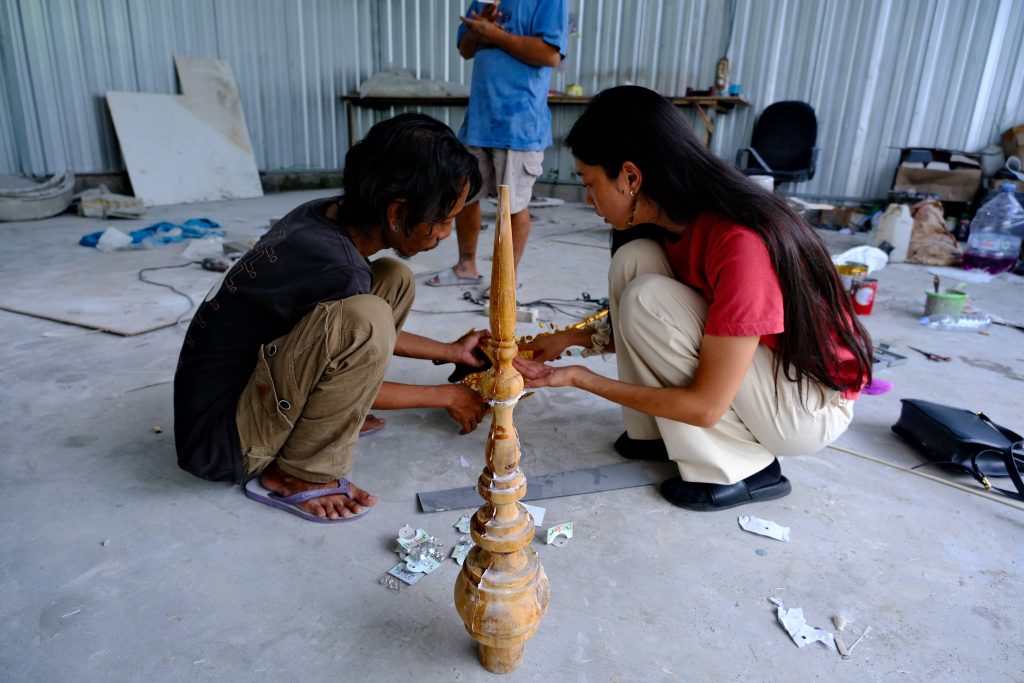
The origin of Starlight, however, is explicitly personal: “I lost my father during the Covid period. Only my mother was allowed to attend the funeral, so I followed everything online via a Facebook video. It was a pixelated experience that kept imposing itself over the years. I noticed that I still had painful feelings about it and that I wanted to do something with them. Starlight became a form of therapeutic processing.”
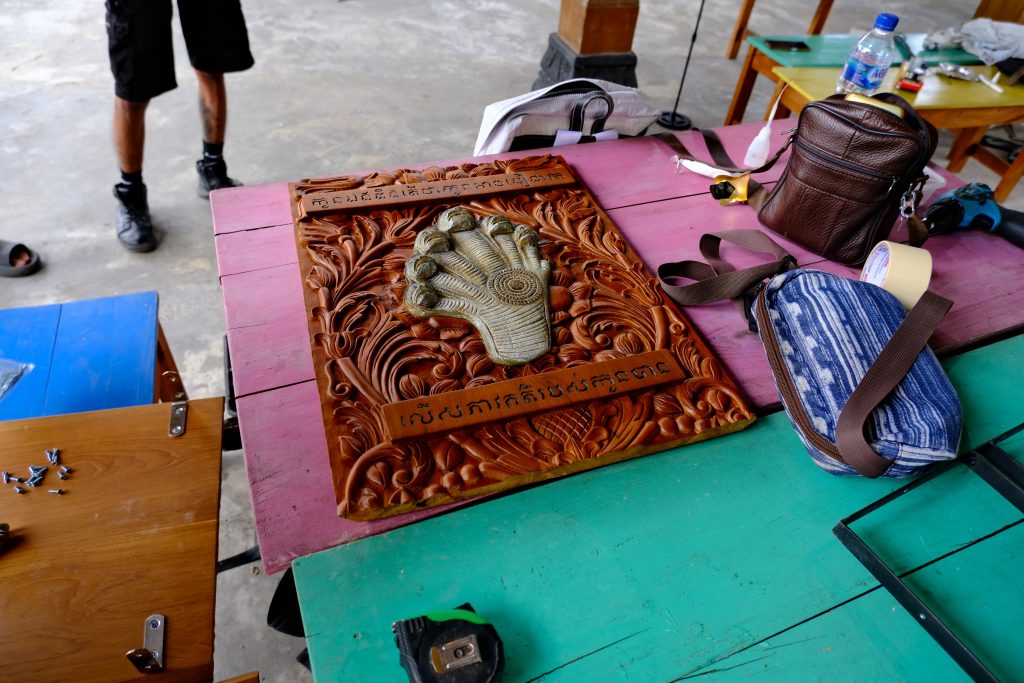
The form that imposed itself was that of the top of the cremation pavilion, an architectural element shaped like a crown. She discovered that this refers to Mount Meru, a mythical cosmic mountain in Hinduism and Buddhism that has been described for thousands of years in Purāṇic stories. At the same time, she learned that Cambodian dancers wear a similar crown, called a makhut. “A Belgian-Cambodian friend told me that this crown is made of gold so that dancers can be in communication with the heavens. Gold conducts energy well and functions as a kind of antenna.”
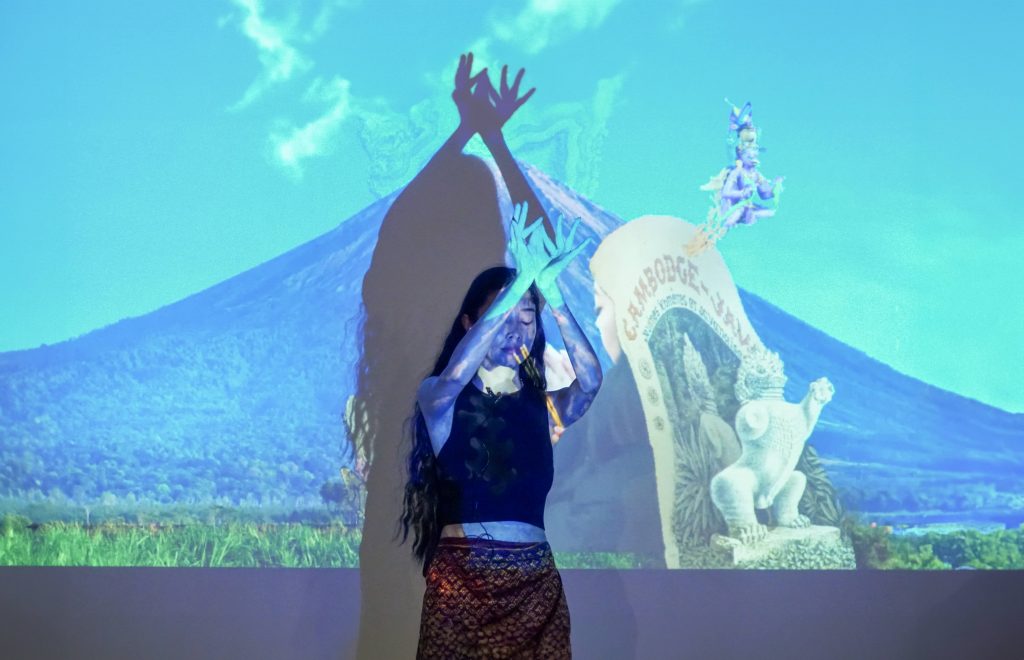
It is as if the development of her visual practice over recent years comes together in her latest work Starlight. In Dharma Songs, Samboleap Tol adopts a caring stance together with friends and family by turning towards the past and addressing questions to ancestors, even when answers remain absent. In Cosmic Tortoise, she connects this care to a longer timeline, through the mythological story of Vishnu, which points to continuity through time. With Starlight, Samboleap Tol explicitly turns towards the future. She asks those closest to her what advice they wish to pass on to future generations. Their words form part of the sculpture and can be discovered in the Prospects section during Art Rotterdam.
Written by Emily van Driessen


