Dagmar van Weeghel: reclaiming the archive with sunlight and silver
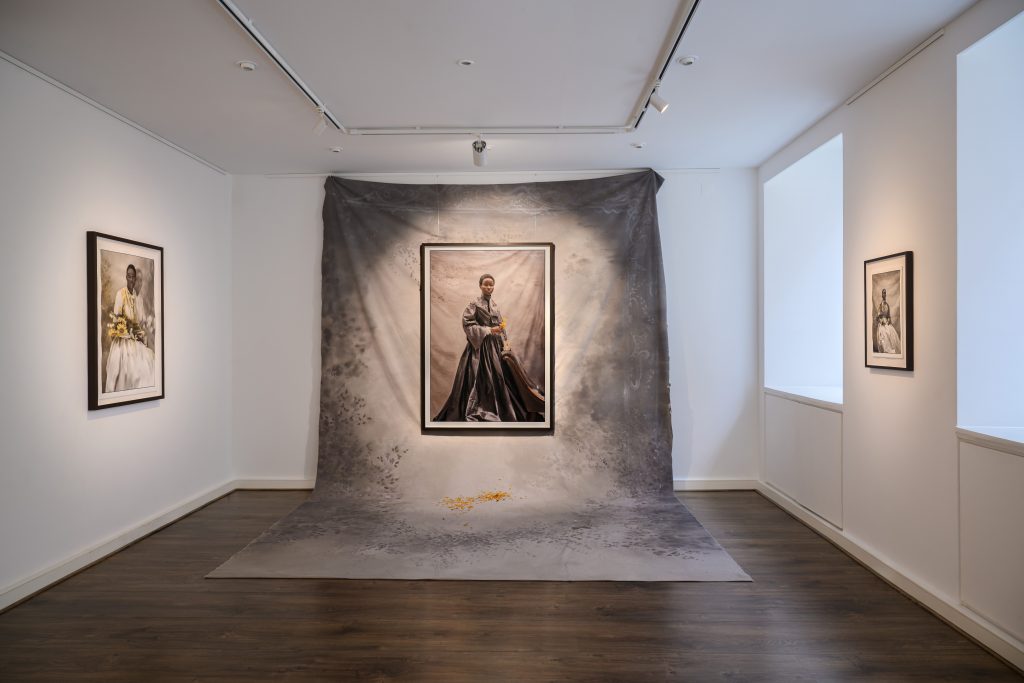
In the section The Past Present at Unseen, THIS IS NOT A WHITE CUBE (Lisbon) will presents the series "BLOOM: Reclaiming Presence Through Botanical and Photographic Memory” by Dagmar van Weeghel. With this body of work, the Dutch photographer returns to the nineteenth century to question the very foundations of the photographic archive. Who was recorded at the time, who remained outside the frame, and what does that mean for the ways in which we look today?
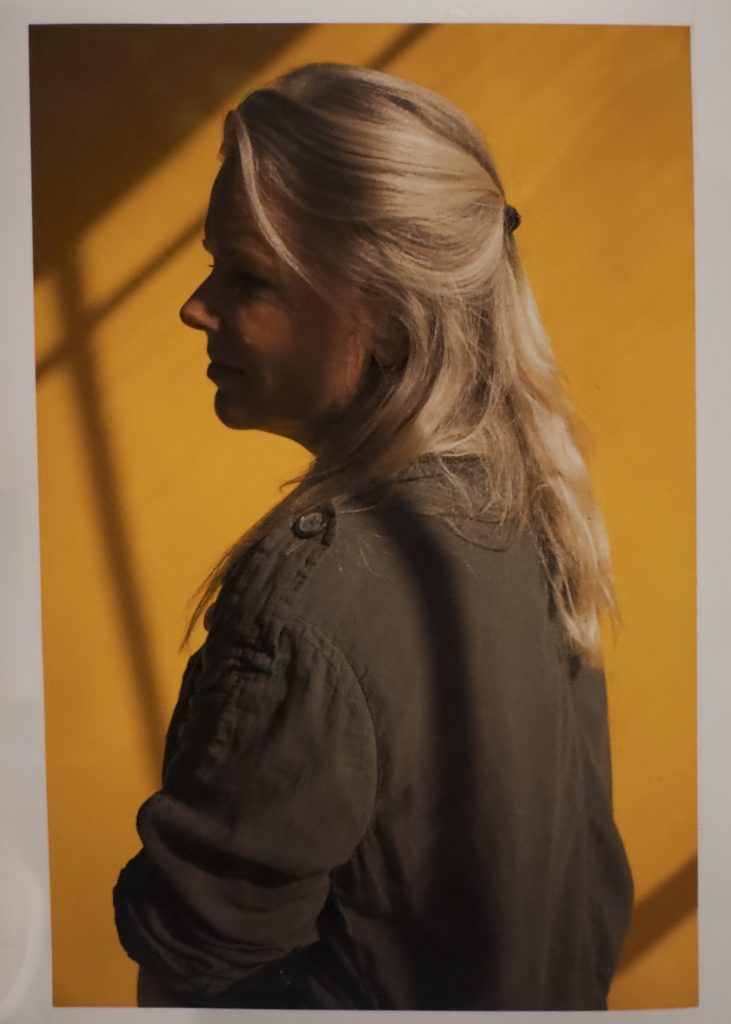
Van Weeghel studied at the Dutch Film Academy in Amsterdam and lived and worked for some ten years in several African countries as a filmmaker, including Zimbabwe, Tanzania, Botswana, Uganda and South Africa. Those years shaped her gaze. Since 2015, photography has been her primary medium, through which she shares stories unfolding between continents, generations and histories. Her practice operates at the intersection of image and archive.
A decisive turning point came with her return to the Netherlands. She witnessed firsthand how persistent prejudices about Africa and African people can be. Her husband, whom she had met in Botswana, was often cast as ‘the other’, and her two children, growing up with a dual identity, also encountered racism. Van Weeghel immersed herself in history in order to understand how such patterns take root. She read, among other works, Edward Said’s seminal ‘Orientalism’, which systematically demonstrated how the Western gaze is not neutral but shaped by power structures and colonial systems of knowledge. That gaze exoticises, categorises and marginalises whatever is defined as ‘other’, presenting it as self-evident and objective reality. What her husband and children experienced was not an exception but a pattern, deeply embedded in Western thought.
Said is regarded as one of the founders of postcolonialism, an academic field that examines how colonial structures, modes of thinking and representations persist after the formal end of colonial rule. Decolonial thinking takes this further by actively seeking to dismantle those structures and develop alternative perspectives and systems of knowledge, often originating in the Global South. Think of theorists such as Frantz Fanon. Within these frameworks, Van Weeghel finds her own position. Between 2016 and 2022 she created the series “Diaspora", for which she portrayed African immigrants in Europe, often people from her own network. In it, she explored how dignity, strength and complexity can be rendered visible within a visual culture that has long been dominated by a Western perspective.
Gradually her attention shifted to nineteenth-century photography and the structural absence of Black Europeans within it. During that period, photography developed into a mass medium and was deployed as an instrument of registration and classification. Between roughly 1839 and 1900, portraits of people of colour in European archives are rare, anonymous or entirely absent, especially when it comes to women. This scarcity is no coincidence but the symptom of a selective gaze. What did not fit the dominant frame was scarcely recorded, if at all. That lacuna lies at the heart of “BLOOM". Rather than merely citing the archive, Van Weeghel constructs an alternative visual memory. Earlier research had already led her to historical figures such as Sarah Forbes Bonetta, a West African woman who unwillingly became a protégée of Queen Victoria, yet in “BLOOM" the emphasis shifts decisively to the present.
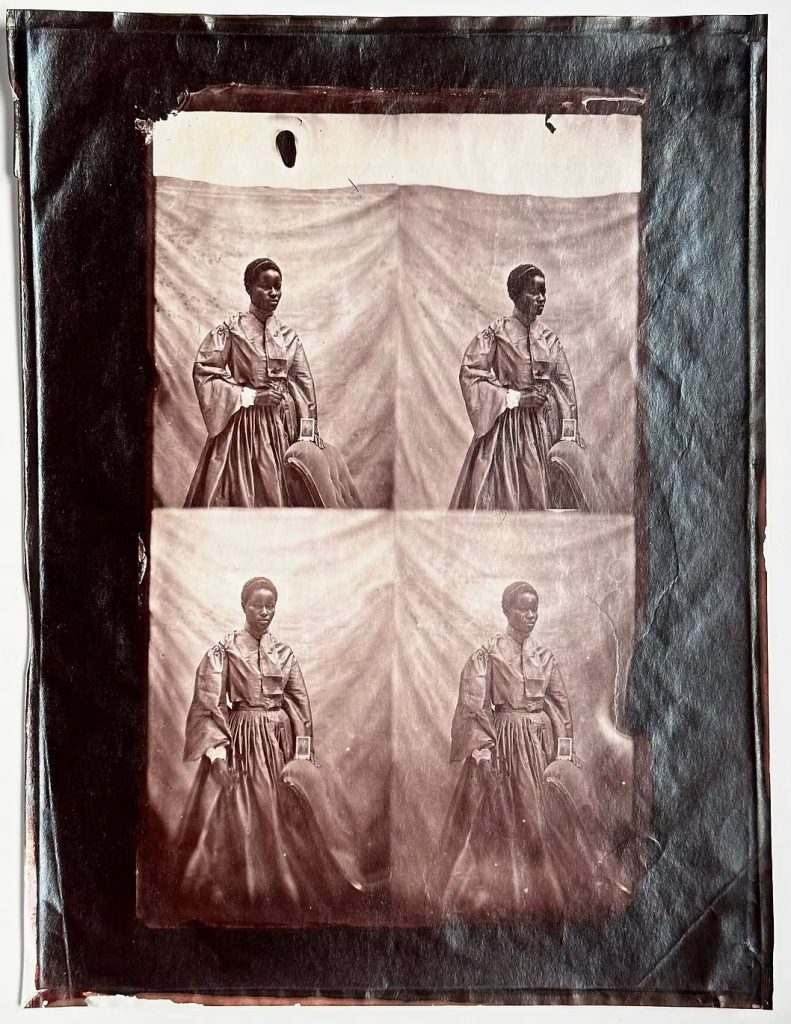
For “BLOOM", a project developed over four years, Van Weeghel employs historical techniques. Yet contemporary women step into a nineteenth-century frame here. Not as curiosities but as protagonists. Using a rare carte de visite camera from 1860, the artist creates portraits of women of African descent who live in Europe today.

Van Weeghel: “Only five of these original cameras still exist, four of which are held in museum collections. One of the remaining cameras is part of the collection of the collector Frédéric Hoch in Strasbourg. He granted me permission to use this wet plate camera. Quite remarkable! In the early nineteenth century, this camera predominantly captured white subjects. We were given five hours, and the camera had likely not been used for 150 years, so it squeaked and creaked, but the process was truly extraordinary.”
The women in the photographs wear carefully crafted garments in nineteenth-century style, with every detail thoughtfully considered. Each photograph is printed on authentic nineteenth-century albumen paper and presented as a carte de visite, the small portrait card mounted on cardboard that was widely exchanged and collected in the nineteenth century.
Within the series, Van Weeghel also produces large-scale anthotypes, prints created by exposing pigments (made from self-grown and foraged wildflowers) to sunlight. These pigments gradually fade, serving as a metaphor for memory, loss and the fragility of the archive. At the same time, the artist invokes Victorian floriography, the coded language of flowers through which emotions and social conventions were communicated and which also carried colonial and racial meanings. For these anthotypes the artist reprints anonymous Black women from nineteenth-century archives. The ephemerality of the technique mirrors the ways in which these women have disappeared from historical narratives. For the pigments she collected flower petals in the Netherlands, France and the United Kingdom, countries with charged colonial histories. She often did so together with her daughter, as a shared act. Van Weeghel also gathered flowers from the private gardens of Queen Victoria and Queen Elizabeth in Scotland. These will also be on view at Unseen. In addition, Van Weeghel hand-coloured a number of black-and-white portraits as an act of remembrance, using self-made flower pigments. The flowers she employs here also carry specific meanings and messages.
All the portraits in the series continuously seek a dialogue with the viewer through the language of floriography and botanical history. Through gestures, specific flowers held by the sitters or hand-painted fabrics, each image conveys a distinct message.
Van Weeghel also works with platinum-palladium prints, a technique she selected for its durability and rich tonal range, and thus for its archival permanence. That way, these women are granted a lasting place within the visual archive. Works from the series have entered collections including the Ministry of Foreign Affairs and Fondation Blachère. A selection from “BLOOM” will be on view at Unseen during Art Rotterdam in the section The Past Present. Works from the series are simultaneously presented at THIS IS NOT A WHITE CUBE in Lisbon.
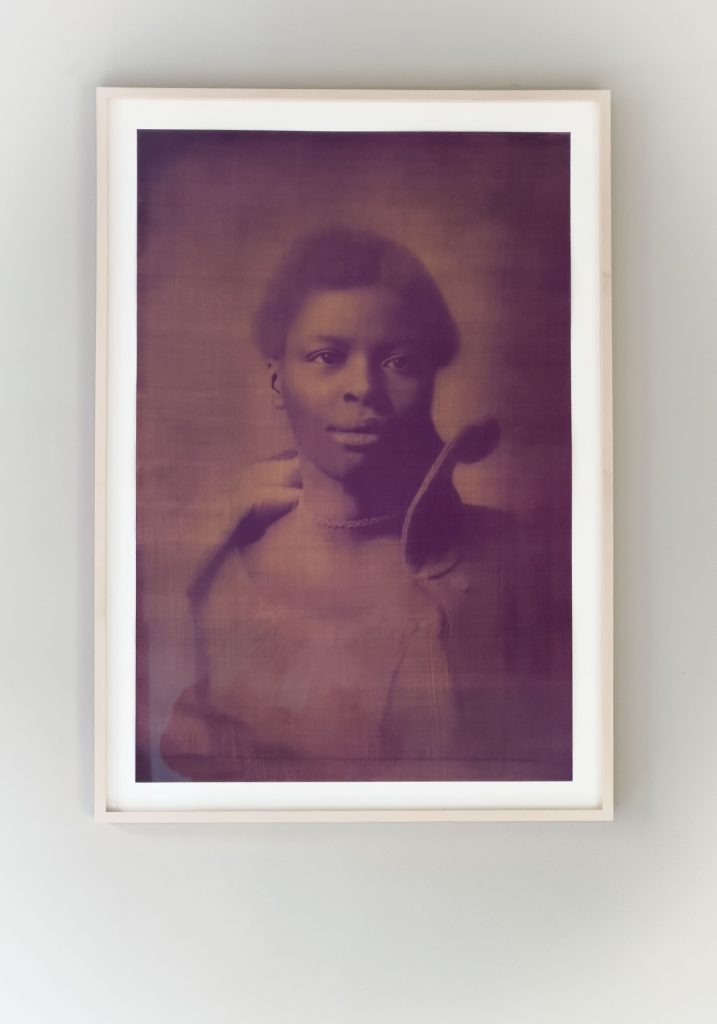
These portraits do not reconstruct the past but anchor new forms of presence within the visual vocabulary of European history. With this series, Van Weeghel consciously enters a charged visual domain, fully aware of the structures that have shaped our field of vision. She adopts the form but not the power relations embedded within them. She places other bodies, stories and perspectives at the centre of the image and grants the portrayed women agency over their representation. Van Weeghel does not speak on their behalf but examines the visual frameworks that have long constrained their visibility and creates space and context for a layered presence. These women are not passive objects of a western gaze but rather co-authors. By reactivating and repositioning historical techniques, Van Weeghel expands the archive and, with it, our way of seeing. She underscores that the archive is not a neutral repository but a construct shaped by selection, exclusion and power, revealing how deeply visibility depends on who looks and who preserves.
About the section The Past Present at Unseen during Art Rotterdam (27–29 March at Rotterdam Ahoy) In The Past Present, photo historian, curator and author Hedy van Erp offers a contemporary perspective on analogue photography up to the year 2000, with particular attention to lost archives and found images. She brings togethWer artists who use existing photographic material and techniques in new ways, to restore weight and meaning to the past.
Written by Flor Linckens


