Thinking with His Hands: Hernán Soriano’s Material Vocabulary
Entering the world of Argentine visual artist Hernán Soriano (1978) feels close to stepping into an archival study lined with cabinets of curiosities. The muted scent of old books creaks in silence, dim amber candlelight washes over brown-tinged paper, and a large coloured world map lies half-unrolled across a solid oak desk.
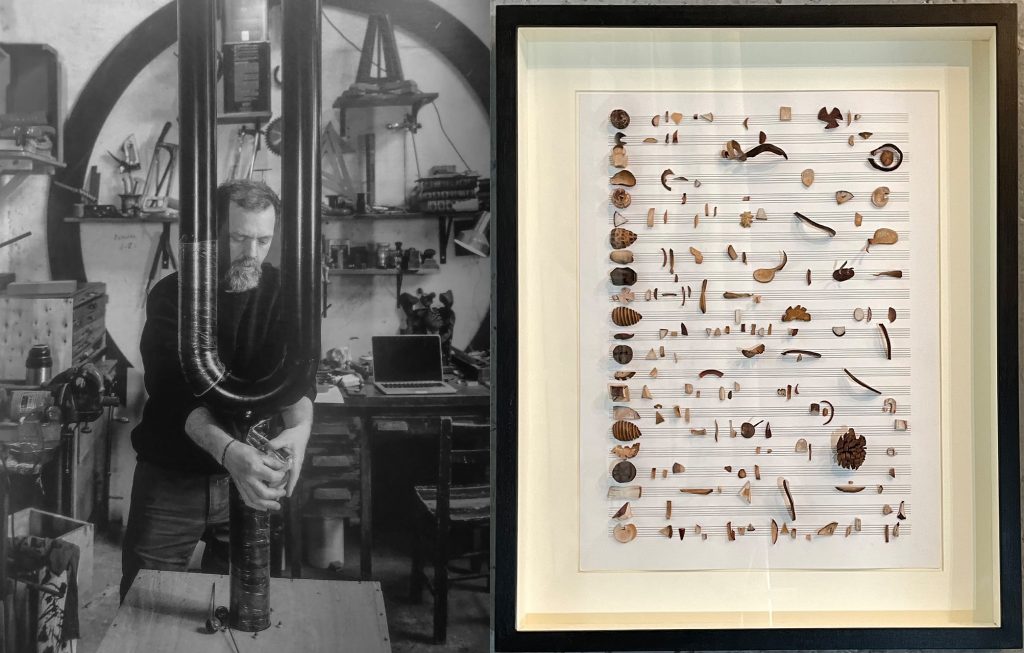
In the New Art Section at the booth of Quimera Galería (based in Buenos Aires) Hernán Soriano presents a selection of works from different periods in his practice. He describes his artistic method as ‘thinking with his hands’, as he folds, cuts, assembles, rips, traces and reimagines what elements of the past might become in the present. He links his craftsmanship directly to the studio, a place to ponder before setting things in motion. The works on view at the fair form part of what he considers an ‘organised system’, one to which he repeatedly returns, reactivating familiar motifs and introducing them into new constellations.
His delicate and precise practice, often consisting of cut-outs from archival paper materials, evokes elements of a revenant ancient world in which art and science were more seamlessly intertwined, and colonial expeditions were undertaken with the use and refinement of cartography. Through his artistic interventions, a multitude of contemporary readings emerges, not least in his subtle play with materials and his nuanced engagement with language.
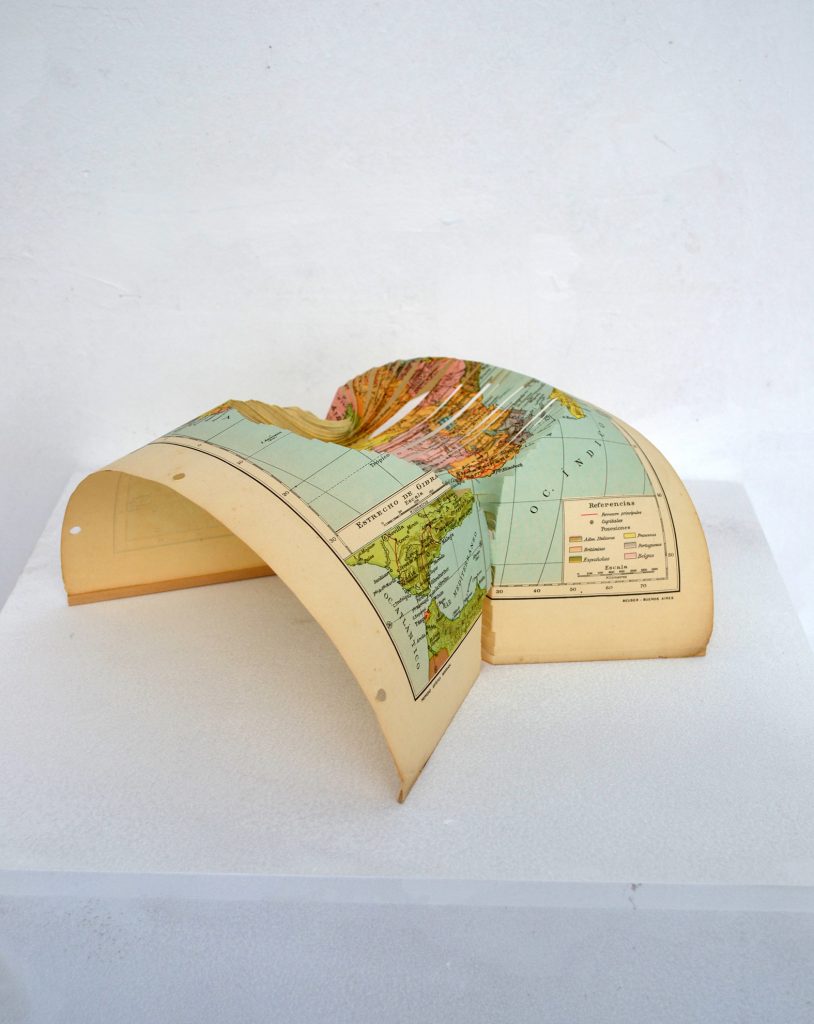
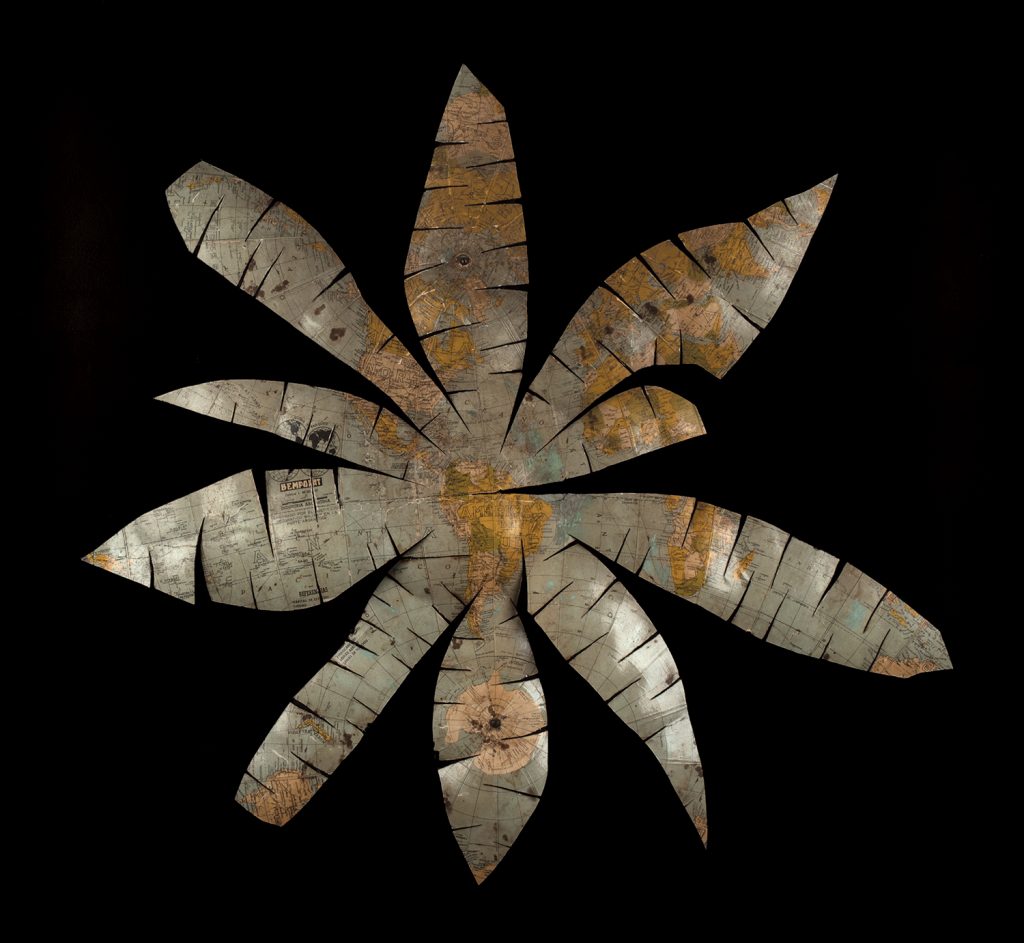
In Nuestra Flor (2021), a globe is split open into a flourishing flower. La flor (flower in English) resonates almost instinctively with the feminine genesis of life, a meaning subtly embedded in the word itself, which can also, in veiled form, allude to the vulva. In La Laguna (2017), a map, a flat surface, but also a lagoon, a shallow body of water, is folded into three dimensions, acquiring a bodily presence. At the same time, Soriano cuts the form out of the map itself. The title equally evokes the Spanish expression una laguna mental, a temporary lapse of memory, while materially inscribing that very missing fragment into the surface of the map.
The artist notes that living in Argentina, a South American country marked by strong European cultural influences, has shaped much of his perspective, as well as his relationship to materials and the way he approaches their exploration.
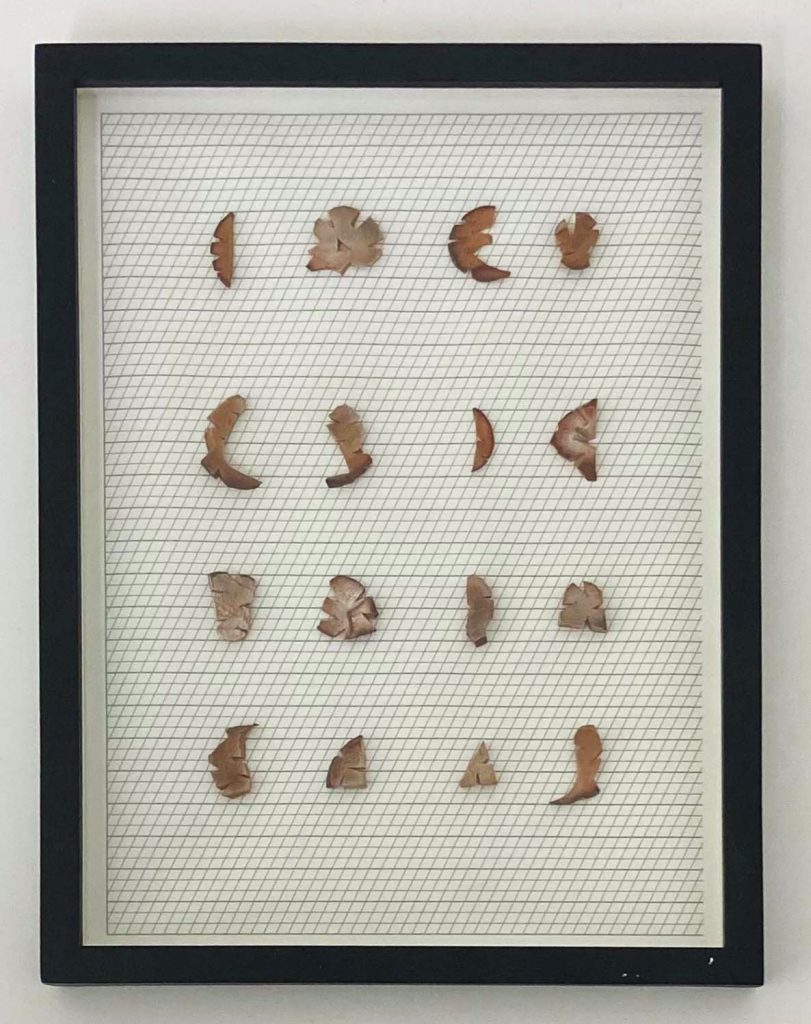
In this respect, his artworks incorporating avocado pits are particularly compelling. He carves into the pit, the heart of the fruit, shaping it into innumerable organic forms until it becomes almost unrecognisable. The avocado pit is an element we often overlook, yet it possesses remarkable aesthetic qualities: a warm amber-brown hue and a wood-like texture. In a distinctly material way, it links the ephemeral, that which decays, to the passage of history.
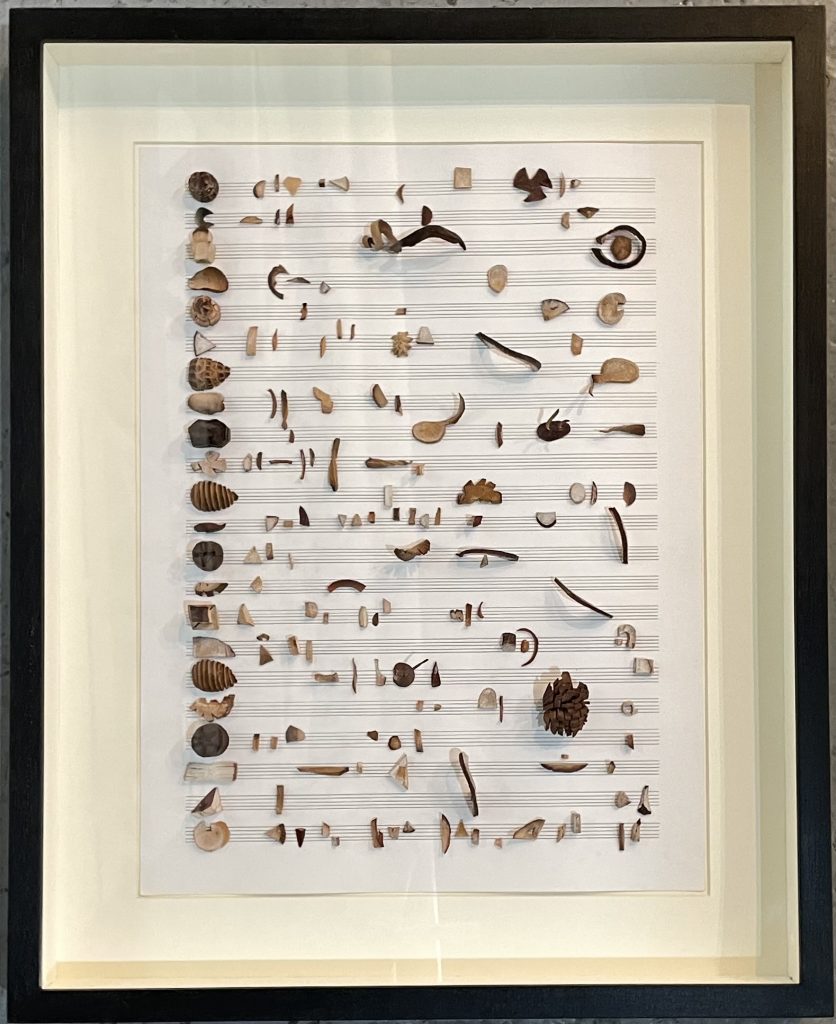
| New Art Section | Quimera Galería
In El Comienzo de la Alborada (2025), organically rounded cut-outs of the avocado pit twirl across sheet music like musical notes. La alborada means dawn in Spanish; it is as if the artist composes a melody of morning glory, where nature becomes musically illustrated.
At the same time, the avocado is an important indigenous product of Latin America and the word “avocado” itself carries multiple layers of indigenous regional identity. There was an avocado tree in his family home where he grew up, making the fruit an element closely tied to his personal and emotional history.
In the titles of several artworks in which Soriano carves elements from avocado pits, he introduces the neologism páltico (with the feminine form páltica), a term he has coined himself, derived from palta (avocado). Just as herbalists, botanists and naturalists once had to invent or adapt new words from other languages to classify flowers, plants or animals, Soriano similarly forges a new term within the Spanish language. It is as if he creates his own taxonomy within his artistic register.
Step into Soriano’s layered world at Art Rotterdam 2026, on view with Quimera Galería in The New Art Section.
Bio
Hernán Soriano (1978, Buenos Aires, Argentine) is a visual artist whose work moves between drawing, sculpture, and the construction of artifacts using accumulated materials and obsolete technologies. One of the most significant milestones in his career was the solo exhibition Formar mentalmente una máquina at the Museo de Arte Moderno de Buenos Aires (October 26, 2016 – February 19, 2017), where he intervened antique books and lithographs as landscapes of memory and poetic repetition.
In 2022, he received the Premio Azcuy de Arte Contemporáneo for the project Sonos, a permanent sound-sculpture installation located in the Donna Magna building, selected from more than 200 national proposals. His work has been recognized for integrating sound, materiality, and active audience participation, and he has taken part in important group exhibitions such as the 23rd Stuttgarter Filmwinter Festival (Germany) and Museo de los mundos imaginarios at Museo MAR.
Written by Emily van Driessen


