I am always a copy, never a fake - Aurelia Mihai on LUPA, her film about the Capitoline Wolf
If, as the saying goes, all roads lead to Rome, then the reverse must also be true. Rome is a starting point. This certainly applies to the founding myth of the Eternal City. According to tradition, Rome was founded by Romulus and Remus, twin sons of the Roman god Mars. The boys decided to establish a city on the spot where they had been found by a she-wolf.
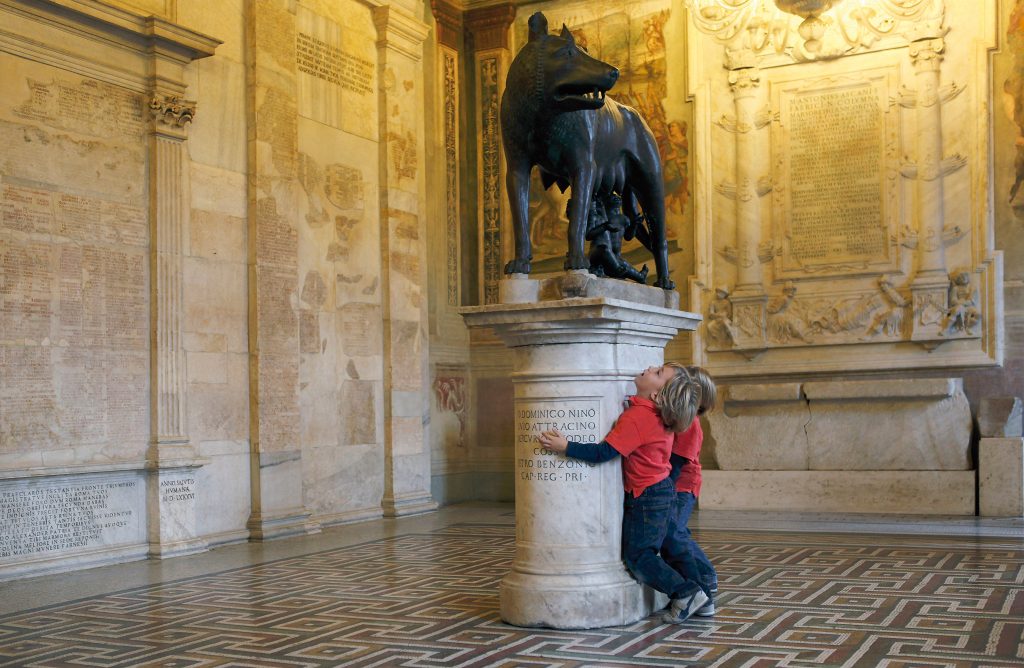
The image associated with this myth may be even more famous: the bronze sculpture of a watchful she-wolf with two infants suckling, better known as the Capitoline Wolf. It appears on the Roman city coat of arms and bronze copies of the sculpture can be found all over the world, from Pisa to Tokyo and from Bucharest to Perth.
Romanian video artist Aurelia Mihai created LUPA, a film about the Capitoline Wolf and the copies of the sculpture that are located around the world. It serves as a good introduction to Mihai’s work, in which she regularly features iconic artwork. Her focus is not only on the work itself, but also on the places where it appears and the value we collectively assign to it. That meaning, after all, can differ from place to place and change over time.
LUPA by Aurelia Mihai can be seen in Projections. Aurelia Mihai is represented by Sector 1.
I had a great time watching LUPA, which centres around the copies of the Capitoline Wolf found all around the world. Why did you pick this particular work for Art Rotterdam?
The decision to present LUPA for the first time in the Netherlands at Art Rotterdam was made collectively. LUPA is a complex project that combines several central aspects of my practice: the intertwining of cultural-historical research with current socially relevant topics such as migration, belonging and postcolonialism, as well as the exploration of monuments and myths as forms of collective belonging. The film's plot spans distances across continents, stretching from historical times to the present day. It also encompasses artistic discourses on originals and replicas and reflects on the medium of art itself.

Lupa narrates the film and at one point, says, “I am always a copy, never a fake.” As a viewer, you immediately sense that this line is the core message. What is the message you are trying to convey?
Here, Lupa refers to her own origins. During restoration work in 2007, it was discovered that the technique used to create the Capitoline Wolf bronze sculpture did not exist during the Etruscan period. Consequently, it was re-dated to the 11th–12th century, rather than the 6th century BC, as previously assumed. Experts believe that the Capitoline Wolf is a replica of a lost Etruscan original. The two children, Romulus and Remus, were added in the 15th century during the Renaissance. The international press then claimed that the Capitoline Wolf was either a ‘medieval fake’ or ‘had fallen from its pedestal’.
Another issue concerns the bronze technique itself. This raises the question of whether bronze itself is a reproduction technique, given that its processes are based on reproduction. In other words, a positive is first created and then destroyed to produce the negative required for bronze casting. Finally, a new positive is cast in bronze within this negative. This is considered the original, but it can also be considered a bronze copy of the original prototype.
The film LUPA examines the historical evolution of this iconic symbol – both a monument and a myth – and follows its journey around the world. In this context, it analyses the reception of this monument after its redating in 2007, but also in the current postcolonial context. Here, it shows that Lupa belongs to everyone and reminds us of its symbolic value.
The Capitoline Wolf is an iconic artwork. As are the Suprematist Black Square in the eponymous video work and Trajan's Column in your film Centi Piedi. Yet the movies are only partially about these iconic works. They are also very much about the way they are seen and the function society ascribes to them. This is a recurring theme in your work, so when did you first establish this as a theme?
From the very beginning, I was interested in precisely this narrative, based on the process of reflection on the subject over time. And that is why I chose video and film as the medium of expression for the work described above.
I would describe why I was interested in this process in Lupa as follows: monuments and myths are part of our collective consciousness. Monuments belong to the public space, while myths belong to intangible heritage. They serve to evoke history or mythology and contain a narrative, a story from the past that can interweave historical facts with fiction. The history and meaning of monuments can be rewritten over time and is linked to the rewriting of history. They can convey an ideology and be propagandistic in nature. Monuments can be misused, forgotten and rediscovered.
Another important aspect is the fact that the Capitoline Wolf migrates around the world and is assimilated into different societies, in different places and in each context, is given its own meaning, similar or different, and even contradictory.
From the outset, I knew that the work would not only be about the Capitoline Wolf or the Black Square, but also become a contemporary narrative highlighting current socio-cultural and political issues. I construct narrations in multiple layers, with the medium of film itself often being one of them.
You mention the differences in context and the various interpretations of the Capitoline Wolf—what are the differences between Bucharest and Tokyo, for example?
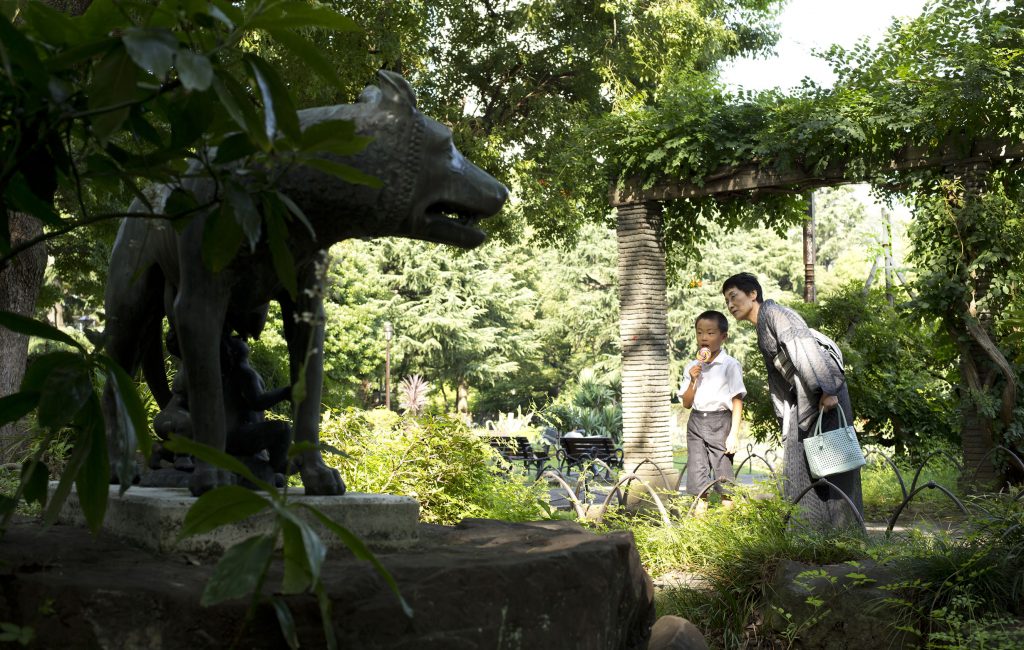
There are three bronze statues of the Roman she-wolf in Tokyo, two of which are located in public places. The first is in a park and was donated by the Italian government in 1938, the second by the city of Rome in 2001 to mark the fifth anniversary of the city partnership between Tokyo and Rome. The third statue was offered to Crown Prince Akihito of Japan during his visit to Rome in July 1953.
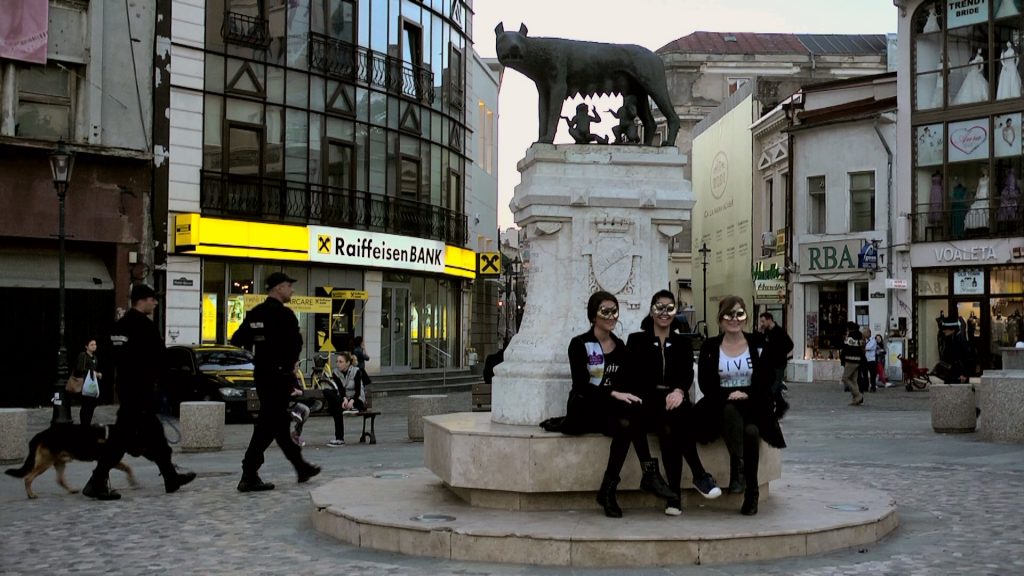
The Municipality of Rome gifted the Lupa statue to Bucharest in 1906 to celebrate the 40th anniversary of King Carol I of Romania's coronation and the 1,800th anniversary of the Roman conquest of Dacia.

Two scenes in the film highlight the importance of the monuments in the two cities. In Tokyo, a grandmother recounts the legend of Rome's creation to her grandson. In Bucharest, the she-wolf recounts its own history:
"Since I arrived in Bucharest in 1906, I've moved five times, only to ultimately return to this same place. I survived two world wars and the Ceausescu dictatorship unscathed. It was a different story in the Moldovan capital of Chisinau. The Soviet army destroyed me in 1945 as an alleged symbol of fascism. I embodied the Latin-Roman roots of the Moldovan people and the Romanian language. They melted me down to make weapons out of me."
The film creates its own reality by staging moments of interference with sculptures as if they were a road movie - a journey through time and space.
I can imagine making a short film like LUPA is a long time in the making, involving considerable resources and travelling. What was the most challenging part about this project?
Yes, it was a very complex project that took several years to complete. The research was intensive and obtaining filming permits in museums and different countries, as well as organising travel, was very time-consuming. But I had a very good team and received a lot of support from institutions in Rome, such as the German Academy Villa Massimo.
Written by Wouter van den Eijkel


