Caring for the Future: Jonathan Hielkema
“Hi, I’m Jonathan, and I’m worried.” That’s how Dutch visual artist Jonathan Hielkema (1994) opens his artist statement. He worries, a lot, and those concerns are precisely what drive his artistic practice. Through a caring approach, he has developed a way of working that helps him (and others) find reassurance.
“I used to think art was made for the viewer, but I’ve come to realize that artists also make work for themselves, for all sorts of reasons. For me, it’s mainly about talking to ordinary people, trying to find ways to move beyond the overwhelming scale of global issues through personal stories. That’s how I give my worries about the world a place.”
Hielkema connects this idea to worryism, a term he coined during his time at art school. “I started wondering what it was exactly that I had studied, and how on earth I was supposed to make a living from it? Because that’s something we were never really taught. That’s how worryism emerged: the act of worrying as art, worrying about art, worried art, a worried artist, art that carries worries.”
Hielkema is one of 92 emerging artists who recently received a Kunstenaar Start grant from the Mondriaan Fund. Part of his latest photographic project, Europe, who are you? (2025–2026), will be presented in the Prospects section at Art Rotterdam. The work fits seamlessly within his wider practice, where personal concerns become an entry point to address broader social questions.
Caring for a European Identity
Europe, who are you? (2025–2026) is Hielkema’s attempt to explore what a European identity might mean today. One part of the project, titled Around Europe, consists of four large oak frames containing archival photographs relating to colonial history, European identity, and integration.
The choice of oak is deliberate. “Oak represents the Franco-German axis and acts as an old connector within European history.” The archival photographs Hielkema collected capture moments from the founding countries of the European Union: France, Germany, the Netherlands, Italy, Belgium and Luxembourg. These archival images are presented alongside large staged photographs taken by the artist himself, which reflect on the present. In this way, historical fragments enter into dialogue with contemporary perspectives. Visitors are even invited to take the photographs out of their frames to read the archival descriptions printed on the back.
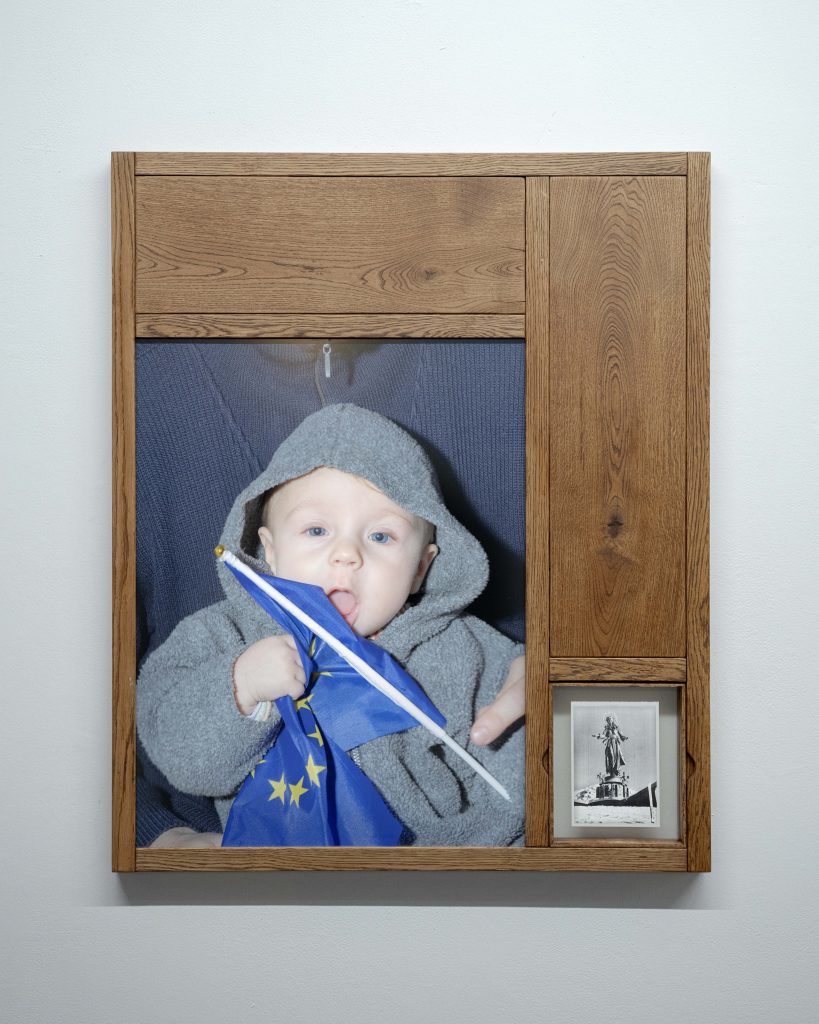
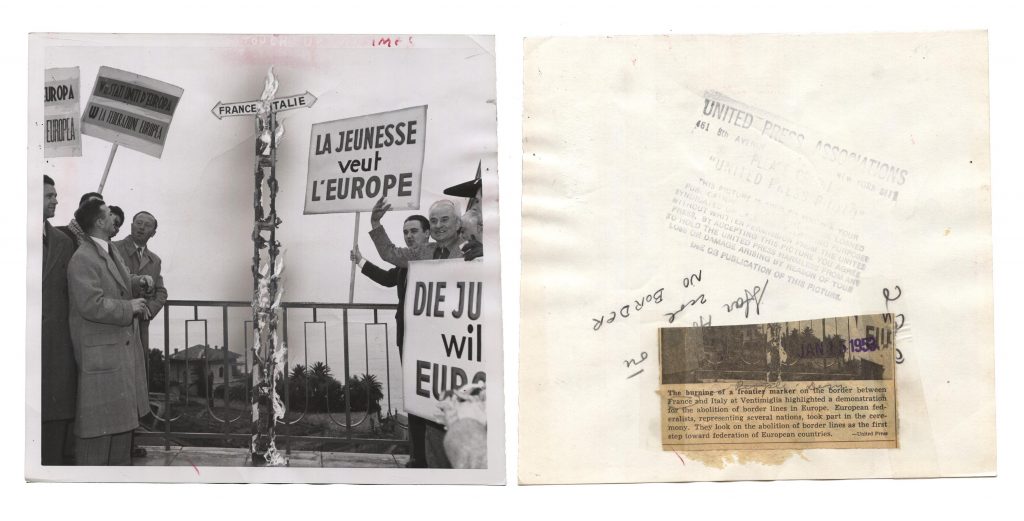
One of the archival photographs shows a border sign with a flag burning on the Italian–French border. “The information on the back reveals that the photo was taken in 1953. The negative was sent to the United States, where it was printed and scanned for newspaper distribution. The flames in the centre were actually drawn onto the negative by hand, because the real fire didn’t show up strongly enough in the image. As a contemporary counterpart, I photographed my own child eating a European flag.”
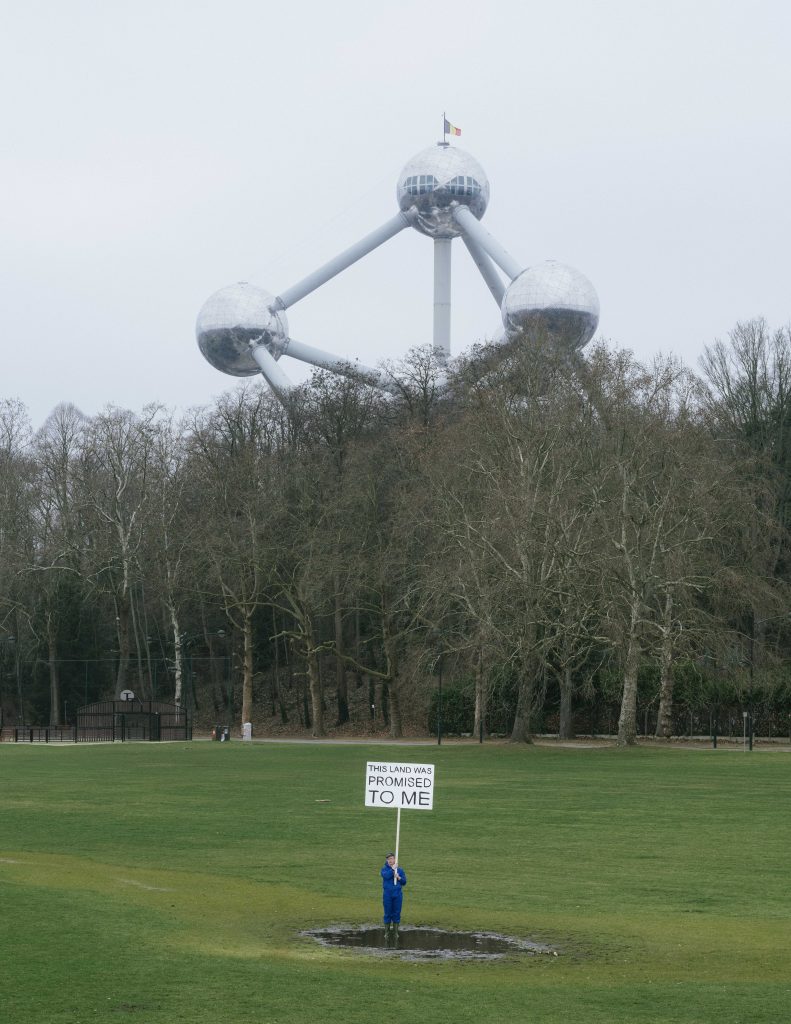
Another archival image comes from Belgium in 1960 and depicts a woman with two children. On the back it reads: Refugees arrive in Brussels. “Of course, this refers to colonists who were forced to return from the Democratic Republic of Congo to Belgium,” Hielkema explains. As a contemporary response, the artist staged a photograph of himself at the Atomium in Brussels, holding a protest sign that reads This Land Was Promised to Me. “At first glance it’s a cynical echo of the archival image, but it’s also a comment on current geopolitical tensions beyond the borders of the European Union.”
Born in 1994, shortly after the founding of the European Union in the early 1990s, Hielkema grew up with open borders and the euro as a matter of course. Yet while interviewing people across Europe, he noticed that many have lost sight of what those freedoms actually make possible, precisely because they have become so normalised.
“Europe often feels both tangible and abstract at the same time. It’s a vast and slow-moving system that can be difficult to grasp. To reflect that ambiguity in the installation, four 6-metre-high barrier gates, from the border between Germany and the Netherlands, tower above the oak frames and archival images. They are arranged as a semi-circular structure inspired by the layout of a parliament. But their meaning remains deliberately unclear. Are open borders something positive? Are they a threat? Or are borders themselves the threat?”
Caring for Masculinity
His search for a European identity resonates with another recent project, Black Butterflies, or; The Ballad of Jonny Toxic & Jacco Macho (2025). During his studies, Hielkema presented The Portable Village, a blueprint for a collaborative residential experiment where different disciplines would come together to tackle a social problem from multiple perspectives.
One of his teachers responded bluntly: “The man who always wants to change the world, do you realize how many disasters that has caused? Maybe you should take a look at your own masculinity.”
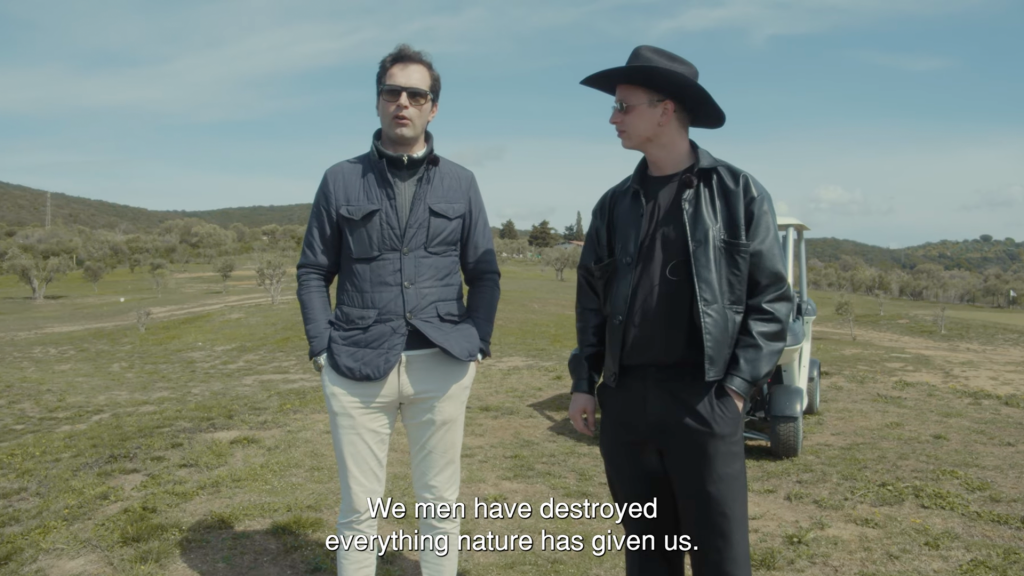
“I was completely taken aback, but it did make me reflect,” Hielkema says. “As a teenager I was relentlessly bullied for my long hair, nail polish and pink clothes. To survive, I started wearing caps, quit athletics and violin lessons, and took up basketball and smoking instead. Eventually I decided to turn that experience into a film together with a friend from Italy, Jacopo Martini. We travelled through the land of machismo and the land of thrifty Calvinists, speaking with ordinary people about how masculinity is experienced today, whether they feel concerned about it, and whether there might be alternatives. Through that process I started questioning my own masculinity, but also embracing it. And eventually I began asking whether it is still possible to celebrate it.”
Caring for One Another
Hielkema grew up in a family with seven brothers; one of them has multiple disabilities. After finishing art school, he chose to work in the healthcare sector. For six years he worked with Olivier, a disabled boy about whom he is also making a film. One question keeps troubling him: who will take care of these boys once their parents are no longer able to?
“Will it be the government? Will it be us brothers? Are we capable of that? What kind of bureaucracy would we have to deal with? My parents always made sure my brother Camiel had every opportunity, and his future path is quite clear. Camiel works as a DJ, DJ Wheelstar, has an assistance dog, works in Amsterdam and travels independently by train and ferry. But Olivier has only one brother and cannot live independently. From morning to night he relies on care provided by others and by his parents. Most people never really see that reality. On a societal level, we all contribute to that care through taxes. But within families themselves, there are countless worries about the future, especially at a time when the Dutch care system is increasingly under strain.”
Caring for Nuance
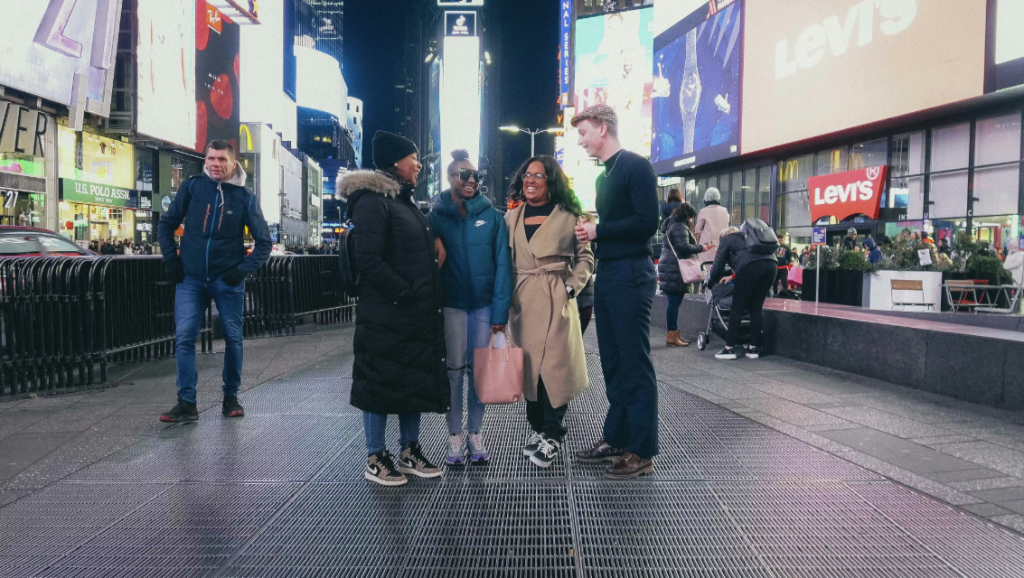
America, how are you? (2020) is the central question of another project. Hielkema wondered whether North American society is truly as polarized as the media and political rhetoric often suggest. “There seems to be this narrative of radical division. But there are roughly 250 million eligible voters in the United States, and about sixty million voted for Trump. So how many fucking people does that still leave?”
By speaking with that often unheard majority, Hielkema attempts to restore nuance to the conversation. “And nuance is precisely what tends to disappear today. Perhaps nuance could help us treat each other a bit more nicely. People often told me: ‘These are the kinds of interviews CNN or Fox News should be doing.’ But unfortunately, genuine human conversations rarely make for clickbait. In the end, good news simply means no news.”
Around Europe, part of the photographic series Europe, who are you? (2025–2026) by Jonathan Hielkema, can be seen in the Prospects section at Art Rotterdam.
Written by Emily van Driessen


