Desire and Empire: Elijah Burgher
“From a teenage emperor, assassinated at seventeen by their praetorian guard, they transform successively into a cruel monster, a creature of unusual and excessive appetites, an effeminate impostor from the East, an anarchist intent on hastening the decline of the empire, an epicurean of metaphysical blasphemies, a sacred fool whose blunders cause the skirts of reality to lift, and an androgynous angel straddling the ruins of the ancient past and our precarious present.”
An evocative and powerful description of Heliogabalus (Elagabalus) by Berlin-based artist Elijah Burgher (1987, USA), whose latest body of work loosely revolves around the image of this infamously controversial Roman emperor.
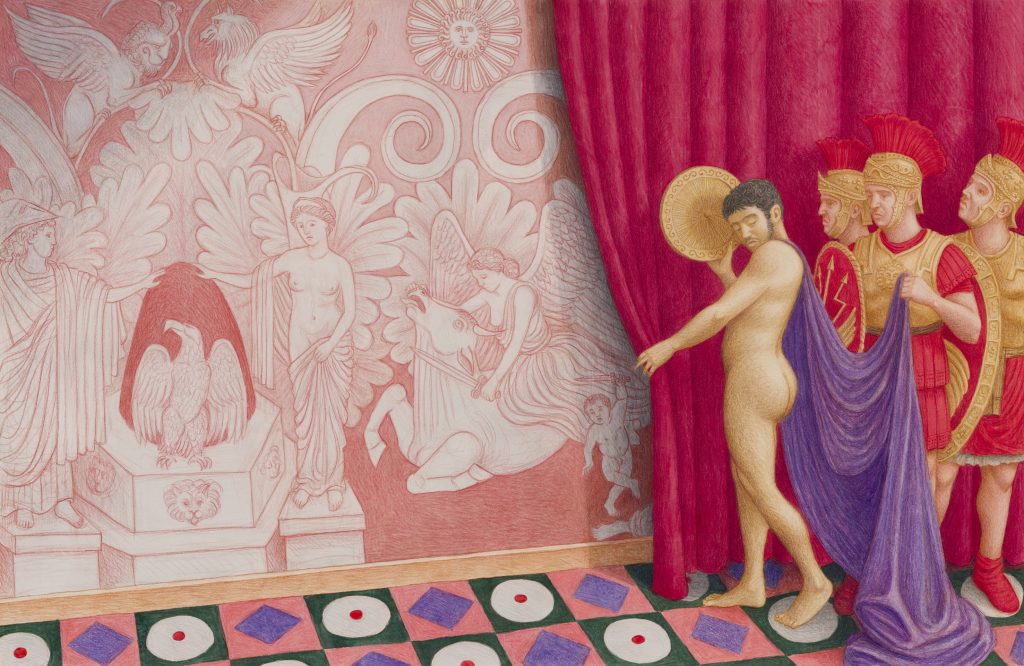
In the New Art section in the booth of Ivan Gallery (Bucharest), Burgher draws on mythology, occult magic, queer desire, and art history to examine how images survive and mutate across time. The New Art section, curated by Övül Ö. Durmuşoğlu, is reserved for solo presentations by emerging artists with a compelling and conceptually thoughtful practice.
Heliogabalus or Elagabalus is a historical figure whose life has long been eclipsed by an unstable and excessive afterlife in literature, painting, opera, devotional fantasy, and gossip. “They were said to have delighted in quizzing embarrassed senators on whether they, too, had enjoyed the passive role in anal sex when they were young and beautiful,” writes Burgher in his essay Our Lady of the Latrines: Notes on the Elagabalus Egregore. Although ancient sources cast the emperor as a depraved tyrant, sexual deviant, and religious scandal, more recent readings crown them “an anarchist, hero of hedonism, saint, and martyr of the sexual revolution,” as Arrizabalaga y Prado (2010, 1) note in his research, quoted by Burgher.
Very little reliable visual evidence of the emperor survives. Only two bust types are generally attributed to Heliogabalus, largely because their name and image were systematically condemned after their death through damnatio memoriae. This scarcity of material evidence has allowed the emperor to become a screen onto which later writers and artists project their own (vicious) ideas.
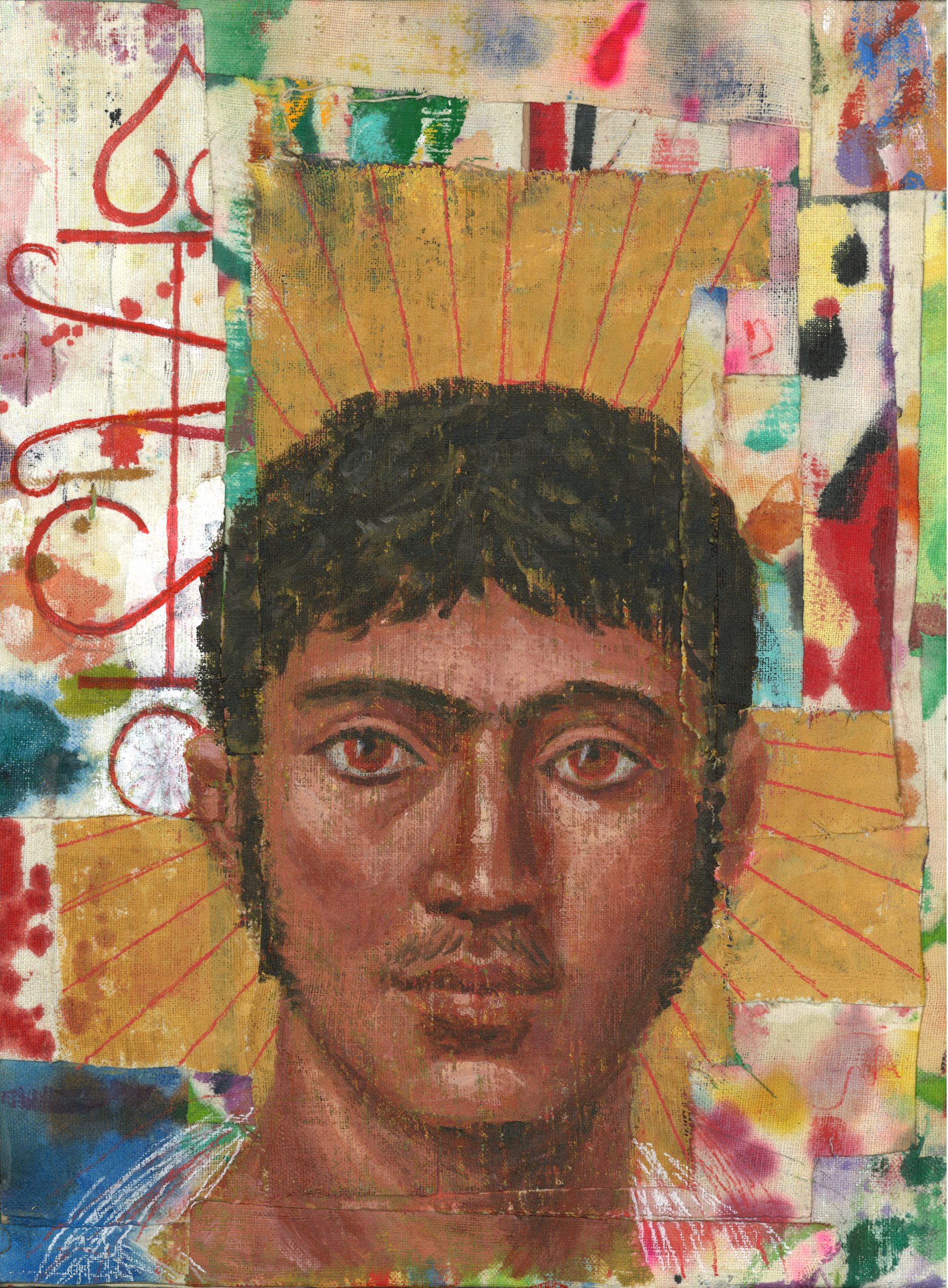
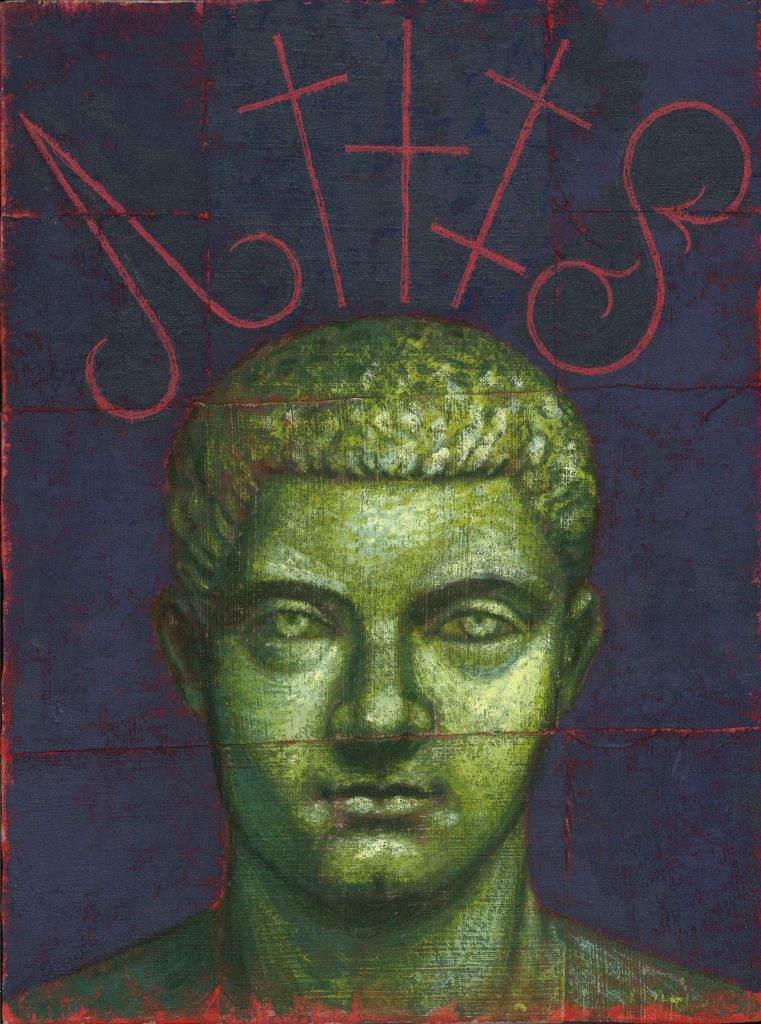
The body of paintings shown at Art Rotterdam is made with acrylic paint on studio rags and material cut from failed or abandoned paintings, mounted on panels. Many works consist of ripped or torn pieces of canvas and linen collaged together. Even when painted over completely, the seams of the surface remain visible and the history of the materials appears along the edge of the panel. “They remind me of mummy rags and bathroom graffiti,” the artist explains. “I am also looking closely at Fayum tomb portraiture and the grisaille paintings of Mantegna and Bellini. Some paintings draw on my work with sigil magic and occult abstraction to explore and amplify the solar phallic cults of antiquity, Heliogabalus being an outstanding and perverse example of one.”
In his essay Our Lady of the Latrines: Notes on the Elagabalus Egregore, Burgher deliberately uses the pronouns she/her when referring to the emperor. The choice functions partly as a provocative gesture that resonates with both transfeminine readings of Heliogabalus and the playful use of feminine pronouns in gay slang.
Outside that specific textual context, however, the emperor’s gender identity remains historically uncertain. In this text, we therefore use they/them pronouns to acknowledge the variety of contemporary interpretations surrounding the emperor’s gender. The question of gender, however, is not the central focus of Burgher’s paintings, which are more concerned with the emperor’s mythos, the scarcity of historical evidence, and the long history of artistic interpretations of this enigmatic figure.
The Golden Ass
While Burgher is primarily presenting new paintings in the booth, The Golden Ass reflects another central aspect of his practice: drawing, and particularly drawing with colored pencils, a medium he has explored intensively for more than fifteen years. The colors in the work are built through watercolor washes on paper, over which the artist carefully hatches layers of colored pencil.
“The emperor is now mainly known as Elagabalus or Heliogabalus, names that derive from the Syrian solar deity they served as high priest. During their brief reign in the early third century, they shocked society by elevating the eastern sun god to the centre of Roman religious life and compelled Roman elites to participate in unfamiliar rituals imported from the eastern provinces,” tells Burgher.
This is just one of many scandalous stories that revolve around the figure of Heliogabalus and their afterlife image. In turn, the emperor acquired an infamous number of vulgar nicknames. “Golden Ass could easily be added to that list”, Burgher notes. “French playwright and theorist Antonin Artaud describes the emperor’s entry into Rome walking backward, ass-first, as they lead the phallic stone representing their god on a golden quadrigal drawn by 300 naked women and 300 drugged bulls.”
Across these legends, gold appears alongside bodily substances during sacrilegious spectacles. Quoting Artaud, Burgher notes that “to the shit, blood, and cum that frame the emperor’s fate, gold can be added, the gold of solar fire as well as the earthly gold embroidered on their purple robes.”
For Burgher, this strange constellation of materials also recalls the symbolic Great Work. In medieval alchemy, the Great Work described a transformative process in which base and chaotic matter is broken down and gradually refined until it becomes gold. The process was often imagined as a cycle of stages associated with different colours (black, white, yellow and red) and substances, moving from darkness and decay toward illumination and completion. Within this framework, the substances evoked by Artaud, blood, excrement, semen, and gold, can be read as markers within a symbolic chain of transformation. Burgher therefore describes the myth of Heliogabalus as a constantly shifting cycle. As he writes, the emperor’s legend operates like a turning wheel: “each pose spins the wheel of Elagabalus’s fortune, turning shit into gold and back again.”
Other compelling nicknames proposed by the artist for the emperor include Solar Phallic Princess, Poor Little Ghost Boy, E\H, and Our Lady of the Latrines, which he often references in the titles of his artworks.
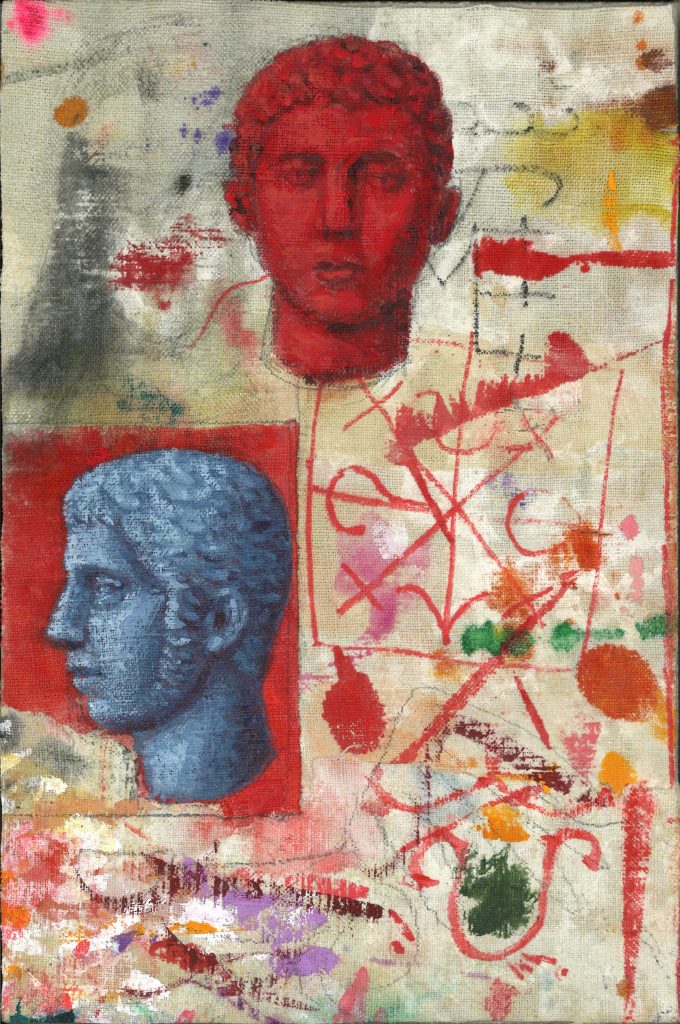
Heliogabalus (Latrine Graffiti)
One of the other works in the booth of Ivan Gallery is Heliogabalus (Latrine Graffiti), which refers to a scene that remained vivid in Burgher’s imagination while he made this series. A latrine is a communal toilet, and the term evokes the crude, careless drawings and writings often scratched onto the walls. Burgher connects this idea to a play by Jean Genet about the Roman emperor, long believed lost but only recently rediscovered and published.
In the play’s final scene, the emperor hides in the palace latrines with his lover, Aeginus, while the guard closes in. There he notices the obscene graffiti covering the walls and recognises that the texts refer to them. The emperor reflects on the strange form of glory they represent:
“Aeginus, here is the glory that I desired, without knowing it: my name and my titles, each distorted, transformed, grimacing or smiling, your choice, among them, and strengthening them, obscene poems and drawings, which everyone would call vile, on the walls of the latrines used by the slaves.” (translation by Elijah Burgher).
For Burgher, this scene suggests a powerful inversion. The emperor’s image survives outside marble monuments and official histories and persists in crude and anonymous graffiti. “This scene lingers in the background of my imagination while I make these paintings, although I am not aiming to illustrate it. I would say that my major themes right now are eroticism, sacrifice, and resurrection,” Burgher explains.
You can explore these works by Elijah Burgher, along with many others, in the booth of Ivan Gallery in the New Art section.
Written by Emily van Driessen


