Watamula - Kevin Osepa's Spiritual Journey on Curaçao
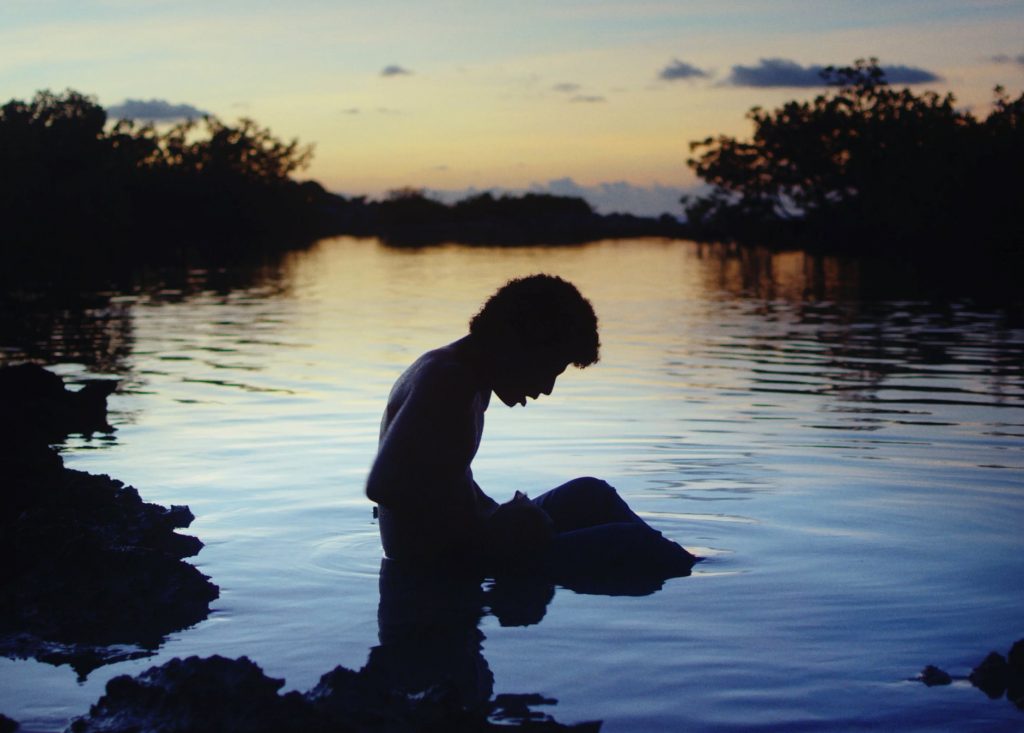
Watamula tells the story of René, a taciturn young man who emerges from a river wearing nothing more than a pair of trousers and an amulet. We follow him on his journey to the western side of Curaçao, to Watamula, a round hole in a rock that juts out above the sea. Beneath it, the ocean crashes against the rocks. It is the place where Curaçao breathes.
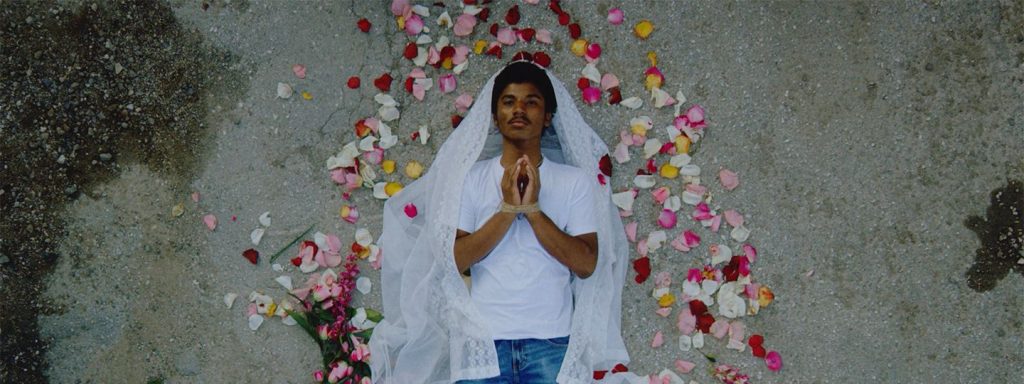
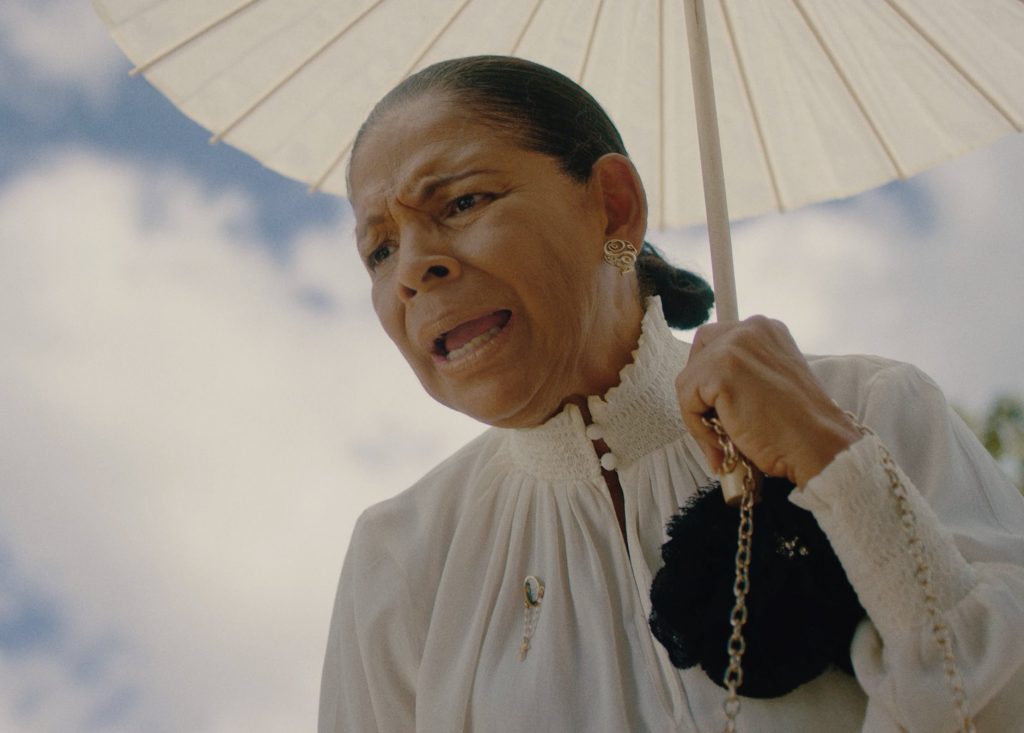
The road to Watamula is both physically and mentally challenging. Along the way, René clings to the amulet he was given at birth. Soon he encounters an older woman dressed in her finest clothes. She tends to René and watches over him. He is thrown out of a Catholic church and initiated into Afro-Caribbean rituals. There also seems to be a budding romance between him and Gabi, the woman’s son.
Kevin Osepa turns René’s journey into a magical-realist odyssey in which landscape and destiny, spirituality, sensuality and machismo converge.
Watamula by Kevin Osepa is shown in Projections. Kevin Osepa is represented by Galerie Ron Mandos.
Osepa’s work often draws on his own childhood and experiences in Curaçao, as well as on rituals, mysticism and stories of older generations from the Dutch Antilles. He frequently develops an idea or narrative into a shared experience aimed at collective healing and a deeper understanding of his own identity. As a result, his work is highly personal, yet accessible to a wider audience.
Last autumn, Kevin Osepa was awarded the prestigious Prix de Rome for Lusgarda, an installation he created especially for the prize. Lusgarda is a total experience in which film, objects, textiles and handmade figures come together to form a new reality. The installation invites viewers to look, feel and move along with it, without imposing a single, fixed interpretation.
Lusgarda revolves around the ritual of Ocho Dia: the eight-day mourning period following a funeral in Curaçao. Osepa focuses not only on individual loss, but also on collective loss: the gradual disappearance of knowledge, rituals and customs passed down from generation to generation. He presents mourning not as a closed moment, but as a process that continues to repeat and transform.
The jury recognised ‘an artist with a highly distinctive visual language who has grown rapidly in both narrative and expression, continually surpassing himself’. Osepa himself is still surprised by the win, he says over the phone. “I knew the Prix de Rome. At the academy, I had a lecturer who had been nominated, but you still feel a certain distance - you’re not anchored there. Also, since my work is personal - a way to process my own emotions - it was unexpected. For it to receive so much recognition is a unique experience.”
Osepa’s career can easily be described as meteoric. Osepa (Willemstad, 1994) moved to the Netherlands at the age of 17 to study photography at HKU. Watamula (2020) was his first short film. For his second film, La Ultima Ascensión (2022), he received a Golden Calf for Best Short Film. In 2023, he won the Charlotte Köhler Prize, the annual incentive award for promising artists.
For Watamula, Osepa swapped photography for film, a step that felt natural at the time. “I was already exploring how to deepen my worlds. I tried to make my photographs speak to one another. That is essentially what film is. As a medium, film also suits Curaçao better because there is no strong museum culture here.”
The medium of film gave Osepa greater freedom to work narratively. He draws both on historical source material from archives and on conversations with anthropologists and older Curaçaoans. Initially, Osepa thought this approach would yield little of use, but instead he tapped into a rich vein of stories that had never been explored.
“I collect stories and do not make a hierarchical distinction between archival material and conversation. All sources are equally valuable. What is unique about oral history is that the stories constantly contain new elements. They reflect the times. That gives you a certain freedom. By adding new images to a story, you can assign new meaning to an existing narrative. You can transform it.”
Many themes that appear in Osepa’s later work are already present in Watamula. A good example is the magical-realist mode of storytelling. The woman who watches over René also takes the form of a parakeet and a flamingo. “In Curaçao, there is only one reality; there is no division between science and superstition, there is just one continuum.” In his work, Osepa seeks to do justice to that reality.
At its core, Watamula is about longing, Osepa says, about belonging somewhere and being rejected. These themes are shaped by his experiences in both the Netherlands, where he lives, and Curaçao, where he spends several months each year. This alternation allows him to view the places he calls home with a fresh perspective, while also feeling not entirely at home in either. In the Netherlands, for example, he is more aware of his skin colour, while in Curaçao, his queer identity stands out in the strongly heteronormative environment.

In Watamula, this is expressed subtly by making René, a queer protagonist, undertake the journey. He comes into conflict with the Catholic faith and halfway through the film, is literally thrown out of the church. Still lying on the ground, he is picked up by a man who initiates him into Afro-Caribbean rituals and points out the difficult path he must follow.
Looking back, Osepa says, “It’s easy to point to Catholicism, but you cannot simply say the Roman Catholic Church should disappear. Our traditions are inextricably linked to it. For example, Carnival in Curaçao ends on the Tuesday before Ash Wednesday and First Communion has been completely shaped by our culture with Afro-Caribbean rituals. It is precisely that tension that makes it interesting.”
Speaking over the phone, Osepa says that with Lusgarda, he felt he was finally making exactly what he wanted: an immersive work about presence and spirituality in which all the themes that engage him find a place. Spiritual healing is one of these: “Lusgarda is an active ritual that can release something.”
That element is already present in Watamula. Towards the end of the film, René has a dream in which he witnesses his own birth. A baby bonnet is buried and he finds the stone from which his amulet is a shard. He places the shard back onto the stone to make it whole again. Afterwards, he awakens and has one final encounter with the woman, who tells him she has followed him throughout his journey. She then digs up the baby bonnet and places it on a funeral pyre. The curse is lifted. The wound is healed. René can complete his journey to Watamula.
Written by Wouter van den Eijkel


