Earthing and Unearthing: A New Artwork by Otobong Nkanga at Art Rotterdam 2026
Internationally renowned visual artist Otobong Nkanga presents a new artwork during Art Rotterdam 2026 at the booth of Lumen Travo (Amsterdam) in the main section of the art fair.
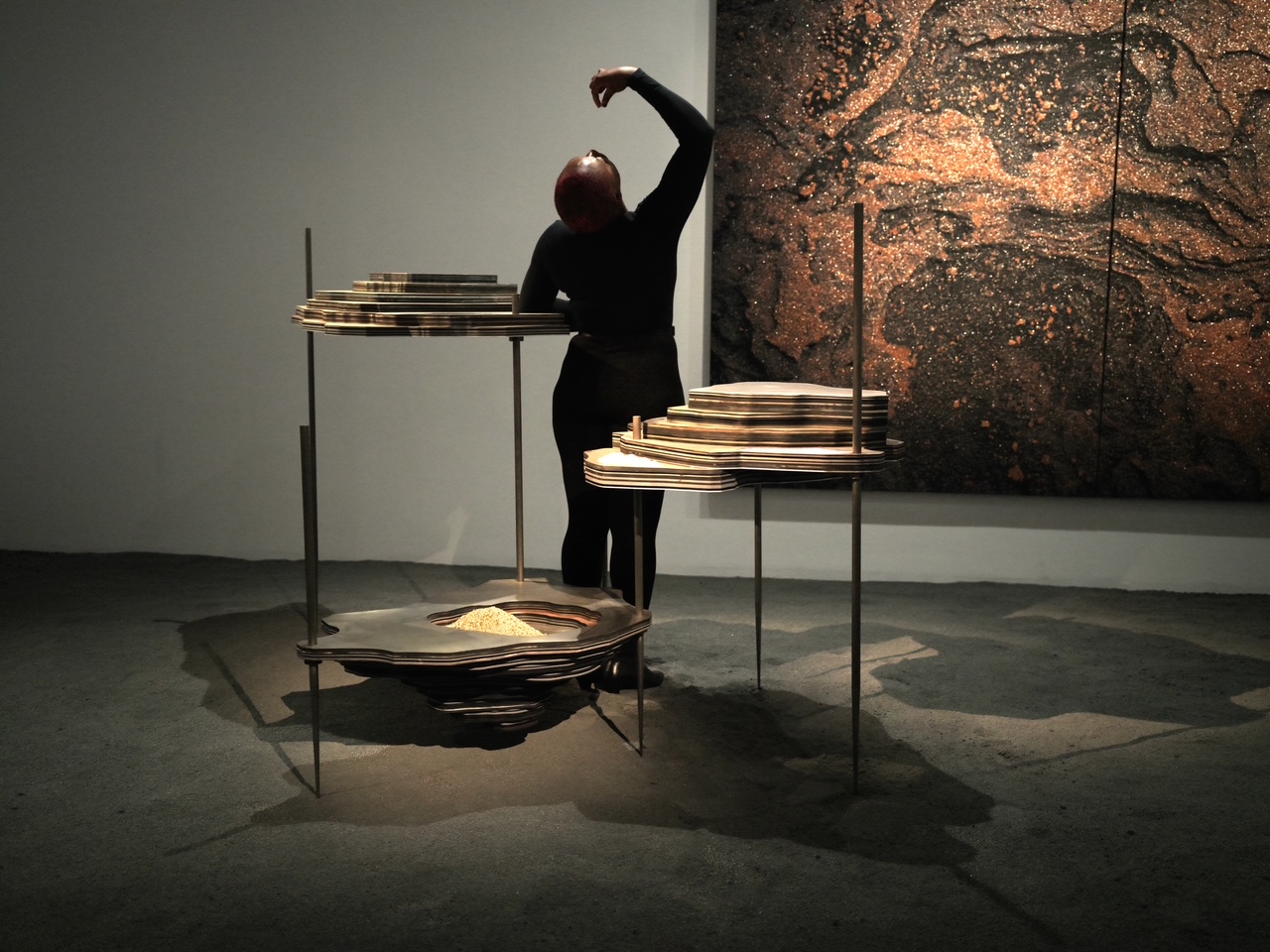
A common thread throughout her multidisciplinary practice is both earthing and unearthing: a horizontal grounding in the entanglement of human existence with natural elements, a physical contact with material realities, and a poetic effort to unearth and heal mutilated landscapes and seascapes. Her work reveals the consequences of humankind’s occupation, exploitation and spoliation of these very elements. And so in her work rivers flow through skies or run like veins through bodies, ropes resemble braided strands of hair bound together, golden textile streams trickle down like the tears of a waterfall.
Her textile works, paintings, drawings, performances, installations and videowork frequently address unequal cultural, economic and ecological exchanges between North and South, with particular attention to their impact on African countries. Nkanga lives and works in Antwerp, Belgium, but was born in Nigeria, a West African country that was under British colonial rule until gaining independence in 1960.
Trade routes
Nkanga is particularly interested in tracing ancient and contemporary trade routes of minerals, spices, herbs and oils, and the stories attached to their circulation. From the nineteenth century onwards, mining expanded rapidly across continents, leaving deep scars in the landscape and demanding physically taxing labour that resulted in a high human toll. In this context, earth appears as ancient and fundamental to humanity, while also dispersed, violated and distorted.
Weaving these links to raw materials into her work, they become tools for a poetic exploration of natural landscapes. In doing so, Nkanga reactivates former trade routes between South and North, while also addressing damage, loss and making attempts at repair. Her oeuvre unfolds as a cyclical narrative in which growth, exchange, decay and death lead to transformation and regeneration. These storylines engage all the senses, including smell: for example the sharpness of pink pepper or the deep, sweet warmth of raw cacao beans. In doing so, she also subtly activates memories whose fragments linger in the present.
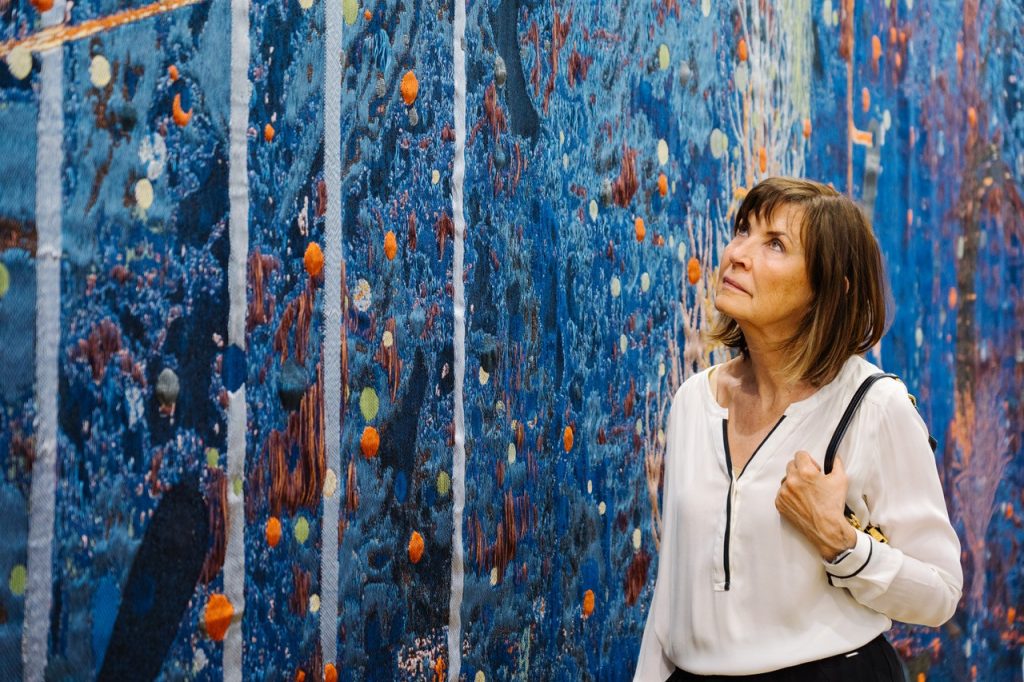
Unearthed, 2021
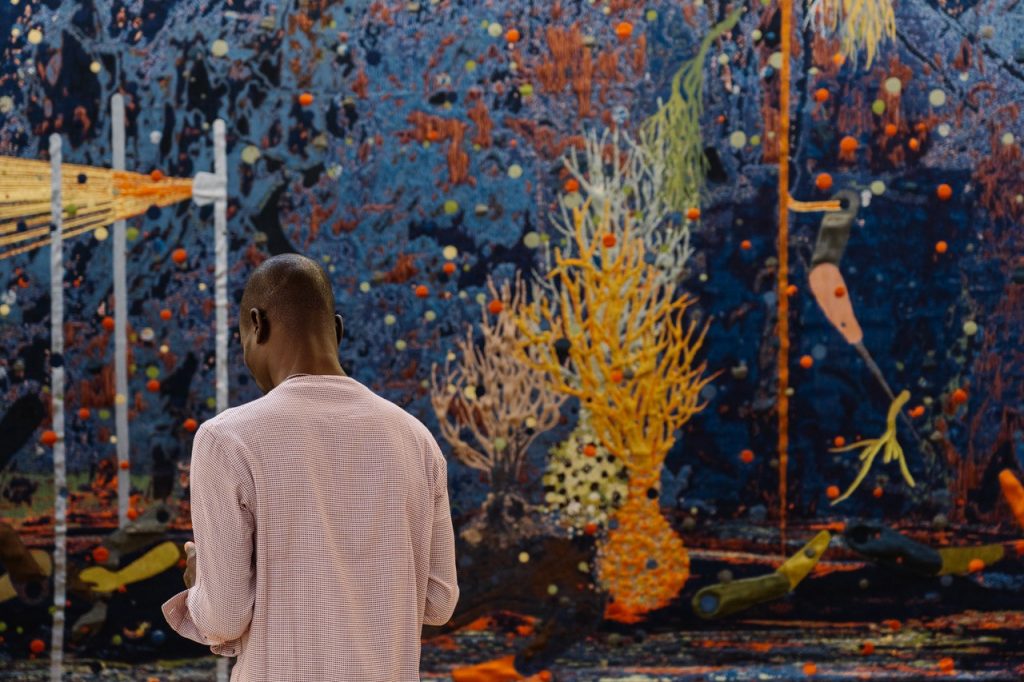
Textile plays a key role within this framework. Threads are woven together, allowing personal and collective stories to intersect. Weaving becomes a social act, based on shared contribution to a final result. A telling example is the tapestry series Unearthed (2021), which the late curator Koyo Kouoh described as “the unsung tales of the earth.” For this series, Nkanga worked with twelve different types of yarn, producing approximately 250 colours across four tapestries, Abyss, Midnight, Twilight and Sunlight, which together form a single narrative. They depict different sea levels and stages of mineral extraction, first by hand and later by machine. In these underwater worlds, anemones transform into human limbs, yarns glimmer like dumped plastic waste, and mechanical excavation arms appear to float in the endless depths of the sea. The body parts refer to the many people lost at sea, whose bodies merge with the water and turn into minerals, allowing the cycle of life to continue.
Cadence, 2024
Another impressive recent textile installation is Cadence (2024), commissioned for the atrium of MoMA, the Museum of Modern Art in New York. The work unfolds vertically through the space and uses the architecture itself as part of the installation. It is structured around the idea of a fall, like the cadence of a teardrop trickling through space. Cadencebrings together decay, mining, labour, water, plants, heat and light, showing how the underworld, the earth, the sun and outer space collapse into one another. Through layered weaving, sculptural handmade textile forms, and sound, Nkanga translates the constant rhythm of natural elements into a single continuous cadence of life.
The artist is currently showing a major retrospective at the Musée d’Art Moderne de Paris, running until 22 February 2026. She is also preparing new commissions for the 61st Venice Biennale and for the opening of the new KANAL Centre Pompidou in Brussels, soon to be the largest museum of contemporary art in Europe. Within this international trajectory, Art Rotterdam is the first stop where her latest work can be explored in the booth of Lumen Travo.
Bio
Otobong Nkanga’s practice explores the notion of land as a place of non-belonging and provides alternative meanings to the social ideas of identity. Paradoxically, she brings to light the memories and historical impacts provoked by humans and nature. A selection of recent solo exhibitions includes I Dreamt of You in Colours, Musée d’Art Moderne de Paris, Paris (runs until 22 February 2026), Each Seed a Body, Nasher Sculpture Center, Dallas (TX) (2025), Cadence, The Museum of Modern Art (MoMA), New York (2024), and Craving for Southern Light, IVAM Centre Julio González, Valencia (2023). A selection of recent group exhibitions includes Project a Black Planet, MACBA Museu d’Art Contemporani de Barcelona, Barcelona (2025), Magical Realism, WIELS centre d’art contemporain, Brussels (2025), and Blue Zone, Kunsthal Rotterdam, Rotterdam (2025). Otobong Nkanga has received several major awards, including the Nasher Prize (2025) and the Zeitz MOCAA Award for Artistic Excellence (2025).
Written by Emily van Driessen


