In Limbo – the dangerous relationship between humans and technology: Meiro Koizumi at Sculpture Park
Developments in AI and biotechnology are progressing at lightning speed. How do they affect our understanding of life, individuality and identity? These are major questions and precisely what leading Japanese artist Meiro Koizumi is famous for addressing.
In his work, he explores such themes as nationalism, power relations and the role played by collective memory in shaping our behaviour. He links these subjects to questions about the position of the human body in a world that is increasingly unfolding online, where technology plays an ever more dominant role.
As mentioned above, these are substantial themes, making it all the more impressive that Koizumi’s work remains accessible and easy to grasp, from drawings and photographs to video installations and sculptures. This is partly due to his working method. While talking about Altars, his new series of sculptures, he explains that they are the result of a series of intuitive actions. “The sum of all these intuitive actions creates a work that transcends words and concepts and speaks directly to our instincts.”
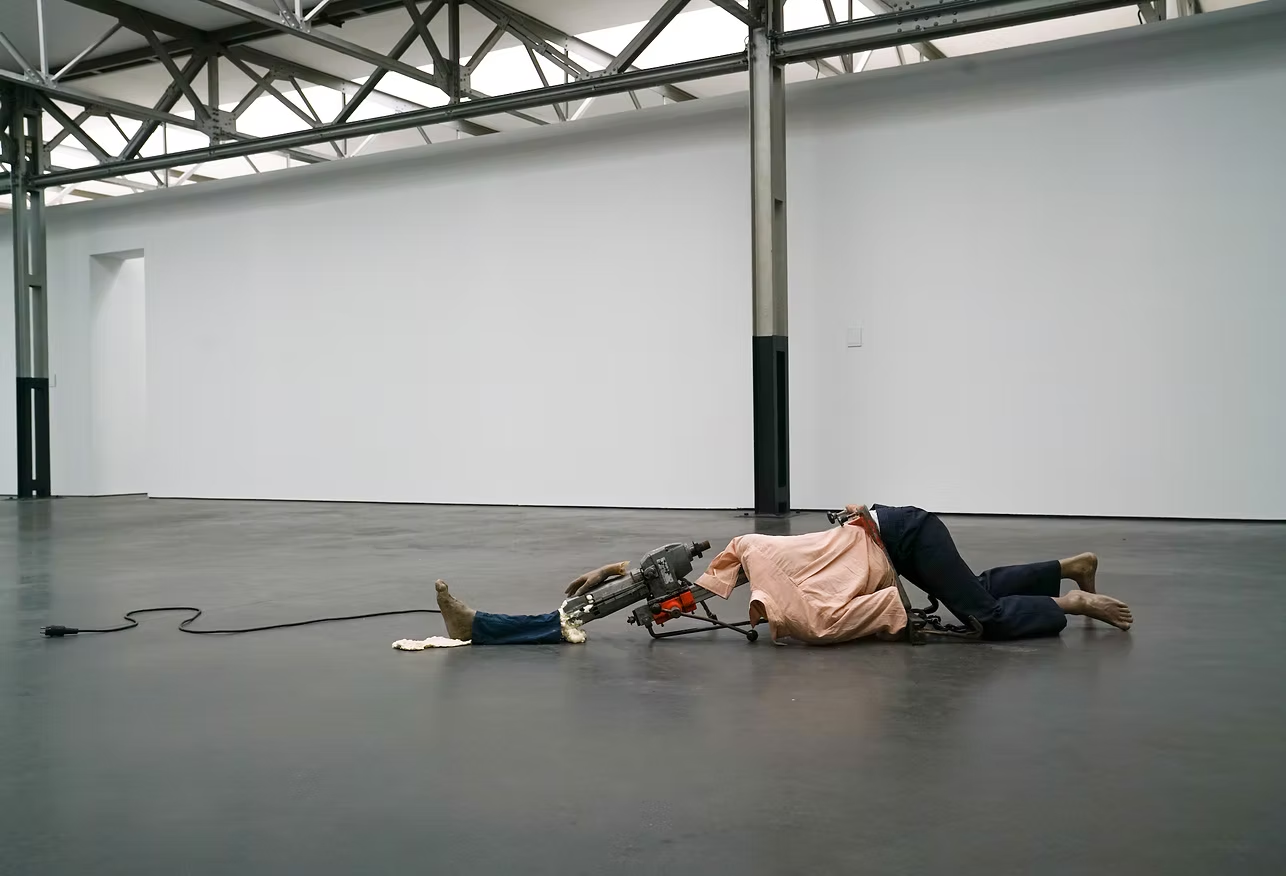
You can find out for yourself, as the recent sculpture BOR (2024) is currently displayed at Sculpture Park. Meiro Koizumi is represented by Galerie Annet Gelink.
Meiro Koizumi (Japan, 1974) lives and works in Yokohama, Japan. But it’s no coincidence that his work is being shown in the Netherlands. His relationship with the country now spans more than 20 years. After studying in Tokyo and London, he was a resident at the Rijksakademie in Amsterdam between 2005 and 2006. In his broad practice, Koizumi looks both to the future and the past, with such recurring elements as power relations, technology and collective memory.
Good Machine Bad Machine
After returning to Japan following his time at the Rijksakademie, he was able to view his homeland with fresh eyes. He noticed how the national mood had shifted. “Our economy was stagnating and the population began to shrink, while China was growing, South Korea was performing well and North Korea is located right next to us. Our self-confidence seemed to have taken a blow.”
He keenly observed how issues that had once been highly sensitive, such as displays of the national flag, celebrating the emperor’s birthday and calls for a national army, suddenly found fertile ground. This sentiment accelerated after the Fukushima disaster in 2011. Symbols can survive natural disasters, as they offer something to hold onto when everything around you is collapsing, both literally and figuratively.
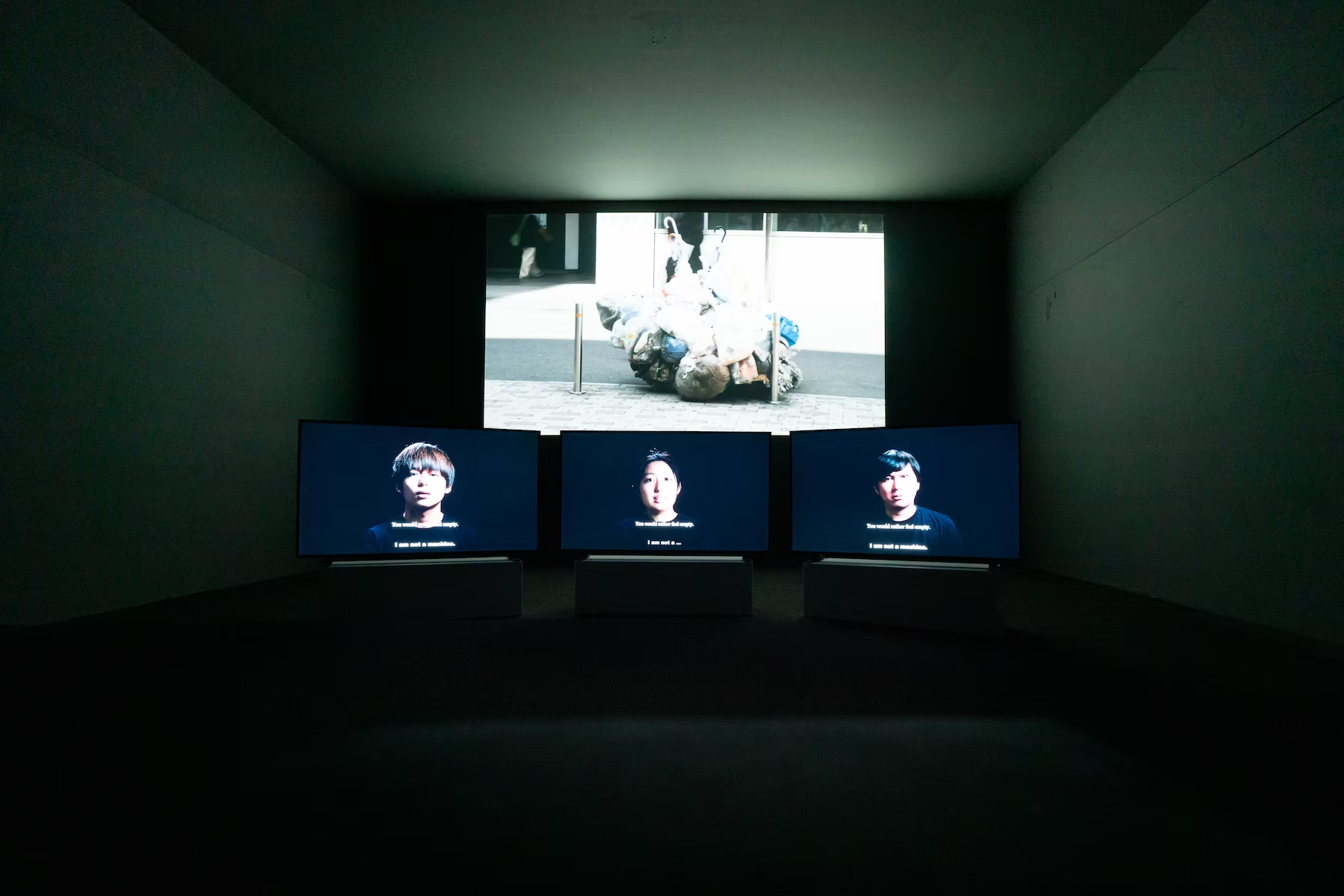
For 11 years, Meiro Koizumi filmed nationalist demonstrations. This resulted in the video installation Good Machine Bad Machine (2023). At the front, we see hypnotised actors uttering words and short phrases while moving through the full emotional spectrum, from fear and anger to happiness and enthusiasm. Behind them, we see footage of the demonstrations. By presenting these films simultaneously, Koizumi questions the extent to which we are truly in control of our own emotions. Do we consciously choose to become outraged about certain issues or are we fuelled by technology and unconsciously influenced by propaganda?

Soluble Meat
In the recent film, Soluble Meat (2025), the tension between technological progress and the loss of free will resurfaces. Again, he links the theme to our subconscious. Koizumi created Soluble Meat using the AI programme Luma Dream Machine. He fed the AI archival footage of hypnosis sessions and entered the prompt: “This is a tragic film about people who are losing their free will.”
He then repeatedly reinserted the image generated by the algorithm back into the programme, each time with the same prompt. By repeating this process every five seconds, a film emerged in which incomprehensible events slowly unfold. The scenes are recognisable yet dreamlike, creating an uncanny atmosphere. The video was subsequently entered into Google Gemini to generate the voice-over.
Although Koizumi considers the film an AI stream of consciousness, he emphasises that there is always a human behind the controls. Soluble Meat not only echoes the automatic writing of the Surrealists; it also demonstrates that our subconscious is influenced not only by memory and imagination, but now also by algorithms.
In limbo
With the series Altars, Koizumi shifts the question of technological influence from the mental to the physical domain. At Sculpture Park, BOR (2024) is on display, a sculpture featuring a lower torso on one side and on the other, a single leg and detached hand. Between them is a column drill. It appears as if the human body has been fed through a shredder and emerged in smaller fragments.
That is precisely the point Koizumi wishes to make. As our social lives increasingly unfold in the digital realm, our awareness of the physical body starts to fade. Last year at Museum De Pont, the Altars hung helplessly from chains, suspended between the real and the virtual in a limbo state that was neither human nor machine.
“What I find dangerous about this development is the tendency to treat living beings as objects. There is a potential for violence here,” says Koizumi. “The challenge is how we can rescue warm-bodied humans from this limbo. I consider that my life’s work.”

“The idea of connecting humans with machines has existed for 200 years – Frankenstein, for example, is now two centuries old. Yet a sculpture of a lower body topped with an engine block still creates a glitch in our brains. Our survival instincts are triggered by a sense of danger.”
Since his time at the Rijksakademie, Meiro Koizumi has been represented by Galerie Annet Gelink, where he has held seven solo exhibitions. His work is included in the collections of the Museum of Contemporary Art Tokyo, Museum of Modern Art, Tate, Kadist Art Foundation, Stedelijk Museum Amsterdam and Museum Boijmans Van Beuningen. Last year, he presented a retrospective exhibition at Museum De Pont in Tilburg in the Netherlands.
Written by Wouter van den Eijkel


