Meet the nominees for the NN Art Award 2026: II Kyra Nijskens
This year marks the tenth edition of the NN Art Award. The annual incentive prize of €10,000 is awarded to a talented artist who completed their education in the Netherlands and presents work at Art Rotterdam (27–29 March at Rotterdam Ahoy). The professional jury nominated four artists: Fiona Lutjenhuis (Galerie Fleur & Wouter), Tina Farifteh (Gallery Vriend van Bavink), Mandy Franca (Night Café Gallery) and Kyra Nijskens (Prospects / Mondriaan Fonds). From 14 March to 25 May 2026, work by all nominees will be on view at Kunsthal Rotterdam.

In the recent work of Kyra Nijskens, biofouling forms an important thread: the process by which marine organisms such as oysters, mussels and algae attach themselves to artificial surfaces like ship hulls and underwater pipelines. These organisms travel unnoticed along global trade routes and settle in ecosystems that are not designed to accommodate them. Conversely, the artificial infrastructures themselves, ships, containers and subsea constructions, were never intended to become habitats for such life forms. The language used to describe this is striking. Within capitalist frameworks, these species are quickly labelled colonisers or invasive, while in their original environments, they carry names such as ‘lucky clam’ or ‘golden clam’. What the logistics industry defines as a technical problem, Nijskens reads as a form of resistance. In her sculptures and installations, she examines the friction between industrial systems and the organisms that force themselves into them. Human systems disrupt and reshape ecological processes, which in turn adapt, transform and survive. Nijskens turns this dynamic into a compelling metaphor, shifting the perspective so that the organism, rather than the system, takes centre stage.
By highlighting biofouling, Nijskens shows how natural processes embed themselves in the margins of human-designed systems. At the same time, more than a thousand sea containers disappear into the ocean each year. Plastic products from lost cargo washing ashore are visible symptoms of an unsustainable system. Two parallel movements converge here: the biological and the economic, meeting on the surface of the sea. Her installations suggest a world in which human control proves relative and in which life, even within tightly organised systems, remains resilient and ultimately finds its own course.

Nijskens’ practice operates at the intersection of sculpture, installation and conceptual research. As she explains: “In my practice, I’m less interested in representing nature and more interested in working alongside it— finding moments where its patterns can challenge or disrupt the narratives we have told ourselves about what is ours and what is not. My approach is a mix of poetic reflection and critical exploration, focusing on how human activity reshapes ecological and cultural landscapes.”
During her residency at PADA Studios in late 2024 in Barreiro, Portugal, a historic departure point for early colonial expeditions, she developed the series "The Thief of Tides". From this context she traced the routes of organisms that travelled aboard ships and wrote texts from their perspective. Shells found on the nearby beach were brought together into what she describes as hybrid technofossils, fossils of a future era that feel both biological and industrial.
Material plays a key role in her work. Nijskens combines found and new materials such as mother-of-pearl, resin, rust, textiles, plexiglass, rope, powdered blood, metal and both real and artificial pearls. She experiments with bio-resin and investigates how natural structures can be bent, combined or transformed into new forms. For her earlier installation "Rusted Mouths, Hollow Veins”, she chemically bent mother-of-pearl shells into a substance that approaches natural fibreglass.

Kyra, could you tell us more about the work you are presenting at Art Rotterdam and at Kunsthal Rotterdam?
Both at Kunsthal Rotterdam and in the Prospects section at Art Rotterdam, I will present work from "The Thief of Tides", a project I started in 2024 during my residency in Portugal, close to the sea and an abandoned industrial area. I took long walks there and encountered industrial surfaces overgrown with shellfish. That is when I became fascinated by biofouling. Biofouling literally means biological contamination, a term I find somewhat paradoxical because somehow, biological carries a negative connotation here. It is often seen as a problem or inefficiency, yet I consider it poetic how life continues to manifest in places designed to exclude it. For me, biofouling is about bodies that do not fit, yet still persist. It is about presence as a form of queer resistance, visible in the frayed edges of global systems.
I follow these journeys and try to imagine what they look like from the perspective of the organisms themselves. In poetic texts written from their point of view, I give them a voice and describe how they cling and disrupt. From this research, the "Clogged Pipe” sculptures emerged, in which I imagine what becomes visible when a pipeline is cut open and these organisms appear inside. From that same line of thought, I began exploring other leaks within global logistics systems. Each year, thousands of sea containers are lost in the ocean, often with absurd and almost mythical consequences. Sometimes their contents resurface years later: beaches covered in Crocs, yellow rubber ducks carried along ocean currents, some frozen for years in Arctic ice. This forms the basis for new work. For this series, I use a backpack as a miniature container, an apparently sunken human object filled with sea organisms and remnants of lost cargo. Cut into segments, the backpack becomes a hybrid technofossil, an object in which economy and ecology, decay and survival converge. Work from these two most recent series will also be shown in the Prospects section of the Mondriaan Fund at Art Rotterdam.

What are your plans for 2026?
In 2026, I will take up a residency in Ebeltoft, a small historic town on the Danish coast. It is a place where the sea is close by and where centuries of trade, shipping and interventions in the landscape remain tangible. I intend to conduct extensive field research there, gather materials, study underwater structures, develop new sculptural forms and above all: respond to what I encounter.
At the same time, I hope to make a film there: an experimental, alternative narrative about hybrid bodies, sea voices and mermaids who lose their voices by conforming to the norm. I see this film as an intuitive and complementary addition to my sculptural work, an exploration of voice, silence and what is lost when one attempts to fit in. It would be wonderful to use my sculptures within this context and create a world of my own.
How did you feel when you heard you had been nominated for the NN Art Award?
I was genuinely surprised and above all: very happy. I have followed this award for years and many artists I admire were previously nominated. I also consider this year’s nominees incredibly strong. Being nominated myself makes me feel that my work is being seen and appreciated, which is of course a great compliment. It is especially meaningful to present my work at Kunsthal Rotterdam. I have lived in Rotterdam for many years and the harbour has become part of the way I work and think. Showing my work here feels really fitting.

Which project would you immediately pursue if you were to win the award?
If I were to win the award, I would immediately begin the experimental short film I have been thinking about for some time. Film is new to me, which makes it exciting. I am always searching for new media and ways to experiment, and this project would allow me to apply my knowledge of materials in an entirely different way, within the framework of film. I usually work alone, but film requires collaboration, and that seems both exciting and instructive. The award would above all give me the space to fully explore this experiment and bring it to life.
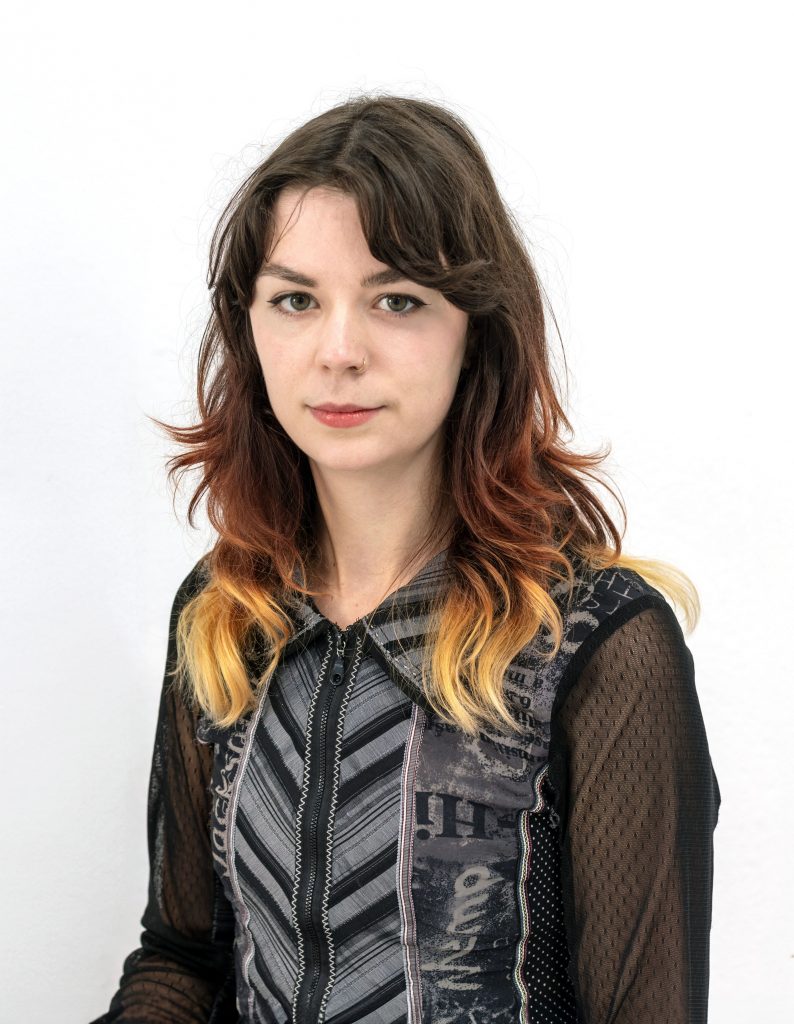
Kyra Nijskens was born in 1997 in Ulestraten. She studied Fine Art at HKU and completed her Master’s degree at the Piet Zwart Institute in Rotterdam. Her work was previously shown at Marres, MaMA, Het HEM and Museum Villa Mondriaan.
During Art Rotterdam, Nijskens’ work will be presented in the Prospects section of the Mondriaan Fund, where the public can encounter a new generation of artists. In this fourteenth edition, the exhibition presents work by 92 emerging artists who received financial support in 2024 through the Artist Start grant scheme, to support the beginning of their careers. The exhibition is curated by Johan Gustavsson and Daphne Verberg.
The winner of the NN Art Award 2026 will be announced on Friday 27 March at Kunsthal Rotterdam. During this festive evening, all exhibitions, including the NN Art Award exhibition, will be freely accessible to invited guests.
Written by Flor Linckens


