Bricolage – the photocollages of Vuyo Mabheka
At first glance, the colourful work of Vuyo Mabheka seems cheerful. The combination of fresh colours, naive childlike drawings and cut-out photographs is easy on the eye. But that impression does not last. With each work you see, your view evolves. You start to recognise the same photos again and again and the same drawn figures reappearing. In his photocollages, Mabheka tells what it is like to grow up as a Black person in a township in post-Apartheid South Africa. It is a highly layered and fragile story that is rarely told, one surrounded by shame and distrust.
Vuyo Mabheka’s work can be seen at Unseen Photo at the Afronova stand.
Mabheka’s series is called Popihuise, a Xhosa corruption of the Afrikaans pophuis (dollhouse). He added the ‘e’ at the end to make the word sound English. The name refers to the original function of the drawings, which were homemade toys. Mabheka used them as a board game when his younger sister brought friends home.
Vuyo Mabheka (South Africa, 1999) and his sister grew up in the township of Thokoza, just outside of Johannesburg. They had an absent father and their mother worked most of the time. At first, they lived with their grandmother, but when she died, much of the responsibility for raising his younger sister fell to Mabheka. Afronova’s Emilie Demon describes it as an unstable environment, one in which a great deal depended on the ability to improvise and the survival instincts of a minor.
The path from an unstable childhood to bricolage art was a long one. Demon lives and works in Johannesburg. In addition to her gallery, the Japanese-French curator runs the photography project Of Souls and Joy in Thokoza. Alongside a photography course, the project also offers tools to learn how to reflect on and talk about traumatic experiences. “I’ve learned a great deal over the past ten years,” Demon says by phone. “At first, the participants were distrustful. What is someone like me doing there? What does she want from us? That was the attitude. So, it took a long time to gain their trust.”
“Talking about traumatic experiences always takes time, but for Black South Africans, it is probably even more difficult. They feel unseen. That’s why I wanted to make it a safe space, a place where you could learn about photography and if you want, to talk about your traumas.”
It proved a challenge to do justice to the layered nature of the work and the original function of the drawings, Demon explains. Not only because many of the sheets are marked on both sides, but above all, because the stories they tell are extremely personal.
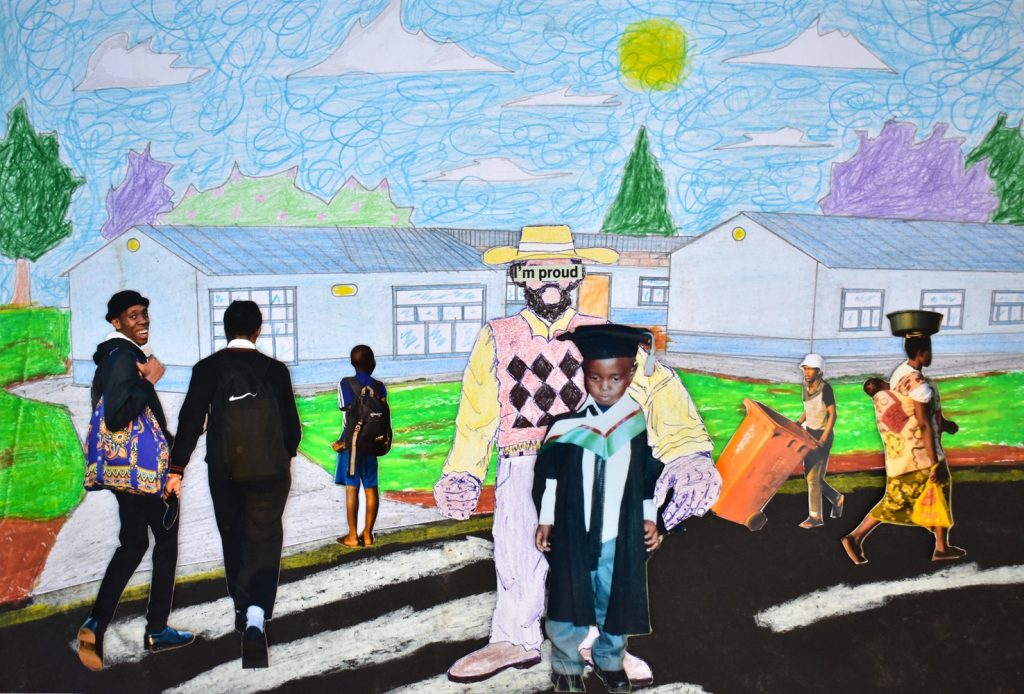
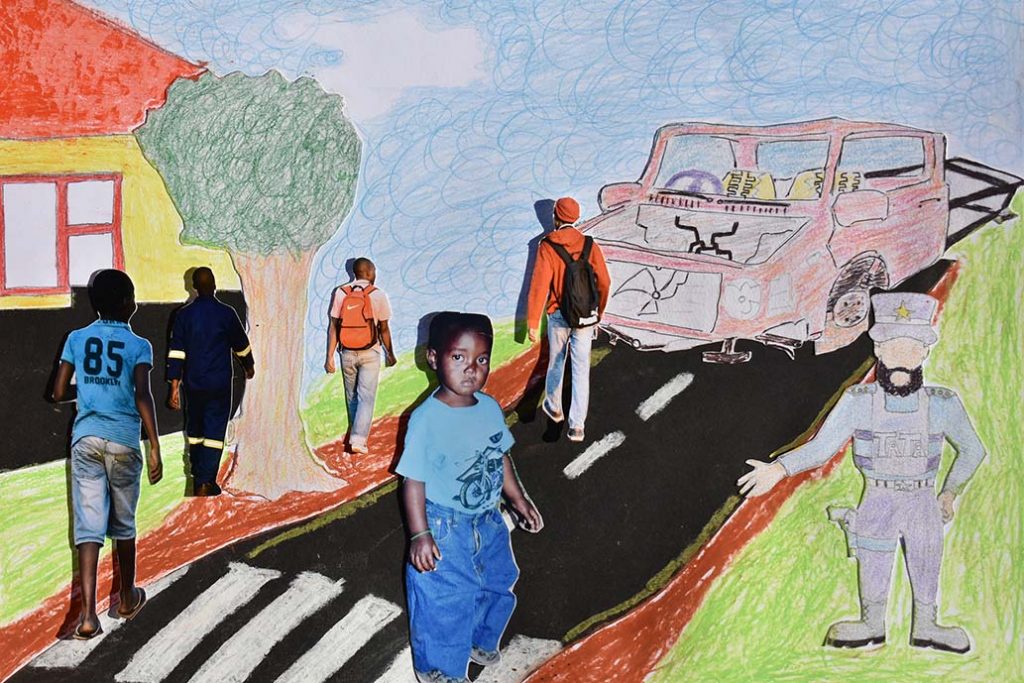
For instance, the father figure returns in several guises—once with the text I’m Proud at eye level, his arm draped around a cut-out photo of a five-year-old Mabheka. Elsewhere, he appears as a police officer helping a young Mabheka cross the street.
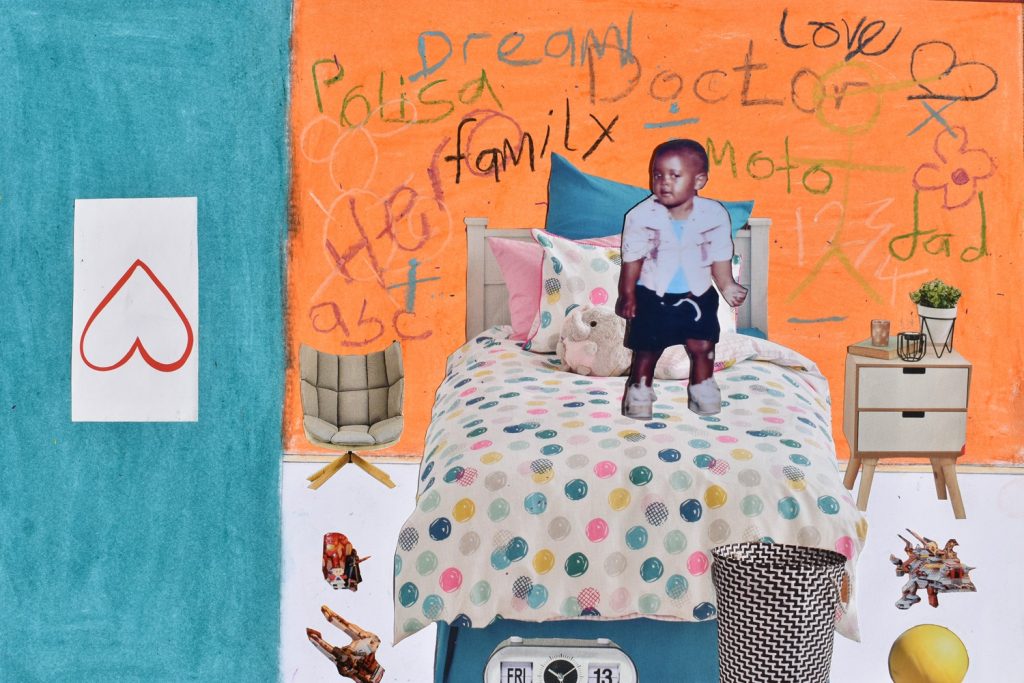
In iGumbi Lam we see Mabheka as a toddler sitting on a bed in a bedroom. Keywords are written on the wall. Whereas the inner world of the average five-year-old in a stable environment might include things like football, Pokémon, Nintendo and a pet, Mabheka’s word cloud is far grimmer: police, family, love, dad, hero, doctor. At the bottom of the image, the date is visible on an alarm clock: Fri / 13.
There are also elements that might be referred to as mythologising. In Top Zinto, a corrugated-iron shack turns into a colourful house, and in Imbali Yesizwe, a house without parents becomes a place of redemption for a nation.
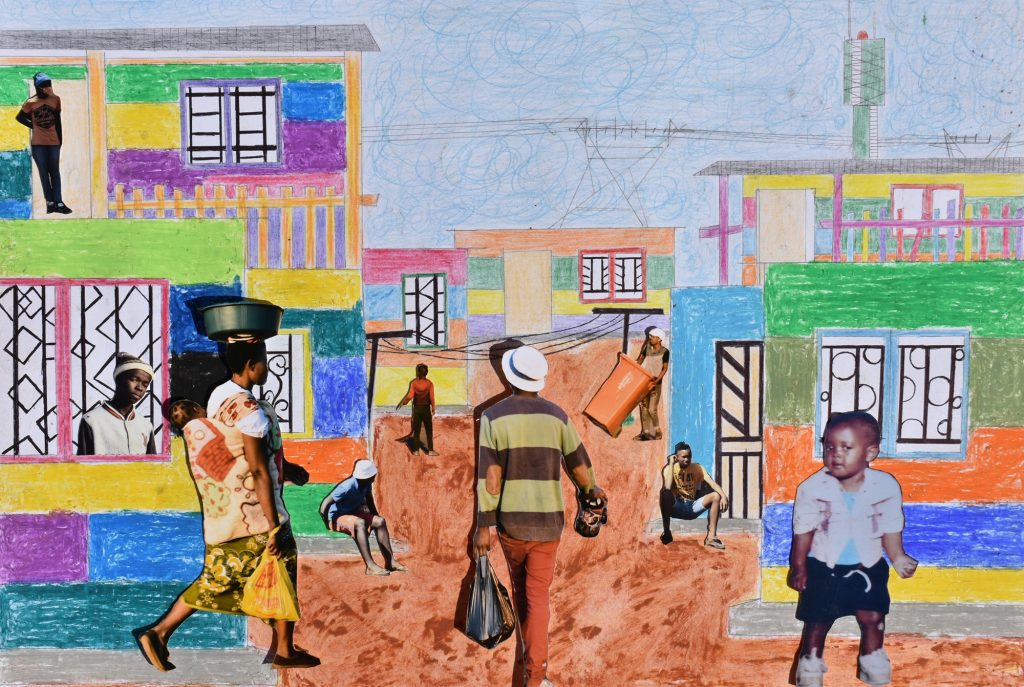
To do justice to all these aspects, Mabheka and Demon chose to allow small differences between edition numbers. Each collage is therefore slightly different. The drawing remains the same each time, but the photos differ per edition because they are cut out by hand. The selection can also vary. “This approach suits the work well,” says Demon.
In 2024, Emilie Demon brought Vuyo Mabheka’s work to Paris Photo. It was an overwhelming success and the work sold out within a few days. The renowned French photobook publisher Chose Commune also published a book about the series. It changed Mabheka’s life; he recently moved into an apartment with brick walls. He now fills his days with painting and visiting museums. “Don’t stay stuck in this anger—be open and curious,” Demon advised Mabheka. That seems to be working out well. We have only seen the beginning, Demon says confidently over the phone. “His peach is so ready now.”
Written by Wouter van den Eijkel


