Shivangi Kalra and the anatomy of a memory
In the New Art Section of Art Rotterdam, Galleria Doris Ghetta from Italy will present a solo booth featuring the work of Shivangi Kalra. In her paintings, she invites the viewer to step into her inner world, a world that is deeply personal yet resonates with something universal. Her works can be read as concentrated studies of memory, intimacy and social relations. The New Art Section, curated by Övül Ö. Durmuşoğlu, is reserved for solo presentations by emerging artists with a compelling and conceptually thoughtful practice.
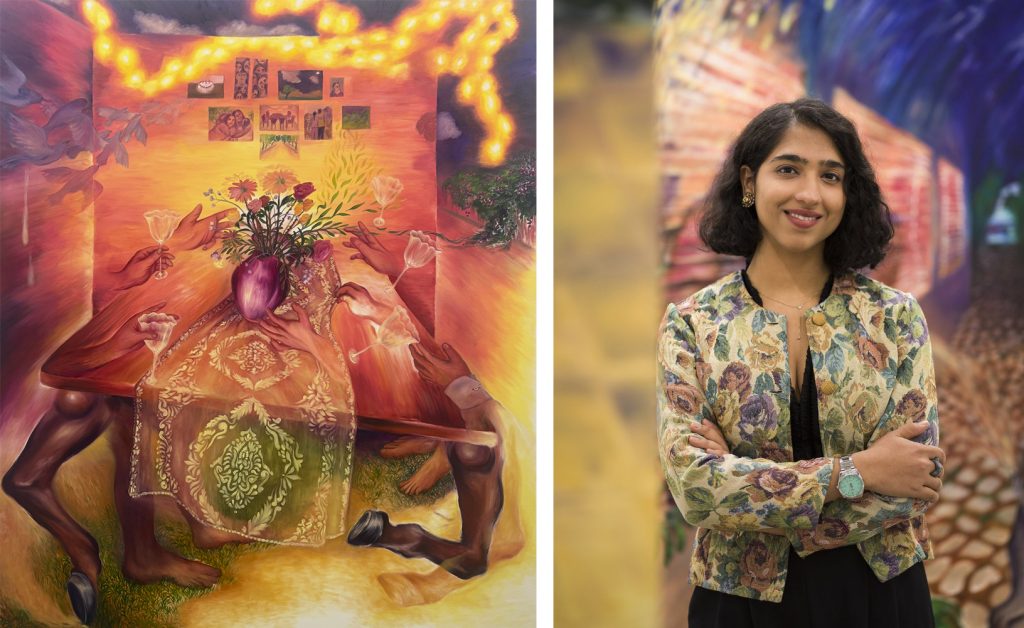
Shivangi Kalra was born in Delhi in 1998. She studied Painting at the College of Art in Delhi and graduated cum laude from the Frank Mohr Institute in Groningen in 2024, following an exchange programme at Uniarts Helsinki. That same year, she received the Royal Award for Modern Painting. She currently divides her time between Amsterdam and India, two contexts that continue to inform her work.
Kalra’s dreamlike and enigmatic paintings explore the ways in which memory and perception can become intertwined. Rather than presenting clearly defined narratives, she depicts fragmented situations in which something has just occurred or is about to unfold. Each painting seems to function as a mental space that she constructs with care, element by element, at times almost staged like a theatrical set. At the same time, she rarely makes the scene explicit. Her compositions feature interiors, terraces and subtle theatrical elements, as well as references to lavish parties that she remembers from her youth. For Kalra, these gatherings form a microcosm in which social hierarchies and ingrained codes become visible, almost like a performance. Yet it is also a space for genuine connection. She seeks to understand what takes place when people come together in such settings, a society in miniature, captured in a painting that reveals as much as it withholds.

One striking aspect of her work is the psychological charge of the spaces she depicts. Many of her scenes are set in the city where she grew up, a place that has undergone profound transformation in recent decades, as has its social landscape. Yet the city functions less as a literal backdrop than as a space of memory. Festive tables appear in seemingly warm living rooms or shift to terraces and outdoor settings. At times, a piece of furniture asserts itself with unusual insistence. Figures emerge in motion blur, appear only as an autonomous hand or as mirrored doubles, cast an ominous shadow in a corner, partially dissolve behind smoke or curtains, remain faceless or fade into their surroundings. In some works, figures are framed by a window while in others, the viewer’s gaze is obstructed by the bars of a balcony. In some paintings, people are conspicuously absent. Animals recur throughout, from shadowy dogs and table legs resembling horse legs to tiger rugs that seem to almost come alive.
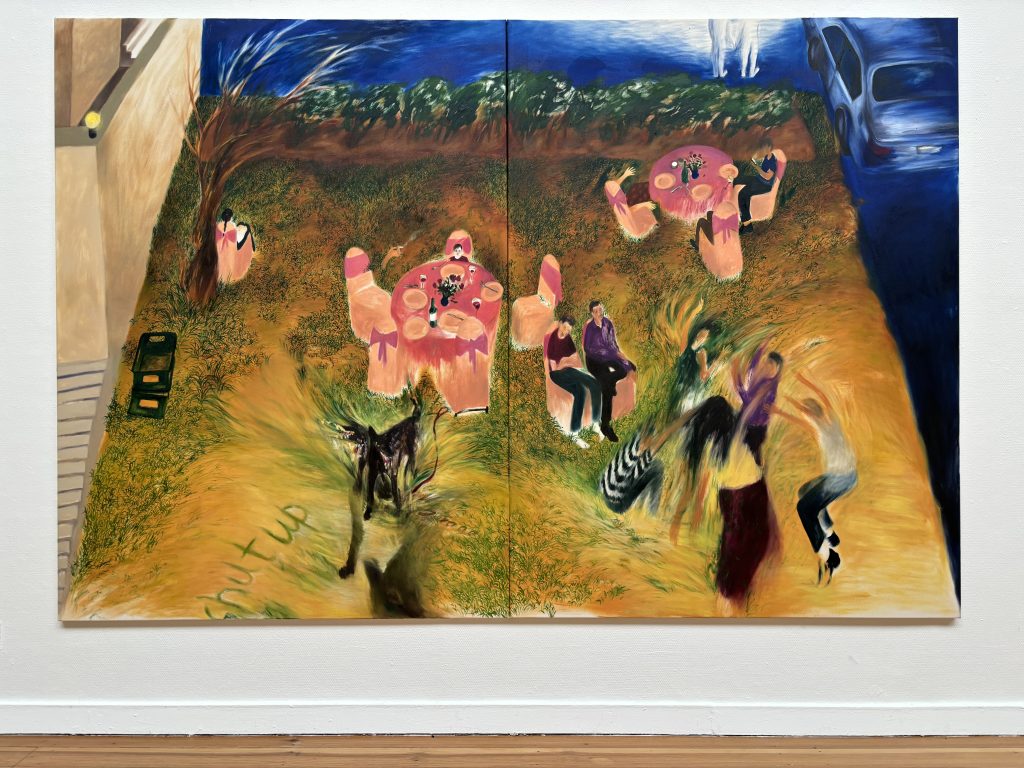
Kalra guides the eye along conspicuous yet slightly unsettled sightlines and charged details, including photographs on the wall that raise more questions than they answer. One can almost sense the silences, the outward display, the underlying friction and the unspoken hierarchies. The explicit and implicit social rules and the different expectations that are assigned to men and women. It is as if you’re looking at a charged yet unstable memory that has shifted over time, governed by a logic that belongs to dreams. In the context of the Royal Award for Modern Painting, Kalra stated, “I have increasingly begun to paint from memory and have learned to embrace the confusion that can arise from it.” As a result, her works carry unsettling and melancholic undertones, while humour and a touch of absurdity offer some soft edges.
Kalra’s work was previously shown at the Groninger Museum, the Chabot Museum, the Royal Palace Amsterdam, Method in Mumbai and the Museum of Goa. Later this year, she will present a solo exhibition at the Drents Museum in Assen.

Shivangi Kalra’s presentation will be on view in the New Art Section during Art Rotterdam (27–29 March in Rotterdam Ahoy), presented by Galleria Doris Ghetta.
Written by Flor Linckens


