Coming soon
Coming soon
Selecteer type
Interview with Filipp Groubnov
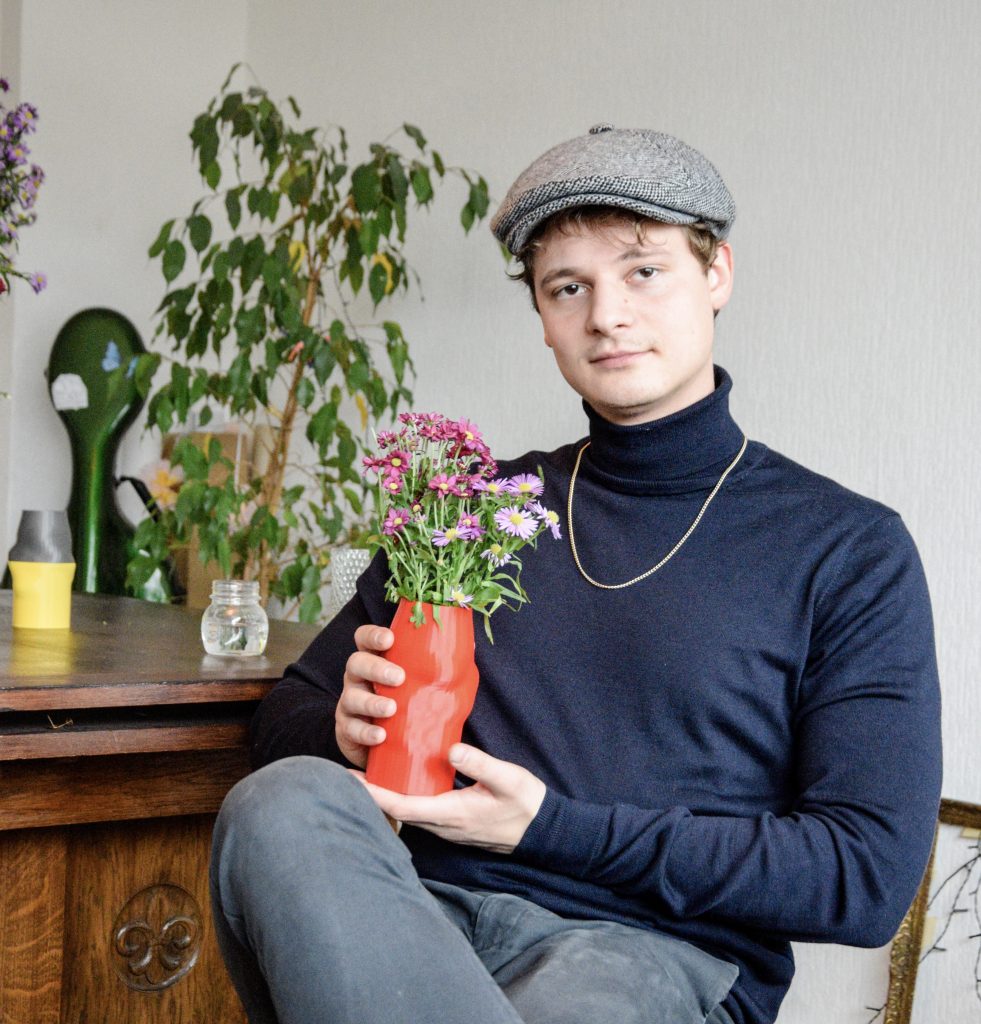
Eight years ago, Filipp Groubnov moved from Belarus to the Netherlands. At the Royal Academy in The Hague he discovered that he could express many of his interests in installations. He prefers to be in the border area of various artistic and scientific disciplines. “There I find space for my own story and the opportunity to discuss all kinds of questions that occupy me. There are simply too many things that inspire me to put them in a single system.” This also applies to his visual language, which is a unique mix of figuration and abstraction, although according to Groubnov this is ultimately a matter of scale. His work is shown at Art Rotterdam by Josilda da Conceição.
Let’s start at the beginning. Before studying fine arts, you studied physics. What made you switch?
Even before studying fine arts, I was very interested in art. I have always been involved in some sort of creative activity, from graffiti to drawing and painting. I think the main reason why I didn’t choose to study art initially was because I didn’t know anyone who followed that route and, at the time in Belarus, I didn’t really consider an art career as a possibility. On the other hand, I was interested in science and I imagined studying physics as a kind of creative process, too. But one year into the programme, I realised that it was very formal and uninspiring. At some point, I simply couldn’t do it any longer and that’s when I decided to switch.
You moved from Belarus to the Netherlands in 2015. What kind of work were you making at the time?
When I moved to the Netherlands in 2015, I wasn’t very familiar with contemporary art. In fact, I was barely familiar with contemporary art at all because it isn’t well represented in Belarus. At the time, there was only one gallery that showed contemporary art in Minsk and I also lacked a context to truly understand it. I was mostly influenced by early 20th and 19th century styles like Impressionism and Surrealism, and was mostly focused on painting and drawing.
Would you say there’s a different approach to art here than in Belarus? If so, was it hard to get used to?
It was definitely hard to get used to the idea of ‘contemporary art’ and what it entails. I often struggled to understand what the teachers expected from me and was also missing a huge number of cultural references since around the 60s. So, it definitely took some time to catch up, but I feel like it also gave me a unique, almost ‘outsider’ perspective to contemporary art.
Your work isn’t political in nature. Given the mass protests after the 2020 general elections in Belarus and the war in Ukraine, as well as the role of Belarus in this, I can’t help but wonder if it is hard to stay away from politics in your work?
For a long time, I’ve had this idea that I wanted to stay away from ‘politics’ in my work, but this is changing, especially due to the events that you mention. I think that I no longer consider ‘political’ as something separate from other facets of life. It is just part of the condition that shapes many complex relationships between human, matter, mind, etc. In my last work, for example, my personal story and the current situation in Ukraine becomes part of the narrative and an essential element of the project.
I’ve read that you started out by painting on canvass. Today, you primarily make installations. What happened along the way?
That’s right, my more ‘conscious’ artistic journey started with canvas and oils. The switch to sculptural installations happened while studying in the Netherlands. I was enrolled in a course on ‘expanded sculpture’, which inspired me to experiment with installation and different media. You might say it opened my eyes to the fact that sculpture and installation can be so many different things. I then began to be aware of all the possibilities to combine materials, images and sounds. I slowly starting realising that in the field on installations, I can combine all my interests in one. To this day, I am in awe of all the possibilities of installations. I still feel like I have only scraped the surface of this discipline.
What would you say is the main theme of your work?
I think an essential (central?) theme of my work is to reject the idea of a ‘main theme’. My interest is in multiplicity and approaching any subject as a kind of choir of detuned, human and non-human, living and non-living voices. What I choose to talk about changes from one project to the other, but what stays the same is my approach to positioning things like personal emotions and narratives in the same ensemble as, for example, the erosion produced by water passing through the landscape. Right now, I am quite fascinated by the subject of war and violence, but it is really through the relationships and interactions I create between the story and different materials that the subject unfolds in front of me and takes on all the complex facets that bring it to life.
Your installations have a mix of abstract and figurative elements. How did you arrive at this visual language?
This developed very organically. I think because, on one hand, I am interested in rather ‘abstract’ concepts like those found in physics and science and, on the other hand, I am also very interested in personal and concrete experiences. Ultimately, my approach is that there is no absolute distinction between what can be called ‘abstract’ and ‘figurative’. In physics, for example, we can imagine ‘particles’, which are described in classical physics as discrete concrete entities. But, if we consider the very small scale described in quantum physics, these particles are more like a very abstract ‘field’ without any clear boundaries. So, figurative or abstract may merely be a matter of scale.
How do you go about assembling your installations? Do you have a preconceived idea and then find the right attributes or do you work with whatever happens to be around?
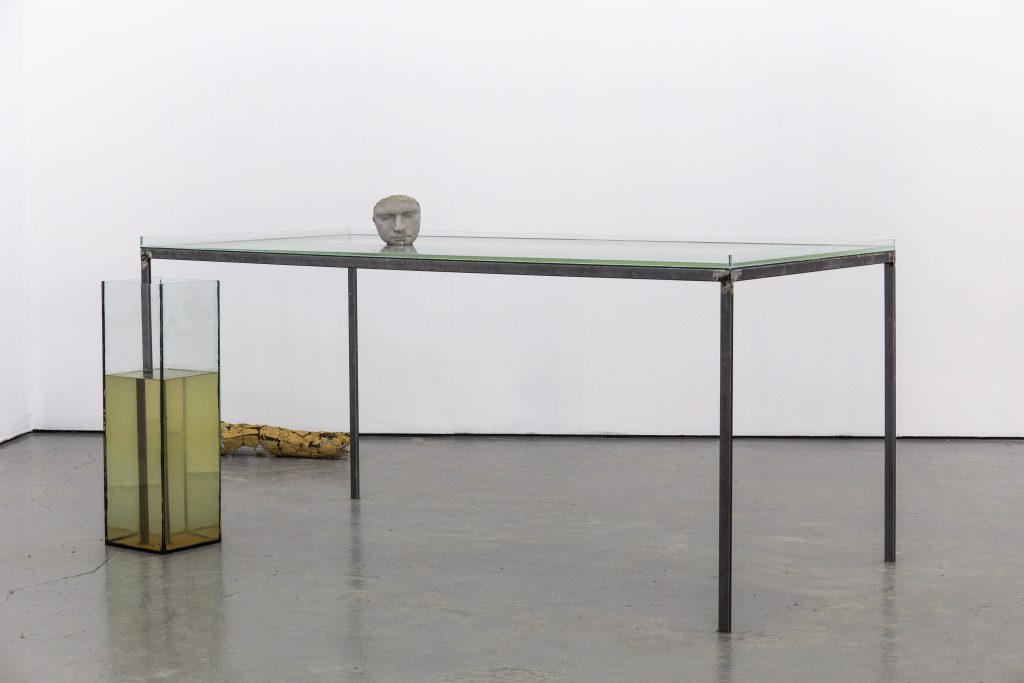
Every installation is a combination of the two. I like to juxtapose some very meticulously crafted elements with ready-made and sometimes more ‘random’ objects that I find. For example, in the installation The Garden of Iarthly Delights, I have placed together a sculptural head of Narges Mohammadi with construction material from a shop. While the construction material was something you can easily buy ready-made, the head on the other hand was a result of a long process of 3D-scanning Narges, 3D-printing the model, casting it, etc. I find the combination of deliberate and spontaneous actions very enriching for the work.
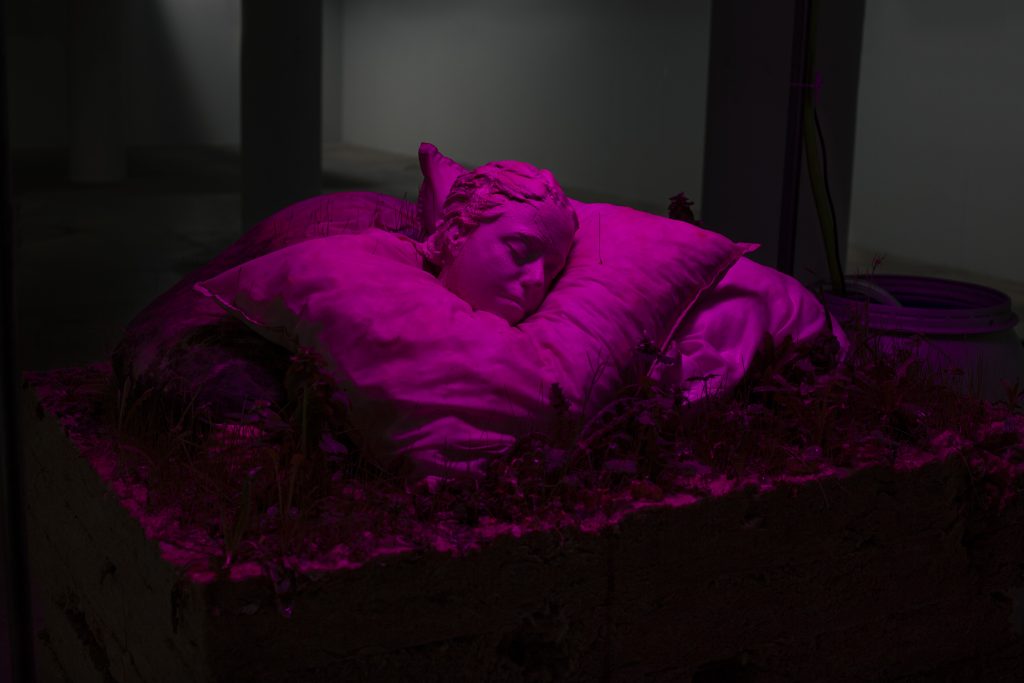
Some of your work has titles that refer to philosophy and biology, such as Natural Philosophy and The Garden of larthly Delights. Are philosophy and biology the main sources of inspiration for you?
In a way, yes, but I think that ‘philosophy’ and ‘biology’ sound so formal. Both of these disciplines are a way of studying phenomena, a systematic approach to research and communication. I am mostly interested in researching areas where these systems start to lose their solid foundation. Within the blurry boundaries of disciplines and systems, I find space for my own story and all kinds of questions that intrigue me. But at the end of the day, there are too many things that inspire me to put them in a single system.
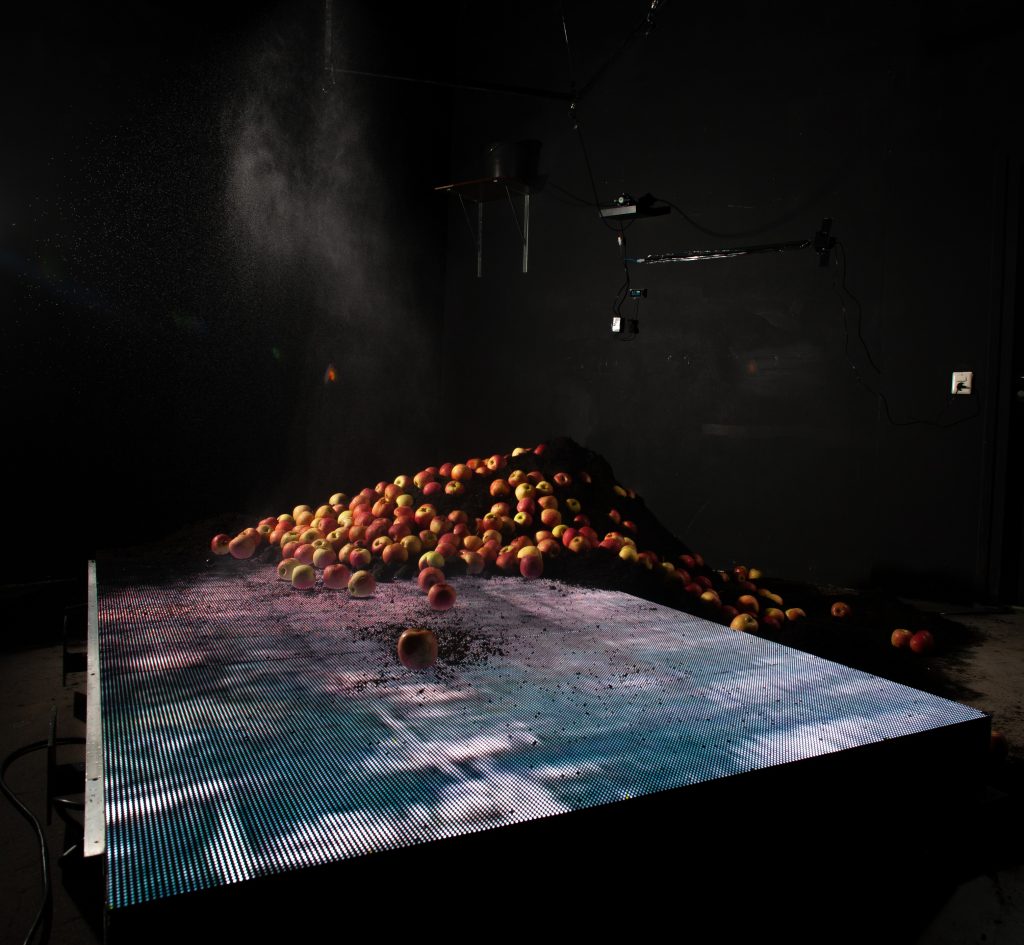
Your installation The Garden of larthly Delights contained living species. I can imagine it can be hard to display in a presentation. So, why do it?
Yes, you are very right. Working with living organism is quite challenging within the context of art exhibitions, which are normally geared towards a different kind of art experience. Most art (or, more specifically, fine art) spaces have a tradition that is based on art objects being static, inanimate ‘beings’. In that context, presenting a living creature requires a completely different set of rules. I find that tension very interesting and it opens up new ways of thinking about art as active participants in the space.
Congratulations on your presentation at Art Rotterdam! What can we expect?
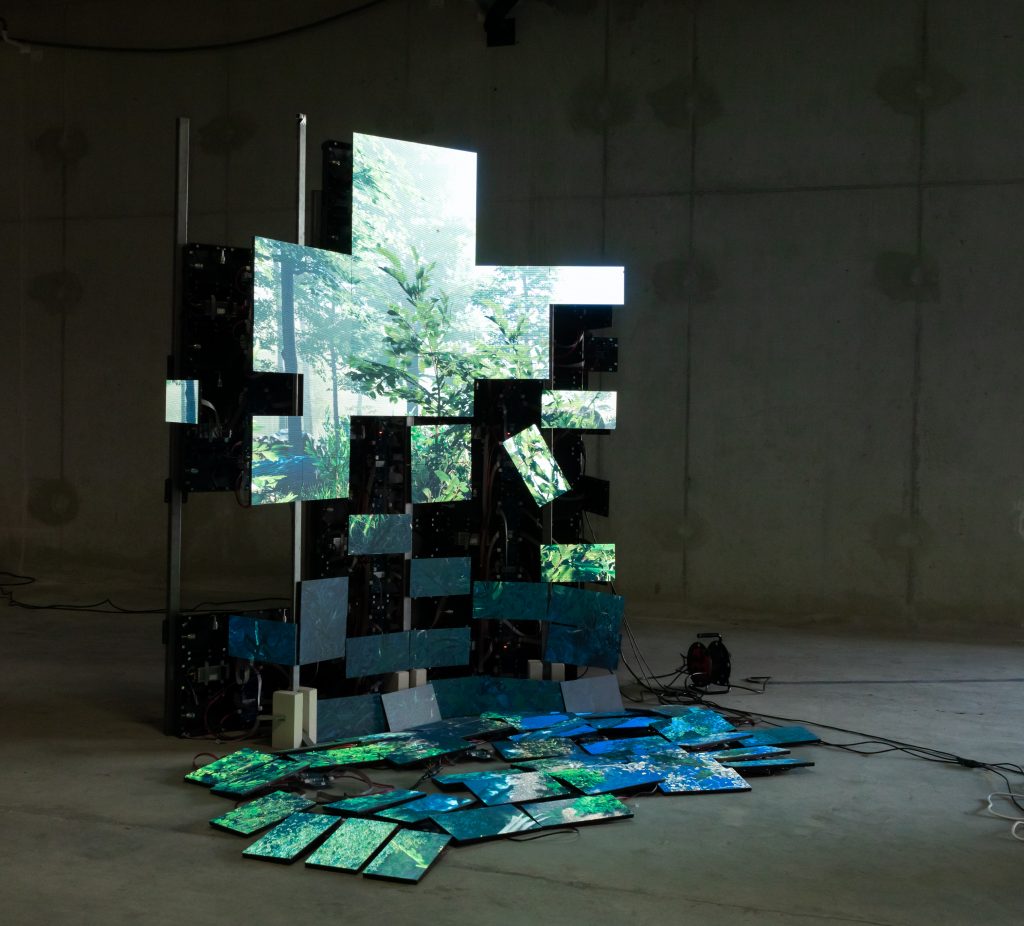
Thank you! Currently, I am working on a project in collaboration with Highlight Delft festival and New Media Center of TU Delft. It revolves around the subject of war and the area of France where the ‘Great War’ left a lasting mark on the landscape. You can expect to see new work with a combination of a digital post-war environment shown on screens and physical sculptural elements. I don’t want to reveal too much because, as a visual artist, I always believe it is better to see for yourself than to hear an explanation. I am also experimenting with glass paintings that might find their way into the final presentation.
Right now, you are at the start of your career. What do you hope to have achieved in the next five years?
There are a lot of things I want to achieve or get involved with. I really hope to participate in residencies that can give me a chance to work with researchers or scientific institutions. I am very interested in interdisciplinary collaboration and, right now, one of my main goals is to establish such partnerships. I would also really like to present my work in more international venues. I have interacted with Dutch audiences for some time now and I am very curious to see how people from other countries and cultural backgrounds interact with my work. I think that would teach me a lot.
Written by Wouter van den Eijkel

AKINCI will present work by Lungiswa Gqunta at Art Rotterdam. In her practice, the South African artist explores the elusive world of dreams. She sees these dreams as a place where important knowledge can be gained that is overlooked or excluded in other places. Her work was recently on display at the Liverpool Biennial, at the Fondazione Sandretto Re Rebaudengo in Turin and at the Centraal Museum in Utrecht and earlier this year, she was invited to submit a proposal for the famous High Line in New York.
In her multidisciplinary practice, which includes performance, installation, sculpture and printmaking, she draws attention to the complex and ongoing ways in which colonialism and patriarchy shape South Africa’s contemporary political, cultural and social landscape — and continues to create systematic inequality until this day. She highlights, among other things, African systems of knowledge and belief that were structurally excluded during the apartheid regime.
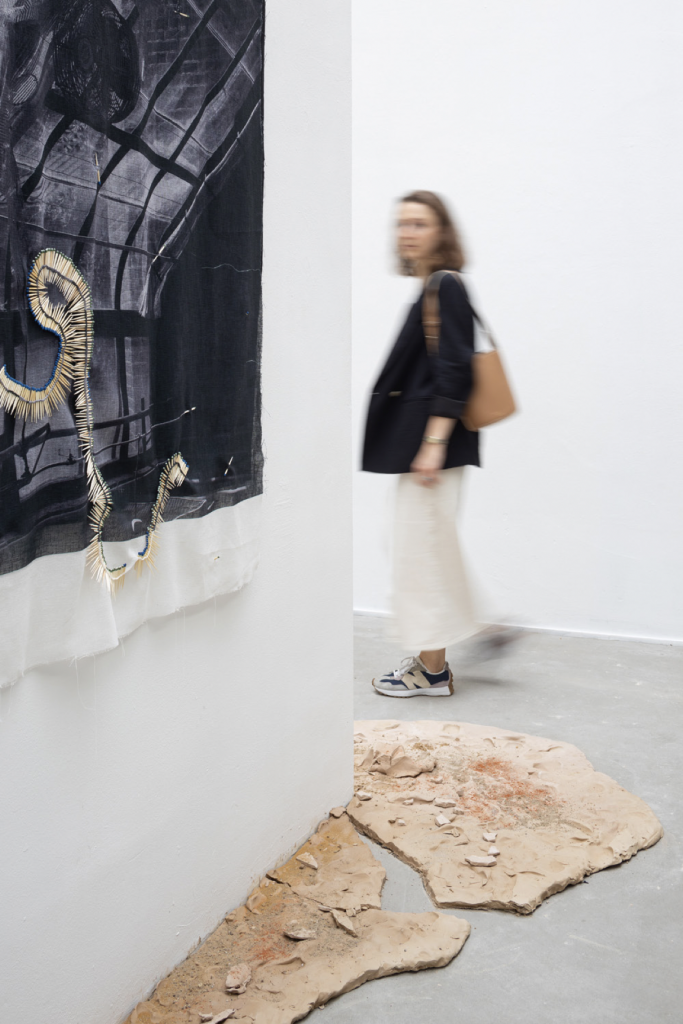
In her most recent work, Gqunta explores the concept of sleep and dreams on the basis of her Xhosa heritage. Dreams function as a connection with her ancestors and are a place where knowledge can be gained. Her multi-sensory and layered work is informed by this dream world and explores themes such as landscape, violence, resistance, collective healing, identity, female power, the domestic space, traditions and rituals, history and collective memory, privilege, globalisation and capitalism. Recurring materials in her work are materials that could also serve as a weapon in a different context or form, such as glass, concrete, barbed wire and more specifically: the more aggressive razor wire. They are symbolic and emotionally charged materials that refer to the townships, which were reserved for the black inhabitants of South Africa during apartheid. Gqunta also regularly uses white sheets in her works, which refer to a recognisable ritual: the processing of the laundry and the folding of the sheets, traditionally a moment when knowledge was shared between the female members of her family, but at the same time a potential moment for secret talks and resistance during apartheid.
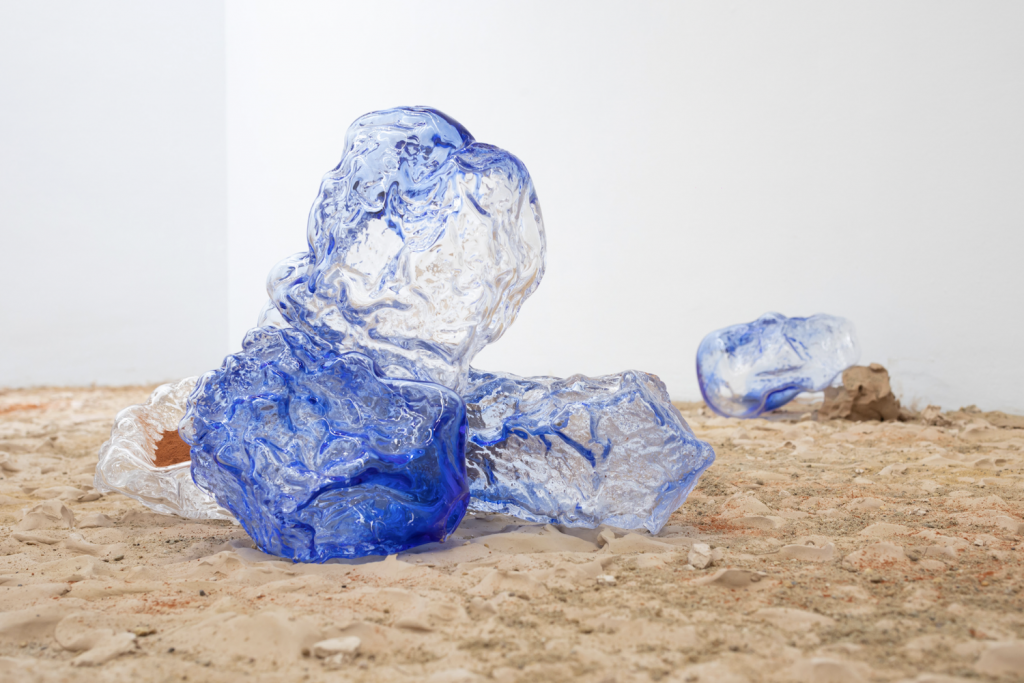
Her recent solo exhibition ‘Sleep in Witness’, that was on display at AKINCI this autumn, was previously presented in a different form at the Henry Moore Institute in Leeds. In both exhibitions, part of the floor was covered with cracked clay and sand, carefully shaped by the artist’s feet. As a viewer, you were forced to walk over it in order to enter the exhibition, which made the instability under your feet tangible. In combination with blue structures of transparent, hand-blown glass — reminiscent of rocks or water — they formed the site-specific installation “Zinodaka”. The video work “Rolling Mountains Dream” in the exhibition referred to remembering and learning from dreams. And the works “Instigation in Waiting I & II” referred to the ways in which colonial oppressors introduced new plant species and removed existing ones as a way of controlling the environment, a tradition that lives on in a different form in conservatories and botanic gardens.
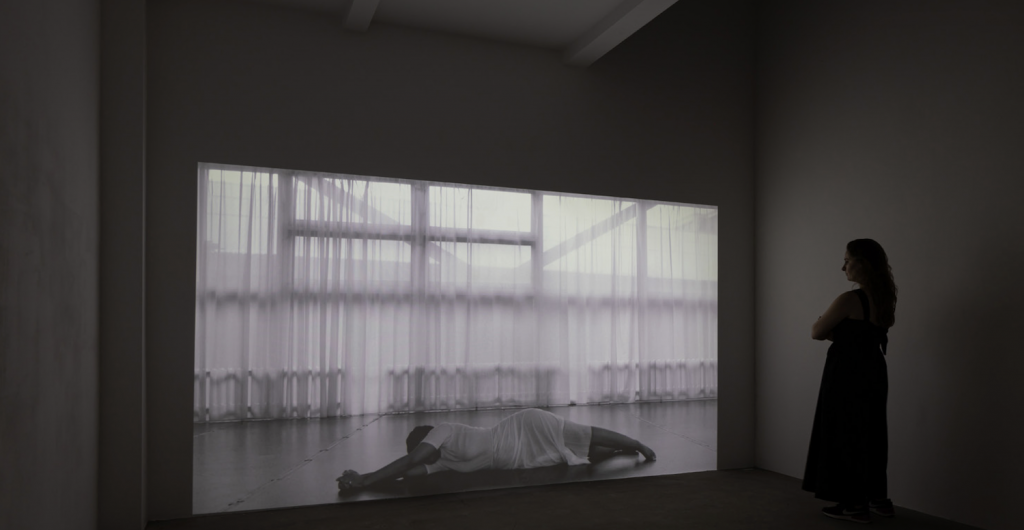
Her room-filling installation “Ntabamanzi”, which consists of wave-like barbed wire wrapped in bright blue fabric, was on show in the Centraal Museum this summer. The large-scale work refers to the reclaiming of healing water rituals that were prohobited during the apartheid regime, but it also challenges the viewer to think about freedom of movement in a space — and how that is not as self-evident for everyone. The name is a combination of two Xhosa words: ntaba (mountain) and manzi (water) and the installation was born in a dream of the artist. Gqunta then worked for months on the execution of the work, after which only the sharp parts still portrude.
Gqunta isn’t afraid to ruffle some feathers and creates installations that cause discomfort and confrontation in white viewers, while other works offer care of the mental health of black viewers. She feels that it’s important to have certain conversations, no matter how uncomfortable they may be. In a video for the Henry Moore Institute, she states: “I think of it as like trapping someone into a conversation. No one’s gonna go willingly to a place that is difficult, that is hard, and so you gotta reel them in. The aim is for the work to follow people home somehow. To haunt them. [Some of my other] installations are I guess the complete opposite, where it’s about rest and recharging.”
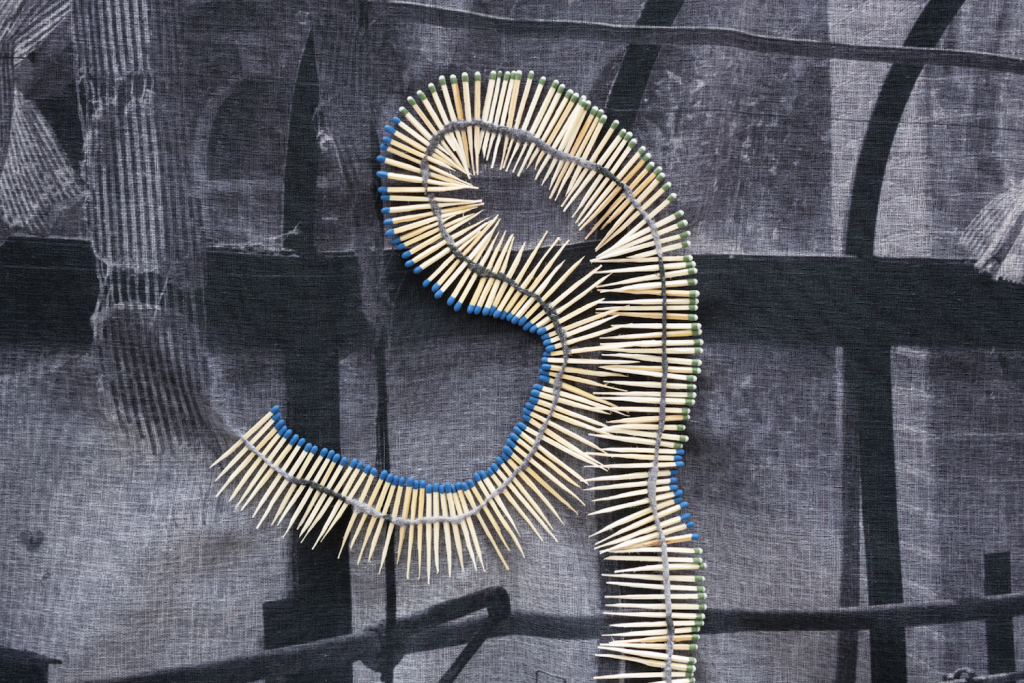
Gqunta studied sculpture at Nelson Mandela Metropolitan University in Port Elizabeth, followed by a master’s degree at the Michaelis School of Fine Arts in Cape Town. She completed residencies at the prestigious Rijksakademie van Beeldende Kunsten in Amsterdam, Gasworks in London and Dumbarton Oaks in Washington DC, a research institute, library and museum affiliated with Harvard University. She currently lives and works in Cape Town. Her work has been shown in the Palais de Tokyo in Paris, during Manifesta 12 and the Istanbul Biennale and has been included in the collections of institutions such as KADIST in Paris, the Kunsthaus Museum in Zurich, the Centraal Museum in Utrecht and Zeitz MOCAA – Cape Town Museum of Contemporary Art.
Written by Flor Linckens
Tijdens Art Rotterdam kan u het werk zien van honderden kunstenaars van over de hele wereld. In deze reeks lichten we een aantal kunstenaars uit die tijdens de beurs opvallend werk tonen.
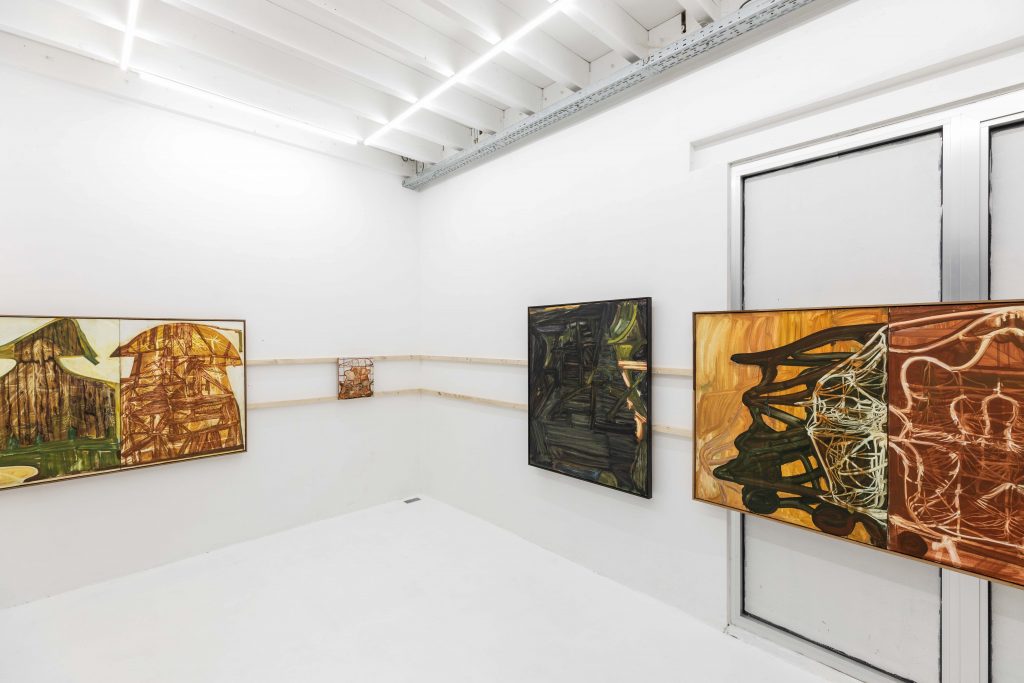
Afgelopen december publiceerde de Belgische krant De Morgen een lijst met de 10 meest boeiende tentoonstellingen in België van 2022. De drie kunstjournalisten achter het artikel prezen het hele programma van de jonge Pizza Gallery in Antwerpen, maar zij besteedden hoofdzakelijk aandacht aan de solotentoonstelling van Jonas Dehnen. Tijdens Art Rotterdam is het werk van de Duitse kunstenaar te zien in de New Art Section.
Schilderen en tekenen staan centraal in de praktijk van Jonas Dehnen, maar afhankelijk van specifieke tentoonstellingscontexten maakt hij ook installaties en sculpturen. Dehnen haalt het gros van zijn visuele input uit de gemeenschappen waarin hij opgroeide. Hij bracht zijn kindertijd door in zowel Duitsland als het Verenigd Koninkrijk en woont nu al enkele jaren in België. De kunstenaar is gefascineerd door de manier waarop gemeenschappen een visuele identiteit opbouwen aan de hand van symbolen en tradities, van uithangborden van Engelse pubs tot praalwagens, van vernaculaire architectuur tot volksschilderingen en andere elementen van wat een ‘visueel patois’ genoemd kan worden. Welke plaats kan het collectieve of het individu nog innemen binnen dat mechanisme? En hoe past globalisering in dat plaatje? Dehnen abstraheert, fragmenteert en herstructureert verschillende culturele betekenaars in zijn schilderijen en creëert zo nieuwe personages en idiosyncratische protagonisten. De beelden komen voort uit een langdurig proces van vallen en opstaan: gelaagdheid, wissen, additieve en subtractieve schilderkunstige gebaren en het herbestemmen van onderliggende beeldfragmenten.
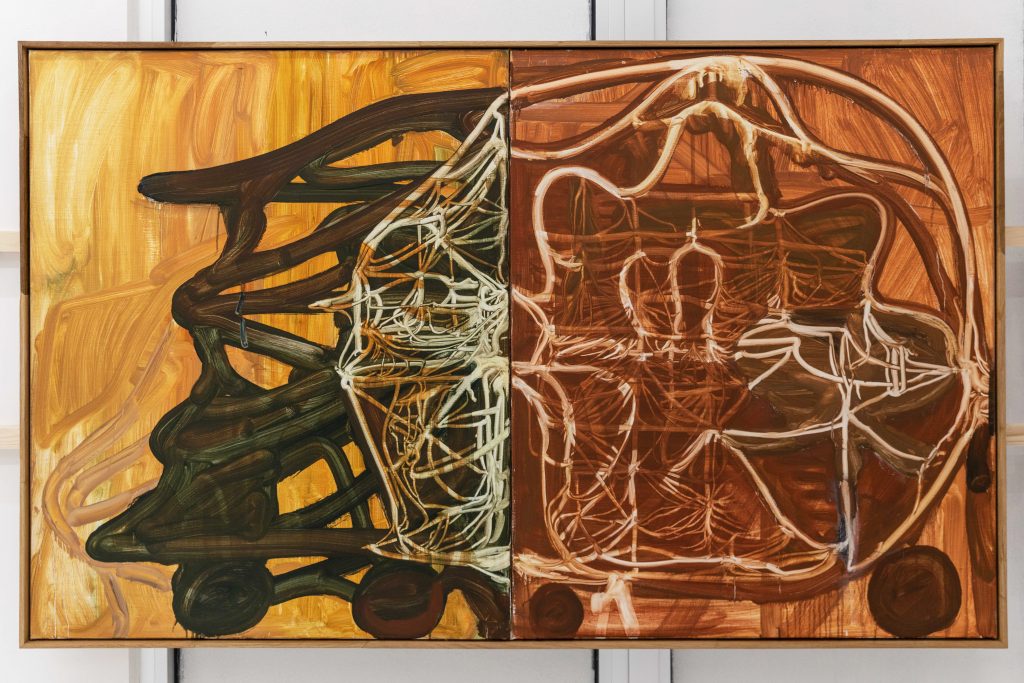
Tijdens Art Rotterdam presenteert Dehnen een reeks schilderijen die hun beeldtaal ontlenen aan de romantiek in brede zin. Onder andere E.T.A. Hoffmanns ‘Der Sandmann’ dient als bron voor motieven zoals een gemechaniseerd oog, handen en wielen. Deze enigmatische structuren en schakelsystemen verwijzen naar ontwerpen voor een primitieve automaton. Ze dienen ook als verhulde visuele verwijzingen naar vroegere werken in het oeuvre van de kunstenaar en naar schilderijen die in zijn ouderlijk huis hingen, waardoor feedbacklussen van schilderkunstige gebaren en ideeën ontstaan. Er ontstaat een verstrengeling tussen de fysieke materie van het werk en de beeltenis. Denken en doen worden eenzelfde proces en belichamen zo een enkelvoudige manier van ‘zijn-in-de-wereld’. De schilderijen kunnen als landkaarten van zichzelf worden geïnterpreteerd, kaart en territorium tegelijk, die in een oneindige regressie in zichzelf terugkeren. Soms wordt de verf aangebracht als op een locatie op een plat vlak, soms op een bepaalde diepte binnen een beeld. Er wordt voortdurend gespeeld met de vlakheid van het object en het artificiële van een geschilderd beeld.
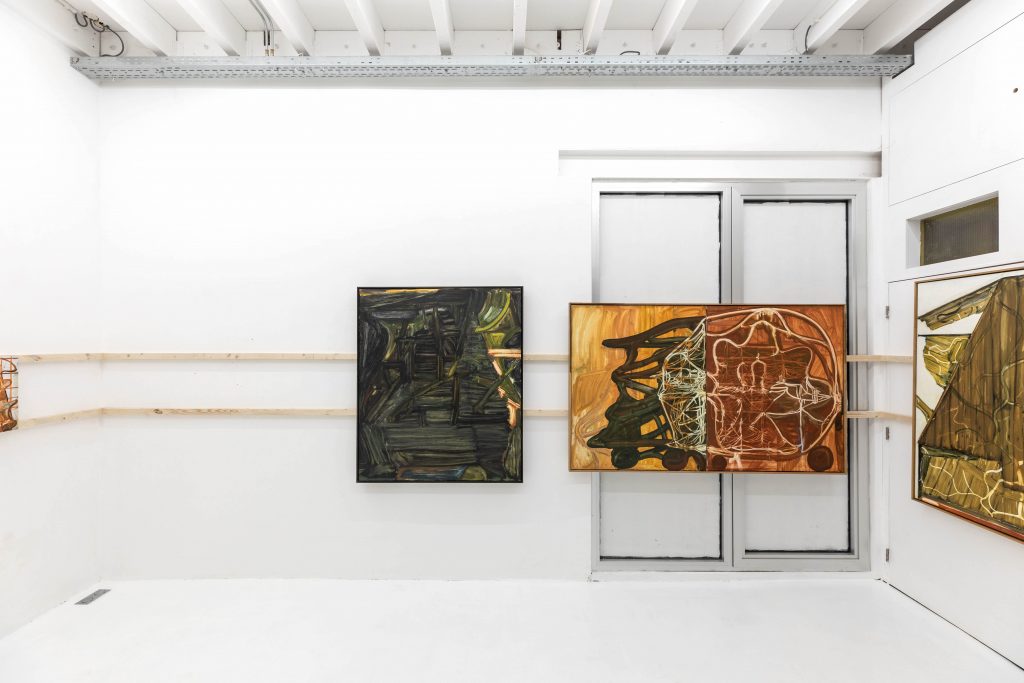
In 2019 behaalde Dehnen zijn masterdiploma schilderkunst aan de Koninklijke Academie voor Schone Kunsten (KASK) in Gent, met Vincent Geyskens als zijn mentor. Eerder voltooide hij een bachelor in schone kunsten aan de Universiteit van Lancaster, Verenigd Koninkrijk. Na zijn afstuderen werd Dehnen uitgenodigd voor een residentie in FLACC te Genk en werd hij vorig jaar genomineerd voor de PrixFintro-prijs, waarvoor hij de tweede prijs behaalde. Zijn werk werd onder meer tentoongesteld in Z33 Huis voor Hedendaagse Kunst in Hasselt, claptrap in Antwerpen en Social Harmony in Gent.
Flor Linckens
At Art Rotterdam, you will spot the work of hundreds of artists from all over the world. In this series, we highlight a number of artists who will show remarkable work during the fair.
Last December, the Belgian newspaper De Morgen presented a list of the 10 most exciting exhibitions in Belgium in 2022. The entire programme of the young Pizza Gallery in Antwerp was singled out for praise by the three art journalists behind the article, but they paid particular attention to the solo presentation of Jonas Dehnen. At Art Rotterdam, the work of the German artist will be on display in the New Art Section.
Painting and drawing are central to Jonas Dehnen’s practice, but he also creates installations and sculptures, depending on specific exhibition contexts. Dehnen takes much of his visual raw material from the communities amongst which he grew up. He spent his formative years in both Germany and the United Kingdom, and has now been living in Belgium for several years. The artist is fascinated by the way in which communities construct a visual identity using symbols and traditions, from pub signs to carnival floats, from vernacular architecture to folk paintings, and other elements of what could be called ‘visual patois’. Which role is reserved for the collective and which for the individual, within that mechanism? And how does globalisation fit into that? Dehnen abstracts, fragments and re-combines different signifiers in his paintings, creating new characters and idiosyncratic protagonists. The pictures emerge from a prolonged process of trial and error: Layering, erasure, additive and subtractive painterly gestures, and the repurposing of underlying image fragments.
At Art Rotterdam, Dehnen presents a series of paintings that derive their imagery from romanticism in a broad sense. E.T.A. Hoffmann’s ‘Der Sandmann’ serves as a source for motifs, such as a mechanised eye, hands and wheels. These enigmatic structures and circuitries hint at designs for a primitive automaton. They also offer veiled visual references to past works in the artist’s oeuvre, and to paintings that hung in his childhood home, thereby establishing feedback loops of painterly gestures and ideas. There is an entanglement between the physical material of the work, and the image that took shape within it. Thinking and doing collapse into one another to become a singular mode of being in the world. The works are maps of themselves, map and territory both, thought-maps looping back into themselves in an infinite regression. At times the paint is applied as though to a location on a flat surface, and at other times at a certain depth within an image. The flatness of the object and the artifice of a painted picture are continually toyed with.
In 2019, Dehnen obtained his master’s degree in painting at the Royal Academy of Fine Arts (KASK) in Ghent, under the tutelage of Vincent Geyskens. Previously he completed a bachelor’s degree in fine arts at the University of Lancaster, UK. After graduating, Dehnen was invited for a residency at FLACC in Genk and last year, he was nominated for the PrixFintro Prize, for which he shared second prize. His work has been exhibited at Z33 House for Contemporary Art in Hasselt, claptrap in Antwerp, and Social Harmony in Ghent, among others.
Flor Linckens
No man is an island: artist Klaas Rommelaere turns family and friends into art
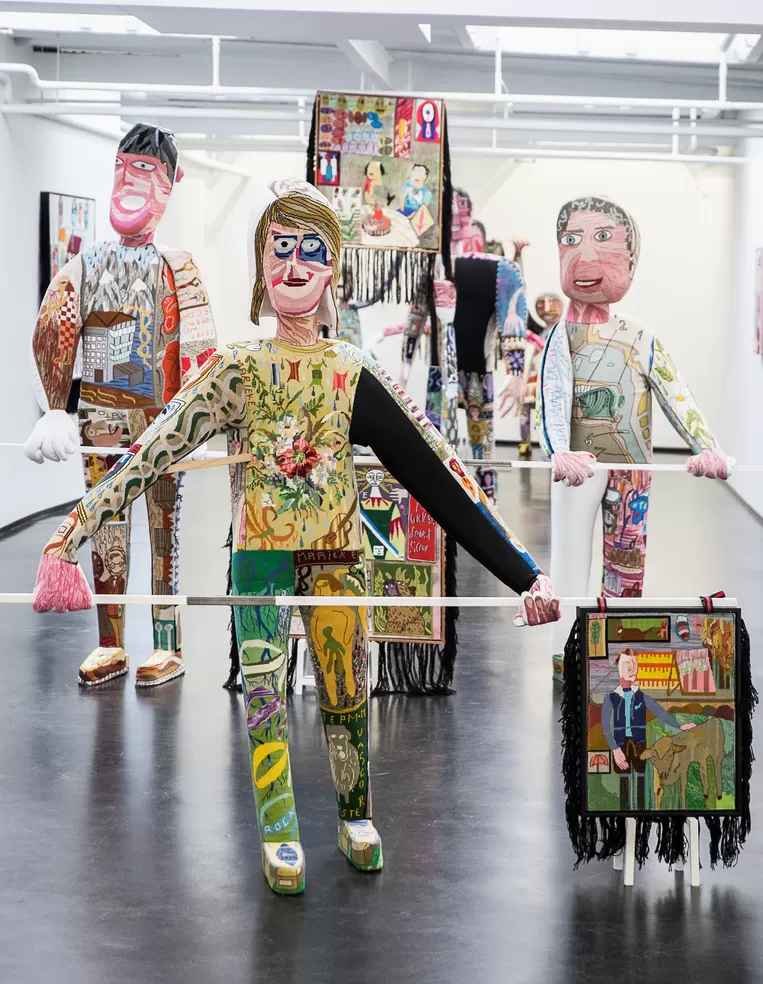
Artist Klaas Rommelaere is currently causing a stir with his Dark Uncles series, consisting of a parade of life-sized embroidered dolls of family and friends. For Art Rotterdam, Rommelaere made no fewer than ten new works to be displayed at Madé van Krimpen’s booth. “I am a loner. The paradox is that my work almost always involves people. I’ve even made them in doll form.”
Rommelaere (Belgium, 1986) studied fashion at the Royal Academy of Fine Arts in Ghent. During his studies, he did internships with Henrik Vibskov and Raf Simons, but soon realised that the fashion world was not a place where he could act on his ideas. Inspired by films, comics, books and personal experiences, Rommelaere began translating his ideas into visual work using the tools and materials he knew best: the needle, thread, wool and yarn.
Do you already know which works you will be showing at Art Rotterdam?
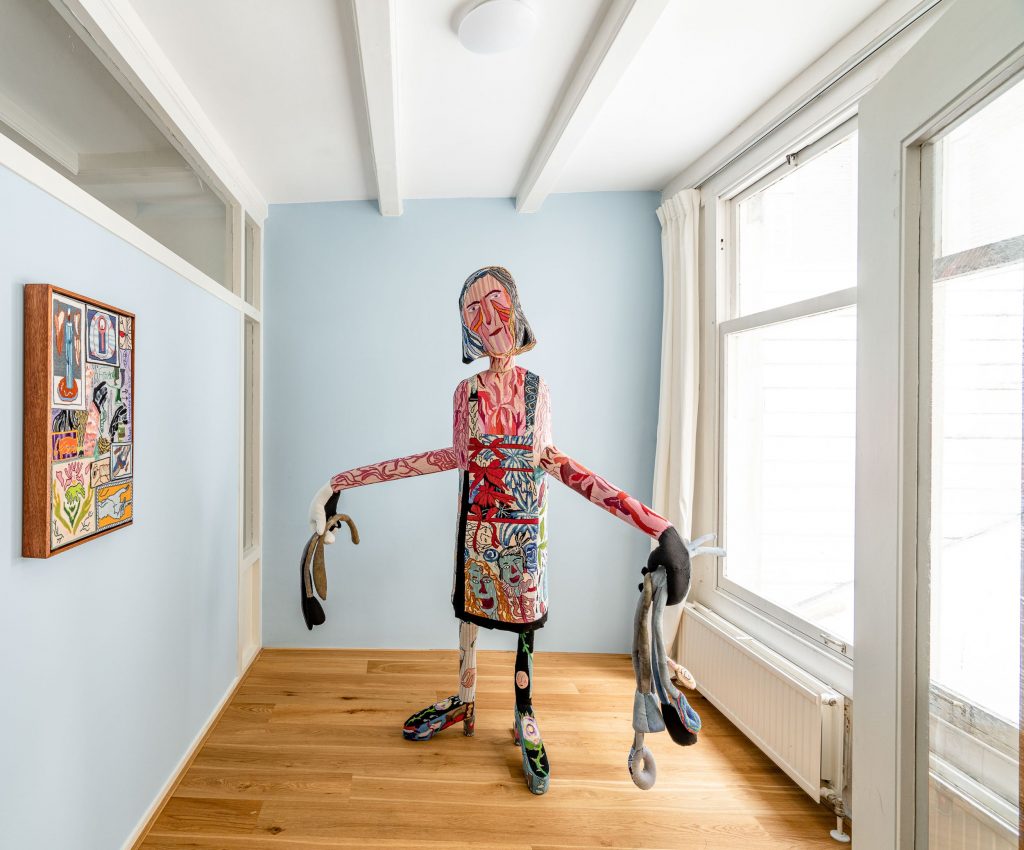
At Art Rotterdam, I’ll be showing works under the name of Dark Uncles. This is a project that started a few years ago when I came up with the idea to create a procession with people who have influenced me over the years, from family to friends. They wear embroideries of memories and photos and are completely covered with embroidery. The project has already been shown in Belgium, France, Germany and the Netherlands, with a different set-up each time. For Art Rotterdam, I made ten new works. I always find it interesting to work on an idea and see how far you can take it.
For those who don’t know your work: you create works of textile, embroidery or in the form of life-sized dolls. Why have you chosen this medium?
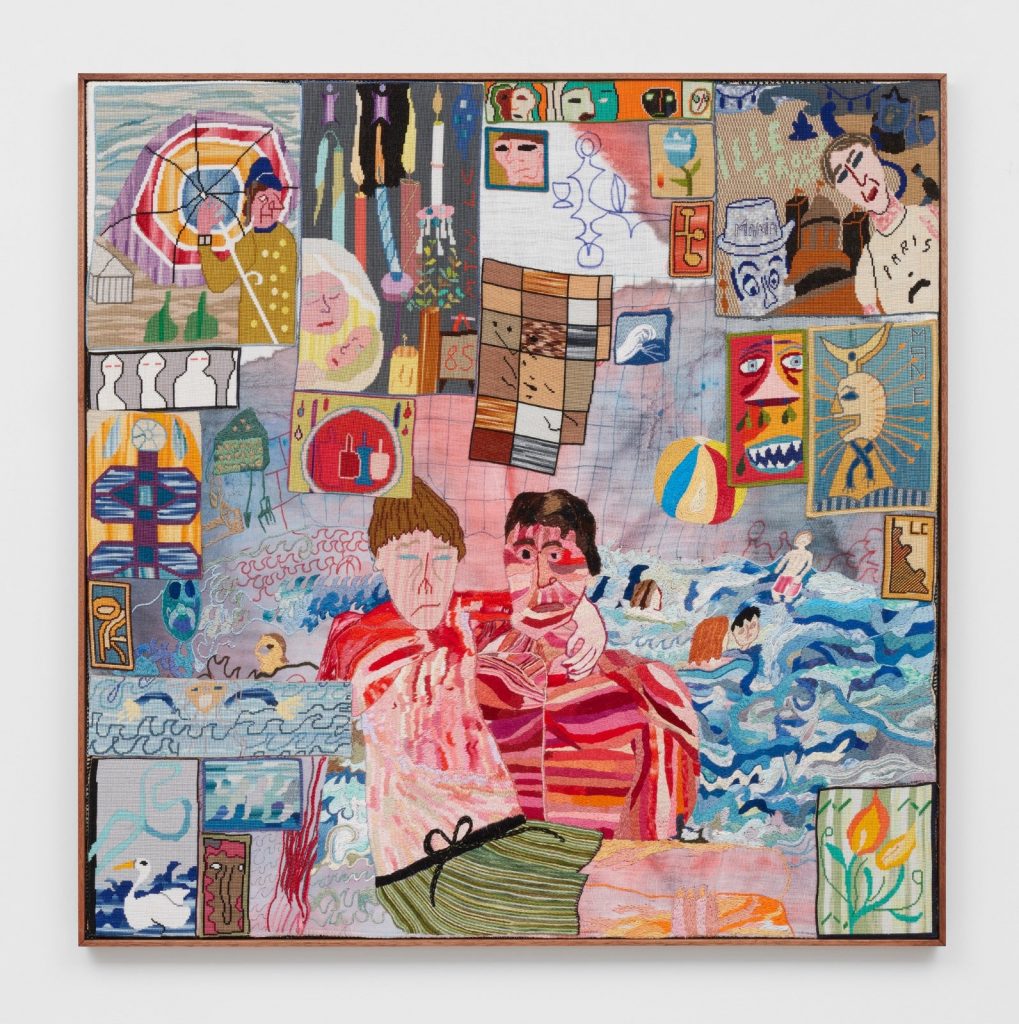
I became familiar with embroidery and handicrafts during my fashion studies. That study programme was my second Bachelor’s and Master’s and I was looking for an easy and direct way to convert my graphics into textiles without too much cost or hassle. So, as early as my first year, I began embroidering with wool and canvas from a local thrift store. In the years after that, I began exploring another technique. This is how my artistic process has evolved, which also fits my way of thinking. Handiwork takes a lot of time, and that time lets me think about my work and how it will end up. It’s like building a house: you lay brick by brick and in the end, you have an entire house or work of art. Completing a work or project can take anywhere from six months to two years.
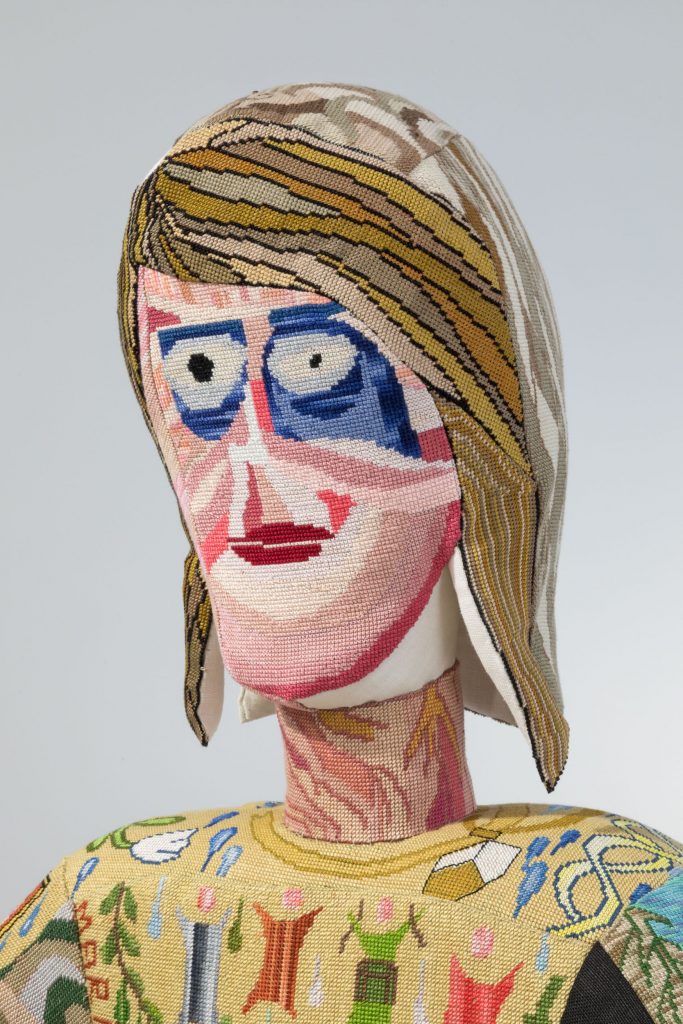
You’ve titled the series Dark Uncles, a Swiss folklore term for doubles. It consists of life-sized dolls of family and friends. Why did you make the people in your immediate environment the subject of your work?
When I began working with canvas and flags, my grandmother always took care of the finishing touches. This was in Ingelmunster and a little ways down the road, there was a beautiful white wall where I always took pictures. The cloth always had to be carried like a flag to that location. My grandfather and a neighbour usually did this. I also took pictures of that little procession and always found it to be a strong image. As I’ve grown older, I sometimes enjoy looking back to see how far I’ve come and which people have influenced me. We’re so obsessed with moving forward these days that we sometimes forget our roots. No man is an island.
I’ve read that as many as 100 people have contributed to the Dark Uncles series. How does such a collaboration come about and where do you find so many people who are willing to embroider for you?
The first part of Dark Uncles was made entirely during the pandemic. At first, the idea was to do everything in workshops, but then the pandemic started. That’s why the museum made a call for volunteers who wanted to embroider. Many people were at home with a lot of time, so the response was massive. We sent everything by mail. I was in contact with them by WhatsApp and email. I did not see most of the people who helped out until the opening. From this project, a new group of ‘madammen’ has emerged, in addition to my first group in Merksem and Ingelmunster.
Embroidery takes a lot of skill and time. It is certainly not a fast technique. Do you consider your work a criticism of the fast-paced art world and our society in general?
It’s not a criticism because I didn’t consciously choose it. It’s just how I work. But I do think it feels different to people who see the work because it is something tangible, something practical and you can tell it has been created with care, time and skill. Visitors are always amazed because it looks different in real life than in pictures due to the details and texture of the canvas. Since it takes so long to finish a work, I can put in a lot of details, so that you cannot ‘read’ the work completely at a single glance. I often hear from people who have my work hanging in their homes that they see something new almost every day.
I read that you are inspired by cult films. Which films and why do these particular films appeal to you?
I try to see all films that are shown in cinemas and luckily, I have a subscription. Usually, it is the atmosphere of a film that appeals to me most. When I’m working on a project, I’m open to things that can ‘feed’ the project and make it stronger. When I was creating Dark Uncles, I travelled to Tokyo and became fascinated with Hayoa Miyazaki (co-founder and artistic director of the famous Japanese animation studio Ghibli, ed.). I’ve watched documentaries about him and read his biography and have learned that we think exactly the same way about life and the artistic process. I believe film is the ultimate art form.
Would you say that the main theme of your work is the relationship with your immediate environment?
I’m not much of a social person. I like to be alone and only need a few people who I see regularly. Apart from that, I’m a loner. The paradox is that there are almost always people in my work; I’ve even made them in puppet form. I think my work is a way to communicate with people, to feel connected to the ‘world’ as it were.
Wouter van den Eijkel
No man is an island: kunstenaar Klaas Rommelaere verheft familie en vrienden tot kunst
Kunstenaar Klaas Rommelaere maakt momenteel furore met zijn serie Dark Uncles, die bestaat uit een stoet manshoge geborduurde poppen van familie en vrienden. Voor Art Rotterdam maakte Rommelaere maar liefst 10 nieuwe werken die te zien zullen zijn bij Madé van Krimpen. “Ik ben een einzelgänger. De paradox is dat in mijn werk bijna altijd mensen zitten. Ik heb ze zelfs gemaakt in popvorm.”
Rommelaere (Roeselare, 1986) studeerde mode aan de Koninklijke Academie voor Schone Kunsten in Gent. Tijdens zijn studie liep hij stage bij Henrik Vibskov en Raf Simons, maar hij besefte al snel dat de modewereld niet de plek was waar hij zijn ideeën kon realiseren. Geïnspireerd door films, strips, boeken en persoonlijke ervaringen, begon Rommelaere zijn ideeën te vertalen in beeldend werk, maar wel nog steeds met het materiaal dat hij kende: naald, draad, wol en garen.
Weet je al welke werken je gaat tonen op Art Rotterdam?
Op Art Rotterdam zal ik werken tonen onder de noemer van Dark Uncles. Dit is een project dat een paar jaar geleden is gestart, ik wou een stoet maken met mensen die mij door de jaren heen hebben beïnvloed, van familie tot vrienden. Zij dragen borduurwerken van herinneringen en foto’s en zelf zijn ze volledig bedekt met borduurwerk.
Ondertussen is dit project al getoond in België, Frankrijk, Duitsland en Nederland in telkens een andere opstelling. Voor Art Rotterdam heb ik 10 nieuwe werken gemaakt. Ik vind het altijd interessant om verder te werken op een idee en te zien hoever je iets kan drijven.
Voor de mensen die je werk nog niet kennen: je maakt werken van textiel, geborduurde werken of in de vorm van levensgrote poppen. Waarom werk je juist in dit medium?
Borduur- en handwerk heb ik leren kennen tijdens mijn studie mode. Die opleiding was mijn tweede bachelor en master en ik zocht een makkelijke en directe manier om mijn grafiek om te zetten in textiel zonder al te veel kosten en gedoe. Al in mijn eerste jaar begon ik te borduren met wol en stramien uit de kringloopwinkel. In de daarop volgende jaren ben ik een andere techniek gaan uitdiepen. Zo is mijn artistiek proces geëvolueerd maar het past ook bij mijn manier van denken. Handwerk vraagt veel tijd en zo kan ik nadenken over mijn werk en hoe het eruit zal zien. Je kan het vergelijken met een huis bouwen, steen voor steen en op het einde heb je een heel huis/werk. Een werk of project afwerken kan tussen de 6 maanden en 2 jaar duren.
De serie heet Dark Uncles, Zwitserse folklore term voor dubbelgangers, en bestond uit manshoge poppen van familie en vrienden. Kan je uitleggen waarom je ervoor koos juist mensen uit je directe omgeving als pop uit te voeren?
Toen ik begon met doeken en vlaggen te maken, zorgde mijn oma altijd voor de afwerking. Dit gebeurde in Ingelmunster en een paar huizen verder was er een mooie witte muur waar ik altijd foto’s nam. Het doek moest dan altijd als een vlag gedragen worden naar die plaats. Meestal deed mijn opa en een buur dit. Ik maakte ook foto’s van die kleine processie en ik vond dat altijd een heel sterk beeld. Ik werd ook al wat ouder en soms is het goed om eens achterom te kijken en te zien waar je vandaag komt, welke mensen je beïnvloed hebben. We zijn tegenwoordig zo geobsedeerd met vooruit gaan dat we soms onze wortels vergeten. No man is an island.
Ik begreep dat er maar liefst 100 mensen hebben meegewerkt aan de serie Dark Uncles. Hoe komt zo’n samenwerking tot stand? Waar vind je zoveel mensen die voor je willen borduren?
Het eerste luik van Dark Uncles is helemaal gemaakt tijdens de coronaperiode. Het was eerst de bedoeling om alles via workshops te doen maar toen begon de pandemie. Daarom heeft het museum zou plaatsvinden een oproep gedaan voor vrijwilligers die mee wilden borduren. Er zaten veel mensen thuis met veel tijd en hierdoor was de respons zo massaal. We stuurden alles op met de post. Ik stond in contact met hun via WhatsApp en mail. De meeste van de mensen die mee geholpen hebben zag ik pas tijdens de opening. Uit dit project is er een nieuwe groep “madammen” ontstaan, naast mijn eerste groep in Merksem en Ingelmunster.
Een geborduurd werk vraagt veel kunde en tijd om te maken. Het is zeker geen snelle techniek. Kan je jouw werken ook zien als een kritiek op de gejaagde kunstwereld en in bredere zin op onze samenleving?
Het is geen kritiek omdat ik er niet bewust voor heb gekozen, het is gewoon hoe ik werk. Ik denk wel dat het voor de mensen die het werk zien anders aanvoelt, omdat het iets echts is, iets praktisch waar je kan zien dat het met zorg, tijd en kunde in elkaar is gestoken. Bezoekers zijn altijd verwonderd omdat het er in het echt anders uitziet dan op foto, dit komt door de details en de textuur van de doeken en het werk. Doordat het zo lang duurt eer iets afgewerkt is kan ik er ook heel veel details insteken, zodat je het werk niet in een oogopslag volledig kan lezen. Ik hoor vaak van mensen die mijn werk in huis hebben hangen dat ze bijna iedere dag iets nieuws zien.
Ik las dat je je laat inspireren door cultfilms. Aan welke films moet ik denken en waarom spreken juist deze films je aan?
Ik probeer elke film te zien die in de cinema komt, gelukkig heb ik een abonnement. Meestal is het de sfeer van een film die mij aanspreekt. Als ik aan een project werk, sta ik open voor dingen die dat project kunnen voeden en sterker maken. Tijdens het bedenken van Dark Uncles maakte ik een reis naar Tokio en daar raakte ik gefascineerd door Hayoa Miyazaki (mede-oprichter en artistiek leider van de bekende Japanse animatiestudio Ghibli, red.). Ik heb documentaires over hem gezien en zijn biografie gelezen. Ik leerde dat we exact hetzelfde dachten over het leven en het artistiek proces. Ik vind film de ultieme kunstvorm.
Kan je stellen dat het overkoepelende thema van je werk de relatie met je directe omgeving is?
Ik ben eigenlijk niet zo een sociaal iemand, ik ben heel graag alleen en heb maar een paar mensen nodig die ik regelmatig zie. Verder ben ik een einzelgänger. De paradox is dat in mijn werk bijna altijd mensen zitten, ik heb ze zelfs gemaakt in popvorm. Mijn werk is denk ik een manier om toch een soort communicatie te hebben met mensen, mij toch verbonden te voelen met de “wereld” om het even kort door de bocht te zeggen.
Wouter van den Eijkel
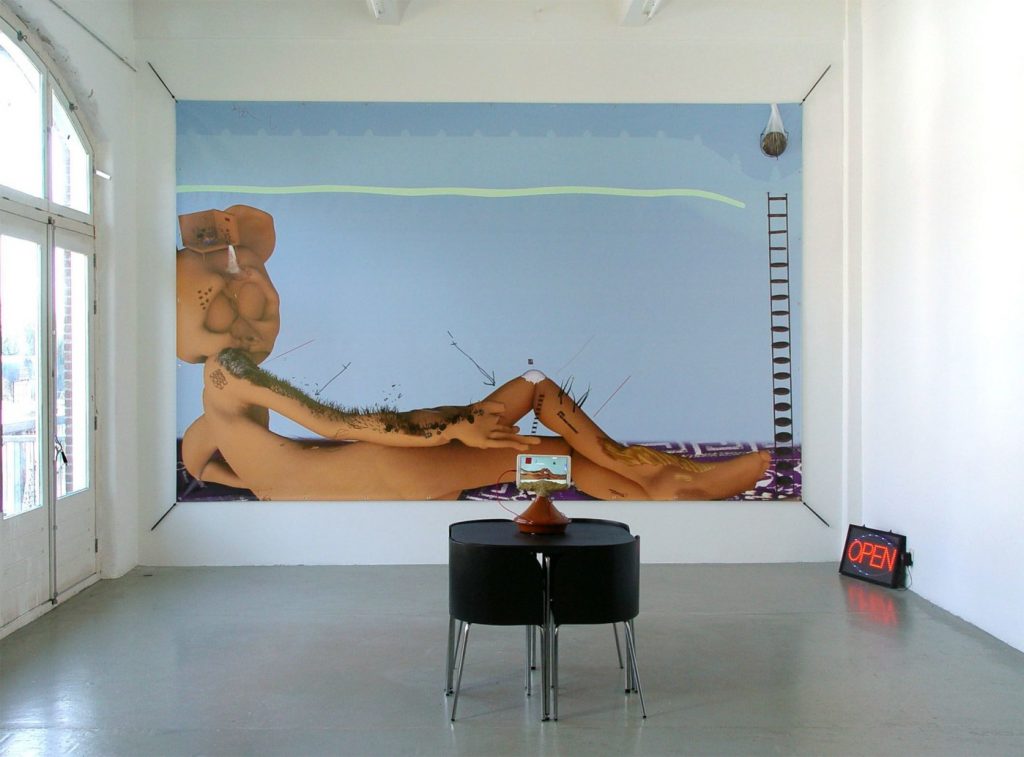
Wat is het effect als je tegengestelde situaties, technologieën en culturen op elkaar laat inwerken? Salim Bayri doet het aan de lopende band en vaak met een grijns. Vertrekkend vanuit een digitale omgeving, kan zijn werk tal van vormen aannemen. Je zou hem de MC van de culturele-technologische botsing kunnen noemen. Dit jaar is hij genomineerd voor de NN Art Award.
Op zoek naar de kern
Salim Bayri (Casablanca, Marokko, 1992) won afgelopen najaar de Volkskrant Beeldende Kunst Prijs. Bayri was voorgedragen door schrijver en jurylid Abdelkader Benali die hem prees om zijn veelzijdige en ongrijpbare oeuvre. Daarmee slaat Benali de spijker op zijn kop, want de kern van Bayri’s werk laat zich lastig definiëren. “Je loopt er als het ware omheen” zei Bayri in een recent interview met Mr Motley. “Het zou ook een mislukking zijn om ‘het’ te pakken, want dan ik zou het werk de nek omdraaien en dat wil ik niet”.
Het zoeken naar een kern is ook lastig, want Bayri kan je met recht een multidisciplinair kunstenaar noemen. Zo maakt hij onder meer video’s, installaties, wearables, apps, tekeningen en digitale prints. Bayri vertrekt daarbij doorgaans vanuit een digitale tekening, maar is niet zo zeer geïnteresseerd in de verschillen tussen online en offline uitingen. Zijn interesse is breder. “In de kern laat hij steeds tegengestelde beelden, situaties, technologieën, cultuurgebruiken, fenomenen met elkaar botsen en met een grijns kijkt hij dan toe naar het effect ervan. Dat brengt een opvallende openheid op allerlei vlakken teweeg”, zegt Baryri’s galeriehouder Kees van Gelder.
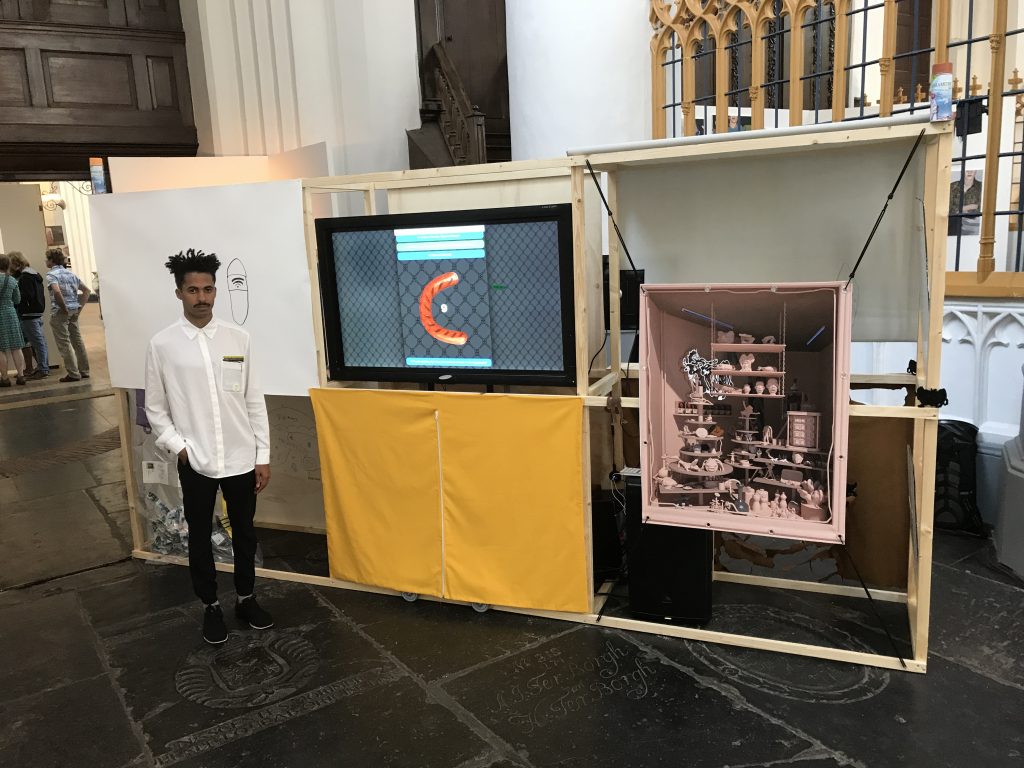
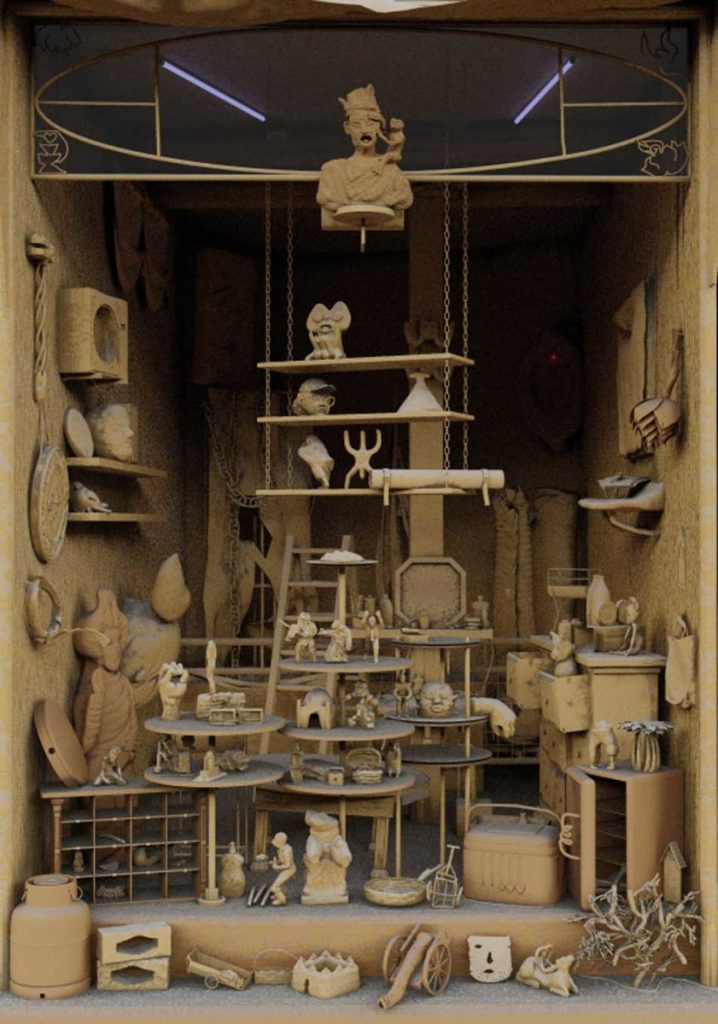
Van Gelder kwam het werk van Bayri in 2017 op het spoor toen hij de eindpresentatie van Kimball Gunnar Holth bezocht in de Groningse A-kerk. Hij was direct verkocht. “Salim stond voor zijn installatie/stellage die hij ‘Smartshop’ noemde en zong richting deze sculptuur door een versterker Arabische, Nederlandse, Franse en Spaanse teksten, geïmproviseerde beschrijvingen van wat hij letterlijk voor zich zag. De zangtoon was duidelijk de Noord-Afrikaanse meertonigheid van de Maghreb. Een geweldige presentatie.”
Van Gelder was niet de enige die Bayri’s werk opviel, want zijn werk kan op veel aandacht rekenen. Sinds het afronden van zijn residency aan de Rijksakamie was het in Nedeland al te zien bij CODA, Framer Framed, W139, La Capella in Barcelona en Fondazione Merz in Turijn. Naast de Volkskrant Beeldende Kunst Prijs, sleepte Bayri afgelopen jaar ook de Charlotte Köhler Prijs van het Prins Bernhard Cultuurfonds in de wacht. Eind januari opent Dead Skin Cash, een duotentoonstelling met Ghita Skali in W139 in Amsterdam, waarbij bezoekers dode huidcellen kunnen verkopen voor geld.
Code switching
Dat het spelen context, conventies en verwachtingen Bayri’s tweede natuur is, is niet verbazingwekkend als je zijn geschiedenis kent. Bayri groeide op in Casablanca, waar hij een Spaanse school bezocht. “Om me heen hoorde ik continu Arabisch en Frans. Online was alles weer in het Engels. Als jonge jongen leerde ik op school over Carlos II, om naar huis te lopen door straten waar iedereen Darija sprak en om eenmaal thuis over de prijs van baguettes in het Franse journaal te horen. In mijn hoofd switch ik continu. Ik zoek naar de gemene deler.”
Aansluitend volgde hij een bacheloropleiding aan de Escola Massana in Barcelona, een Master in Media, Art Design and Technology aan het Groningse Frank Mohr Instituut en een residency aan de Rijksakademie waar hij in 2020 een vergelijkbare presentatie zou maken als in de A-kerk.
Sad Ali
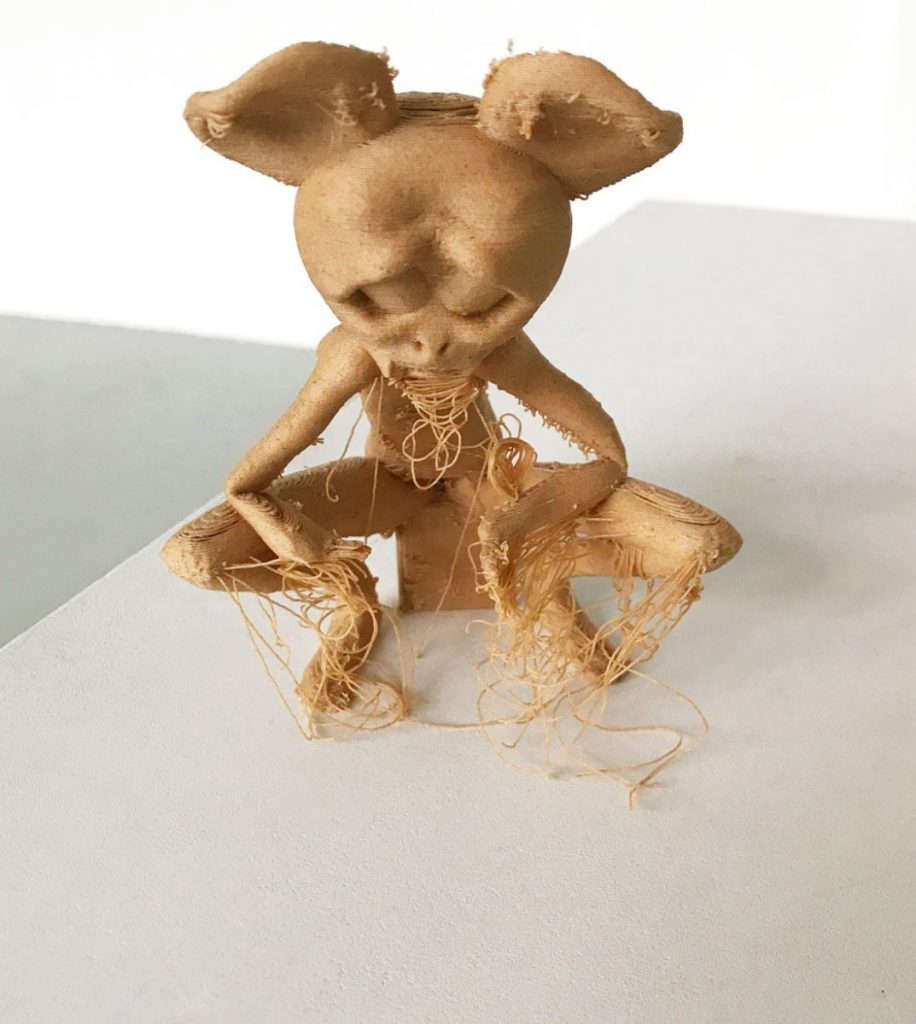
Het bekendste voorbeeld van een object dat Bayri in een andere context plaatst is zij alter ego Sad Ali, kort voor Sad Alien. Het is geen toeval dat het woord Alien in het Engels een homoniem is zowel kan verwijzen naar buitenaards wezen als naar iemand uit een ander land. Sad Ali is een woordeloos, verdrietig cartoonfiguur dat regelmatig opduikt in Bayri’s werk en ontstond als digitale tekening, als computerbestand.
Qua vormgeving kan Sad Ali zo uit een Pixar-film komen. Net als de cartoonfiguurtjes is Sad Ali een holle vorm. Hij heeft geen hart, botten of hersenen. “Dus deze vormen zijn containers. Alles wat beweegt op het scherm is hol. Sad Ali is ook leeg, het praat of zegt niets en heeft geen eigen agenda. Maar het is er wel, en de aanwezigheid ervan is zo kwetsbaar dat het de olifant in de kamer wordt”, vertelt Bayri. Dat laatste blijkt wel uit de uiteenlopende reacties die Sad Ali bezoekers ontlokt. Waar de ene bezoeker erom moet lachen, vindt de ander hem doodeng.
De analoge tegenhanger van ChatGPT
Voor veel mensen is de spraakmakende, zelflerende een chatbot ChatGPT een uitkomst. Je stelt de chatbot de meest uiteenlopende vragen en je krijgt een antwoord in volzinnen terug. Maar voor een kunstenaar die speelt met conventies en vertrekt vanuit een digitale omgeving is het natuurlijk een cadeautje.
Naast een presentatie van zijn Smartshop, speelde Bayri met het idee om op Art Rotterdam een analoge pendant van de chatbot te presenteren. Hij wilde galeriehouder Van Gelder voor een witte wand laten plaatsnemen in een stoel. Van Gelder zou dan A4-tjes uitdelen met daarop telkens een andere vraag. “Helaas was daar geen plek voor op de beursvloer, maar Bayri onderzoekt mogelijkheden om iets soortgelijks te doen”, aldus Van Gelder.
Wouter van den Eijkel
Salim Bayri – The MC of collision
What happens when opposing situations, technologies and cultures collide? Salim Bayri creates such collisions all the time, and often with a smile. With the digital environment as his point of departure, his work takes on various forms. You might call him the MC of the cultural-technological clash. Bayri has been nominated for this year’s NN Art Award.
In search of the core
Salim Bayri (Casablanca, Morocco, 1992) won the Volkskrant Visual Arts Prize last autumn. He was nominated by writer and jury member Abdelkader Benali, who praised him for his versatile and elusive body of work. Benali hits the nail on the head, as the core of Bayri’s work is difficult to define. “You sort of walk around it,” Bayri said in a recent interview with the magazine Mister Motley. “It would also be a failure to seize it as it were, because I would then be destroying the work and I don’t want to do that.”
Finding a core is also difficult because Bayri can rightly be called a multidisciplinary artist. He creates videos, installations, wearables, apps, drawings, digital prints and more. Bayri usually starts with a digital drawing, but is not very interested in the differences between online and offline expression. His interests are broader. “In essence, he allows opposing images, situations, technologies, cultural practices and phenomena to collide and then looks at the result with a smile. That creates a striking openness in all kinds of respects,” says Bayri’s gallery owner Kees van Gelder.
Van Gelder first came across Bayri’s work in 2017 when he visited Kimball Gunnar Holth’s graduation show in Groningen’s A-kerk. He was immediately sold. “Salim stood in front of his installation/scaffolding, which he called ‘Smartshop’, and sang towards the sculpture through an amplifier in Arabic, Dutch, French and Spanish, improvising descriptions of what he literally envisioned. The singing tone was clearly the North African multi-tone of the Maghreb. A fabulous presentation.”
Van Gelder is not the only one who has noticed Bayri’s work, given that his work is guaranteed to attract a lot of attention. Since completing his residency at the Rijksakademie, it has already been shown in the Netherlands at CODA, Framer Framed, W139, La Capella in Barcelona and Fondazione Merz in Turin. In addition to the Volkskrant Visual Art Prize, Bayri also won the Charlotte Köhler Prize awarded by the Prince Bernhard Culture Fund last year. At the end of January, Dead Skin Cash, a duo exhibition with Ghita Skali, will be opening in W139 in Amsterdam, where visitors can sell dead skin cells for money.
Code switching
Considering his background, the fact that toying with context, conventions and expectations is Bayri’s second nature is hardly surprising. Bayri grew up in Casablanca, where he attended a Spanish school. “I constantly heard Arabic and French all around me, while everything online was in English. As a young boy, I learned about Carlos II at school, after which I walked home along streets where everyone spoke Darija, and once at home, heard about the price of baguettes in French news. In my head, I switch constantly, searching for the common denominator.”
He went on to earn a Bachelor’s degree from the Escola Massana in Barcelona, a Master’s degree in Media, Art Design and Technology from the Frank Mohr Institute in Groningen and did a residency at the Rijksakademie, where he ultimately made a presentation similar to the one in the A-kerk in 2020.
Sad Ali
The most famous example of an object Bayri places in a different context is his alter ego Sad Ali, short for Sad Alien. It is no coincidence that the word Alien is a homonym that can refer to an alien life form as well as someone from another country. Sad Ali is a wordless, sad cartoon character who regularly appears in Bayri’s work and originated as a digital drawing, a computer file.
In terms of design, Sad Ali is like something straight out of a Pixar movie. Like cartoon characters, Sad Ali is a hollow shape. He has no heart, bones or brains. “So, these shapes are like containers. Everything that moves on the screen is hollow. Sad Ali is also empty; it doesn’t talk or say anything and has no agenda of its own. But there it is, and its presence is so fragile that it becomes the elephant in the room,” says Bayri. The latter is evident from the diverse reactions that Sad Ali elicits from visitors. While one visitor laughs about it, the other finds him terrifying.
ChatGPT’s analogue counterpart
For many people, the self-learning chatbot ChatGPT is a fantastic tool. You can ask the chatbot almost any kind of question and receive an answer in a complete sentence. But for an artist who toys with conventions and works from a digital environment, it is nothing short of a godsend.
In addition to a presentation of his Smartshop, Bayri has also considered presenting an analogue counterpart to the chatbot at Art Rotterdam. He originally intended for gallerist Van Gelder to sit in a chair in front of a white wall and hand out sheets of paper, each with a different question. “Unfortunately, there was not enough room for this on the exhibition floor, but Bayri is looking into possibilities to do something similar,” says Van Gelder.
Wouter van den Eijkel
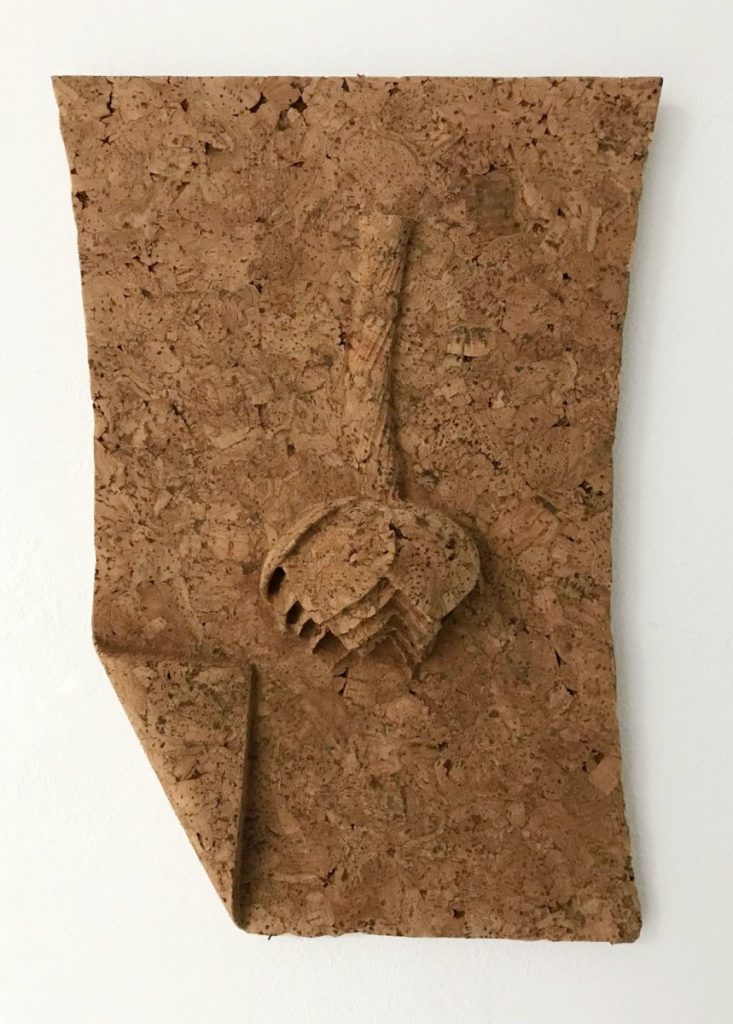
At Art Rotterdam, you will spot the work of hundreds of artists from all over the world. In this series we highlight a number of artists who will show remarkable work during the fair. During Art Rotterdam, Upstream Gallery will present work by Noor Nuyten, Kévin Bray (who was nominated for the NN Art Award), Frank Ammerlaan and Marinus Boezem. In their practice, these artists all explore a connection between material, physical worlds and immaterial or digital worlds. Experimentation in terms of materials and techniques plays a significant role in that.
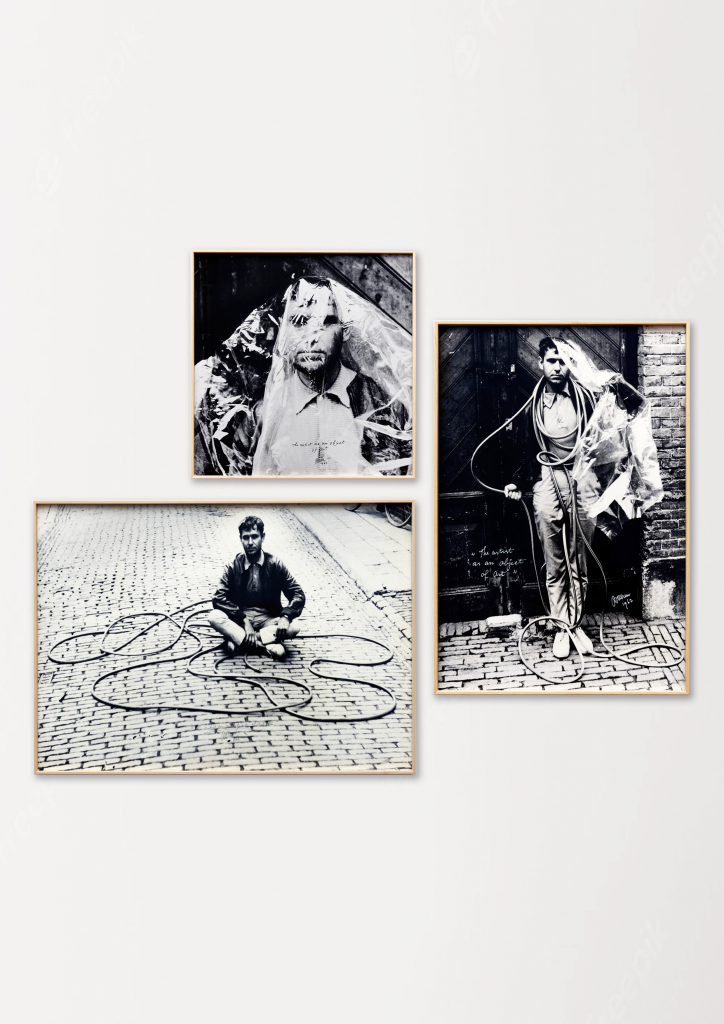
Marinus Boezem (1934) is considered to be one of the most influential Dutch conceptual artists of the past century, alongside Ger van Elk and Jan Dibbets. In the 1960s, Boezem discovered the artistic potential of elusive elements such as air, weather, movement and light, resulting in a series of exciting, intelligent and immaterial works that often contain a powerful, poetic and humorous charge.
His work “3 Seconds of Dutch Light” from 1976 offers a striking illustration. Most people will think of 17th century paintings when they hear the term ‘Dutch light’. Boezem offered a more conceptual twist to the genre, when he exposed a sheet of photosensitive photo paper to Dutch light for three seconds, after which he mounted it on an aluminum plate. Three full seconds of light, however, will result in a completely monochromatic black sheet of paper. The 17th-century painters who traveled en masse to our coast may have managed to capture a representation or interpretation of light, but Boezem’s work actually captures Dutch light — as a material or ingredient, even if it is no longer visible to the viewer.
The idea is central to Boezem’s practice, alongside a curious imagination. This means that he works in a multitude of materials and disciplines. In 2021, the Kröller-Müller Museum presented his ‘shows’, based on a series of fifteen drawings that he made between 1964 and 1969. These are conceptual blueprints for installations that could possibly be realised. Boezem sent them to art institutions or presented them in person. Some concepts were implemented at the time, other sketches first found a physical form in the exhibition at the Kröller-Müller Museum.
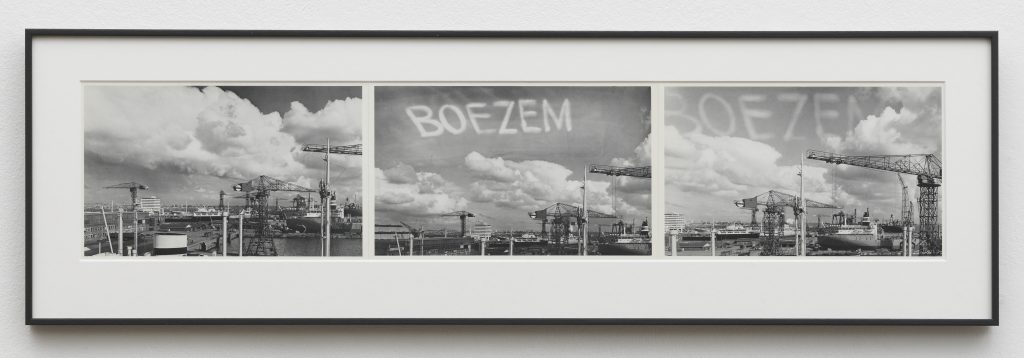
Boezem wants to make art that is close to life, in part because museums do not always invest in their relationship with (and relevance within) society. In 1969 he was co-initiator of the rebellious and leading exhibition ‘On loose screws’ in the Stedelijk Museum. One of the works he exhibited was “Bedding”, for which he hung pillows and sheets from all the windows of the museum. With a wink he symbolised both a breath of fresh air through the museum and a recognisable household tradition. At the same time, Boezem manages to make something immaterial visible: a breeze. Moreover, the artist effectively blurs the boundaries between the almost sacred museum space and the public space, presenting art as a bridge between the museum and society.
Boezem would later make several works of art for the public space. His “Green Cathedral” in Almere was voted the most popular outdoor artwork in the Netherlands — wedding ceremonies are even performed there. The work consists of 174 Italian poplars that form the floor plan of the Notre-Dame cathedral of Reims, true to size. A little further on, the exact same shape has been removed from a wooded area, reshaping the floor plan of the structure, but now in negative space. The cathedral is a recurring element in Boezem’s oeuvre and the artist also joked that a new city, rising from the polder, deserved a cathedral. Other recurring themes in his practice include the universe and cartography.
Boezem’s conceptual work is also related to the arte povera of the 1960s and 1970s, an originally Italian art movement in which artists resisted the commercialisation of the art world, among other things. On the one hand, materials were chosen that represented no financial value — such as earth or twigs — and on the other hand, the often perishable or immaterial art of these makers was sometimes difficult to trade as a commercial product. The movement was extremely influential, with significant parallels in other international art forms of the time; from land art and minimal art to conceptual art.
Boezem’s work has been exhibited at Museum Boijmans Van Beuningen, the MoMA, the Brooklyn Museum, the Van Abbemuseum, Kunsthalle Bern, the Museum of Contemporary Art in Chicago, the Hamburger Bahnhof and the Kyoto Municipal Museum of Art, among others. His work has been collected by institutions like the MoMA, Museum Voorlinden, Kunstmuseum Den Haag, the Stedelijk Museum, Museum Boijmans van Beuningen and the Kröller-Muller Museum. During Art Rotterdam, the work of Marinus Boezem will be on display in the booth of Upstream Gallery.
Flor Linckens
Tijdens Art Rotterdam tref je het werk van honderden kunstenaars van over de hele wereld. In deze reeks lichten we een aantal kunstenaars uit die bijzonder werk tonen tijdens de beurs. Upstream Gallery presenteert tijdens Art Rotterdam werk van Noor Nuyten, Kévin Bray (die werd genomineerd voor de NN Art Award), Frank Ammerlaan en Marinus Boezem. Deze kunstenaars onderzoeken in hun praktijk allemaal een verbinding tussen materiële, fysieke werelden en immateriële of digitale werelden. Experiment in termen van materialen en technieken speelt hierin een belangrijke rol.
Marinus Boezem (1934) staat bekend als een van de meest invloedrijke Nederlandse conceptuele kunstenaars van de afgelopen eeuw, naast Ger van Elk en Jan Dibbets. In de jaren zestig ontdekte Boezem het artistieke potentieel van ongrijpbare elementen als lucht, weer, beweging en licht, resulterend in een reeks spannende, intelligente en immateriële werken die niet zelden een poëtische en humoristische lading hebben.
Zijn werk ‘3 Seconds of Dutch Light’ uit 1976 biedt hiervoor een treffende illustratie. De meeste mensen zullen bij de term ‘Hollands licht’ denken aan 17e eeuwse schilderijen. Boezem gaf een meer conceptuele draai aan de term en stelde een vel lichtgevoelig fotopapier drie seconden bloot aan het Nederlandse licht, waarna hij het op een aluminium plaat monteerde. Drie volle seconden aan licht resulteren echter in een volledig monochroom zwart vel papier. De 17e-eeuwse schilders die en masse naar onze kust afreisden wisten misschien een representatie of interpretatie van het licht vast te leggen, maar het werk van Boezem vangt daadwerkelijk Hollands licht — als materiaal of ingrediënt, zelfs als het niet langer zichtbaar is voor de kijker.
Het idee staat centraal in de praktijk van Boezem, naast een nieuwsgierige verbeeldingskracht. Dat betekent dat hij in een veelheid aan materialen en disciplines werkt. In 2021 presenteerde het Kröller-Müller Museum zijn ‘shows’, gebaseerd op een reeks van vijftien tekeningen die hij tussen 1964 en 1969 maakte. Dit zijn in feite conceptuele blauwdrukken voor installaties die eventueel verwezenlijkt konden worden. Boezem stuurde ze op naar kunstinstellingen of presenteerde ze daar persoonlijk. Sommige concepten werden uitgevoerd, andere schetsen vonden voor het eerst een fysieke vorm in de tentoonstelling in het Kröller-Müller Museum.Boezem wil kunst maken die dicht bij het leven staat, mede ook omdat musea niet altijd even goed investeren in hun relatie met (en relevantie binnen) de maatschappij. In 1969 was hij mede-initiatiefnemer van de rebelse en toonaangevende tentoonstelling ‘Op losse schroeven’ in het Stedelijk Museum. Een van de werken die hij tentoonstelde was ‘Beddengoed’, waarbij hij uit alle ramen van het museum kussens en lakens liet wapperen. Met een knipoog symboliseerde hij hiermee zowel een frisse wind door het museum als een herkenbare huishoudelijke traditie. Tegelijkertijd weet Boezem iets immaterieels zichtbaar te maken: een briesje. Bovendien vervaagt de kunstenaar hiermee de grenzen tussen de haast heilige museale ruimte en de publieke ruimte, en presenteert hij kunst als brug tussen het museum en de maatschappij.
Boezem zou later nog verschillende kunstwerken maken voor de publieke ruimte. Zijn ‘Groene Kathedraal’ in Almere werd verkozen tot het meest populaire buitenkunstwerk van Nederland — er worden zelfs huwelijksceremonies voltrokken. Het werk bestaat uit 174 Italiaanse populieren die samen de plattegrond vormen van de Notre-Dame kathedraal van Reims, op ware grootte. Een stukje verderop is precies dezelfde vorm weggehaald uit een bosrijk gedeelte waardoor de plattegrond van het bouwwerk opnieuw gevormd wordt, maar dan in de negatieve ruimte. De kathedraal is een terugkerend element in het oeuvre van Boezem en de kunstenaar grapte bovendien dat een nieuwe stad, verrezen uit de polder, een kathedraal verdiende. Andere terugkerende thema’s in zijn praktijk zijn bijvoorbeeld het heelal en cartografie.
Het conceptuele werk van Boezem is bovendien gerelateerd aan de arte povera van de jaren zestig en zeventig, een oorspronkelijk Italiaanse kunststroming waarin kunstenaars zich onder andere verzetten tegen de vercommercialisering van de kunstwereld. Enerzijds werden er materialen gekozen die geen financiële waarde vertegenwoordigden — zoals aarde of twijgjes — en anderzijds was de vaak vergankelijke of immateriële kunst van deze makers soms lastig te verhandelen als commercieel product. De stroming was buitengewoon invloedrijk, met belangrijke parallellen binnen andere internationale kunstuitingen uit die tijd; van land art en minimal art tot de conceptuele kunst.
Het werk van Boezem werd verder onder meer tentoongesteld in Museum Boijmans Van Beuningen, het MoMA, het Brooklyn Museum, het Van Abbemuseum, Kunsthalle Bern, het Museum of Contemporary Art in Chicago, het Hamburger Bahnhof en het Kyoto Municipal Museum of Art. Zijn werk werd verzameld door instituten als het MoMA, Museum Voorlinden, Kunstmuseum Den Haag, het Stedelijk Museum, Museum Boijmans van Beuningen en het Kröller-Muller Museum. Tijdens Art Rotterdam zal het werk van Marinus Boezem te zien zijn in de booth van Upstream Gallery.
Flor Linckens


