Coming soon
Coming soon
Selecteer type
Tijdens Art Rotterdam zie je het werk van honderden kunstenaars van over de hele wereld. In deze reeks lichten we een aantal kunstenaars uit die bijzonder werk tonen tijdens de beurs.
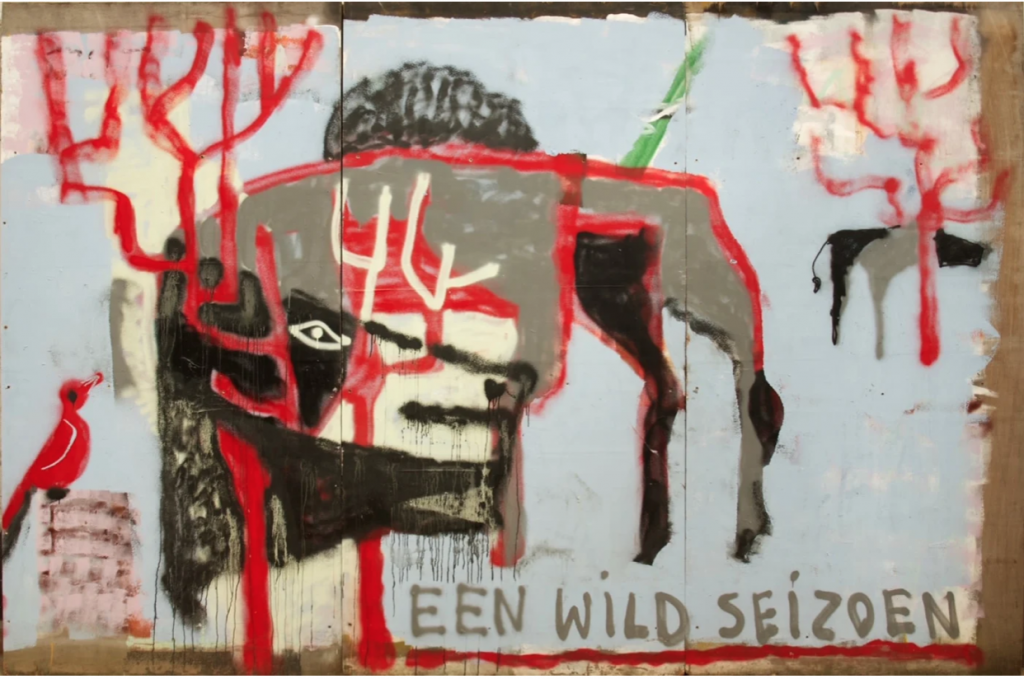
Niet alle kunstenaars gedijen bij een gestructureerd kunstenaarsbestaan, waarin de studio dient als een al dan niet magisch toevluchtsoord waarin het allemaal maar moet gaan gebeuren. De Vlaamse kunstenaar Frederik Lizen, die sinds 2010 werkt onder het synoniem En plein public, werkt het liefst buiten. Meestal in een stedelijke context in Antwerpen, waar hij woont en werkt. Daarbinnen is hij vooral geïnteresseerd in de non-spaces — loze, non-functionele openbare ruimtes — en andersoortige grijze publieke ruimten. Zijn kleurrijke werken schildert hij bij voorkeur op de houten hekken die bouwplaatsen afschermen van de buitenwereld, in feite het tegenovergestelde van een leeg canvas. Soms neemt Lizen het concept van ‘en plein air’ letterlijker en vlucht hij naar het platteland, waar hij zijn gebruikelijke modus operandi — het gebruik van spuitverf, inkt, collage en acryl op monumentale panelen — verruilt voor het meer klassieke en kleinschalige gebruik van aquarel en krijt op papier. De kunstenaar heeft wel degelijk een atelier, maar dat beschouwt hij eerder als een laboratorium voor experiment en de opslag van materialen. Misschien is zijn echte atelier het gigantische bouwterrein aan de Pelikaanstraat in Antwerpen, waar hij een afspraak maakte met de projectontwikkelaar zodat hij een honderdvijftig meter lange muur aan multiplex panelen mag beschilderen.
Als kunstenaar begeeft Lizen zich tussen twee werelden waar hij zich allebei niet volledig in thuisvoelt: de hedendaagse schilderkunst en de wereld van graffiti. Hij verkiest het werken in de publieke ruimte omdat zijn werken daardoor letterlijk gaan leven. En juist die veranderlijkheid en spontaniteit zijn een essentieel onderdeel van het werk van de Antwerpse kunstenaar. Zodra een werk achtergelaten wordt in de buitenlucht verliest Lizen er de controle over. Het werk is niet alleen onderhevig aan weersomstandigheden, maar ook aan (straat)kunstenaars en dronken studenten die zijn werk overschilderen of de politie die zijn werk zandstraalt of verwijdert — zoals het geval was toen hij in een kritisch werk over George Floyd ook elementen toevoegde die verwezen naar de Belgische politie, om aan te geven dat het niet enkel een Amerikaans probleem is. Die maatschappijkritische insteek is tekenend voor zijn thematiek, vaak met een goede dosis humor. En juist de beperkingen van het werken in de stad dwingen de kunstenaar om snel te werken met een beperkt aantal materialen. Hij ontwikkelde daardoor een specifieke beeldtaal.
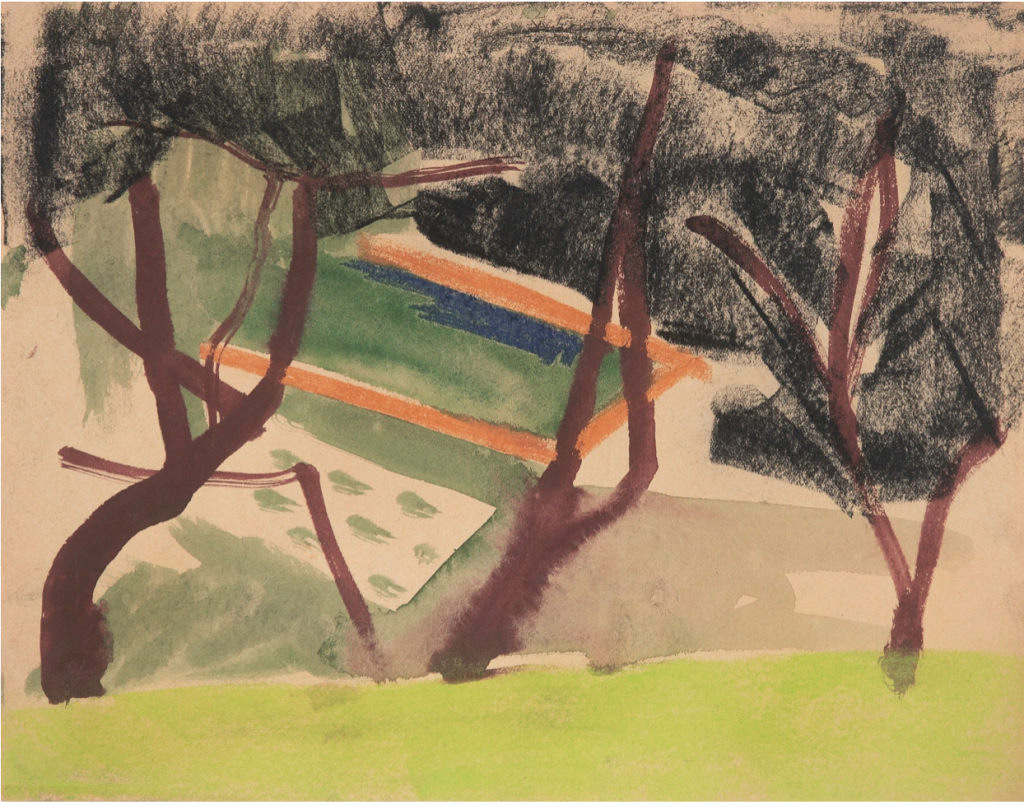
De bewuste en onbewuste aanpassingen van zijn werk maken een wezenlijk onderdeel uit van zijn werkproces. In veel gevallen komt Lizen na een tijdje terug naar een bepaald werk om verder te werken. Van het werk met de tekst ‘I can’t breathe’ bleef weinig over na ingrijpen van de politie, maar de overgebleven verflagen gaven het paneel ineens een abstracte kwaliteit. Lizen verkocht het werk vervolgens aan een verzamelaar. Door het werk uit de publieke ruimte naar een white cube te tillen krijgt het meteen een nieuwe context. Maar de kunstenaar bepaalt zelf welke werken een kunstcontext krijgen en welke werken eindigen in een afvalcontainer. Het werk van Lizen vertegenwoordigt eigenlijk een zeker democratisch ideaal: hij nodigt mensen uit om te interveniëren en dat stopt niet bij het maakproces. Hij vertelde in een interview met het Koninklijk Museum voor Schone Kunsten Antwerpen dat een koper van zijn werk de vrijheid heeft om er naar believen mee door te werken. Lizen: “Als een werk verkocht wordt, kan de eigenaar er zijn zin mee doen: een kast maken of zo… Voor mij is de tentoonstelling dus geen eindstadium.”
Lizen rondde onder meer een Arteventura residentie af in Andalusië en toonde zijn werk onder meer tijdens in SMAK tijdens de Biënnale Van België en in de Vebeke Foundation.
Tijdens Art Rotterdam is het werk van Frederik Lizen te zien in de Solo/Duo Section, gepresenteerd door Geukens & De Vil.
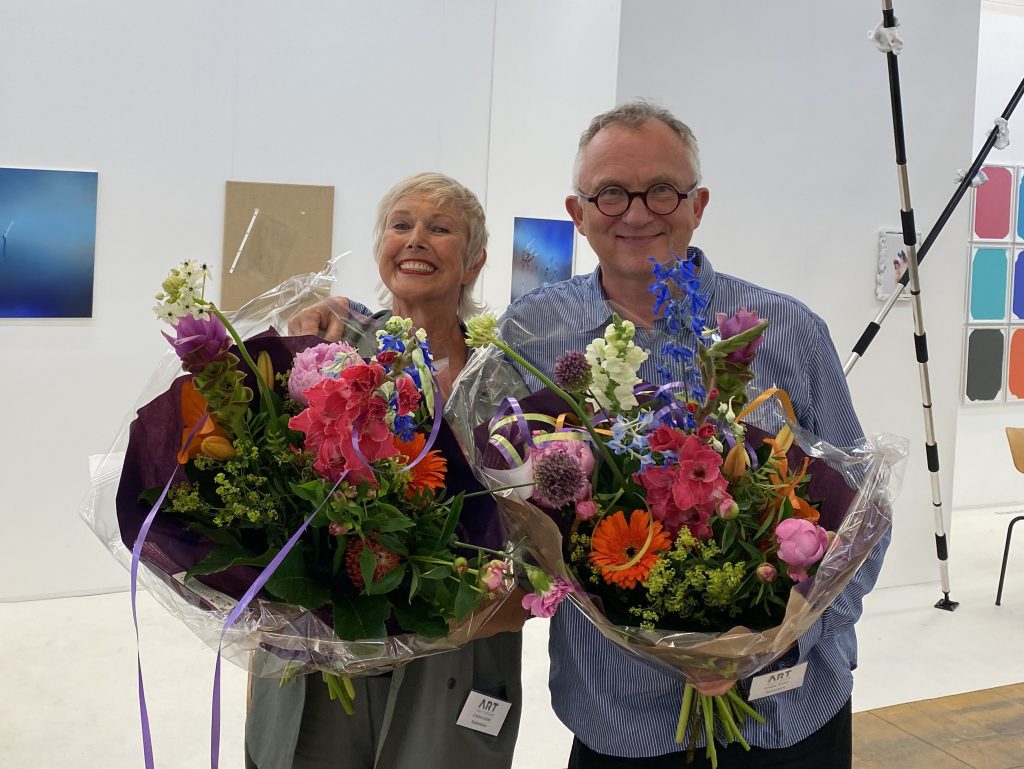
During the May edition of Art Rotterdam, the NN Art Award will be presented for the sixth time: to a contemporary art talent with an authentic visual language and an innovative angle. NN Group has been a partner of Art Rotterdam since 2017 and has been awarding an incentive prize every year since then. An annually changing jury of art professionals makes a selection of four promising talents, from which a winner is ultimately chosen. Since last year, these four nominees also have a chance to win a public choice award, so that regular visitors to the fair can also cast their votes. The conditions are clear: the nominated artists have all been trained in the Netherlands and all show their work during Art Rotterdam. Each year, NN Group buys one or more works from the four nominees for its corporate collection. Last year, the NN Art Award (worth €10,000) and the NN Art Award Public Choice (worth €5,000) were both won by the Dutch artist Erik Mattijssen, who is represented by Cokkie Snoei. We interview him to find out what the prize has meant to him and how he has experienced the past period.
How did it feel like to win the NN Art Award?
Actually, the nomination that preceded it was the most exciting. Knowing that your work has been noticed, in the midst of so many colleagues, was flattering and uplifting. By now, I know what I’m worth, but it remains a strange profession that is accompanied by many uncertainties. These are often questions that I tend to ask myself in the studio: are the steps that I take exciting enough, is it not too indebted to other people’s work, or is it perhaps too careful? When you get this kind of recognition, some of that melts away. Moreover, I was in good company with the three other nominees: Priscila Fernandes, Lilian Kreutzberger and Claudia Martinez Garay. Perhaps the greatest luxury is the spacious, tall and well-designed NN Art Award stand, right in the middle of the fair, as well as the opportunity that this presented: to create a beautiful exhibition together. I am grateful to Cokkie Snoei, who had the courage to nominate me while I had become accustomed that such an award was more for young and up-and-coming talent. I found that encouraged colleagues of my age; that your work can also be valued on other grounds. When I also received the audience award on top of the NN Art Award, that was almost too much of a good thing, but of course I was very happy with it.
What has the past year been like for you, in terms of all the lockdowns? Do you notice that it influences your mood and/or your work in a substantive way?
I felt especially privileged that I have a job that I can continue, independently of others. Imagine playing in a band or making theater or having four school-aged children. Initially, it increased my focus, without any temptations to distract me. But I have to say that after the last lockdown in December, I noticed that I was suffering from the lack of shine to our lives. Amsterdam, the city I live in, is duller without all the hustle and bustle you were used to. Everyone is doing their best, but it’s still sad, all those cafe chairs on top of the tables, windows taped up and deserted streets. In my work, I have always wanted to offer a counterbalance, but there is undeniably a greater melancholy creeping in.
How did the works you showed during Art Rotterdam come about? Are you following a specific process?
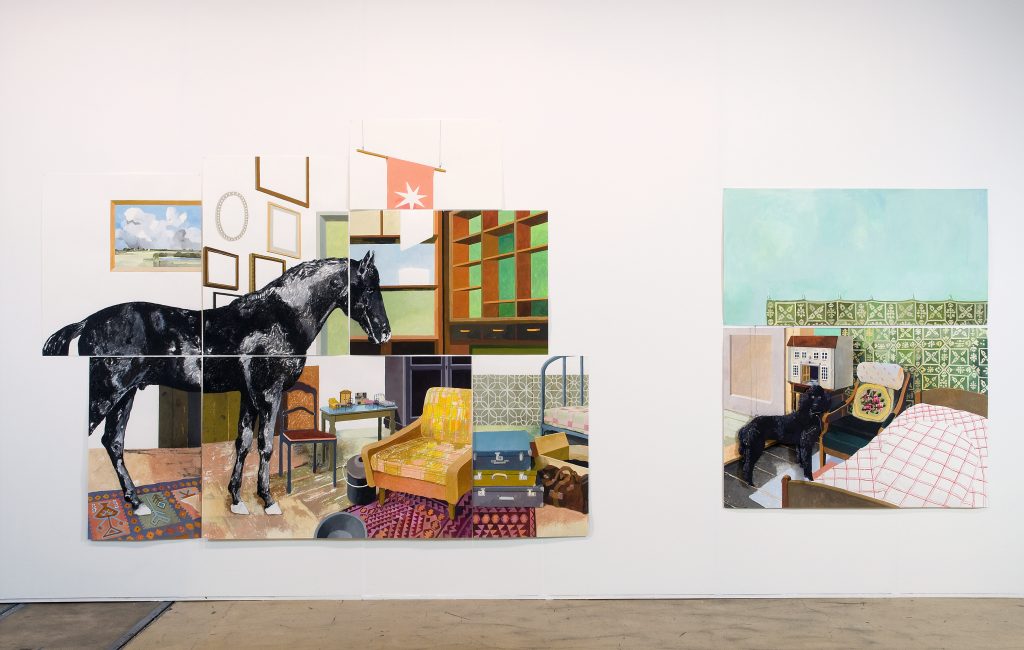
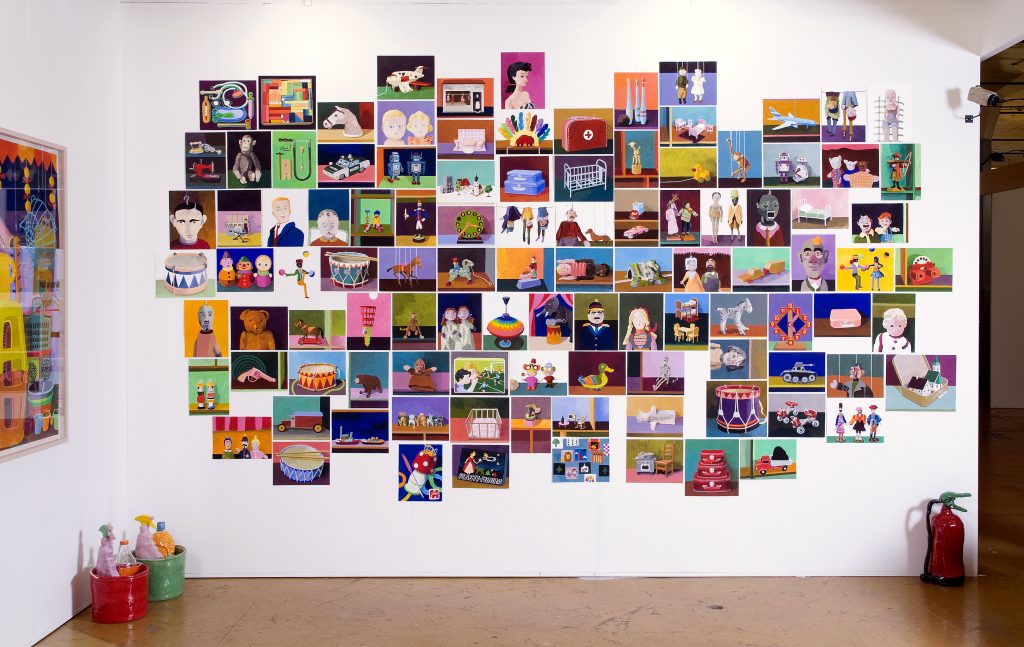
During the six months prior to the fair, I was able to work in a pleasant studio in Berlin, from Livingstone Gallery Projects. That city was also locked down, so I had to come up with my own kind of rhythm. That is how I got to start every morning by painting a small gouache that had to be finished before noon. It turned out to be toys, not too complicated, a subject I had initially saved for the establishment of a large, overcrowded toy store. I made over a hundred, which we exhibited on a signle wall in Cokkie Snoei’s gallery booth. I also continue to work on large, composite scenes, interiors in which something takes place that you can’t quite get a grip on. There were two: Zum Abschied, based on a text by writer Judith Herzberg and Des Pudels Kern, inspired by Goethe’s bedroom in his house in Weimar. The fact that both new works were immediately shown to a large audience in the NN Art Award booth was a great encouragement and a nice addition to what we were able to show in the gallery’s stand.
Are there any particular things that you have been able to achieve thanks to the prize money? What did winning the prizes mean to you in concrete terms?
It often happens that I spend money that actually isn’t there yet, with full confidence that things will work out. In Berlin, for example, I already decided that the toy series could become a nice book, and that was ultimately financed for a large part with the prize money. Receiving the prize in the Art Rotterdam week also led to an interview on NPO radio 1 in the program Kunststof and I immediately saw my followers on Instagram increase in number after that! All in all, I felt like I was floating a bit that week.
What is your ultimate advice for young artists?
That may sound obvious, but it isn’t: I would advise them not to chase anything: to make sure that the work you create is truly yours. That you don’t care too much about the criticism of others, or about what happens to be fashionable at that point in time. It’s important that you are the only one who decides which way to go. I would also like to recommend that they take the initiative themselves, to make sure that they exhibit their work somewhere and not just wait for gallery owners to start moving.But above all: the most important thing is to keep working, to take good care of yourself, to isolate yourself. I have seen too many former students of the Rietveld Academy — where I taught for a long time — who let other things take precedence. That their drive and passion disappeared and that the pleasure diminished simultaneously. And that’s a real shame.
As the winner of the previous edition, you can take a seat in the jury during this edition. What is it like as an artist to judge the work of other artists?
It was particularly nice to be part of such a competent and passionate jury, who made a point of careful viewing and speaking. After much deliberating and weighing, we came to a beautiful, diverse group of four nominees. It remains quite arbitrary of course, comparing apples and oranges. Winners and losers are uncomfortable categories in art.
Tijdens de mei-editie van Art Rotterdam zal de NN Art Award voor de zesde keer uitgereikt worden aan een hedendaags kunsttalent met een authentieke beeldtaal en een innovatieve invalshoek. NN Group is sinds 2017 partner van Art Rotterdam en reikt sindsdien ieder jaar een stimuleringsprijs uit. Een jaarlijks wisselende jury van kunstprofessionals maakt daarbij een selectie van vier veelbelovende talenten, waaruit uiteindelijk een winnaar wordt gekozen. Sinds vorig jaar maken deze vier genomineerden ook kans op een publieksprijs, zodat ook de reguliere beursbezoekers hun stem kunnen uitbrengen. De voorwaarden zijn helder: het gaat om kunstenaars die in Nederland zijn opgeleid en hun werk tonen tijdens Art Rotterdam. NN Group koopt daarbij één of meerdere werken van de vier genomineerden voor haar bedrijfscollectie. Vorig jaar werden de NN Art Award (t.w.v. €10.000) én de NN Art Award Public Choice (t.w.v. €5.000) in de wacht gesleept door de Nederlandse kunstenaar Erik Mattijssen, die wordt vertegenwoordigd door Cokkie Snoei. Wij interviewen hem om er achter te komen wat de prijs voor hem betekend heeft en hoe hij de afgelopen periode ervaren heeft.
Hoe voelde het om de NN Art Award te winnen?
Eigenlijk was de nominatie die daaraan vooraf ging het meest opwindend. Te weten dat je werk is opgevallen, temidden van zoveel collega’s, was strelend en vrolijk stemmend. Ik weet inmiddels wel wat ik waard ben, maar het blijft een raar beroep dat met veel onzekerheden gepaard gaat. Het zijn vragen die ik me in het atelier met grote regelmaat stel: zijn de stappen die ik zet spannend genoeg, is het niet teveel schatplichtig aan anderen, is het misschien te voorzichtig enzovoorts. En daar valt — met zo’n erkenning — ineens wat van weg. Bovendien verkeerde ik in goed gezelschap met de drie andere genomineerden: Priscila Fernandes, Lilian Kreutzberger en Claudia Martinez Garay. De grootste luxe is misschien wel de ruime, hoge en goed ontworpen NN Art Award stand, midden op de beurs, en de gelegenheid die dat bood om samen met elkaar een mooie tentoonstelling te maken. Ik ben Cokkie Snoei erkentelijk, die de moed had me voor te dragen terwijl ik er aan gewend was geraakt dat zo’n prijs meer iets was voor jong en aanstormend talent. Ik merkte dat dat voor collega’s van mijn leeftijd bemoedigend werkte; dat er ook op andere gronden gewaardeerd kan worden. Het óók nog krijgen van de publieksprijs vond ik bijna een beetje veel van het goede, maar natuurlijk was ik er blij mee.
Hoe is het afgelopen jaar voor je geweest, in termen van alle lockdowns? Merk je dat het op een inhoudelijke manier invloed heeft op je gemoed en/of je werk?
Ik voelde me vooral geprivilegieerd met werk dat onafhankelijk van anderen door kan gaan. Je zult maar in een band spelen, of theater maken of vier schoolgaande kinderen hebben. Het vergrootte aanvankelijk de concentratie, zo zonder alle verleidingen. Maar ik moet zeggen dat ik na de laatste lockdown in december bespeurde last te krijgen van het ontbreken van glans. Amsterdam, de stad waarin ik woon, is doffer zonder alle leven waaraan je gewend was. Iedereen doet z’n best, maar het blijft droevig, al die caféstoelen bovenop de tafels, dichtgeplakte ramen en verlaten straten. Ik heb in mijn werk vooral tegenwicht willen bieden, maar er sluipt ontegenzeggelijk een grotere melancholie in.
Hoe kwamen de werken die je toonde tijdens Art Rotterdam tot stand? Volg je een specifiek proces?
Het half jaar voorafgaande aan de beurs kon ik werken in een prettig atelier in Berlijn, van Livingstone Gallery Projects. Ook die stad zat op slot, dus ik moest een eigen ritme verzinnen. Zo kwam ik er toe elke ochtend te beginnen met het schilderen van een kleine gouache die vóór twaalf uur af moest zijn. Het werd speelgoed, niet te ingewikkeld, een onderwerp dat ik aanvankelijk bewaard had voor het tekenen van een grote, overvolle speelgoedwinkel. Ik maakte er ruim honderd, die we op één wand tentoonstelden in de galeriestand van Cokkie Snoei. Daarnaast werke ik verder aan grote, samengestelde scenes, interieurs waarin zich iets afspeelt waar je niet helemaal grip op krijgt. Het werden er twee: Zum Abschied, naar aanleiding van een tekst van schrijfster Judith Herzberg en Des Pudels Kern, waarvoor de slaapkamer van Goethe, in zijn huis in Weimar, de inspiratie vormde. Dat beide nieuwe werken in de NN Art Award stand meteen aan een groot publiek getoond konden worden was een flinke aanmoediging en een mooie aanvulling op wat we in de stand van de galerie konden laten zien.
Zijn er bijzondere dingen die je hebt kunnen verwezenlijken dankzij het prijzengeld? Wat heeft het winnen van de prijzen concreet voor je betekend?
Het gebeurt wel vaker dat ik geld uitgeef dat er eigenlijk nog niet is, in vol vertrouwen dat het wel goed komt. Zo besloot ik in Berlijn al dat de speelgoedserie een mooi boek zou kunnen worden, en dat is uiteindelijk voor een groot deel bekostigd met het prijzengeld. Het krijgen van de prijs heeft in de Art Rotterdam-week mede geleid tot een interview op NPO radio 1 in het programma Kunststof en ik zag mijn volgers op instagram meteen in aantal toenemen! Al met al zweefde ik een beetje, die week.
Wat is jouw ultieme advies voor jonge kunstenaars?
Dat klinkt misschien vanzelfsprekend, maar dat is het niet: ik zou hen willen aanraden niets na te jagen: er voor te zorgen dat het werk dat je maakt echt helemaal van jóu is. Dat je je weinig aantrekt van kritiek van anderen, of van wat er in de mode is; jij bent de enige die beslist welke kant het op moet. Daarbij zou ik hen willen aanbevelen zelf het initiatief te nemen om het werk ergens tentoon te kunnen stellen en niet te wachten op galeriehouders.
Maar bovenal: het belangrijkste is aan het werk te blijven, goed voor jezelf te zorgen, je af te zonderen. Ik heb het bij teveel oud-studenten van de Rietveld Academie — waar ik lang les gaf — gezien, dat andere zaken voor gingen. Dat de bezetenheid verdween en het plezier minder werd. En dat is jammer.
Als winnaar van de vorige editie mag je tijdens deze editie plaatsnemen in de jury. Hoe is het om als kunstenaar het werk van andere kunstenaars te beoordelen?
Het was vooral leuk om in een bekwame, enthousiaste jury te zitten, waar heel zorgvuldig gekeken en gesproken werd. Wikkend en wegend zijn we tot een mooi, divers gezelschap van vier genomineerden gekomen. Het blijft arbitrair natuurlijk, appels en peren vergelijkend. Winnaars en verliezers zijn ongemakkelijke categorieën in de kunst.
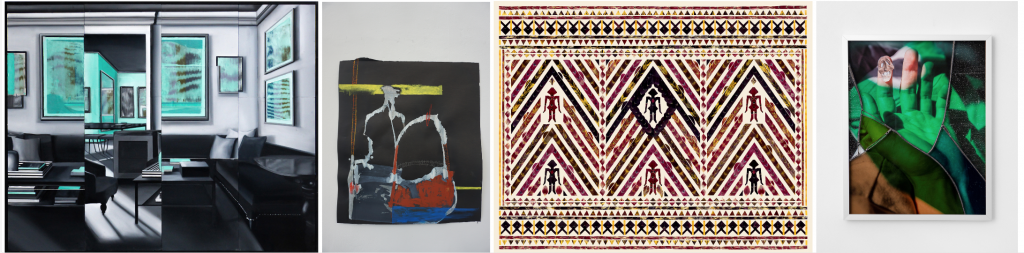
This year the NN Art Award will be presented for the sixth time at Art Rotterdam to an extraordinary talent who has received an education in the Netherlands. The jury; Yuki Kho, culture journalist; Alexandra Landré, artistic director Stroom, The Hague; Charl Landvreugd, head of research & curatorial practice, Stedelijk Museum Amsterdam; Erik Mattijssen, visual artist and winner of the NN Art Award 2021; Elisah van den Bergh, advisor NN Art Collection has announced the 4 nominees:
The 4 nominated artists are:
Inez de Brauw – Brinkman & Bergsma
Vytautas Kumža – Gallery Martin van Zomeren
Thierry Oussou – Lumen Travo Gallery
Jennifer Tee – Gallery Fons Welters
The works of the 4 nominated artists can be seen in the NN Art Award booth at Art Rotterdam 2022.
The winner of the NN Art Award 2022 will be announced during the Press Preview of Art Rotterdam on Wednesday 18 May. The winner of the Audience Award will be announced online on Sunday afternoon 22 May. The public can vote online from mid-April to Saturday 21 May at midnight via the Nationale-Nederlanden website. The public can also vote at the exhibition stand during the exhibition days from Thursday 19 to Saturday 21 May.
The winner will receive a cash prize of €10,000 and an artwork by one of the four nominees will be purchased for NN Group’s corporate collection. The public favorite will receive a cash prize of €5,000. The winners will also receive an online article on GalleryViewer.com.
During Art Rotterdam you will find the work of hundreds of artists from all over the world. In this series we highlight a number of artists who will show special work during the fair.
The kinetic work of Dutch installation artist Philip Vermeulen
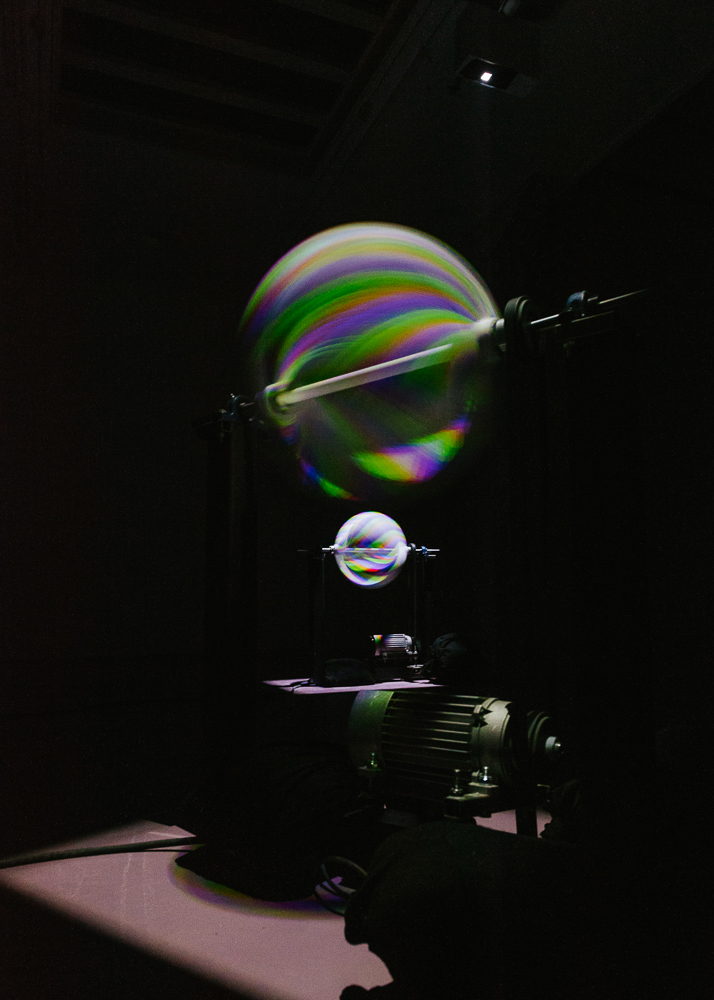
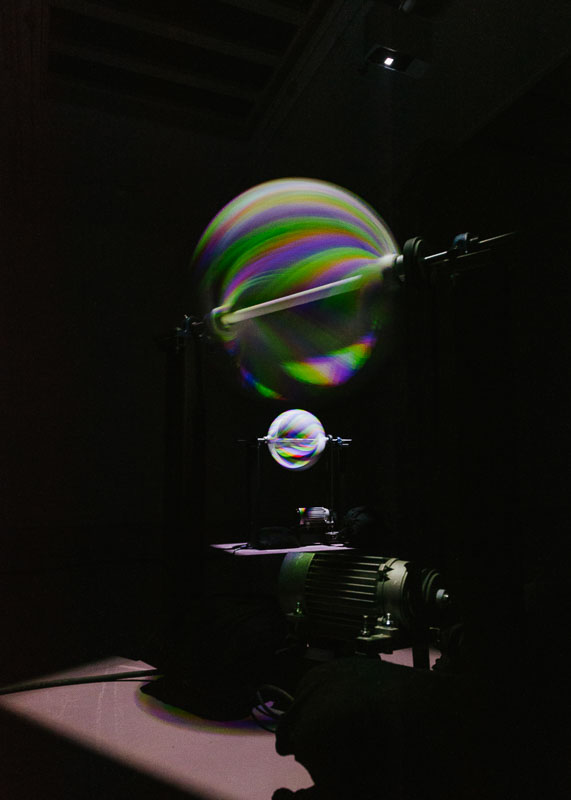
Philip Vermeulen is known for manipulating and isolating — and then maximizing or minimizing — physical phenomena such as light, sound and movement. This gives rise to what he calls ‘hypersculptures’: kinetic sculptures that move so quickly that their physical properties seem to transform before your eyes. With his latest installation ‘Fanfanfan’, which can be seen in the Prospects section, Vermeulen responds to a period of relative stagnation. For this installation, he bends bundled white light into thousands of pieces of color, using fans that move so fast that the projected white light is split and reflected multiple times.
With his practice, Vermeulen builds on the tradition of experimental kinetic art of art movements such as the ZERO movement, but also light art, op art, sound art and audiovisual art. Like many other artists from these movements, Vermeulen is interested in the ways in which our eyes translate images for our brain, and vice versa. In his installation ‘Flap Flap’, for example, we see a canvas that flutters so quickly that it seems to stand still. The effect is almost hypnotic. In other installations he uses stroboscopes to create visual illusions.
But Vermeulen’s experimental installations are characterized by movement and sound. Sometimes so hard that it becomes overwhelming. As a spectator you experience conflicting feelings: the works are aesthetic and elusive, but at the same time sharpen all your senses. There is always a certain danger lurking, because what if the device suddenly does something unpredictable? If you allow yourself to be sucked into that field of tension, the installations can even have a mind-expanding effect. Vermeulen consciously seeks out that field of tension: the border where beauty, fear and destruction overlap. His installations sometimes seem dangerous, such as his graduation artwork, in which tennis balls were fired at 150 kilometers per hour against a wooden sound box. Admittedly in a safe way — provided you as a visitor followed the directions carefully — but the tension and potential danger must have been clearly palpable.
Vermeulen: “My installations are all quite large and they are all about a kind of existential fear: when does the machine go so fast that you no longer trust it. When does it get visually so hardcore that you actually want to leave, but at the same time stay attracted.”
Although his installations sometimes seem to rage on in an uncoordinated way, there is indeed a choreography worked out in detail, as the artist himself refers to. An enormous amount of research precedes the installations and the artist is currently studying machine learning, among other things.
Vermeulen initially studied at the Film Academy for a while, followed by two years at an art academy, where he found the art history classes particularly traditional. He was only really in the right place when he ended up at the ArtScience Interfaculty, an interdisciplinary partnership between the Royal Academy of Art (KABK) and the Royal Conservatoire in The Hague. There was plenty of room for experimentation here and during this period Vermeulen mainly explored the limits of his materials. He graduated summa cum laude in 2017.
In 2020 Suzanne Swarts, director of Museum Voorlinden, nominated him for the Volkskrant Visual Arts Prize 2020. Swarts: “Philip Vermeulen’s work is about looking, but even more about feeling. Vermeulen makes compelling performative installations in which he stimulates all the senses with sound, light and movement. In each work, he once again allows science, technology, visual arts and theater to merge into unforgettable sensations with great ease.” In the same year, Vermeulen was also nominated for a Golden Calf in the category ‘Best Interactive 2020’.
Vermeulen’s installations have previously been shown in the Stedelijk Museum in Amsterdam, during Into the Great Wide Open, in the Berlin club Berghain, during TodaysArt and in the Stedelijk Museum Schiedam and Rijksmuseum Twenthe.
The work of the Dutch installation artist Philip Vermeulen can be seen during Art Rotterdam not only in the booth of No Man’s Art Gallery (Main Section), but also in the outdoor presentation around the Van Nelle factory and in the Prospects section. For ten years now, the Mondriaan Fund has presented work by artists who recently received a contribution for the start of their professional practice.
Watch the video Fanfanfan | Philip Vermeulen here
Tijdens Art Rotterdam treft u het werk van honderden kunstenaars van over de hele wereld. In deze reeks lichten we een aantal kunstenaars uit die bijzonder werk tonen tijdens de beurs.
Het kinetische werk van de Nederlandse installatiekunstenaar Philip Vermeulen
Philip Vermeulen staat bekend om de manieren waarop hij natuurkundige verschijnselen als licht, geluid en beweging weet te manipuleren en te isoleren — en vervolgens te maximaliseren of minimaliseren. Daaruit ontstaan wat hij zelf ‘hypersculpturen’ noemt: kinetische sculpturen die zo snel bewegen dat hun fysieke eigenschappen voor je ogen lijken te transformeren. Met zijn nieuwste installatie ‘Fanfanfan’, die te zien zal zijn in de Prospects sectie, reageert Vermeulen op een periode van relatieve stilstand. Hij buigt voor deze installatie gebundeld wit licht om tot duizenden stukjes kleur, met behulp van ventilatoren die zo snel bewegen dat het geprojecteerde witte licht wordt opgesplitst en meervoudig wordt weerkaatst.
Vermeulen bouwt met zijn praktijk voort op de traditie van de experimentele kinetische kunst van kunststromingen als de ZERO-beweging, maar ook de lichtkunst, op-art, geluidskunst en audiovisuele kunst. Net als veel andere kunstenaars uit deze stromingen is Vermeulen geïnteresseerd in de manieren waarop onze ogen beelden vertalen voor ons brein, en vice versa. In zijn installatie ‘Flap Flap’ zien we bijvoorbeeld een doek dat zo snel wappert dat het lijkt stil te staan. Het effect is haast hypnotisch. In andere installaties maakt hij gebruik van stroboscopen om visuele illusies te creëren.
Maar de experimentele installaties van Vermeulen worden gekenmerkt door beweging én geluid. Soms zo hard dat het overweldigend wordt. Als toeschouwer ervaar je tegenstrijdige gevoelens: de werken zijn esthetisch en ongrijpbaar, maar zetten tegelijkertijd al je zintuigen op scherp. Er sluimert altijd een zeker gevaar, want wat als het apparaat ineens iets onvoorspelbaars doet? Als je je laat meezuigen in dat spanningsveld dan kunnen de installaties zelfs geestverruimend werken. Vermeulen zoekt dat spanningsveld bewust op: de grens waar schoonheid, angst en destructie overlappen. Zijn installaties lijken soms iets gevaarlijks te hebben, zoals zijn afstudeerkunstwerk, waarin tennisballen met 150 kilometer per uur werden afgevuurd tegen een houten klankkast. Weliswaar op een veilige manier — mits je als bezoeker de aanwijzingen goed opvolgde — maar de spanning en het potentiële gevaar moeten duidelijk voelbaar zijn geweest.
Vermeulen: “Mijn installaties zijn allemaal vrij groot en ze gaan allemaal over een soort existentiële angst: wanneer gaat de machine zo hard dat je hem niet meer vertrouwt. Wanneer wordt het visueel zo hardcore dat je eigenlijk weg wilt gaan, maar tegelijkertijd toch aangetrokken blijft.”
Hoewel zijn installaties soms ongecoördineerd voort lijken te razen is er wel degelijk sprake van een tot in detail uitgewerkte choreografie, zoals de kunstenaar er zelf naar refereert. Er gaat ontzettend veel onderzoek vooraf aan de installaties en de kunstenaar verdiept zich op dit moment onder meer in machine learning.
Vermeulen studeerde in eerste instantie een tijdje aan de Filmacademie, gevolgd door twee jaar op een kunstacademie, waar hij de kunstgeschiedenislessen vooral erg traditioneel vond. Hij was pas echt op zijn plek toen hij terecht kwam op de ArtScience Interfaculty, een interdisciplinair samenwerkingsverband tussen de Koninklijke Academie van Beeldende Kunsten (KABK) en het Koninklijk Conservatorium in Den Haag. Hier was volop ruimte voor experiment en Vermeulen zocht in deze periode vooral de grenzen van zijn materialen op. Hij studeerde in 2017 summa cum laude af.
In 2020 droeg Suzanne Swarts, directeur van Museum Voorlinden, hem voor voor de Volkskrant Beeldende Kunstprijs 2020. Swarts: “Het werk van Philip Vermeulen gaat over kijken, maar nog meer over voelen. Vermeulen maakt meeslepende performatieve installaties waarin hij met geluid, licht en beweging alle zintuigen prikkelt. In ieder werk laat hij opnieuw met groot gemak wetenschap, technologie, beeldende kunst en theater versmelten tot onvergetelijke sensaties.” In datzelfde jaar werd Vermeulen ook genomineerd voor een Gouden Kalf in de categorie ‘Best Interactive 2020’.
De installaties van Vermeulen waren eerder onder andere te zien in het Stedelijk Museum in Amsterdam, tijdens Into the Great Wide Open, in de Berlijnse club Berghain, tijdens TodaysArt en in het Stedelijk Museum Schiedam en Rijksmuseum Twenthe.
Het werk van de Nederlandse installatiekunstenaar Philip Vermeulen is tijdens Art Rotterdam niet alleen te zien in de booth van No Man’s Art Gallery (Main Section), maar ook in de buitenpresentatie rondom de Van Nellefabriek én in de Prospects sectie. Hierin presenteert het Mondriaan Fonds al tien jaar werk van kunstenaars die onlangs een bijdrage ontvingen voor de start van hun beroepspraktijk.
Zie de video hier: Fanfanfan | Philip Vermeulen
During Art Rotterdam you will find the work of hundreds of artists from all over the world. In this series we highlight a number of artists who will show special work during the fair.

Minne Kersten works at the intersection of art and literature and is fascinated by the relationship between image and the written word. She completed a bachelor’s degree in Image & Language at the Gerrit Rietveld Academy and a residency at the prestigious De Ateliers institute in Amsterdam. She also studied art history for a year and participated in the Slow Writing Lab, a postgraduate course of the Dutch Foundation for Literature, which focuses on creative writing. The artist’s literary background is expressed in large-scale installations, videos, sculptures and drawings, which are part of a fictional experiential world. In addition to her visual art practice, Kersten also writes poems and essays.
The artist’s works and visual language arise from a deep-seated desire to tell stories and, in a sense, function as a support for those stories. Sometimes the sculptural sets tell their own story. Chaos, decay and deconstruction are emphasized by the frequent use of natural materials and building materials. The animal or human figures in her narratives often relate to each other in unexpected ways and sometimes there are absurdist or eerie elements. Reality and imagination seem to flow seamlessly into one another in Kersten’s works.
Mourning and loss are recurring themes. The artist has done a lot of research into the symbolism and mythology surrounding mourning and loss in painting, sculpture and cinema. These are often symbolized by black birds, sometimes with mythological connotations. She recently made the video artwork ‘Constant Companion’ (2021) in a chapel in Hoorn, in which the leading role is reserved for a raven. Kersten films the bird close to its feathers as it explores its surroundings. Four hours of material were reduced to six minutes for this.
Kersten is also interested in the ways in which people relate to architectural structures and their immediate living environment. She analyzes spaces as psychological constructs, referring to theories such as the Stone Tape theory and place memory, which state, among other things, that certain spaces are permanently affected when emotional or traumatic events take place.
Later this year, her work will be featured in The Studio series at the Bonnefanten Museum in Maastricht, a special, small-scale solo exhibition for young artists. Kersten is also showing her work this year in The Living Art Museum in Reykjavik. In addition to the contribution from the Mondriaan Fund, she also won various other grants and grants, including from the Niemeijer Fund, the Dommering Foundation, the AFK and the Prins Bernhard Cultuurfonds.
During Art Rotterdam, the work of Minne Kersten can be seen in the booth of Annet Gelink Gallery as part of the video section Projections and in the Prospects exhibition of the Mondriaan Fund. For the 10th time in a row, the Mondriaan Fund presents the work of 88 starting artists here. In 2020, all artists received a financial contribution from the Mondriaan Fund to start their career.
Tijdens Art Rotterdam treft u het werk van honderden kunstenaars van over de hele wereld. In deze reeks lichten we een aantal kunstenaars uit die bijzonder werk tonen tijdens de beurs.
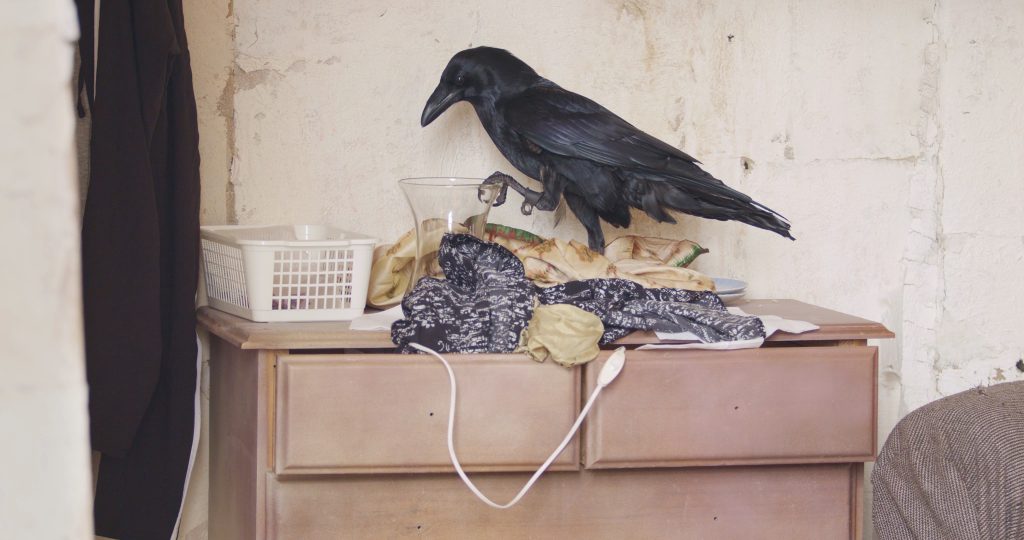
Minne Kersten werkt op het snijvlak van kunst en literatuur en is gefascineerd door de relatie tussen beeld en het geschreven woord. Ze rondde een bachelor af in Beeld & Taal aan de Gerrit Rietveld Academie en een residentie aan het prestigieuze instituut De Ateliers in Amsterdam. Ze studeerde ook een jaar kunstgeschiedenis en nam deel aan het Slow Writing Lab, een postdoctoraal traject van het Nederlands Letterenfonds, dat gericht is op creatief schrijven. De literaire achtergrond van de kunstenaar komt tot uiting in grootschalige installaties, video’s, sculpturen en tekeningen, die onderdeel zijn van een fictieve belevingswereld. Naast haar beeldende kunstpraktijk schrijft Kersten ok gedichten en essays.
De werken en beeldtaal van de kunstenaar komen voort uit een diepgeworteld verlangen om verhalen te vertellen en functioneren in zekere zin als ondersteuning voor die verhalen. Soms vertellen de sculpturale decors hun eigen verhaal. Chaos, verval en deconstructie worden benadrukt door het veelvuldige gebruik van natuurlijke materialen en bouwmaterialen. De dierlijke of menselijke figuren in haar narratieven verhouden zich vaak op onverwachte manieren tot elkaar en soms is er sprake van absurdistische of griezelige elementen. Werkelijkheid en verbeelding lijken in de werken van Kersten naadloos in elkaar over te lopen.
Rouw en verlies zijn daarbij terugkerende thema’s. De kunstenaar heeft veel onderzoek gedaan naar de symboliek en mythologie rondom rouw en verlies in de schilderkunst, beeldhouwkunst en cinema. Die worden vaak gesymboliseerd door zwarte vogels, met soms mythologische connotaties. Onlangs maakte ze het videokunstwerk ‘Constant Companion’ (2021) in een kapel in Hoorn, waarin de hoofdrol gereserveerd is voor een raaf. Kersten filmt de vogel dicht op de veren terwijl hij zijn omgeving verkent. Vier uur aan materiaal werden daarvoor teruggebracht naar zes minuten.
Kersten is ook geïnteresseerd in de manieren waarop mensen zich verhouden tot architecturale structuren en hun directe woonomgeving. Ze analyseert ruimtes als psychologische constructen en refereert daarbij aan theorieën als de Stone Tape-theorie en plaatsgebonden geheugen (place memory), die onder meer stellen dat bepaalde ruimtes permanent beïnvloed worden wanneer er emotionele of traumatische gebeurtenissen plaatsvinden.
Later dit jaar zal haar werk te zien zijn in The Studio reeks in het Bonnefanten Museum in Maastricht, een speciale, kleinschalige solotentoonstelling voor jonge kunstenaars. Kersten toont haar werk dit jaar bovendien ook in The Living Art Museum in Reykjavik. Ze sleepte naast de bijdrage van het Mondriaan Fonds ook verschillende andere subsidies en toelagen in de wacht, van onder meer het Stichting Niemeijer Fonds, de Dommering Foundation, het AFK en het Prins Bernhard Cultuurfonds.
Tijdens Art Rotterdam is het werk van Minne Kersten te zien de booth van Annet Gelink Gallery als onderdeel van de videosectie Projections en in de Prospects tentoonstelling van het Mondriaan Fonds. Voor de 10e keer op rij presenteert het Mondriaan Fonds hier het werk zien van 88 startende kunstenaars. Alle kunstenaars ontvingen in 2020 een financiële bijdrage van het Mondriaan Fonds om een start te maken met hun carrière.
During Art Rotterdam you will find the work of hundreds of artists from all over the world. In this series we highlight a number of artists who will show special work during the fair.
Modern solutions require modern problems
Just before the pandemic, Lund gave a presentation about his work in Ljubljana. It featured, among other things, trivial inventions for modern inconveniences, such as a magnifying glass for the small screen of your mobile phone. Or a mobile projector that allows you to share your screen with others in a decent way. The audience laughs. Finally, Lund shows an apparently equally odd device that manipulates your phone’s pedometer by means of a constant rocking motion. Why was this device invented, you ask? In China you get a discount on your health insurance if you demonstrably exercise a lot. Modern solutions require modern problems.
It is not surprising that Lund (SE,1984) has an eye for such inventions, because a number of central themes of his work come together: power relations, data analyses and algorithms, and how to circumvent them.
FOMO
The above themes are already reflected in early exhibitions such as Fear of Missing Out (Showroom Mama, Rotterdam, 2013). One of the works is a photo collage featuring the 100 most important curators. At least, according to Lund’s algorithm. According to Lund, his knowledge of the who-is-who would give him an edge over the average collector, he would be more aware of trends and appreciations.
At the beginning of his career, Lund, who was educated in the Netherlands, was sometimes accused of making art about art, including jokes that only insiders understand. Lund’s work is certainly playful and funny, but his message is broader. In 2019, for example, he set up the London Photographer’s Gallery as a twelve-person editorial team for making propaganda and fake news. Here too, Lund was interested in the data collection and Cambridge Analytica’s anything but neutral algorithm, which mainly concentrated its efforts on the leave voice.
Strings Attached
It is not a coincidence that Lund initially ended up in the art world; it’s a small, uncluttered version of the real world. According to Lund, the art world has a classic top-down structure, with a relatively small group of people at the top deciding among themselves what is good art. Underneath is a broad layer of gallery owners, collectors and artists.
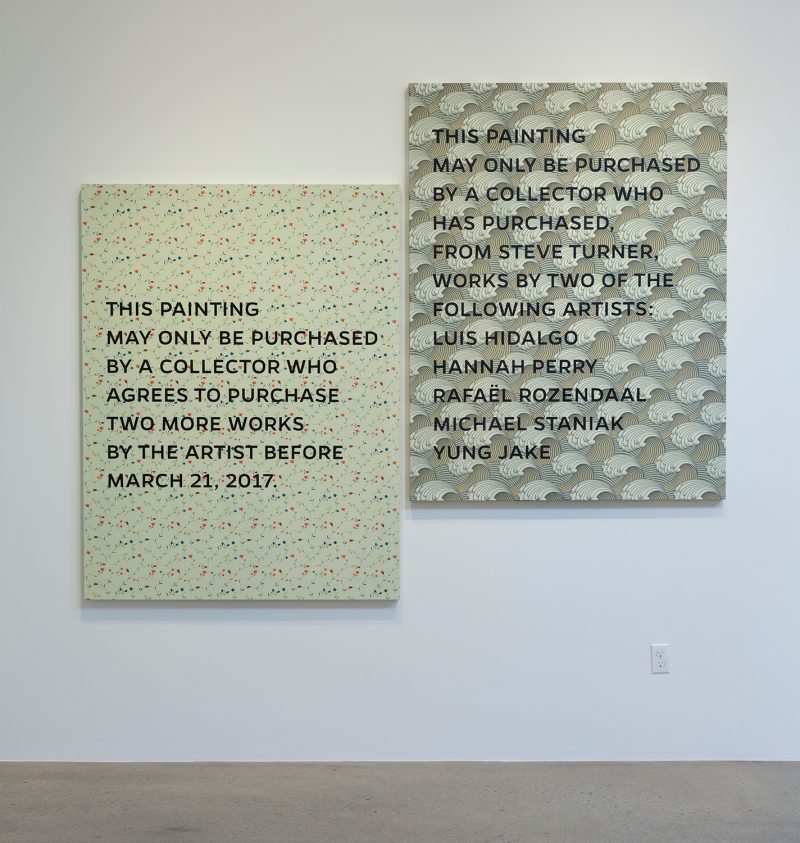
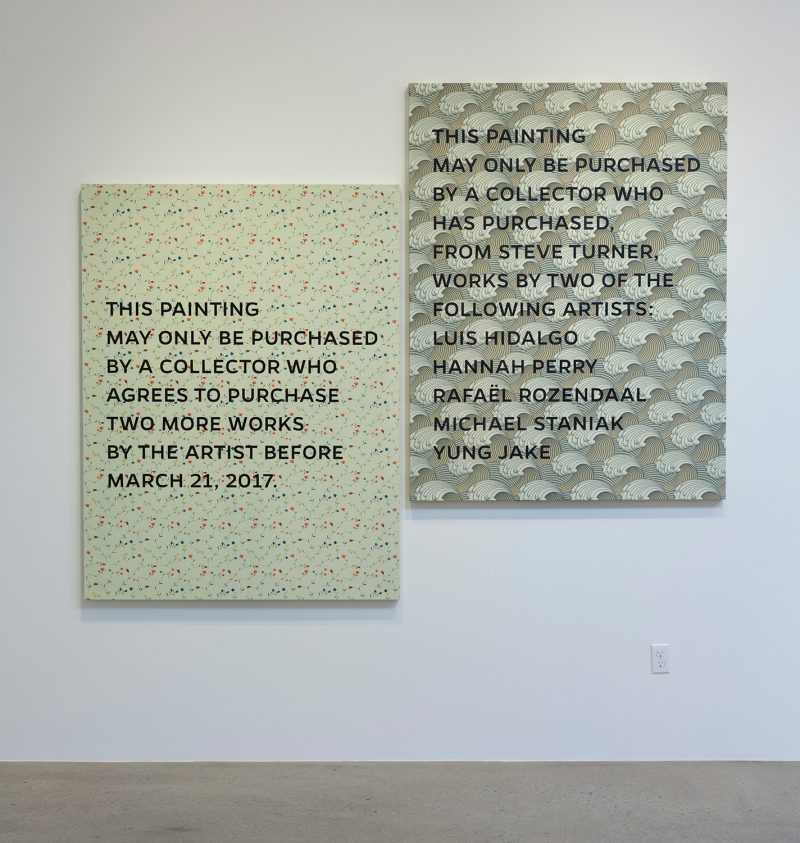
The power relations between the players in the bottom layer are discussed in the series Strings Attached (2015). Although the artist is the producer, he has little to say about how his work is marketed. Gallery owners can decide not to sell work to a collector no if the collector has not previously purchased a work from the gallery or only sell if a customer immediately buys two works or oblige the buyer to donate one of the purchased works to a museum. Lund circumvented these practices by stating the conditions on his canvases.
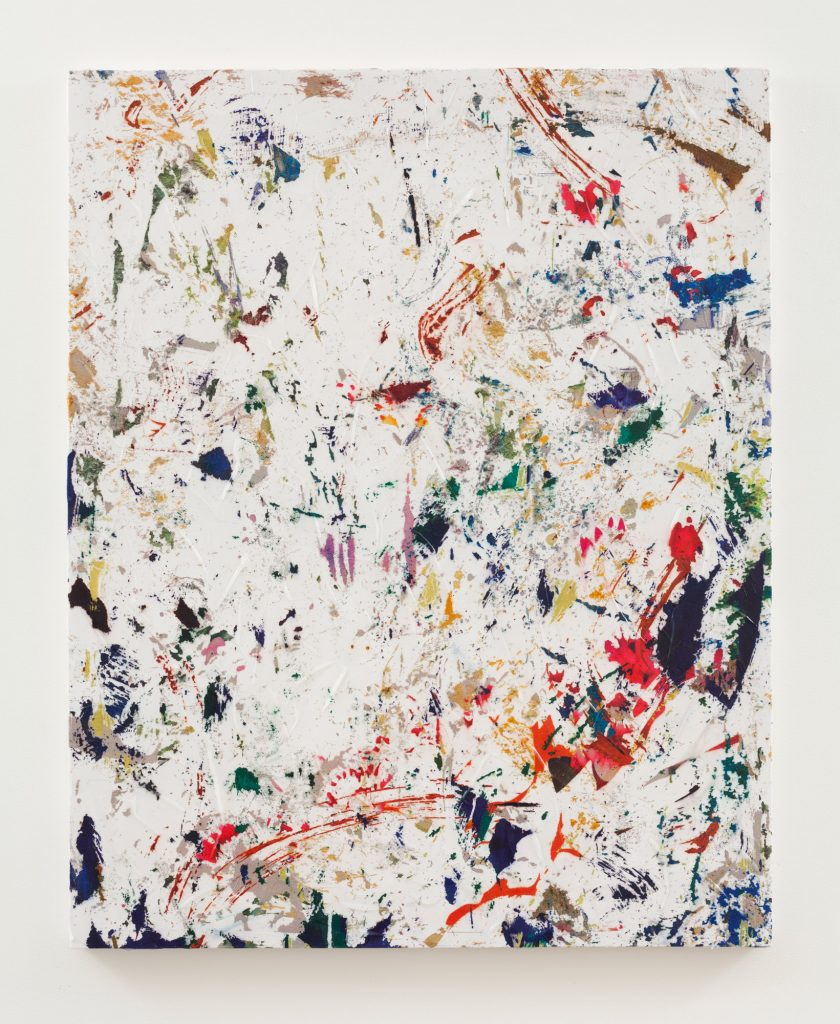
Invest in Jonas Lund
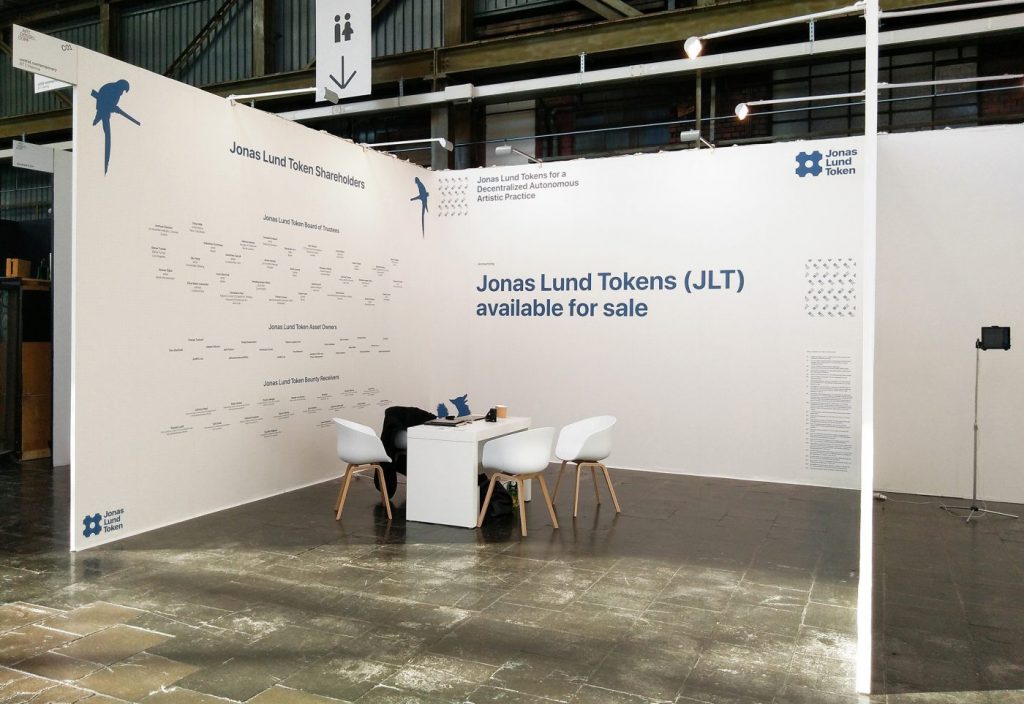
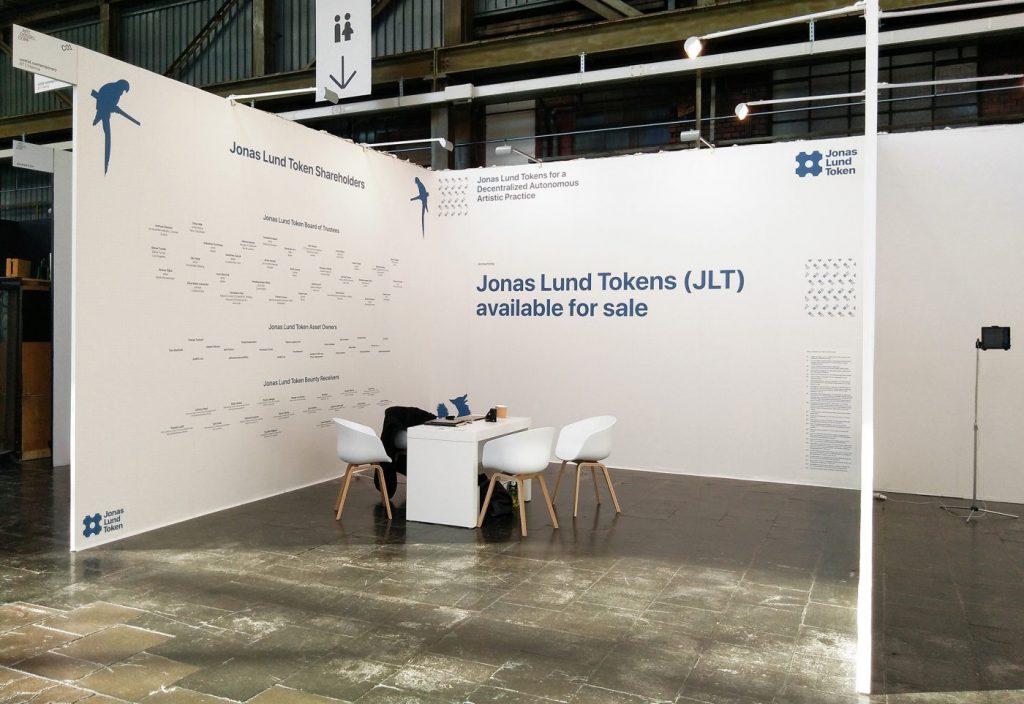
Of course, Lund also saw the possibilities of crypto currencies early on. In 2018, he developed his own Jonas Lund Token, including a daft corporate logo and advertising materials. At art fairs, the booths of his gallerist therefore looked exactly like those of a financial services provider.
This may seem like a far-fetched joke, but data collections and power relations play a major role here too. You can get JLTs by buying one of Lund’s work or by providing him with a service, such as inviting him to a lecture or advertising his work. Lund set up his token in such a way that owners of the JLTs are de facto shareholders in Lund’s artistic practice. He regularly puts questions to his shareholders and their advice is binding.
For you, by you
At Art Rotterdam, the Milanese gallery Bianconi is showing the work of this Swedish multimedia artist from the For you series from 2021. Lund created this series in response to the hyper-personalization that takes place on social media. On your favourite platform you are continuously served new content that matches your taste with the aim of letting you spend more time online.

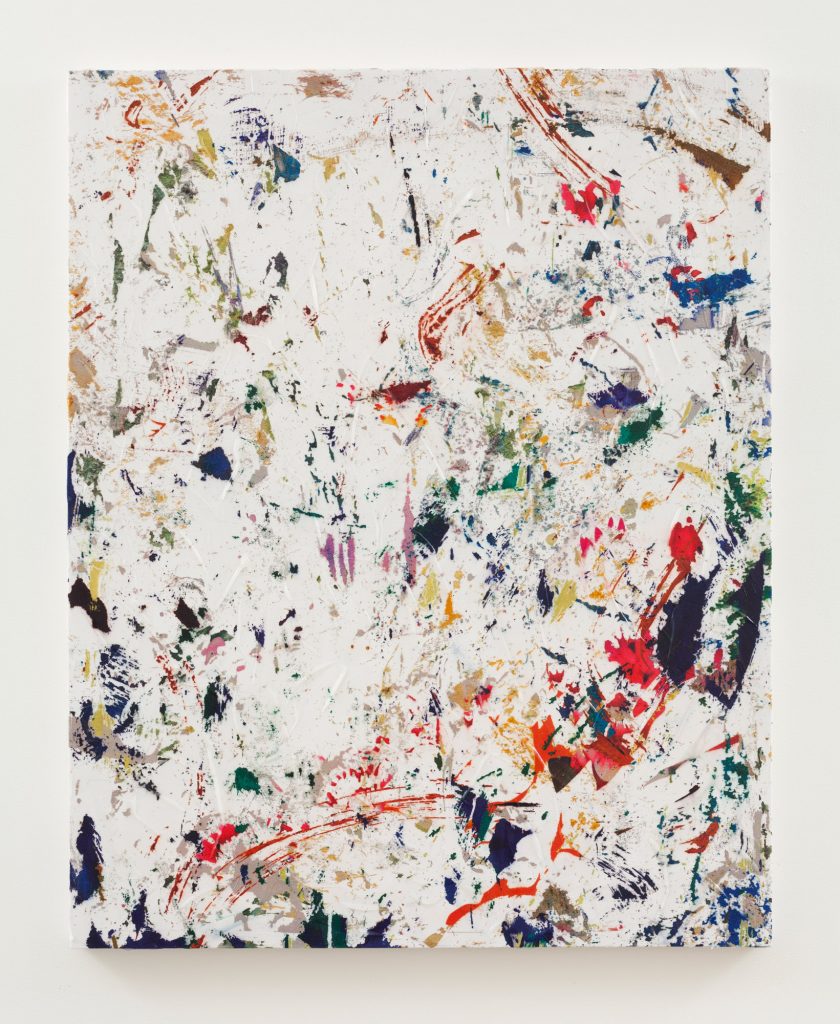
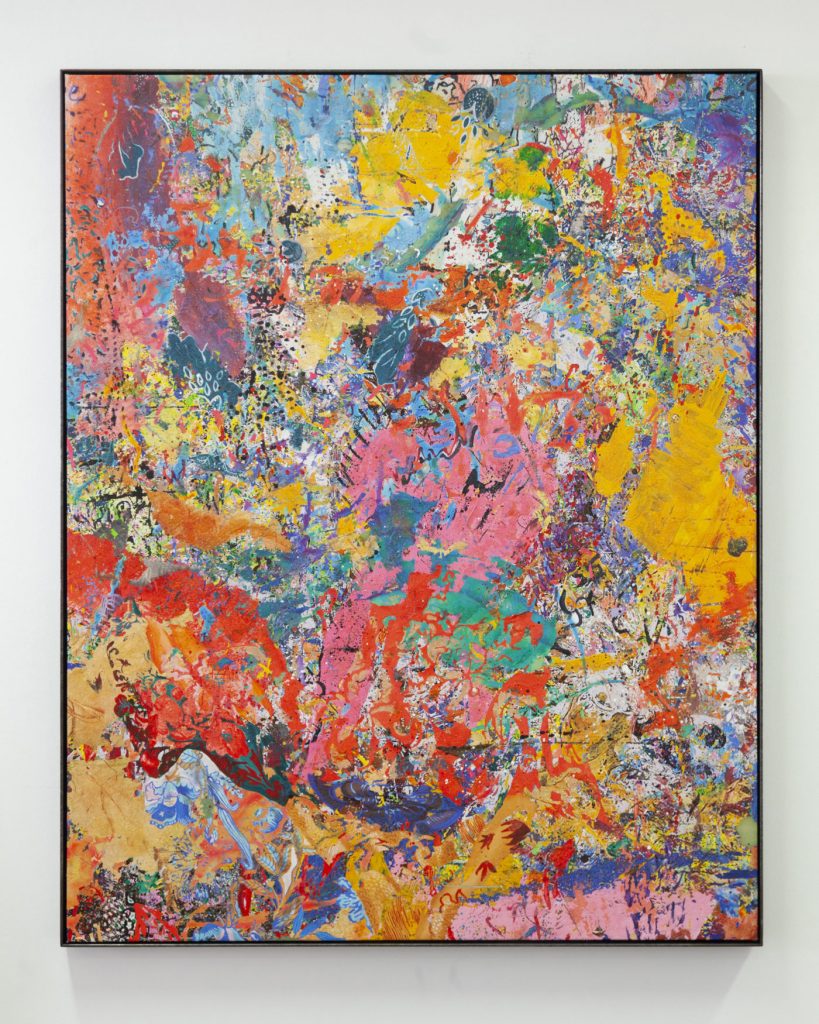
In the works of this series, which include elements of recently auctioned well-known works of art, Lund translated this principle into a series of works that continuously adapts on the basis of algorithms. Just like on Instagram and Tiktok, Lund’s algorithms analyse the way the viewer relates to the works. As a result, the continuously changing compositions gradually match the behaviour of the viewer more and more. Because you, as a viewer, put together the works yourself, just like your social media feed, you become more and more entangled in your own bubble in which you never see anything unwelcome again.
Jonas Lund’s work can be seen in the Solo/Duo section, at Galleria Bianconi.
Tijdens Art Rotterdam treft u het werk van honderden kunstenaars van over de hele wereld. In deze reeks lichten we een aantal kunstenaars uit die bijzonder werk tonen tijdens de beurs.
Modern solutions require modern problems
Vlak voor de pandemie gaf Lund in Ljubljana een presentatie over zijn werk. Daarin toonde hij onder meer onbenullige vindingen voor moderne ongemakken, zoals een vergrootglas voor het kleine scherm je mobieltje. Of een mobiele projector waardoor je je scherm tenminste op een behoorlijke manier kan delen met anderen. De zaal lacht. Als laatste toont hij een ogenschijnlijk even stompzinnig apparaat dat door een constante schommelbeweging de stappenteller van je telefoon manipuleert. In China krijg je namelijk korting op je zorgverzekering als je aantoonbaar veel beweegt. Modern solutions require modern problems.
Dat Lund (1984) juist oog heeft voor dergelijke vondsten is niet gek, er komen namelijk een aantal centrale thema’s van zijn werk in samen: machtsverhoudingen, data-analyses en algoritmes, en hoe deze te omzeilen.
FOMO
Bovenstaande thema’s zie je al terug in vroege tentoonstellingen als Fear of Missing Out (Showroom Mama, Rotterdam, 2013). Een van de werken is een fotocollage met de 100 belangrijkste curatoren. Althans, volgens het algoritme van Lund. Volgens Lund zou zijn kennis van de who-is-who hem voorsprong geven op de doorsnee verzamelaar, hij zou eerder op de hoogte zijn van trends en waardestijgingen.
Aan het begin van zijn carrière werd de in Nederland opgeleide Lund wel eens verweten kunst over kunst te maken, inclusief grappen die alleen insiders snappen. Lunds werk is zeker speels en grappig, maar zijn boodschap is echter breder. Zo richtte hij in 2019 de Londense Photographer’s Gallery in als twaalfkoppige redactie voor het maken van propaganda en fake news. Ook hier was het Lund te doen om de dataverzameling en het allesbehalve neutrale algoritme van Cambridge Analytica dat zich vooral richtte op de leave-stem.
Strings Attached
Dat Lund aanvankelijk uitkwam bij de kunstwereld is niet heel vreemd; het is een kleine, overzichtelijke versie van de echte wereld. De kunstwereld kent volgens Lund een klassieke top-down structuur met aan de top een relatief kleine groep mensen onderling bepalen wat goede kunst is. Daaronder bevindt zich een brede laag met galeriehouders, verzamelaars en kunstenaars.
De machtsverhoudingen tussen die laatste komt aan bod in de serie Strings Attached (2015). Hoewel de kunstenaar de producent is, heeft deze weinig te vertellen over de wijze waarop zijn werk wordt verhandeld. Galeriehouders kunnen verzamelaars nee verkopen als ze niet eerder een werk bij de galerie kochten of alleen verkopen als een klant meteen twee werken koopt of de koper verplichten een van de aangekochte werken te doneren aan een museum. Lund omzeilde deze praktijken door de voorwaarden op zijn doeken te zetten.
Invest in Jonas Lund
Uiteraard zag Lund ook snel de mogelijkheden van crypto currencies. In 2018 ontwikkelde hij zijn eigen Jonas Lund Token, inclusief een uiterst degelijk beeldmerk en reclamemateriaal. De stands van zijn galeriehouders op kunstbeurzen zagen er dan ook precies zo uit als die van een financieel dienstverlener.
Dat lijkt misschien een ver doorgevoerde grap, maar ook hier spelen dataverzamelingen en machtsverhoudingen een grote rol. Je kan namelijk aan JLTs komen door een werk van Lund te kopen of hem een dienst te verlenen, zoals hem uitnodigen voor een lezing of reclame te maken voor zijn werk. Lund richtte zijn token zo in dat eigenaars van de JLTs de facto aandeelhouder zijn in Lunds artistieke praktijk. Regelmatig legt hij zijn aandeelhouders vragen voor en hun advies is daarbij bindend.
In de werken waarin Lund elementen van recent geveilde bekende kunstwerken opnam, vertaalde hij dit principe naar een serie werken die zich continu aan past op basis van algoritmes. Net als op Instagram en Tiktok analyseren Lunds algoritmes de manier waarop de kijker zich tot de werken verhoudt. Daardoor sluiten de continu veranderende composities gaandeweg steeds beter aan op het (kijk)gedrag van de kijker. Omdat je de werken als kijker in zekere zin zelf samenstelt, net als je social media feed, raak je steeds meer verstrikt in je eigen bubbel waarin je nooit meer iets onwelgevalligs te zien krijgt.
For you, by you
Op Art Rotterdam toont de Milanese galerie Bianconi het werk van deze Zweedse multimedia kunstenaar uit de serie For you uit 2021. Deze serie maakte Lund in reactie op de hyperpersonalisatie die plaatsvindt op social media. Op je favoriete platform krijg je continu nieuwe content geserveerd die aansluit op jouw smaak met als doel je meer tijd op online te laten doorbrengen.
Het werk van Jonas Lund is te zien in de sectie Solo/Duo, bij Galleria Bianconi.


