Coming soon
Coming soon
Selecteer type
“Van een tienerkeizer, op zeventienjarige leeftijd vermoord door diens praetoriaanse garde, transformeert die achtereenvolgens tot een wreed monster, een wezen met uitzonderlijke en buitensporige verlangens, een verwijfd bedrieger uit het Oosten, een anarchist die vastbesloten is de ondergang van het rijk te bespoedigen, een epicurist van metafysische godslasteringen, een heilige dwaas wiens misstappen de plooien van de werkelijkheid doen oplichten, en een androgyne engel die schrijlings zit op de ruïnes van het antieke verleden en ons wankele heden.”
Zo omschrijft de in Berlijn gevestigde kunstenaar Elijah Burgher (1987, VS) de figuur van Heliogabalus (Elagabalus). Een evocatieve en krachtige beschrijving van de beruchte Romeinse keizer, waarop zijn recente reeks werken losjes gebaseerd is.
In de New Art-sectie in de stand van Ivan Gallery (Boekarest) put Burgher uit mythologie, occulte magie, queer verlangen en kunstgeschiedenis om te onderzoeken hoe beelden doorheen de tijd blijven voortbestaan en veranderen. De New Art-sectie, gecureerd door Övül Ö. Durmuşoğlu, is voorbehouden voor solopresentaties van opkomende kunstenaars met een sterke en conceptueel doordachte praktijk.
Heliogabalus of Elagabalus is een historische figuur wiens leven al lang overschaduwd wordt door een onstabiel en buitensporig na-leven in literatuur, schilderkunst, opera, devotionele fantasieën en roddelverhalen. “Er werd gezegd dat die er genoegen in schepte om verlegen senatoren te ondervragen of zij, toen ze jong en mooi waren, ook genoten hadden van de passieve rol bij anale seks,” schrijft Burgher in zijn essay Our Lady of the Latrines: Notes on the Elagabalus Egregore. Hoewel antieke bronnen de keizer afschilderen als een verdorven tiran, seksueel deviant en religieus schandaal, kronen recentere interpretaties hem tot “een anarchist, held van het hedonisme, heilige en martelaar van de seksuele revolutie”, zoals Arrizabalaga y Prado (2010, 1) in zijn onderzoek stelt, geciteerd door Burgher.
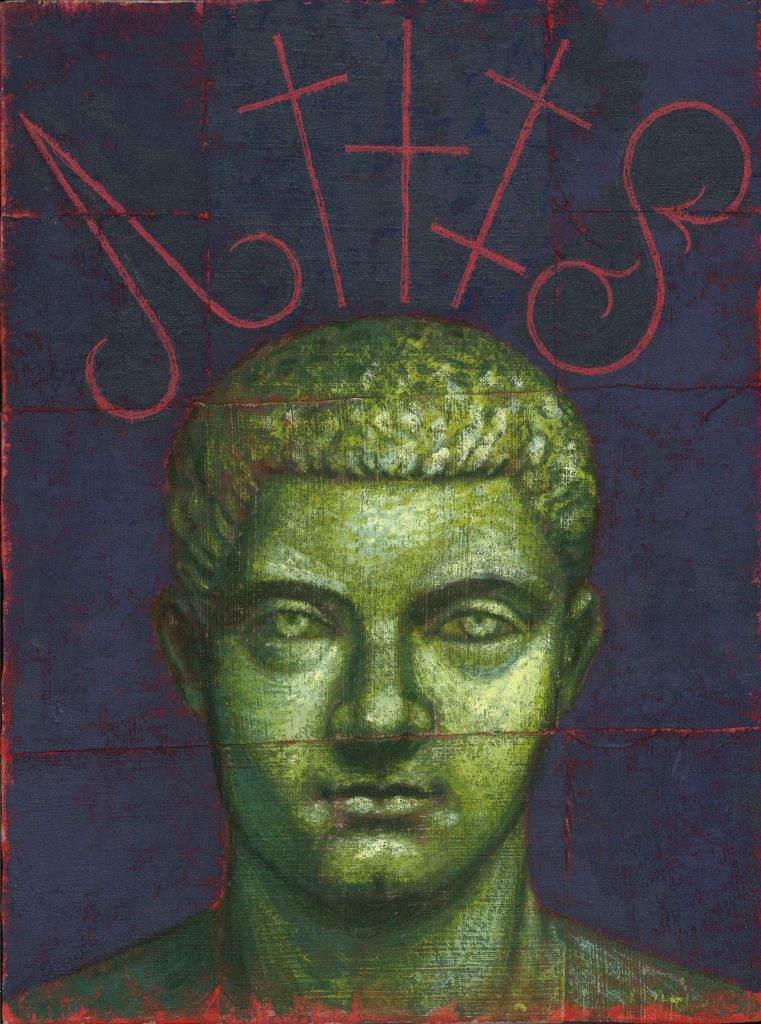
Er is zeer weinig betrouwbaar beeldmateriaal van de keizer bewaard gebleven. Slechts twee bustetypes worden doorgaans aan Heliogabalus toegeschreven, grotendeels omdat diens naam en beeltenis na de dood systematisch werden veroordeeld via damnatio memoriae. Door deze schaarste aan materieel bewijs is de keizer een projectiescherm geworden waarop latere schrijvers en kunstenaars hun eigen (soms kwaadaardige) ideeën projecteren.
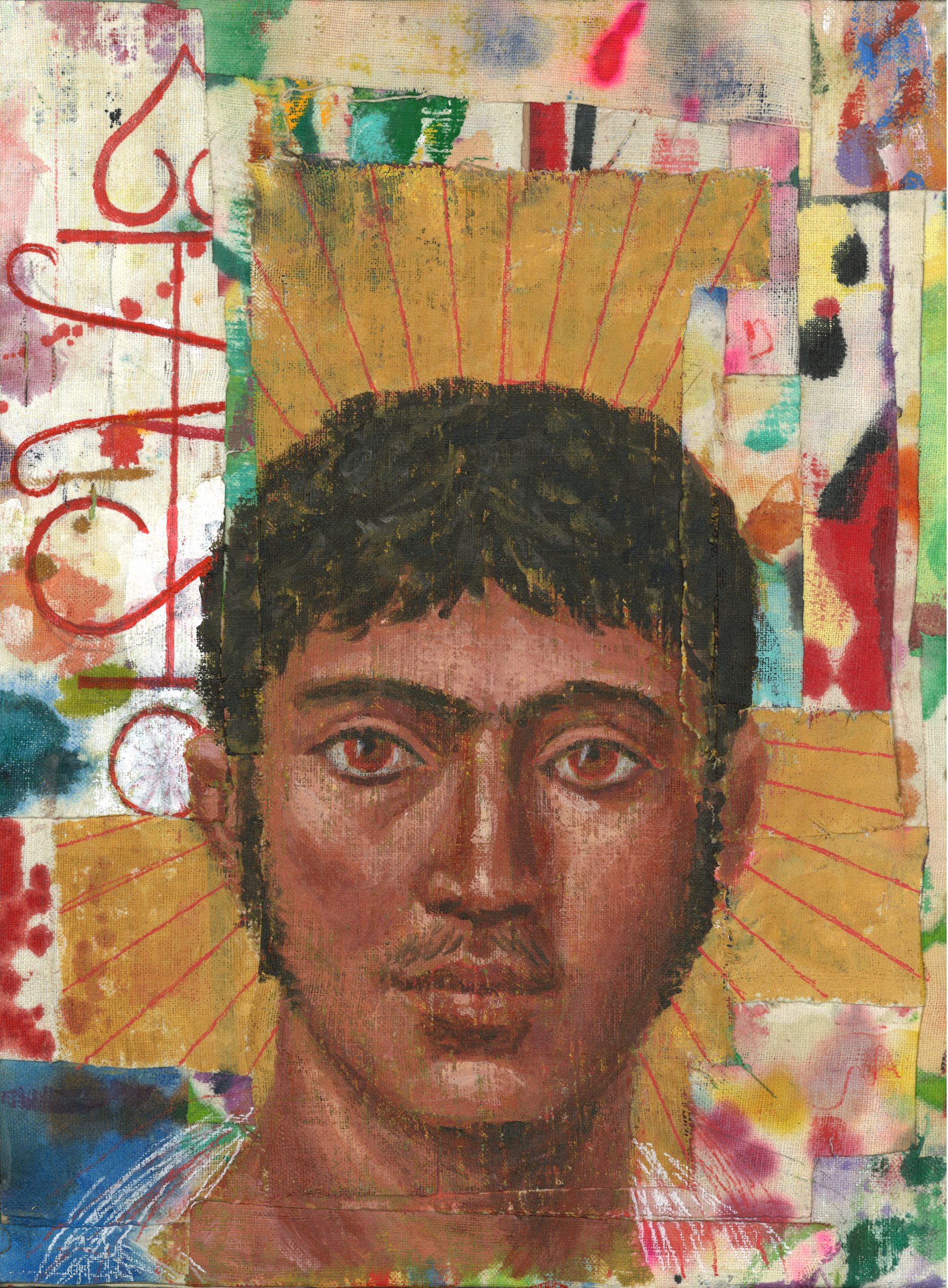
De schilderijen die in Art Rotterdam worden getoond, zijn gemaakt met acrylverf op atelierdoeken en materiaal dat uit mislukte of verlaten schilderijen werd gesneden en vervolgens op panelen werd gemonteerd. Veel werken bestaan uit gescheurde of gerafelde stukken canvas en linnen die als collage samengebracht zijn. Zelfs wanneer ze volledig overschilderd worden, blijven de naden van het oppervlak zichtbaar en verraadt de rand van het paneel de geschiedenis van de gebruikte materialen. “Ze doen me denken aan mummiewindsels en graffiti in toiletten,” legt de kunstenaar uit. “Ik kijk ook aandachtig naar de Fayum-portretten en naar de grisaille-schilderijen van Mantegna en Bellini. Sommige schilderijen vertrekken van mijn werk met sigil-magie en occulte abstractie om de zonne-fallische culten uit de oudheid te onderzoeken en te versterken, waarbij Heliogabalus een uitzonderlijk en pervers voorbeeld vormt.”
In zijn essay Our Lady of the Latrines: Notes on the Elagabalus Egregore gebruikt Burgher bewust de voornaamwoorden zij/haar wanneer hij naar de keizer verwijst. Die keuze werkt deels als een provocatief gebaar dat zowel verwijst naar transfeminiene interpretaties van Heliogabalus als naar het speelse gebruik van vrouwelijke voornaamwoorden in gay slang.
Buiten die specifieke tekstuele context blijft de genderidentiteit van de keizer echter historisch onzeker. In deze tekst gebruiken we daarom die/hun-voornaamwoorden om de uiteenlopende hedendaagse interpretaties van Heliogabalus’ gender te erkennen. Tegelijk is de vraag naar gender niet het centrale onderwerp van Burghers schilderijen, die zich eerder richten op de mythologie rond de keizer, de schaarste aan historisch bewijsmateriaal en de lange geschiedenis van artistieke interpretaties van deze raadselachtige figuur.
The Golden Ass
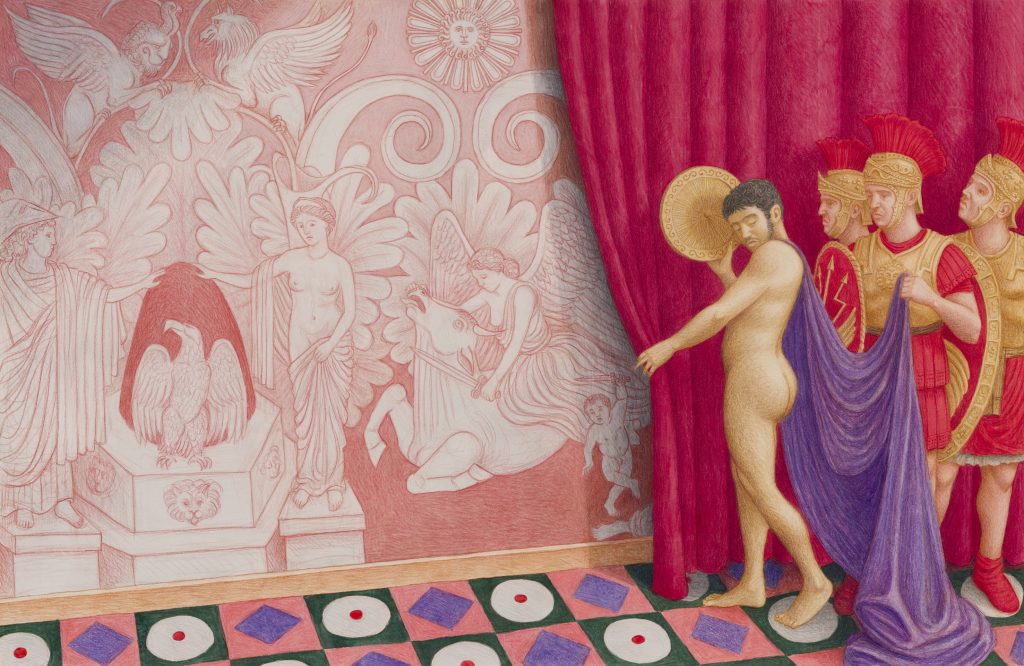
Hoewel Burgher in de stand voornamelijk nieuwe schilderijen toont, weerspiegelt The Golden Ass een ander essentieel aspect van zijn praktijk: tekenen, en meer bepaald tekenen met kleurpotlood, een medium waarmee hij al meer dan vijftien jaar intensief werkt. De kleuren in het werk worden opgebouwd via aquarelwassingen op papier, waarover de kunstenaar zorgvuldig lagen kleurpotlood arceert.
“De keizer staat tegenwoordig vooral bekend als Elagabalus of Heliogabalus, namen die afgeleid zijn van de Syrische zonnegod waarvan die hogepriester was. Tijdens diens korte regeerperiode in het begin van de derde eeuw schokte die de samenleving door de oosterse zonnegod tot het centrum van het Romeinse religieuze leven te verheffen en de Romeinse elite te verplichten deel te nemen aan onbekende rituelen uit de oostelijke provincies,” vertelt Burgher.
Dit is slechts één van de vele schandaalverhalen die rond de figuur van Heliogabalus en diens latere reputatie circuleren. De keizer kreeg in de loop der tijd dan ook een berucht aantal vulgaire bijnamen. “Golden Ass zou makkelijk aan die lijst toegevoegd kunnen worden,” merkt Burgher op. “De Franse toneelschrijver en theoreticus Antonin Artaud beschrijft hoe de keizer Rome binnenkomt terwijl die achteruit loopt, met de billen eerst, terwijl die de fallische steen die zijn god vertegenwoordigt voortleidt op een gouden quadriga, getrokken door 300 naakte vrouwen en 300 gedrogeerde stieren.”
In deze verhalen verschijnt goud naast lichamelijke substanties tijdens sacrilegische spektakels. Burgher citeert Artaud: “bij de stront, het bloed en het sperma die het lot van de keizer omkaderen, kan nog goud worden toegevoegd: het goud van het zonnevuur én het aardse goud dat op de paarse gewaden is geborduurd.”
Voor Burgher roept deze vreemde combinatie van materialen ook de symbolische Great Work op. In de middeleeuwse alchemie beschrijft de Grote Werk een transformatief proces waarbij ruwe, chaotische materie wordt afgebroken en geleidelijk verfijnd tot ze goud wordt. Dat proces werd vaak voorgesteld als een cyclus van stadia verbonden met verschillende kleuren (zwart, wit, geel en rood) en substanties, die bewegen van duisternis en verval naar verlichting en voltooiing. Binnen dit kader kunnen de stoffen die Artaud oproept (bloed, uitwerpselen, sperma en goud) gelezen worden als schakels in een symbolische keten van transformatie. Burgher beschrijft de mythe van Heliogabalus daarom als een voortdurend verschuivende cyclus. Zoals hij schrijft, functioneert de legende van de keizer als een draaiend wiel: “elke pose doet het wiel van Elagabalus’ lot draaien, waardoor stront in goud verandert en weer terug.”
Andere intrigerende bijnamen die de kunstenaar voor de keizer heeft bedacht zijn onder meer Solar Phallic Princess, Poor Little Ghost Boy, E\H en Our Lady of the Latrines, die hij geregeld verwerkt in de titels van zijn werken.
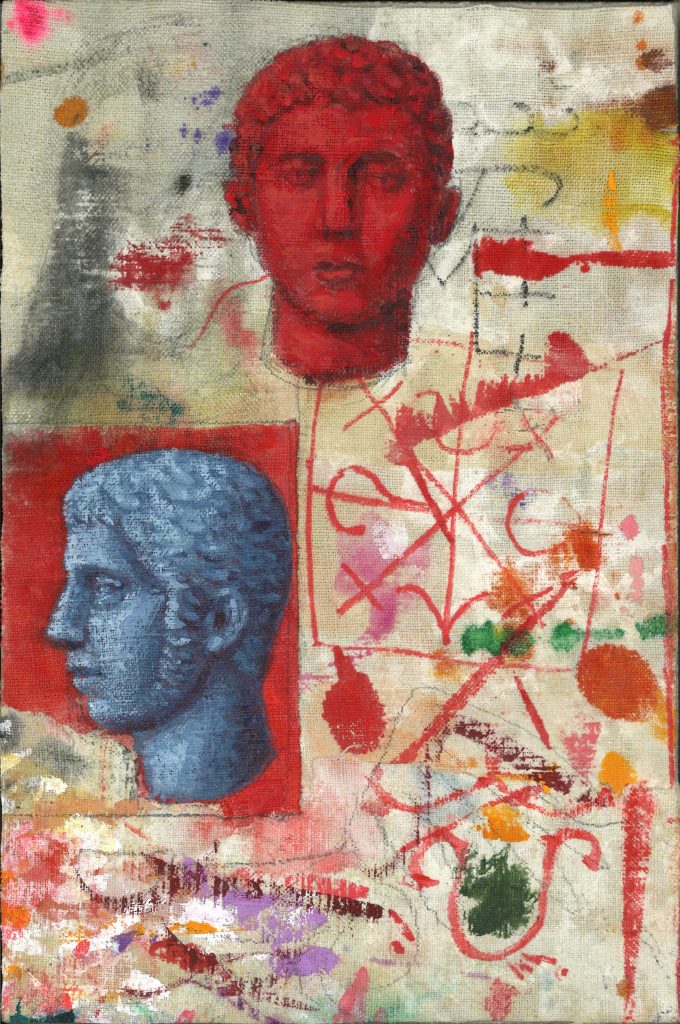
Heliogabalus (Latrine Graffiti)
Een ander werk in de stand van Ivan Gallery is Heliogabalus (Latrine Graffiti), dat verwijst naar een scène die Burgher levendig voor ogen stond terwijl hij aan deze reeks werkte. Een latrine is een gemeenschappelijk toilet, en de term roept meteen de ruwe tekeningen en teksten op die vaak achteloos op de muren worden gekrast. Burgher verbindt dat beeld met een toneelstuk van Jean Genet over de Romeinse keizer, dat lange tijd als verloren werd beschouwd maar onlangs werd teruggevonden en gepubliceerd.
In de slotscène van het stuk verschuilt de keizer zich met diens geliefde Aeginus in de paleislatrines terwijl de garde dichterbij komt. Daar merkt die de obscene graffiti op de muren op en beseft dat de teksten naar hem verwijzen. De keizer overdenkt de merkwaardige vorm van roem die daarin besloten ligt:
“Aeginus, dit is de roem waarnaar ik verlangde zonder het te weten: mijn naam en mijn titels, telkens vervormd, veranderd, grijnzend of glimlachend, kies maar, en daartussen, ze versterkend, obscene gedichten en tekeningen, die iedereen verachtelijk zou noemen, op de muren van de latrines die door de slaven worden gebruikt.” (vertaling door Elijah Burgher)
Voor Burgher suggereert deze scène een krachtige omkering. Het beeld van de keizer overleeft niet in marmeren monumenten of officiële geschiedenissen, maar in grove en anonieme graffiti. “Die scène blijft ergens op de achtergrond van mijn verbeelding aanwezig wanneer ik deze schilderijen maak, al probeer ik ze niet letterlijk te illustreren. Ik zou zeggen dat mijn belangrijkste thema’s op dit moment erotiek, offer en wederopstanding zijn,” aldus Burgher.
Deze en vele andere werken van Elijah Burgher zijn te ontdekken in de stand van Ivan Gallery in de New Art sectie.
Geschreven door Emily van Driessen
“From a teenage emperor, assassinated at seventeen by their praetorian guard, they transform successively into a cruel monster, a creature of unusual and excessive appetites, an effeminate impostor from the East, an anarchist intent on hastening the decline of the empire, an epicurean of metaphysical blasphemies, a sacred fool whose blunders cause the skirts of reality to lift, and an androgynous angel straddling the ruins of the ancient past and our precarious present.”
An evocative and powerful description of Heliogabalus (Elagabalus) by Berlin-based artist Elijah Burgher (1987, USA), whose latest body of work loosely revolves around the image of this infamously controversial Roman emperor.
In the New Art section in the booth of Ivan Gallery (Bucharest), Burgher draws on mythology, occult magic, queer desire, and art history to examine how images survive and mutate across time. The New Art section, curated by Övül Ö. Durmuşoğlu, is reserved for solo presentations by emerging artists with a compelling and conceptually thoughtful practice.
Heliogabalus or Elagabalus is a historical figure whose life has long been eclipsed by an unstable and excessive afterlife in literature, painting, opera, devotional fantasy, and gossip. “They were said to have delighted in quizzing embarrassed senators on whether they, too, had enjoyed the passive role in anal sex when they were young and beautiful,” writes Burgher in his essay Our Lady of the Latrines: Notes on the Elagabalus Egregore. Although ancient sources cast the emperor as a depraved tyrant, sexual deviant, and religious scandal, more recent readings crown them “an anarchist, hero of hedonism, saint, and martyr of the sexual revolution,” as Arrizabalaga y Prado (2010, 1) note in his research, quoted by Burgher.
Very little reliable visual evidence of the emperor survives. Only two bust types are generally attributed to Heliogabalus, largely because their name and image were systematically condemned after their death through damnatio memoriae. This scarcity of material evidence has allowed the emperor to become a screen onto which later writers and artists project their own (vicious) ideas.
The body of paintings shown at Art Rotterdam is made with acrylic paint on studio rags and material cut from failed or abandoned paintings, mounted on panels. Many works consist of ripped or torn pieces of canvas and linen collaged together. Even when painted over completely, the seams of the surface remain visible and the history of the materials appears along the edge of the panel. “They remind me of mummy rags and bathroom graffiti,” the artist explains. “I am also looking closely at Fayum tomb portraiture and the grisaille paintings of Mantegna and Bellini. Some paintings draw on my work with sigil magic and occult abstraction to explore and amplify the solar phallic cults of antiquity, Heliogabalus being an outstanding and perverse example of one.”
In his essay Our Lady of the Latrines: Notes on the Elagabalus Egregore, Burgher deliberately uses the pronouns she/her when referring to the emperor. The choice functions partly as a provocative gesture that resonates with both transfeminine readings of Heliogabalus and the playful use of feminine pronouns in gay slang.
Outside that specific textual context, however, the emperor’s gender identity remains historically uncertain. In this text, we therefore use they/them pronouns to acknowledge the variety of contemporary interpretations surrounding the emperor’s gender. The question of gender, however, is not the central focus of Burgher’s paintings, which are more concerned with the emperor’s mythos, the scarcity of historical evidence, and the long history of artistic interpretations of this enigmatic figure.
The Golden Ass
While Burgher is primarily presenting new paintings in the booth, The Golden Ass reflects another central aspect of his practice: drawing, and particularly drawing with colored pencils, a medium he has explored intensively for more than fifteen years. The colors in the work are built through watercolor washes on paper, over which the artist carefully hatches layers of colored pencil.
“The emperor is now mainly known as Elagabalus or Heliogabalus, names that derive from the Syrian solar deity they served as high priest. During their brief reign in the early third century, they shocked society by elevating the eastern sun god to the centre of Roman religious life and compelled Roman elites to participate in unfamiliar rituals imported from the eastern provinces,” tells Burgher.
This is just one of many scandalous stories that revolve around the figure of Heliogabalus and their afterlife image. In turn, the emperor acquired an infamous number of vulgar nicknames. “Golden Ass could easily be added to that list”, Burgher notes. “French playwright and theorist Antonin Artaud describes the emperor’s entry into Rome walking backward, ass-first, as they lead the phallic stone representing their god on a golden quadrigal drawn by 300 naked women and 300 drugged bulls.”
Across these legends, gold appears alongside bodily substances during sacrilegious spectacles. Quoting Artaud, Burgher notes that “to the shit, blood, and cum that frame the emperor’s fate, gold can be added, the gold of solar fire as well as the earthly gold embroidered on their purple robes.”
For Burgher, this strange constellation of materials also recalls the symbolic Great Work. In medieval alchemy, the Great Work described a transformative process in which base and chaotic matter is broken down and gradually refined until it becomes gold. The process was often imagined as a cycle of stages associated with different colours (black, white, yellow and red) and substances, moving from darkness and decay toward illumination and completion. Within this framework, the substances evoked by Artaud, blood, excrement, semen, and gold, can be read as markers within a symbolic chain of transformation. Burgher therefore describes the myth of Heliogabalus as a constantly shifting cycle. As he writes, the emperor’s legend operates like a turning wheel: “each pose spins the wheel of Elagabalus’s fortune, turning shit into gold and back again.”
Other compelling nicknames proposed by the artist for the emperor include Solar Phallic Princess, Poor Little Ghost Boy, E\H, and Our Lady of the Latrines, which he often references in the titles of his artworks.
Heliogabalus (Latrine Graffiti)
One of the other works in the booth of Ivan Gallery is Heliogabalus (Latrine Graffiti), which refers to a scene that remained vivid in Burgher’s imagination while he made this series. A latrine is a communal toilet, and the term evokes the crude, careless drawings and writings often scratched onto the walls. Burgher connects this idea to a play by Jean Genet about the Roman emperor, long believed lost but only recently rediscovered and published.
In the play’s final scene, the emperor hides in the palace latrines with his lover, Aeginus, while the guard closes in. There he notices the obscene graffiti covering the walls and recognises that the texts refer to them. The emperor reflects on the strange form of glory they represent:
“Aeginus, here is the glory that I desired, without knowing it: my name and my titles, each distorted, transformed, grimacing or smiling, your choice, among them, and strengthening them, obscene poems and drawings, which everyone would call vile, on the walls of the latrines used by the slaves.” (translation by Elijah Burgher).
For Burgher, this scene suggests a powerful inversion. The emperor’s image survives outside marble monuments and official histories and persists in crude and anonymous graffiti. “This scene lingers in the background of my imagination while I make these paintings, although I am not aiming to illustrate it. I would say that my major themes right now are eroticism, sacrifice, and resurrection,” Burgher explains.
You can explore these works by Elijah Burgher, along with many others, in the booth of Ivan Gallery in the New Art section.
Written by Emily van Driessen
Als alle wegen naar Rome leiden, zoals het gezegde wil, dan is het omgekeerde ook waar. Dan is Rome ook een startpunt. Dat geldt in ieder geval voor de stichtingsmythe van de eeuwige stad. Volgens de overlevering werd Rome gesticht door Romelus en Remus, de tweelingzonen van de Romeinse god Mars. De jongens besloten een stad te stichten op de plek waar ze werden gevonden door een wolvin.
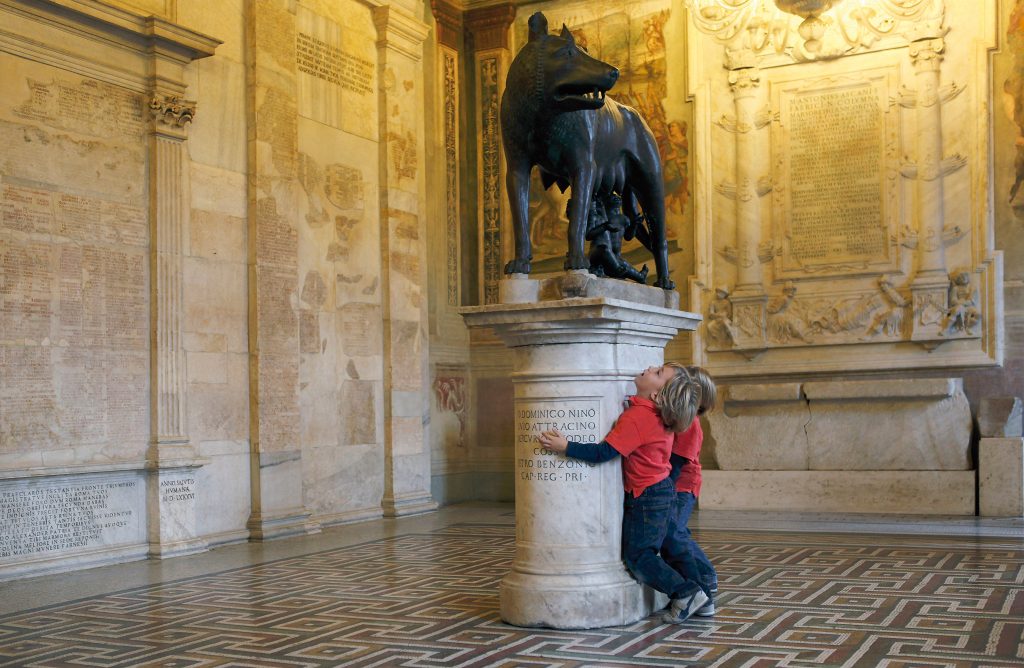
De beeltenis van deze mythe is misschien nog bekender: de bronzen sculptuur van een waakzame wolvin met twee babies als zuigelingen, beter bekend als de Lupa Capitolina. Ze staat op het Roomse stadswapen en bronzen kopieën van het beeld bevinden zich over de hele wereld: van Pisa tot Tokio en van Bucharest tot Perth.
De Roemeense videokunstenaar Aurelia Mihai maakte LUPA, een film over de Lupa Capitolina, en de kopieën van het beeld die zich overal ter wereld bevinden. Het is een goede introductie tot het werk van Mihai, die in haar werk regelmatig iconische kunstwerken opvoert. Daarbij draait het niet alleen om de werken, maar ook over de plek en de waarde die we er collectief aan toekennen. Die betekenis kan namelijk van plaats tot plaats verschillen en over tijd veranderen.
LUPA van Aurelia Mihai is te zien in Projections. Aurelia Mihai wordt vertegenwoordigd door Sector 1.
Ik heb met veel plezier naar LUPA gekeken. De film draait om de kopieën van de Lupa Capitolina die over de hele wereld te zien zijn. Waarom koos je juist dit werk voor Art Rotterdam?
De beslissing om LUPA voor het eerst in Nederland te tonen tijdens Art Rotterdam werd gezamenlijk genomen. LUPA is een complex project dat verschillende hoofdonderwerpen van mijn praktijk samenbrengt: het verweven van cultuurhistorisch onderzoek met actuele maatschappelijk relevante thema’s zoals migratie, verbondenheid en postkolonialisme, evenals het onderzoeken van monumenten en mythen als vormen van collectieve identiteit.
Het verhaal van de film omspant afstanden over verschillende continenten, van historische tijden tot het heden. Het omvat ook artistieke discoursen over originelen en replica’s en reflecteert op het medium kunst zelf.

Lupa vertelt de film en zegt op een bepaald moment: ‘I am always a copy, never a fake.’ Als kijker voel je meteen dat deze zin de kernboodschap is. Wat is de boodschap die je probeert over te brengen?
Hier verwijst Lupa naar haar eigen oorsprong. Tijdens restauratiewerkzaamheden in 2007 werd ontdekt dat de techniek die werd gebruikt om het bronzen beeld van de Capitolinische Wolvin te maken, niet bestond in de Etruskische periode. Daarom werd het beeld opnieuw gedateerd op de 11e–12e eeuw, in plaats van de 6e eeuw voor Christus, zoals eerder werd aangenomen.
Experts denken dat de Capitolinische Wolvin een replica is van een verloren gegaan Etruskisch origineel. De twee kinderen, Romulus en Remus, werden in de 15e eeuw tijdens de Renaissance toegevoegd. Vervolgens beweerde de internationale pers dat de Lupa een middeleeuwse vervalsing was of van haar voetstuk was gevallen.
De vraag is of dat terecht is, want bronsgieten roept de vraag op of brons niet al een reproductietechniek is, aangezien het proces gebaseerd is op reproductie. Met andere woorden: eerst wordt een positief model gemaakt en vervolgens vernietigd om de negatieve vorm te creëren die nodig is voor het bronsgieten. Uiteindelijk wordt in deze negatieve vorm een nieuw positief in brons gegoten. Dat wordt beschouwd als het origineel, maar het kan ook worden gezien als een bronzen kopie van het oorspronkelijke prototype.
De film LUPA onderzoekt de historische ontwikkeling van dit iconische symbool – dat zowel een monument als een mythe is – en volgt haar reis over de wereld. Door deze bril analyseert de film de ontvangst van dit monument na de herdatering in 2007, maar ook in de huidige postkoloniale context. Daarbij laat de film zien dat Lupa van iedereen is en herinnert ze ons aan haar symbolische waarde.
De Lupa Capitolina is een iconisch kunstwerk. Dat geldt ook voor het suprematistische Zwarte vierkant in de gelijknamige videowerk en voor de Zuil van Trajanus in je film Centi Piedi. Toch gaan de films slechts gedeeltelijk over deze iconische werken. Ze gaan ook sterk over de manier waarop ze worden bekeken en over de functie die wij, als samenleving, eraan toekennen. Dat is een terugkerend thema in je werk. Wanneer besefte je dat dit een onderwerp kon zijn voor je praktijk?
Vanaf het allereerste begin was ik geïnteresseerd in precies dit narratief, gebaseerd op het proces van reflectie op een onderwerp door de tijd heen. Daarom koos ik video en film als expressiemedium voor de hierboven genoemde werken.
En bij LUPA? Bij LUPA interesseerde me de notie dat monumenten en mythen deel uitmaken van ons collectieve bewustzijn. Monumenten behoren tot de openbare ruimte, terwijl mythen tot het immateriële erfgoed behoren. Ze dienen om geschiedenis of mythologie op te roepen en bevatten een narratief, een verhaal uit het verleden waarin historische feiten met fictie kunnen worden verweven. De geschiedenis en betekenis van monumenten kunnen in de loop van de tijd worden herschreven en hangen samen met het herschrijven van geschiedenis. Ze kunnen een ideologie overbrengen en propagandistisch van aard zijn. Monumenten kunnen worden misbruikt, vergeten en opnieuw ontdekt.
Een ander belangrijk aspect is dat de Capitolinische Wolvin over de wereld migreert en wordt opgenomen in verschillende samenlevingen en plaatsen, waarbij zij in elke context haar eigen betekenis krijgt — soms vergelijkbaar, soms verschillend en zelfs tegenstrijdig.
Vanaf het begin wist ik dat het werk niet alleen over de Lupa Capitolina of het Zwarte Vierkant zou gaan, maar ook een hedendaags narratief zou worden dat actuele sociaal-culturele en politieke kwesties belicht. Ik construeer verhalen in meerdere lagen, waarbij het medium film zelf vaak een van die lagen vormt.
Kan je de context en de uiteenlopende interpretaties van de Lupa Capitolina schetsen – wat zijn de verschillen tussen Boekarest en Tokio bijvoorbeeld?
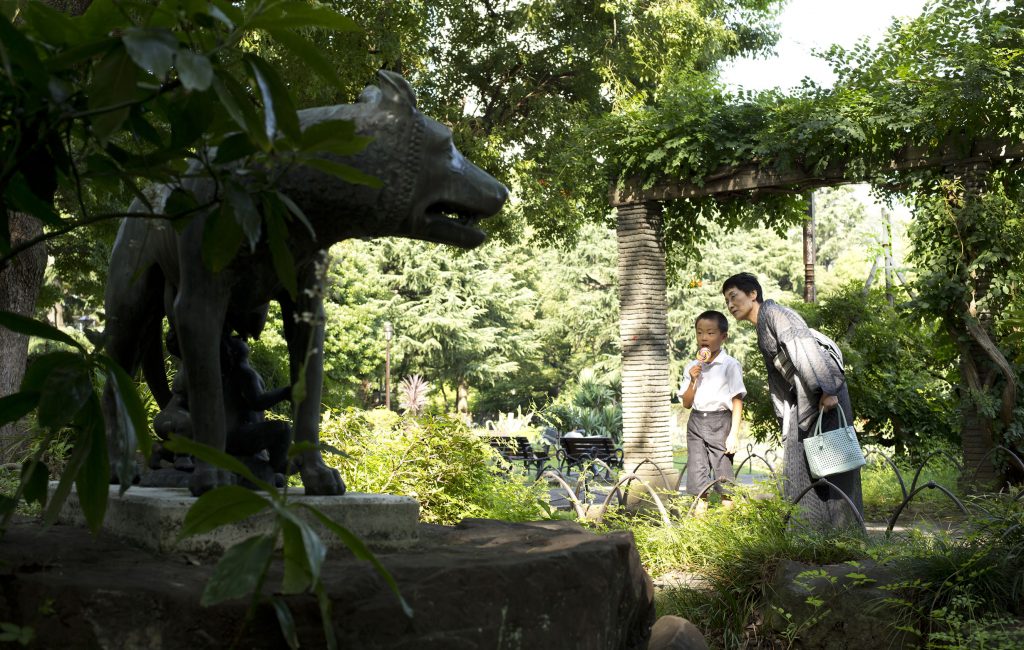
Er staan drie bronzens standbeelden van de Romeinse wolvin in Tokio, waarvan er twee zich op openbare plaatsen bevinden. Het eerste staat in een park en werd in 1938 geschonken door de Italiaanse regering; het tweede werd in 2001 door de stad Rome geschonken ter gelegenheid van de vijfde verjaardag van het stedenpartnerschap tussen Tokio en Rome. Het derde standbeeld werd aangeboden aan kroonprins Akihito van Japan tijdens zijn bezoek aan Rome in juli 1953.
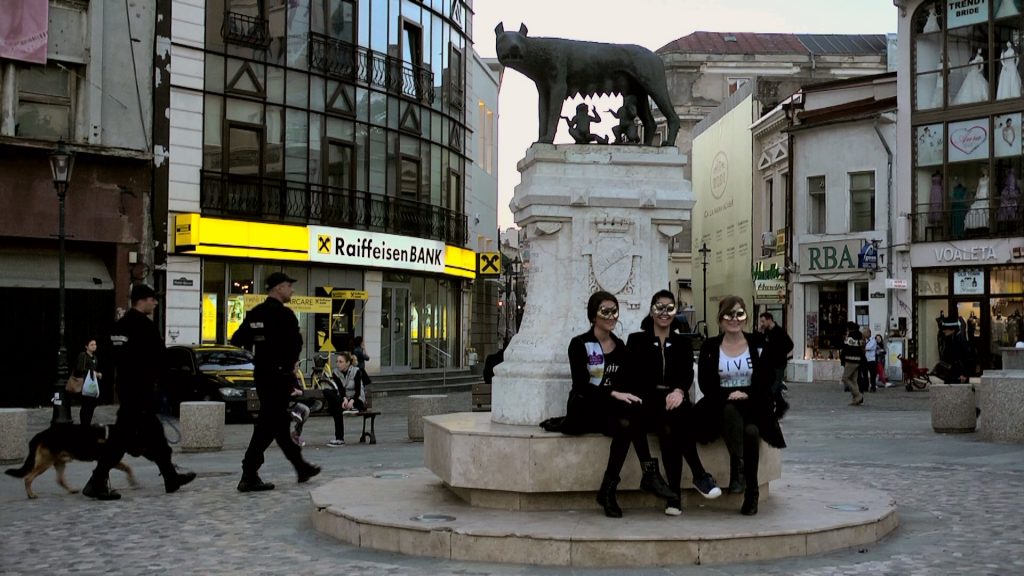
De gemeente Rome schonk het Lupa-standbeeld aan Boekarest in 1906 ter viering van de 40e verjaardag van de kroning van koning Carol I van Roemenië en de 1.800e verjaardag van de Romeinse verovering van Dacië.

Twee scènes in de film benadrukken het belang van de monumenten in de twee steden. In Tokio vertelt een grootmoeder aan haar kleinzoon de legende over het ontstaan van Rome. In Boekarest vertelt de wolvin haar eigen geschiedenis:
“Sinds ik in 1906 in Boekarest aankwam, ben ik vijf keer verplaatst, om uiteindelijk weer naar dezezelfde plek terug te keren. Ik heb twee wereldoorlogen en de dictatuur van Ceaușescu ongedeerd overleefd. In de Moldavische hoofdstad Chișinău liep het anders af. Het Sovjetleger vernietigde mij in 1945 als vermeend symbool van het fascisme. Ik belichaamde de Latijns-Romeinse wortels van het Moldavische volk en de Roemeense taal. Ze smolten mij om om er wapens van te maken.”
De film creëert zijn eigen werkelijkheid door momenten van interactie met de sculpturen in scène te zetten alsof het een roadmovie is – een reis door tijd en ruimte.
Ik kan me voorstellen dat het maken van een korte film als LUPA veel tijd kost. Het vraagt veel middelen en reizen. Wat was het meest uitdagende onderdeel van het realiseren van dit project?
Inderdaad, het was een zeer complex project dat meerdere jaren in beslag nam. Het onderzoek was intensief en het verkrijgen van filmvergunningen in musea en verschillende landen, evenals het organiseren van reizen, was zeer tijdrovend. Ik had echter een heel goed team en kreeg veel steun van instellingen in Rome, zoals de Villa Massimo van de Duitse Academie.
Geschreven door Wouter van den Eijkel
If, as the saying goes, all roads lead to Rome, then the reverse must also be true. Rome is a starting point. This certainly applies to the founding myth of the Eternal City. According to tradition, Rome was founded by Romulus and Remus, twin sons of the Roman god Mars. The boys decided to establish a city on the spot where they had been found by a she-wolf.
The image associated with this myth may be even more famous: the bronze sculpture of a watchful she-wolf with two infants suckling, better known as the Capitoline Wolf. It appears on the Roman city coat of arms and bronze copies of the sculpture can be found all over the world, from Pisa to Tokyo and from Bucharest to Perth.
Romanian video artist Aurelia Mihai created LUPA, a film about the Capitoline Wolf and the copies of the sculpture that are located around the world. It serves as a good introduction to Mihai’s work, in which she regularly features iconic artwork. Her focus is not only on the work itself, but also on the places where it appears and the value we collectively assign to it. That meaning, after all, can differ from place to place and change over time.
LUPA by Aurelia Mihai can be seen in Projections. Aurelia Mihai is represented by Sector 1.
I had a great time watching LUPA, which centres around the copies of the Capitoline Wolf found all around the world. Why did you pick this particular work for Art Rotterdam?
The decision to present LUPA for the first time in the Netherlands at Art Rotterdam was made collectively. LUPA is a complex project that combines several central aspects of my practice: the intertwining of cultural-historical research with current socially relevant topics such as migration, belonging and postcolonialism, as well as the exploration of monuments and myths as forms of collective belonging. The film’s plot spans distances across continents, stretching from historical times to the present day. It also encompasses artistic discourses on originals and replicas and reflects on the medium of art itself.
Lupa narrates the film and at one point, says, “I am always a copy, never a fake.” As a viewer, you immediately sense that this line is the core message. What is the message you are trying to convey?
Here, Lupa refers to her own origins. During restoration work in 2007, it was discovered that the technique used to create the Capitoline Wolf bronze sculpture did not exist during the Etruscan period. Consequently, it was re-dated to the 11th–12th century, rather than the 6th century BC, as previously assumed. Experts believe that the Capitoline Wolf is a replica of a lost Etruscan original. The two children, Romulus and Remus, were added in the 15th century during the Renaissance. The international press then claimed that the Capitoline Wolf was either a ‘medieval fake’ or ‘had fallen from its pedestal’.
Another issue concerns the bronze technique itself. This raises the question of whether bronze itself is a reproduction technique, given that its processes are based on reproduction. In other words, a positive is first created and then destroyed to produce the negative required for bronze casting. Finally, a new positive is cast in bronze within this negative. This is considered the original, but it can also be considered a bronze copy of the original prototype.
The film LUPA examines the historical evolution of this iconic symbol – both a monument and a myth – and follows its journey around the world. In this context, it analyses the reception of this monument after its redating in 2007, but also in the current postcolonial context. Here, it shows that Lupa belongs to everyone and reminds us of its symbolic value.
The Capitoline Wolf is an iconic artwork. As are the Suprematist Black Square in the eponymous video work and Trajan’s Column in your film Centi Piedi. Yet the movies are only partially about these iconic works. They are also very much about the way they are seen and the function society ascribes to them. This is a recurring theme in your work, so when did you first establish this as a theme?
From the very beginning, I was interested in precisely this narrative, based on the process of reflection on the subject over time. And that is why I chose video and film as the medium of expression for the work described above.
I would describe why I was interested in this process in Lupa as follows: monuments and myths are part of our collective consciousness. Monuments belong to the public space, while myths belong to intangible heritage. They serve to evoke history or mythology and contain a narrative, a story from the past that can interweave historical facts with fiction. The history and meaning of monuments can be rewritten over time and is linked to the rewriting of history. They can convey an ideology and be propagandistic in nature. Monuments can be misused, forgotten and rediscovered.
Another important aspect is the fact that the Capitoline Wolf migrates around the world and is assimilated into different societies, in different places and in each context, is given its own meaning, similar or different, and even contradictory.
From the outset, I knew that the work would not only be about the Capitoline Wolf or the Black Square, but also become a contemporary narrative highlighting current socio-cultural and political issues. I construct narrations in multiple layers, with the medium of film itself often being one of them.
You mention the differences in context and the various interpretations of the Capitoline Wolf—what are the differences between Bucharest and Tokyo, for example?
There are three bronze statues of the Roman she-wolf in Tokyo, two of which are located in public places. The first is in a park and was donated by the Italian government in 1938, the second by the city of Rome in 2001 to mark the fifth anniversary of the city partnership between Tokyo and Rome. The third statue was offered to Crown Prince Akihito of Japan during his visit to Rome in July 1953.
The Municipality of Rome gifted the Lupa statue to Bucharest in 1906 to celebrate the 40th anniversary of King Carol I of Romania’s coronation and the 1,800th anniversary of the Roman conquest of Dacia.
Two scenes in the film highlight the importance of the monuments in the two cities. In Tokyo, a grandmother recounts the legend of Rome’s creation to her grandson. In Bucharest, the she-wolf recounts its own history:
“Since I arrived in Bucharest in 1906, I’ve moved five times, only to ultimately return to this same place. I survived two world wars and the Ceausescu dictatorship unscathed. It was a different story in the Moldovan capital of Chisinau. The Soviet army destroyed me in 1945 as an alleged symbol of fascism. I embodied the Latin-Roman roots of the Moldovan people and the Romanian language. They melted me down to make weapons out of me.”
The film creates its own reality by staging moments of interference with sculptures as if they were a road movie – a journey through time and space.
I can imagine making a short film like LUPA is a long time in the making, involving considerable resources and travelling. What was the most challenging part about this project?
Yes, it was a very complex project that took several years to complete. The research was intensive and obtaining filming permits in museums and different countries, as well as organising travel, was very time-consuming. But I had a very good team and received a lot of support from institutions in Rome, such as the German Academy Villa Massimo.
Written by Wouter van den Eijkel
The fact that the work of Daphne van de Velde is being shown at Unseen Photo is not surprising. Her work consists of photographs and sculptures made from photographs. But this simple description does not do justice to the breadth and singularity of Van de Velde’s work. The results are preceded by a performance and video registration. As a result of this procedure, and the associative image manipulation that follows, Van de Velde’s work cannot easily be pinned down or compared with that of others. It stands on its own.
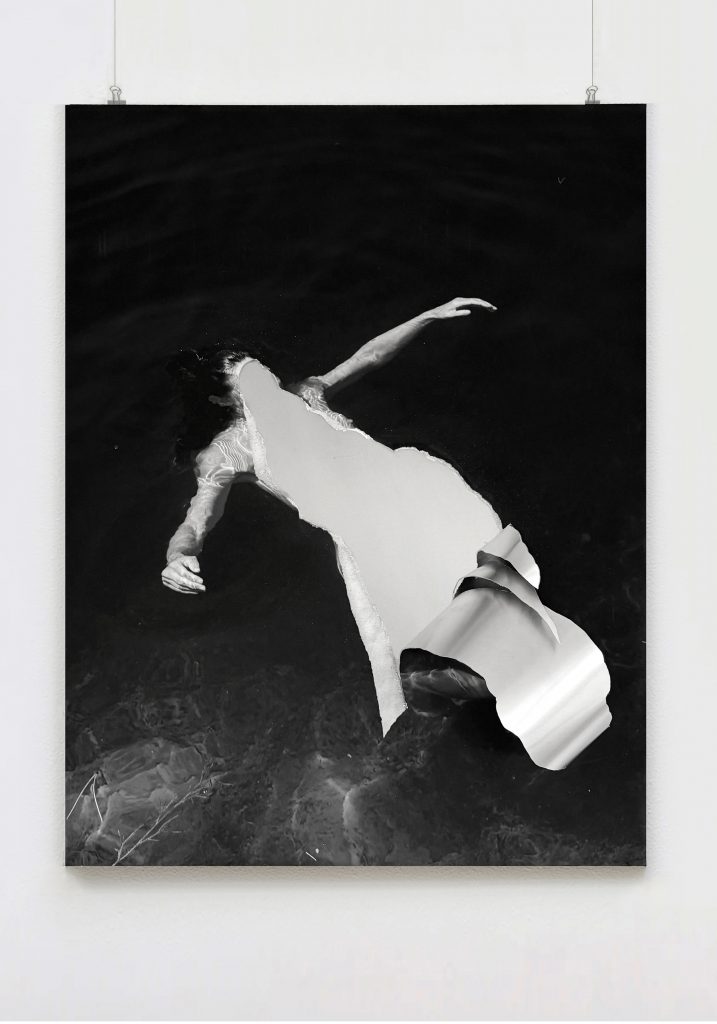
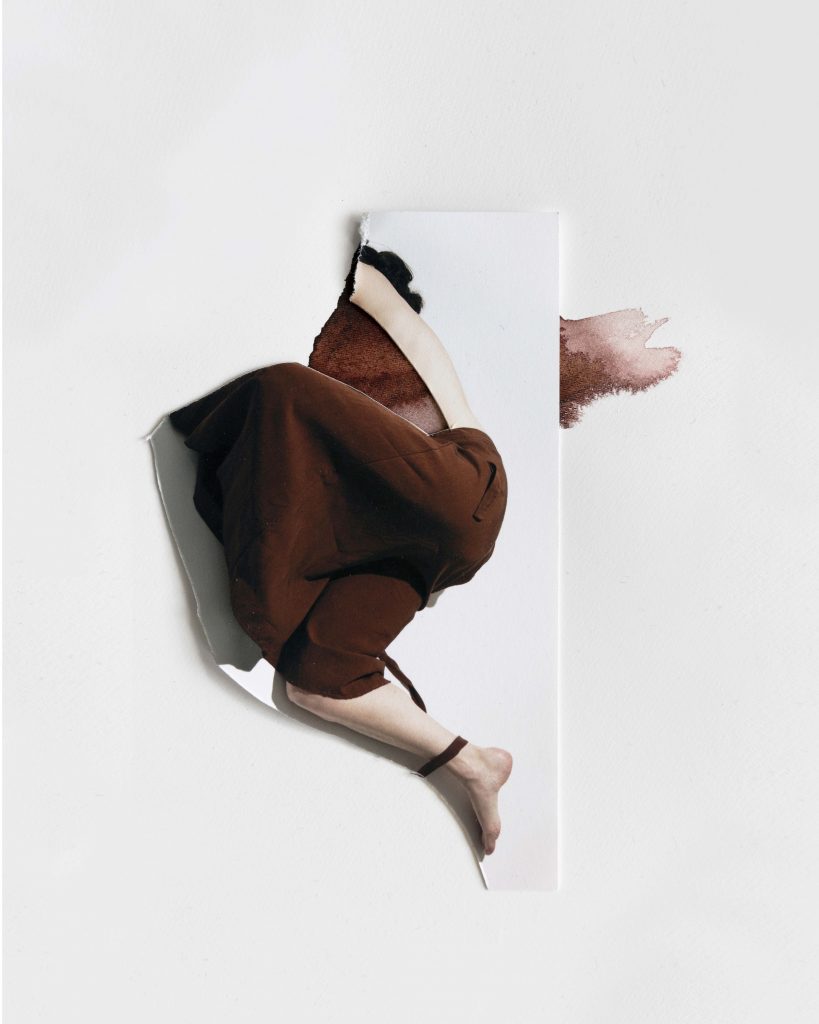
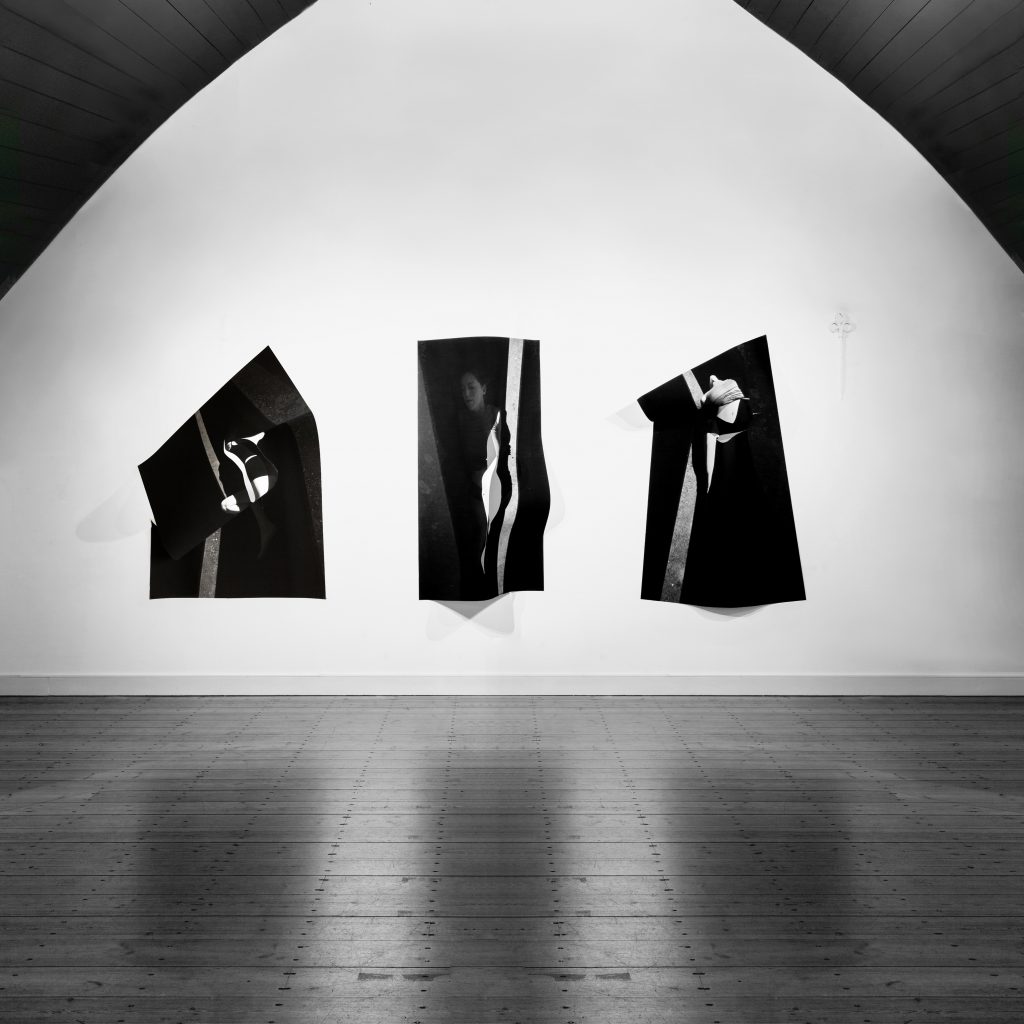
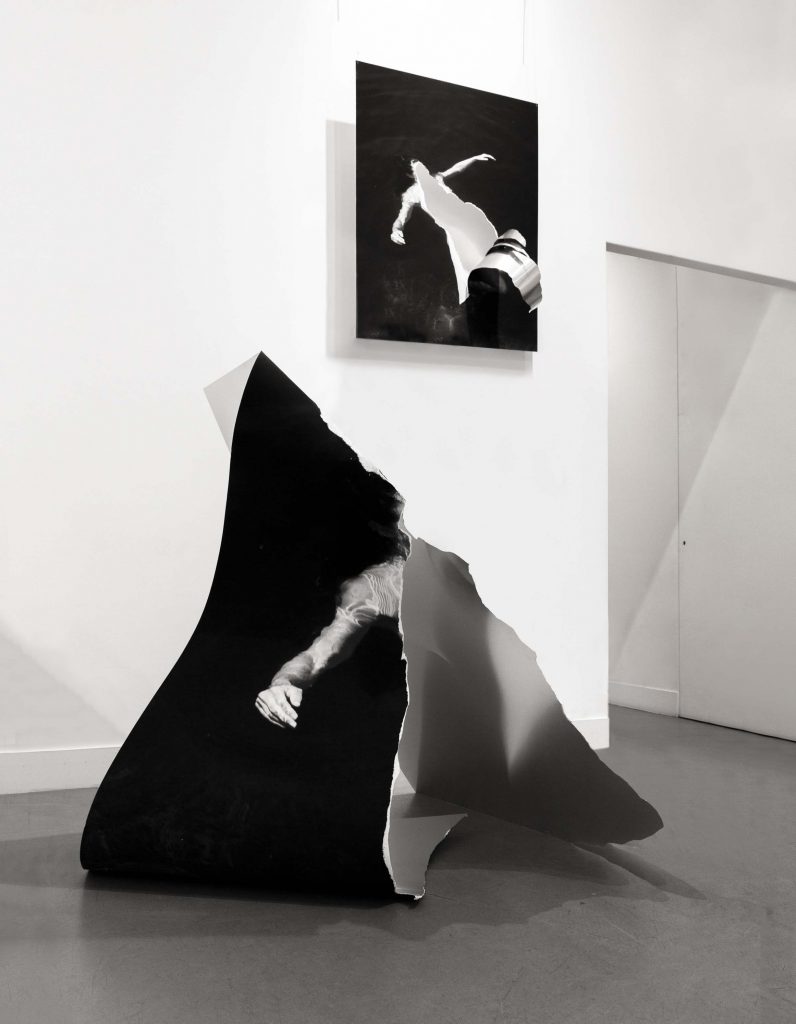
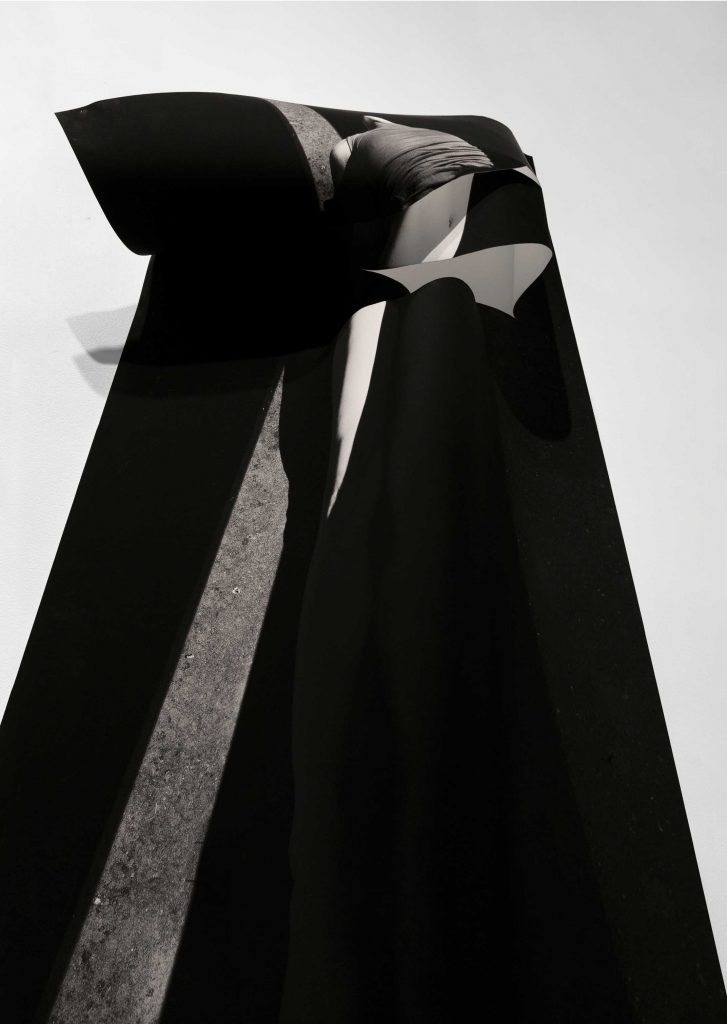
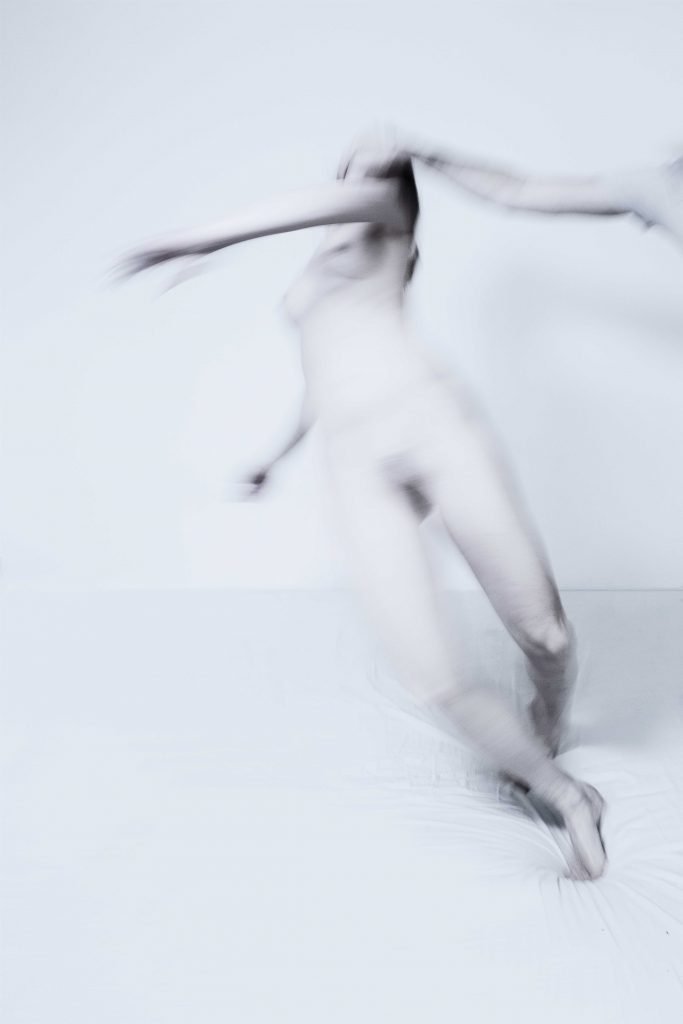
The person in the photographs is Van de Velde herself. The pictures are stills from the recording of a performance. She prints the images and then tears or bends them so that the tension she experienced as a dancer is incorporated into the image.
In a photograph from her newest series, Penthesilea, we see her lying in water with her arms spread out, the silhouette of her body visible. The core—her torso and face—has been torn out. That portion of paper curls out from the flat surface. The tension is palpable.
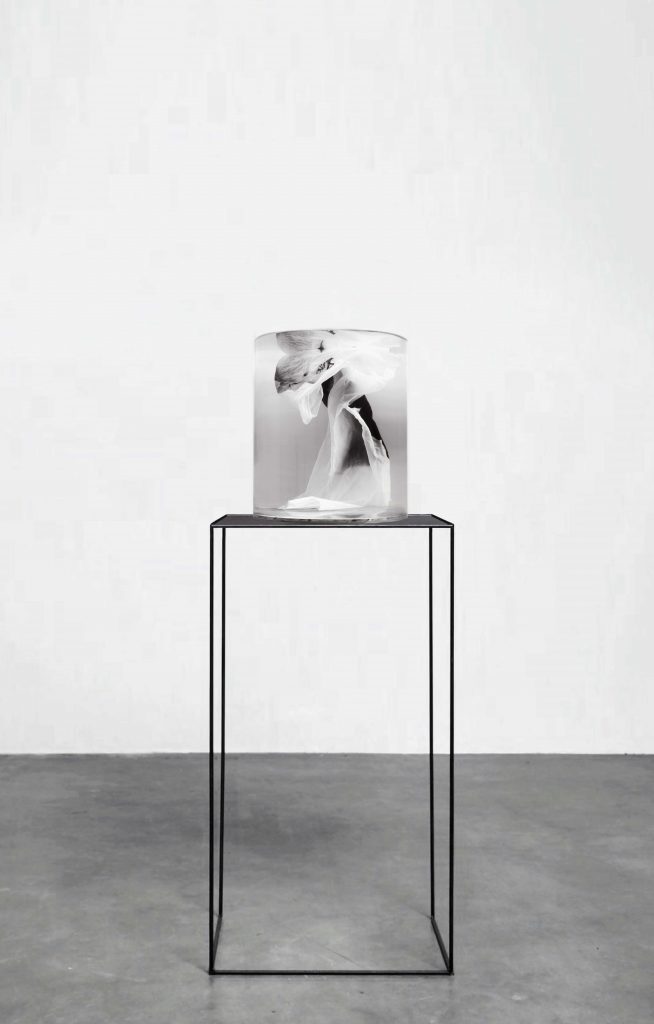
In the sculpture Crossing, the movement of a dancer can be recognised: a raised knee in a brown tunic. Here, too, part of the body is missing—the face this time. Revealing and concealing is a central theme in Van de Velde’s work. In Penthesilea, she links this to the myth of Penthesilea, the Amazon queen who, in a male-dominated world, chose love rather than indifference. We spoke with Van de Velde about her new series and unique approach.
Works from the series Penthesilea by Daphne van de Velde can be seen at Unseen Photo at the Black Swan Gallery stand.
At Art Rotterdam, work from your new series Penthesilea will be shown. Not everyone is familiar with the myth of this Amazon queen. Why were you inspired by this story and why did you decide to use it in your work?
The unusual names in Greek mythology make it seem as if we are speaking about another era, yet they also essentially address our own time: how we relate to ourselves and to one another, and how we position ourselves within the world we inhabit. What appeals to me in these texts is that they are stripped of all irrelevant information that characterises our time.
Penthesilea caught my attention because she clearly positions herself as a woman in a male-dominated world. I admire her courage to cast off her armour, step out of her self-chosen prison and move from indifference towards love. In my newest series of work, I walk alongside her for a while, though at times I also follow my own path.
At the fair, we see the final result of what could be described as a multi-stage process: dance, performance-photography-sculpture. Can you explain your approach?
I do not divide my work that way, but choose a medium that best suits what I want to express in a particular artwork, but I understand what you mean. Because of my background in contemporary dance and degrees in Fine Arts, Architecture and Autonomous Photography, my work is rooted in spatial awareness and bodily movement. I move between photography, performance and sculpture to explore these transitions. My own body functions as subject, instrument, carrier and voice.
What does your work require?
To make art, I need five dimensions: the first three to give a work spatial presence, supplemented by time and place. The notion of time is especially important because my work has a narrative quality. The title of the series, Penthesilea, suggests this.
Can you elaborate on this?
You need time to watch a performance. With a photograph, this is different – you receive all the information at once. A sculpture lies somewhere in between: you need time to observe it from all sides. The reason sculpture stands at the end of this three-stage process is that I create my art for an audience and that audience does not always have access to my performance.
Within my process, I effectively freeze time several times. The moment I take a still from a performance is the first instance. To visualise the bodily tension I experience as a dancer, I transform the two-dimensional plane of the photograph into a three-dimensional one. I do this by pulling or pushing the surface—sometimes until it tears—to allow certain parts of the body to disappear and others to emerge. In some cases, the documentation of the final sculpture can be a third freezing of time, as it enables me to incorporate the direction of light.
You also mentioned the place where your work is shown. Do you determine that on a work-by-work basis?
Location is important. For Art Rotterdam, the sculptural form comes closest to what I want to convey in relation to the audience there. Soon my work will be shown at an exhibition at the EYE Filmmuseum in Amsterdam, where my films function best as the medium. In places where I can meet the audience within the space and where sufficient room is available, performance works well.
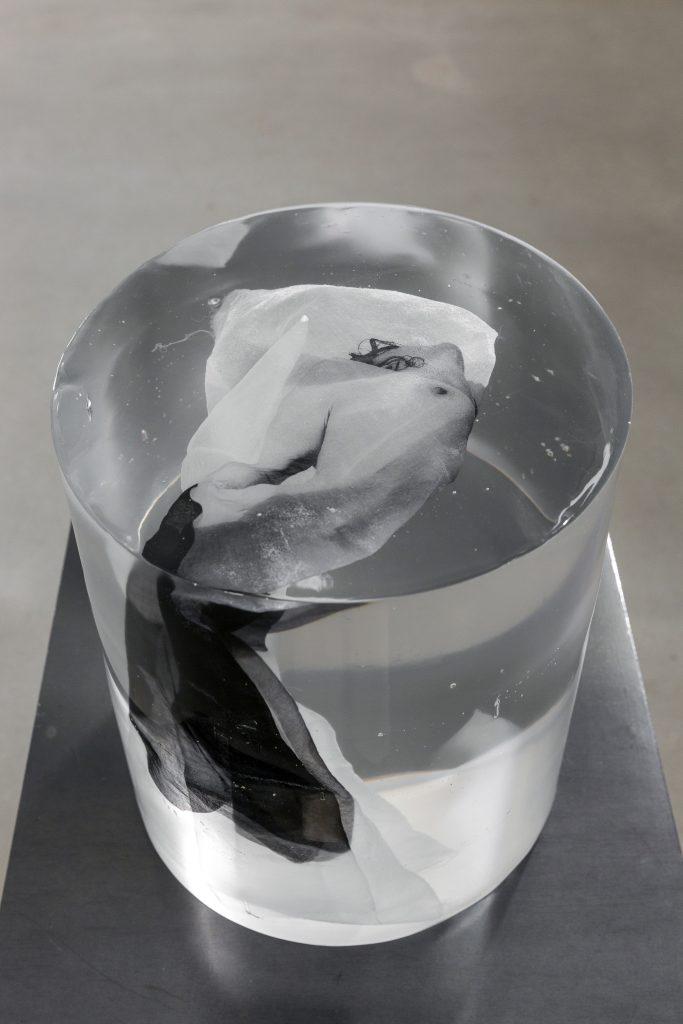
During the opening of the PhotoBrussels Festival, I presented a performance in which I encountered the image of my body on a life-size photograph that was 2 1/2 metres high and manipulated it with my body until a sculpture remained. Dance and the deformation of the photograph intertwine, something I can literally demonstrate to the audience.
This is also reflected in the presentation of the work within the series Penthesilea. Some sculptures consist of folded photographic paper. Others are torn. In both cases, the images are not entirely visible. My approach is highly associative. At the moment of creation, I choose the form that best suits the artwork.
How would you describe the theme of your work?
Conceptually, my work involves the revealing and concealing of the body, exposure and protection. That is why I never show the body in its entirety, but emphasise certain parts, while allowing others to be omitted by literally removing them or placing them in shadow.
Your gallerist told me you were once a timid person and that dance helped you to develop a sense of presence. That connects with the theme of revealing and concealing the body. When someone moves, you never see everything at once.
Everyone has their own way of communicating. There was a time in my life when I found it very difficult to express myself verbally. Dance became a way for me to speak – and became almost addictive.
My initial form of communication was contemporary dance, followed by photography. In recent years, I have combined both, rooted in a personal narrative. For me, making art remains a means of communication. The artworks reflect my emotions, such as love and the fear of it, but it is not exclusively about me. It involves feelings we all share as human beings.
Your work stands apart in that it does not directly reference other artists. Are there artists with whom you feel an affinity?
I am drawn to artists who want to tell their own story, regardless of form or conceptual consequences. In that sense, I have great admiration for the music of PJ Harvey, who adopts a musical style appropriate to each project. Her work is cumulative and comparable to my art. Each project stands on its own, yet is built on previous ones. I am not interested in repeating the same art or music; once I have done something, it loses its sense of urgency.
Another artist I deeply admire is the prematurely deceased British-Iraqi architect Zaha Hadid. With her well-known statement, “There are 360 degrees, so why stick to one?”, she articulated a vision of architecture in which materials and forms offer infinite possibilities beyond the familiar 90-degree angle. I approach my art in a similar way. I enjoy material research and connections that initially seem impossible. I continue to experiment until I find a solution that makes them possible.
You mentioned earlier that Penthesilea lived as a woman in a male-dominated world and the artists you cited are also women. Is there a feminist critique within your work?
Penthesilea is not an idealised figure according to the male gaze, but a fallible female character. She inspired me to show how the conflict between desire and self-control continues to this very day. Despite women’s emancipation, female desire often remains beneath the surface. Penthesilea embodies the charged moment when an inner boundary is crossed and interior experience breaks outward.
Through my work, I want to advocate female strength, yet it is certainly not intended as anti-male. I believe in a fundamental difference between women and men in how they think, feel and act. Every individual contains, to varying degrees, elements of both femininity and masculinity. To me, there is no such thing as male or female art. What exists is the act of working based on your own strength—and for me that includes the strength I experience through womanhood and the courage to acknowledge both boundaries and desires.
Is there a project you would like to carry out in the future?
I would very much like to create the spatial work shown at Art Rotterdam on a monumental scale. The enlarged dimensions would allow audiences to relate optimally to the artwork.
A grant I received last year from the Province of Gelderland enabled me to develop a technique that makes it possible to produce my photo-sculptures in life-size, while maintaining structural stability.
My greatest dream is to present my sculptures in a monumental museum space where I can combine them with my films and performances to create a comprehensive experience of my work. Yet outdoor settings-squares and parks-are equally compelling, as they allow me to combine the direct nature of my work with the direct nature of public spaces.
Written by Wouter van den Eijkel
Dat het werk van Daphne van de Velde te zien is op Unseen Photo is begrijpelijk. Het resultaat van haar werk zijn foto’s en sculpturen gemaakt van foto’s. Tegelijk doet het geen recht aan de breedte en eigenzinnigheid van Van de Veldes praktijk. Aan de resultaten gaan namelijk een performance en een videoregistratie vooraf. Dit procedé en de associatieve beeldbewerking die daarop volgt, zorgen ervoor dat Van de Veldes werk zich niet laat vastpinnen of vergelijken met dat van anderen. Het staat op zichzelf.
De persoon op de foto’s is Van de Velde zelf. Het zijn stills van de registratie van een performance. Die beelden drukt ze af, vervolgens scheurt of buigt ze die precies op zo’n manier dat de spanning die ze als danser voelde ook terugkeert in het beeld.
Op een foto uit haar nieuwste serie Penthesilea zien we haar in het water liggen met haar armen wijd gespreid en het silhouet van haar lichaam. De inhoud, haar torso en gezicht, scheurde ze eruit. Dat deel van het papier kom als een krul het platte vlak uit. De spanning is voelbaar.
In de sculptuur Crossing herken je de beweging van een danser. Een opgeheven knie in een bruine tunica. Ook hier ontbreekt een deel van het lichaam: het gezicht. Onthullen en verbergen is een centraal thema in het werk van Van de Velde. In Penthesilea koppelt ze dit aan de mythe van deze Amazone-koningin die in een door mannen gedomineerde wereld koos voor liefde in plaats van onverschilligheid. We spraken Daphne van de Velde over haar nieuwe serie en unieke werkwijze.
Werken uit de serie Penthesilea van Daphne van de Velde zijn te zien op Unseen Photo in de stand van Black Swan Gallery.
Op Art Rotterdam is werk te zien uit je nieuwe serie Penthesilea. Ik denk dat niet iedereen de mythe van deze Amazone-koningin meteen paraat heeft. Hoe kwam juist dit verhaal op je pad en waarom besloot je hierover werk te maken?
Door de afwijkende namen in de Griekse mythen lijkt alsof wij over een heel andere tijd praten, maar inhoudelijk gaan ze ook over onze tijd: hoe gaan wij met onszelf en elkaar om, en hoe verhouden wij ons tot de wereld waarin wij leven. Wat mij in de teksten aanspreekt is dat ze zijn ontdaan van alle irrelevante informatie die onze tijd kenmerkt.
Penthesilea was mij opgevallen doordat zij zich manifesteert als vrouw in een door mannen gedomineerde wereld. Ik bewonder haar moed om haar pantser af werpen, uit haar zelfgekozen gevangenis te stappen en van onverschilligheid op liefde over te gaan. In mijn nieuwste serie kunstwerken loop ik een stukje met haar mee, maar neem soms ook een eigen afslag.
Op de beurs krijgen we straks het eindresultaat te zien van een drietrapsraket: dans, performance-fotografie-sculptuur. Kan je uitleggen hoe je te werk gaat?
Zelf deel ik mijn werk niet zo in, ik kies het medium dat het best past bij wat ik met een bepaald kunstwerk wil zeggen, maar ik begrijp wel wat je bedoelt. Door mijn achtergrond in contemporaine dans, en diploma’s in Fine Arts, in Architectuur en in Autonome Fotografie, is mijn werk geworteld in ruimtelijk bewustzijn en lichamelijke beweging. Ik beweeg me tussen fotografie, performance en sculptuur om deze grensovergangen te verkennen. Mijn eigen lichaam fungeert zowel als onderwerp, als instrument, als drager én als stem.
Wat heb je nodig om jouw werk te maken?
Om kunst te maken heb ik vijf dimensies nodig, de eerste drie om een werk ruimtelijk te maken, aangevuld met tijd en plaats. Met name het begrip ‘tijd’ is belangrijk in mijn werk, omdat mijn werk een verhalend karakter heeft. Alleen al door de titel van de serie, Penthesilea.
Kan je dat toelichten?
Je hebt tijd nodig om een performance te bekijken. Dat speelt bij een foto niet, daar krijg je alle informatie in een keer. Een sculptuur zit daar tussenin, je hebt tijd nodig om het van alle kanten te bekijken. Dat het toch aan het eind van die drietrapsraket staat komt doordat ik mijn kunst voor publiek maak, en het publiek heeft natuurlijk niet altijd de beschikking over een performance van mij.
Je noemde ook de plaats waar je werk te zien is. Bepaal je dat van geval tot geval, van locatie tot locatie?
De locatie in ook belangrijk. Voor Art Rotterdam komt de sculptuurvorm het dichtst bij wat in wil zeggen in relatie tot het publiek wat daar rondloopt. Binnenkort is mijn werk te zien op een tentoonstelling in het EYE filmmuseum in Amsterdam, daar komen mijn films als medium het best tot hun recht. Op plekken waar ik het publiek wel in de ruimte kan ontmoeten en er daarvoor genoeg ruimte is, werkt een performance goed.
In mijn proces bevries ik in feite meerdere malen de tijd. Het moment dat ik een still neem uit een performance is het eerste moment. Om de spanning van het lichaam te verbeelden die ik als danser in mijn lichaam voel, vervorm ik het tweedimensionale vlak van de foto tot een driedimensionaal vlak. Dit doe ik door aan het vlak te trekken of te duwen – soms tot het kapot gaat – , waarbij ik op deze manier sommige delen van het lichaam laat verdwijnen en ik andere delen juist naar voren laat komen. De registratie van de uiteindelijke sculptuur is in sommige gevallen nog een derde bevriezing, omdat ik dan de richting van het licht nog mee kan nemen.
Tijdens de opening van het PhotoBrussels Festival (eind. januari, red.) deed ik een performance waarbij ik de beeltenis van mijn lichaam op een levensgrote foto van 2,5 meter hoog ontmoet en bewerk met mijn lichaam totdat er een sculptuur over blijft. Dans en het vervormen van de foto verweef ik en dat kan ik hier letterlijk aan het publiek laten zien.
In de serie Penthesilea zie je dat ook terug in de manier waarop de werken worden gepresenteerd. Een aantal sculpturen bestaat uit gevouwen fotopapier. Andere werken zijn gescheurd. In beide gevallen zijn de afbeeldingen niet in zijn geheel te zien. Mijn werkwijze is in hoge mate associatief. Op het moment dat ik het maak, kies ik de beste vorm voor een kunstwerk.
Hoe zou je het thema van je werk beschrijven?
Inhoudelijk gaat mijn werk gaat over het onthullen en het verbergen van het lichaam, over blootstelling en bescherming. Dat is waarom ik het lichaam nooit in zijn geheel laat zien, maar delen belangrijk maak en delen laat wegvallen door ze letterlijk weg te nemen of ze in de schaduw te plaatsen.
Je galeriehouder vertelde mij dat je ooit een timide persoon was en dat dans je hielp om jezelf een houding te geven. Dat sluit aan bij het thema onthullen en verbergen van het lichaam. Als iemand beweegt, krijg je nooit alles tegelijk te zien.
Iedereen heeft een eigen manier van communiceren. Er is een tijd in mijn leven geweest waarin ik mij heel moeilijk in woord kon uitdrukken. In die tijd werd dans voor mij een manier was om toch iets te kunnen zeggen, een bijna verslavende manier.
Mijn vorm van communicatie was aanvankelijk contemporaine dans en vervolgens fotografie. De laatste jaren combineer ik beide, vanuit een persoonlijk verhaal. Voor mij is het maken van mijn kunst nu nog steeds een manier om te communiceren. De kunstwerken geven weliswaar mijn emoties weer, zoals liefde en de angst daarvoor, maar gaan niet exclusief over mij. Ze gaan over gevoelens die wij als mens allemaal hebben.
Je werk staat op zichzelf in die zin dat het niet verwijst naar andere kunstenaars. Zijn er kunstenaars waarmee je je verwant voelt?
Ik houd van kunstenaars die hun eigen verhaal willen vertellen, ongeacht de vorm of de inhoudelijke consequenties die daaraan verbonden zijn. In die zin heb ik veel waardering voor de muziek van PJ Harvey die bij elk muziekproject een muzieksoort gebruikt die daarbij past. Haar muziek is in die zin cumulatief en vergelijkbaar met mijn kunst. Ieder project staat op zichzelf, maar staat wel op de schouders van eerdere projecten. Steeds dezelfde kunst of muziek maken is voor mij niet interessant. Als ik het al gedaan heb mist het elke urgentie voor mij.
Een andere kunstenaar waarvoor ik veel waardering heb, is de veel te vroeg overleden Brits-Irakese architecte Zaha Hadid. Met haar beroemd geworden uitspraak “There are 360 degrees, so why stick to one?” verwoordde ze haar visie op architectuur waarin de mogelijkheden van materialen en vormen oneindig zijn niet gebonden aan de veel gebruikte rechte hoek van 90 graden. Zo benader ik mijn kunst ook. Ik houd van materiaalonderzoek en verbindingen die in eerste instantie niet mogelijk lijken, dan ga ik net zo lang proberen tot ik een oplossing gevonden heb, waardoor het wel kan.
Je noemde eerder al dat Penthesilea als vrouw in een door mannen gedomineerd wereld leeft, de voorbeelden die je zojuist geeft als verwante kunstenaars zijn allebei vrouw. Zit er een feministische kritiek in jouw werk?
Penthesilea is geen ideaalbeeld volgens de mannelijke blik, maar een feilbaar vrouwelijk personage. Ze inspireerde me te tonen hoe het conflict tussen verlangen en zelfbeheersing nog steeds voortduurt. Ondanks de vrouwenemancipatie schuilt het vrouwelijke verlangen onder de oppervlakte. Penthesilea verbeeldt het geladen moment waarop een innerlijke grens wordt overschreden en het innerlijke naar buiten breekt.
Met mijn werk wil ik inderdaad een lans breken voor de vrouwelijke kracht, maar mijn werk is absoluut niet man-onvriendelijk bedoeld. Wel geloof ik in een fundamenteel verschil tussen vrouwen en mannen: hoe ze denken, voelen en handelen. In elk mens zit in meer of mindere mate een deel vrouwelijkheid en mannelijkheid. Voor mij bestaat er dan ook niet zoiets als mannelijke of vrouwelijke kunst. Wel bestaat er zoiets als uitgaan van jouw eigen kracht, en dat is bij mij mede de kracht die ik ondervind van het vrouw-zijn en het durven uitkomen voor je vrouwelijke grenzen én verlangens.
Is er een project dat je graag in de toekomst zou willen oppakken?
Ik zou heel graag het ruimtelijke werk dat ik op Art Rotterdam laat zien in metershoog formaat uitgevoerd zien. Door de schaal kan het publiek zich dan optimaal tot het kunstwerk verhouden.
Door een subsidie die ik afgelopen jaar van de Provincie Gelderland heb ontvangen, kon ik een techniek ontwikkelen die het mogelijk maakt om mijn fotosculpturen levensgroot te maken en vormvast te houden, zodat dit nu mogelijk gaat zijn.
Mijn grootste droom is om mijn sculpturen in een monumentale museumruimte te tonen waar ik ze kan combineren met mijn films en mijn performances voor een totaalbeleving van mijn werk. Maar buiten op pleinen en in parken werkt ook, want dan kan ik het directe karakter van mijn werken combineren met het directe karakter van publieke ruimtes.
Geschreven door Wouter van den Eijkel
“Hi, I’m Jonathan, and I’m worried.” That’s how Dutch visual artist Jonathan Hielkema (1994) opens his artist statement. He worries, a lot, and those concerns are precisely what drive his artistic practice. Through a caring approach, he has developed a way of working that helps him (and others) find reassurance.
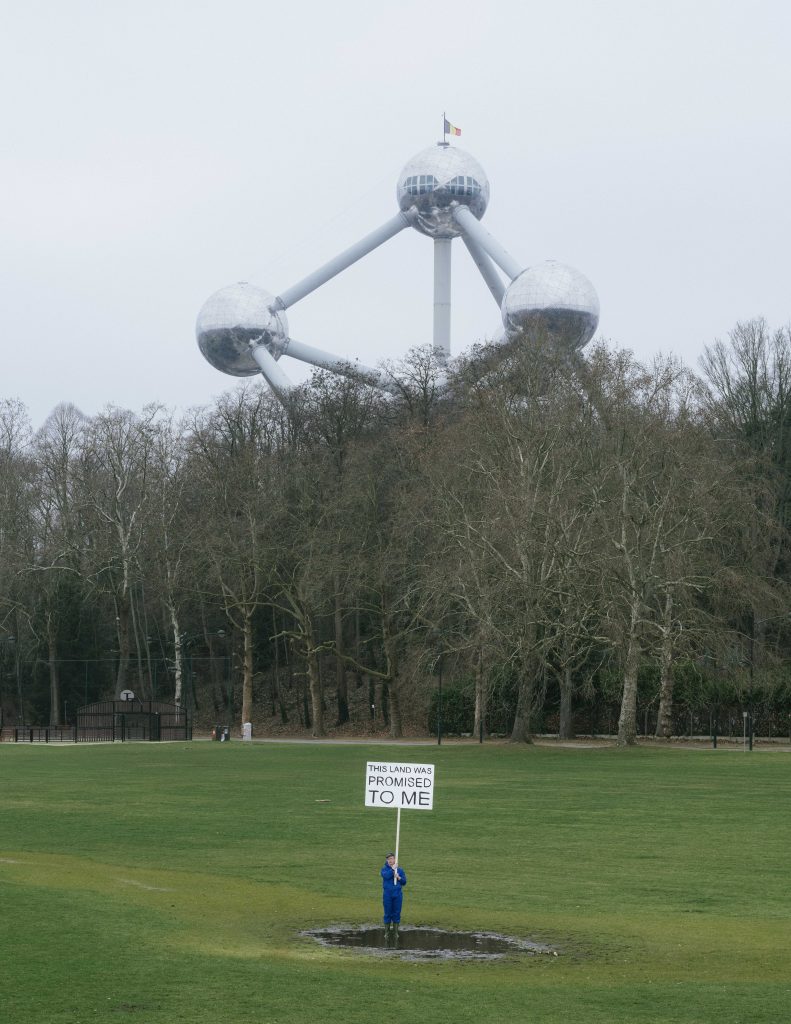
“I used to think art was made for the viewer, but I’ve come to realize that artists also make work for themselves, for all sorts of reasons. For me, it’s mainly about talking to ordinary people, trying to find ways to move beyond the overwhelming scale of global issues through personal stories. That’s how I give my worries about the world a place.”
Hielkema connects this idea to worryism, a term he coined during his time at art school. “I started wondering what it was exactly that I had studied, and how on earth I was supposed to make a living from it? Because that’s something we were never really taught. That’s how worryism emerged: the act of worrying as art, worrying about art, worried art, a worried artist, art that carries worries.”
Hielkema is one of 92 emerging artists who recently received a Kunstenaar Start grant from the Mondriaan Fund. Part of his latest photographic project, Europe, who are you? (2025–2026), will be presented in the Prospects section at Art Rotterdam. The work fits seamlessly within his wider practice, where personal concerns become an entry point to address broader social questions.
Caring for a European Identity
Europe, who are you? (2025–2026) is Hielkema’s attempt to explore what a European identity might mean today. One part of the project, titled Around Europe, consists of four large oak frames containing archival photographs relating to colonial history, European identity, and integration.
The choice of oak is deliberate. “Oak represents the Franco-German axis and acts as an old connector within European history.” The archival photographs Hielkema collected capture moments from the founding countries of the European Union: France, Germany, the Netherlands, Italy, Belgium and Luxembourg. These archival images are presented alongside large staged photographs taken by the artist himself, which reflect on the present. In this way, historical fragments enter into dialogue with contemporary perspectives. Visitors are even invited to take the photographs out of their frames to read the archival descriptions printed on the back.
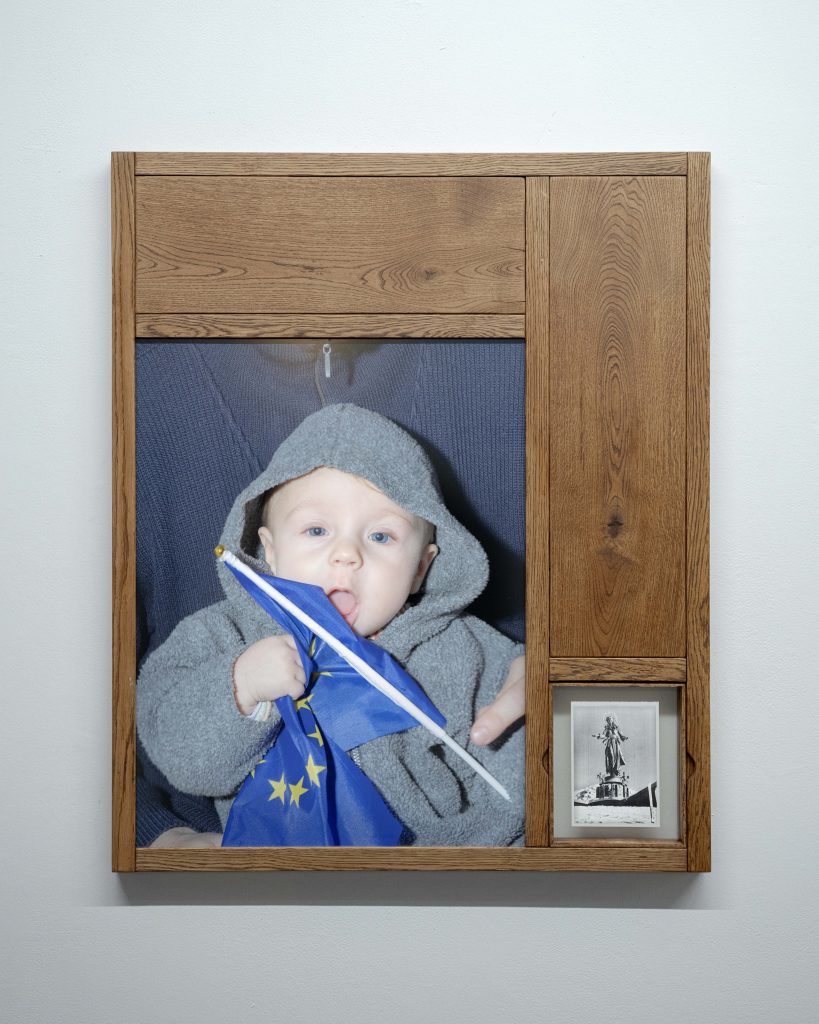
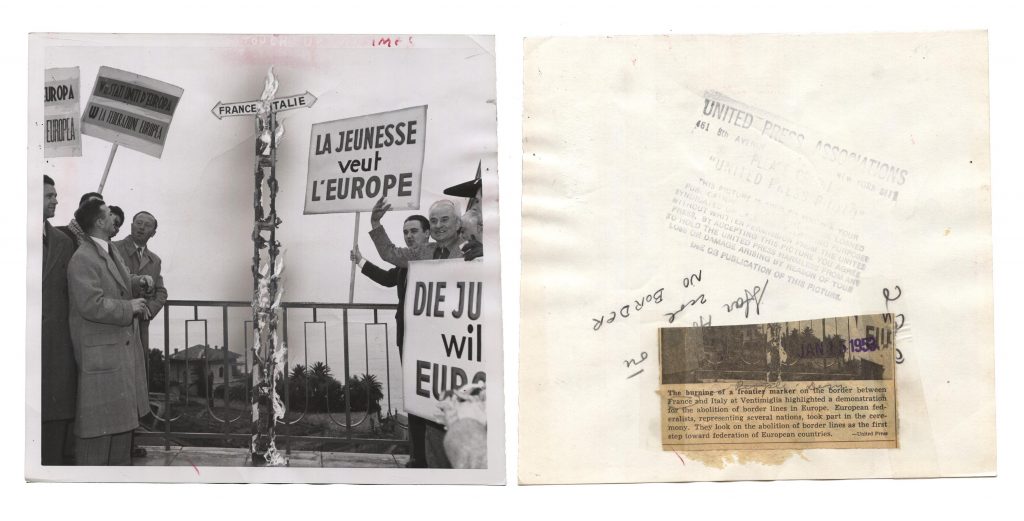
One of the archival photographs shows a border sign with a flag burning on the Italian–French border. “The information on the back reveals that the photo was taken in 1953. The negative was sent to the United States, where it was printed and scanned for newspaper distribution. The flames in the centre were actually drawn onto the negative by hand, because the real fire didn’t show up strongly enough in the image. As a contemporary counterpart, I photographed my own child eating a European flag.”
Another archival image comes from Belgium in 1960 and depicts a woman with two children. On the back it reads: Refugees arrive in Brussels. “Of course, this refers to colonists who were forced to return from the Democratic Republic of Congo to Belgium,” Hielkema explains. As a contemporary response, the artist staged a photograph of himself at the Atomium in Brussels, holding a protest sign that reads This Land Was Promised to Me. “At first glance it’s a cynical echo of the archival image, but it’s also a comment on current geopolitical tensions beyond the borders of the European Union.”
Born in 1994, shortly after the founding of the European Union in the early 1990s, Hielkema grew up with open borders and the euro as a matter of course. Yet while interviewing people across Europe, he noticed that many have lost sight of what those freedoms actually make possible, precisely because they have become so normalised.
“Europe often feels both tangible and abstract at the same time. It’s a vast and slow-moving system that can be difficult to grasp. To reflect that ambiguity in the installation, four 6-metre-high barrier gates, from the border between Germany and the Netherlands, tower above the oak frames and archival images. They are arranged as a semi-circular structure inspired by the layout of a parliament. But their meaning remains deliberately unclear. Are open borders something positive? Are they a threat? Or are borders themselves the threat?”
Caring for Masculinity
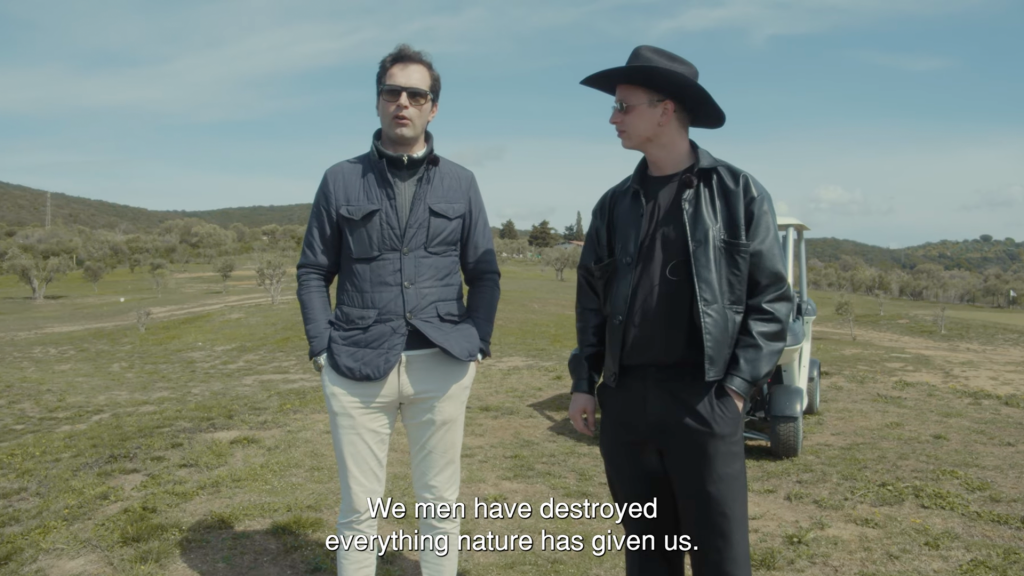
His search for a European identity resonates with another recent project, Black Butterflies, or; The Ballad of Jonny Toxic & Jacco Macho (2025). During his studies, Hielkema presented The Portable Village, a blueprint for a collaborative residential experiment where different disciplines would come together to tackle a social problem from multiple perspectives.
One of his teachers responded bluntly: “The man who always wants to change the world, do you realize how many disasters that has caused? Maybe you should take a look at your own masculinity.”
“I was completely taken aback, but it did make me reflect,” Hielkema says. “As a teenager I was relentlessly bullied for my long hair, nail polish and pink clothes. To survive, I started wearing caps, quit athletics and violin lessons, and took up basketball and smoking instead. Eventually I decided to turn that experience into a film together with a friend from Italy, Jacopo Martini. We travelled through the land of machismo and the land of thrifty Calvinists, speaking with ordinary people about how masculinity is experienced today, whether they feel concerned about it, and whether there might be alternatives. Through that process I started questioning my own masculinity, but also embracing it. And eventually I began asking whether it is still possible to celebrate it.”
Caring for One Another
Hielkema grew up in a family with seven brothers; one of them has multiple disabilities. After finishing art school, he chose to work in the healthcare sector. For six years he worked with Olivier, a disabled boy about whom he is also making a film. One question keeps troubling him: who will take care of these boys once their parents are no longer able to?
“Will it be the government? Will it be us brothers? Are we capable of that? What kind of bureaucracy would we have to deal with? My parents always made sure my brother Camiel had every opportunity, and his future path is quite clear. Camiel works as a DJ, DJ Wheelstar, has an assistance dog, works in Amsterdam and travels independently by train and ferry. But Olivier has only one brother and cannot live independently. From morning to night he relies on care provided by others and by his parents. Most people never really see that reality. On a societal level, we all contribute to that care through taxes. But within families themselves, there are countless worries about the future, especially at a time when the Dutch care system is increasingly under strain.”
Caring for Nuance
America, how are you? (2020) is the central question of another project. Hielkema wondered whether North American society is truly as polarized as the media and political rhetoric often suggest. “There seems to be this narrative of radical division. But there are roughly 250 million eligible voters in the United States, and about sixty million voted for Trump. So how many fucking people does that still leave?”
By speaking with that often unheard majority, Hielkema attempts to restore nuance to the conversation. “And nuance is precisely what tends to disappear today. Perhaps nuance could help us treat each other a bit more nicely. People often told me: ‘These are the kinds of interviews CNN or Fox News should be doing.’ But unfortunately, genuine human conversations rarely make for clickbait. In the end, good news simply means no news.”
Around Europe, part of the photographic series Europe, who are you? (2025–2026) by Jonathan Hielkema, can be seen in the Prospects section at Art Rotterdam.
Written by Emily van Driessen
“Hi, ik ben Jonathan en ik ben bezorgd.” Zo begint de artist statement van de Nederlandse beeldend kunstenaar Jonathan Hielkema (1994). Hij piekert en precies die bezorgdheden vormen de aanleiding voor zijn beeldende praktijk, waarin hij met een zorgende aanpak een methode heeft gevonden om zichzelf (en anderen) gerust te stellen.
“Vroeger dacht ik dat kunst werd gemaakt voor de toeschouwer, maar nu besef ik dat artiesten dat ook voor zichzelf doen, om allerlei beweegredenen. Voor mij gaat het voornamelijk over in gesprek gaan met gewone mensen om manieren te vinden om het grote te overstijgen via het persoonlijke, zodat ik mijn zorgen over de wereld een plek kan geven.”
Hieraan koppelt Hielkema worryism, een term die hij verzon toen hij nog aan de kunstacademie studeerde: “Ik vroeg me af wat ik nu eigenlijk precies had gestudeerd en hoe ik in godsnaam hiermee geld zou kunnen verdienen. Want daar werden we helemaal niet voor opgeleid. Zo ontstond worryism: the act of worrying as art, being worried about art, worried art, a worried artist, art with worries.”
Hielkema is een van de 92 opkomende kunstenaars die recent een Kunstenaar Start-beurs ontvingen van het Mondriaan Fonds. Een onderdeel van zijn nieuwste fotoproject Europe, who are you? (2025-2026) wordt tentoongesteld in de Prospects-sectie van Art Rotterdam. Het project past binnen Hielkema’s praktijk, waarin hij zijn persoonlijke zorgen koppelt aan grotere maatschappelijke vragen.
Zorgen voor Europese identiteit
Europe, who are you? (2025-2026) is Hielkema’s zoektocht naar een Europese identiteit. Een onderdeel van het project heet Around Europe en bestaat uit vier grote eikenhouten lijsten met archieffoto’s over koloniale (oorlogs)geschiedenis, Europese identiteit en integratie.
De foto’s zitten in eikenhouten lijsten, “omdat eikenhout de Duits-Franse as weergeeft en zo fungeert als een oude verbinder van de Europese geschiedenis.” De archieffoto’s die de artiest verzamelt, verwijzen naar momentopnamen uit de founding countries van de EU: Frankrijk, Duitsland, Nederland, Italië, België en Luxemburg. De archiefbeelden worden gepresenteerd op een landelijke vieras en aangevuld met grote geënsceneerde foto’s van de artiest zelf, die reflecteren op het nu. Het kleine correspondeert zo met het grote, en als bezoeker kan je de beelden uit het frame halen om op de achterkant meer informatie te bekijken.
Een van de archieffoto’s toont een grensbord met een vlag in brand op de grens tussen Italië en Frankrijk. “Op de achterkant kan je de archiefinformatie lezen: deze foto is genomen in 1953. Het negatief werd naar de VS gestuurd om daar te worden uitgeprint en ingescand voor de kranten. Het vuur in het midden van het beeld is er met de hand extra opgetekend omdat de echte vlammen niet voldoende overkwamen op de foto. Mijn hedendaagse tegenhanger voor dit beeld is mijn eigen kind dat een Europese vlag opeet.”
Een ander archiefbeeld komt uit België in 1960 en toont een vrouw met twee kinderen. Op de achterkant lees je de beschrijving: Vluchtelingen komen aan in Brussel. “Het gaat hier natuurlijk over kolonisten die vanuit de Democratische Republiek Congo naar België moesten terugkeren”, vertelt Hielkema. Als hedendaagse tegenhanger ensceneert de artiest een foto van zichzelf bij het Atomium in Brussel, met een protestbord in de hand: This Land Was Promised to Me. “Het is in eerste instantie een cynische verwijzing naar die archieffoto, maar tegelijk ook een aanklacht tegen wat er nu geopolitiek gebeurt buiten de grenzen van de Europese Unie.”
Hielkema is geboren in ’94, kort na de oprichting van de Europese Unie in ’92 en ’93. Het concept van open grenzen en de euro als munt zijn voor hem vanzelfsprekend. In interviews met verschillende Europese burgers merkte Hielkema op dat velen vergeten zijn wat die Europese vrijheden vandaag precies voor ons mogelijk maken, omdat we er zo aan gewend zijn geraakt.
“Ik merkte dat Europa voor velen enerzijds concreet is, maar tegelijk ook iets heel abstracts waar we maar moeilijk bij kunnen. Het is een log en sloom systeem. Om die verschillende aspecten ook in mijn werk te verwerken, torenen naast de eikenhouten lijsten vier 6 meter hoge slagbomen boven de archieffoto’s uit, afkomstig van de grens tussen Duitsland en Nederland. Ze staan opgesteld als een half platform, geïnspireerd op de vorm van een parlement, en het is eigenlijk onduidelijk hoe je ze precies moet interpreteren. Zijn de grenzen open en is dat goed? Of vormt het een bedreiging? Of zijn die grenzen juist de bedreiging?”
Zorgen voor masculiniteit
Zijn zoektocht naar een vorm van Europese identiteit sluit thematisch nauw aan bij zijn project Black Butterflies, or; The Ballad of Jonny Toxic & Jacco Macho (2025). Tijdens zijn studies stelde hij The Portable Village voor, een blauwdruk voor een residentieel experiment waarin allerlei disciplines zouden samenkomen om vanuit verschillende hoeken een oplossing voor een sociaal probleem te vinden.
Een leerkracht gaf hem de volgende bruuske commentaar: “De man die altijd maar de wereld wil veranderen, weet je hoeveel slechte dingen daarvan gekomen zijn? Je moet eens even kijken naar je eigen masculiniteit.”
“Ik was heel erg geschokt, maar het zette me wel aan het denken. Ik werd vroeger vreselijk gepest met mijn lange haren, nagellak en roze kleding. Om te overleven ben ik petjes gaan dragen, gestopt met atletiek en viool spelen, en begonnen met basketballen en roken. Ik besloot er een film over te maken, samen met een vriend uit Italië, Jacopo Martini. We zijn samen in het land van het machismo en het land van de gierige calvinisten gaan filmen en voerden gesprekken met gewone mensen om erachter te komen hoe masculiniteit ervaren wordt, of zij zich daar ook zorgen over maken en of er oplossingen zijn. Op die manier ben ik mijn eigen masculiniteit beginnen te bevragen, maar ook beginnen te omarmen, om daarna aan de wereld te vragen of het nog mogelijk is om dat te vieren.”
Zorgen voor elkaar
Hielkema groeide op in een gezin met zeven jongens; één van zijn broers is meervoudig gehandicapt. Na zijn kunstenaarsstudies besloot hij in de zorg te gaan. Gedurende zes jaar werkte hij met Olivier, een gehandicapt jongetje over wie hij een film aan het maken is. Hielkema maakt zich zorgen: wie zorgt er voor de jongens als hun ouders sterven of het niet meer aankunnen?
“Is dat de overheid? Zijn wij broers dat? Kunnen wij dat wel? Welke bureaucratische formaliteiten moeten wij in orde maken? Mijn ouders hebben er altijd voor gezorgd dat mijn broer Camiel alle kansen kreeg en zijn toekomstplan is duidelijk. Camiel dj’t, DJ Wheelstar, heeft een hulphond, werkt in Amsterdam, neemt de trein en de veerboot. Maar Olivier heeft maar één broer en hij leeft niet zelfstandig. Hij wordt van ’s ochtends tot ’s avonds verzorgd door anderen en zijn ouders. Niemand ziet het écht, maar op grotere schaal dragen we als belastingbetaler allemaal bij aan die zorg. Op kleine schaal, in die families, leven heel veel zorgen voor later, terwijl het zorgsysteem in Nederland aan het wankelen is.”
Zorgen voor nuance
America, how are you? (2020) is de vraag die Hielkema stelt in het gelijknamige project. Hij vraagt zich af of Noord-Amerikaanse burgers echt zo gepolariseerd zijn als de media en de politiek doen uitschijnen. “Er lijkt een soort radicale exclusiviteit te heersen terwijl er ongeveer 250 miljoen stemgerechtigden zijn en zestig miljoen mensen op Trump stemden. Hoeveel mensen blijven er dan nog godverdomme over?”
Door in gesprek te gaan met die stilzwijgende meerderheid laat hij zien dat de U.S. helemaal niet zo gepolariseerd is als het nu lijkt. Hielkema zorgt voor nuance. “En nuance is precies waar we vandaag vaak aan voorbijgaan. Door nuance kunnen we misschien weer wat liever met elkaar omgaan. Dat hoorde ik vaak terugkeren:‘Dit zouden de interviews van CNN en Fox News moeten zijn!’ Maar menselijke gesprekken leveren jammer genoeg geen clickbaits op. Good news is uiteindelijk no news.”
Ontdek Around Europe, een onderdeel van de fotoreeks Europe, who are you? (2025-2026) van Jonathan Hielkema in Prospects op Art Rotterdam.
Geschreven door Emily van Driessen
In the New Art Section of Art Rotterdam, Galleria Doris Ghetta from Italy will present a solo booth featuring the work of Shivangi Kalra. In her paintings, she invites the viewer to step into her inner world, a world that is deeply personal yet resonates with something universal. Her works can be read as concentrated studies of memory, intimacy and social relations. The New Art Section, curated by Övül Ö. Durmuşoğlu, is reserved for solo presentations by emerging artists with a compelling and conceptually thoughtful practice.
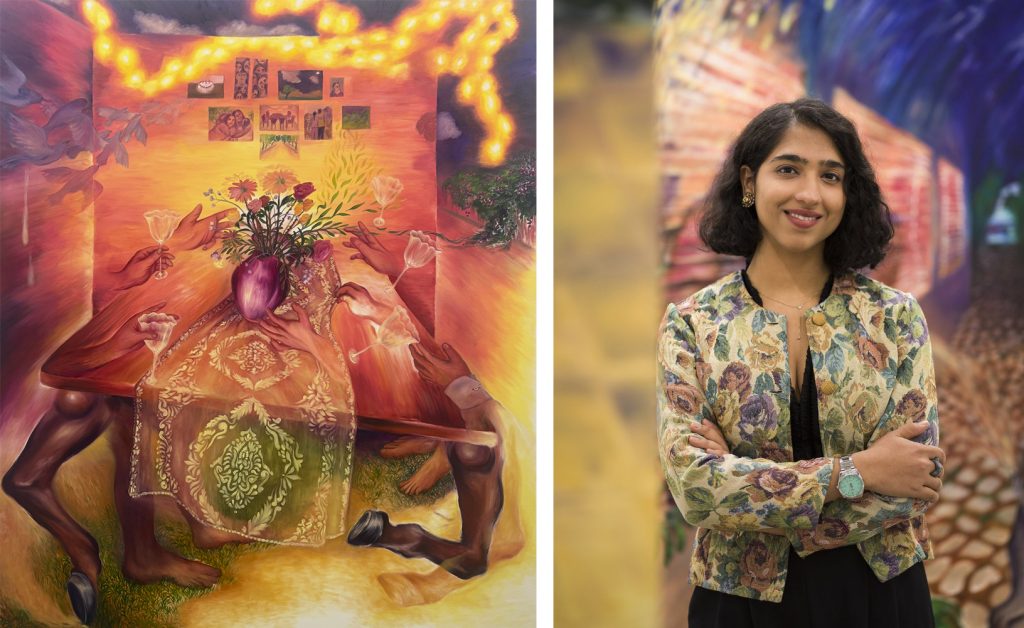
Shivangi Kalra was born in Delhi in 1998. She studied Painting at the College of Art in Delhi and graduated cum laude from the Frank Mohr Institute in Groningen in 2024, following an exchange programme at Uniarts Helsinki. That same year, she received the Royal Award for Modern Painting. She currently divides her time between Amsterdam and India, two contexts that continue to inform her work.
Kalra’s dreamlike and enigmatic paintings explore the ways in which memory and perception can become intertwined. Rather than presenting clearly defined narratives, she depicts fragmented situations in which something has just occurred or is about to unfold. Each painting seems to function as a mental space that she constructs with care, element by element, at times almost staged like a theatrical set. At the same time, she rarely makes the scene explicit. Her compositions feature interiors, terraces and subtle theatrical elements, as well as references to lavish parties that she remembers from her youth. For Kalra, these gatherings form a microcosm in which social hierarchies and ingrained codes become visible, almost like a performance. Yet it is also a space for genuine connection. She seeks to understand what takes place when people come together in such settings, a society in miniature, captured in a painting that reveals as much as it withholds.

One striking aspect of her work is the psychological charge of the spaces she depicts. Many of her scenes are set in the city where she grew up, a place that has undergone profound transformation in recent decades, as has its social landscape. Yet the city functions less as a literal backdrop than as a space of memory. Festive tables appear in seemingly warm living rooms or shift to terraces and outdoor settings. At times, a piece of furniture asserts itself with unusual insistence. Figures emerge in motion blur, appear only as an autonomous hand or as mirrored doubles, cast an ominous shadow in a corner, partially dissolve behind smoke or curtains, remain faceless or fade into their surroundings. In some works, figures are framed by a window while in others, the viewer’s gaze is obstructed by the bars of a balcony. In some paintings, people are conspicuously absent. Animals recur throughout, from shadowy dogs and table legs resembling horse legs to tiger rugs that seem to almost come alive.
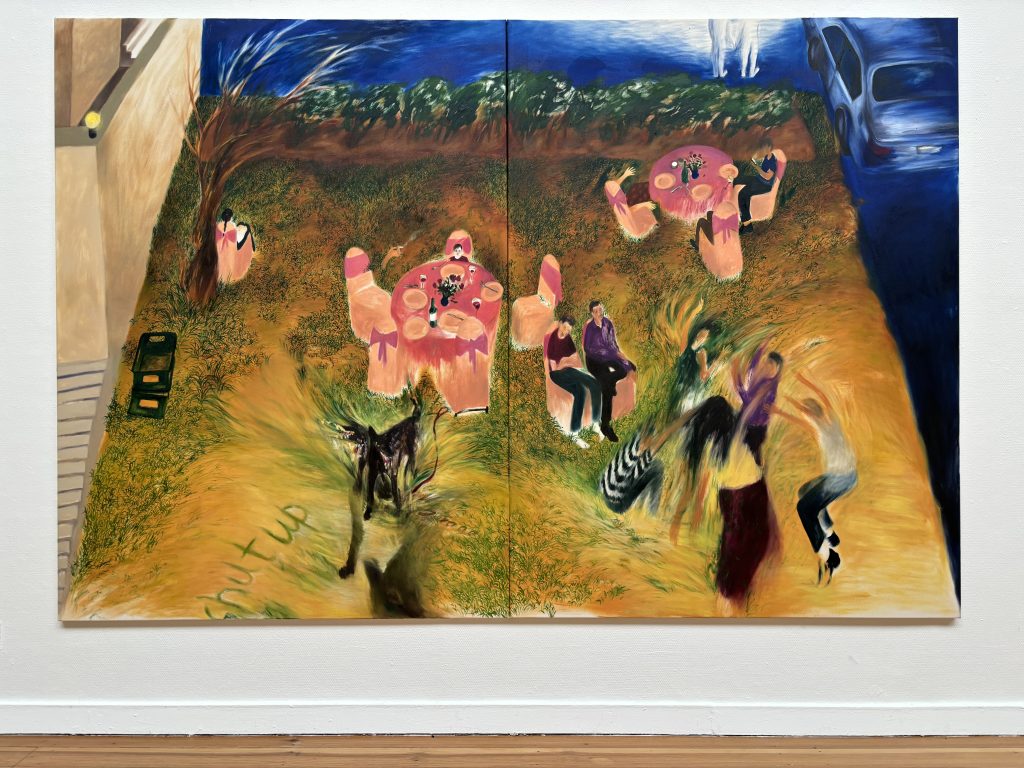
Kalra guides the eye along conspicuous yet slightly unsettled sightlines and charged details, including photographs on the wall that raise more questions than they answer. One can almost sense the silences, the outward display, the underlying friction and the unspoken hierarchies. The explicit and implicit social rules and the different expectations that are assigned to men and women. It is as if you’re looking at a charged yet unstable memory that has shifted over time, governed by a logic that belongs to dreams. In the context of the Royal Award for Modern Painting, Kalra stated, “I have increasingly begun to paint from memory and have learned to embrace the confusion that can arise from it.” As a result, her works carry unsettling and melancholic undertones, while humour and a touch of absurdity offer some soft edges.
Kalra’s work was previously shown at the Groninger Museum, the Chabot Museum, the Royal Palace Amsterdam, Method in Mumbai and the Museum of Goa. Later this year, she will present a solo exhibition at the Drents Museum in Assen.

Shivangi Kalra’s presentation will be on view in the New Art Section during Art Rotterdam (27–29 March in Rotterdam Ahoy), presented by Galleria Doris Ghetta.
Written by Flor Linckens
Galleria Doris Ghetta uit Italië toont in de New Art Section van Art Rotterdam een solopresentatie met werk van Shivangi Kalra. In haar schilderijen nodigt ze de kijker uit om haar innerlijke wereld binnen te stappen: een wereld die heel persoonlijk is, maar tegelijk aan iets universeels raakt. Haar werken laten zich lezen als geconcentreerde studies naar herinnering, intimiteit en sociale verhoudingen. De New Art Section, gecureerd door Övül Ö. Durmuşoğlu, is gereserveerd voor solopresentaties van opkomende kunstenaars met een spannende en inhoudelijk doordachte praktijk.
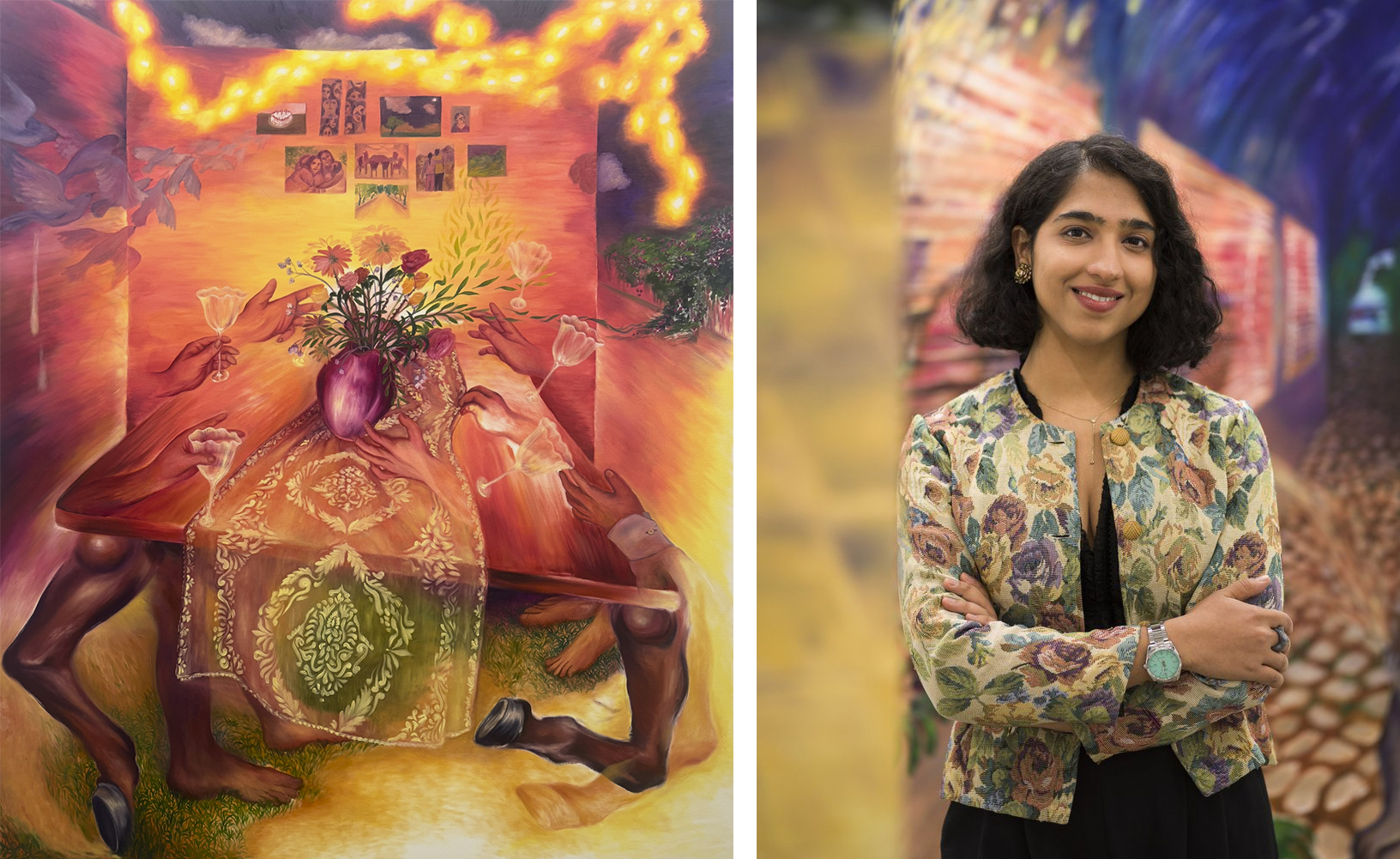
Shivangi Kalra werd in 1998 geboren in Delhi. Ze studeerde Schilderkunst aan de College of Art in Delhi en studeerde in 2024 cum laude af aan het Frank Mohr Instituut in Groningen, na een uitwisseling aan Uniarts Helsinki. In datzelfde jaar ontving ze de Koninklijke Prijs voor Vrije Schilderkunst. Tegenwoordig verdeelt ze haar tijd tussen Amsterdam en India, twee contexten die doorwerken in haar schilderijen.
Kalra’s dromerige en mysterieuze schilderijen zeggen iets over de manieren waarop herinnering en waarneming soms door elkaar heen lopen. De kunstenaar schildert meestal geen duidelijk omlijnd verhaal, maar toont gefragmenteerde situaties waarin net iets is gebeurd, of op het punt staat te gebeuren. Als een mentale ruimte die ze zorgvuldig, element voor element inricht, soms bijna geënsceneerd als een toneelstuk. Tegelijkertijd maakt ze het tafereel zelden expliciet. In haar composities zien we bijvoorbeeld interieurs, terrassen en theatrale elementen, maar ook referenties naar overdadige feesten uit haar jeugd. Voor Kalra vormen die feesten een microkosmos waarin sociale verhoudingen en subtiele, ingesleten codes zichtbaar worden, bijna als een performance. Tegelijkertijd is er ruimte voor oprechte verbondenheid. Ze probeert in feite te doorgronden wat er gebeurt wanneer mensen samenkomen in een dergelijke context. Als een maatschappij in het klein, gevangen in een beeld dat evenveel prijsgeeft als achterhoudt.
Wat opvalt in haar werk is de manier waarop ruimtes een psychologische lading krijgen. Veel van haar taferelen spelen zich af in de stad waar ze opgroeide, die in de afgelopen decennia ingrijpend van gedaante is veranderd, net als het sociale landschap. Toch vormt de stad meer een ruimte voor haar herinneringen dan een letterlijk decor. Feestelijke tafels staan soms in ogenschijnlijk warme woonkamers, soms verschuiven ze naar terrassen of buitenruimtes. Soms zien we een meubelstuk dat net iets te nadrukkelijk aanwezig is. Personages verschijnen in motion blur, zijn alleen zichtbaar als autonome hand of als dubbel spiegelbeeld, vormen een onheilspellende schaduw in een hoek, verdwijnen deels achter rook of gordijnen, zijn gezichtsloos of lossen op in hun omgeving. Soms worden figuren in haar composities ingelijst door een raam, terwijl je blik als kijker soms wordt tegengehouden door de spijlen van een balkonhek. In andere schilderijen zijn mensen juist opvallend afwezig. Dieren duiken regelmatig op: schimmen van honden, tafelpoten die aan paardenbenen doen denken, tijgervloerkleden die tot leven lijken te komen.
De kunstenaar stuurt je oog langs opvallende, net niet kloppende zichtlijnen en veelbetekenende details, waaronder foto’s aan de muur die alleen maar meer vragen oproepen. Je voelt de stiltes, het uiterlijke vertoon, de frictie en de onuitgesproken hiërarchieën: de sociale spelregels en verhoudingen tussen wat van mannen en vrouwen wordt verwacht. Alsof je kijkt naar een geladen maar onstabiele herinnering die in de loop van de tijd van vorm is veranderd, met een interne logica die alleen een droom kan hebben. Kalra zei daarover, in de context van de Koninklijke Prijs voor Vrije Schilderkunst: “Ik ben meer gaan schilderen naar herinneringen en ben de verwarring die daaruit kan ontstaan gaan omarmen.” De resulterende werken hebben iets onheilspellends en melancholisch, met een onscherp randje door de toevoeging van humor en een mate van absurdisme.
Het werk van Shivangi Kalra was de afgelopen jaren onder meer te zien in het Groninger Museum, het Chabot Museum, het Koninklijk Paleis Amsterdam, Method in Mumbai en het Museum of Goa. Later dit jaar presenteert de kunstenaar een solotentoonstelling in het Drents Museum in Assen.
De presentatie van Shivangi Kalra zal tijdens Art Rotterdam (27-29 maart in Rotterdam Ahoy) te zien zijn in de New Art Section, gepresenteerd door Galleria Doris Ghetta.
Geschreven door Flor Linckens


