Coming soon
Coming soon
Selecteer type
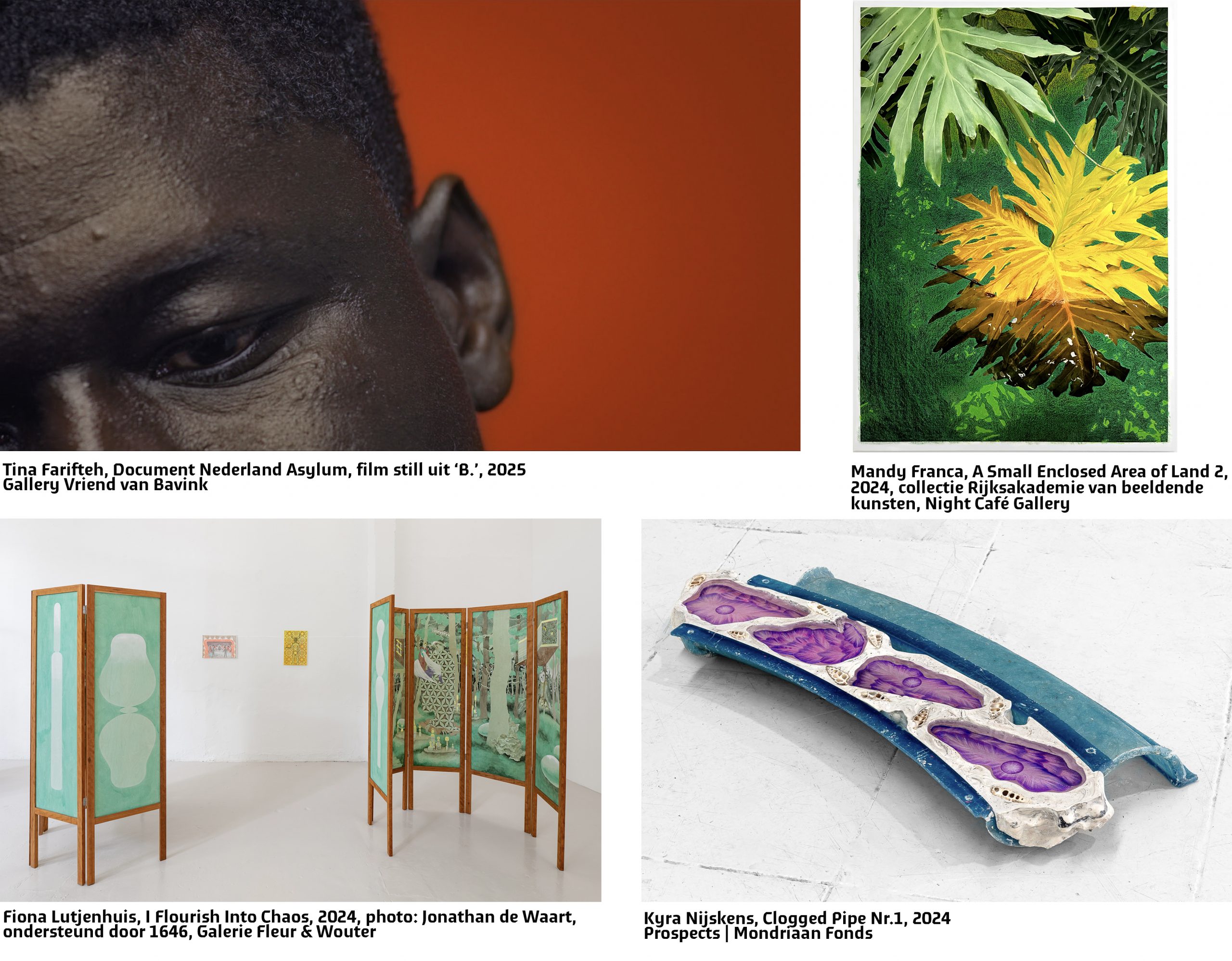
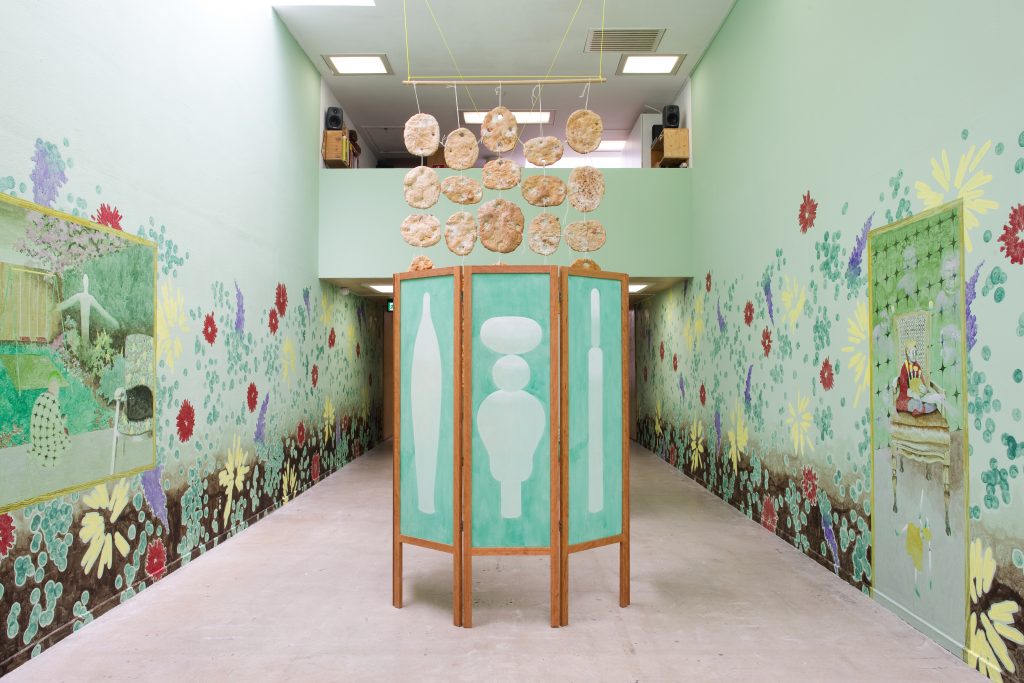
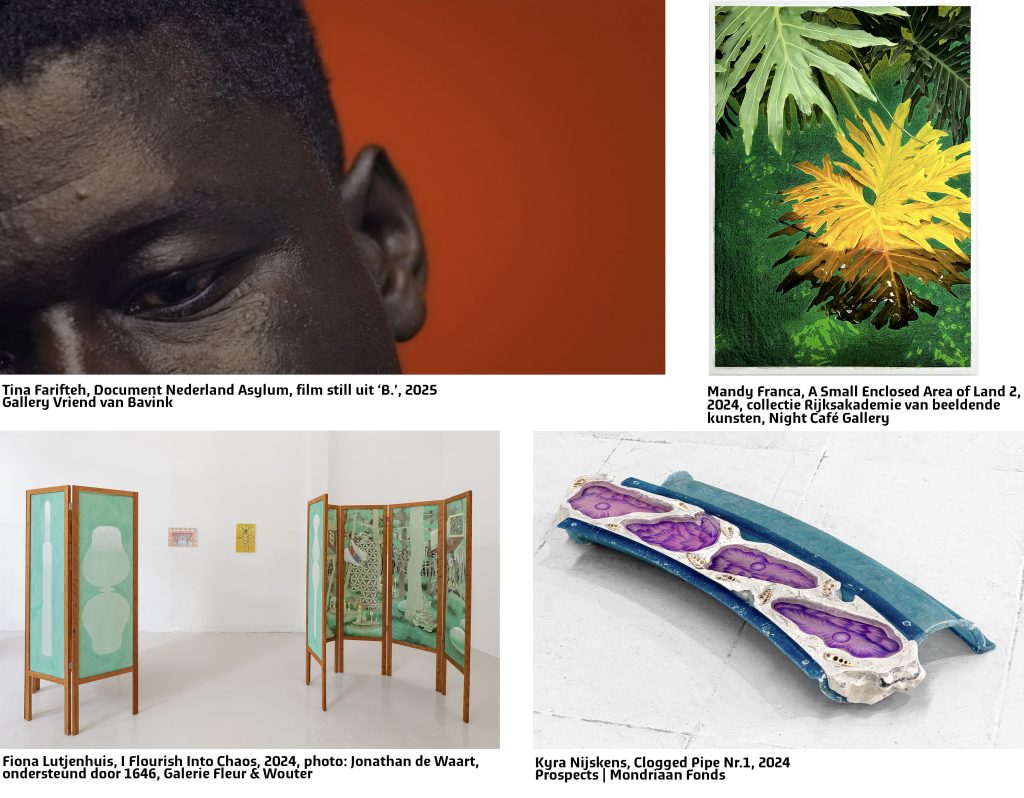
This year marks the tenth edition of the NN Art Award. The annual incentive prize of €10,000 is awarded to a talented artist who completed their education in the Netherlands and presents work at Art Rotterdam (27–29 March at Rotterdam Ahoy). The professional jury nominated four artists: Fiona Lutjenhuis (Galerie Fleur & Wouter), Tina Farifteh (Gallery Vriend van Bavink), Mandy Franca (Night Café Gallery) and Kyra Nijskens (Prospects / Mondriaan Fonds). From 14 March to 25 May 2026, work by all nominees will be on view at Kunsthal Rotterdam.
Fiona Lutjenhuis’s youth was shaped by an exceptional context: she grew up in the Malva sect, a religious community in a village in Brabant, which she left behind at the age of sixteen. This closed sect drew on an eclectic mix of theosophy, esoteric cosmology, secret societies and beliefs surrounding supernatural and extraterrestrial life. Lutjenhuis translates this ideological legacy and her personal memories into a hybrid visual language, enriched by archival research. Her work is not a literal reconstruction, but rather a symbolic and poetic retelling, often infused with humour, as a way of getting some grip on her past. The resulting works frequently combine playful and grim elements. For Lutjenhuis, her practice is a way of reinterpreting her exceptional childhood without attaching judgement to it. She approaches the world from a rational, autonomous and agnostic worldview, while at the same time retaining a spiritual curiosity about could might possibly exist.
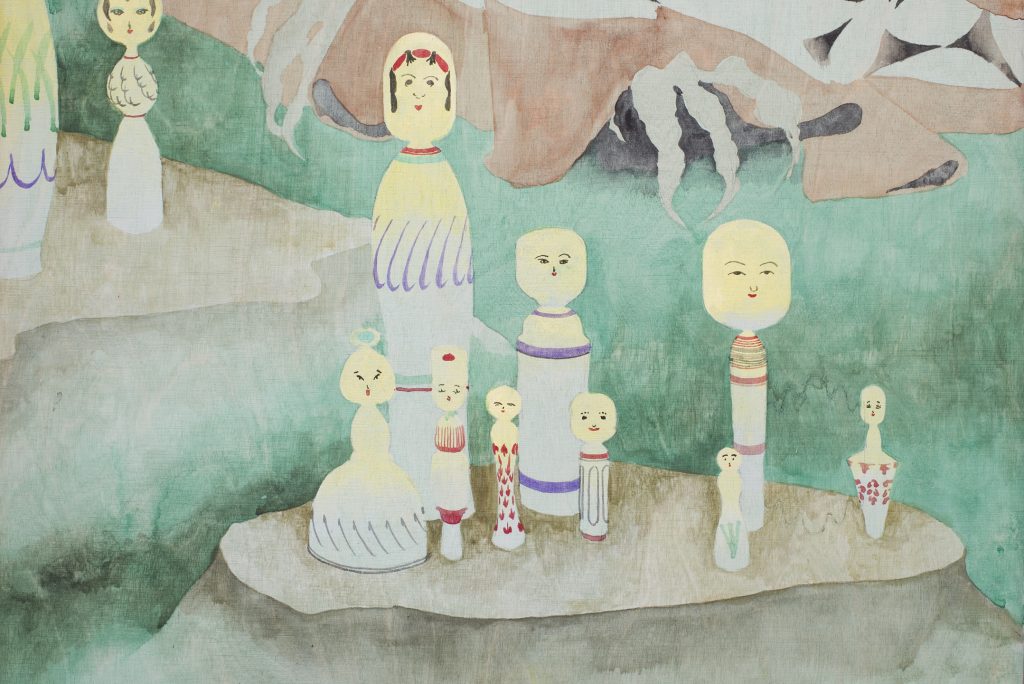
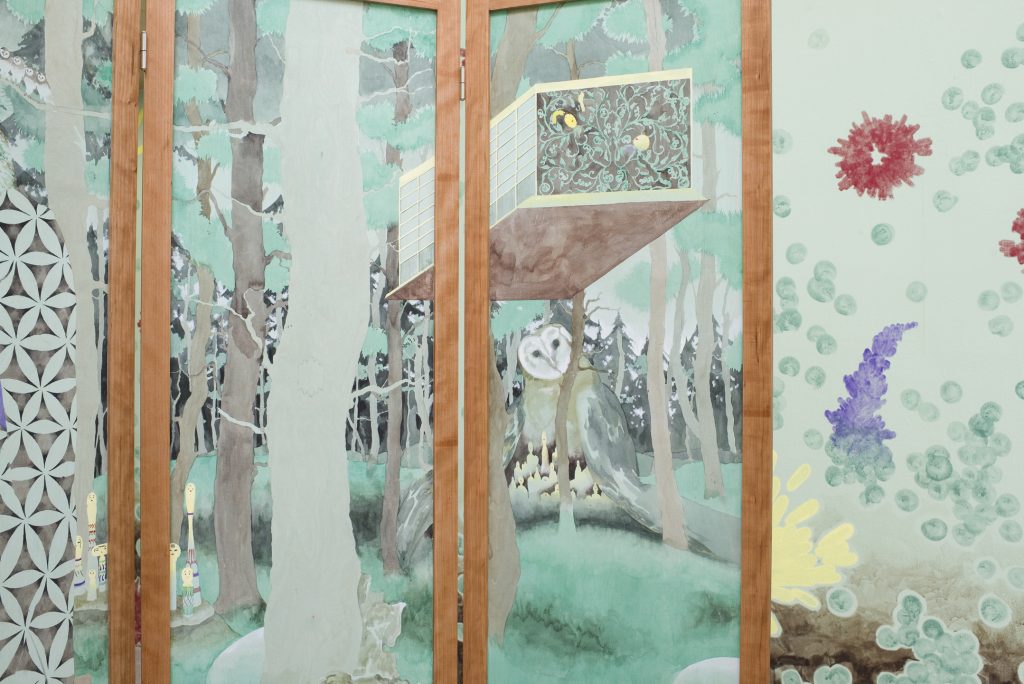
At Kunsthal Rotterdam, Lutjenhuis presents, for example, two large folding screens titled “I Flourish Into Chaos” (2024). On the panels, the leaders of the sect appear as birds of prey: owls and a hawk. Floating buildings with seemingly transparent walls depict scenes from her family history, in which people are rendered as static Japanese kokeshi dolls. This visual language is not a coincidence: the Malva sect regularly appropriated elements from different religious and cultural traditions. The all-seeing eye that recurs on the screens refers to Geza-4, the planet that is regarded within the sect as the ultimate place of refuge.
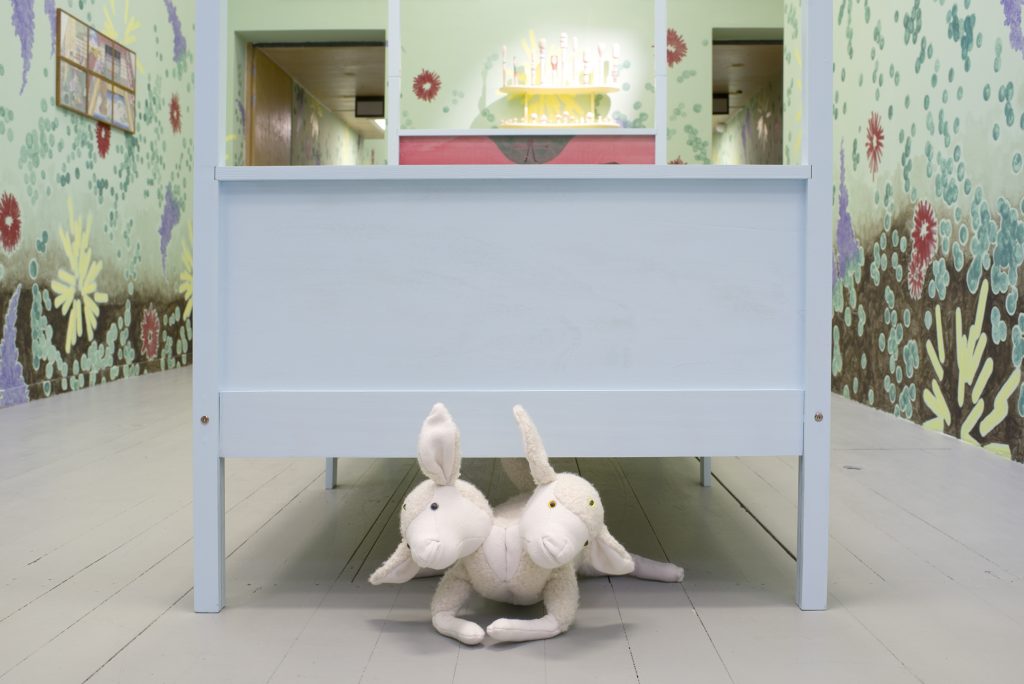
The artist often creates works that evoke a sense of domestic shelter, including a birdhouse and a painted light-blue bed construction with the telling title “Family Trip”. In that work, the bed frame is transformed into a sandbox with small sandcastles, causing the piece of furniture to lose its domestic function and literally turn into a charged landscape. Lutjenhuis’s oeuvre is populated by human, animal and extraterrestrial figures and engages with themes such as belief, power and submission.
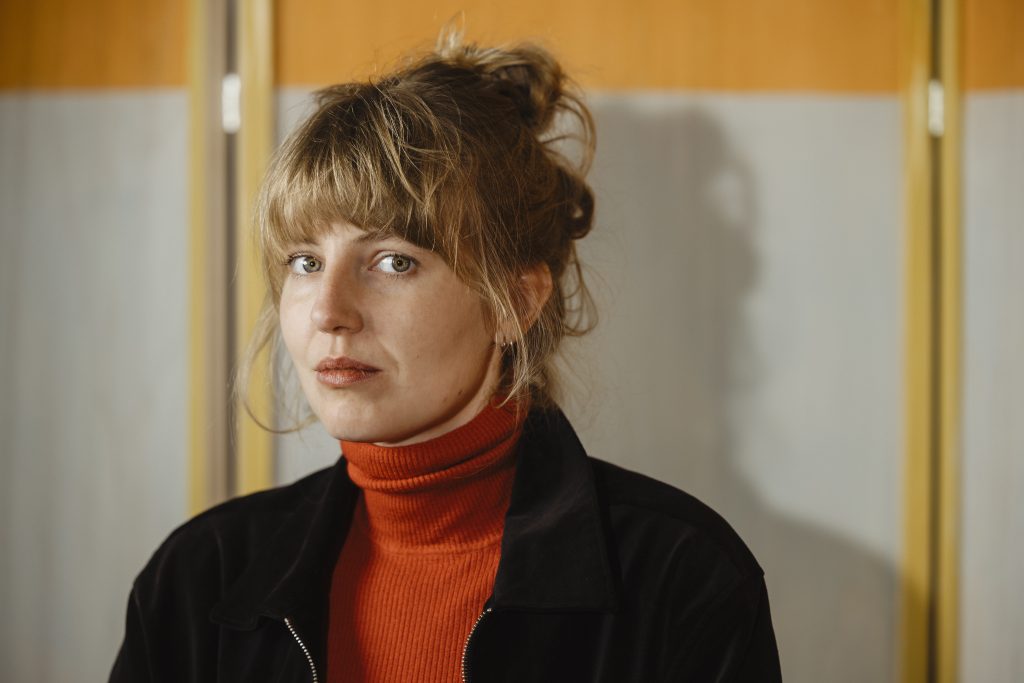
Fiona Lutjenhuis was born in Zevenaar in 1991. She studied at the ArtEZ University of the Arts in Arnhem and subsequently took part in the residency programme at the Rijksakademie van Beeldende Kunsten in Amsterdam. Her work was previously shown at Stedelijk Museum Amsterdam, Het Noordbrabants Museum, 1646, the Dordrechts Museum, Schiphol Airport, the H3H Biennale and Drawing Centre Diepenheim. It is held in the collections of, among others, the AkzoNobel Art Foundation, Museum Helmond and SCHUNCK Glaspaleis.
Fiona, could you tell us more about the work you are presenting at Art Rotterdam and at Kunsthal Rotterdam?
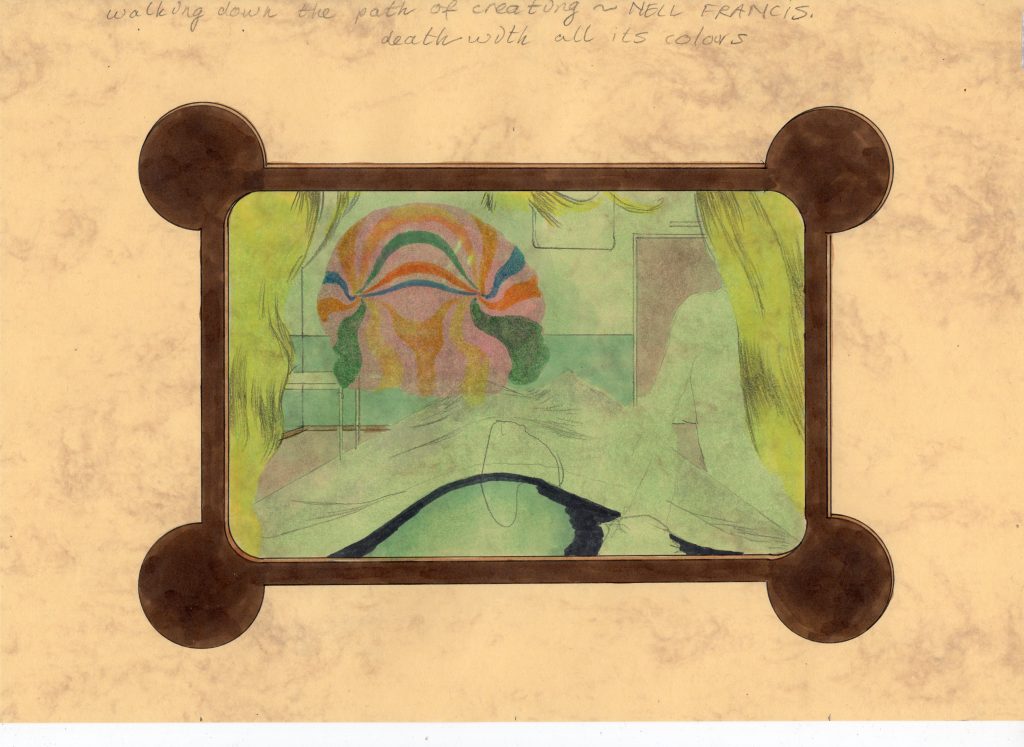
The work I am showing at Art Rotterdam is an installation with a combination piece of furniture as a bed, with a mosquito net, paintings, sculptures and soft toys. For this presentation, I deliberately chose a setting in which I feel safest and where I can retreat for a moment, even at an art fair. The imagery in the paintings is based on dreams that have stayed with me: a world between sleeping and waking, a place where I like to be and where rules can be distorted. Once I wake up, I am often disappointed that everything is once again governed by social, political and natural rules. Despite the fact that I have many nightmares, I also love sleeping, because the world then feels more fluid, as a form of escape. Three paintings are presented in which dreams are depicted.
For Kunsthal Rotterdam, I have two folding screens in mind, which together form the work “I Flourish Into Chaos” (2024). I made these two screens based on the ten entities from other planets that were central to my parents’ religious beliefs. The entity that was discussed most was Master Ankhmania. The masters, also known as the guardians, are depicted on the reverse side as conical forms.
Within the screens unfolds a pine forest populated by birds, including birds of prey and an owl. Notably, the owl is not counted among the birds of prey. The birds stand for the entities believed to inhabit birds. They hold us like dolls. The dolls in the floating houses represent metaphorical scenarios from our household. For me, the combination of birds and dolls conveys the feeling that I was protected, but at the same time also controlled. Out of fear of the unknown, I hoped that the entities from other planets would look like birds.
The eastern influences that often recur in my work have a clear origin. As a child, I was convinced that my previous life had taken place somewhere in Asia. My father affirmed that idea: he believed he had lived in Scotland in a previous life and my mother in France or Spain, where she was labelled a witch. Absurd, of course, but within my childhood imagination and the context in which I grew up, this felt entirely normal.
In addition, I have a strong preference for Japanese, South Korean, Thai and Chinese design. What appeals to me, for example, is that in South Korea, art and design are not separated. I believe that’s a realistic way of looking at culture: as a whole in which belief, art and daily life are interconnected. For the folding screens, I also looked at their origins. They travelled from China to Europe and gradually became westernised there. Both works contain quite intimate references to my own worlds and those of my parents and the religious sect. By presenting these references in a playful, childlike way, I hope to soothe myself and make the whole more bearable.
What are your plans for 2026?
This year, I started compiling drawings, together with publisher Terry Bleu. That book will be published in March. In addition, I am working on two presentations abroad, although unfortunately I cannot share anything about those just yet.
I am also busy ticking off everything I still want to do. It think it’s important to realise the work I truly want to make, without later regretting that I never did it. To that end, I collaborate a lot with other artists and makers, combining our crafts and challenging one another. In this way, boundaries continue to be pushed.
From these collaborations, a new, free presentation will also emerge. In that context, experimentation is a plus. For me as an artist, it is the driving force that keeps the engine running.
Can you describe how you felt when you heard that you had been nominated for the NN Art Award?
I felt honoured, but also somewhat conflicted, as I’ve also been nominated for another prize recently [the Prix de Rome, ed.]. At the same time, I am very grateful that I am able to take up space as an artist and represent my imagination and the horror within it. It makes me happy that I am being welcomed into the art world with this work.
What project would you take on immediately if you were to win the award?
I would love to curate an exhibition myself with other makers and artists, working from project-based collectives. What I truly dream of are large installations in which others can physically enter our worlds. For me, one work is basically half a work. I enjoy creating series with multiple layers and contexts, in which all kinds of stories emerge. I would therefore like to realise a show in which a great deal of work comes together, with room for others to also take their place within it. I would want to curate that exhibition myself.
The winner of the NN Art Award 2026 will be announced on Friday 27 March at Kunsthal Rotterdam. During this festive evening, all exhibitions, including the NN Art Award exhibition, will be freely accessible to invited guests.
Written by Flor Linckens
Dit jaar viert de NN Art Award haar tiende editie. De jaarlijkse stimuleringsprijs van €10.000 gaat naar een getalenteerd kunstenaar die een opleiding in Nederland afrondde en werk presenteert op Art Rotterdam (27-29 maart in Rotterdam Ahoy). De vakjury nomineerde vier kunstenaars: Fiona Lutjenhuis (Galerie Fleur & Wouter), Tina Farifteh (Gallery Vriend van Bavink), Mandy Franca (Night Café Gallery) en Kyra Nijskens (Prospects / Mondriaan Fonds). Van 14 maart tot en met 25 mei 2026 is het werk van alle genomineerden te zien in Kunsthal Rotterdam.
De jeugd van Fiona Lutjenhuis werd gevormd door een uitzonderlijke context: ze groeide op in de Malva-sekte, een religieuze gemeenschap in een Brabants dorp, die ze op haar zestiende achter zich liet. Deze gesloten sekte putte uit een eclectische mix van theosofie, esoterische kosmologie, geheime genootschappen en overtuigingen over bovennatuurlijk en buitenaards leven. Lutjenhuis vertaalt deze ideologische erfenis en persoonlijke herinneringen naar een hybride beeldtaal, die ze voedt met archiefonderzoek. Haar werk is geen letterlijke reconstructie, maar een symbolische en poëtische hervertelling, vaak met een dosis humor, om zo grip te krijgen op haar verleden. Dat levert werken op die vaak zowel een speels als grimmig element hebben. Voor Lutjenhuis is haar praktijk een manier om haar uitzonderlijke jeugd te herinterpreteren zonder daar een waardeoordeel aan te verbinden. Ze benadert de wereld vanuit een rationeel, autonoom en agnostisch wereldbeeld, maar behoudt tegelijkertijd een spirituele nieuwsgierigheid naar wat er mogelijk zou kunnen bestaan.
In Kunsthal Rotterdam presenteert Lutjenhuis bijvoorbeeld twee grote kamerschermen met de titel ‘I Flourish Into Chaos’ (2024). Op de panelen verschijnen de leiders van de sekte als roofvogels: uilen en een havik. Zwevende gebouwen met opengewerkte wanden tonen scènes uit haar familiegeschiedenis, waarin mensen zijn weergegeven als statische Japanse kokeshi-poppen. Die beeldtaal is niet toevallig: de Malva-sekte eigende zich regelmatig elementen toe uit verschillende religieuze en culturele tradities. Het alziende oog dat op de schermen terugkeert, verwijst naar Geza-4, de planeet die binnen de sekte werd gezien als uiteindelijke toevlucht.
De kunstenaar maakt vaker werken die een zekere huiselijke geborgenheid oproepen, waaronder een vogelhuisje en een beschilderde lichtblauwe bedconstructie met de veelzeggende titel ‘Family Trip’. Het bedframe verandert hier in een zandbak met kleine zandkastelen, waardoor het meubelstuk zijn huiselijke functie verliest en letterlijk verandert in een beladen landschap. Het oeuvre van Lutjenhuis wordt bevolkt door menselijke, dierlijke en buitenaardse gedaanten en raakt aan thema’s als geloof, macht en onderwerping.
Fiona Lutjenhuis werd in 1991 geboren in Zevenaar. Ze studeerde aan ArtEZ University of the Arts in Arnhem en was daarna resident aan de Rijksakademie van Beeldende Kunsten in Amsterdam. Haar werk was eerder te zien in Stedelijk Museum Amsterdam, Het Noordbrabants Museum, 1646, het Dordrechts Museum, op Schiphol, tijdens de H3H Biënnale en in Drawing Centre Diepenheim. Haar werk bevindt zich in de collecties van onder andere de AkzoNobel Art Foundation, Museum Helmond en Schunck Glaspaleis.
Fiona, kun je ons wat meer vertellen over het werk dat je presenteert op Art Rotterdam en in Kunsthal Rotterdam?
Het werk dat ik op Art Rotterdam laat zien is een installatie met een combinatiemeubel als bed, met een klamboe, schilderijen, beelden en knuffels. Voor deze presentatie kies ik bewust voor een setting waarin ik me het meest veilig voel en waar ik me, zelfs op een kunstbeurs, even kan terugtrekken. De verbeeldingen op de schilderijen zijn gebaseerd op dromen die me zijn bijgebleven: een wereld tussen slapen en waken, een plek waar ik graag ben en waar regels kunnen worden vervormd. Als ik eenmaal wakker word, ben ik vaak teleurgesteld dat alles weer wordt bepaald door sociale, politieke en natuurlijke regels. Ondanks het feit dat ik veel nachtmerries heb houd ik toch ook erg van slapen, aangezien de wereld dan meer fluïde is, als een vorm van ontsnapping. Er worden drie schilderijen gepresenteerd waarin dromen worden afgebeeld.
Voor Kunsthal Rotterdam heb ik twee kamerschermen in gedachten, die samen het werk ‘I Flourish Into Chaos’ (2024) vormen. Deze twee schermen heb ik gemaakt vanuit de tien entiteiten van andere planeten die centraal stonden in het religieuze gedachtegoed van mijn ouders. De entiteit waar het meest over werd gesproken was Meester Ankhmania. De meesters, ook wel de wachters genoemd, zijn op de achterzijde verbeeld als kegelvormen.
Binnen de schermen ontvouwt zich een dennenbos bevolkt door vogels, waaronder roofvogels en een uil. De uil wordt opvallend genoeg niet tot de roofvogels gerekend. De vogels staan voor de entiteiten die in vogels zouden schuilen. Ze houden ons vast als poppen. De poppen in de zwevende huisjes verbeelden metaforische scenario’s uit ons huishouden. De combinatie van vogels en poppen verbeeldt voor mij het gevoel dat ik werd beschermd, maar tegelijkertijd ook werd gecontroleerd. Vanuit angst voor het onbekende hoopte ik dat de entiteiten van andere planeten eruit zouden zien als vogels.
De oostelijke invloeden die vaak in mijn werk terugkomen hebben een duidelijke oorsprong. Als kind was ik ervan overtuigd dat mijn vorige leven zich ergens in Azië had afgespeeld. Mijn vader beaamde dat idee: hij zou in een vorig leven in Schotland hebben geleefd en mijn moeder in Frankrijk of Spanje, waar ze als heks werd bestempeld. Absurd natuurlijk, maar binnen mijn kinderlijke fantasie en de context waarin ik opgroeide voelde dit volkomen normaal.
Daarnaast heb ik een sterke voorkeur voor Japans, Zuid-Koreaans, Thais en Chinees design. Wat mij bijvoorbeeld aantrekt is dat in Zuid-Korea kunst en design niet van elkaar worden gescheiden. Dat vind ik een realistische manier om naar cultuur te kijken: als een geheel waarin geloof, kunst en het dagelijks leven met elkaar verbonden zijn. Bij de kamerschermen heb ik ook gekeken naar hun oorsprong. Die zijn vanuit China naar Europa gekomen en daar gaandeweg verwesterd. Beide werken bevatten vrij intieme verwijzingen naar mijn eigen werelden en die van mijn ouders en de religieuze sekte. Door deze verwijzingen op een speelse, kinderlijke manier weer te geven, hoop ik mezelf te kunnen sussen en het geheel draaglijker te maken.
Wat zijn je plannen voor 2026?
Dit jaar ben ik begonnen met het bundelen van tekeningen, samen met uitgeverij Terry Bleu. Dat boek zal in maart verschijnen. Daarnaast werk ik aan twee presentaties in het buitenland, al kan ik daar op dit moment helaas nog niets over delen.
Verder ben ik bezig met het afstrepen van alles wat ik nog graag wil doen. Ik vind het belangrijk om het werk te realiseren dat ik echt wil maken, zonder later spijt te hebben dat ik het nooit heb gedaan. Ik werk daarvoor ook veel samen met andere kunstenaars en makers, waarbij we onze ambachten combineren en elkaar uitdagen. Daardoor worden grenzen steeds verlegd.
Vanuit die samenwerkingen zal ook een nieuwe, vrije presentatie ontstaan. Daarin is experiment een pré. Voor mij als kunstenaar is het de drijfveer om de motor draaiende te houden.
Kun je beschrijven hoe je je voelde toen je hoorde dat je was genomineerd voor de NN Art Award?
Ik voelde me vereerd, maar ook een beetje opgelaten, omdat ik kort daarvoor ook werd genomineerd voor een andere prijs [de Prix de Rome, red.]. Tegelijkertijd ben ik dankbaar dat ik als kunstenaar een plek mag innemen en mijn fantasie en de horror daarin mag vertegenwoordigen. Het stemt me gelukkig dat ik met dit werk word verwelkomd in de kunstwereld.
Welk project zou je onmiddellijk oppakken als je de award zou winnen?
Ik zou graag zelf een tentoonstelling samenstellen met andere makers en kunstenaars, vanuit projectmatige collectieven. Waar ik echt van droom zijn grote installaties waarin anderen onze werelden kunnen betreden. Want voor mij geldt: één werk is een half werk. Ik maak graag series met meerdere lagen en contexten, waarin allerlei verhalen ontstaan. Ik zou daarom graag een show realiseren waarin veel werk samenkomt, met ruimte voor anderen die daarin ook een plek innemen. Die tentoonstelling zou ik zelf willen cureren.
De winnaar van de NN Art Award 2026 wordt bekendgemaakt op vrijdag 27 maart in Kunsthal Rotterdam. Tijdens deze feestelijke avond zijn alle tentoonstellingen, inclusief de NN Art Award tentoonstelling, vrij toegankelijk voor genodigden.
Geschreven door Flor Linckens
During the upcoming edition of Art Rotterdam, the NN Art Award will be presented for the tenth time. This prestigious incentive prize is awarded to an artist showing work at the fair who has completed their education at a Dutch institution.
The award is not only a mark of recognition, but also offers artists support in further developing their practice. As part of the nomination, the work of all nominees will be on view at Kunsthal Rotterdam from 14 March to 25 May.
This year’s professional jury, representing a broad perspective on the contemporary art field, consisted of:
They nominated the following four artists:
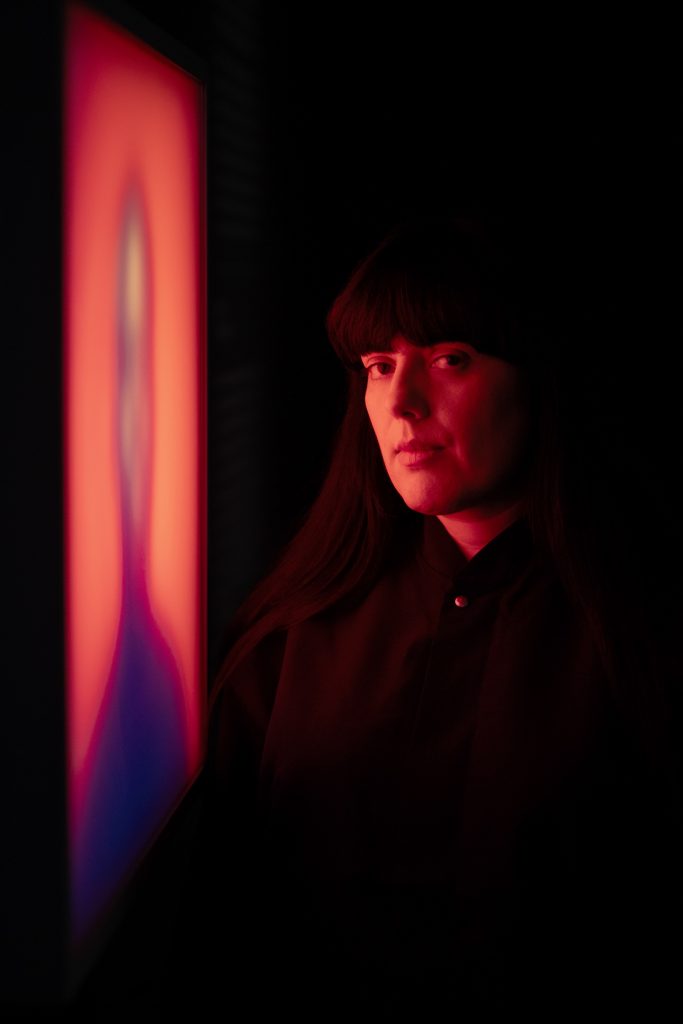
Tina Farifteh (Tehran, 1982) is a photographer and filmmaker. In her work, she investigates how power structures affect the lives of ordinary people. She entices the viewer to look at subjects we would rather turn away from because they are complex or uncomfortable. For Document Nederland 2025, her project on the Dutch asylum system, Farifteh follows B., who, after more than four months in immigration detention at Schiphol and a stay in Ter Apel, enters the asylum procedure. By positioning B. as the narrator, Farifteh shifts our perspective on asylum processes. Rather than speaking about asylum seekers, she allows us to listen to them directly. In doing so, Farifteh holds up a mirror to the viewer: the work is not about them, but about us. Tina Farifteh is represented by Gallery Vriend van Bavink.
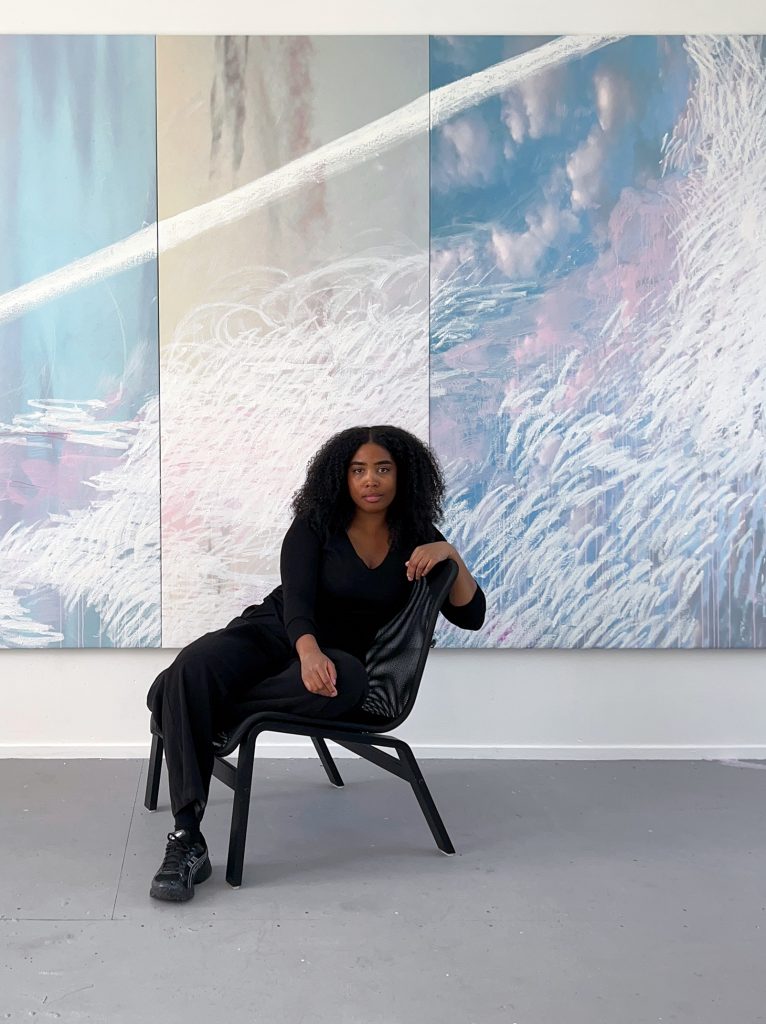
The work of Mandy Franca (Rotterdam, 1989) is an ongoing investigation into connectedness, drawing on her childhood in a cross-cultural environment and her personal memories. Franca examines and observes the significance of the everyday, granting lasting value to what may seem insignificant. As an artist, she subverts and questions the traditional use of printmaking by experimenting with a wide range of artistic media that come together in painting, iPhone photography, printmaking, drawing, collage, video, sound, sculpture and installation. Recurring elements are the photographic image and mark-making. Mandy Franca is represented by Night Café Gallery.
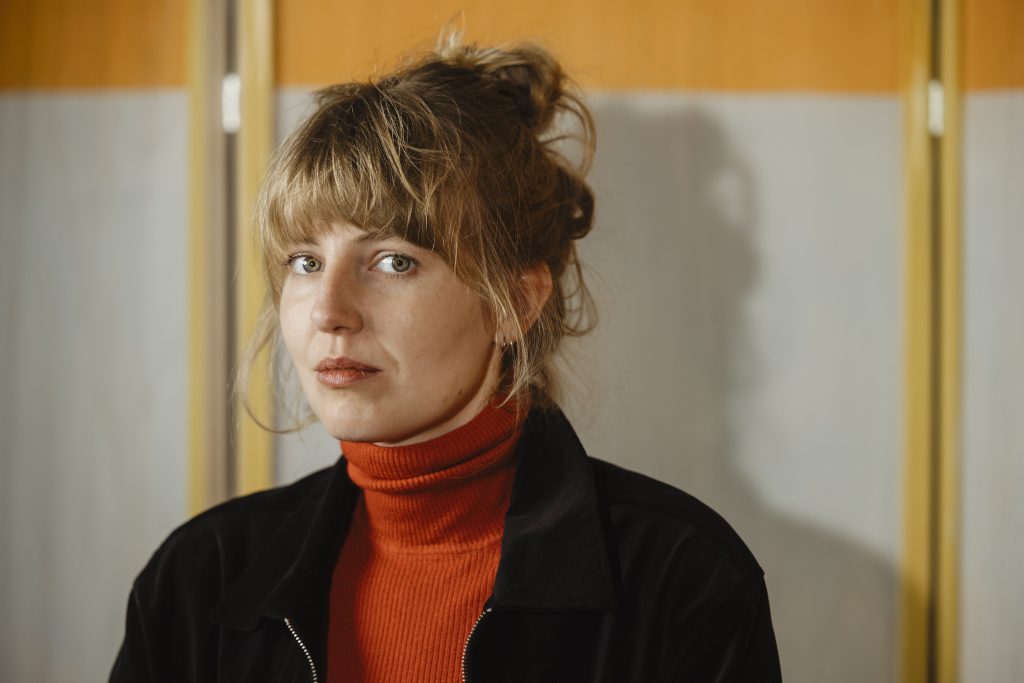
The practice of Fiona Lutjenhuis (Zevenaar, 1991) centres on depicting and reinterpreting the religious ideologies she grew up with in a village in North Brabant. Her parents were members of a sect based on a mix of theosophical ideas, esoteric cosmologies and beliefs in extraterrestrial life and supernatural beings. Lutjenhuis’ folding screens, drawings and murals function as carriers of stories. In a poetic way, she combines esoteric new age aesthetics with a range of visual influences drawn from comics, Japanese prints and medieval religious paintings. Fiona Lutjenhuis is represented by Galerie Fleur & Wouter.
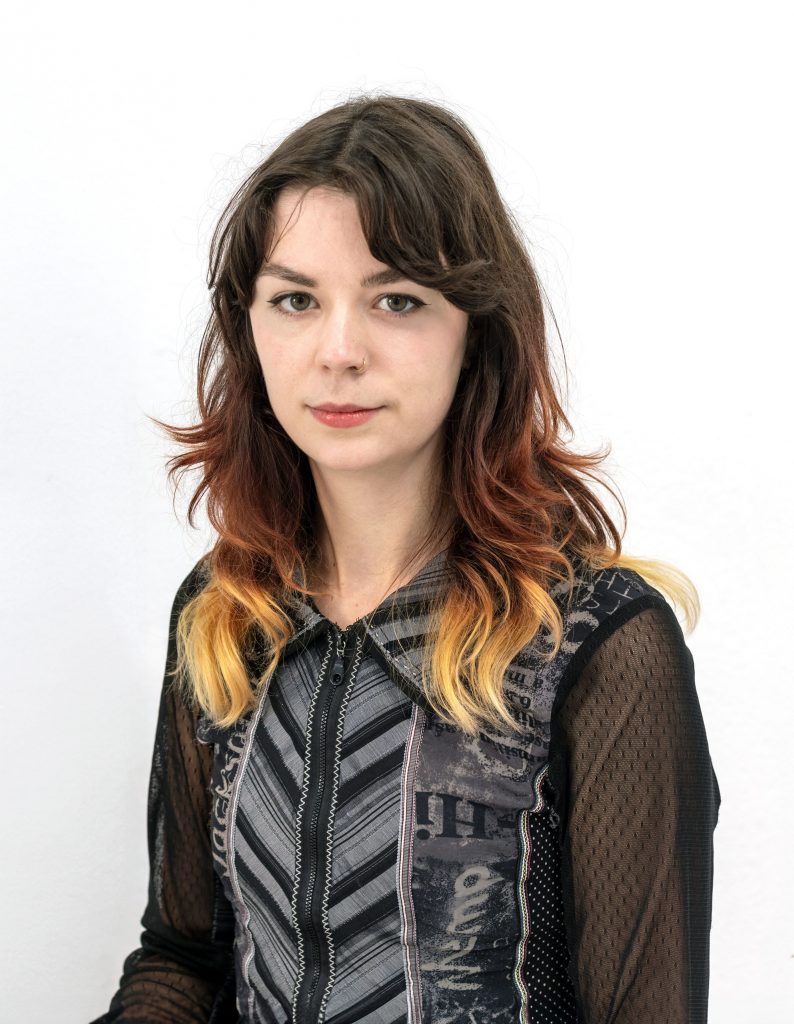
Kyra Nijskens (Ulestraten, 1997) explores how humans influence and reshape ecological systems. Her work focuses on biofouling: the attachment of marine and micro-organisms to industrial structures such as ship hulls and underwater pipelines. Unnoticed, these organisms travel along shipping routes, settle and disrupt existing infrastructures. Her work also comments on logistical systems. Each year, 1,382 shipping containers are lost at sea, sometimes resulting in cargoes of Crocs or yellow rubber ducks polluting beaches.
The winner of the NN Art Award will be announced on Friday 27 March 2026 during a festive gathering at Kunsthal Rotterdam.
Written by Flor Linckens
Tijdens de komende editie van Art Rotterdam wordt voor de tiende keer de NN Art Award uitgereikt. Deze prestigieuze stimuleringsprijs gaat naar een kunstenaar die werk toont op de beurs en een opleiding heeft afgerond aan een Nederlands instituut.
De prijs is niet alleen een blijk van erkenning, maar biedt kunstenaars ook ondersteuning bij het doorontwikkelen van hun praktijk. Als onderdeel van de nominatie is het werk van alle genomineerden te zien in Kunsthal Rotterdam van 14 maart tot en met 25 mei.
De vakjury, die een brede blik op het hedendaagse kunstveld vertegenwoordigt, bestond dit jaar uit:
Zij nomineerden de volgende vier kunstenaars:
Tina Farifteh (Teheran, 1982) is fotograaf en filmmaker. In haar werk onderzoekt zij hoe machtsstructuren het leven van gewone mensen beïnvloeden. Ze verleidt de toeschouwer om te kijken naar onderwerpen waarvoor we liever wegkijken, omdat ze ingewikkeld of ongemakkelijk zijn. Voor Document Nederland 2025, haar project over het Nederlandse asielsysteem, volgt Farifteh B., die na ruim vier maanden vreemdelingendetentie op Schiphol en een verblijf in Ter Apel in een asielprocedure terechtkomt. Door B. als verteller op te voeren, kantelt Farifteh onze blik op asielprocedures. In plaats van over asielzoekers te spreken, laat zij ons letterlijk naar hen luisteren. Daarmee houdt Farifteh de toeschouwer een spiegel voor: het werk gaat niet over hen, maar over ons. Tina Farifteh wordt vertegenwoordigd door Gallery Vriend van Bavink.
Het werk van Mandy Franca (Rotterdam, 1989) is een doorlopend onderzoek naar verbondenheid; zij put hierbij uit haar jeugd in een crossculturele omgeving en haar persoonlijke herinneringen. Franca onderzoekt en observeert de betekenis van het alledaagse om het schijnbaar onbeduidende een blijvende waarde toe te kennen. Als kunstenaar ondermijnt en bevraagt zij de traditionele toepassing van grafiek door te experimenteren met een breed scala aan artistieke media die samenkomen in schilderkunst, iPhone fotografie, grafiek, tekenen, collage, video, geluid, sculptuur en installatie. Terugkerende elementen zijn het fotografische beeld en mark-making. Mandy Franca wordt vertegenwoordigd door Night Café Gallery.
De praktijk van Fiona Lutjenhuis (Zevenaar, 1991) draait om het weergeven en herinterpreteren van de religieuze ideologieën waarmee zij opgroeide in een dorp in Noord-Brabant. Haar ouders waren er lid van een sekte die zich op een mix van theosofische ideeën, esoterische kosmologieën en het bestaan van buitenaards leven en bovennatuurlijke levensvormen baseerde. Lutjenhuis’ kamerschermen, tekeningen en muurschilderingen vormen dragers van verhalen. Op poëtische wijze combineert zij esoterische, new age-esthetiek met diverse visuele invloeden uit stripboeken, Japanse prenten en middeleeuwse religieuze schilderijen. Fiona Lutjenhuis wordt vertegenwoordigd door Galerie Fleur & Wouter.
Kyra Nijskens (Ulestraten, 1997) onderzoekt hoe de mens ecologische systemen beïnvloedt en hervormt. Haar werk draait om biofouling: het hechten van zee- en micro-organismen aan industriële structuren zoals scheepsrompen en onderzeese pijpleidingen. Onopgemerkt reizen deze organismen mee op scheepsroutes, nestelen zich en verstoren bestaande infrastructuren. Haar werk is ook een commentaar op logistieke systemen. Jaarlijks verdwijnen 1.382 zeecontainers in de oceaan, waarna soms ladingen Crocs of gele badeendjes de stranden vervuilen.
De winnaar wordt op vrijdag 27 maart 2026 bekendgemaakt tijdens een feestelijke bijeenkomst in Kunsthal Rotterdam.
Geschreven door Flor Linckens
“My delusional thinking brings sinister light, uncanny shadows, and a dystopian background, evoking the melancholy of my memory onto the canvas.” – Shimon Kamada
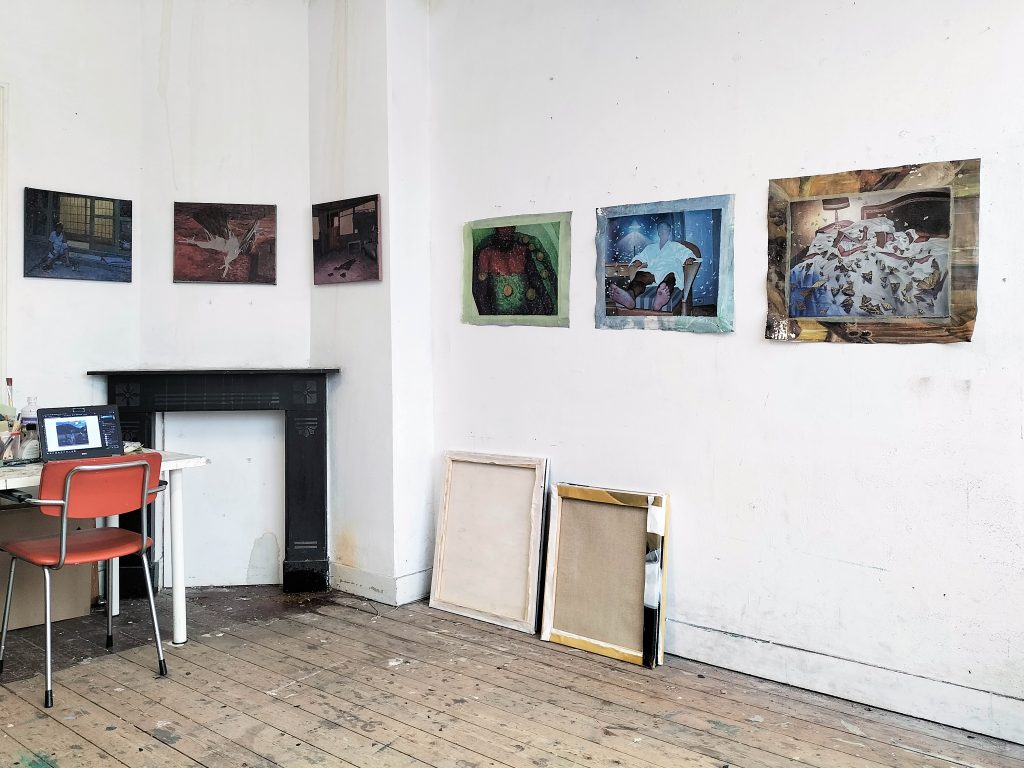
Through the fascinating psyche of artist Shimon Kamada (1997, Japan), we enter a treacherous terrain between abstraction and figuration. Here, a silver lining emerges: the relief that these two are not split ends of a spectrum at all. When reality begins to resemble a dream, and dreams become ever more rooted in reality, the duality itself starts to feel redundant. It is precisely within this intriguing in-between space that Kamada’s paintings take shape.
In the new art section of Art Rotterdam 2026, Diez Gallery presents a solo exhibition with recent works by Shimon Kamada which depict scenes from the artist’s early childhood until the present day. “My work is rooted in personal history and recalls nostalgic scenes from my mind. Having been away from my hometown in Japan for many years, I have had more time to reflect on it, and my recent works are influenced by customs, events, upbringing, and family dynamics. I hope they will evoke sensations of past memories running through the visitors’ minds, just like seeing a flashback.”
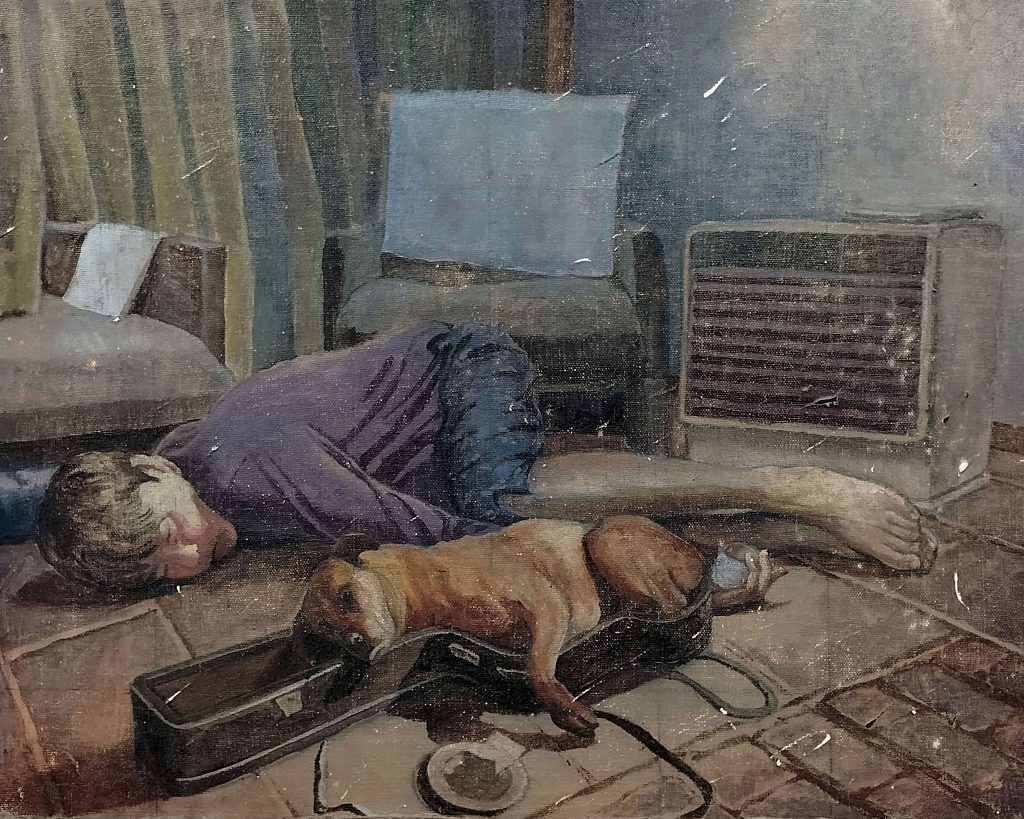
Using memory as his driving force brings with it an elusive, and therefore deceptive, creative energy. However at the same time, it can be strangely soothing and reassuring when our minds start to play tricks on us, as our recollection begins to lose clarity. Fusing seemingly divergent elements of reality, figuration, abstraction and fiction together is one of Kamada’s ways of coping with latent trauma. “There are many moments I want to return to; they are so beautiful that it feels almost pitiful to forget them, yet they are also painful memories I wish I could do over,” Kamada says.
In his latest series of works, Kamada also touches upon the overlapping and intersectional nature of lived experiences and the memories attached to them. He refers to an intimate family situation that became a profound experience for his work: a few years ago, his grandfather asked him to paint his funeral portrait, shortly before being diagnosed with a terminal illness. As different family members responded to his illness from their own positions, Kamada became increasingly aware of the conflicting emotions surrounding that moment. “By depicting our memories and the unique position of each family member, I explore these conflicting emotions to find ways to empathize with one another. It allows every family member to become an important character in my paintings.”
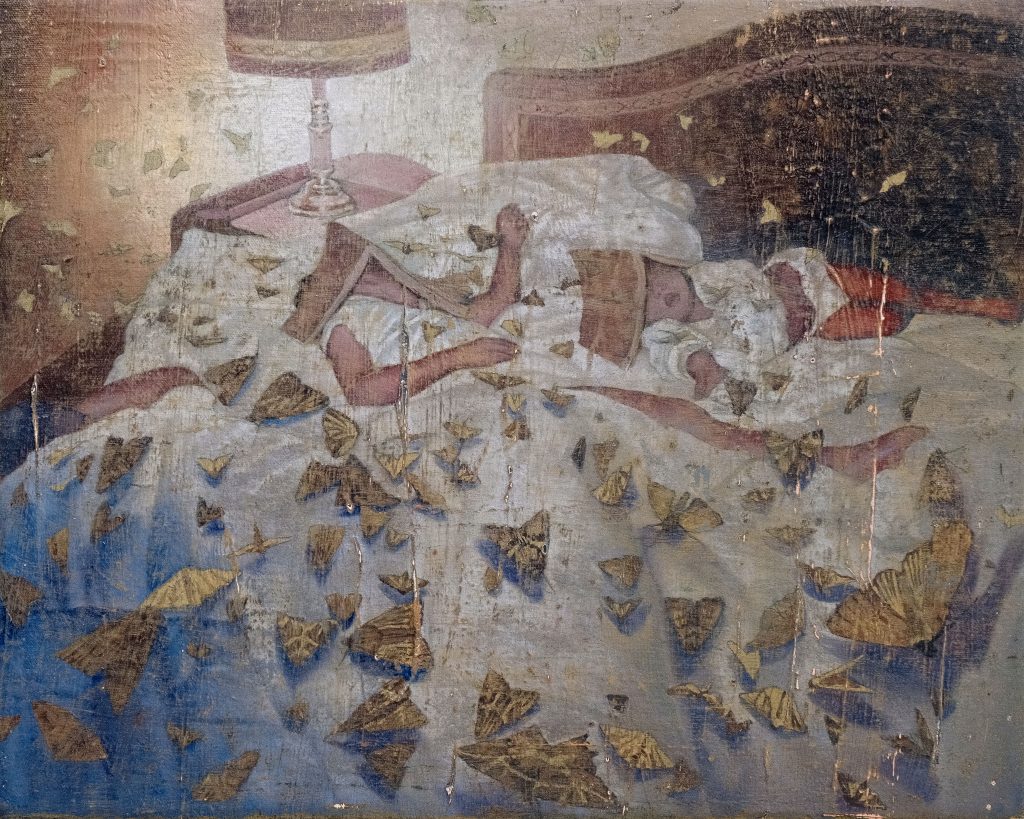
By projecting these different positions and sensations into dreamlike scenes, viewers with different memories may draw different worlds from Kamada’s paintings. An agency of one’s subjectivity is felt throughout the openness that Kamada provides. “My house, for example, is a typical Japanese home, but certain elements escape recognition by Western audiences and evoke unexpected interpretations. I hope viewers imagine the events depicted in my paintings as if they were happening in their own lives, and that a deja vu-like experience will provide opportunities for us to share stories in front of my paintings.”
Also the physical materiality of the paintings overlaps with Kamada’s emotional concept. The artist has already been experimenting with the approach of repainting on used canvases, but more recently he sands the surface as well to reveal fragments of hidden paintings on the underlayer. “I apply acrylic and oil on secondhand paintings and then damage the surface with sandpaper. The layered paint displays the multifaceted reality in everyday life moments. In each painting I depict family members that I extract from photo albums. I think sanding feels like an additional process to reinforce the context of recorrection. The damaged texture and faded colours even evoke the old photo albums, and the layering of new paintings on old paintings represents the process of memory: new pieces of information accumulate and overlay the old ones.”
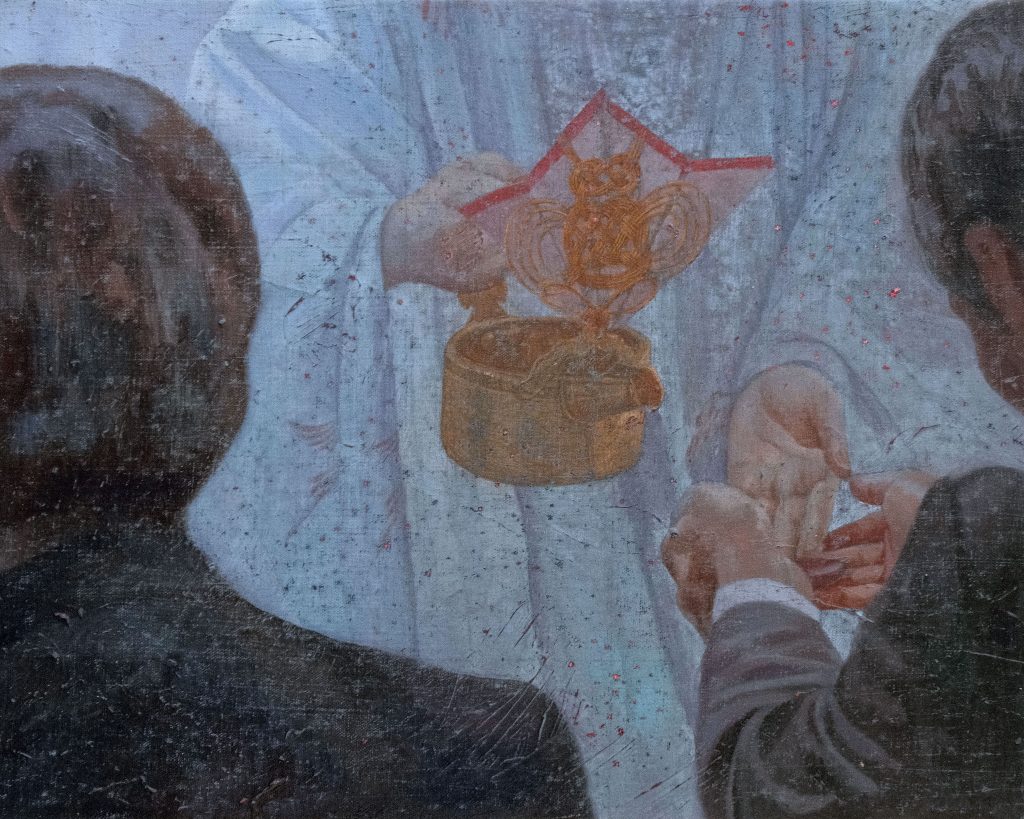
It is as if sanding is Kamada’s way of treating the surface like a wooden dining table that holds dear memories of family meals, coffee stains, love and conflict, gently sanded down over the years, only so it can be lived with again, allowing new memories to settle over the old ones.
And so it becomes clear that beyond what the eye can perceive Kamada’s paintings capture what lies dormant in the subconscious: the vapourness of time, the lingering scents of fading stories, and the nostalgia that comes with reliving memories, whether real, imagined, or somewhere in between.
Bio
Shimon Kamada (1997, Japan, lives and works in The Netherlands) won the Ron Mandos Residency Award (2020) and worked at Brutus Lab in Rotterdam (2021) as an artist-in-residence. He has participated in group exhibitions including Podium Gallery, Hong Kong (2025), Van Nelle Fabriek, Rotterdam (2024), Enari Gallery, Amsterdam (2023), ARWE Gallery, Gouda (2022), Wilford X, Temse (2022), Felix Solo Gallery, Nijmegen (2021), Atelier of AVL Mundo, Rotterdam (2021), Het HEM, Zaandam (2020), among others.
On show at New Art section, Shimon Kamada, diez gallery
Written by Emily van Driessen
“Mijn waanachtige denken werpt een sinister licht en unheimliche schaduwen tegen een dystopische achtergrond, en roept zo de melancholie van mijn herinneringen op het doek op.” – Shimon Kamada
Via de fascinerende psyche van kunstenaar Shimon Kamada (1997, Japan) betreden we een precair terrein tussen abstractie en figuratie. Daar tekent zich een hoopvol inzicht af: de geruststelling dat deze twee geen uitersten van een spectrum zijn. Wanneer de werkelijkheid een droomachtige gedaante aanneemt en dromen steeds sterker verankerd raken in het reële, begint die tweedeling zelf overbodig te worden. Precies in die intrigerende tussenzone ontstaan Kamada’s schilderijen.
In de new art section van Art Rotterdam 2026 presenteert Diez Gallery een solotentoonstelling met recente werken van Shimon Kamada, waarin scènes te zien zijn die vertrekken van zijn vroege kindertijd tot vandaag. “Mijn werk wortelt in mijn persoonlijke geschiedenis en roept nostalgische beelden op uit mijn herinneringen. Doordat ik al vele jaren weg ben uit mijn geboortestad in Japan, heb ik meer ruimte gehad om daarop te reflecteren. Mijn recente werken worden beïnvloed door gebruiken, gebeurtenissen, mijn opvoeding en de dynamiek binnen mijn familie. Ik hoop dat ze bij bezoekers gevoelens en beelden oproepen, zoals bij het ervaren van een flashback.”
Herinnering als drijvende kracht inzetten brengt een ongrijpbare, en daardoor ook misleidende, creatieve energie met zich mee. Tegelijk kan het vreemd genoeg kalmerend en geruststellend werken wanneer onze geest ons parten begint te spelen en herinneringen hun scherpte verliezen. Het samenbrengen van ogenschijnlijk uiteenlopende elementen als realiteit, figuratie, abstractie en fictie is voor Kamada één van de manieren om om te gaan met latent trauma. “Er zijn veel momenten waar ik naar wil terugkeren; ze zijn zo mooi dat het bijna pijnlijk voelt om ze te vergeten, maar tegelijk zijn het ook pijnlijke herinneringen die ik het liefst opnieuw zou willen beleven,” zegt Kamada.
In zijn meest recente reeks werken raakt Kamada ook aan de overlappende en intersectionele aard van geleefde ervaringen en de herinneringen die daaraan verbonden zijn. Hij verwijst daarbij naar een intieme familiesituatie die een diepgaande betekenis kreeg binnen zijn praktijk: enkele jaren geleden vroeg zijn grootvader hem om zijn begrafenisportret te schilderen, kort voordat bij hem een terminale ziekte werd vastgesteld. Terwijl verschillende familieleden elk vanuit hun eigen positie op zijn ziekte reageerden, werd Kamada zich steeds bewuster van de tegenstrijdige emoties die dat moment omgaven. “Door onze herinneringen en de unieke positie van elk familielid te verbeelden, onderzoek ik deze conflicterende emoties en zoek ik naar manieren om empathie voor elkaar te ontwikkelen. Zo krijgt elk familielid de ruimte om een belangrijk personage te worden in mijn schilderijen.”
Door deze uiteenlopende posities en gevoelens te projecteren in droomachtige scènes, kunnen kijkers met verschillende herinneringen elk hun eigen wereld uit Kamada’s schilderijen halen. In de openheid die Kamada creëert, is een vorm van handelingsruimte voor de eigen subjectiviteit voelbaar. “Mijn huis is bijvoorbeeld een typisch Japans huis, maar bepaalde elementen ontsnappen aan herkenning bij een westers publiek en roepen onverwachte interpretaties op. Ik hoop dat kijkers zich de afgebeelde gebeurtenissen voorstellen alsof ze zich in hun eigen leven afspelen, en dat een deja-vu-achtige ervaring kansen biedt om samen verhalen te delen voor mijn schilderijen.”
Ook de fysieke materialiteit van de schilderijen sluit aan bij Kamada’s emotionele concept. De kunstenaar experimenteert al langer met het overschilderen van gebruikte doeken, maar recent schuurt hij ook het oppervlak op om fragmenten van verborgen schilderingen in de onderlaag bloot te leggen. “Ik breng acryl en olie aan op tweedehands schilderijen en beschadig het oppervlak vervolgens met schuurpapier. De gelaagde verf toont de veelvormige realiteit van alledaagse momenten. In elk schilderij beeld ik familieleden af die ik haal uit fotoalbums. Het schuren voelt voor mij als een bijkomend proces dat de context van herziening versterkt. De beschadigde textuur en vervaagde kleuren roepen zelfs oude fotoalbums op, en het aanbrengen van nieuwe schilderingen over oude schilderingen staat voor het geheugenproces: nieuwe stukjes informatie stapelen zich op en leggen zich over de oude heen.”
Het is alsof het schuren voor Kamada een manier is om het oppervlak te behandelen als een houten eettafel die dierbare herinneringen draagt aan familiemaaltijden, koffievlekken, liefde en conflict, doorheen de jaren zachtjes opgeschuurd, zodat ze opnieuw kan worden gebruikt en nieuwe herinneringen zich over de oude heen kunnen nestelen.
Zo wordt duidelijk dat Kamada’s schilderijen, voorbij wat het oog kan waarnemen, vastleggen wat sluimert in het onderbewuste: de vluchtigheid van tijd, de blijvende geuren van vervagende verhalen en de nostalgie die gepaard gaat met het herbeleven van herinneringen, of ze nu werkelijk zijn, ingebeeld, of ergens daartussenin.
Bio
Shimon Kamada (1997, Japan, woont en werkt in Nederland) won de Ron Mandos Residency Award (2020) en werkte in 2021 als artist-in-residence bij Brutus Lab in Rotterdam. Hij nam deel aan groepstentoonstellingen bij onder meer Podium Gallery, Hongkong (2025), Van Nelle Fabriek, Rotterdam (2024), Enari Gallery, Amsterdam (2023), ARWE Gallery, Gouda (2022), Wilford X, Temse (2022), Felix Solo Gallery, Nijmegen (2021), Atelier of AVL Mundo, Rotterdam (2021) en Het HEM, Zaandam (2020).
Te zien op Art Rotterdam, New Art Section: Shimon Kamada, diez gallery
Geschreven door Emily van Driessen
First look, then read. Let your eyes take everything in before forming an opinion and only then read the title. That applies to the viewing of all art, but especially to the newest work by Helen Verhoeven. If you go by the titles alone, you miss the actual subject of the image. It is not the black cat in Black Cat, the white mask in White Mask or the yellow head in Yellow Head; rather, they are a corpse, a pistol—aimed at the viewer—and a machine gun. The subject is violence and its consequences.
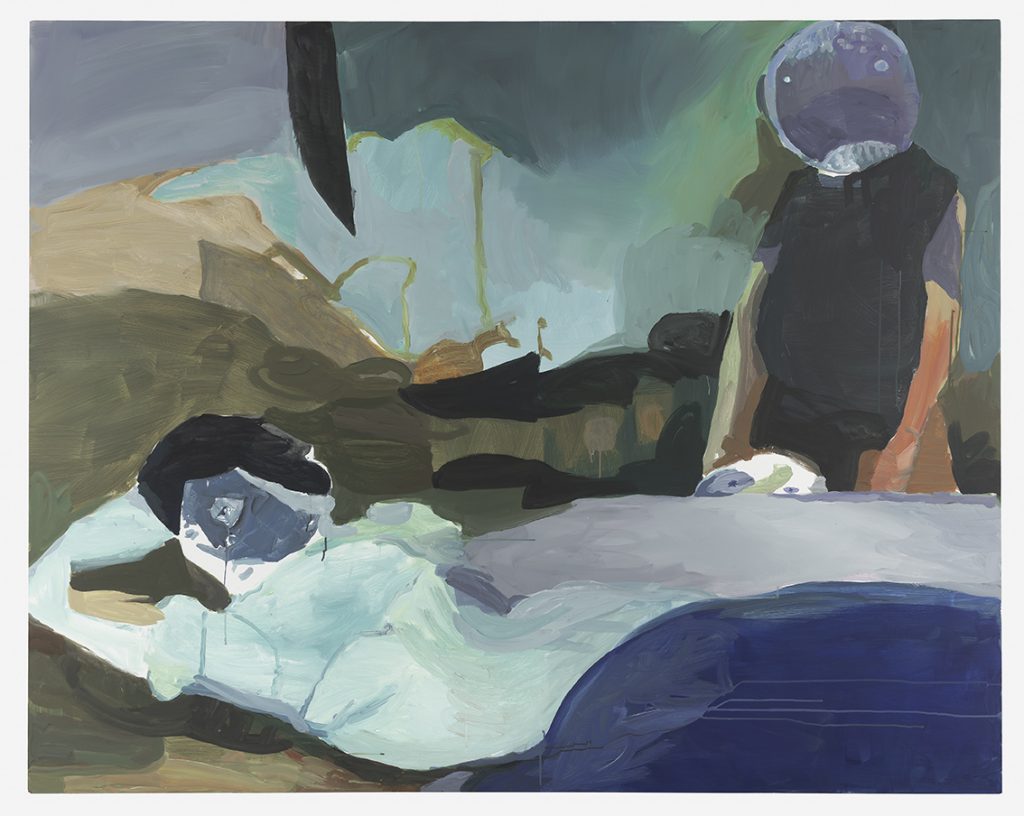
The artworks are part of the series Verhoeven has made over the past year titled Because. Because is no more than a prompt toward an explanation, because without further qualification, it has something of a lazy appeal to authority: simply because I say so, simply because it can be done and because I felt like it. Seen this way, it seems to concern senseless violence.
Helen Verhoeven’s work can be seen at the Annet Gelink Gallery stand. At the time of publication, it is not yet clear which work will be shown.
Verhoeven’s work is a combination of figuration and abstraction. She uses different textures and patterns, giving the entirety an almost collage-like effect. In Verhoeven’s work, you can see exactly what is happening on the canvas. You recognise the situations, the spaces, references to current events or historical occurrences and you can interpret the body language and facial expressions of human figures. At the same time, little is worked out in detail, which also gives Verhoeven’s work a magical quality, like a scene from a dream. The image is as tangible as a thought. At any moment, it could burst apart or slip through your fingers.
Verhoeven’s palette also leads you astray. At first glance, the purple, blue and pink feel cheerful, but the colours are almost always accompanied by a grey undertone. This makes them appear matte. The subjects, by contrast, are generally darker and anything but naive. Thematically, Verhoeven connects autobiographical elements with universal themes such as fertility and beauty, also touching on subjects like power relations and death. The work in Because is no exception.
“My paintings often depict unpleasant things, but hopefully, with a certain lightness, because humour is ultimately the best antidote to all misery,” she said a few years ago to Het Parool. Because of that lightness, Verhoeven’s work always presents you with a whole range of emotions. In Black Cat, we see a black cat next to what appears to be a deceased person. The black cat sheds a tear, but in such a way that it feels light. Something cheerful.
Helen Verhoeven (Leiden, 1974) lives and works in Berlin. She has a studio in Lichtenberg, a district in former East Berlin, just outside the S-Bahn ring. Her studio is housed in an old Stasi listening station and overlooks a former Stasi prison. At first, she did not know what had taken place there. That might even have been too much for someone who, for a time, actively sought out difficult emotional and mental experiences and drew on them for her work.
One of the places where she encountered such intense experiences was the secondary school Verhoeven attended in 1986. That year, the Verhoeven family moved from the neatly groomed town of Oegstgeest to the metropolis of Los Angeles due to her father’s film career. A great contrast in terms of liveliness, but also in terms of society. On the surface, it resembles ours, but one that overlooks the enormous differences in opportunity, health and prosperity.
Verhoeven’s parents moved to L.A. with a progressive, European mindset. As a result, they chose to send Verhoeven and her sister to a local public school, as was customary in the Netherlands. At that school, she came into contact with aggression, alcohol, drugs, sexual boundary-crossing behaviour and gangs. “I arrived as a child who had experienced nothing and within a year, I felt as though I had experienced just about everything and the innocence of my youth was gone.” From the age of 15, she attended another school that was geographically close by, but with a completely different composition.
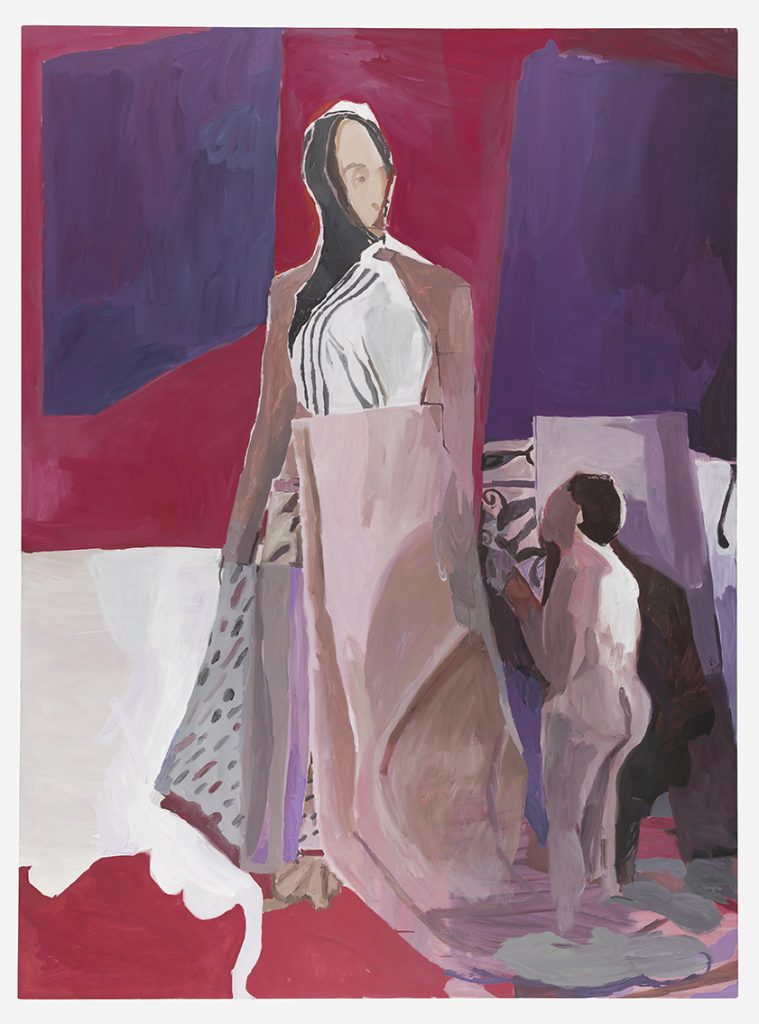
During her American academy years at the San Francisco Art Institute and New York Academy of Art, she actively sought out intense emotional experiences—shocks she could process in her work. “I wanted to see, feel and experience the bad; as if only that were real life.” For example, she worked at an abortion clinic in a disadvantaged neighbourhood, where she encountered the most heartbreaking situations. Verhoeven comments, “A very young girl came in for an abortion. She had an enormous, homemade tattoo of a penis on her stomach. Terrifying—that image has always stayed with me.”
She also worked for a while in an emergency room, dissected corpses in a laboratory and helped out for some time at a homeless shelter. Verhoeven continues, “I collected an endless well of feelings alongside factual knowledge.” She justified this to herself by making work about it, but this has come at a price: “It produced interesting art—and still does—but I also suffered from those deliberately sustained traumas.”
During her working process, Verhoeven seals off her studio hermetically from the critical gaze of outsiders. A single word about a work that is not yet finished can ruin a painting. Verhoeven explains, “I find making art extremely private, very personal.” For a while, she made a lot of work about mothers and children as a way of dealing with the fact that she was unable to become pregnant. A month later, she turned out to be expecting after all. Verhoeven says, “I find painting to be a kind of exorcism anyway. You let it go, you let it out and you move on.”
That not every work needs to be preceded by an intense emotional experience is demonstrated by the work Verhoeven has made on commission. In 2015, she completed an ambitious work for the Supreme Court of the Netherlands and in 2021, The Family, an imposing group portrait of the Royal Family, starting with Juliana of Stolberg. Both works of art were preceded by extensive studies.
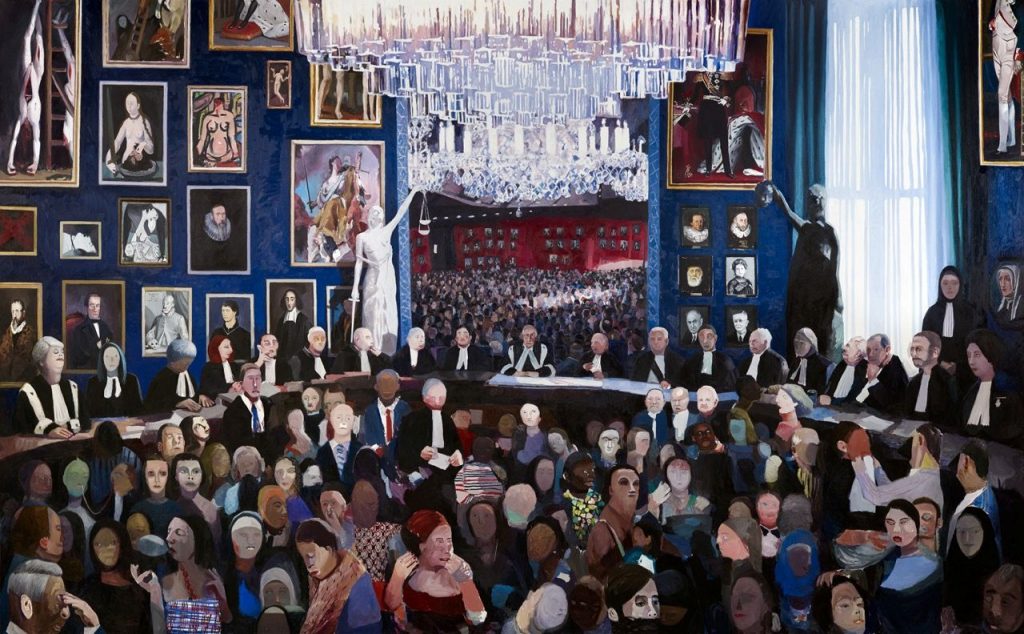
The Supreme Court painting is imposing in every respect. The canvas measures no less than 4 by 6.5 meters—Verhoeven worked on it for a year—and is packed with historical and art-historical references to the development of Dutch law. But here, too, all is not peace and harmony. The Supreme Court rather holds up a mirror to us. The judiciary and rule of law as we know them are just as fragile as the dream images in a series like Because. Over the centuries, a price has been paid for them and if we do not maintain them, they will disappear like snow in the sun.
On the walls of the courtroom, we see former politicians, scholars, heads of state and philosophers. Most striking is the famous painting of the lynched De Witt brothers by Jan de Baen. In front of it sits the Supreme Court under the leadership of its president, Lodewijk Ernst Visser, who was the first Jewish-Dutch president of the Supreme Court, but was dismissed by the German occupiers in 1941—without public protest from the other justices. In the foreground, we see a crowd of sad, angry, lonely, kind and familiar figures who together form our society.
Helen Verhoeven’s work is included in, among others, the collections of the Centraal Museum, Stedelijk Museum and Bonnefantenmuseum, where she held a solo exhibition in 2018. Her work can also be found in the collections of the Saatchi Gallery, Museum of Contemporary Art in Miami, DSM, De Nederlandsche Bank, Eneco and Rabobank. In 2008, she won the Royal Award for Modern Painting, followed by the Wolvecamp Prize in 2010 and ABN AMRO Art Award in 2018. Helen Verhoeven is represented by the Annet Gelink Gallery.
Written by Wouter van den Eijkel
Eerst kijken, dan lezen. Eerst je ogen de kost geven, zelf een mening vormen en dan pas kijken wat de titel is. Dat zou voor het kijken naar alle kunst moeten gelden, maar zeker voor de nieuwste werken van Helen Verhoeven. Als je daarbij op de titels afgaat, mis je het eigenlijke onderwerp van de voorstelling. Dat is niet de zwarte kat in Black Cat, het witte masker in White Mask of het gele hoofd in Yellow Head, het zijn: een lijk, een pistool -gericht op de kijker- en een machinegeweer. Het onderwerp is geweld en de gevolgen daarvan.
De werken zijn onderdeel van de serie die Verhoeven afgelopen jaar maakte, getiteld Because (omdat). Because is niet meer dan een aanzet tot een verklaring, want zonder verdere toevoeging heeft iets van een gemakzuchtig autoriteitsargument: gewoon, omdat ik het zeg. Gewoon, omdat het kan. Gewoon, omdat ik er zin in had. Zo bezien lijkt het te gaan om zinloos geweld.
Het werk van Helen Verhoeven is te zien in de stand van Annet Gelink Gallery. Op het moment van publicatie is nog niet duidelijk welke werken getoond zullen worden.
Verhoevens werk is een combinatie van figuratie en abstractie. Ze maakt gebruik van verschillende texturen en patronen, waardoor het geheel haast een collage-effect krijgt. Op een werk van Verhoeven zie je precies wat er op het doek gebeurt. Je herkent de situaties, de ruimtes, verwijzingen naar de actualiteit of historische gebeurtenissen, en kan de lichaamshoudingen en gezichtsuitdrukkingen van menselijke figuren duiden. Tegelijk is weinig in detail uitgewerkt waardoor Verhoevens werk ook iets magisch heeft; als een scene uit een droom. De voorstelling is net zo tastbaar als een gedachte. Ieder moment zou die uiteen kunnen spatten of je door de vingers kunnen glippen.
Ook Verhoevens palet zet je op het verkeerde been. Op het eerste gezicht stemt het paars, blauw en roze vrolijk, maar de kleuren gaan vrijwel altijd vergezeld van een grijze ondertoon. Daardoor ogen ze mat. De onderwerpen daarentegen zijn in de regel donkerder en allesbehalve naïef. Thematisch verbindt Verhoeven namelijk autobiografische elementen met universele thema’s zoals vruchtbaarheid en schoonheid, en stipt ze ook onderwerpen aan als machtsverhoudingen en de dood. De werken in Because vormen daarop geen uitzondering.
‘In mijn schilderijen gaat het vaak over akelige dingen, maar hopelijk met een zekere lichtvoetigheid, omdat humor nu eenmaal het beste tegengif is voor alle ellende’, zei ze een aantal jaar terug tegen Het Parool. Door die lichtvoetigheid krijg je bij Verhoeven altijd een scala aan emoties voorgeschoteld. In Black Cat zien we een zwarte kat bij wat lijkt op een overleden persoon. De zwarte kat laat een traan, maar wel op zo’n manier dat het iets lichts heeft. Iets vrolijks.
Helen Verhoeven (Leiden, 1974) woont en werkt in Berlijn. Ze heeft een atelier in Lichtenberg, een wijk in voormalig Oost-Berlijn, net buiten de ring van de S-bahn. Haar atelier zit in een oude afluistercentrale van de Stasi en heeft uitzicht op een voormalige Stasi-gevangenis. Aanvankelijk wist ze niet wat er allemaal had plaatsgevonden. Dat zou zelfs te veel zijn voor iemand die moeilijke emotionele en mentale ervaringen een tijd lang opzocht en eruit put voor haar werk.
Een van de plekken waar ze dergelijke intense ervaringen opdeed, was de middelbare school waarop Verhoeven in 1986 belandde. Dat jaar verhuisde het gezin Verhoeven voor haar vaders filmcarrière van het aangeharkte Oegstgeest naar de metropool Los Angeles. Een groot contrast qua levendigheid, maar ook qua maatschappij. Op het oog lijkt die op de onze, alleen dan ga je voorbij aan de gigantische verschillen in kansen, gezondheid en welvaart.
Verhoevens ouders verhuisden naar LA met een progressieve, Europese mindset. Daardoor kozen ze ervoor Verhoeven en haar zus naar een openbare school in de buurt te sturen, wat in Nederland gebruikelijk was. Op die school kwam ze in contact met agressie, drank, drugs, seksueel grensoverschrijdend gedrag en gangs. ‘Ik kwam er als kind dat nog niets had meegemaakt en binnen een jaar had ik voor mijn gevoel zo’n beetje álles meegemaakt en was de onschuld uit mijn jeugd verdwenen.’ Vanaf haar 15e zou ze een andere school bezoeken die hemelsbreed niet ver uit de buurt lag, maar een totaal andere samenstelling had.
Tijdens haar Amerikaanse academietijd aan het San Francisco Art Institute en de New York Academy of Art ging ze actief op zoek naar intense emotionele ervaringen, shocks die ze kon verwerken in haar werk. “Ik wilde het slechte zien, voelen en meemaken; alsof alleen dat het echte leven is.” Zo werkte ze in een abortuskliniek in een achterstandswijk, waar ze de meest hartverscheurende situaties aantrof. Verhoeven: “Een piepjong meisje kwam voor een abortus. Zij had een enorme, huisgemaakte tatoeage van een piemel op haar buik. Doodeng, dat beeld is me altijd bijgebleven.”
Ook werkte ze een tijdje op de spoedeisende hulp, ontleedde lijken in een laboratorium en hielp ze een tijdje in een daklozenopvang. Verhoeven: “Ik heb een eindeloze put gevoelens verzameld, naast feitelijke kennis.” Ze verantwoordde dit voor zichzelf door er werk over te maken, maar ze betaalde er ook een prijs voor: ‘Het leverde interessante kunst op, en nog steeds, maar ik kreeg ook last van die expres opgelopen trauma’s.”
Tijdens haar werkproces sluit Verhoeven haar atelier hermetisch af voor de kritische blik van buitenstaanders. Een enkel woord over een werk dat nog niet af is, kan een schilderij verpesten. Verhoeven: “Ik vind kunst maken extreem privé, heel persoonlijk.” Zo maakte ze een tijdje veel werk over moeders en kinderen, als manier om om te gaan met het feit dat het niet lukte om zwanger te worden. Een maand later bleek ze alsnog in verwachting. Verhoeven: “Ik vind schilderen sowieso een soort proces van exorcisme. Je laat het los, je laat het er uit en je laat het gaan.”
Dat niet aan ieder werk een intense emotionele ervaring vooraf hoeft te gaan, bewijzen de werken die Verhoeven in opdracht maakte. Zo rondde ze in 2015 een ambitieus werk af voor de Hoge Raad en 2021 The Family, een imposant groepsportret van de Koninklijke familie, vanaf Juliana van Stolberg. Aan beide werken gingen uitgebreide studies vooraf.
De Hoge Raad is in alle opzichten imposant. Het doek meet maar liefst 4 bij 6,5 meter – Verhoeven werkte er een jaar aan – en zit tjokvol historische en kunsthistorische verwijzingen naar de ontwikkeling van het Nederlands recht. Maar ook hier is het niet allemaal pais en vree. De Hoge Raad houdt ons eerder een spiegel voor. De rechtspraak en rechtstaat zoals we die kennen is net zo kwetsbaar als de droombeelden in een serie als Because. Over de eeuwen heen is er een prijs voor betaald en als we hem niet onderhouden verdwijnt ie als sneeuw voor de zon.
Op de wanden va de rechtszaal zien we gewezen politici, geleerden, staatshoofden en filosofen. Het meest in het oog springt het bekende schilderij van de gelynchte gebroeders De Witt van Jan de Baen. Daarvoor zit de Hoge Raad onder leiding van president, mr. Visser. Mr. Visser was de eerste joodse president van de Hoge Raad, maar werd in 1941 door de Duitse bezetters ontslagen – zonder publiekelijk protest van de andere raadsheren. Op de voorgrond zien we een menigte van treurige, boze, eenzame, lieve en vertrouwde figuren die samen onze samenleving vormen.
Het werk van Helen Verhoeven is onder meer opgenomen in de collecties van het Centraal Museum, het Stedelijk Museum en het Bonnefantenmuseum, waar ze een solotentoonstelling had in 2018. Haar werk is daarnaast te vinden in de collecties van Saatchi Gallery, The Museum of Contemporary Art in Miami, DSM, De Nederlandsche Bank, Eneco en de Rabobank. In 2008 sleepte ze de Koninklijke Prijs voor Vrije Schilderkunst binnen, gevolgd door de Wolvecampprijs in 2010 en de ABN Amro Kunstprijs in 2018. Helen Verhoeven wordt vertegenwoordigd door de Annet Gelink Gallery.
Geschreven door Wouter van den Eijkel
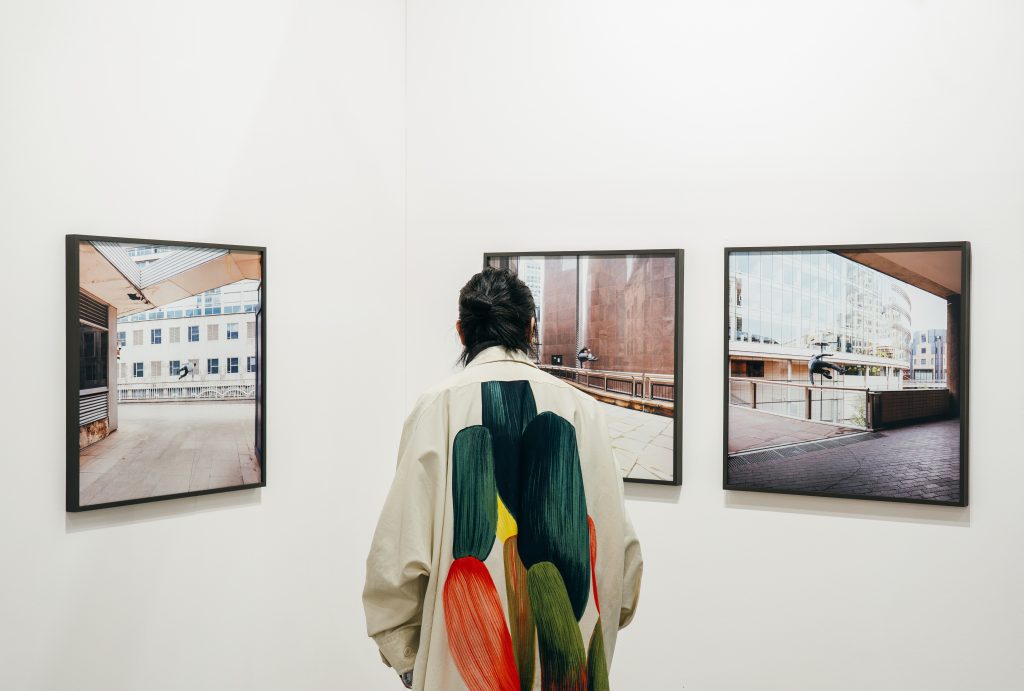
From Friday 27 to Sunday 29 March, Art Rotterdam returns with a sharpened fair format that brings together visual art, photography, video and large-scale installations. The format offers space for both emerging talent and established galleries, while the addition of Unseen Photo introduces a sharply curated and internationally oriented photography programme, fully integrated into the fair. With the return to Rotterdam Ahoy, Art Rotterdam continues the course set in 2025. The venue’s scale and openness, along with its hospitality facilities, contribute to a pleasant visit with room for quiet moments of rest. As a result, visitors spend more time on the fair floor. Last year, Art Rotterdam welcomed 28,000 visitors.
This edition features over 150 galleries from the Netherlands and abroad, including exhibitors from Lisbon, Istanbul, Buenos Aires, Copenhagen, Johannesburg, Bratislava, London, Rome, Paris, Madrid, Vienna and Riga. Art Rotterdam also maintains a strong bond with the city. The Wall Street Journal recently included Rotterdam in their 10 Best Places to Visit in 2026: “The city has reinvented itself as one of Europe’s most experimental urban laboratories, with starchitect-designed towers and cultural districts built on former docklands.” Last year, the city saw the opening of the 15,000 m² migration museum Fenix, and the brand-new eight-storey Nederlands Fotomuseum is set to open its doors soon with a festive launch.
DHB Bank returns as the main sponsor of Art Rotterdam. DHB Bank is a Dutch savings bank where you can save online. Its head office has been based in Rotterdam for over 30 years. Over time, the city became its home base, which is one of the reasons DHB Bank proudly supports Art Rotterdam.
Art Rotterdam is divided into distinct sections that offer a clear and coherent view of today’s contemporary art practice. These sections help visitors to navigate the fair.

Art Rotterdam 2026 sections
In the Main Section, participating galleries present a diverse selection of contemporary art. The Solo/Duo section is integrated within this format, with booths that highlight the work of one or two artists.
The New Art Section is devoted to solo presentations by emerging artists with exciting practices. After a successful first edition, curator Övül Ö. Durmuşoğlu returns for Art Rotterdam 2026. In addition to Unseen booths in the Main and Solo/Duo sections, three specially curated sections form a distinctive photography pavilion: New Photography, Encounters and The Past Present. These sections explore hybrid visual languages, crossovers with other disciplines, and new perspectives on analogue photography and archival material. Alongside this, the Unseen Book Market will take place in the new Nederlands Fotomuseum, where forty publishers present a wide selection of photobooks and publications. Van Lanschot Kempen is the new partner of Unseen Photo.
The Prospects section by the Mondriaan Fund introduces a broad audience to a new generation of artists. This fourteenth edition presents work by 92 emerging artists who received financial support in 2024 to help launch their careers. The exhibition is curated by Johan Gustavsson and Daphne Verberg.
Projections is the fair’s video art section: a darkened space of over 800 square metres with twelve projections on freestanding five-metre-wide screens.
Sculpture Park serves as a meeting point within the fair, offering 280 square metres of sculptures and installations. Designed by Tom Postma Design, the section literally brings air and space into the fair layout.
Highlights
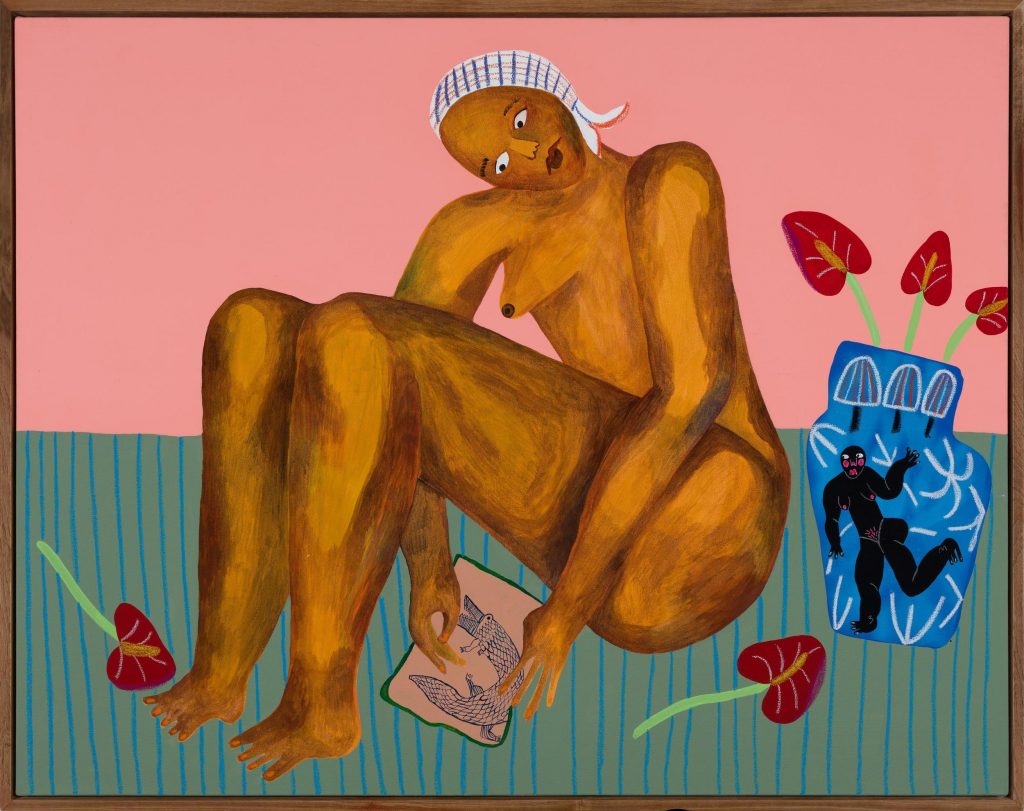
kumalo | turpin from Johannesburg presents work by Boemo Diale in the Main Section. Diale grew up within the complex racial and socio-political structures of post-apartheid South Africa and works from a multidisciplinary practice in which identity, generational trauma and dreams converge. Her visual language is deeply personal, with a strong focus on her maternal lineage, while also addressing the shared cultural heritage of African women. By intertwining fragments from her family archive with colourful, dreamlike settings, she creates friction between reality and imagination, raising questions about her position, origins and the potential of art to effect change.
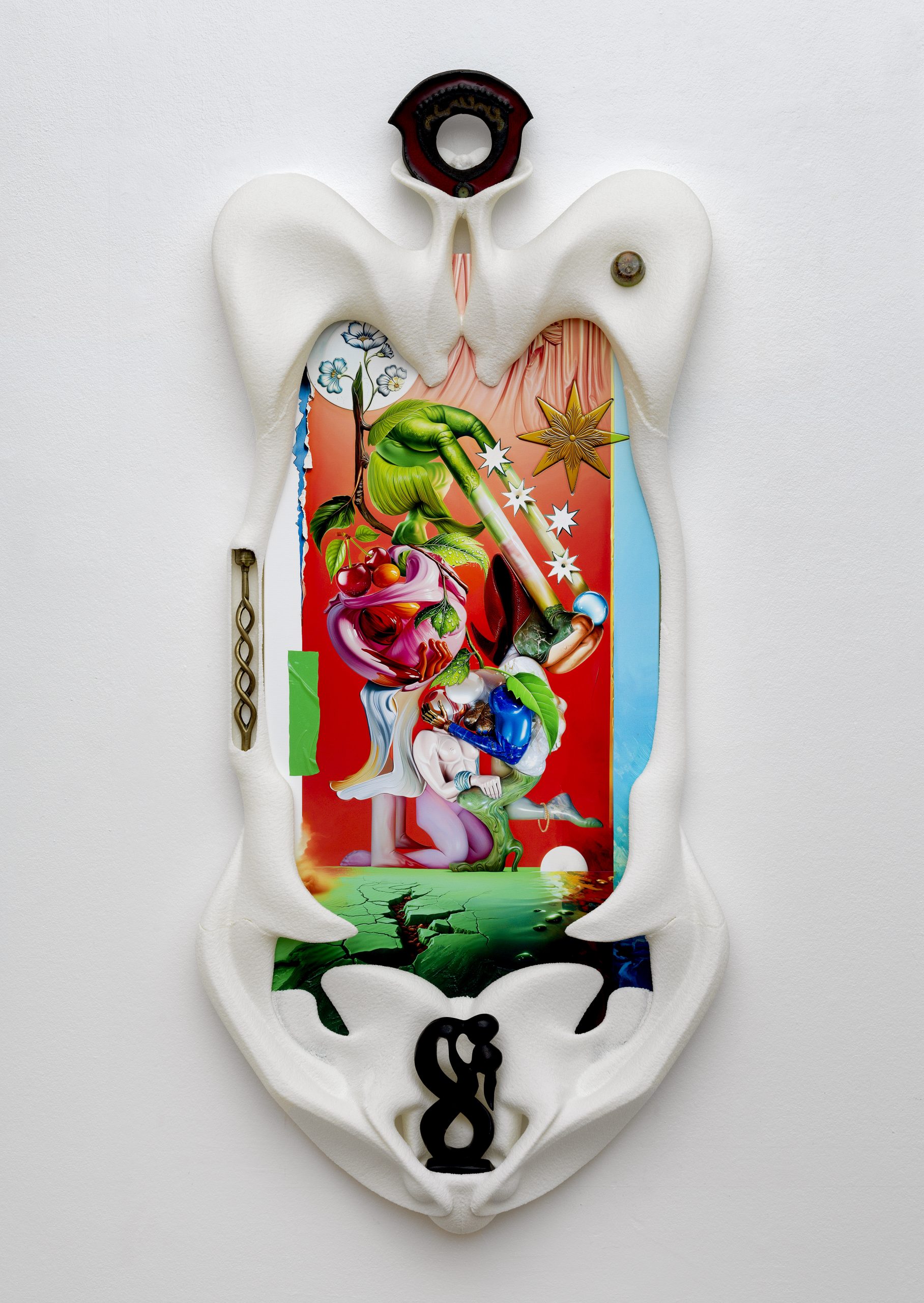
Kévin Bray (Upstream Gallery) works from a multidisciplinary practice where digital and physical realities continuously merge, using video, digital painting, 3D-printed sculptures and sound as equal components. Drawing on his background in graphic design, the French artist unpacks the logic of software, games and interfaces, translating these into hybrid forms that demonstrate how images shape not only our perception, but also our behaviour and reality. In the Main Section, it becomes clear how Bray deliberately equalises fiction and matter, consistently dissolving the boundaries between digital and tactile, imagination and reality. His work was previously shown at Stedelijk Museum Amsterdam, Palais de Tokyo in Paris, Kunstinstituut Melly, Foam Amsterdam, Het Nieuwe Instituut and The Hole in New York, and has been included in the collections of the AkzoNobel Art Foundation, ING and the Dutch Ministry of Foreign Affairs.
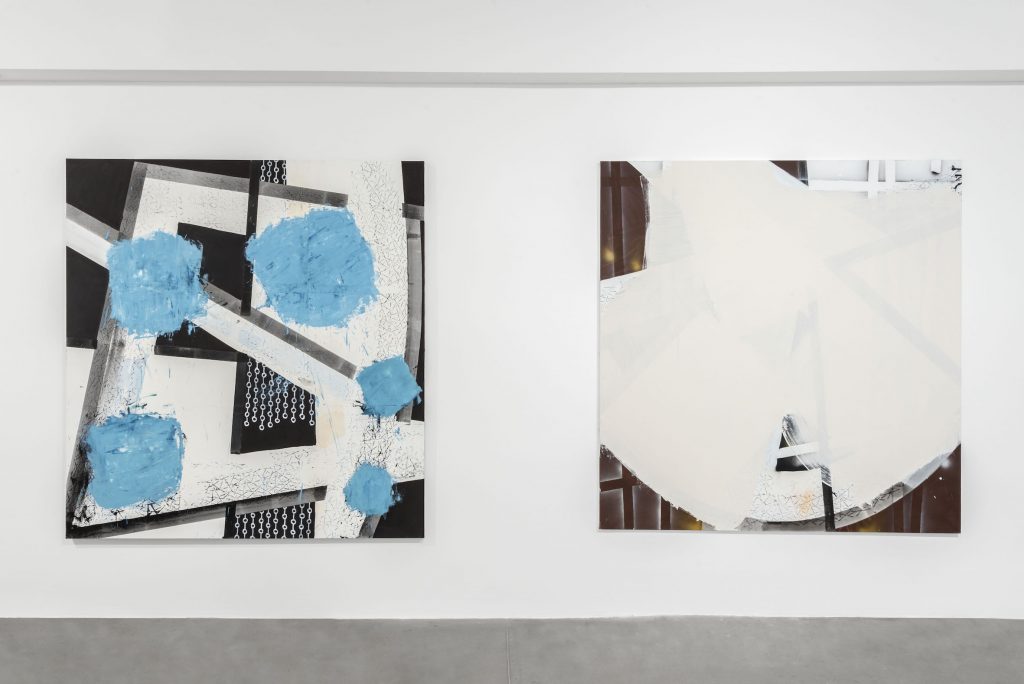
ZAHORIAN & VAN ESPEN from Bratislava (Main Section) presents work by Vladimír Ossif, a painter working within the tradition of geometric abstraction. The Slovak artist spent time in cities such as Paris, Bratislava, Madrid and New York, and his vibrant paintings are therefore infused with motion and change, expressed in dynamic compositions in which forms collide, overlap or balance alongside each other. His works explore what images can communicate when language falls short. His work is included in the collections of Musée d’Art Moderne de Paris, Casa de Velázquez in Madrid and the National Gallery in Prague, and was featured in the 13th Havana Biennial.
In the Solo/Duo section at Annet Gelink Gallery, works are presented by Helen Verhoeven and Steffani Jemison, two artists who each in their own way explore the tension between individual and collective, delving into themes of the body and representation. Jemison investigates how African-American culture, history, knowledge systems, movement, language and storytelling are transmitted, creating performances, videos, audio works and sculptures that have been shown at MoMA, the Whitney Museum (the Whitney Biennial), the Brooklyn Museum, Stedelijk Museum Amsterdam, Jeu de Paume and MoMA PS1. Verhoeven works with large, layered paintings in which dream, history, religion, mythology and social violence merge. She created a royal portrait for the Dutch Royal Family, and her work has been included in the collections of the Centraal Museum, Stedelijk Museum Amsterdam, the Bonnefanten museum, Saatchi Gallery, The Museum of Contemporary Art in Miami, De Nederlandsche Bank and Rabobank.
In the Main Section, Heejsteck# presents the installation ‘Add to Cart’ by Peer Vink and Tom Putman. The project takes the shopping mall as a starting point, not as a nostalgic backdrop but as an outdated status symbol, comparable to a film set that convinces from a distance but reveals its construction up close. The largely enclosed booth is accessible only through a cave-like portal and leads to an artificial grotto with a waterfall and bar, exposing how artificial nature and fictional worlds are used to drive desire and consumption. The installation is accompanied by new works from both artists.
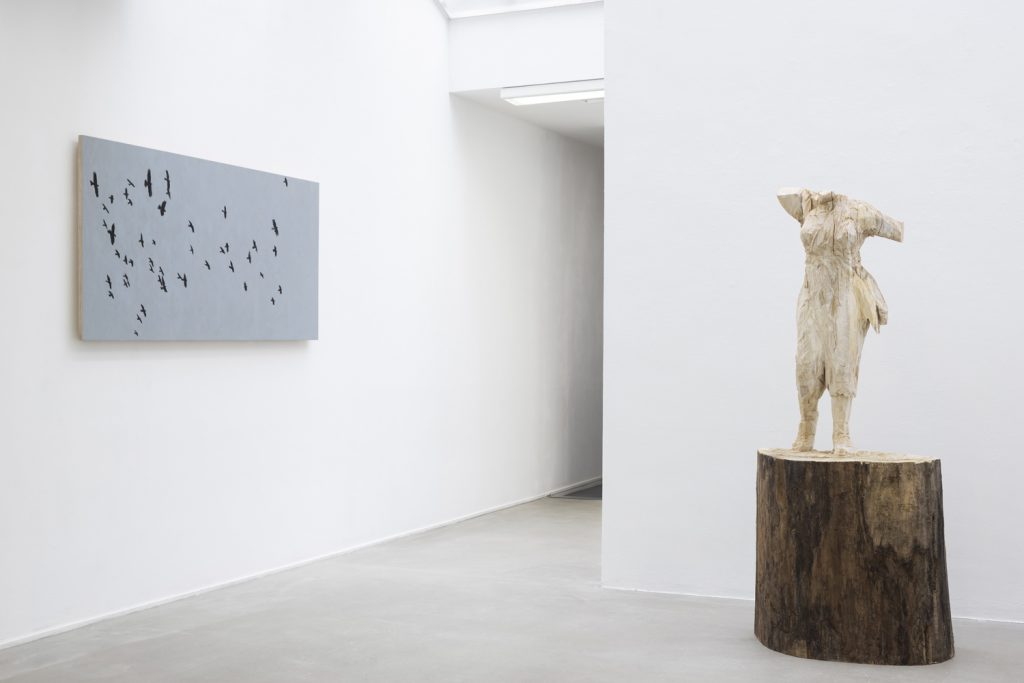
Stephan Balkenhol creates hand-carved wooden sculptures in which the human figure almost always takes centre stage. He typically carves his works from a single block of wood, sometimes even an entire tree trunk, using hammers and chisels with minimal use of machinery, leaving visible splinters, cracks and grooves. Shown by AKINCI in the Main Section, his practice reveals how this sober, artisanal approach results in sculptures that resonate universally. His work is held in the collections of Centre Pompidou, Tate, ARKEN Museum of Modern Art, Museum Voorlinden, Museum of Contemporary Art Tokyo, MoMA, LACMA, the Art Institute of Chicago, Hamburger Bahnhof, the Peggy Guggenheim Collection and Kunstmuseum Den Haag. His work was recently shown in a solo exhibition at Kunsthal Rotterdam.
In the Solo/Duo section, Galerie Fontana presents work by Thijs Segers, including recent paintings and a new installation. Segers explores themes such as decay, transformation and impermanence. His paintings capture both personal memories and universal themes, often inspired by abandoned places, nature and his inner world. His work has previously been shown at the Noordbrabants Museum, Paleis op de Dam, the Vincent van GoghHuis, Museum Villa Mondriaan and Het HEM. In 2021, 2024 and 2025 he was nominated for the Royal Award for Modern Painting.
For tickets and a full list of participants, visit www.artrotterdam.com. The fair catalogue will be published on GalleryViewer.com on 20 March 2026.
Written by Flor Linckens
From 27 to 29 March 2026, Unseen Photo will present a sharply curated international photography programme within Art Rotterdam at Rotterdam Ahoy, bringing together established names and emerging talent. This year, Unseen consists of six interconnected components. On the fair floor, Unseen appears in the Main Section and the Solo/Duo programme, both tightly selected and fully embedded among the wider Art Rotterdam presentations across 14,000 m².
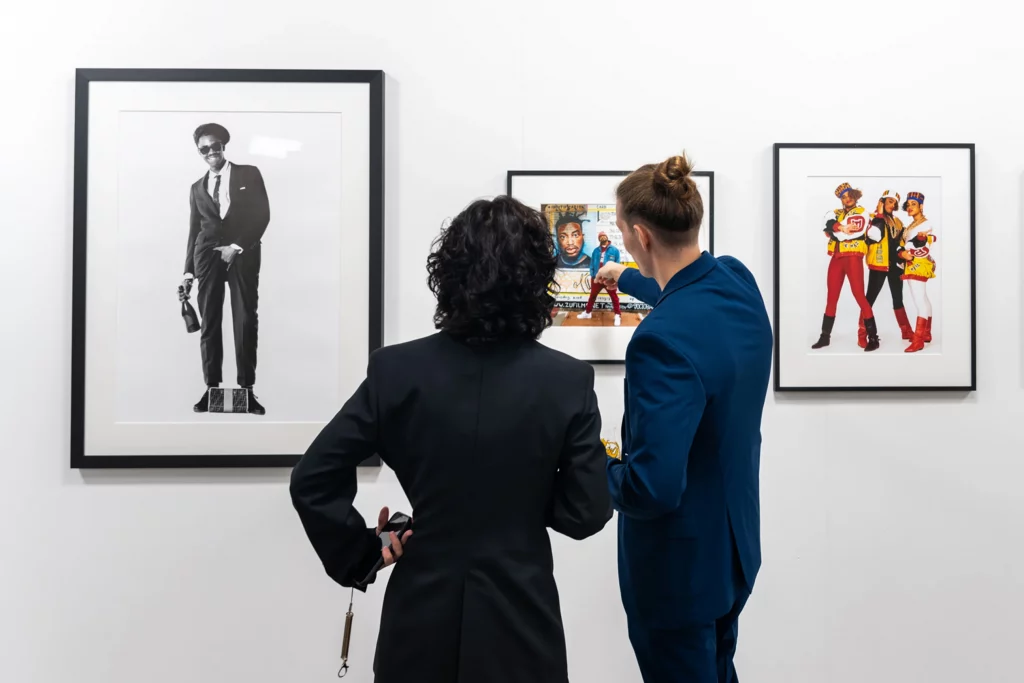
The curated sections bring Unseen’s conceptual depth into focus. Presenting photography within a curated framework lends the works a museum-level focus while revealing how dynamic, varied and resonant the medium is today. The New Photography section, curated by the Unseen fair committee (Caroline O’Breen, Domenico de Chirico, Els Drummen, Hedy van Erp and Dries Roelens), forms a distinctive photographic pavilion on the fair floor, together with Encounters and The Past Present.
In Encounters, the Milan-based curator Domenico de Chirico examines the interplay between photography and other artistic practices, generating new narratives and hybrid visual worlds that stretch the medium’s boundaries.
In The Past Present, photo historian, curator and author Hedy van Erp offers a contemporary perspective on analogue photography up to the year 2000, with particular attention to lost archives and found images. She brings together artists who use existing photographic material and techniques in new ways, to restore weight and meaning to the past.
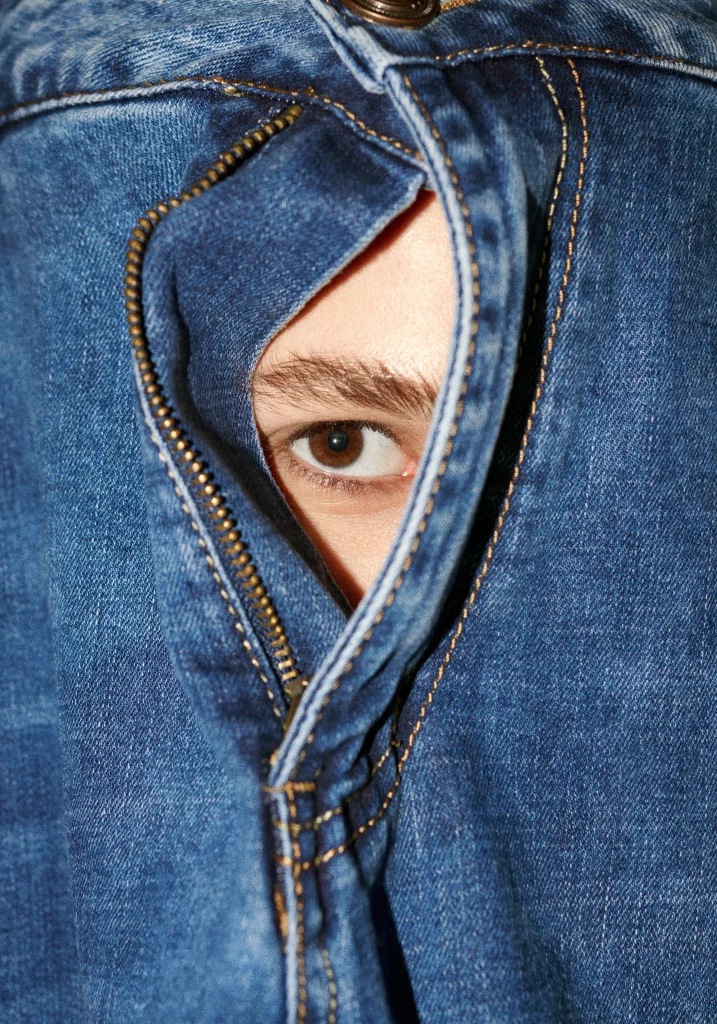
Together, these curated sections offer a layered overview of photographic positions, ranging from conceptual research projects to spatial installations and post-digital image culture. The featured artists respond to themes such as identity, technology and materiality as well as to the shifting circulation and interpretation of images. As a result, Unseen Photo develops a distinct signature within Art Rotterdam and deepens the fair’s artistic scope, creating a platform that connects photography with other contemporary disciplines in a dynamic environment that appeals to a young and international public.
The sixth pillar, the Unseen Book Market, takes place simultaneously at the new location of the Nederlands Fotomuseum in Pakhuis Santos, which opens in February. In the museum, an official partner, forty publishers present a wide range of photobooks and publications.
Unseen Photo is powered by the new Partner Van Lanschot Kempen.
A number of highlights
Several presentations stand out within the selection.
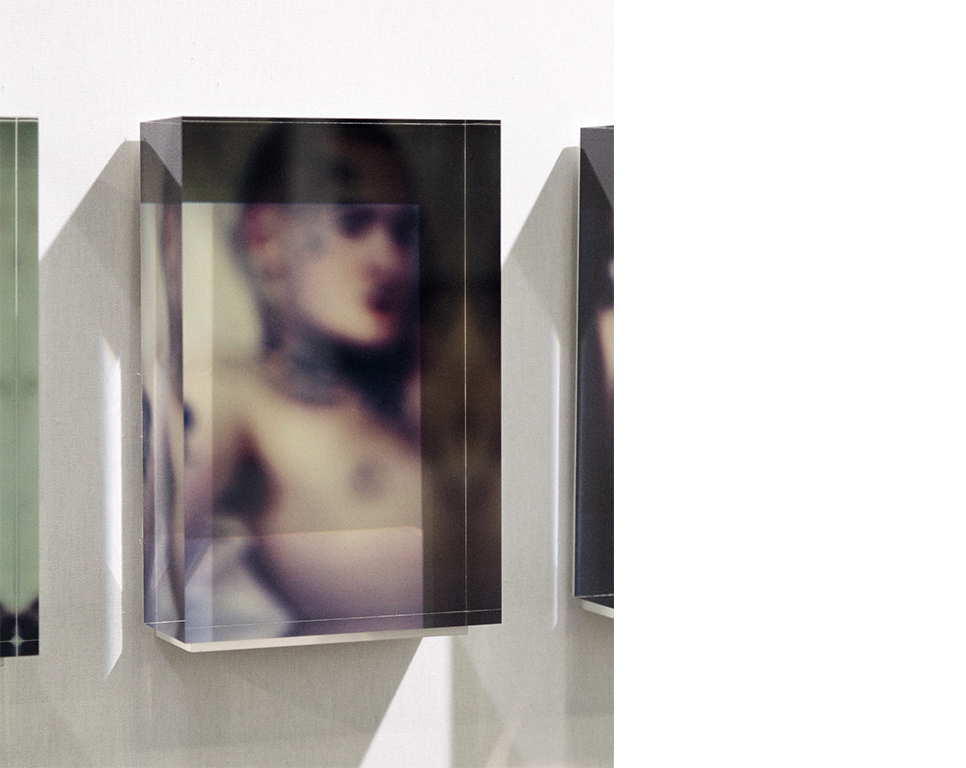
Intervalle (Paris) highlights Julien Mignot’s series “Screenlove” in the New Photography section. In these works, the artist examines how intimacy and distance shift in an era in which relationships unfold through screens. Mignot works with blurred webcam images, created with the explicit consent of his models, which he casts in semi-transparent blocks, so that the image appears or disappears depending on the viewing angle. The series, rooted in his youthful curiosity about the lives unfolding behind windows, reflects on digital voyeurism, the fragility of relationships, contemporary forms of loneliness and the power embedded in the act of looking. For Unseen Photo 2026 Intervalle presents new, previously unseen works from the series. Mignot has previously created commissioned work for The New York Times, Vanity Fair, The New Yorker, Chanel, Hermès, Louis Vuitton and the Opéra de Paris.
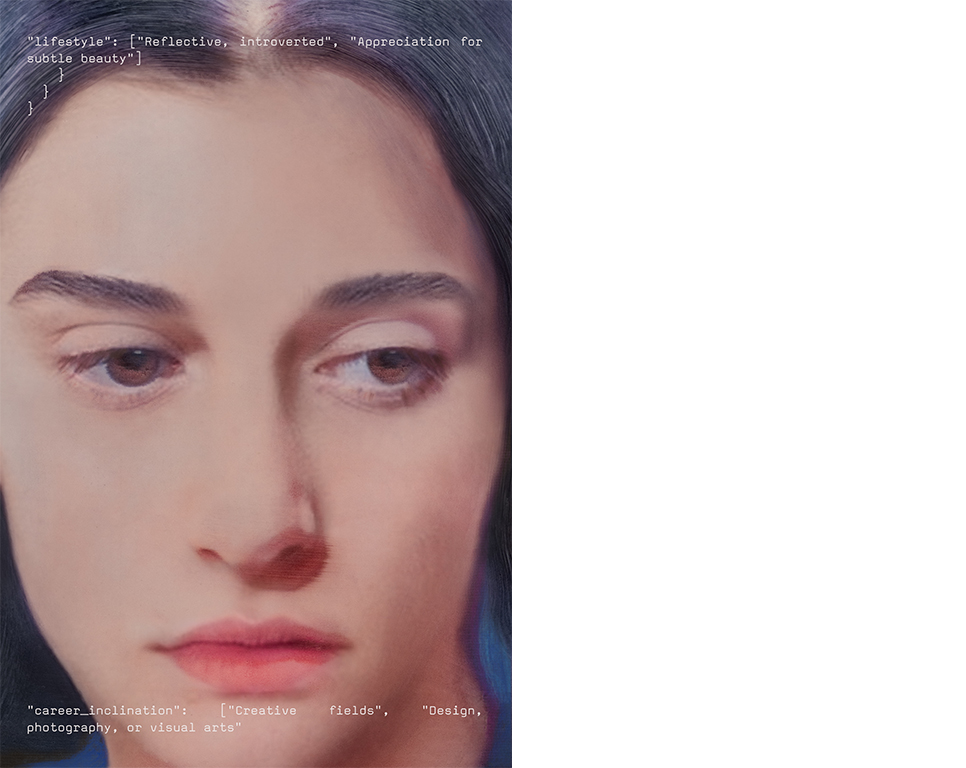
In the Encounters section, VIASATERNA (Milan) will show work by Teresa Giannico, who transforms digital image fragments from the online realm into layered compositions at the intersection of photography, collage and painting. Her dreamlike scenes reveal how algorithms shape our ways of seeing and how the mind reconstructs fragmented imagery into new realities. In her recent work, she examines the objectivity of photography with both precision and poetic restraint, in an age of endless digital reproducibility. Until 18 January 2026, her work is on view at the eighteenth Quadriennale d’Arte in Rome.
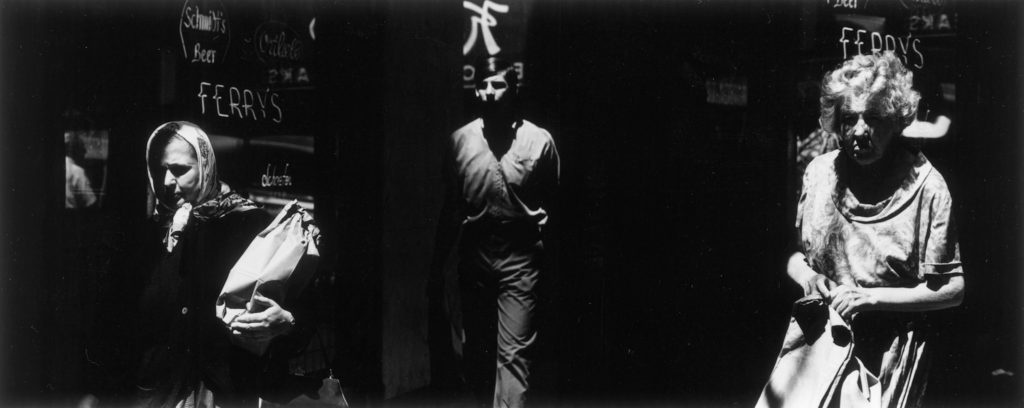
Hedy van Erp: “Ray K. Metzker (1931–2014, United States) is regarded as part of the photographic avant-garde and a pioneer of urban photography, in which he experimented extensively with light. In 2026, a monograph of his work, City Lux, will be published. His work is held in the collections of institutions including MoMA, the Metropolitan Museum, the Whitney Museum, the J Paul Getty Museum and the Albertina. The Paris gallery Les Douches La Galerie is presenting rare vintage Ray Metzker prints, which are seldom offered.”
Erika Deák Gallery (Budapest) will present work by Andrea Gáldi Vinkó in the Encounters section. In her practice, the artist examines the tension between intimacy, identity and the vulnerability of everyday life, weaving personal experience together with universal themes. Her photographs, often balancing between the everyday and the absurdly poetic, have been shown at the Robert Capa Contemporary Photography Center and Kunsthalle Budapest. She has created commissioned work for Tate, Vogue Italia, The New Yorker, Die Zeit, i-D, Dazed and Le Monde. With her distinctive visual narratives, she is regarded as one of the most compelling voices in Hungarian photography.
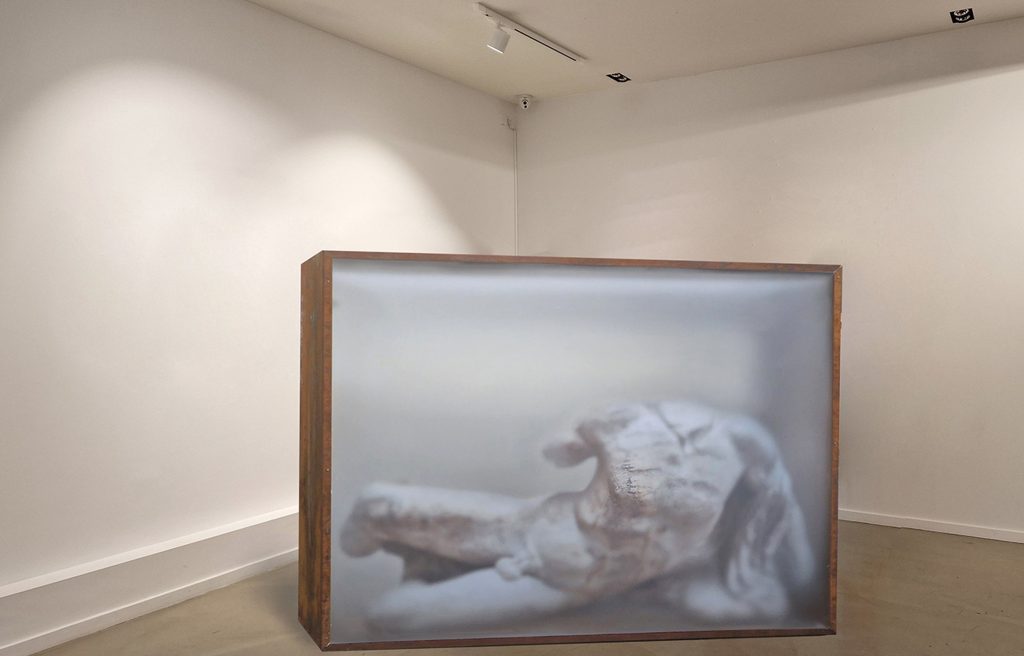
In “ReCollection”, Casper Faassen (Bildhalle, Amsterdam, in the Solo/Duo section) explores how photography can move beyond documentation into an almost sculptural form by creating 1:1 reinterpretations of contested colonial artefacts from museum collections such as those of the Louvre and the British Museum. In a contemporary Wunderkammer, he gathers these photographic objects as a critical reflection on collecting, ownership and the stories inherited from previous generations. Through layered techniques, visible traces of time and the question of who holds the right to preserve history, Faassen turns photography into a poetic and political medium.
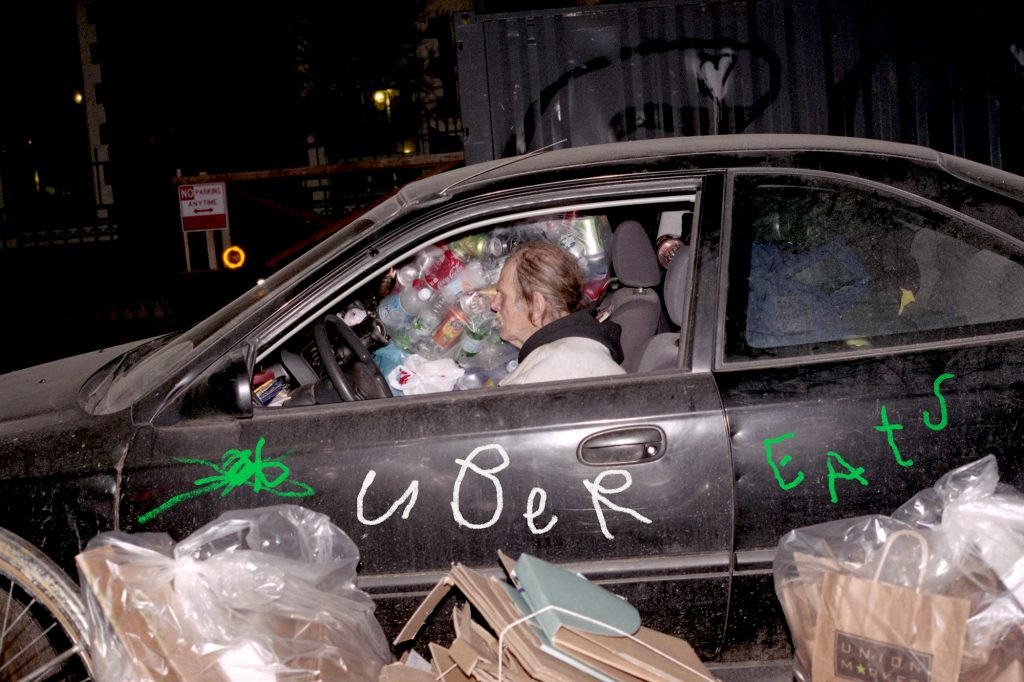
Einspach & Czapolai Fine Art (Budapest) will show work by Tamas Dezsö in the Main Section. His ongoing series ‘Notes for an Epilogue’ reveals the quiet legacy of a post-communist Romania. Dezsö’s work captures with remarkable sensitivity how history becomes embedded in the everyday and shapes the ways societies move forward in the layered aftermath of a regime. His photographs have been shown at Foam Photography Museum Amsterdam, the Robert Capa Contemporary Photography Center and the Shanghai Museum of Contemporary Art, and have appeared in publications such as The New York Times and Le Monde.
About the curators
Domenico de Chirico is an independent curator based in Milan. He taught Visual Culture and Trend Research at Istituto Europeo di Design Milan (2011–2015) and served as Artistic Director of DAMA Fair, Turin (2016–2019). His experience includes jury roles, artist residencies, and teaching positions at institutions such as Goldsmiths (London), Academy of Arts, Architecture and Design (Prague), Nuova Accademia di Belle Arti (Milan), and the Accademia di Belle Arti di Bologna. He has been a visiting curator at the Swiss Institute in Rome and the Artistic Director of Ortigia Contemporanea 2024. Current projects include curatorial roles at SWAB Barcelona, MIA Photo Fair (Milan), and Prisma Art Prize (Rome).
Hedy van Erp is a Dutch photo historian, curator, and author specialising in vintage and vernacular photography. She has worked on exhibitions for institutions such as the Nederlands Fotomuseum, Fotomuseum The Hague, the National Media Museum (UK), the Science Museum (London) and (now) H’ART Museum in Amsterdam. She is also the co-author of Photography Decoded (Tate Publishing, 2019). Current projects include an exhibition co-curated with Susan Bright, scheduled for June 2026 at the Alice Austen House Museum in New York, and an upcoming issue of the international photozine Fotozini, dedicated to vintage, obscure and unconventional photography.