Coming soon
Coming soon
Selecteer type
For the ninth consecutive year, the NN Art Award will be presented in 2025 to a promising artist showcasing their work at Art Rotterdam. This year’s nominees are Diana Scherer (andriesse eyck galerie), Marcos Kueh (Prospects section of the Mondriaan Fund, courtesy of Galerie Ron Mandos), Pris Roos (Mini Galerie) and Bodil Ouédraogo (Prospects section of the Mondriaan Fund). The work of the four nominees will be on view at Kunsthal Rotterdam from 15 March until 11 May 2025.
Marcos Kueh (1995) explores the intersections of heritage, identity and contemporary visual culture through his textile-based practice. His woven installations serve as vessels for storytelling, blending traditional craftsmanship with contemporary themes and techniques. At the heart of his work lies an inquiry into the role of textiles as a medium for historiography and self-reflection.
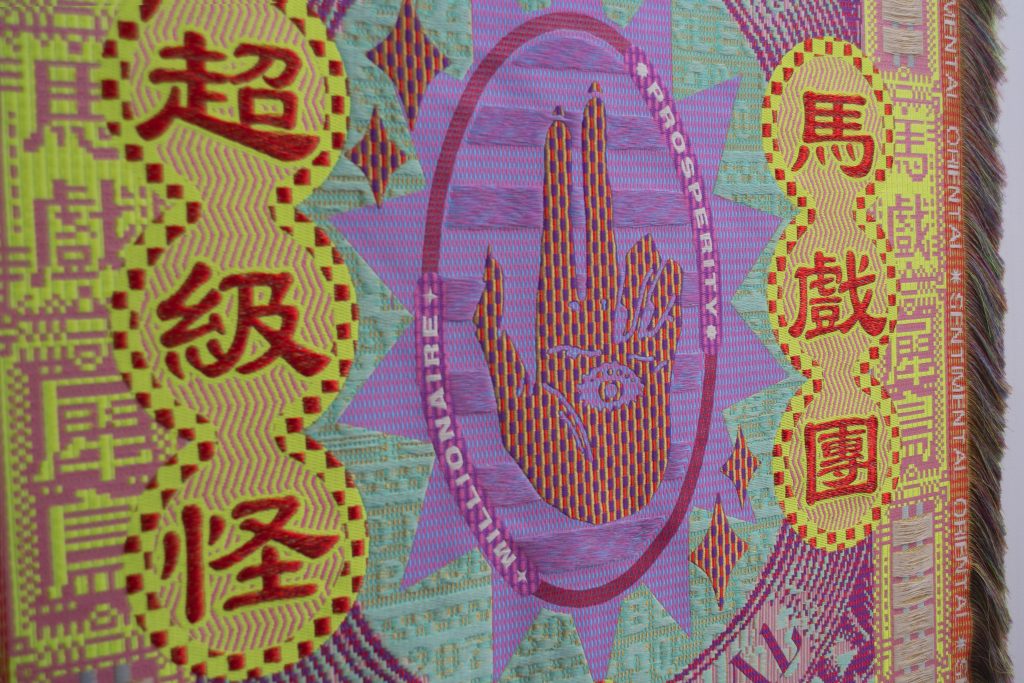
Kueh grew up in postcolonial Malaysia, in the Malaysian part of Borneo, where the legacy of colonial influence, exoticisation and cultural displacement remains deeply embedded. This layered history is central to his artistic practice. Initially, Kueh studied graphic design and advertising at the Royal Academy of Art in The Hague, but it was only when he began exploring textile design at the same institution that he recognised the potential of textiles as a form of expression. He became fascinated by how his ancestors in Borneo wove stories, myths, and dreams into intricate patterns. This discovery led him to merge traditional weaving techniques from Borneo and other Southeast Asian regions with contemporary Western industrial methods, forging a dialogue between past and present. Beyond its narrative potential, Kueh is also deeply invested in the technical precision and craftsmanship inherent to textile-making.
His work engages with self-awareness and the complexities of decolonisation: both as a historical process and in the ways it continues to shape personal and collective identities. While studying in the Netherlands, he first encountered academic discourses on decolonisation. This experience gave language to a longstanding sense of injustice he had struggled with, revealing it to be not only personal but also systemic. Kueh juxtaposes constructed representations with his own lived experience, interrogating the persistent colonial and postcolonial narratives that continue to shape identity in Southeast Asia. He raises critical questions about terms like ‘Third World country’ and examines who holds the power to narrate the histories of formerly colonised nations. He points out that in Western academic contexts, decolonisation is often framed as a theoretical concept, while the voices from formerly colonised regions — those who originally led decolonisation movements — remain underrepresented. Through his textile works, Kueh confronts these dynamics. His practice bridges personal lived experience with academic reflection, examining how we shape and understand our own histories. He observes that Malaysians often neglect their own stories and history, while unconsciously internalising the colonial gaze that was once imposed upon them.
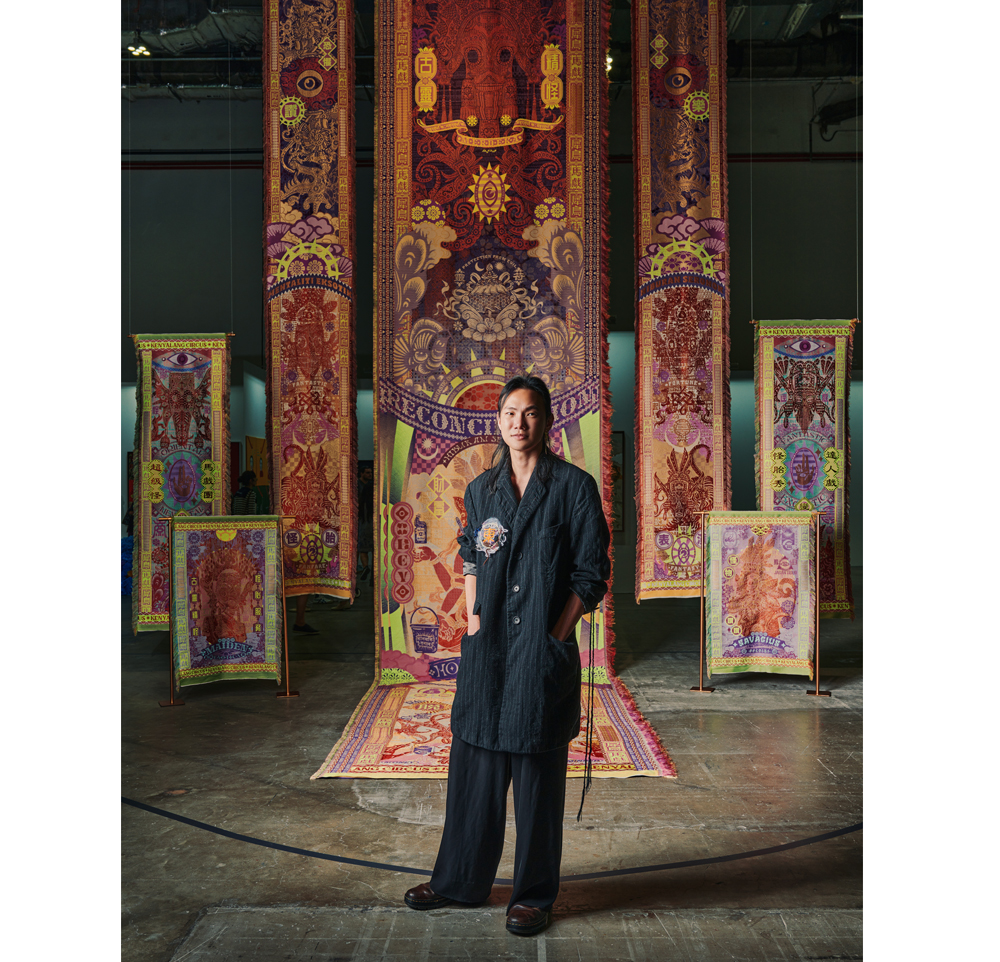
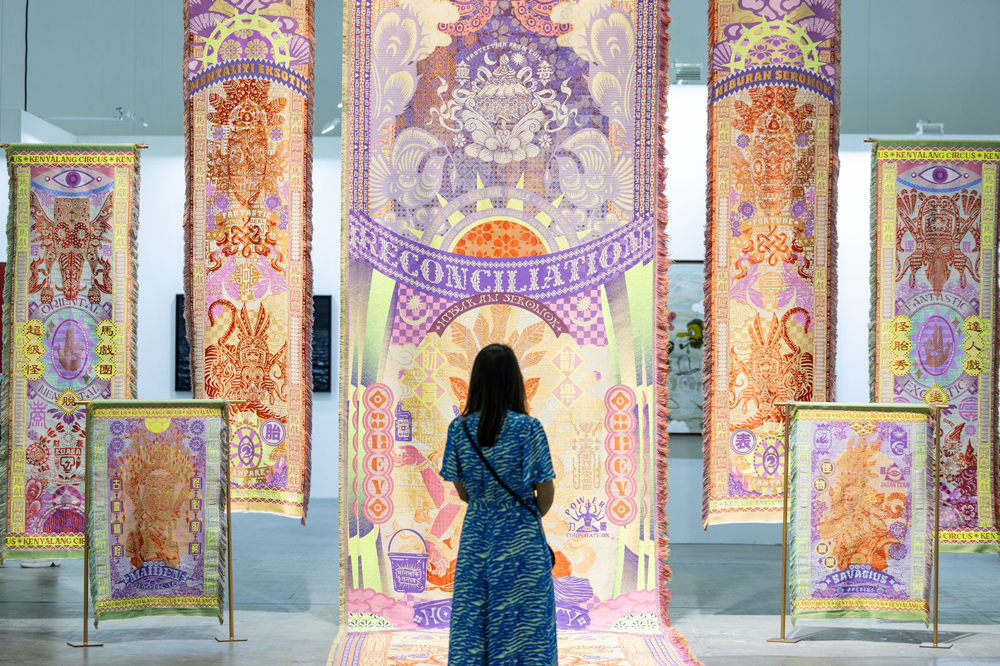
At Art Rotterdam, Kueh (courtesy of Galerie Ron Mandos) will present a work in the Prospects section of the Mondriaan Fund, delving deeper into the layered nature of identity and cultural heritage. Originally developed for Manifesta 15, this installation was previously exhibited in a 17th-century church in Barcelona, where it engaged in dialogue with a Christian altarpiece — an emblem of the religion introduced to Malaysia by European colonial powers under the guise of ‘civilisation’. In this work, Kueh visualises the inner tension of a postcolonial identity: the struggle between assimilation and authenticity, between adaptation and resistance. In doing so, he dismantles the colonial legacy of Catholicism in Borneo in a way.
Beyond the historical and political dimensions of his work, Kueh also examines how mass communication and advertising shape cultural representation. He draws parallels between traditional storytelling systems and contemporary marketing strategies, exploring how visual communication can manipulate or instrumentalise cultural identity. His woven billboards construct a fictional world where textiles function as a form of visual propaganda, commenting on the ways in which identity is consumed, redefined, and eroded within the capitalist system.
Kueh invites the viewer to look beyond the aesthetic qualities of textiles and instead engage with the deeper structures of history, identity, and craftsmanship embedded within them. At the same time, he infuses his work with humour and satire, perhaps to make the medicine go down easier or to start more meaningful conversations. By interweaving contemporary myths and legends with Sarawakian motifs, symbols, and figures, he creates an alternative mode of visual storytelling.
Marcos, could you tell us a bit more about the work you’re presenting at Art Rotterdam and in the Kunsthal?
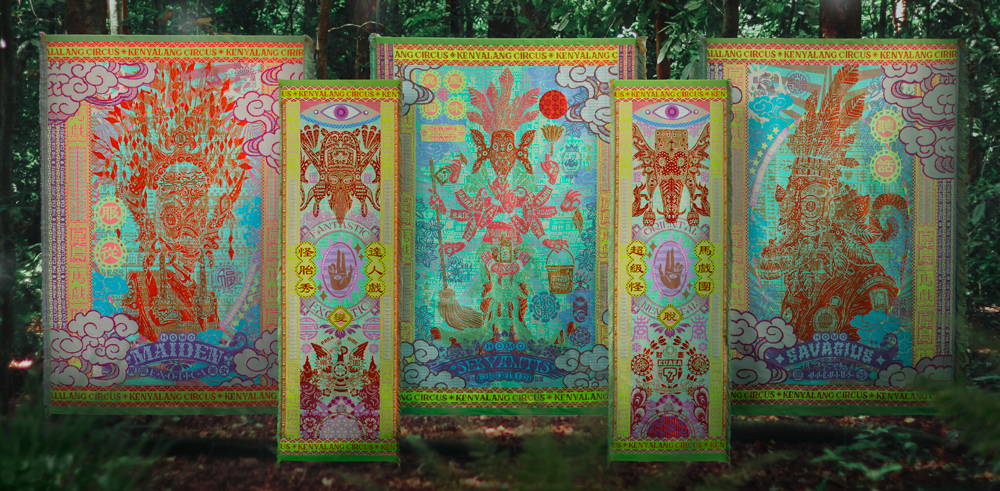
Kenyalang Circus is a long term project I started in 2016, that speaks about the exotification of my identity as a person from Borneo. From anthropological museums to tourism advertisements, how we are being described becomes how we describe ourselves, becomes how we perform to the people who wrote our descriptions. The giant woven posters and billboards in these series usually depict images of creatures manifested from stereotypical ideas of the mysterious unknown of the Borneo rainforests. My job, as the ringmaster of the circus, is to parade them around and try to “sell my exotic identity”. The circus has travelled all over the world in many iterations and this will be our debut in Rotterdam.
The work “Homo Reconciliation Eternatus”, originally commissioned for the 15th Manifesta Biennale in Spain, will be performing at the Prospects section of Art Rotterdam. It speaks about the internal struggle to love ourselves and find pride as people from developing countries. “Nenek Moyang”, which debuted in ART Singapore, will be showcased in Kunsthal Rotterdam. The 8 meter woven billboard is displayed like a waterfall – a nod to the Bornean myth in which the ancestors who live in heaven would only travel to the earthly realms through the waterfalls. The high display also prompts viewers to practise looking upwards to your own culture.
What are your plans for 2025?
In 2025, I will be attending a few residencies for the first time as a professional artist. Many of the project plans have been naturally progressing into conversations about factory work. As a Chinese-passing [a person often perceived as Chinese based on their appearance, ed.] non-European person who is deeply involved in the Dutch textile industries, I am excited to dive into stories and conversations about class, capitalism, migration and identity on the factory line. My work has always been about textiles as a finished product, so it is interesting to expand my exploration into the systems surrounding this production. Hopefully by this time next year, I will have many meaningful stories to share.
Can you describe how you felt when you heard you were nominated for the NN Art Award?
I was in Malaysia when I received the news and immediately went to grab some food with my family to celebrate. I’m just glad that there are people out there who consider my work valuable and am glad that by chance, my family was close by to share in the joy.
If you were to win the award, which project would you immediately pursue?
The award will definitely open up new possibilities on my upcoming research projects into factory work and allow me to consider more locations to visit, plus more people to talk to. In a way, the award has already given me so much spotlight, I am also hoping to bring that light forward to undiscovered stories, conversations and perspectives of labourers who we normally can’t interact with in our day to day lives.
At Art Rotterdam, Kueh’s work will be on view in the 13th edition of Prospects, an initiative by the Mondriaan Fund. This exhibition presents work by 116 artists who received financial support in 2023 to aid them in the start of their careers. The section is curated by Johan Gustavsson and Louise Bjeldbak Henriksen. Explore all Prospects artists here.
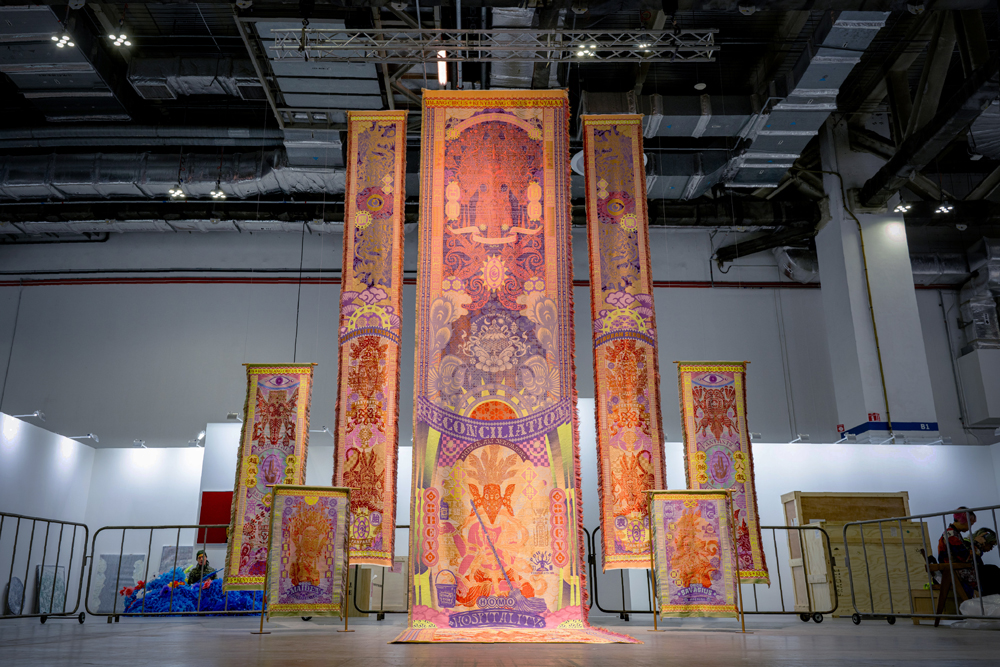
Marcos Kueh was born in 1995 in Sarawak and divides his time between the Netherlands and Malaysia. In recent years, his work has been exhibited at the Stedelijk Museum, Kunstinstituut Melly, Manifesta, The Backroom in Kuala Lumpur, and Museum Voorlinden. In 2022, he was awarded the Ron Mandos Young Blood Award, after which Museum Voorlinden acquired one of his works. Joop van Caldenborgh, founder of Museum Voorlinden, praised his work for its ‘raving beauty, craftsmanship, and visual power that opens our eyes to the world of yesterday, today, and tomorrow.’ In 2023, Kueh was recognised as Young Designer at the Dutch Design Awards.
The winner of the NN Art Award 2025 will be announced on Friday 28 March at 20:00 in Kunsthal Rotterdam. During this celebratory evening, all exhibitions, including the NN Art Award exhibition, will be freely accessible to attending guests.
Written by Flor Linckens
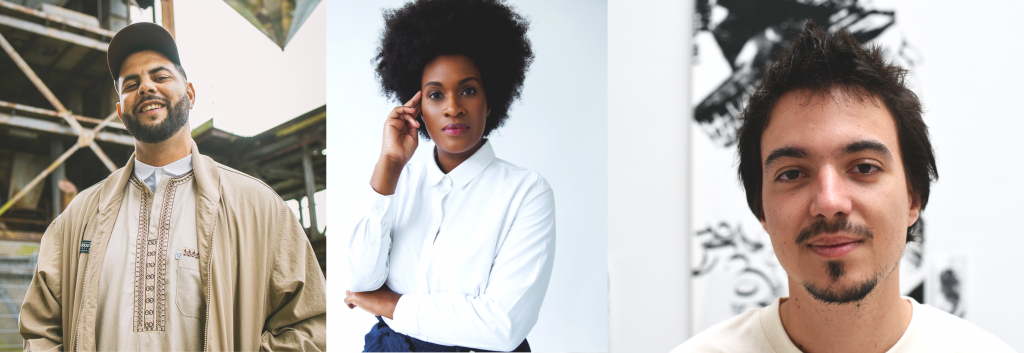
In the DHB Art Space, made possible by new main partner DHB Bank, Rotterdam-based collective Unity in Diversity Rotterdam (UID) presents an interactive sound artwork by media artist Pedro Gil Farias (developed in collaboration with sound artist Marcin Sky). This artwork, Echoes of Us, focuses on a dreamed future for the residents of Zuid and the area development around Zuidplein and Rotterdam Ahoy. Following an ‘open call’, UID selected Rotterdam-based media artist Pedro Gil Farias from dozens of submissions. Echoes of Us gives a voice to the dreams of artists and residents in the neighbourhood, and invites visitors to Art Rotterdam to share their own dreams too. As an interactive tool, the artwork builds a collective dream for a liveable and sustainable future of Rotterdam South.
Atelier Van Lieshout (AVL) is known for monumental sculptures that merge art, architecture, and social research, balancing a playful yet confrontational tone. The work explores power, autonomy, and the role of the artist in a society where visibility and recognition are never guaranteed. Since 1995, Joep van Lieshout has worked under the name Atelier Van Lieshout, a deliberate choice to challenge the classical myth of the individual artist. At Art Rotterdam 2025, in collaboration with Galerie Ron Mandos, AVL presents the Tomb of the Unknown Artist (2024) in Sculpture Park, an homage to the many artists who have remained in the shadows of art history.
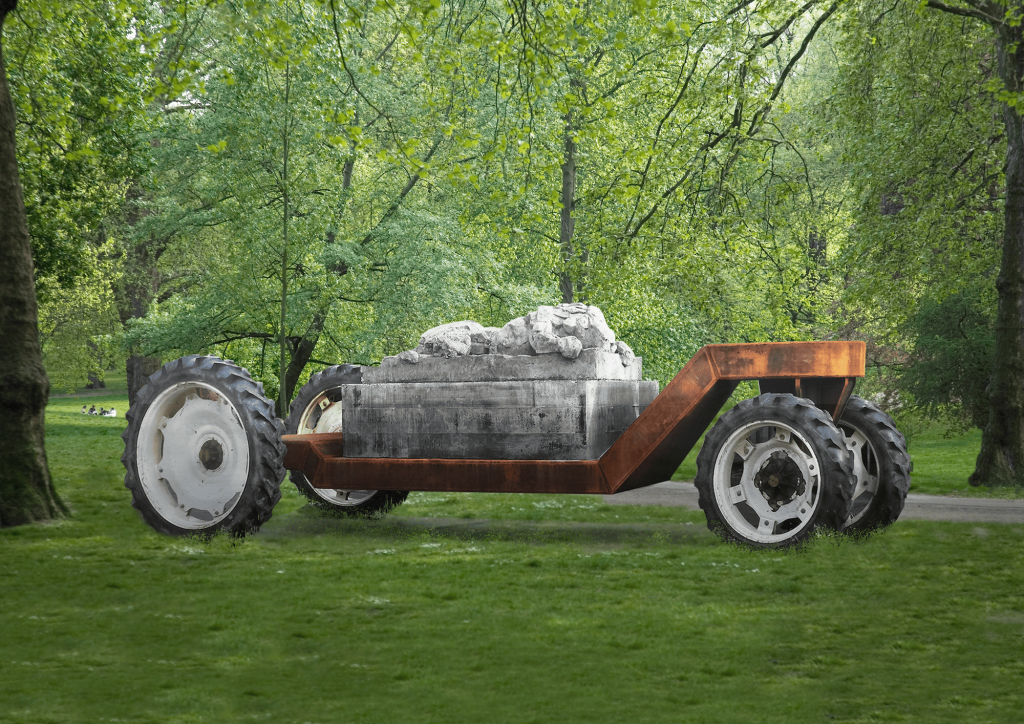
Tomb of the Unknown Artist: A Tragedy of Unrecognised Love
A concrete tomb rests on a gun carriage, the undercarriage of a cannon traditionally used to transport the coffins of generals, emperors, and heads of state to their final resting place. Once a symbol of state power and heroism, the gun carriage took on a ceremonial role in state funerals, marking national mourning on a grand scale. In many traditions, it is not a final resting place but merely a temporary means of transport to a grave or mausoleum. Here, it no longer carries a statesman but a monument to the forgotten artist. It is a symbolic transition between life and death, between oblivion and recognition.
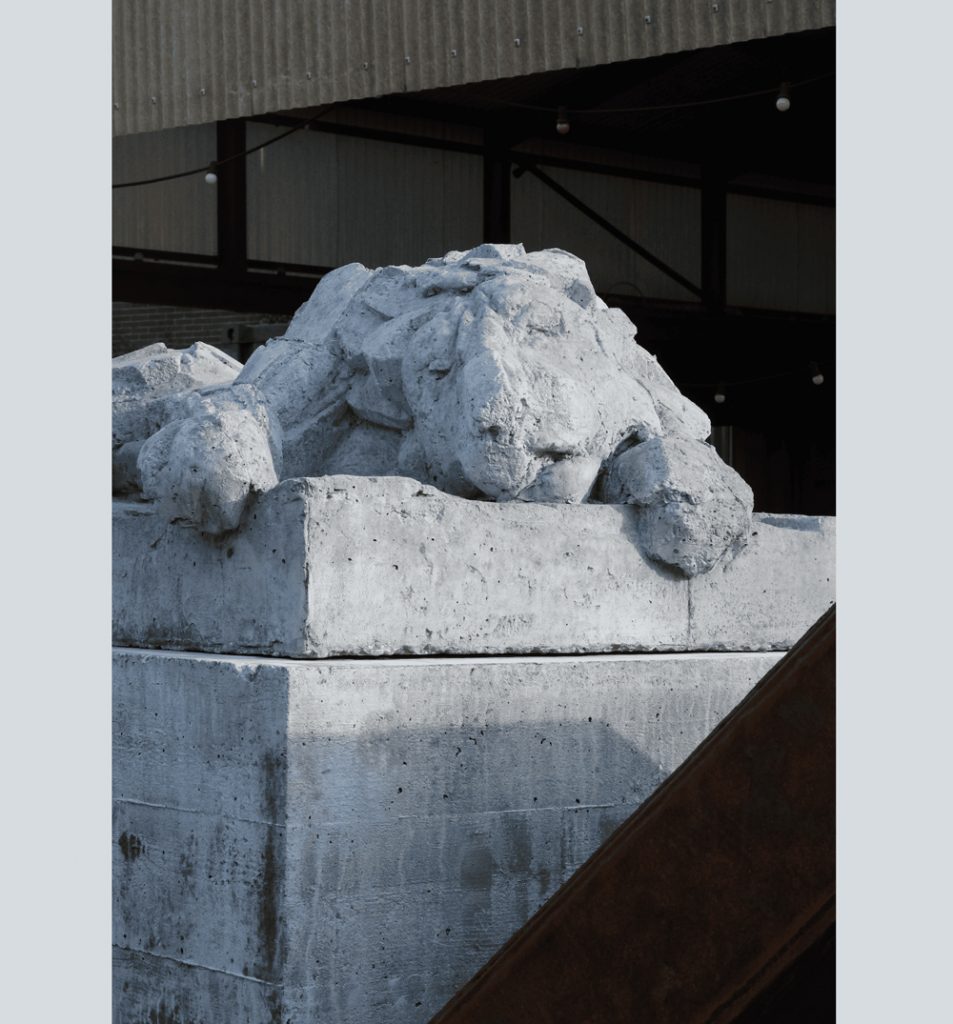
Atop the tomb lies a bronze lion, still, perhaps asleep, perhaps lifeless. “That lion is a symbol of strength and perseverance,” says Joep van Lieshout. “The king of the animal kingdom sleeps, or dies, but could also wake up and move on.”
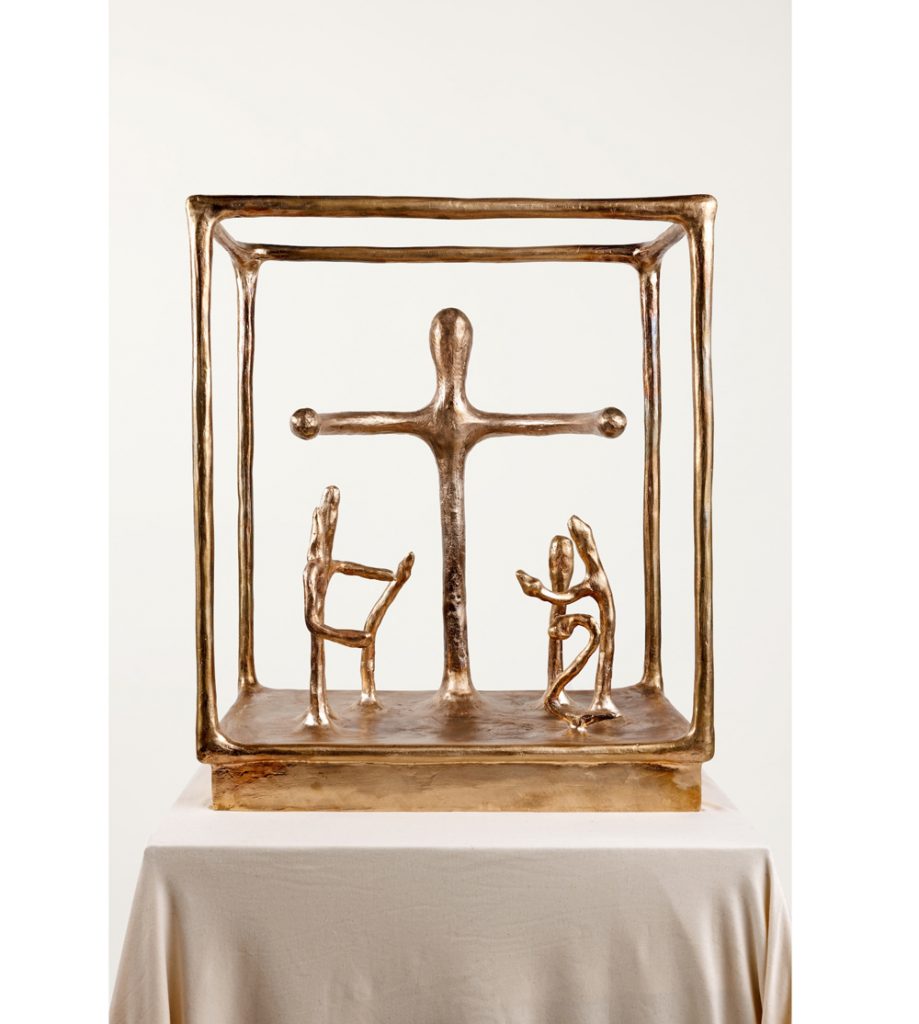
The work is both a monument and a commentary on the unpredictability of recognition. “Artists often lead incredibly tough lives,” says Van Lieshout. “I know so many people who dedicate their entire lives to creating beautiful things, only to be in the wrong place at the wrong time.” Some are later rediscovered; others disappear entirely. He calls it “a tragedy of unrecognised love.” The work carries a humorous undertone while being deeply serious at the same time. “Humour makes serious messages easier to digest,” he adds with a smile.
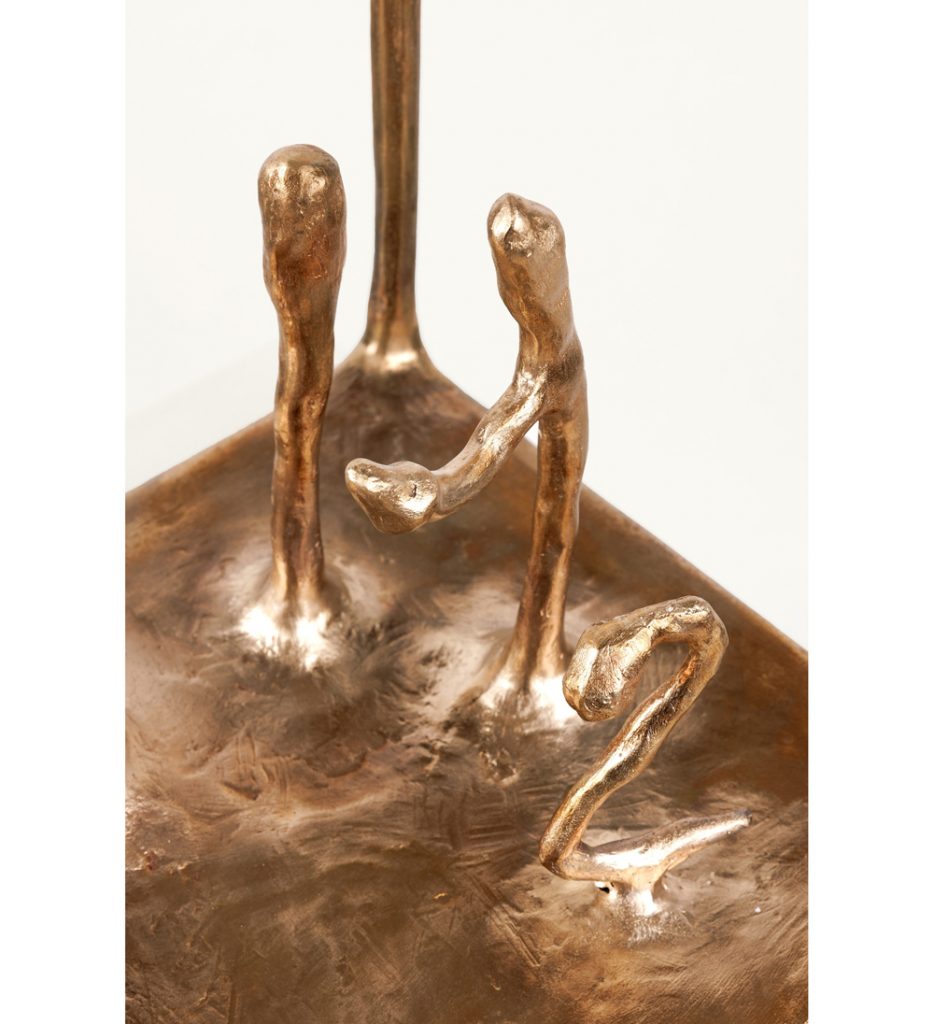
On the side of the sculpture, there is an opening, an alcove reminiscent of an ossuary, a place where human remains are stored. “We looked at ossuaries as a source of inspiration for this monument,” says Van Lieshout. “It is a sculpture that remains open to what is yet to come.” In the future, the bones and ashes of unknown artists could be placed here. It is not a closed monument but a space that can literally be filled with the physical remains of those who never received recognition.
Protected, Forgotten, Almighty?
Alongside the Tomb of the Unknown Artist, Atelier Van Lieshout presents three other sculptures at Art Rotterdam, each exploring, in its own way, the tension between protection, power, and erasure.
Tree of Life (2016) is a tree standing over three metres tall, bearing human-shaped fruit in various stages of ripeness. “It can be a representation of life and fertility, but just as much of violence and disappearance,” says Van Lieshout.
Maria’s Cloak (2023) questions who receives protection and who is left outside. Maria’s cloak does not offer automatic safety.
Omnipotent (2023) plays with authority and submission. “Omnipotent is another word for the Almighty,” says Van Lieshout. The sculpture depicts a hand whose meaning shifts depending on its positioning. “You can place it upright, and it becomes a stop sign. Turn it with the palm facing up, and suddenly, it becomes the begging hand of an artist.”
A Floral Tribute at the Monument
On 27 March 2025 at 19:00, a symbolic flower-laying ceremony will take place at the Tomb of the Unknown Artist (2024). Visitors are invited to bring flowers and lay them at the monument, a final tribute to the artists who remained invisible during their lifetimes. Joep van Lieshout will give a short speech about the work and its broader context within Art Rotterdam.
Is it a comic or tragic gesture? It seems to carry the same ambiguity as the lion resting atop the tomb.
Written by Emily Van Driessen
Kunstenaar Tanea Hynes groeide op in Labrador City, een afgelezen plaats in Newfoundland en Labrador, Canada, die maar om maar één ding draait: de winning van ijzererts. In haar werk reflecteert Hynes op de impact van deze industrie op de bevolking, de natuur en de identiteit. Aan de hand van fotografie, tekeningen en installaties onderzoekt ze hoe arbeid, natuur en kapitalisme met elkaar verweven zijn.
Het werk van Tanea Hynes is te zien in de booth van KIN in de New Art Section
Een stad gebouwd op ijzer
De plaatsnaam is misschien wat misleidend, want Labrador City geen stad in de gebruikelijke zin van het woord. Het is geen regionaal knooppunt van handel, heeft geen rijk cultureel leven, en jonge mensen trekken er ook niet heen om te gaan studeren. In Labrador City draait alles om de mijnbouw, het startpunt van een mondiale productieketen.
Het stadje ontstond in de jaren ‘60 na de ontdekking van een grote hoeveelheid ijzererts in de regio. De plaats werd opgebouwd volgens de utopische idealen de laat 19e-eeuwse Garden City-beweging. Het moest een gemeenschap worden waarin de mijnwerkers en hun families een goed leven konden leiden. Enige tijd werden die verwachtingen ingelost. In de beginjaren investeerde de Iron Ore Company of Canada in moderne faciliteiten en sociale programma’s, maar na overnames door multinationals als Rio Tinto en Mitsubishi verdwenen deze voorzieningen.
Die sociale programma’s waren geen overbodige luxe als je beseft dat er in de wijde omgeving niets anders is dan bos en wildernis. Als iemand vermist zou worden in de bossen, is het zoeken naar een speld in de hooiberg, merkt Hynes op in haar afstudeerproject. De dichtstbijzijnde grote stad is Montreal, die ligt hemelsbreed op 1250 km afstand – ongeveer de afstand van Rotterdam naar noord-Spanje. Het inwonertal schommelt momenteel rond de 7500. Op het toppunt, medio jaren ’70, woonden er 12.000 mensen.
Die fluctuaties van het inwonertal houden verband met de fluctuaties in de mondiale vraag naar ijzererts. Tanea Hynes werd er in 1996 geboren en maakte de afgelopen decennia meerdere boom- en bustcylci mee. Perioden van economische hoogtij werden afgewisseld door diepe recessies, waarin mensen hun banen verloren, hypotheken niet werden afgelost en huizen onverkoopbaar werden. Deze cycli laten niet alleen hun sporen na in de lokale economie, maar bepalen ook het sociale leven in de stad. Labrador City heeft dan ook een eigen klassensysteem van mijnwerkers en management. Elk met eigen belangen. Regelmatig staan ze lijnrecht tegenover elkaar op het punt van arbeidsvoorwaarden en -omstandigheden.
De mijn als levensader en vloek
Ook Hynes’ leven is onlosmakelijk verbonden met de mijnbouw. Om haar studie te bekostigen, werkte ze vijf zomers als vrachtwagenchauffeur in een open-pit-mijn. Ze ervoer de fysieke en mentale belasting van het werk en de constante druk om de productie op te voeren. De mijnen zijn namelijk constant in bedrijf – 24 uur per dag, 365 dagen per jaar en het werk wordt enkel onderbroken bij ernstige ongelukken. Terugblikkend op die ervaring schrijft Hynes:
‘This experience helped to shape my perspective on global economics, natural resource extraction, human impact on ecological systems, labour politics, and the world at large. I hold an understanding of the unforgiving demands of the mining industry and the place of myself, my family, and my closest friends within that system. I have experienced many close calls and felt the pressures of the endless push for faster production. Furthermore, I have felt my own body resist in ways that I cannot put into words. These experiences fuel my desire to create urgent works of art and photographs, attempts to materialize what can only be felt in one’s gut.’
Dit meedogenloze ritme heeft niet alleen een impact op de arbeiders, maar uiteraard ook op het landschap. Hynes richt zich in haar werk op beide. In meer theoretische verhandelingen over de mijnbouw staat deze vaak, en niet ten onrechte, gelijk aan de vernietiging van de natuurlijke wereld. Maar wie zich, zoals Hynes, in een dergelijke gemeenschap begeeft, ziet naast verveling, verslaving en fysieke pijn ook hoop, saamhorigheid, doorzettingsvermogen. Ze heeft oog voor mensen die geven om de natuurlijke wereld en er afhankelijk van zijn voor fysiek en geestelijk welzijn, ontspanning en vreugde. Zo legt ze vast hoe mijnwerkers hun vrije tijd doorbrengen in de natuur, op zoek naar rust in hetzelfde ecosysteem dat ze doordeweeks ontginnen. De relatie tussen de mijnwerkers, de mijn en de natuur is dus uiterst complex.
Getuigenis en protest
Hynes’ werk wordt vaak vergeleken met de documentaire traditie van Newfoundland en Labrador. In de jaren 1950-1970 speelden documentaires een grote rol in het aankaarten van sociale ongelijkheid en de gevolgen van grootschalige mijnbouw. Sindsdien blijft de mijnindustrie liever uit de media en blijven de poorten gesloten voor buitenstaanders.
In het najaar van 2023 vroeg een jeugdvriendin, die inmiddels een managementpositie had, Hynes om te komen fotograferen in een mijn. Hynes was verbaasd over het gemak waarmee het voorstel werd gedaan. Het feit dat Hynes is opgegroeid in Labrador City en deel uitmaakt van de gemeenschap, zal daarbij een rol hebben gespeeld, het maakt haar een insider. Wellicht heeft het ook te maken met haar minder activistische benadering dan de documentairemakers van weleer. Hynes erkent de paradox van de mijnbouw: deze is destructief, maar vormt tegelijkertijd de bestaanszekerheid van haar gemeenschap.
Die paradox spreekt ook uit haar beschrijving van de beelden die ze in de mijn maakte: ‘While this industry provides vital metals to the ever-expanding world at large, these scenes represent the epicentre of so much chaos, of pain, addiction, sadness, and bleak degradation.’ Enerzijds erkent het ze het belang van de mijnbouw, anderzijds is de prijs die daarvoor wordt betaald hoog.
Remediated
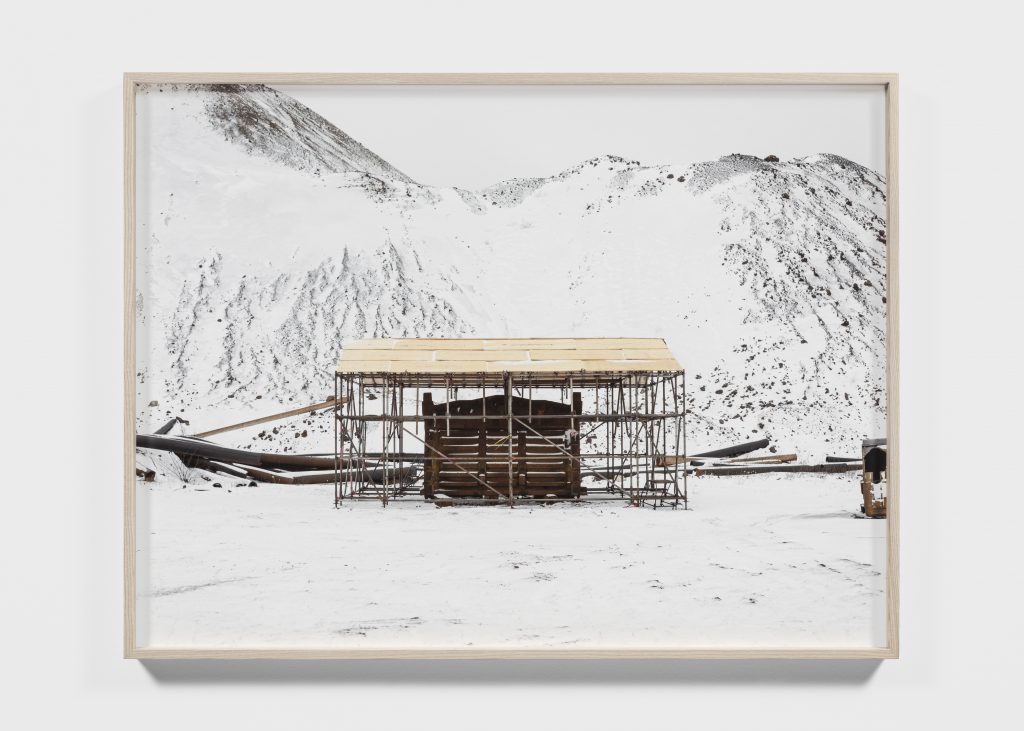
De beelden die ze in de mijn maakte wisselt Hynes in haar serie Remediated af met foto’s van verlaten landschappen waar de natuur zich probeert te herstellen. Plekken die ooit bruisende werkterreinen waren, zijn nu littekens in de aarde. Wat blijft er over wanneer de grondstoffen op zijn en de mijnen worden verlaten, is de vraag die Hynes opwerpt. De langetermijnschade die mijnbouw aanricht wordt in de regel namelijk afgewenteld op lokale gemeenschappen, zoals die van Labrador City.
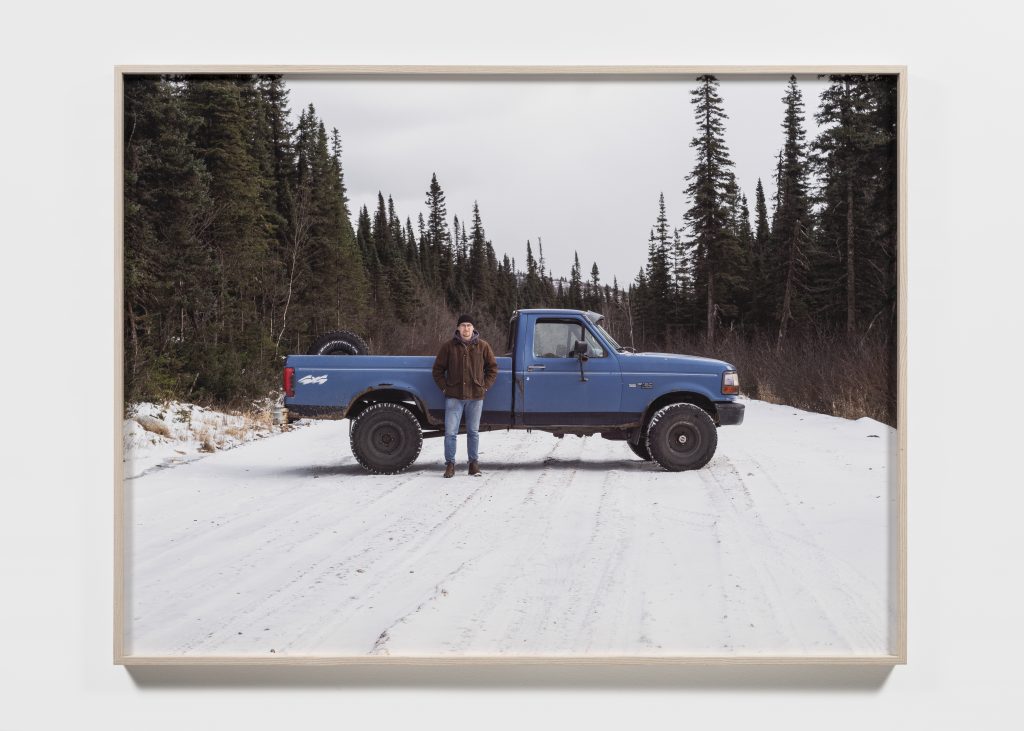
Deze serie is niet te zien tijdens Art Rotterdam, maar geeft wel een idee waarom Hynes ook hoopvol is. “Remediated, along with the portraits in my exhibition, communicate that there is a path forward, and that we are already on that path. The way forward is not only through physical remediation of the land, but in meaningful, mutually beneficial communion with both the land and with each other.”
De weg voorwaarts
De weg voorwaarts ligt volgens Hynes in een inheemse, anti-koloniale denkwijze, een die de aarde niet ziet als een verzameling te ontginnen goederen, maar als een verlengstuk van onszelf. In deze visie zorgt de aarde voor ons en is ze de belichaming van talen, verhalen en geschiedenissen.
De relatie tussen de mens en de aarde is dan ook het onderliggende, bredere thema van Hynes’ werk. Mijnbouw komt immers overal ter wereld voor, Labrador City is daar slechts een voorbeeld van. De schaal ontstijgt het individu en waarschijnlijk ook ons voorstellingsvermogen. Miljoenen tonnen steen worden verplaatst, rivieren worden omgeleid en bergen verdwijnen ervoor. De mijnwerkers in Labrador City zijn slechts een onderdeel van een systeem dat uit vele schakels bestaat. Ze zien de vruchten van hun werk niet, want de grondstoffen worden elders tot producten verwerkt.
Hynes’ werk is daarmee tegelijk een pijnlijke herinnering aan het feit dat voor iedere industrie een menselijke en ecologische prijs wordt betaald, en een pleidooi voor een andere manier van denken over landgebruik. In plaats van de aarde te beschouwen als een eindeloze bron van economisch gewin, moeten we haar zien als een verlengstuk van onszelf, als een plek die zorg en respect verdient.
Geschreven door Wouter van den Eijkel
At Art Rotterdam (28-30 March at Rotterdam Ahoy), No Man’s Art Gallery presents a dual presentation featuring the work of Benjamin Francis and Tobias Thaens. For Francis, this marks the beginning of his collaboration with the gallery, which will continue with his solo exhibition ‘A foot between the door’, on view at the gallery in Amsterdam from 22 March until 20 April 2025.
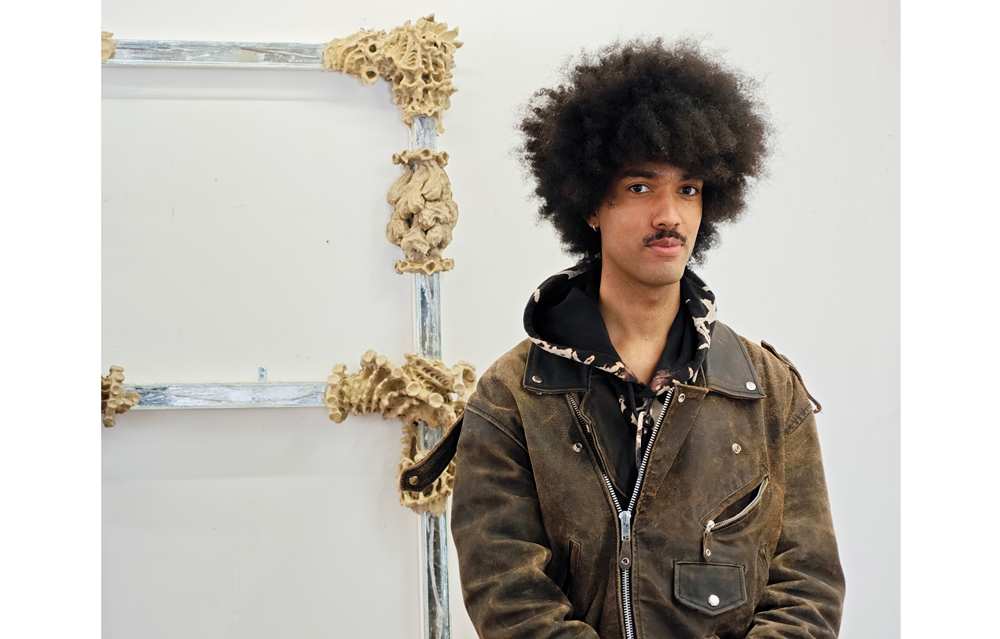
In his multidisciplinary practice, Francis explores the hidden mechanisms of power, control and correction that shape our perception of right and wrong. Through installations, videos, sculptures, texts and performances, he exposes the underlying structures that define the individual. His work invites viewers to pause and consider: who makes the rules, and what happens when we rewrite them? Why do we seek control over our surroundings — both bodies and inanimate objects — and how does that lead to a rigid normativity and conformity?
Drawing inspiration from dance and the tension between obedience and resistance, Francis examines how subtle forms of correction — through language, body language or architecture — shape social structures and the human experience. In a society driven by efficiency, where deviation from the norm is deemed undesirable and imperfections are meticulously erased, his work creates space for doubt, discomfort and the imperfect. He investigates how errors and deviations are corrected or excluded within social, pedagogical and knowledge systems. This theme resonates with him personally: as someone with dyslexia, he experienced firsthand how spelling mistakes were treated as undesirable, subjecting him to constant correction. His work raises the question: who determines what is ‘right’, and what dogmas and power dynamics lie beneath? Does such a strict binary opposition between right and wrong even exist? Francis sees his art as a means not to conceal flaws and decay but to examine them, both in language and in material.
Language plays a central role in his research, and his work moves between object-based pieces and participatory performances, often placing the audience in unexpected situations and inviting them to become part of the installation. In a previous performance at Hotel Maria Kapel, where he completed a residency program, Francis used texts that had been repeatedly processed through translation software, revealing errors and misinterpretations. Participants were asked to read these texts aloud and relate to them, undermining the supposed objectivity and neutrality of language and exposing its entanglement with power and hierarchy. In these performances, the viewer is not merely an observer but an active participant in a constantly shifting system. In “A Claim for Your Own Good”, performed at the Luther Museum, Francis staged a fictional cleaning company that subtly exposed power dynamics through ritualised actions.
The relationship between body and memory also plays a crucial role. Our bodies make mistakes that shape our awareness. We feel things or are moved by them without always realising it. Memories are stored in our bodies, often without our conscious awareness.
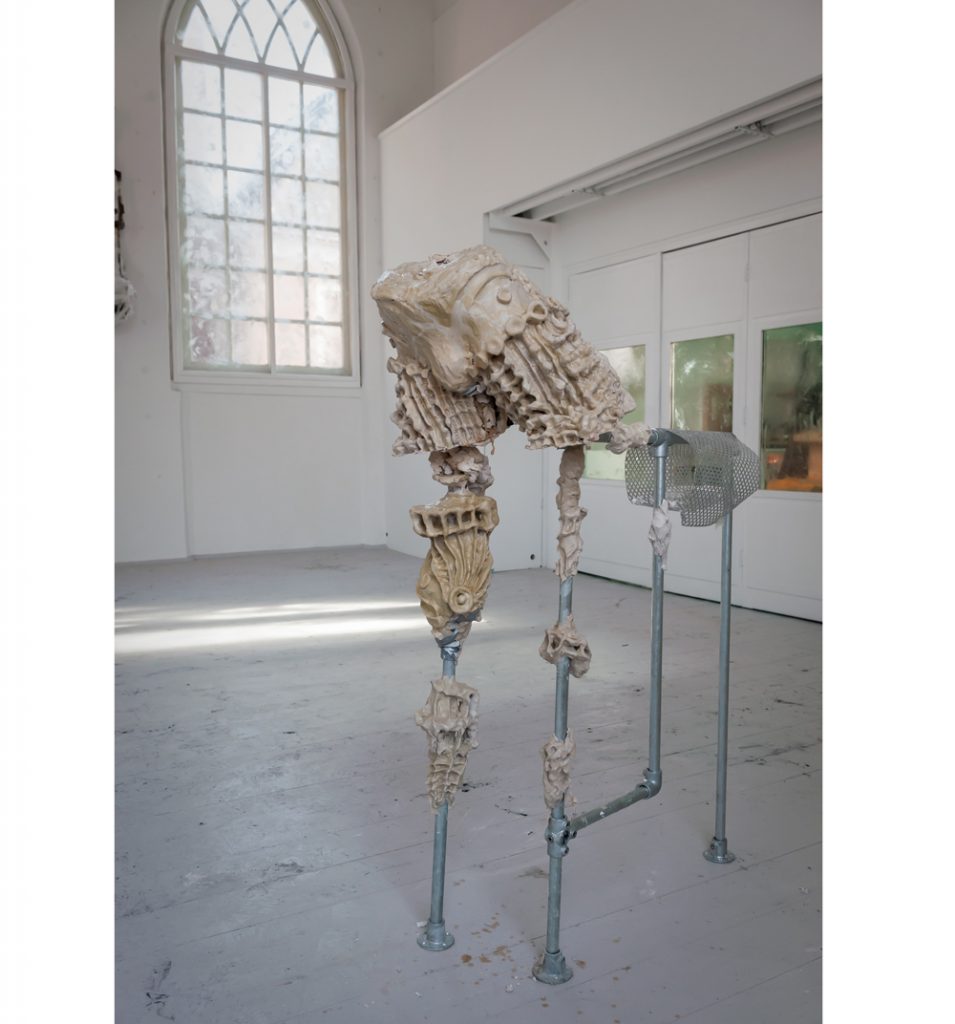
A recurring motif in his work is the interplay between dirt and cleanliness. Excessive purification is bound to leaves traces. What remains is a reality that has been repeatedly polished, adjusted, corrected and purified. What does that do to a body that must constantly submit to this process, effectively becoming an archive of discipline? And how can we erase the traces of years of imposed correction, ingrained deep into our skin and minds? And what happens when cleaning is no longer just a physical act but a means of control? When purification is disguised as care — a care imposed upon you because, for whatever reason, you hold less power within the dominant system? Francis confronts the viewer with this paradoxical dynamic, where systems of power, correction and normativity are embedded in our most everyday actions.
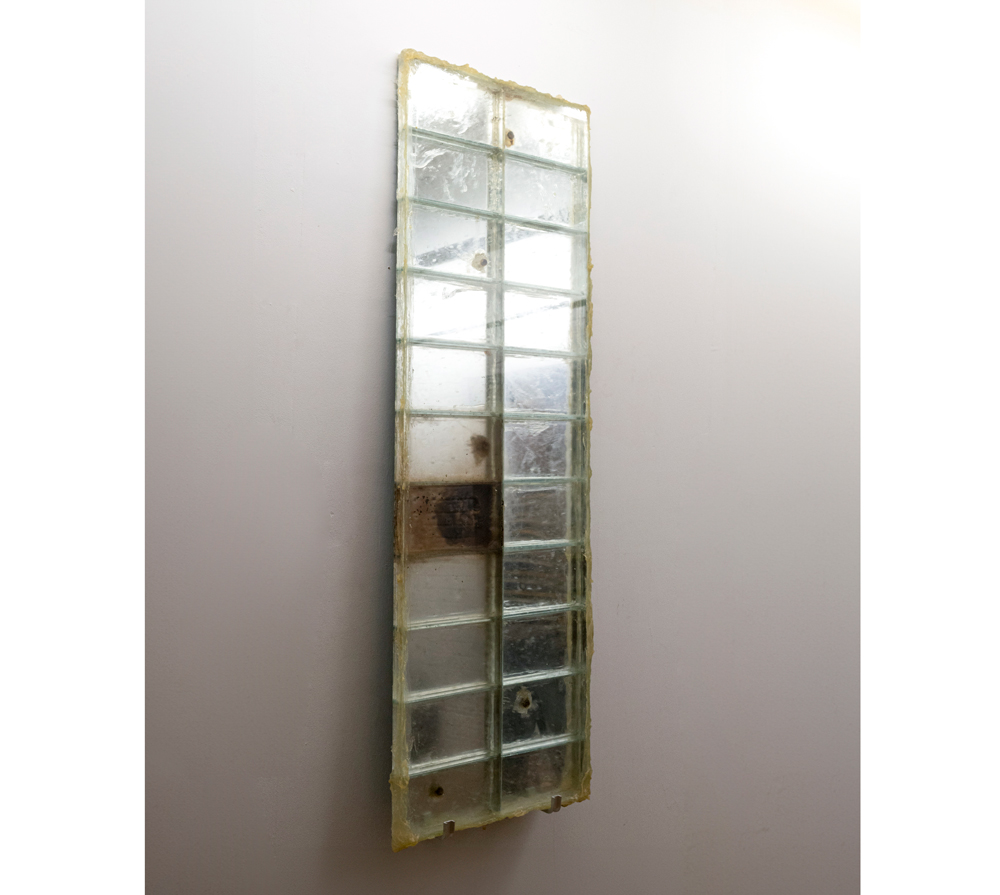
The installations of the artist transform environments into performative spaces, making visitors acutely aware of their position within systems of discipline and normativity. A bathroom, a classroom, a mortuary, a ballet studio: functional spaces that he subtly disrupts, making them no longer ‘fit’. Their original function shifts, becomes unsettled, and gives way to tension and new meanings. In previous installations, such as “The Removal of the Eye” at P/////AKT, visitors were challenged to walk across fragile white tiles, each step leaving a mark: a direct confrontation with the tension between purity and decay, control and surrender. These fields of tension are central to his practice.
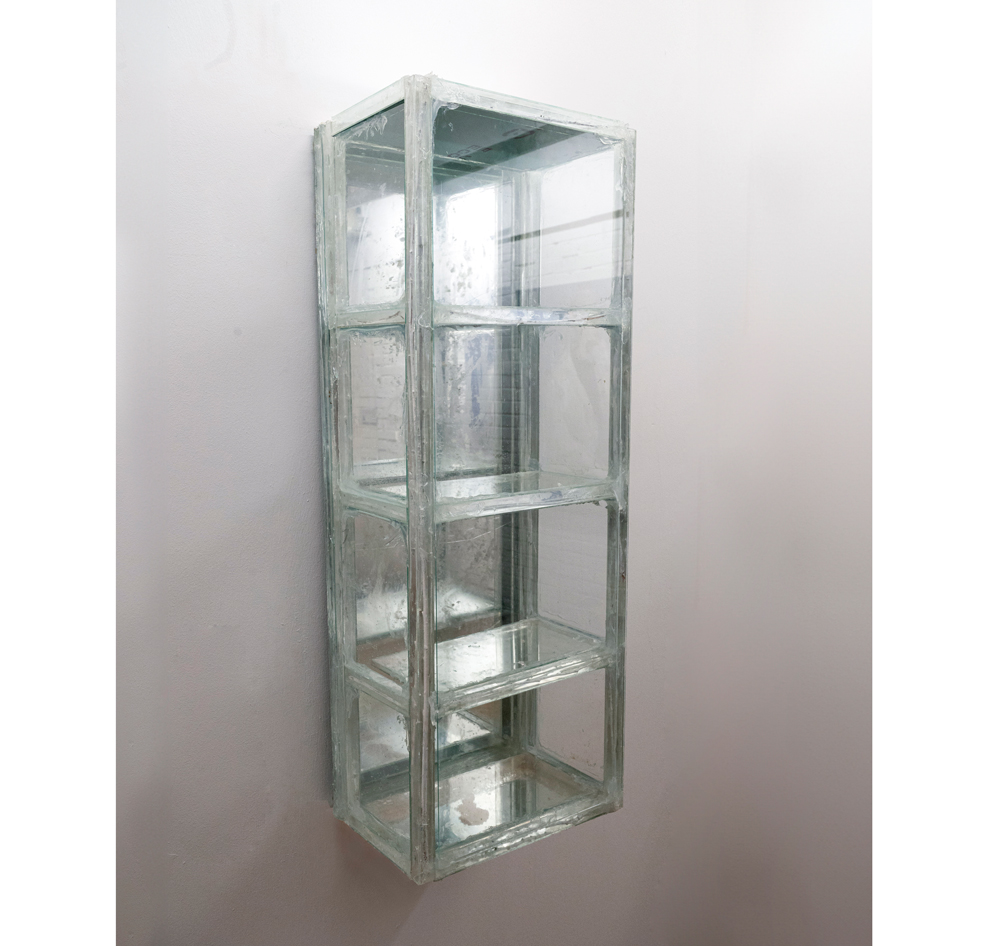
Francis continually returns to the notion of ‘the other’, those who deviate from the norm. It is a position that he identifies with personally as a queer person of colour with dyslexia. Those who do not fit into societal frameworks, for instance due to their social or economic position, are subject to greater control. By positioning ‘the other’ as the norm (the opposite of ‘othering’) he makes the norm itself visible, open to analysis and critique. He shifts the perspective: it is not ‘them’ who are questioned, but the norm itself. This process allows him to examine and challenge how these systems function and who enforces them. Authority and normativity are not fixed concepts but are constantly rewritten by the structures that uphold them.
At Art Rotterdam and in his solo exhibition at No Man’s Art Gallery, Francis explores the relationship between space and the body.
Benjamin Francis (1996) graduated from the Fine Arts department at ArtEZ BEAR in Arnhem in 2020, with a focus on Experiment, Art, and Research. His work has previously been shown at No Man’s Art Gallery, NL; Christine König Galerie, AU; Art Antwerp, BE; Luther Museum, NL; PuntWG, NL; Ballroom Project #6, BE; Hotel Maria Kapel, NL; If I Can’t Dance, Kunsthuis Syb, Het HEM, P/////AKT, NL; MÉLANGE, DE; Rencontres internationales, DE; SECONDroom, BE; and Mutter, NL.
At Art Rotterdam, Benjamin Francis will present his work in the booth of No Man’s Art Gallery. His solo exhibition will be on view at the gallery in Amsterdam from 22 March until 20 April 2025.
Written by Flor Linckens
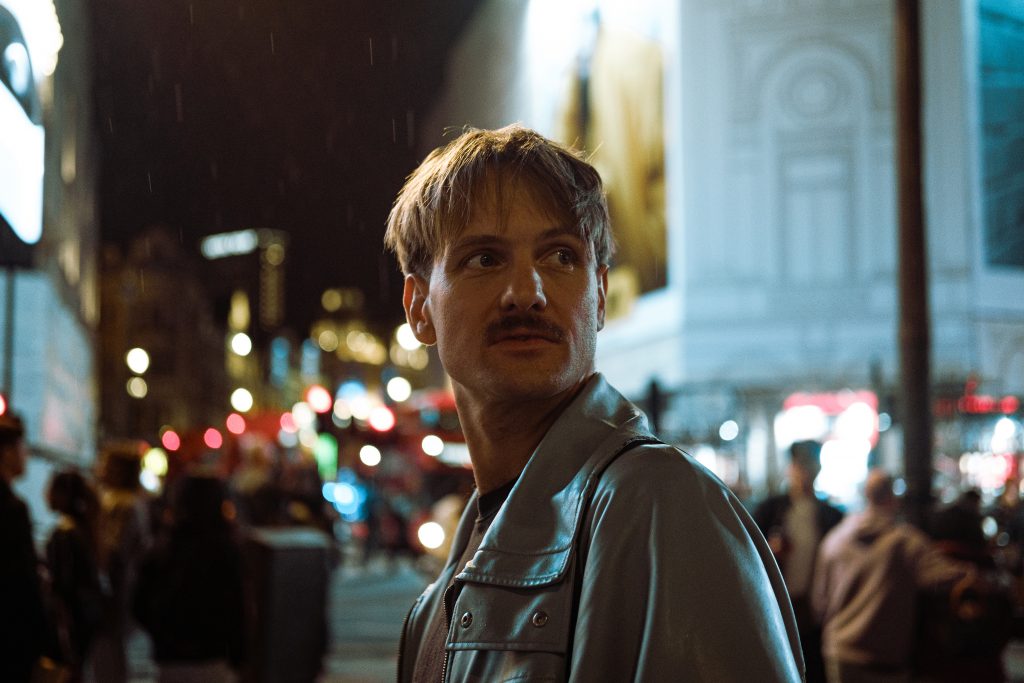
On the way to his apartment one night, Jonas Brinker was walking through Times Square and much to his surprise, saw a dragonfly resting on the sidewalk in one of the busiest places in the world. Brinker had his camera with him and decided to kneel down and film the insect head-on. The dragonfly appears to be looking at us throughout the entire film because it is the only thing we see. But at the same time, we are able to take in much of the surroundings: the constantly changing lights of the LED billboards, sirens, cars and conversations.
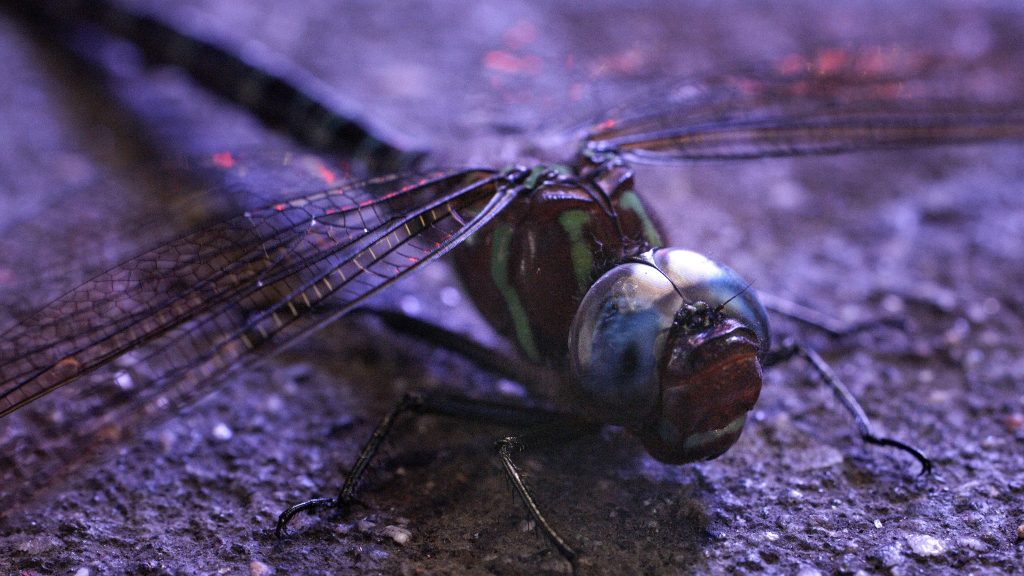
“The work is centred on presence rather than meaning,” says Brinker. “The dragonfly is not there to represent anything, but to simply exist as an individual in that moment.” Untitled (25.07.2022, 02:14 AM) fits seamlessly with Brinker’s work, in which elements that have existed for a long time – the dragonfly has been around for around 320 million years – come together in a fleeting manner.
Jonas Brinker (Germany, 1989) is regarded as one of the most prominent video artists of his generation. His work has been exhibited at Marres in Maastricht (2018), Palais de Tokyo in Paris (2018), the Berlin nightclub Berghain (2020), and last year at Piccadilly Circus in London. We spoke with Jonas Brinker shortly before the opening of his first institutional solo exhibition at the Kunstverein Harburger Bahnhof in Hamburg.
Jonas Brinker is presented by Zyrland Zoiropa, Berlin and his Untitled (25.07.2022, 02:14 AM) is on display in the Projections Section.
You mentioned earlier you were working on a major show at Kunstverein Harburger Bahnhof in Hamburg last week. Are you pleased with how it turned out?
Yes, I was preparing my first institutional solo show at Kunstverein Harburger Bahnhof in Hamburg. The exhibition revolves around fireflies in Central Park, translated into an expansive video installation within the historic waiting room of the Kunstverein. Their bioluminescent signals, emitted during their final phase of life for species-specific communication, are set against aerial shots of the New York skyline at night, transforming an attempt to capture their flashes into a melancholic exploration of longing, time and the interwoven worlds of human and non-human beings.
I’m really pleased with how the show turned out and just love the fact that the space is located between the tracks of a railway station, making it an especially compelling setting for time-based works.
The way your time-based works are presented is a key aspect of your work. What presentation did you have in mind/would be ideal for Untitled (25.07.2022, 02:14 AM)?
When I filmed the piece, I envisioned it being shown as a floor-standing projection, so the image extends into the actual space. The projection should be taller than a human, so we look at the insect at eye level or even slightly upward, creating an intimate situation where a small, easily overlooked being takes on a strong presence. The encounter gains weight, becoming something resonant.
At Art Rotterdam, Untitled (25.07.2022, 02:14 AM) will be featured in the Projections Section. It revolves around a dragonfly resting in New York’s Times Square. In it we see a close-up of the dragonfly, with its eyes and wings reflecting the changing lights in the surroundings. How did the idea of a dragonfly in Times Square come about?
Well, there’s an interesting connection here – it was not something I had planned or set out to film. I had been working on the other piece and while walking back to the apartment where I was staying downtown, I crossed Times Square in the middle of the night and spotted the dragonfly on the sidewalk. Since I had my camera with me, equipped with a macro lens, I decided to kneel down on the concrete and spend a moment filming the insect. So, in a way, the work is a direct response to an unlikely encounter, something that happened entirely by chance.
The dragonfly is all we see. You might describe it as a recording of the impressions of a dragonfly while resting in Times Square. Was that deliberate?
The deliberate choice here was to film the insect at eye level, with the camera aimed at it head-on. In turn, the dragonfly seems to be looking back at us. This makes it the subject of the encounter, a wild animal recognised as an individual, one I can see very clearly yet whose essence remains elusive. I was intrigued by the reflections of the city lights and billboards in its wings and eyes, in which the surroundings are both absorbed and refracted.
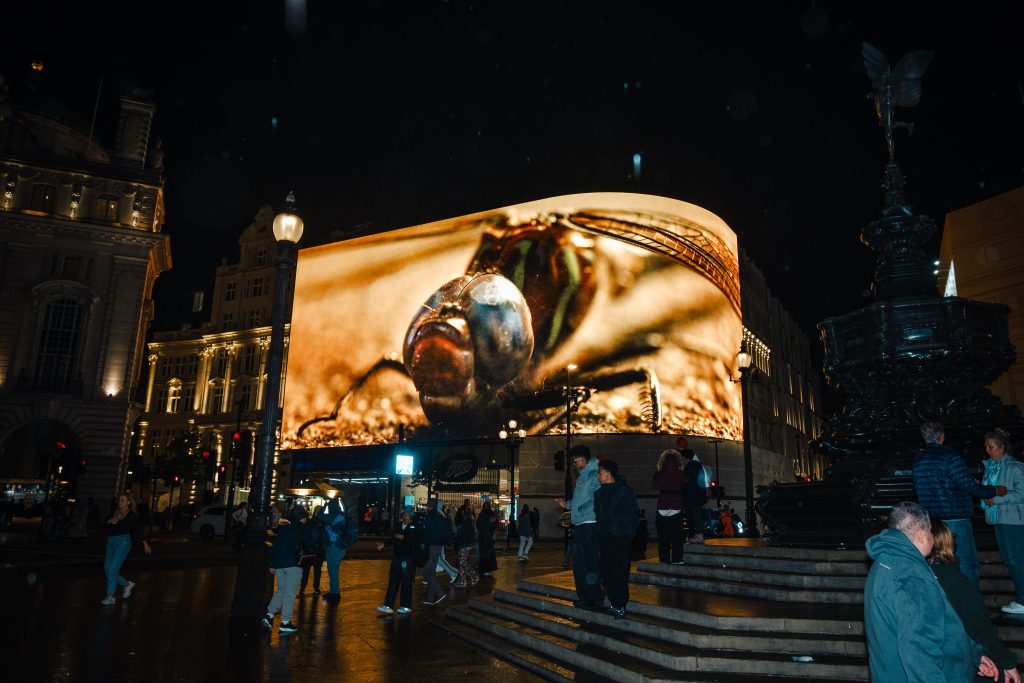
There’s also an element of deep time to it, the ancient insect, largely unchanged for 320 million years, resting on a sidewalk cast from concrete mixed with the glittering remnants of Manhattan’s bedrock, illuminated by the shifting colours of digital screens and advertisements. So, in many ways, I’m interested in what is already there – different elements coming together in a fleeting way.
Of course, we can only speculate on what the insect is observing, but the dragonfly was surely displaced, likely misled by the stark illumination of the square, causing it to get lost. After filming, I brought it to the nearest park.
Throughout history, animals are frequently used metaphorically: lions signify power, wolves represent freedom. The close-up in Untitled (25.07.2022, 02:14 AM) resists metaphorical interpretation. Why do you challenge anthropocentric narratives in your time-based works?
I’m interested in stepping away from the tendency to assign symbolic meaning to non-human animals. The dragonfly is not there to represent anything, but to simply exist as an individual in that moment. The work is centred on presence rather than meaning.
I try to keep that openness in my work, to perceive without imposing, to observe without assuming, to create space for an encounter in which meaning is not fixed but unfolding. By shifting the focus from interpretation to observation, I aim to acknowledge non-human subjectivity without reducing it to a human-assigned role. Even as I try to step away from anthropocentric narratives, I can only ever adopt a human perspective. But by being aware of this limitation, I hope to create a space in which meaning emerges through observation, rather than being imposed.
Written by Wouter van den Eijkel
Op weg naar zijn appartement liep Jonas Brinker ’s nachts over Times Square. Tot zijn verbazing zag hij een libelle uitrusten op het trottoir, midden in een van de drukste plekken ter wereld. Brinker had zijn camera bij zich en besloot op zijn knieën te gaan zitten en het insect frontaal te filmen. De libelle lijkt ons de hele film aan te kijken, waardoor het de hoofdrolspeer wordt van de film. “Een wild dier dat wordt erkend als individu. Een wezen dat je heel duidelijk kan zien, maar waarvan de essentie toch ongrijpbaar blijft.
“Het werk draait meer om aanwezigheid dan om betekenis,” zegt Brinker. “De libelle is er niet om iets te vertegenwoordigen, maar bestaat simpelweg, als individu, in dat moment.” Untitled (25.07.2022, 02:14 AM) sluit naadloos aan bij Brinkers werk, waarin verschillende elementen die al lang bestaan—de libelle bestaat al ongeveer 320 miljoen jaar—op een vluchtige manier samenkomen.
Jonas Brinker (Duitsland, 1989) wordt beschouwd als een van de meest prominente videokunstenaars van zijn generatie. Zijn werk is onder meer geëxposeerd bij Marres in Maastricht (2018), Palais de Tokyo in Parijs (2018), in de legendarische Berlijnse nachtclub Berghain (2020), en vorig jaar op Piccadilly Circus in Londen. We spraken Jonas Brinker kort voor de opening van zijn eerste institutionele solotentoonstelling in de Kunstverein Harburger Bahnhof in Hamburg.
Jonas Brinker wordt gepresenteerd door Zyrland Zoiropa uit Berlijn. Zijn werk Untitled (25.07.2022, 02:14 AM) is te zien in de Projections-sectie.
Je zei eerder dat je druk bezig was met de voorbereidingen voor een grote tentoonstelling in Hamburg. Ben je tevreden over hoe het is geworden?
Ja, ik was bezig met mijn eerste institutionele solotentoonstelling in Kunstverein Harburger Bahnhof in Hamburg. De tentoonstelling draait om vuurvliegjes in Central Park, vertaald naar een grootschalige videoinstallatie in de historische wachthal van de Kunstverein. Hun bioluminescente signalen, uitgezonden in hun laatste levensfase als soort-specifieke communicatie, worden gecombineerd met luchtbeelden van de skyline van New York ’s nachts. De poging om hun lichtflitsen vast te leggen, verandert zo in een melancholische verkenning van verlangen, tijd en de verweven werelden van mensen en niet-menselijke wezens.
Ik ben erg blij met hoe de tentoonstelling is geworden en ik ben helemaal verliefd op het feit dat de ruimte zich tussen de sporen van een treinstation bevindt, waardoor het een bijzonder geschikte locatie is voor werken die zich in de tijd ontvouwen.
De wijze waarop je jouw werken presenteert, is een cruciaal onderdeel van je werk. Wat voor presentatie had je in gedachten voor Untitled (25.07.2022, 02:14 AM)?
Toen ik de film maakte, stelde ik me een vrijstaande wandprojectie voor, zodat het beeld zich uitstrekt in de daadwerkelijke ruimte. De projectie moet hoger zijn dan een mens, zodat we het insect op ooghoogte bekijken of zelfs iets omhoog moeten kijken. Dit creëert een intieme situatie waarin een klein wezen dat we gemakkelijk over het hoofd zien een krachtige aanwezigheid krijgt. Zo krijgt de ontmoeting krijgt betekenis en resoneert daardoor.
Untitled (25.07.2022, 02:14 AM) draait om een libelle die uitrust op Times Square in New York. We zien een close-up van de libelle, waarvan de ogen en vleugels het veranderende licht van de omgeving reflecteren. Hoe ontstond het idee van een libelle op Times Square?
Hier zit een interessante connectie: het was niet iets dat ik had gepland of bewust van tevoren had bedacht. Ik was bezig met mijn andere werk en terwijl ik ’s nachts terugliep naar het appartement waar ik verbleef, kwam ik door Times Square. Daar, midden op de stoep, zag ik ineens die libelle. Omdat ik mijn camera bij me had, uitgerust met een macrolens, besloot ik op de grond te gaan liggen en een moment de tijd te nemen om het insect te filmen. Op die manier is het werk een directe reactie op een onverwachte ontmoeting, iets dat volledig toevallig gebeurde.
De libelle is het enige dat we te zien krijgen. Je zou het kunnen beschrijven als een opname van de indrukken die een libelle heeft terwijl hij rust op Times Square. Was dat een bewuste keuze?
De bewuste keuze was om het insect op ooghoogte te filmen, met de camera recht op hem gericht. Hierdoor lijkt de libelle ons terug aan te kijken. Zo wordt het de hoofdrolspeler van de ontmoeting: een wild dier dat wordt erkend als individu, een wezen dat je heel duidelijk kan zien, maar waarvan de essentie toch ongrijpbaar blijft.
Ik was gefascineerd door de reflecties van de stadslichten en billboards in zijn vleugels en ogen, waarin de omgeving zowel wordt geabsorbeerd als weerkaatst. Er zit ook een element van diepe tijd in: dit oeroude insect, dat in 320 miljoen jaar nauwelijks is veranderd, rust op een stoep van beton vermengd met de glinsterende resten van de oeroude rotsen van Manhattan, verlicht door de verschuivende kleuren van digitale schermen en advertenties.
Dus op veel manieren ben ik geïnteresseerd in wat er al is—verschillende elementen die op een vluchtige manier samenkomen. Natuurlijk kunnen we alleen maar speculeren over wat het insect waarneemt, maar de libelle was waarschijnlijk gedesoriënteerd, waarschijnlijk misleid door de felle verlichting van het plein, waardoor hij verdwaald raakte. Na het filmen heb ik hem naar het dichtstbijzijnde park gebracht.
Door de geschiedenis heen zijn dieren vaak gebruikt als metaforen: leeuwen staan voor kracht, wolven voor vrijheid, enzovoort. De close-up in Untitled (25.07.2022, 02:14 AM) verzet zich tegen deze metaforische interpretatie. Waarom daag je antropocentrische narratieven uit met je werk?
Ik ben geïnteresseerd in het loslaten van de neiging om symbolische betekenissen toe te kennen aan niet-menselijke dieren. De libelle is er niet om iets te vertegenwoordigen; hij bestaat simpelweg, als individu, in dat moment. Untitled (25.07.2022, 02:14 AM) draait om aanwezigheid in plaats van betekenis.
Ik probeer die openheid in mijn werk te bewaren: waarnemen zonder op te leggen, observeren zonder te veronderstellen, ruimte creëren voor een ontmoeting waarvan de betekenis niet vaststaat, maar zich ontvouwt. Door de focus te verschuiven van interpretatie naar observatie, wil ik niet-menselijke subjectiviteit erkennen zonder deze te reduceren tot een door mensen toegewezen rol.
Zelfs als ik probeer af te stappen van antropocentrische narratieven, kan ik natuurlijk nooit ontsnappen aan mijn menselijke perspectief. Maar door me bewust te zijn van deze beperking, hoop ik een ruimte te creëren waarin betekenis ontstaat door observatie, in plaats van deze op te leggen.
Geschreven door Wouter van den Eijkel
Artist Tanea Hynes grew up in Labrador City, a remote town in Newfoundland and Labrador, Canada, centred around one thing: iron ore mining. In her work, Hynes reflects on the impact of this industry on the people, nature and identity of the region. Through photography, drawings and installations, she explores how labour, nature and capitalism are intertwined.
Tanea Hynes’ work can be seen at the KIN booth in the New Art section.
A city built on iron
The name might be somewhat misleading, as Labrador City is not a city in the usual sense of the word. It is not a regional trade hub, it lacks a rich cultural life and young people do not move there for education. In Labrador City, everything revolves around mining, the starting point of a global production chain.
The town emerged in the 1960s after the discovery of a large iron ore deposit in the region. It was built according to the utopian ideals of the late 19th-century Garden City movement, intended to create a community where miners and their families could live well. For some time, those expectations were met. In its early years, the Iron Ore Company of Canada invested in modern facilities and social programmes, but after acquisitions by multinationals like Rio Tinto and Mitsubishi, these amenities disappeared.
These social programmes were not a luxury, given that the surrounding area consists of nothing but forest and wilderness. If someone were to go missing in the woods, finding them would be like searching for a needle in a haystack, Hynes notes in her graduation project. The nearest major city, Montreal, is 1,250 km away as the crow flies—roughly the distance from Rotterdam to northern Spain. The population currently fluctuates around 7,500. At its peak in the mid-1970s, the town had 12,000 residents.
These population fluctuations are linked to the global demand for iron ore. Born in 1996, Tanea Hynes has witnessed multiple boom-and-bust cycles over the past decades. Periods of economic prosperity have alternated with deep recessions, during which people lost their jobs, mortgages went unpaid and houses became unsellable. These cycles leave not only an economic imprint, but also shape the social fabric of the town. Labrador City has its own class system of miners and management, each with its own interests, often clashing over labour conditions and wages.
The mine as lifeline and curse
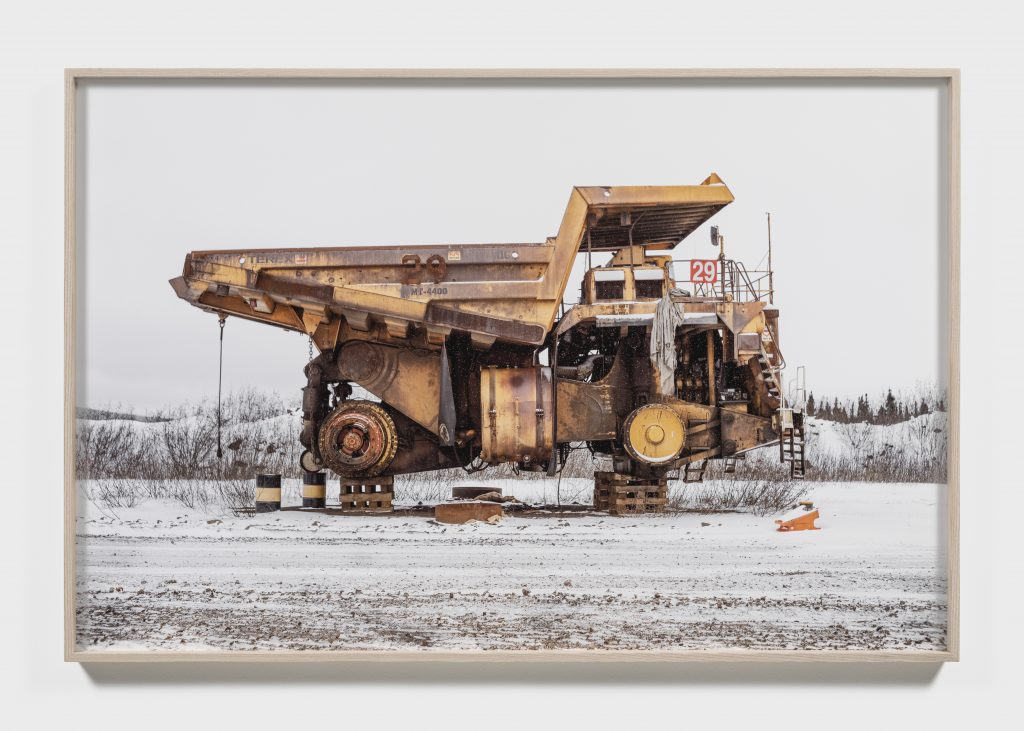
Hynes’ own life is inextricably linked to mining. To finance her studies, she spent five summers working as a truck driver in an open-pit mine. She experienced firsthand the physical and mental toll of the work and relentless pressure to increase production. The mines operate 24/7, 365 days a year, and work only stops in the event of serious accidents.
Reflecting on this experience, Hynes writes:
“This experience helped to shape my perspective on global economics, natural resource extraction, human impact on ecological systems, labor politics, and the world at large. I hold an understanding of the unforgiving demands of the mining industry and the place of myself, my family, and my closest friends within that system. I have experienced many close calls and felt the pressures of the endless push for faster production. Furthermore, I have felt my own body resist in ways that I cannot put into words. These experiences fuel my desire to create urgent works of art and photographs, attempts to materialize what can only be felt in one’s gut.”
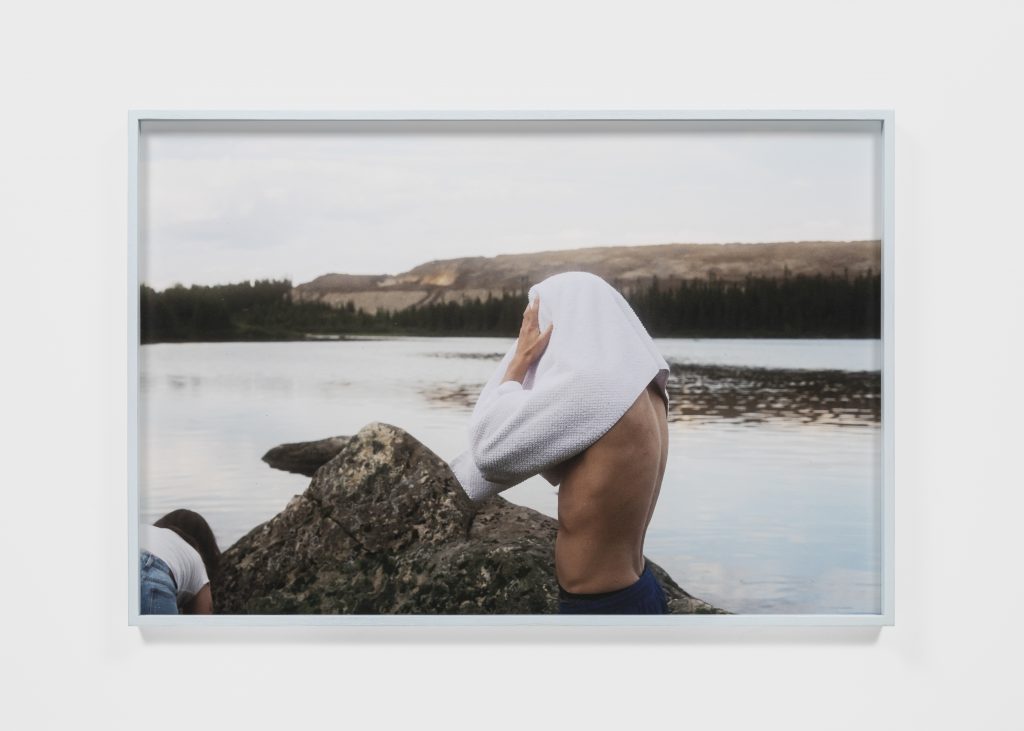
This relentless pace impacts not only the workers, but also the landscape. Hynes’ work focuses on both. In theoretical discussions, mining is often—and rightly—equated with environmental destruction. But for those embedded in such a community, like Hynes, mining is more than just devastation. Alongside boredom, addiction and physical pain, there is also hope, solidarity and resilience. She highlights people who care about the natural world and rely on it for physical and mental well-being, relaxation and joy. Her images capture miners spending their free time in nature, seeking peace in the same ecosystem they extract resources from during the week. The relationship between miners, the mine and nature is therefore highly complex.
Testimony and protest
Hynes’ work is often compared to the documentary tradition of Newfoundland and Labrador. In the 1950s–1970s, documentaries played a key role in exposing social inequality and the consequences of large-scale mining. Since then, the mining industry has preferred to stay out of the media, keeping its gates closed to outsiders.
In the fall of 2023, a childhood friend—now in a management position—invited Hynes to photograph a mine. She was surprised at how casually the offer was made. Her upbringing in Labrador City and her connection to the community likely played a role, making her an insider. It may also relate to her less overtly activist approach compared to past documentary filmmakers. Hynes acknowledges the paradox of mining: it is destructive, yet it provides her community’s livelihood.
This paradox is evident in her description of the images she captured in the mine: “While this industry provides vital metals to the ever-expanding world at large, these scenes represent the epicenter of so much chaos, of pain, addiction, sadness, and bleak degradation.” She recognises the importance of mining, yet the cost is undeniably high.
Remediated
In her series Remediated, Hynes juxtaposes images of the mine with pictures of abandoned landscapes where nature is attempting to recover. Sites that were once bustling workplaces are now scars on the land. She poses a crucial question: What remains when the resources are depleted and the mines are abandoned?
Long-term damage from mining is often shifted onto local communities like Labrador City. This series is not on display at Art Rotterdam, but does it gives us an idea why Hynes remains hopeful: “Remediated, along with the portraits in my exhibition, communicate that there is a path forward, and that we are already on that path. The way forward is not only through physical remediation of the land, but in meaningful, mutually beneficial communion with both the land and with each other.”
The road ahead
For Hynes, the way forward lies in an Indigenous, anti-colonial perspective—one that does not consider the earth a collection of extractable commodities, but as an extension of ourselves. In this view, the earth nurtures us and embodies languages, stories and histories.
The broader theme underlying Hynes’ work is humanity’s relationship with the land. Mining occurs worldwide—Labrador City is only one example. The scale surpasses the individual and likely even our imagination. Millions of tons of rock are moved, rivers rerouted and mountains erased. The miners of Labrador City are merely one link in a vast system. They never see the end products of their labour, as the extracted materials are processed elsewhere.
Hynes’ work is both a stark reminder that every industry carries a human and ecological cost and a plea for a new way of thinking about land use. Rather than viewing the earth as an endless source of economic gain, we should see it as an extension of ourselves, a place that deserves care and respect.
Written by Wouter van den Eijkel
No Man’s Art Gallery presenteert op Art Rotterdam (28-30 maart in Rotterdam Ahoy) een duopresentatie met werk van Benjamin Francis en Tobias Thaens. Voor Francis markeert dit het begin van zijn samenwerking met de galerie, die wordt voortgezet in zijn solotentoonstelling ‘A foot between the door’, die van 22 maart t/m 20 april 2025 te zien is in de galerie in Amsterdam.
Francis onderzoekt in zijn multidisciplinaire praktijk de verborgen mechanismen van macht, controle en correctie die onze perceptie van goed en fout vormgeven. Met installaties, video’s, sculpturen, teksten en performances legt hij de onderliggende structuren bloot die het individu vormen. Met zijn werk nodigt hij de kijker uit om even stil te staan bij wie de regels bepaalt, en wat gebeurt er als we ze herschrijven? Waarom streven we naar controle over onze omgeving – zowel levende lichamen als niet-levende objecten – en hoe leidt dat tot een dwingende normativiteit en conformiteit?
Geïnspireerd door het medium dans en de spanning tussen gehoorzamen en weigeren verkent Francis hoe subtiele vormen van correctie – via taal, lichaamstaal of architectuur – sociale structuren en de menselijke ervaring vormgeven. In een op efficiëntie gerichte maatschappij, waar afwijken van de norm als ongewenst geldt en imperfecties zorgvuldig worden weggepoetst, biedt zijn werk ruimte aan twijfel, ongemak en het onvolmaakte. Francis kijkt naar de manieren waarop fouten en afwijkingen gecorrigeerd of uitgesloten worden binnen maatschappelijke en pedagogische structuren en kennissystemen. Het is een thema dat persoonlijk resoneert: als iemand met dyslexie zag hij hoe spelfouten als ongewenst werden beschouwd en dat hij voortdurend werd gecorrigeerd. Zijn werk stelt de vraag wie bepaalt wat ‘juist’ is en welke dogma’s en machtsdynamieken daar achter schuilen. Bestaat zo’n strikte tweedeling, zo’n binaire benadering tussen goed en fout überhaupt? Francis beschouwt zijn kunst als een manier om fouten en verval niet te verbergen, maar juist te onderzoeken: zowel in taal als in materie.
Taal speelt een centrale rol in zijn onderzoek en zijn werk beweegt zich tussen object-gebaseerde werken en participatieve performances, waarbij hij het publiek in onverwachte situaties plaatst en regelmatig uitnodigt om deel te worden van de installatie. Voor een eerdere performance in Hotel Maria Kapel, waar de kunstenaar een residentieprogramma afrondde, maakte de kunstenaar bijvoorbeeld gebruik van teksten die meerdere malen door vertaalmachines waren gehaald, waardoor fouten en misinterpretaties zichtbaar werden. Deelnemers aan de performance werden gevraagd om deze teksten voor te lezen en zich er toe te verhouden. Dit ondermijnt de veronderstelde objectiviteit en neutraliteit van taal en laat zien hoe taal, macht en en hiërarchie onlosmakelijk verbonden zijn. In deze performances wordt de kijker niet enkel observator, maar medespeler in een systeem dat constant verschuift en zich aanpast. In ‘A Claim for Your Own Good’, opgevoerd in het Luther Museum, liet Francis een fictief schoonmaakbedrijf rituelen uitvoeren die subtiel machtsdynamieken blootlegden.
Ook de relatie tussen lichaam en herinnering speelt een rol. Ons lichaam maakt fouten die ons bewustzijn beïnvloeden: we voelen dingen of worden ergens door geraakt zonder het direct te beseffen. Herinneringen worden opgeslagen in ons lichaam, zonder dat we ons daarvan altijd bewust zijn.
Een terugkerend motief in zijn werk is de wisselwerking tussen vuil en reiniging. Want teveel reiniging laat sporen achter. Wat rest is een werkelijkheid die telkens opnieuw is bijgeschaafd, geboend, gecorrigeerd en gezuiverd. Wat doet dat met een lichaam dat zich hier voortdurend aan moet onderwerpen, als een archief van discipline? En hoe wissen we de sporen van jarenlang opgelegde correctie, die zich diep in onze huid en ons brein heeft vastgezet? En wat als schoonmaken niet langer slechts een fysieke handeling is, maar een instrument van controle? Wanneer reiniging wordt vermomd als zorg — een zorg die je wordt opgelegd omdat je, om welke reden dan ook, minder macht hebt binnen het heersende systeem? Francis confronteert de kijker met deze paradoxale dynamiek, waarin systemen van macht, correctie en normativiteit verweven zijn met onze dagelijkse handelingen.
De installaties van Francis veranderen omgevingen in performatieve ruimtes, waarin bezoekers zich onvermijdelijk bewust worden van hun eigen positie binnen systemen van discipline en normativiteit. Een badkamer, een klaslokaal, een mortuarium, een balletstudio — functionele ruimtes die hij verstoort met subtiele ingrepen, waardoor ze niet langer kloppen. Hun oorspronkelijke functie verschuift, raakt ontwricht, en maakt plaats voor spanning en nieuwe betekenissen. In eerdere installaties, zoals ‘The Removal of the Eye’ in P/////AKT werd het publiek uitgedaagd om over breekbare witte tegels te lopen. Elke stap liet sporen achter: een directe confrontatie met de spanning tussen zuiverheid en verval, controle en loslaten. Deze spanningsvelden spelen een belangrijke rol binnen zijn praktijk.
Francis keert steeds terug naar het uitgangspunt van ‘de ander’: zij die afwijken van de norm. Het is een positie waarmee de kunstenaar zich ook zelf identificeert als queer persoon van kleur met dyslexie. Mensen die niet passen binnen de maatschappelijke kaders, bijvoorbeeld door hun sociale, maatschappelijke of financiële positie, worden zwaarder onderworpen aan controlemechanismen. Door ‘de ander’ juist als de norm te gebruiken (het tegenovergestelde van ‘othering’) kun je de norm effectief zichtbaar maken, analyseren en bekritiseren. Hij keert het perspectief om: niet zij, maar de norm zelf wordt bevraagd. Dit proces stelt hem in staat om te analyseren en bekritiseren hoe deze systemen functioneren en door wie ze worden gehandhaafd. Autoriteit en normativiteit zijn geen vaststaande begrippen, maar worden constant herschreven door de structuren die ze in stand houden.
Op Art Rotterdam en in zijn solotentoonstelling in No Man’s Art Gallery onderzoekt Francis hoe ruimte en lichaam op elkaar inwerken.
Benjamin Francis (1996) studeerde in 2020 af aan de afdeling Fine Arts van ArtEZ BEAR in Arnhem, met een focus op Experiment, Kunst en Onderzoek. Zijn werk werd eerder getoond bij No Man’s Art Gallery (NL), Christine König Galerie (OOS), Art Antwerp (BE), Luther Museum (NL), PuntWG (NL), Ballroom Project #6 (BE), Hotel Maria Kapel (NL), If I Can’t Dance, Kunsthuis Syb, Het HEM, P/////AKT (NL), MÉLANGE (DE), Rencontres Internationales (DE), SECONDroom (BE) en Mutter (NL).
Tijdens Art Rotterdam presenteert Benjamin Francis zijn werk in de booth van No Man’s Art Gallery. Van 22 maart t/m 20 april 2025 is zijn solotentoonstelling te zien in de galerie in Amsterdam.
Geschreven door Flor Linckens
Atelier Van Lieshout (AVL) staat bekend om monumentale sculpturen waarin kunst, architectuur en maatschappelijk onderzoek samenkomen, met een speelse maar confronterende ondertoon. Het werk onderzoekt macht, autonomie en de rol van de kunstenaar binnen een samenleving waarin zichtbaarheid en erkenning niet vanzelfsprekend zijn. Sinds 1995 werkt Joep van Lieshout onder de naam Atelier Van Lieshout, een bewuste keuze om de klassieke mythe van de individuele kunstenaar te bevragen. Op Art Rotterdam 2025 toont AVL, in samenwerking met Galerie Ron Mandos, het Graf van de Onbekende Kunstenaar (2024) in Sculpture Park. Het is een eerbetoon aan de talloze kunstenaars die in de schaduw van de kunstgeschiedenis bleven.
Graf van de Onbekende Kunstenaar: Een tragedie van de miskende liefde
Een betonnen tombe rust op een affuit, een onderstel van een kanon dat traditioneel werd gebruikt om de kisten van generaals, keizers en staatshoofden naar hun laatste rustplaats te vervoeren. Ooit een symbool van staatsmacht en heroïek, kreeg het affuit in staatsbegrafenissen een ceremoniële functie om grootschalige nationale rouw te markeren. In veel tradities is het affuit geen permanente rustplaats, slechts een tijdelijk transportmiddel naar een begraafplaats of mausoleum. Hier draagt het affuit niet langer een staatsman, maar een monument voor de vergeten kunstenaar. Een symbolische overgang van leven naar dood en van vergetelheid naar blijvende herinnering.
Bovenop de tombe ligt een bronzen leeuw, stil, misschien slapend, misschien levenloos. “Die leeuw is een teken van kracht en doorzettingsvermogen,” zegt Joep van Lieshout. “De koning van het dierenrijk slaapt, of sterft, maar kan ook weer wakker worden om verder te trekken.”
Het werk is zowel een monument als een commentaar op de grilligheid van erkenning. “Kunstenaars hebben vaak een keihard leven,” zegt Van Lieshout. “Ik ken zóveel mensen die hun hele leven werken, prachtige dingen maken, maar op het verkeerde moment op de verkeerde plek zijn.” Soms worden ze later opgepikt, soms verdwijnen ze voorgoed. Hij noemt het een “tragedie van de miskende liefde.” Het werk heeft een ludieke ondertoon, maar is tegelijk bloedserieus. “Door humor glijden serieuze boodschappen gemakkelijker binnen,” voegt de kunstenaar er lachend aan toe.
Aan de zijkant van de sculptuur bevindt zich een opening, een niche die doet denken aan een ossuarium, een plek waar menselijke overblijfselen worden verzameld. “We hebben gekeken naar ossuaria als inspiratiebron voor het monument,”zegt Van Lieshout. “Het is een sculptuur die zich opent voor wat nog komt.” Hier kunnen, in de toekomst, de botten en as van onbekende kunstenaars worden toegevoegd. Het werk is geen gesloten monument, maar een plek die zich letterlijk kan vullen met de stoffelijke resten van zij die nooit erkenning kregen.
Beschermd, vergeten, almachtig?
Naast het Graf van de Onbekende Kunstenaar presenteert Atelier Van Lieshout drie andere sculpturen op Art Rotterdam, die elk op hun manier de spanning tussen bescherming, macht en vergetelheid belichten.
Tree of Life (2016), een boom met sokkel van ruim 3 meter, draagt mensvormige vruchten in verschillende stadia van rijpheid. “Het kan een beeld zijn van leven en vruchtbaarheid, maar net zo goed van geweld en verdwijnen,” zegt Van Lieshout.
Maria’s Cloak (2023) roept de vraag op wie bescherming geniet en wie erbuiten valt. De mantel van Maria biedt geen vanzelfsprekende veiligheid.
Omnipotent (2023) speelt met gezag en overgave. “Omnipotent is een ander woord voor de almachtige,” zegt Van Lieshout. De sculptuur toont een hand die afhankelijk van de plaatsing verschillende betekenissen krijgt. “Je kan hem rechtop zetten en dan is het een stopgebaar, je kan hem draaien met de handpalm naar boven, en dan wordt die ineens de bedelende hand van een kunstenaar.”
Bloemlegging bij het monument
Op 27 maart 2025 om 19:00 uur vindt bij Graf van de Onbekende Kunstenaar (2024) een symbolische bloemlegging plaats. Bezoekers worden uitgenodigd om bloemen mee te brengen en bij het monument neer te leggen, een laatste eerbetoon aan de kunstenaars die bij leven onzichtbaar bleven. Joep van Lieshout zal een korte toespraak geven over het werk en de bredere context binnen Art Rotterdam.
Is het een komisch of tragisch gebaar? Het lijkt dezelfde dubbelzinnigheid te dragen als de leeuw op de tombe zelf.
Geschreven door Emily Van Driessen


