Coming soon
Coming soon
Select type
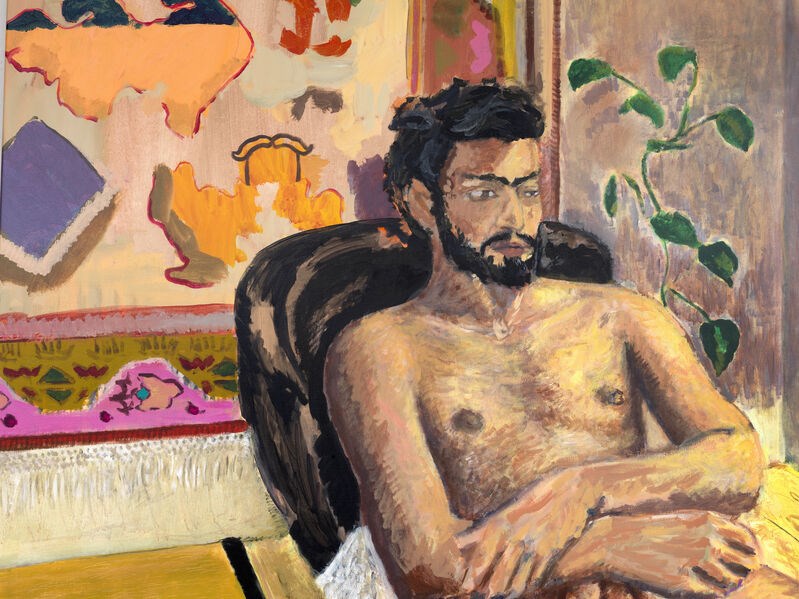
In the Solo/Duo Section, No Man’s Art Gallery shows new work by painter Sam Samiee. In his work, Samiee combines a Western visual language with Eastern narratives and psychoanalytic concepts. Samiee is always looking for shared traditions. He previously found it in abstract work. This time, he focusses on Nastaliq calligraphy. A conversation about the importance of 1001 Nights, transnationalism, Freud’s ideas about framing and the Dutch René Daniëls.
Sam Samiee was born in Tehran (Iran, 1988). He completed his residency at the Rijksakademie in 2015 and completed ArtEZ AKI in 2013. Prior to that, Samiee studied industrial design and painting at the University of Arts in Tehran. Samiee won the Dutch Royal Prize for Painting in 2016 and the Wolvecam Prize in 2018. He is currently a member of the jury for both prizes. Samiee’s work is shown internationally and was shown earlier this year at Melly in Rotterdam.
What will you be showing at Art Rotterdam?
I assume that I will be showing a new work from the series that I’m working on called Nastaliq. Nastaliq is a type of calligraphy which is used mostly in Persian and Urdu. And so in the Eastern Islamic art, not in Western Islamic art, which is more geometrical. The Eastern Islamic world, which includes North India, Afghanistan, Pakistan, Iran, Kurdistan, tends to use Nastaliq. This is what I’m trying to focus on, on the beauty and representation of groups of people who I don’t want to bind them to nation states, to the concept of Iran or Afghanistan.
I would like to signify this group of people with a type of aesthetic that they relate to transnationally. That’s why I call it Nastaliq. In the portrait it might be an Indian boy or an Afghan boy or an or a Kurdish girl or an Armenian boy.
So the series takes its name from eastern Islamic calligraphy, yet the canvasses are painted in a Western style. Why is that?
My education is Western art and in visual arts. So, usually my references are very heavily about Western art history for this series. For the last two to three years, I’m particularly looking at Bonnard more than anybody else, because of his position in European history; postwar, prewar, postwar. As Bonnard, and Matisse too, was an artist who would go unapologetically for decoration. There are also other references to cinematographers and theorists like Pasolini. I think these artists are also looking for a shared tradition that I would say is very related to 1001 nights. I am talking about the usage of aesthetics for the sake of ethics.
You mentioned 1001 Nights and the concept of transnationalism, how are these concepts related and why are they central to your work?
I try to work very discursively based on art history, modes of work. I think in European art history we have well researched intertwined networks of empire and nation states. But when it gets to the intertwined networks of Asia or West Asia, there’s very little scholarship in Europe on art, historical understanding of references or literature of the intertwined networks of Asia, of West Asia.
So I wouldn’t like to concentrate too much on Iran, because not only Iran that has these traditions, it’s Indo Iranian. It has a lot of Arabic influences, Ottoman influences, Turkish influences, and North African influences too. So, when 1001 nights was translated into Latin in 17th century and then into French and English and other languages it became, as Jorge Luis Borges wrote, transnational. It’s not really Persian, it’s not really Arabic. It’s a shared tradition. I’m very interested in taking something out of the realm of identity politics of one particular group of people. That’s why I insist on transnationalism.
Is this also the reason you are interested in abstractionism, because it transcends national or local identities?
Yes, that is correct.
I recently saw your show at Melly in which you tried to escape the traditional frame of a canvas. Why is that important to you?
I’ve been doing this since 2014-15, when I was at the Rijksakademie. I am addressing the very fundamental question of how to deconstruct painting. Again, it was very related to 1001 nights, because 1001 nights is not just a set of stories. It’s a programme for framing. How can you produce a frame of a story? Then from within that frame, you enter another frame, and then from that frame you enter another frame. By breaking frames over and over, you also influence the modes of relation within the frame that you are in together with the person who is hearing the story.
This is very similar to the psychoanalytic idea of the frame, because in psychoanalysis Freud produces a mode of relation to the patient, which is not so much about the content of what the patient says, but more about when the patient should come in, when he would lie on the couch, when they finish, what should be the exchange between the analyst and the patient. So the framework as the mode of relationality.
How do you apply these concepts to painting?
I arrived at this question from two ways. One, after the 1970’s, you rarely see painting commenting on architecture. Expect in Europe, except in the work of Constant Nieuwenhuis and COBRA artist. They were situationists. The situation is very much about the architecture, but also about mode of relation, mode of production: who is there, who is playing, who is not playing, who is excluded, who is included. So all these questions relate to the framework.
And through Paul Thek. I think Thek was a great example of a person in seventies and eighties who broke away from the frame of the painting and thought about the painting again within the architecture. More like how Matisse and artists before him would think about painting. But then art history that we studied basically decontextualized painting from the wall. Studying art history we just look at one image.
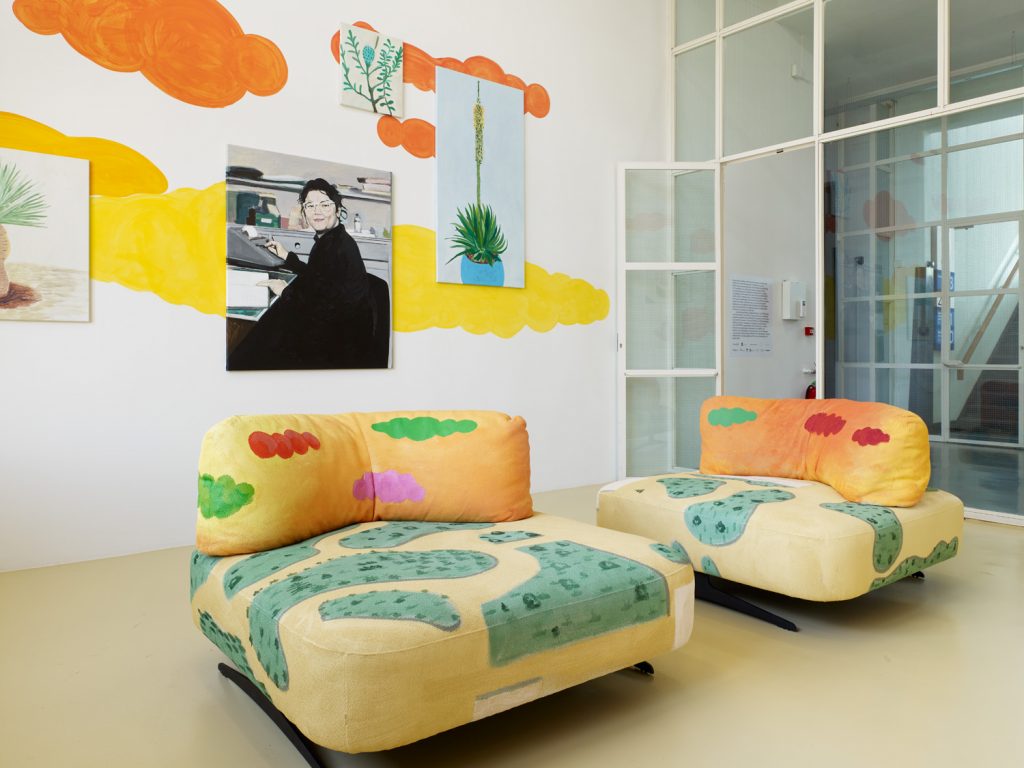
You rarely see someone like Rothko saying, Well, I want these images to be together. They should be installed in such and such ways. That is why I became interested in the relationship between the painting and where it’s installed. And I think as you break the frame a bit by painting on the couch or by painting on the wall, mixing it with painting or any other way, you immediately call into questions of politics and economy and anthropological rituals.
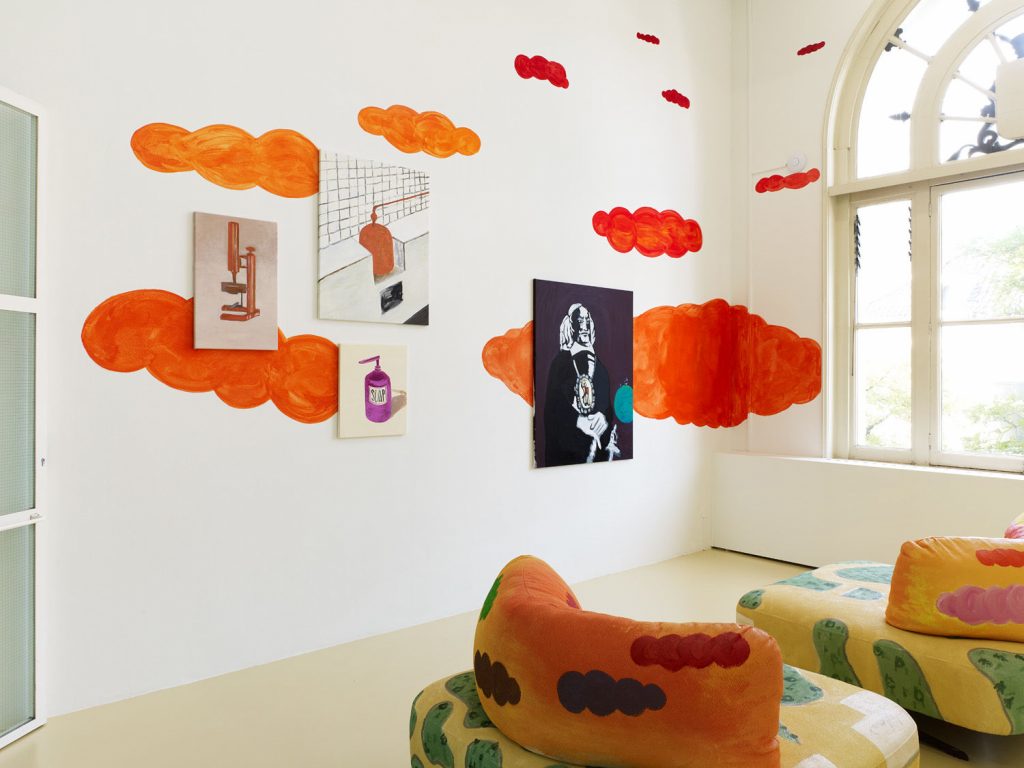
So to summarize it: It touches on the questions of alternative modes of relationality. It poses the question how can we relate differently? In the Melly exhibition, that was why we wanted to have one of the works outside of the room looking like a poster, and we wanted the clouds to move towards the window where it relates to the outside landscape. We wanted the couch to be a condensation of the entire boomgaardstraat and the whole neighborhood. So you have all these relationships in a metaphoric way.

You made a painting about the Dutch painter Rene Daniels as well. Is that also related to his use of space and the interested he had for psychoanalysis?
Absolutely. That painting was a homage to two of his paintings. One of them is called Aux. In it he shows Razi and Ibn Haytham (Alhazen), two Muslim opticians who introduced a theory of optics in the 12th century, and they are connecting an auxiliary cord to this European theory of perspective. It’s such a beautiful homage to history of optics and perspective.
Daniels used geometric lines of Islamic art in quite an ironic and funny way, turning it into an auxiliary cord one uses to plug into your amplifier. He’s connecting our Western theory of perspective to that theory of optics that the Islamic world introduced in the 12th century
In my homage I painted a few of my own drawings I chose from my ten years of drawing. I called it Rene Daniels Academy. So he has all these different styles of painting – a Japanese painting, a drawing of a model, a surrealist painting, calligraphy, writing and still life – which brought into a different perspective. And he has also painting of candle and candle is also very common theme in Persian painting. And I have also this.
In an interview with art magazine Mr Motley you mentioned that the Dutch are very much geared to it towards the Anglo-Saxon world and seem to have forgotten about their own past, also when it comes to participation in public discourse. You said wanted to step in, as it were. Was your show at Melly an attempt at participating in public discourse?
I was very satisfied with the experience at Melly. Although I was expecting more media attention considering all the newsworthy questions on the name change (from Witte de With to Melly, ed.), maybe there has been and I yet have to tune in. Now that the painstaking job of archiving is being carried out, other cultures are being recognised for their contribution to Dutch history. With all the contending political ideas, modes of painting and history of painting all merging in Melly, I expected there to be more of a dialogue. I think we are drawn to the Anglo-Saxon world because they do a great job, meaning that they have a specific history in shaping museology. They put things out there and say with confidence: this is the way.
Since you’re interested in politics or political discourse, I was wondering if you are working on something reflecting the current events in Iran?
I think becoming an artist itself is so political, even if you don’t necessarily show politics. I think 1001 nights is one of the greatest political positionings in the history of Iran. 1001 nights is an example of politics by artists in Persia. How to use beauty to introduce ethics.
Also, at some point you realise that the excess of catastrophes exceeds your capacity to capture screenshots of history. Therefore, you must produce something that is not journalistic because journalism on Iranian politics is gone by the wind every day. Some 70, 80 days have passed since the revolution. There are 2 to 3000 important points and letters and pieces that can be curated. As an artist, what can you do?
We need to produce works that transcend all this in order to create an analytic space to think and be political. I don’t produce political content. I produce the space within which political thinking should become possible, and I think that should be my role as an artist.
So, the politics is in the form and context?
I think my position was always to use aesthetics. Formalism and beauty and decor, uncertainty and to think of what will remain and keep things together.
So my Nastaliq paintings are just as political as Rene Daniels was. He decentralizes Europe in European art history, that’s as political as when you paint a Muslim Indian boy who is now under the fascist state of India. Also, I think Pasolini’s film 1001 night was dealing with fascism as much as his Salo was. Bonnard was purposefully distancing himself from avantgarde artists because he realized its machismo was feeding fascism. He opted for a more feminine and decorative approach instead.
All of these were political positions. It’s just that our art, our art history hasn’t touched on it as such, and our institutions haven’t managed to take a strong position on them. Maybe there are some institutions have, and some have not. So, I don’t think that as one artist I can do the Herculean job of changing the narrative for everyone.
Written by Wouter van den Eijkel
Making a feature film on your own seems impossible in advance. Yet, this exactly what artist and filmmaker Bob Demper is trying to do. He exchanged the rigid film world for his own creative approach, in order to achieve the same result with intermediate steps. At Prospects, Demper shows such an intermediate step: Black Rock, Soft Storm. An installation in the form of a generic American office. It is the workplace of Donny, the main character in his forthcoming feature film.
Black Rock, Soft Storm
Demper has been working on 5000 Miles for over 4 years, a film that he partly shoots in the US and partly in his studio in The Hague. In recent years, the pandemic has forced him to revise his travel plans. Still, he was productive. The restrictions imposed gave him time and the opportunity to experiment.
“The movie is a long-running project from which smaller projects regularly emerge. Black Rock, Soft Storm is such a smaller project,” says Demper over the phone. This installation consists of the decor of the workplace of main character Donny, an anonymous office space behind a cold glass front. A scene from the movie can be seen on Donny’s PC, while a benign storm rages outside. On large LCD screens, which act as a window, many large, soft objects are pressed against the glass.
Mental composite drawings
The idea of considering set pieces as spatial installations came about gradually. Seen from the right angle, the imagined reality holds, but as soon as you step back, it’s gone. “From my interest in this fragility, which is very specific to cinema, paintings, sculptures and installations emerge that are both autonomous works and part of my films.”

For the design of his sets, Demper (The Hague, 1991) draws on his memory, or rather: his viewing experience. “Donny’s apartment is in New York. When designing that space, I included a window that faces an alleyway. When I was in New York, it turned out that alleys like these almost didn’t exist. They are missing in New York’s rigid grid, where there is no room for ‘useless alleyways’. The alleys stem from Hollywood’s vision of the city. Screenwriters in LA added them, because space is less scarce there. Partly because of this, they are part of our collective memory. Ask someone to imagine an apartment in New York, and everyone will have a mental approximation of what it looks like drawing on a wide variety of pop culture examples.” Mental composite drawings, Demper calls them.
A factory on wheels
Demper graduated as a film director from the HKU in 2014 and subsequently worked on Borgman and Schneider vs Bax, two more recent films by director Alex van Warmerdam. It was educational, but it made Demper realize that the film world was not for him. “When I decided to become a filmmaker, I thought that if you were far enough along in your career, you could find a way of filmmaking in which the making process, especially the shooting days, would leave a lot of room for adventure. The reality is that as that ‘factory on wheels’ gets bigger, it also becomes less and less agile. Van Warmerdam does have creative freedom, but like any other filmmaker, he is bound by the limitations of the medium. That was a disillusionment for me and that is why I understand that he also paints”
Demper therefore recognizes himself in the statement of Alfred Hitchcock, who once said that he liked coming up with a project, but did not find the filming itself particularly exciting. What Demper especially missed while shooting was a lack of experiment, it was the mere ‘execution’ of an idea conceived earlier, as is possible in other disciplines such as painting or sculpture. With film this is only possible if you take matters into your own hands.
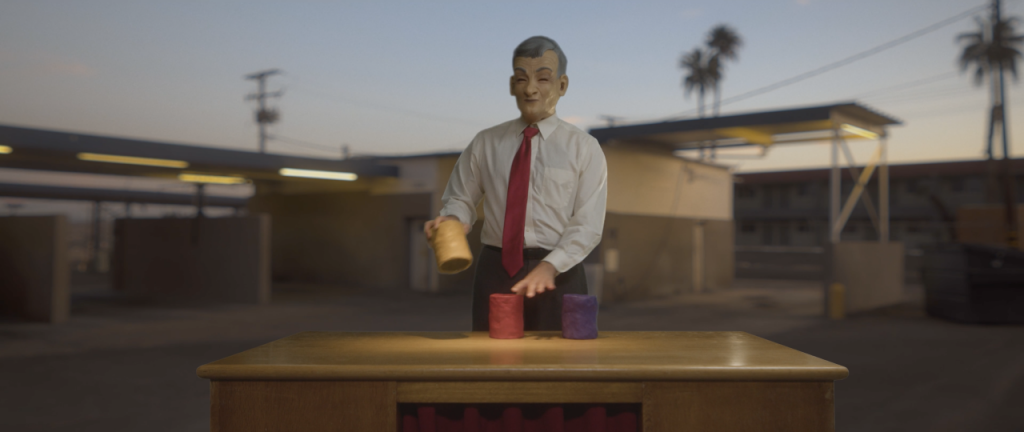
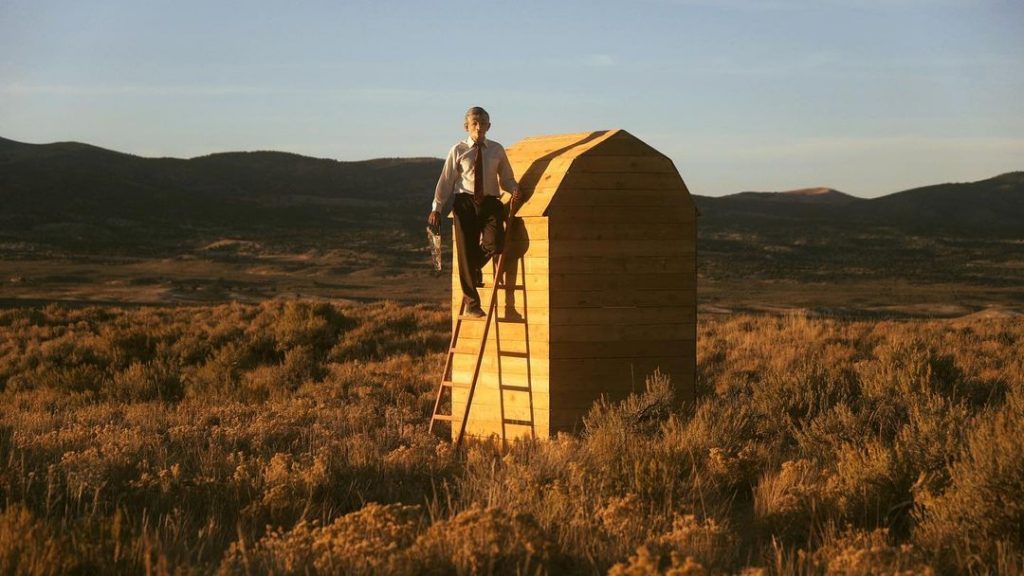
Demper’s preference for a method dictated by the process also means that the budget is a fraction of a full-length feature film, which in turn means that he pretty much does everything himself, both in front of and behind the camera. For example, in 5000 Miles, the limited number of actors is accommodated by making them wear masks, allowing the same actor to play multiple roles. The cottage on the still-timbered Damper in the Nevada desert during a residency. “Before I would stay in the desert for two weeks, I did not know that the house was coming. That came to me there and then. That’s how I like to work, by building a set and spending some time there.”
Blackrock
Some degree of headstrongness is thus not foreign to Demper. A good example of this is his website, which is completely textless except for a few lines of a modest pop hit. Even contact information is missing. At the same time, the themes he addresses in Black Rock, Soft Storm stem from a great involvement with his immediate surroundings. For example, the main character Donny is at home dealing with a burnout, just like a number of people in Demper’s immediate environment.
His interest in Donny’s employer, an American asset manager, does not come out of the blue either. In addition to his art practice, Demper works for a company that records shareholders’ meetings, which piqued his interest in the world of finance and power structures.
The asset manager Donny works for is Blackrock, which manages about one-tenth of the total assets of the entire world. Such companies are dedicated to risk management. They operate by spreading investments, not only across different sectors, but also across the globe. For example, the company is controversial in the Netherlands because of the adverse effects their real estate portfolio has on the Amsterdam rental market.
To contain investment risks, the company has developed Aladdin, software that predicts market risks based on past events and personal information of millions of people. On this basis, the system shifts shareholders’ assets, resulting in more stable financial markets and therefore more certain returns forecasts. “In such a world, real change seems impossible, because an algorithm predicts and corrects every outlier,” says Demper. “Not only is it slowly eroding a way of living together, but above all I think it is an anxious continuation of a disenchanted world. A world in which there is less and less room for personal feelings, magic or anything that cannot be expressed in figures or manageable units.”
Bob Demper’s work can be seen during Art Rotterdam in the Mondriaan Fund’s Prospects exhibition. For the 11th time in a row, the Mondriaan Fund presents the work of 73 starting artists. In 2021, all artists received a financial contribution from the Mondriaan Fund to kickstart their careers.
Written by Wouter van den Eijkel
During Art Rotterdam, you will see the work of hundreds of artists from all over the world. In this series, we highlight a number of artists who will show remarkable work during the fair.
The versatile work of Toon Boeckmans is not easy to capture or classify. The Belgian artist makes installations, videos, paintings and drawings. Through his practice, he searches for the poetry in the mundane. He often uses found material for his works, or he creates visual references to familiar objects himself. From mikado sticks and old board games to red and white barrier tape, completely silver traffic signs and a blank tear-off calendar that even fails to mention the date. Boeckmans creates these objects from scratch or he transforms found objects using minimal, yet witty and sophisticated interventions. That way, familiar symbols acquire new meanings, functions, contexts and connotations, and the resulting works often have both humorous and dystopian undertones.
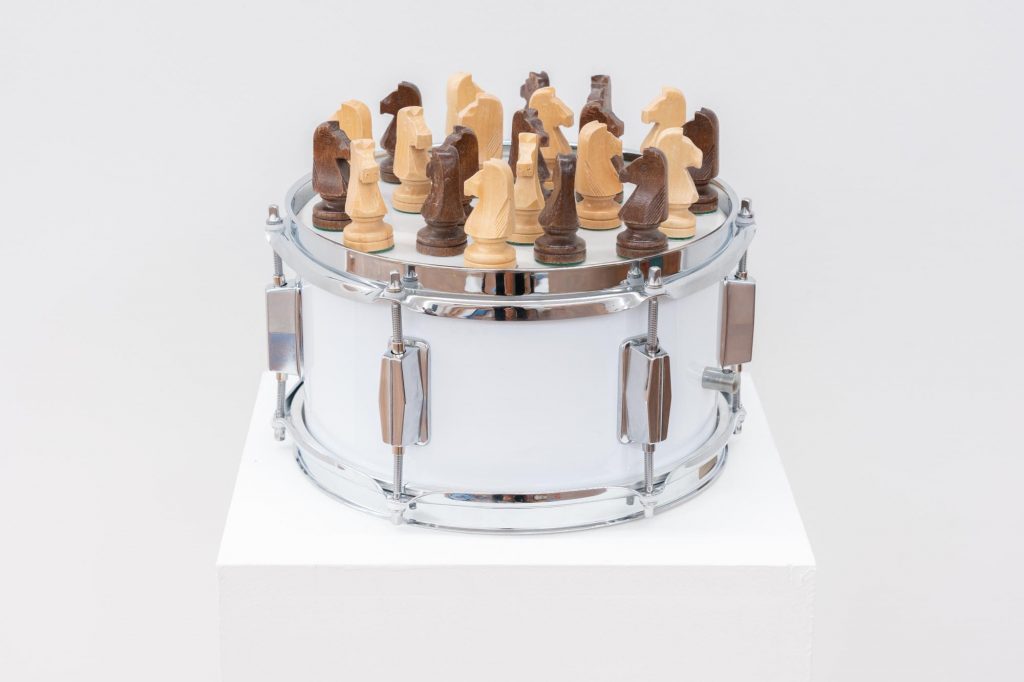
Yet the overtone in Boeckmans’ oeuvre is often playful. Because he uses or imitates such well-known objects, he invites recognition on the one hand, but on the other hand his unconventional compositions actively put you on the wrong track. In 2022, the artist presented a drum with 22 horses on it that seemed to originate from a chess game. A chessboard, a regulated universe that is characterised by laws and strict rules, only has four knights. Seeing 22 chess horses may therefore cause some confusion for the viewer, but in that chaotic situation there is also room for a new, more intuitive interpretation. Dark and light pieces are mixed, in a dynamic composition — as if they were on a dance floor and could start moving at any moment. Another connotation could be the carousel, which is also marked by the presence of wooden horses.
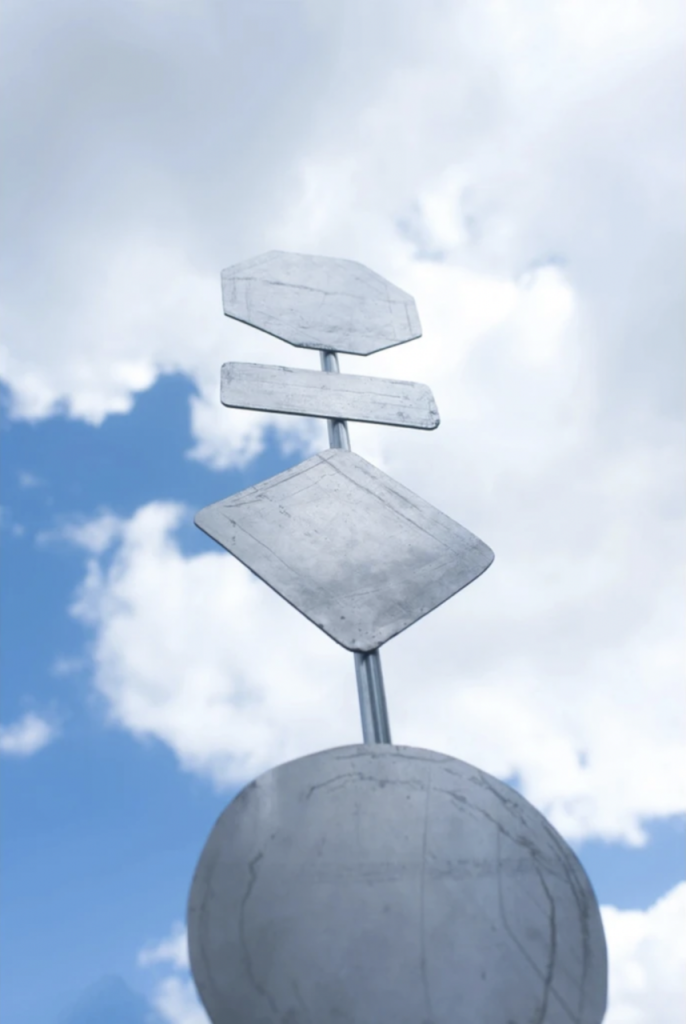
In many cases, Boeckmans’ works are not linguistic, in the sense that they rather refer to a universal, non-verbal form of communication. Sometimes, however, it is precisely the title of the work that evokes a smile, such as the cheerful yellow “Fort from Soft Butter” (2015) which, as the name suggests, consists of a composition of pieces of butter, that form a fortress that’s just two blocks of butter tall — unfunctional as a defense mechanism in more ways than one. But however intuitive and impulsive some works may seem at first glance, the ideas first arise on paper, after which they are carefully thought out and developed. The viewer is then invited to think of their own interpretations.
Boeckmans studied Mixed Media at Sint-Lucas Beeldende Kunst Gent. The program presents the artist on their website in a list of alumni who have managed to secure a place in the art world, as a success story for prospective students. Boeckmans’ work has previously been shown in the Concertgebouw in Bruges, twice in the Summer Salon in Kunsthal Ghent and Dauwens & Beernaert Gallery presented his work at Artissima in Turin, in Ballroom Project in Antwerp and during Art on Paper in Bozar in Brussels. His work is currently also on display in Gevaertsdreef 1 and Merode Ronse.
During Art Rotterdam, Toon Boeckmans will show his work in the booth of Dauwens & Beernaert Gallery in the New Art Section.
Written by Flor Linckens
During Art Rotterdam, you will see the work of hundreds of artists from all over the world. In this series, we highlight a number of artists who will show remarkable work during the fair.
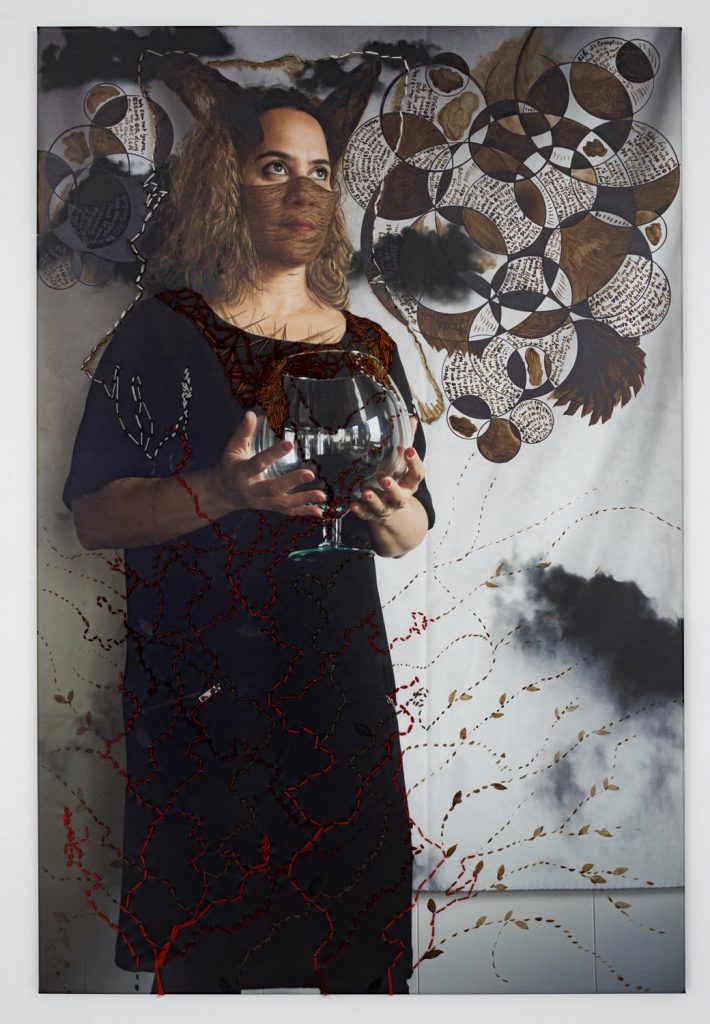
Monali Meher works in a multitude of disciplines: from video, installation and performance to photography and textiles. But it is performance art that occupies the most prominent place in her practice. The body plays a central role in this, alongside recurring themes such as time, a sense of belonging, migration, cultural cross-pollination, a hybrid and diaspora identity, gender, intimacy, decay, the climate, transformation and the reshaping of objects and memories — often in a social or political context. In fact, time, and the physical and spatial dimension of time, is such an essential part of her practice that it almost counts as a medium in itself. She compresses or stretches the concept of time. The artist is also interested in oppositions such as sadness and happiness, continuity and transience, birth and death.
Meher’s practice is a continuous quest in which she mirrors her own experiences through the media she chooses. Sometimes certain objects play a role in this, often transitory or natural in nature. When the online platform ITSLIQUID asked her about her personal interpretation of art in 2014, Meher stated: “Art is the language, the body, an expression, emotion, sound, pain, struggle, growth, change, statement, something which stays with you in your memory and/or changes it’s form over a period of time.”
In recent years, Meher has performed a number of compelling performances. She used her body to simulate the almost imperceptibly slow change of nature in the performance “Gilded” (2022), amidst a staged natural landscape. She made stone soup in Kunsthal Gent and in 2011 she organised a ‘Silent Walk’ on the Museumplein in Amsterdam as part of International Migrants Day, specifically in the context of the worldwide art campaigns of Tania Bruguera. In 2021, she presented a performance in De Kerk in Arnhem. For this she painted 700 kilos of potatoes in black paint with words with a negative connotation. In different languages you could read words like “anger”, “violence”, “hass” (hate), “guerre” (war) and more. Visitors were invited to peel the potatoes to remove their (emotionally) toxic skin. The potatoes were then donated to various homeless institutions and the sustainable local restaurant De Stadskeuken. When the performance ended early due to a lockdown, Meher continued the project on her own. Later in 2021, Meher presented a performance in a snowy valley in Norway. In “Arctic Action VI” she wrapped yellow, green and blue transparent fabric over an old rusty oven, which had previously been used for burning garbage. Meher: “I started wrapping objects in 2005, transforming, giving them new skin with the aim to make emotions emerge from them.” The Arctic Action project, that the performance was a part of, draws attention to the fragility of the planet and the relationship between human beings and nature.
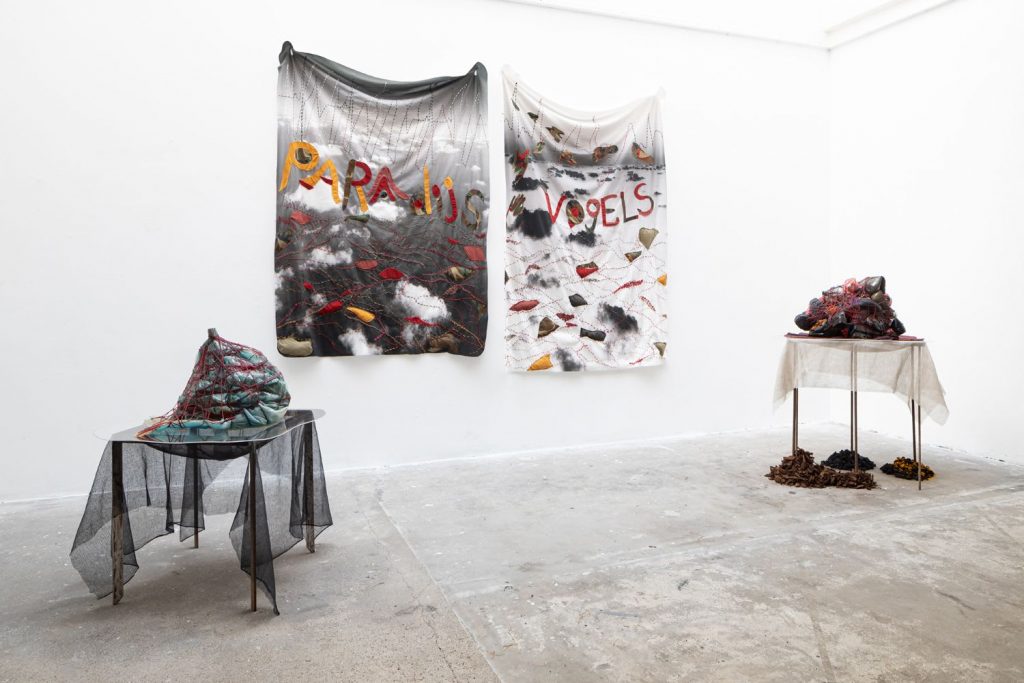
Meher graduated from the Sir J. J. School of Arts in Mumbai in 1998. In the same year, she travels to Vienna, where she is invited for a UNESCO-Aschberg residency. In 2000 she started a residency program at the Rijksakademie van Beeldende Kunsten in Amsterdam and remained in the Netherlands after that. In 2004 she briefly traveled back to India, where she participated in the Khoj residency project in New Delhi for two months. She currently lives and works in Ghent.
In the Belgian magazine rekto:verso, Meher wrote that it can frustrate her when people always center her Indian background, even in the interpretation of her work — and with that her “otherness”, an expression of “othering” in the terminology of Edward Said. Meher mentioned that she initially adapted to the Netherlands by applying a neutral palette, but that none other than Marina Abramović advised her to embrace her background in her artistic practice.
In addition to performances, Meher also creates work on paper. Meher: “Drawings for me are like autobiographical diagrams. My use of natural and ephemeral ingredients results in a process of perishing and transitory moment of the time. I transform the nature of manner in which materials react, what shape or smell they produce, what impact they make on my viewers and how the space around my art and audience gets transformed.” Meher enriches these works with food colouring, inks, pigments, face paint and sandalwood oil, which are then used as a means to soothe physical and mental pain. In combination with the images, this creates a number of almost ritual acts.
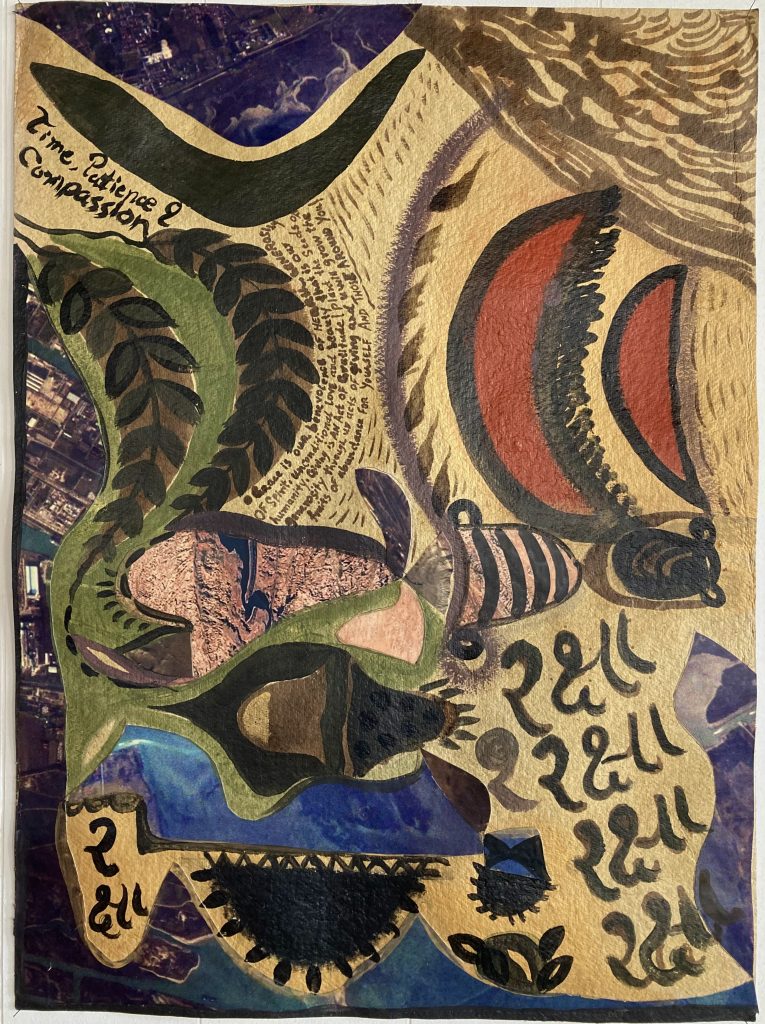
Meher has shown her work at Tate Modern, the National Gallery of Modern Art in India, the Van Gogh Museum, the MAXXI museum in Rome, the Sinop Biennale Turkey, DaDao Beijing, the Venice Experimental Cinema and Performance Art Festival and the Arezzo Biennale, where she won the Golden Chimera Award for innovation and originality. In the Netherlands, her work is included in the collections of the Centraal Museum and the AkzoNobel Art Foundation, among others.
During Art Rotterdam, Monali Meher will present her work in the booth of Lumen Travo Gallery in the main section.
Written by Flor Linckens
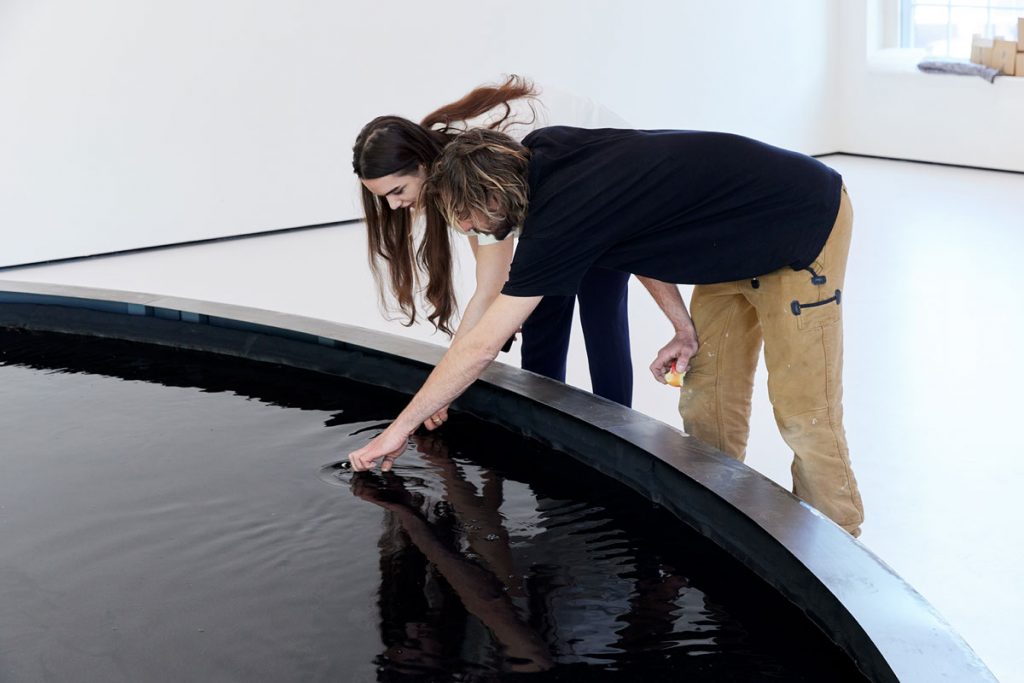
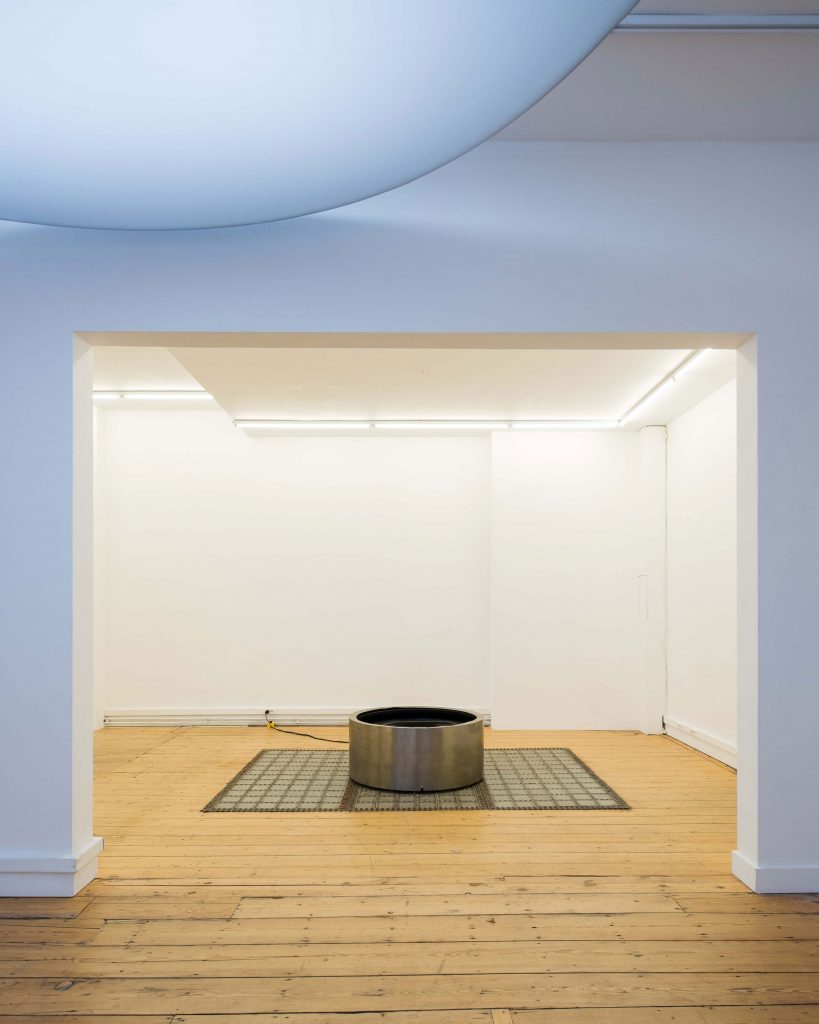
Zoro Feigl (NL 1983) has his office in Amsterdam, but works in the Belgian Kempen region where he has a large outdoor studio. Space is essential for Feigl, as his installations are usually large and noisy. Feigl has always had a fascination for ‘how things are put together’. Only later did he realize that this had to do with art. Initially, he studied design in Utrecht, and enjoyed himself there, but got stuck because he didn’t stick to the instructions of his teachers. He ended up at the Rietveld Academy, where he graduated in 2007. In 2011, he followed a further education at the HISK in Ghent. His work has already been shown at Art Rotterdam, where he won the prize for the best presentation at Intersections in 2015.
On Saturday 14 May, Feigl’s solo exhibition Zonvonkengesproei will open in the Stedelijk Museum Schiedam, a stone’s throw from the Van Nelle Factory. The museum opens its doors after a thorough renovation that lasted two years. Ellis Kat is involved in Zonvonkengesproei as a curator and talks about the effect the newly renovated museum had on Feigl’s work, his method and the ideas behind his work.
You have built up the exhibition over the past few days. Is that different with Zoro’s machines than with an exhibition with two-dimensional works?
Past days?! Past weeks, you mean. Due to the size and complexity of the installations, a large team spent weeks building it up. In fact, work on this exhibition started about three years ago. Initially, Zoro’s solo exhibition was planned just before the renovation. He was given a license to use the spaces as he wished, as the museum would be renovated afterwards anyway. Everything was cut and dried, the works were ready for transport and then the lockdown followed. It was decided to renovate first and postpone the exhibition.
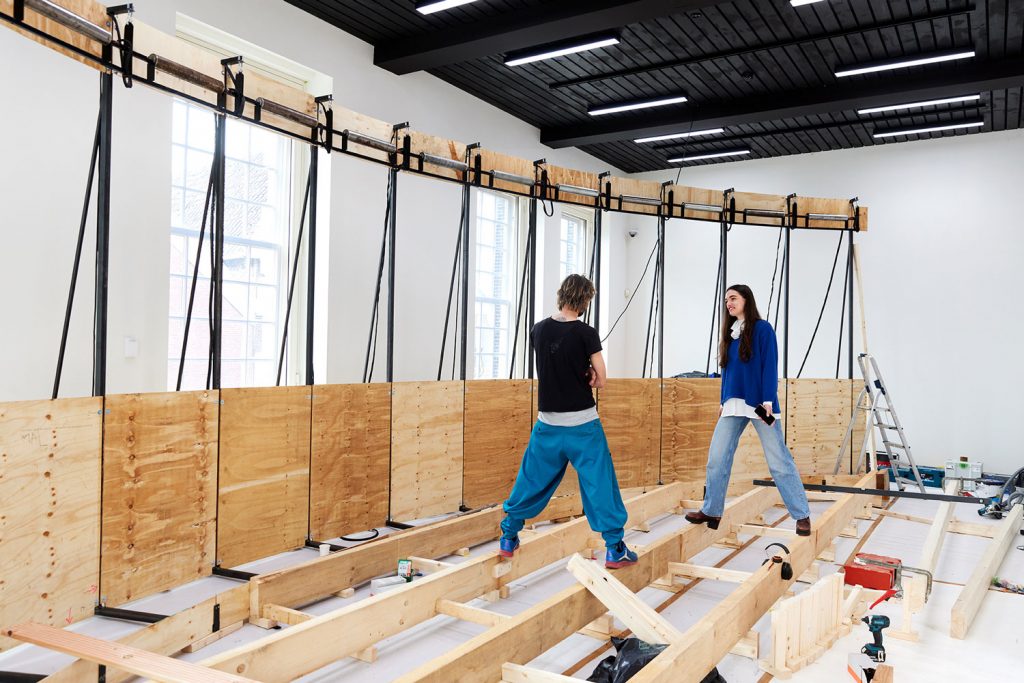
A big difference in curating this exhibition compared to an exhibition with two-dimensional works is that paintings are usually completed in the studio, transported to the museum where they are unpacked and hung. Now every installation was actually made in the museum itself. Zoro’s studio in Belgium is large, but an eighteen meter long installation such as Getij cannot be completely built there. So the Stedelijk Museum Schiedam actually functioned as Zoro’s studio for weeks. Only there and then did it become clear how it all came together.
In some cases Zoro made a smaller version of a work in his studio, such as the work Fosfenen, which consists of countless moving mirrors that reflect in space. He first showed me that version in his studio amid the clutter and in the semi-darkness. In the museum it really comes into its own and I saw the magic of the end result.
Is curating an exhibition like this different from a ‘normal’ exhibition?
I’m afraid a normal exhibition doesn’t really exist. Zonvonkengesproei is a special exhibition to curate. More than ever I have learned that the place where an exhibition takes place plays a fundamental role. At first we were in the midst of the renovation, during which he was given carte blanche to demolish the museum. Now, Zoro was obliged to act neatly; he not only ensures that the new building is not damaged, but with his art he knows how to unlock the new elements in the halls for the visitor. It has become a completely different exhibition. Due to these circumstances, Zoro had to work very carefully and he has shaken off the bad boy image. When you think of his installations, you envision robust, twisting, spinning machines. Now I have seen how ingenious, concentrated and skilful Zoro works. In retrospect, the pandemic is a gift to the renovated museum and Zoro’s artistic development: they pull each other up.
The exhibition comprises six rooms. Do those rooms provide a survey of Zoro’s work or are they six recent or new works?
It is almost all new work. Only Zwermen, an installation that the museum acquired in 2020, has been on display before. The works in Zonvonkengesproei mark a new step in Feigl’s oeuvre. He has grown up. It remains kinetic work and it does make noise, but it was made with a lot of attention, so that the visitor also dares to give that attention to the works. He has managed to get to the core of his artistic practice.
The exhibition is called Zonvonkengesproei. What does that mean and why exactly does that term cover the charge?
That is a neologism, a non-existent word that comes from Herman Gorter’s 1889 poem Mei. In the poem the girl Mei meets the love of her life, Balder. She is in ecstasy and directly projects her feelings onto the young god. It’s such an overwhelming feeling that she can’t quite put it into words and that’s why she uses this word. Zoro’s work evokes a similar overwhelming feeling. It’s so all-encompassing that it’s hard to describe.
What is the core of Zoro’s artistic practice you were talking about?
In his work Zoro tries to incorporate natural phenomena and everyday things in installations. Think of the behaviour of a flock of starlings, ripples in the sand in the surf or glowworms on your retina, which you see when you close your eyes for a long time. They are things that happen, but which we cannot influence. No human can control the way a flock of starlings moves in the sky, no matter how much we think we have power over nature. Zoro does try to seize these elusive situations and make them accessible in his work. Suddenly he takes control. Just for a moment, because when he turns on his installations, all the balls – the starlings, or the mirrors – the glowworms – all go in a direction that he could never have predicted himself. The work itself has come alive again. If you have seen his installations, hopefully when you exit the exhibition you will notice everyday things that you previously passed by.
How does Zoro work? Does he start from an idea, a vision, or rather from material that he finds interesting?
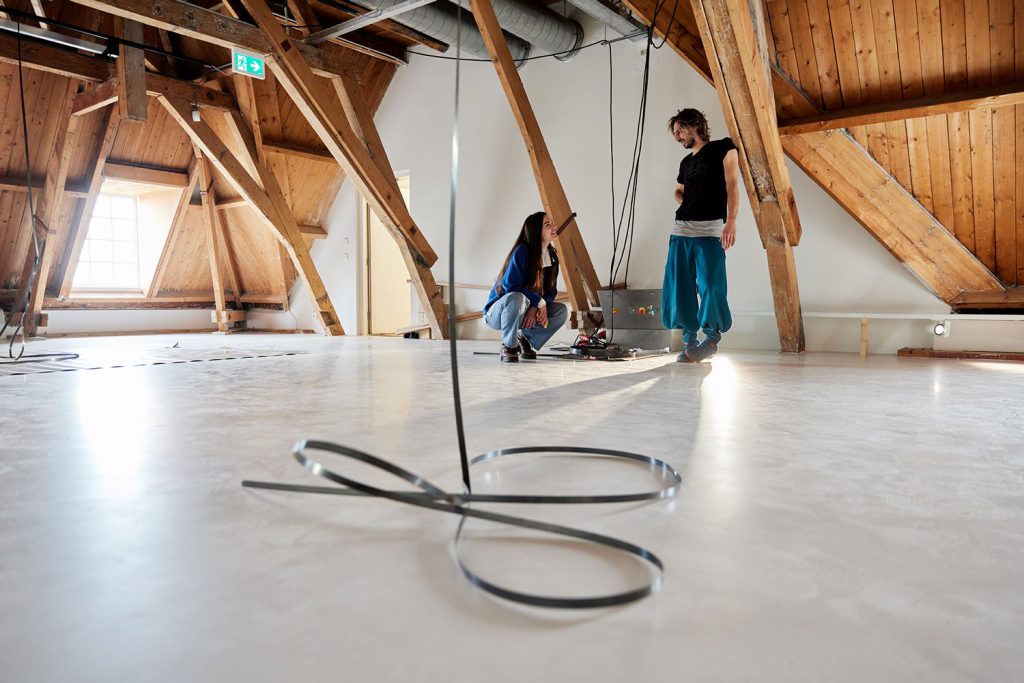
Zoro has no set method. Some works, such as Floating Floor, are created by association. One evening, Zoro took the bag from a 5-litre carton of Aldi wine, squeezed it and watched the wine flow to other parts of the bag. A kind of waterbed effect. What if we have floors like this, he wondered. In Schiedam you can now walk on a parquet floor that is constantly sagging. Another example is the installation Lianen, which is displayed in the attic of the museum. This installation consists of four metal ribbons that are driven by motors and that wind continuously. Together they form a choreography. Like many of his installations, this one takes on a more human character the longer you look at it. The idea for Lianen was a package that was closed with tie-wraps, they flew away when he cut them open. This uncontrollable effect intrigued him and he tries to capture it in a work. However, the reason for a work can also be much more pragmatic. It also happens that a material has been wandering around in his studio for a long time, he keeps tripping over it and decides to use the material, so that it is finally cleaned up. Not having a set method ensures that Zoro is always open to play and accidental discoveries.
Zoro often uses classical mechanics in his work. Motorcycles in all shapes and sizes. Why does he use this rather dated technology?
Why does a painter use paint? I disagree that he uses outdated technology. Now that I had a look behind the scenes, I see how much modern technology is involved. An installation such as Getij consists of PCs at the back that control programmed choreographies of the bands. It is a combination of raw materials and modern techniques. The assumption that he only gets things from scrap to use in his work is patently incorrect. At times he spends weeks looking for a specific part of his installation to finish it exactly the way he envisioned. He received this time from the Stedelijk Museum Schiedam, so that he has transcended his bad boy image.
In articles about Zoro’s work you often read something like: if you have ever seen a work by Zoro, you will not soon forget it. Can you explain why his works leave such a strong impression?
That’s Zonvonkengesproei; you can’t quite put it into words. Let me not say too much about it: just come to the exhibition, then you can experience it for yourself.
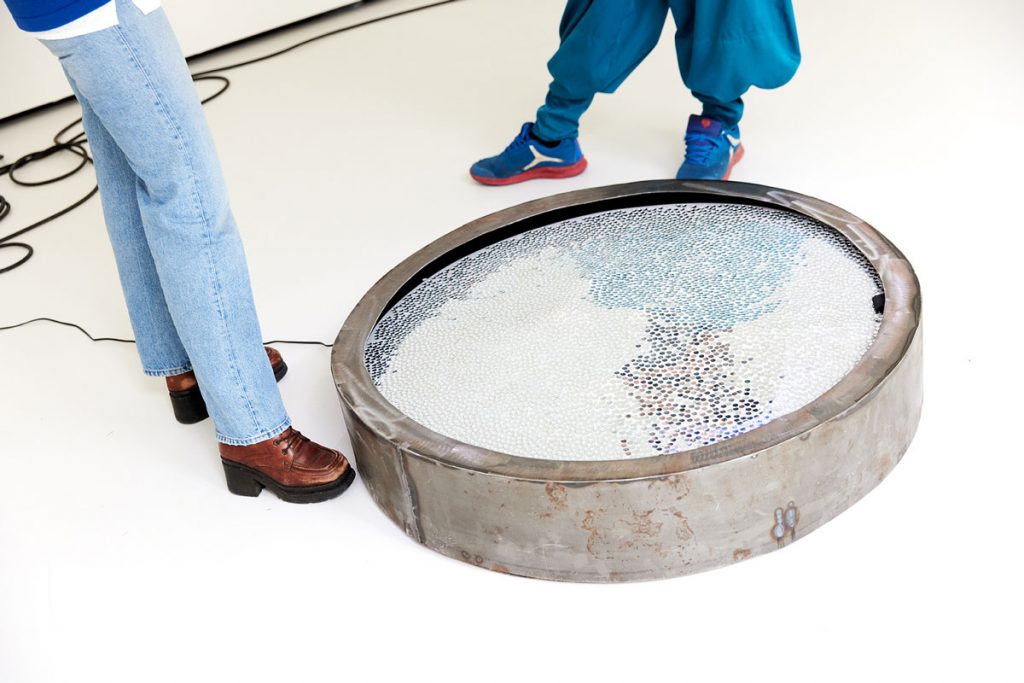
Abysses by Zoro Feigl can be seen at Art Rotterdam in the booth of Gallery Fred&Ferry.
The exhibition Zonvonkengesproei by Zoro Feigl can be seen from 14 May through 11 September in Stedelijk Museum Schiedam.
During Art Rotterdam, you will see the work of hundreds of artists from all over the world. In this series, we highlight a number of artists who will show remarkable work during the fair.
In her practice, the British-Japanese artist Lilah Fowler investigates the effects and consequences of technology on our contemporary landscape. She analyses the extent to which these are natural and man-made technologies. These human technologies consist of both analogous variants (such as Roman pottery or Navajo weaving techniques) as well as digital forms (such as large data centers). How do these change our contemporary landscape? And what role does (a common) language play in the ways in which we interpret our direct environment? In her work, Fowler delves deeper into the geopolitical layers of our globalised virtual and analog landscapes — and the ways in which these parallel worlds occasionally overlap.
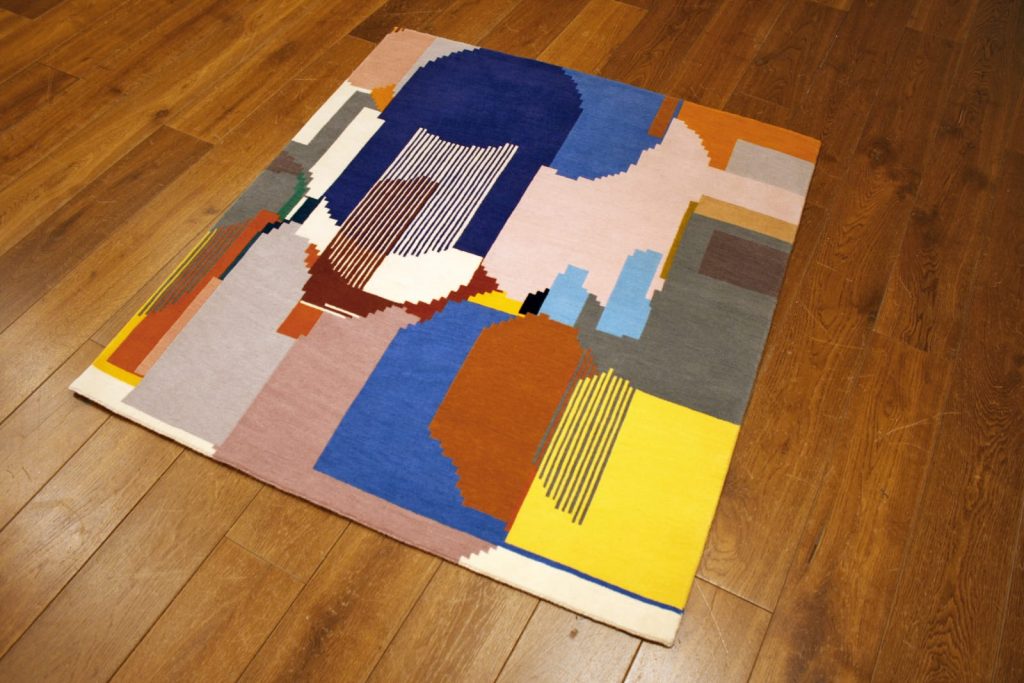
Fowler’s complex and layered installations include sound installations, woven works, photography, sculpture and video art. For her projects, the artist regularly collaborates with experts from other fields, including biochemists, quantum physicists, computer programmers, mathematicians and weavers. For an exhibition on behalf of the Colchester and Ipswich Museums, she combined her own installations with works from the museum collection. For example, she made large-scale textile works whose patterns derived from a tailor-made algorithm.
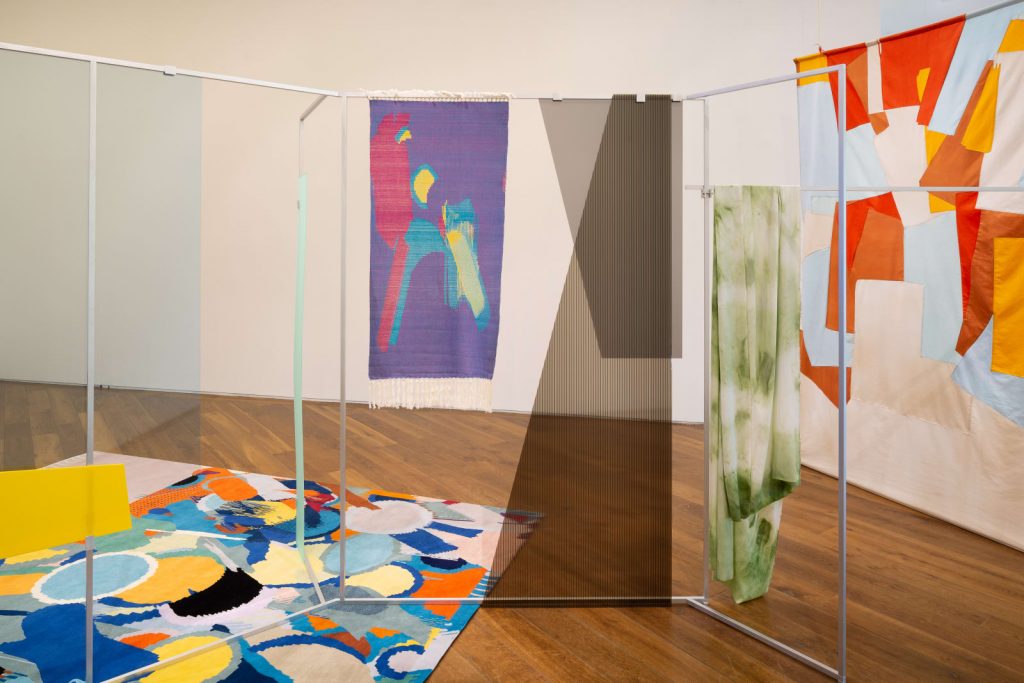
Fowler studied at the Edinburgh College of Art and obtained a master’s degree in Sculpture at the Royal College of Art in London. She has completed several residencies — including a residency at Whipps Cross Hospital — as well as research projects in places including Nevada, California, Hong Kong and the United Kingdom. She created several site-specific outdoor works and exhibited her work at the Bonner Kunstverein, Kunsthal KaDe and Museum Vasarely in Budapest, among others. Her work is currently also on display at the Whitechapel Gallery as part of the interactive side programming of the exhibition ‘A Century of the Artist’s Studio: 1920-2020’.
During Art Rotterdam, the work of Lilah Fowler will be on show in the New Art Section, presented by UN-SPACED Gallery.
During Art Rotterdam, you will see the work of hundreds of artists from all over the world. In this series, we highlight a number of artists who will show remarkable work during the fair.
The practice of Thibault Brunet explores the vague boundaries between reality and virtuality in the digital age. On a technical level, Brunet questions the functioning of photography: he seeks insight into the relationship between virtual images and reality and our own relationship with virtuality, in a society that is slowly becoming more and more digitized. In his work, he searches for new ways to capture reality and make it virtual, making use of surprising areas of research and experiments. For instance, he makes frequent use of existing virtual worlds for his photographic research.

In the spring of 2018, Brunet completed an Etant donnés residency in New York, which was made possible in part by the Aperture Foundation. In an interview about this with the French embassy in the United States, he explains more about his thinking. Brunet: “Today’s world is extremely documented. Everything is photographed, any gas station, any path; recreational drones, dashcams of cars and Gopros on the helmets of cyclists record everything. If I know how to recover and use all of this data, I can recreate the recorded world, add more in volume, make topographical interpretations. Because all of these recorded instances one after another mobilize a new world, a world numerical and immaterial, it is not a perfect replica of reality, but a misrepresented and sick replica, with holes.”
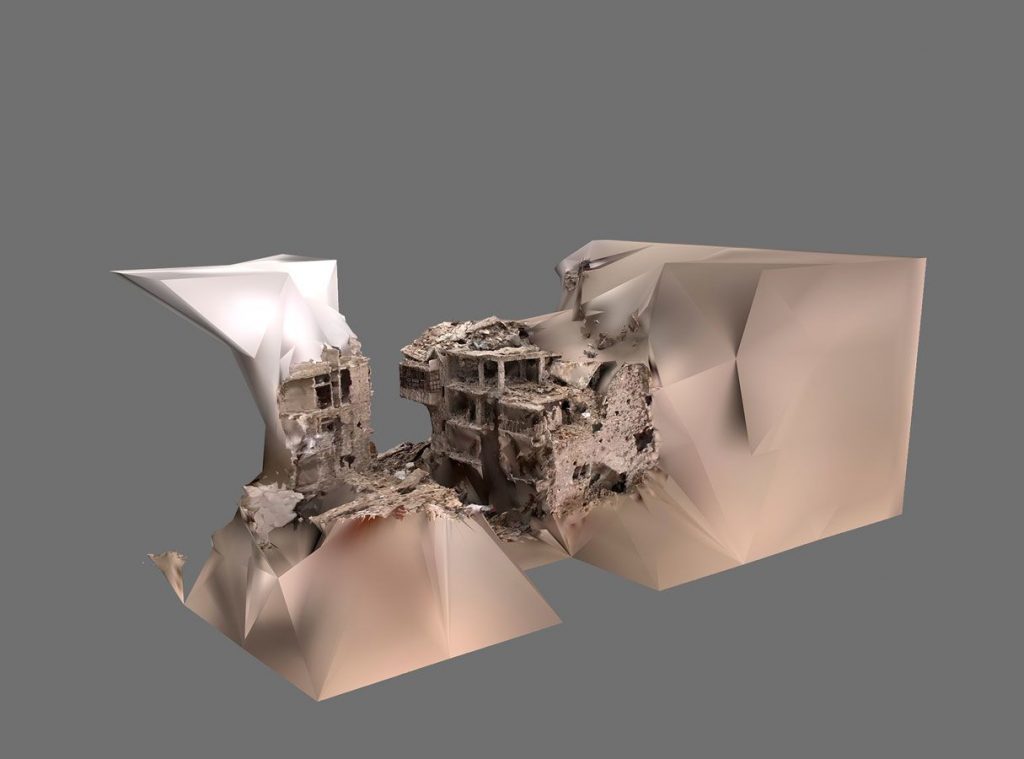
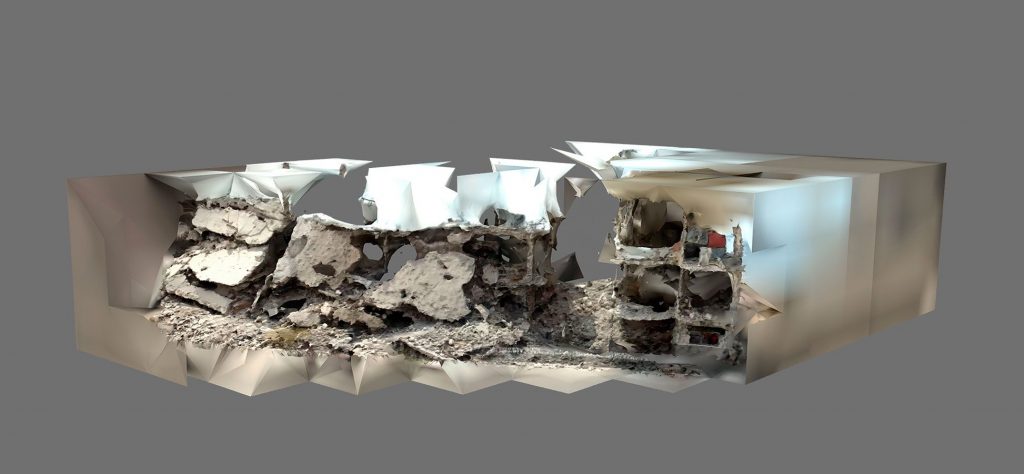
For his first series, Brunet did virtual landscape studies in video games like Grand Theft Auto and Call of Duty, and in his most recent work he delved into the popular game Minecraft. For his series “Boîte noire” (‘Black box’) he traveled in a virtual sense to war zones in Syria. He used images from Google Street View and drone images to compose 3D models. This creates a model, a simplified and incomplete representation of reality that resembles a video game. For other projects — including “Soleil noir”, which will be on display in the booth of Galerie Binome during Art Rotterdam — the artist experimented with a LIDAR (Laser Imaging Detection And Ranging) 3D scanner, which allows him to add more perspectives than you can perceive with the naked eye. As a result, he effectively changes our relationship with those same spaces.
Brunet studied at the Ecole Supérieure des Beaux-Arts in Nîmes. His work has been shown at the Lyon Biennale in 2015 and at the Center Pompidou in the exhibition “Imprimer le Monde/Print the World”. The artist was a finalist of the Aperture Foundation Prize 2012 in New York, won the Photo London John Kobal Residency Award (2016) and was chosen as one of the FOAM Talents of 2013.
During Art Rotterdam, the work of Thibault Brunet will be on show in the booth of Galerie Binome, as part of Projections.
During Art Rotterdam, you will see the work of hundreds of artists from all over the world. In this series, we highlight a number of artists who will show remarkable work during the fair.
Tarona’s video artwork “Pivot” opens with a powerful English quote in purple against a black background: “When Black bodies are on the stage, Black perspectives must be reflected. This is not simply a matter of ‘artistic interpretation’; race and sex play a pivotal role in determining who holds the power to shape representation.”
This quote was uttered by the award-winning American actress Tonya Pinkins, who previously received a prestigious Tony Award. She noted that her perspective as a Black woman was structurally ignored throughout her career, in favour of a different kind of portrayal of the Black woman: viewed through a filter of the white gaze.
The academic concept of ‘the gaze’ analyses a certain power relationship when one person is captured by another. The recorder determines how the portrayed person will be immortalised — and will be viewed by others in the future. This inequality is exacerbated when there is also another level of power inequality between these two people. In 1975, the British feminist film theorist Laura Mulvey first spoke about the ‘male gaze’, the way in which women are captured and viewed by men: often as a decorative (sex) object. Three years later, the term took on additional depth when literature professor Edward Said, founder of the field of Postcolonial Studies, published the book ‘Orientalism’. Terms such as the “oriental gaze” or the “western gaze” are useful when referring to the ways in which people from non-Western countries were (and are) represented by the West; in many cases by their (former) colonial oppressors. These people were regularly portrayed and diminished as ‘exotic’ or ‘uncivilized’, to serve as a contrast, as ‘the other’. In line with this, there is also the ‘straight gaze’ and the ‘white gaze’. This terminology is important because it signals that the mere presence of (for example) people of colour does not automatically mean that there is a correct and balanced representation.
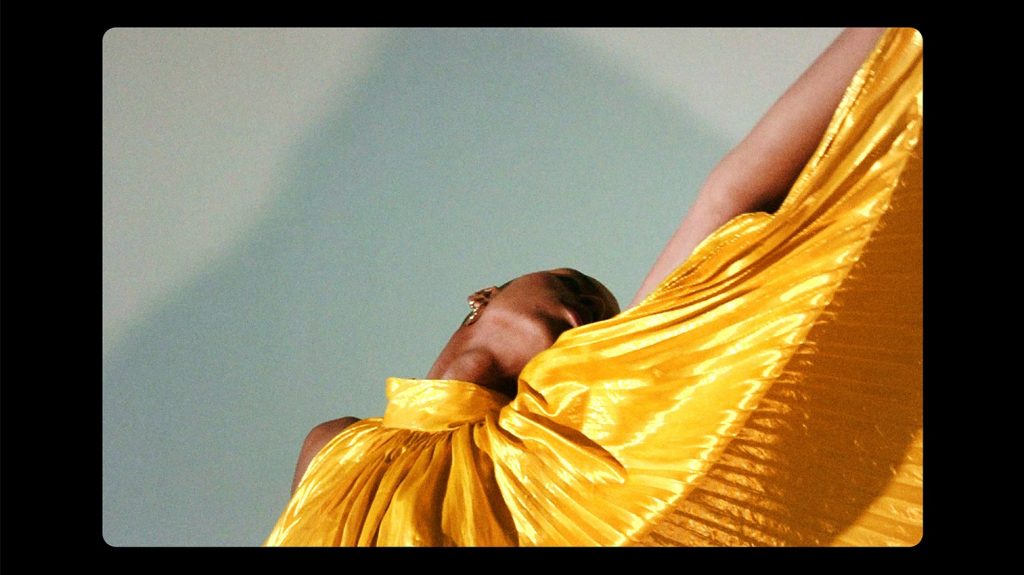
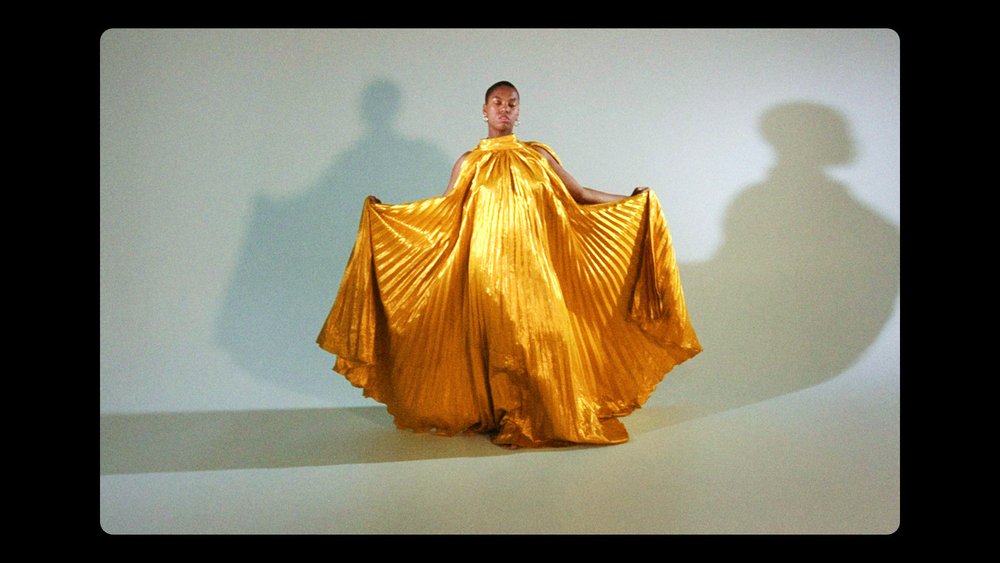
In this work, Tarona takes a closer look at Black performances in white spaces. How are Black people and people from the African diaspora (mis)represented? In the video artwork “Pivot”, we see a Black performer who resists the expectations of a white audience. In eleven minutes we see her dancing expressively in a striking golden dress that almost becomes a character in its own right. It seems like a contemporary interpretation of the famous ‘Serpentine Dance’ (1899) by the Lumière brothers, one of the very first coloured films, that was shot at an accelerated pace. However, the character in “Pivot” dances in slow motion. Tarona: “She occupies time and space, on her own terms. Since video is a time-bound medium, I chose to make this idea tangible by slowing down the visuals.”
Tarona was born in Curaçao and also uses her work as a way to explore her own identity. In her practice, the artist is inspired by the work of Johny Pitts, whose book ‘Afropean’ examines how Black and African diaspora identities are shaped in a European landscape. In her own research, Tarona often focuses specifically on Black Caribbean and South American identities in Europe, in all their versatility and complexity. In doing so, she searches for forms of representation and communality, in a landscape in which these identities are often invisible or erased.
You can view the video “Pivot” during Art Rotterdam in the Prospects exhibition of the Mondriaan Fund. For the 10th consecutive time, the Mondriaan Fund presents the work of 88 starting artists who received a financial contribution to start their career. Tarona studied at the School Of Visual Arts in New York and the Willem de Kooning Academy and her work has previously been shown in the ‘Caribbean Ties’ exhibition at the Museon in The Hague.
The video “Pivot” was made in collaboration with Chanel Vyent, Qianwei Tong, Sam van Eenbergen, Ivan Hidayat, Imane Saksou, Gaea Studio, de Makeover Factory en Captcha!.
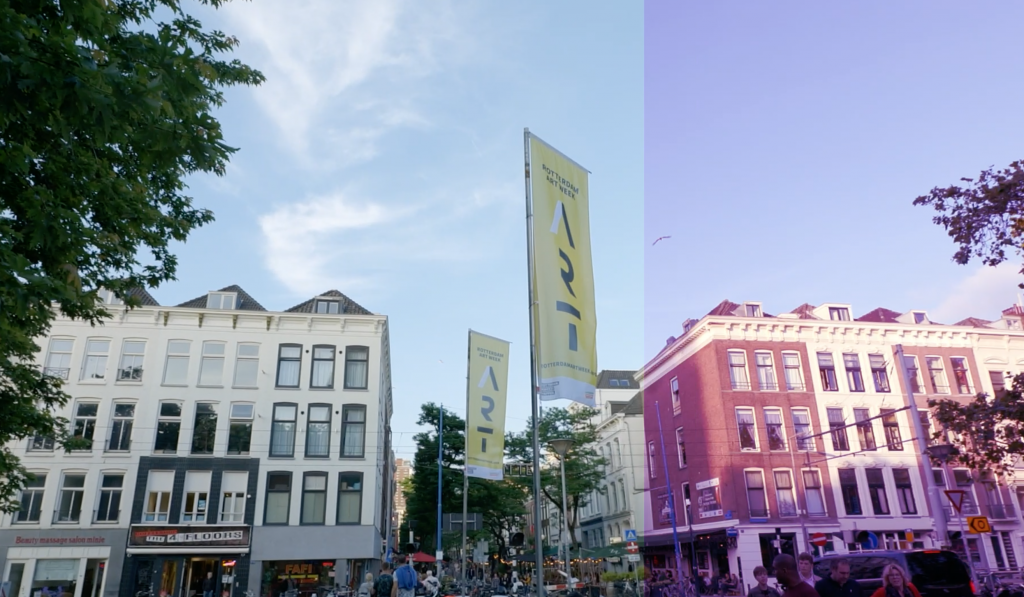
During Rotterdam Art Week (18 to 22 May), art, design and architecture are placed on a pedestal. With about 70 events at 50 locations, you get a chance to rediscover what makes Rotterdam so unique. Like every year, the pivotal event of Rotterdam Art Week is the international art fair Art Rotterdam, supplemented by the leading design fair Object Rotterdam, young talent at The New Current, the Kunstavond XL in the Witte de Withstraat and the TEC ART festival; at the exciting event at the intersection of art, creative technology and science. In addition, there is a lot to see in the galleries, open studios and unique creative breeding grounds such as STEUR, which are only open to the public once a year. In addition to these must-sees, we highlight a few more tips below.
Charlotte Nijsten, coordinator of Rotterdam Art Week: “The best aspect of Rotterdam Art Week? The whole city is buzzing! That is the result of approximately 70 events at 50 locations, including various fairs like contemporary art fair Art Rotterdam and design fair Object Rotterdam, as well as special openings and exhibitions in museums and art institutions, pop-up exhibitions and open studios that actively enhance and enliven the art climate in the city.”
Tip: did you know that during Rotterdam Art Week, you can borrow a VanMoof e-bike (for free) between 11 am and 5 pm? Please note: It is necessary to make a reservation in advance. In addition, there is a free MINI shuttle service between the Van Nelle factory and the Merwe-Vierhaven area.
Do It Yourself Routes
Do you prefer to go out on your own but don’t know where to start? Then make use of the handy Do It Yourself Routes, which were created in collaboration with Art Index Rotterdam and her tour partner. The walking routes cover the five focus areas: the Merwe-Vierhaven area (M4H), the Van Nelle Factory area, the Kop Van Zuid, the Museum Park and the vicinity of the Central Station. View all walking routes here. Tip: click on the Google Maps button on the website to open the route (including all locations in Google Maps) on your phone. That way you can effortlessly navigate through the city.


