Coming soon
Coming soon
Select type
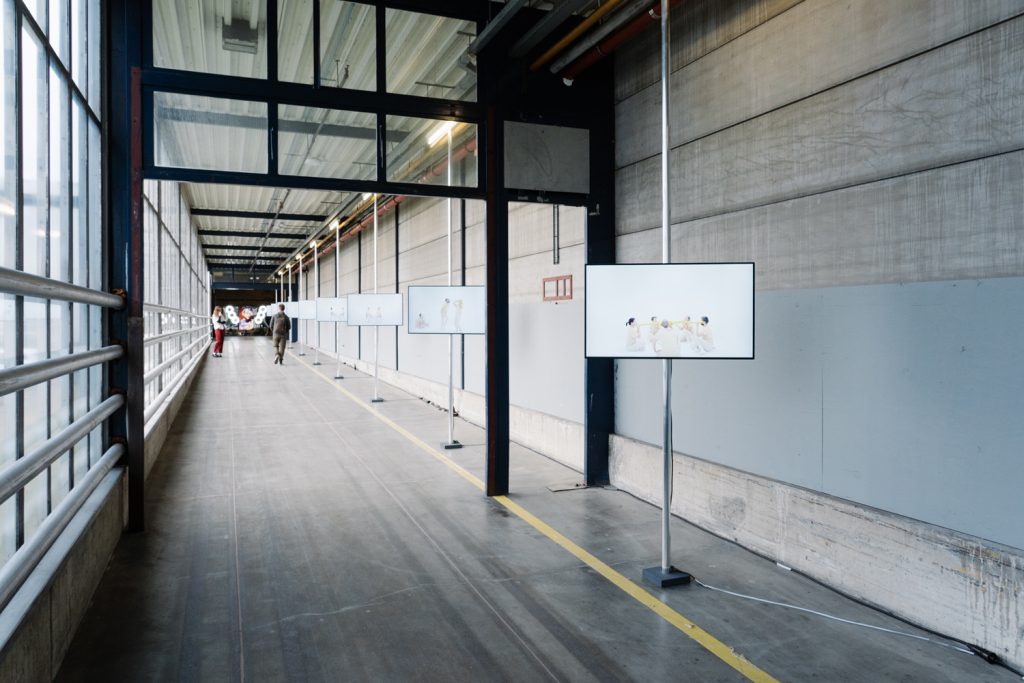
The tenth edition of Prospects, the exhibition of the Mondriaan Fund, shows work by all artists who recently received a contribution towards the start of their professional practice. New this year is the extension of Prospects to the Expedition Building, which is located directly opposite the entrance to Art Rotterdam. 88 visual artists will take part in Prospects. The exhibition is curated for the third time by experienced guest curator Johan Gustavsson, in collaboration with Gabija Seiliute.
Waèl el Allouche, Cindy Bakker, Cedric ter Bals, Marwan Bassiouni, Sophie Bates, Simon Becks, Sjef van Beers, Asgerdur Birna Bjornsdottir, Irene de Boer, Wiosna van Bon, Suzette Bousema, Wiebe Bouwsema, Anna Bravo Pérez, Leon de Bruijne, Ryan Cherewaty, Robin Alysha Clemens, Angelo Custodio, Anders Dickson, Daniel Dmyszewicz, Jurjen Galema, Andrés García Vidal, Elena Giolo, Esmay Groot Koerkamp, Sarah Rose Guitian Nederlof, Gijsje Heemskerk, Laurence Henriquez, Marta Hryniuk, Rosalynn van Hummel, Danae Io, Karlijn Janssen, Honey Jones-Hughes, Lotte Louise de Jong, Maureen Jonker, Sonia Kazovsky, Minne Kersten, Susanne Khalil Yusef, Julia Kiryanova, Bin Koh, Anne Kranenborg, Sarah Ksieska, Tarona Leonora, Nazif Lopulissa (Nasbami), Florence Marceau-Lafleur, Sjoerd Martens, Donglai Meng, Salvador Miranda, Ruben Mols, Rossella Nisio, David Noro, Evi Olde Rikkert, Tjitske Oosterholt, Ana Oosting, Anastasija Pandilovska, Natalia Papaeva, Alice Reis, Flora Reznik, Thom van Rijckevorsel, Duncan Robertson, Victor Santamarina, Joana Schneider, Simone Schuffelen, Hans Schuttenbeld, Miriam Sentler, Mirre Yayla Séur, Katerina Sidorova, Ghita Skali, Kateryna Snizhko, Machiel van Stokkum, Jonathan Straatman, Cécile Tafanelli, Michiel Ubels, Piotr Urbaniec, RJM (Robin) van der Heijden, Luciënne Venner, Lara Verheijden, Jeanine Verloop, Philip Vermeulen, Raquel Vermunt, Wessel Verrijt, Roosje Verschoor, Arian Vette, Majda Vidakovic, Marit Westerhuis, Bente Wilms, Joeri Woudstra, Iris Woutera de Jong, Bernardo Zanotta, Valerie van Zuijlen, Zindzi Zwietering.
During Art Rotterdam, you will spot the work of hundreds of artists from all over the world. In this series, we highlight a number of artists who will show remarkable work during the fair.
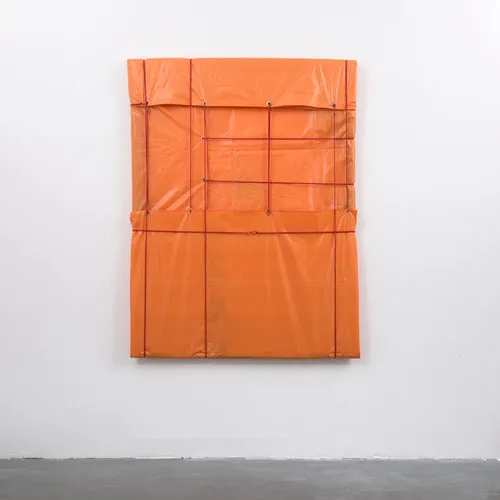
Brazilian artist Mano Penalva studied social communication and social sciences in Rio de Janeiro, with a specialisation in anthropology. In addition, he followed seven years worth of art courses at the Escola de Artes Visuais. Above all, he is fascinated by material culture: an umbrella term that is used in various fields, including anthropology, to refer to the total of tangible objects from contemporary cultures and cultures from the past. How are these products made, distributed and used?
The artist investigates this material culture in relation to behavioural changes and globalisation. He particularly prefers everyday objects that have been converted into commodities and are both local and global in character — as a result of an increasingly intensified, industrialised and internationalised production process. Penalva is interested in the ways in which objects and images are distributed around the world in an exponential fashion. This exchange can also reveal something about the socio-economic and cultural reality of a particular people or an underlying colonial history.
Penalva collects everyday objects that he finds on the street or during his many trips to major world cities, especially at popular street markets. For earlier works, the artist has used the tarpaulin that is used in these stalls. He collects and buys materials such as embroidery, appliqué patches, nets, jute bags, nylon strips, hooks, brushes and seat belts. For a recent series from 2021, Penalva used raffia packaging bags that are used for things like flour, fertilizer, mail and brown sugar.
The artist then appropriates these examples of material culture, after which he removes them from their original context in order to arrive at new, poetic meanings. Sales strategies also play a role in this. For example, for the work “Maiz”, Penalva made a corn cob out of Cheetos (chips), the size of a popular type of corn that is sold in Mexico, but is imported from the United States. He photographed that object and then printed 3,000 postcards of it, which he distributed to local souvenir sellers in Mexico City. They were allowed to keep the proceeds of the sale. The artist wants to say something about material culture, but also about the effects of globalisation.
For his practice, Penalva works in a variety of media, including painting, photography, video, sculpture and installation. His work is sometimes identified with Brazilian culture because he makes extensive use of characteristic local items, but by offering new applications, he removes the boundaries of the material. The artist is also intrigued by the idea that an object or word can have different meanings in different cultures. He searches for objects that transcend these boundaries and thus become a symbol for globalisation, after which he places them in a new context. A recurring theme is the contrast between (private) domestic life and the more ephemeral (public) life on the street, and the ways in which these influence our values and habits.
In recent years, Penalva has completed residencies in Mexico, Miami, Brussels, New York and Brazil. His work has been exhibited worldwide, including in Brussels, Mexico, Barcelona, Venice, Paris and New York. During Art Rotterdam, the work of Mano Penalva will be on show in the booth of Galerie Felix Frachon.
Vriend van Bavink | Teun Castelein
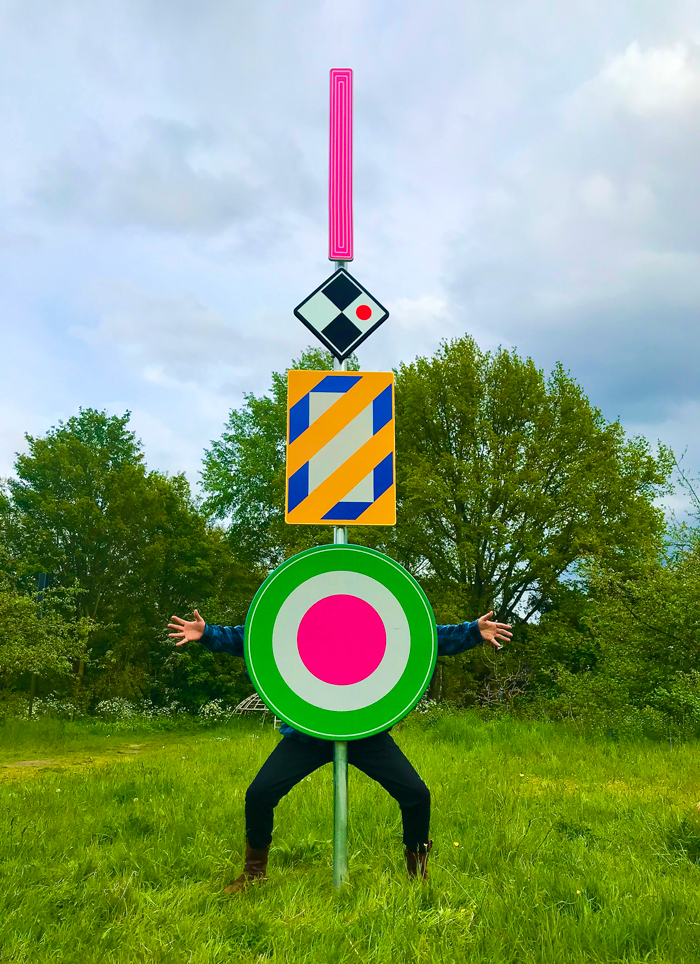
The Totem project by artist Teun Castelein is a response to the far-reaching regulation of our public domain with a multitude of rules and instructions. The project is an experimental research to find some space for the artistic within our controlled environment, for some free jazz on the beaten track.
The series of traffic signs will be placed in your street after purchase. Plates can also be ordered separately.
Martin van Zomeren | Paul Geelen
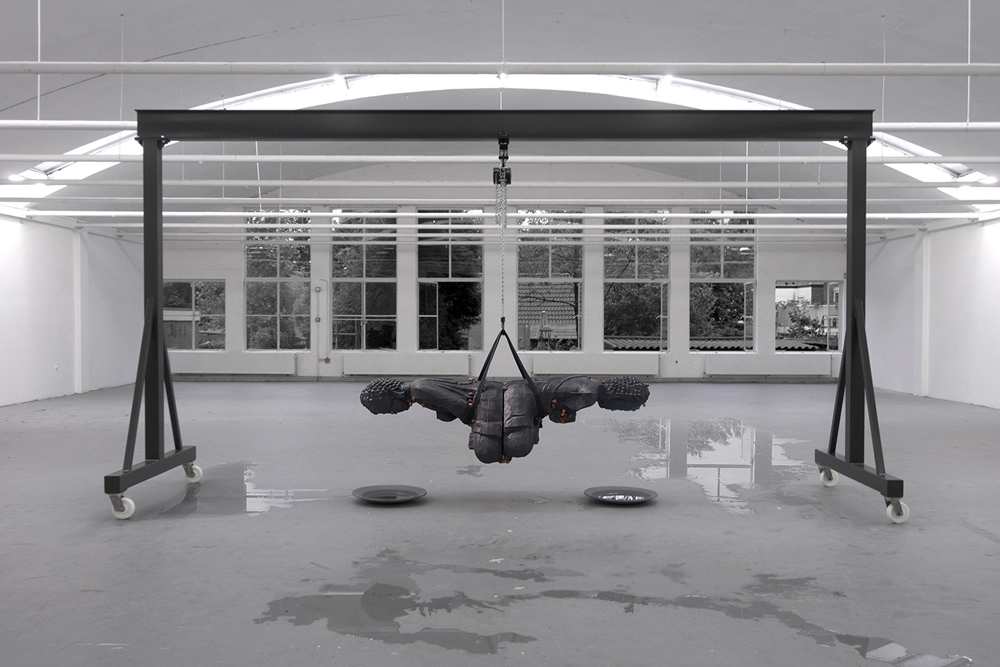
Mothership (…) is a large suspended ceramic sculpture that accumulates over a stretched period of time and descends from an immediate fusion between a series of contradictions and imbalances; an anecdote and the visual associations between a Snail Shell and the mutations of the hair on the Buddha’s Head and Uṣṇīṣa.
In addition to the direct impact – or by rapprochement, some closer tensions between formal, abstract and semantic associations – the ‘performative’ presence of living snails on the two bodies is characterized by a chemical reaction between the bronze glaze and the soft body of the snail.
These traces – leaving an iridescent etching effect and a permanent mark – reveal a colourful potential and transform the snail from a temporary bit player into a humble protagonist, protector and martyr at the same time.
Note: A snail is able to naturally adapt and protect itself against more severe conditions.
Mondriaan Fonds| Wiebe Bouwsema
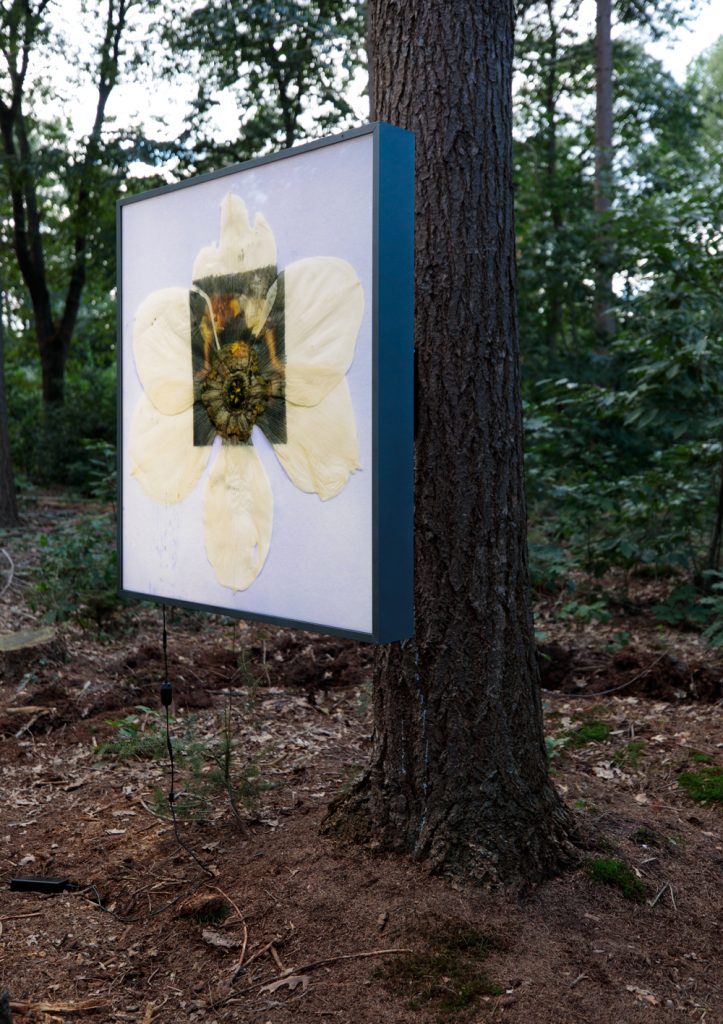
For Wiebe Bouwsema, boundaries or limitations are a recurring theme: between the material and the immaterial, between interior and exterior spaces, between the actual and the virtual worlds and between man and nature. He brings these contradictions together in his work, allowing them to flow into one another, cancelling them out as well as emphasizing them. You can see it as oppressive, as dark, but also as quiet and poetic, as figures who – like Michelangelo’s Prisoners – still have to free themselves from their material.
Opperclaes | Onno Poiesz
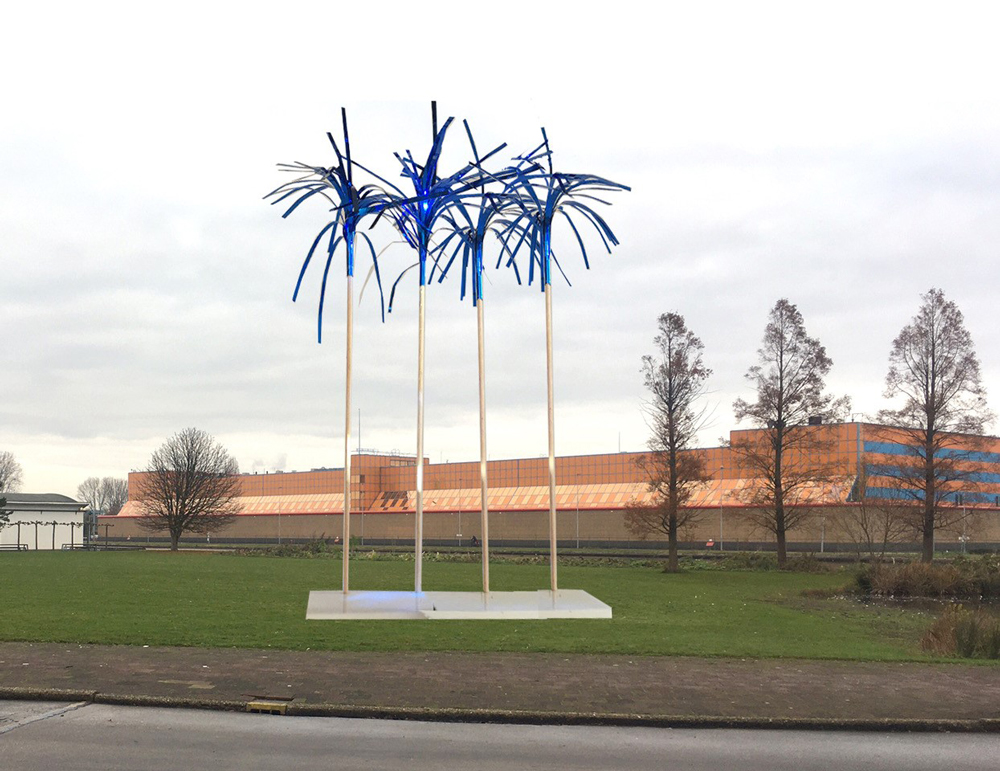
The blues
With the blues, Onno Poiesz welcomes the public. The work is meant to be festive, but is also a reference to war and pandemic, or contemporary “blues” that dominate the beginning of 2022.
NEST | Eugenie Boon
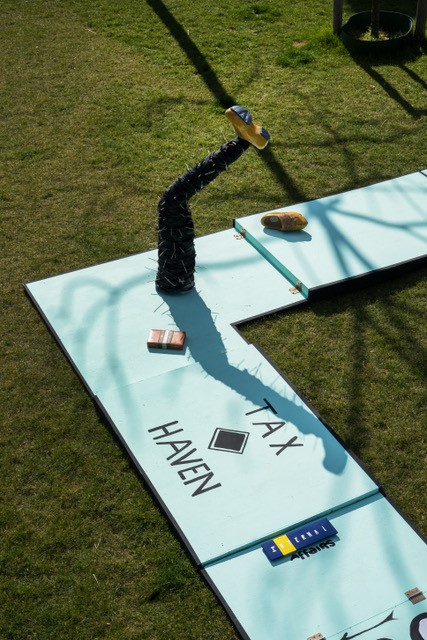
The Pawns that Wandered in Promised Land is an installation which creates an analogy between the physical and the spiritual, fused by references of Hebrew literature, philosophy and boardgames.
“The Promised Land” in Hebrew literature expresses an image of a restored homeland that brings salvation and liberation and is understood as a goal to be reached. With this work Boon suggests that the Promised land is not only a physical place but can be understood as a state of mind- with the brain as the main battlefield, figuratively represented as a board game and the pawns as either reactive or proactive in their approach to this understanding.
With this installation Boon reflects on what can be seen and experienced versus that which cannot be seen yet still experienced. The experience is constant while the components around change through visualization.
Josilda da Conceição | Bernardus Baldus
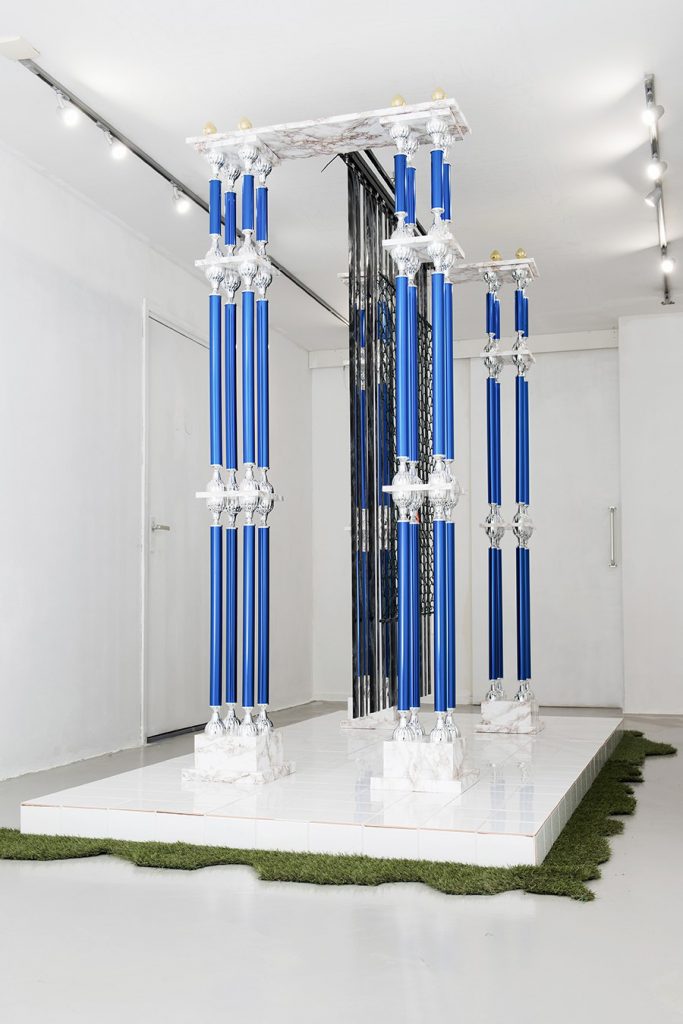
In my work I investigate the power and influence of corporate language and visual culture and its disciplining effect on society. A culture where everything can be made and controlled on the basis of figures and efficiency. I am inspired by things like efficiency, success and manufacturability, entrepreneurship, positivity, transparency, office architecture and office supplies. This leads to business objects (sculptures), performances, drawings or photos that function as illusions (simulacrum or simulation). I find it stimulating that the symbolic value – such as luxury and/or status – is more important than originality and authenticity. As an artist, I myself consider originality to be a meaningless, empty concept. Baudrillard calls this the ‘irony of the object’.
In my work I use irony as an ambiguous game with which I can seduce, surprise or make the viewer doubt. The most exciting thing about irony is that it functions through the unsaid judgment. To understand irony, context and foreknowledge are important to understand that which is not spoken. If, through irony, I ask the viewer to understand that there is a moral judgment in my work, then both the viewer and I must share that judgment in order to understand the unspoken. That does not always work.
With my ironic, critical work I want to stretch the line between what people expect from art and what it is now. The context and/or prior knowledge of the spectator are important aspects here.
Josilda da Conceição | Marjolein Witte
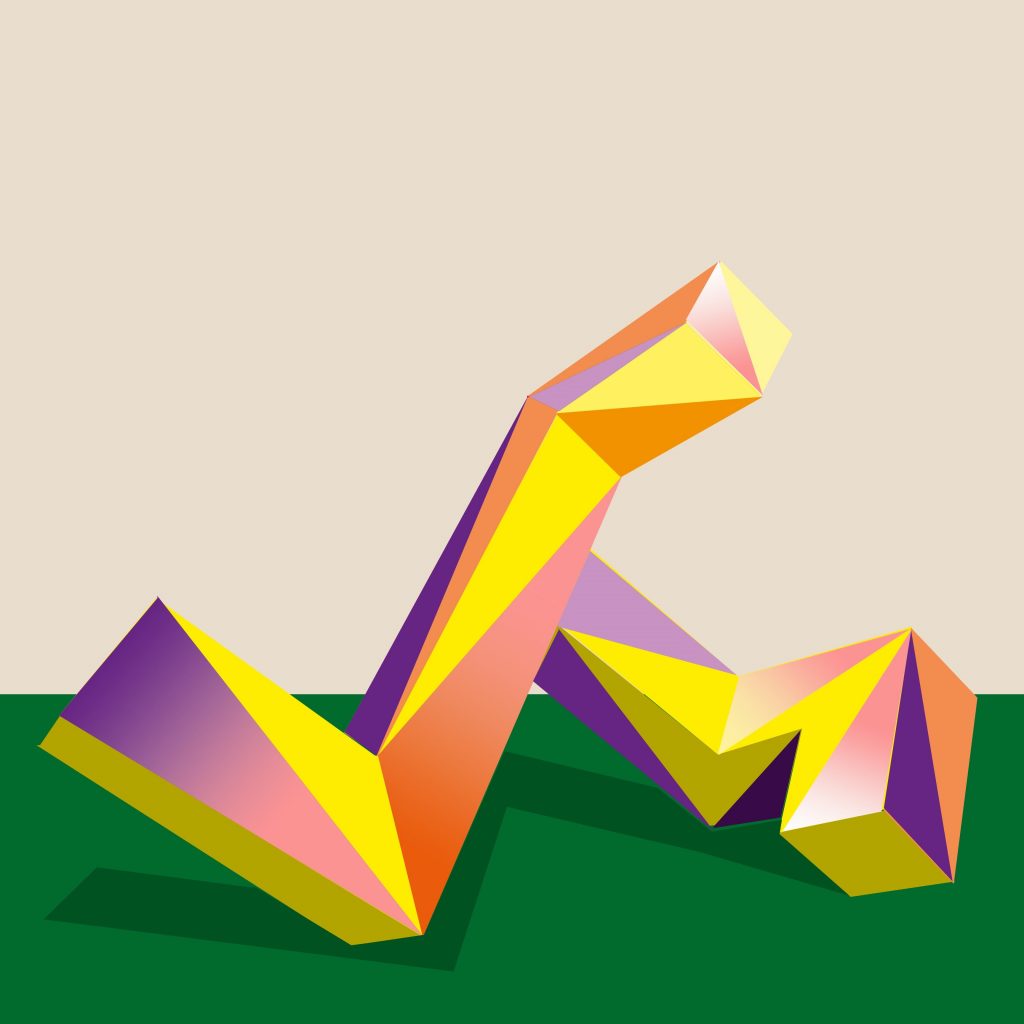
Seduction is a sculpture that is a follow-up to the Evolution sculpture Witte made in 2019 for the exhibition Masterly Women at Stedelijk Museum Schiedam. By making robust, bold and strikingly colored geometric constructions, Witte investigates how we as a group or individual claim space and try to bend the world to our will. The need to be seen is at the core of our existence. We seek confirmation of our identity in family, in relationships, at work, in society and in the world. As happens similar to the animal kingdom, people have come up with all kind of ways to stand out and claim a place with different sensory means. On a micro level, here it is the artist who spreads her feathers like a bird in an attempt to seduce the viewer.
Galerie Nadja Vilenne | Charlotte Lagro
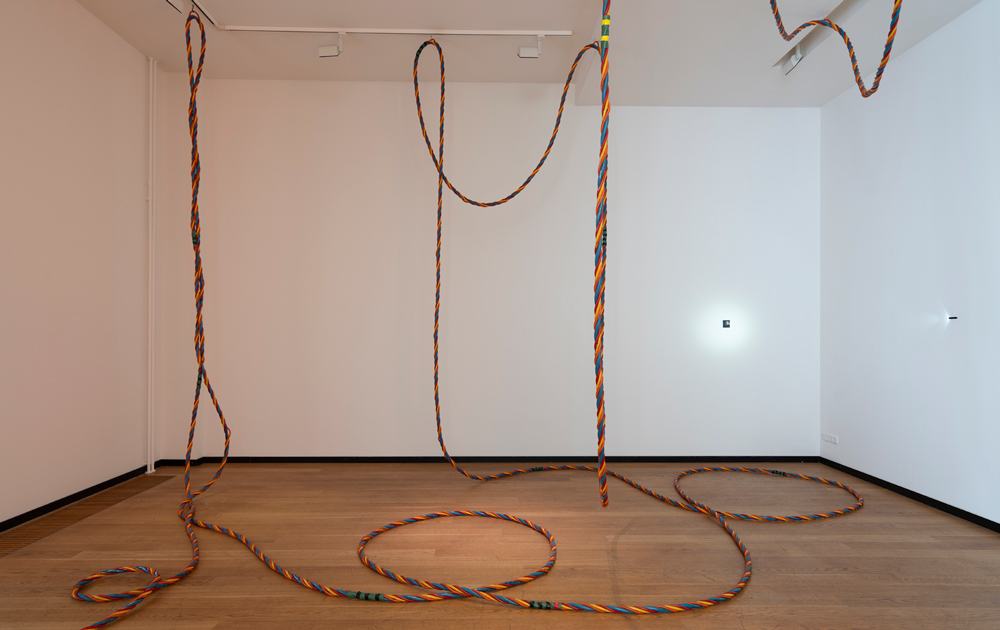
Charlotte Lagro takes found objects and relieves them of their intended purpose and function to accommodate new possibilities for exchange and desire. She strips them bare, plays with them and transforms them, and makes videos about them, often inviting others to join in the process. With sleight of hand, Lagro can make heavy objects appear almost weightless. The work “The Beginning and Ending is Always Ambiguous” centers around an umbilical cable used to supply oxygen, as well as light and communication signals, to deep sea divers. From a hundred meters below, divers climb the umbilical, hand over hand, to make their way back to the surface. In water, its air-filled tubes have just the right amount of added mass to gently sink. This artificial lifeline materializes the vulnerability of human existence. And the search for the familiar in the unfamiliar with handcrafted extensions. An optimistic relic of the human endeavor to the leave the bubble.
PHOEBUS Rotterdam | Esther Bruggink
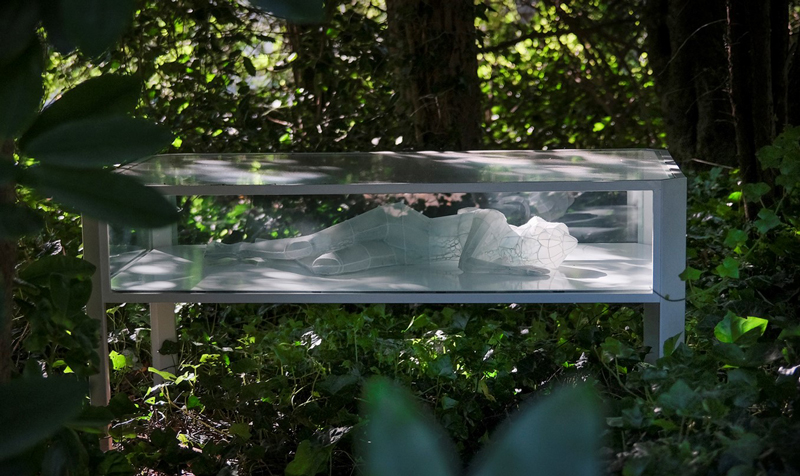
I would like to escape from the watery depths, to become human and live in the golden sunshine! – this is what the little mermaid from Andersen’s fairy tale sings, in Dvorak’s opera “Rusalka”. In her longing for the prince, she sacrifices her voice and with it her ‘uniqueness’. She loses herself in vulnerability and the prince has to let her go… Full of sorrow she dissolves in the foam of the sea. The sculpture shows a structure of veins and scales, while the lungs on Rusalka’s back refer to angel wings…
Winterlicht Schiedam | Leonard Passchier
Alarm!
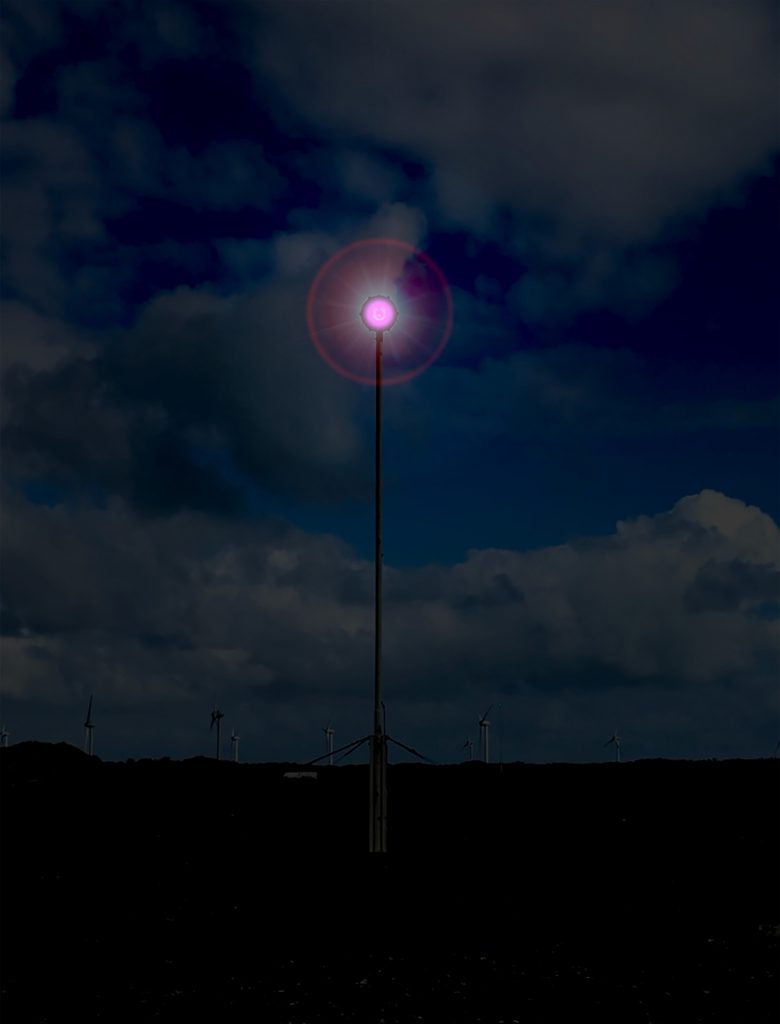
UV light is essential for all living organisms on earth, but it also makes capital grow. In Rotterdam’s backyard, the Westland, you can see the purple-blue LED UV lights lighting up more and more often. Will artificial light be our future? Will we no longer be able to live without it? Will it be our only way of getting the vitamin D we need in a world where artificiality is becoming increasingly important?
Passchier’s beacon screams for attention. It’s five minutes to midnight and our climate is changing rapidly. Is this beacon warning us of rising water? Can we trust this beacon, can we navigate on it? Or will we suffer the fate of flies and mosquitoes that get too close to UV light and burn up?
In December 2022, the beacon will be part of the Winterlicht light art festival in Schiedam, which will take place in the Julianapark.
Jaap Sleper | V&B (Alex Jacobs en Ellemieke Schoenmaker)
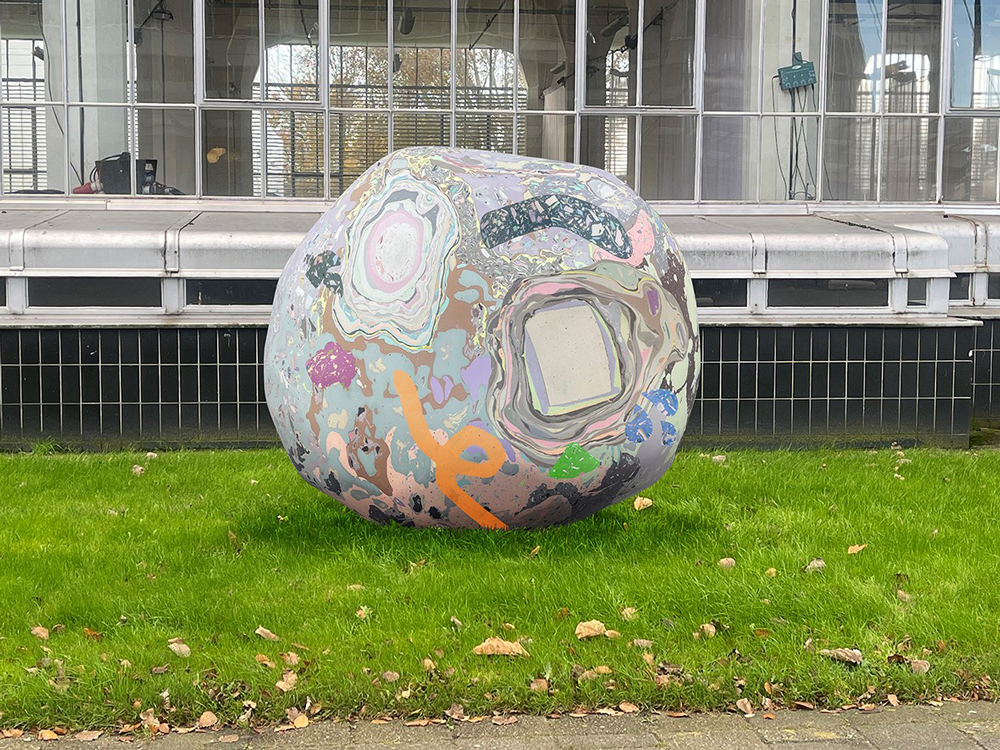
Over millions of years, our world has been shaped by various geological processes. I would like to introduce you to ‘Continental Drifter no.3’, the promoter of this long forgotten history.
Stones are very sensitive to their environment and especially to vibrations. This sensibility has an effect on their surface.
My appearance is cuddly. This is because I consist of many layers of colored plaster that have been sanded until my skin feels polished. Where necessary I have been restored and drawing has been applied to come as close as possible to a feeling:
‘What would it feel like to be a rock; what was it like when dinosaurs walked the earth. Stones may not be able to speak, but they are telling us something and we need to listen. Because, even though we don’t know much about existence beyond humans, we can still try to imagine it….‘
Albada Jelgersma | Jelle Koorevaar
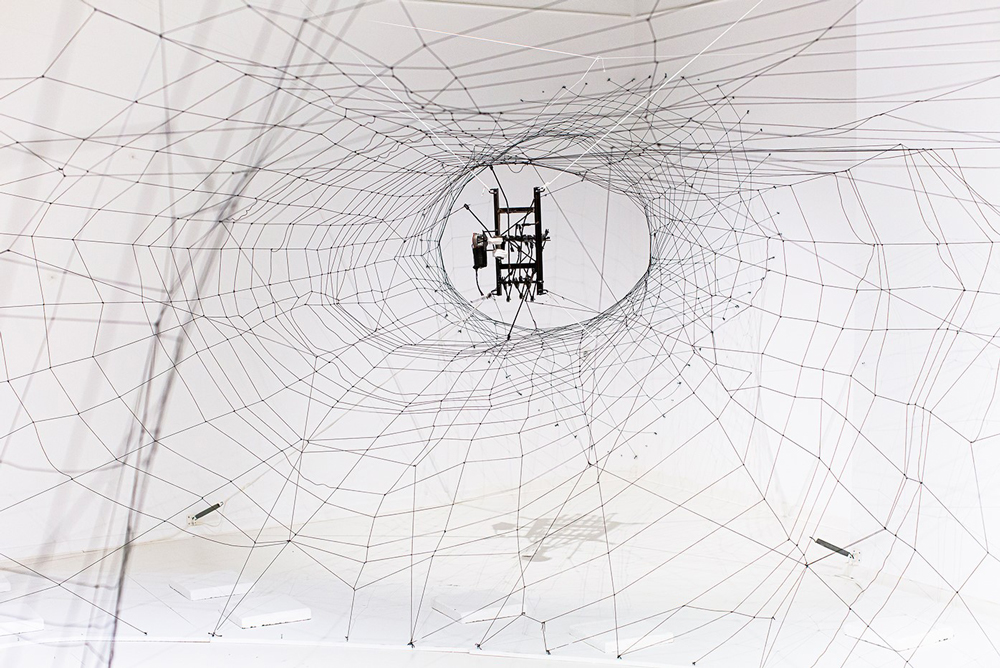
A populist creates his own image of the world, together with his followers. Together they create their own truth within reality. There is an interdependency. Without his followers the populist is nothing. But being part of this worldview is what gives followers a sense of belonging. Populism shows this interaction between a central figure and his followers. In a very large spiderlike web a machine is hung. From a central point, the machine and the web together create a movement that spreads out. Both are dependent on each other. Without the machine the web hangs still. Without the web, the movement would just be inside the machine. Ultimately, it’s unclear who is in control.
Mundriaan Fund| Roosje Verschoor
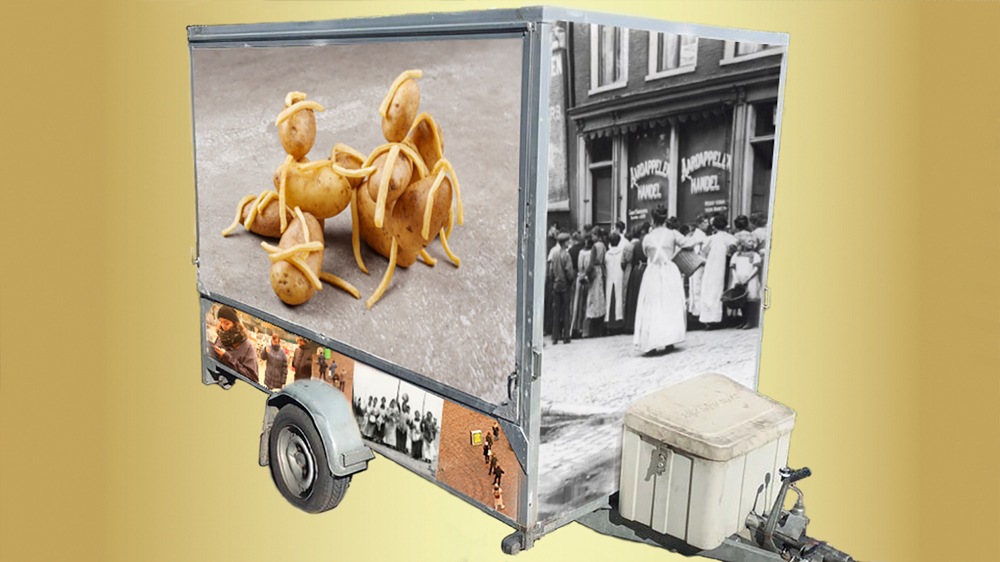
An investigation into the phenomenon of hoarding led Roosje Verschoor back to World War I and the food shortages that so prevailed among the poor in Dutch cities. The Amsterdam Potato Riot took place at that time and forms the foundation for this work. Verschoor hands out small, pointed paper bags of fries from a traditional chip cart, an action that refers to a period when potatoes were rationed. At the same time, the snack refers to the ‘spoiled fries generation’, as Verschoor and her peers are called.On the chip bags is a QR code that links to a digital chart in which we can follow how and where the riot unfolded in Amsterdam. In this Boezelaarskompas, named after the aprons worn by the women, archival material and fiction have been brought together. Verschoor has also incorporated archival materials into collages on paper made of potato peels. The final part of this investigation into the Netherlands’ best-known popular food is a series of precious bronze potatoes.
Mondriaan Fund | Jonathan Straatman
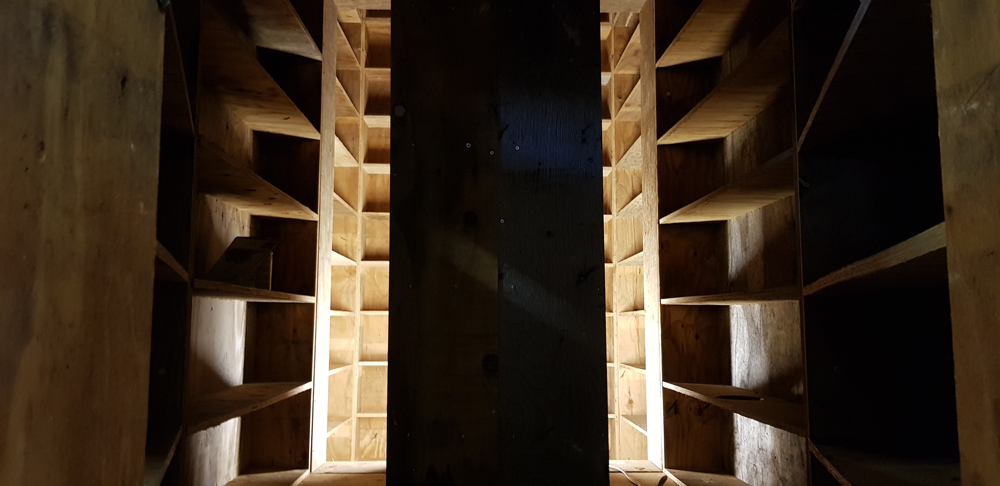
Jonathan Straatman makes architectural installations, sculptures with interiors as well as exteriors. Here, the emphasis is on how the interior space is experienced. His architectural assemblages are a kind of ‘mind map’, translations of ideas and concepts about spaces that can be walked through. In this work as well, the way in which we move through the installation plays an important role. The work is about our urge and desire to hold on to and comprehend a reality. At the heart of the experience awaits a soundscape by Twan Bracco Gartner, made especially for this sculpture.
Trendbeheer | Toine Dutch Bushman Klaassen
Not For Sale is a living installation. Contemporary archeology in a laboratory of make-believe: generatio spontanea, visual chemistrymix.
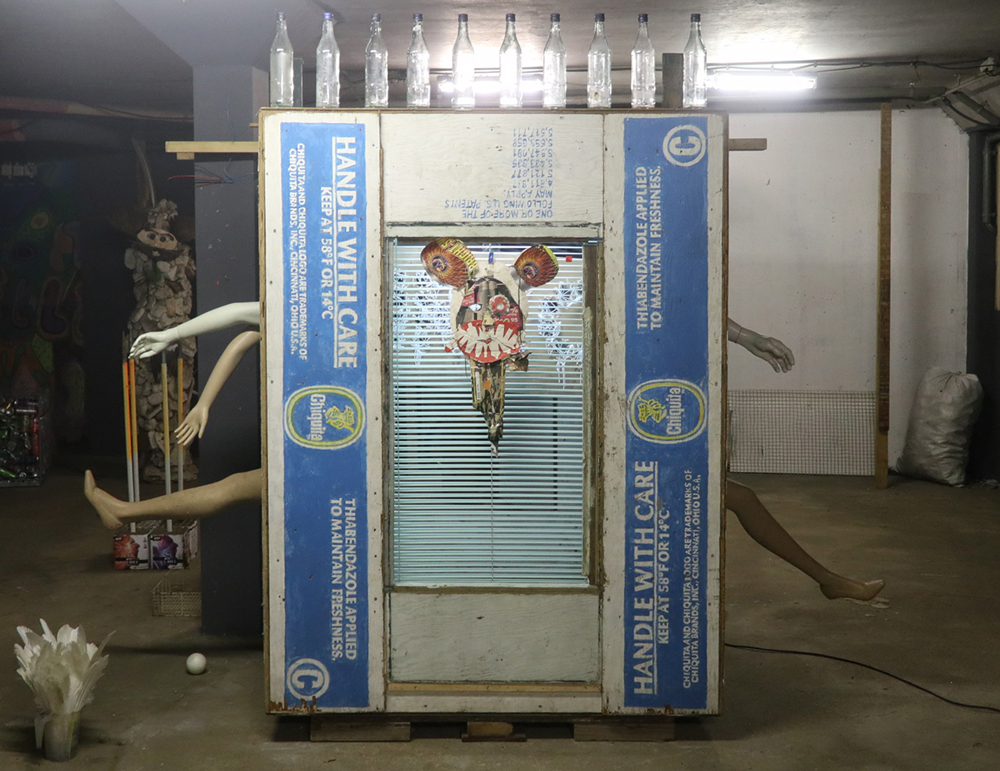
Lumen Travo Gallery | Thierry Oussou
The flag “Equilibrium Wind” is part of the on-going project that artist Thierry Oussou has developed in recent years, addressing the cotton plantations located in the district of Panouignan in Benin and the significant impact they have on the country’s economic growth.
Cotton is an important African product in the globalized arena. It is featured in international discourses and debates on privatisation, poverty alleviation, agricultural subsidies, and sustainable development. But unlike gold or oil, cotton grows from the efforts and sweat of millions of small‐scale farmers, with households and entire communities depending on it.
This flag represents all the people working in the shadows. It is a symbol for the farmers that work hard and are not seen in our society. Oussou re-connects the dots of cotton manufacturing, pointing out the sequence of actions that we, as consumers, often forget about.

Tim Wes
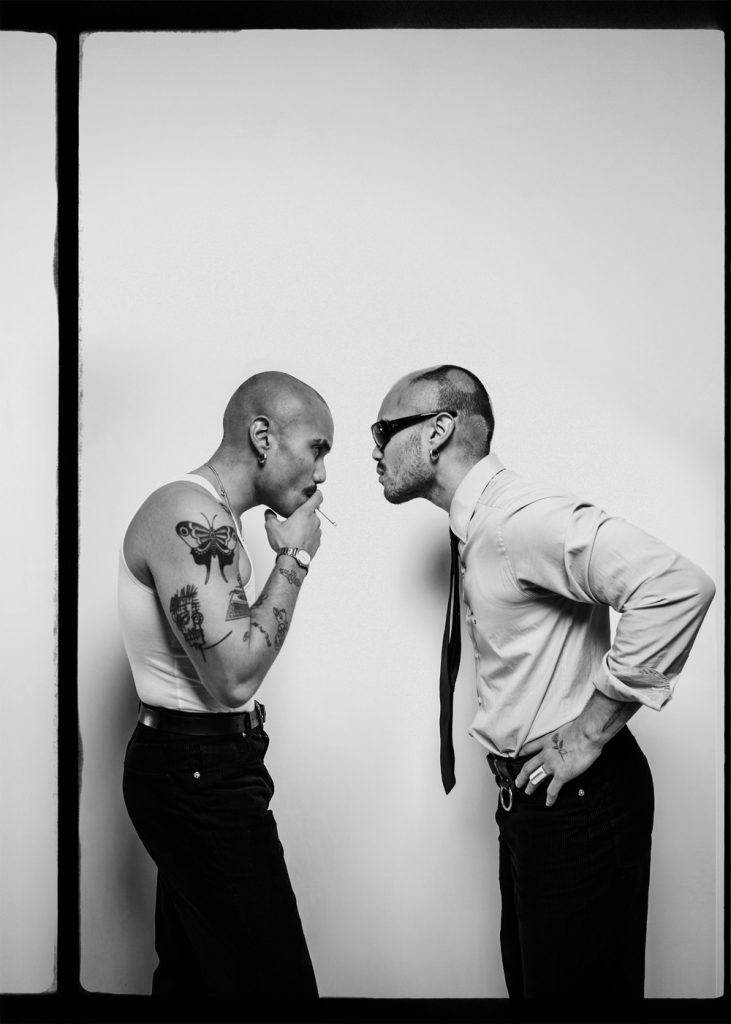
“This is my best body of work until date”, says Wes. As his delicate taste for cultural blending and ability to challenge the status quo of the universal perception of art, gave life to a genre bending artistry, the proverbial energy that flows through his creations reflect the disruptive-healing vision he has for the world. In his latest work he shows us the term uomo universale, today also referred to as a multidisciplinary artist, still exists. Just as Da Vinci embodied this in the 15th century, the Rotterdam based creator redefines the definition of this term by establishing unprecedented innovations in the contemporary fields. A blueprint for the new order. With the installation Trauma Triggers Triumph he uses film, music, canvas and objects to narrate his story and that of many others.
During Art Rotterdam, you will see the work of hundreds of artists from all over the world. In this series, we highlight a number of artists who will show remarkable work during the fair.
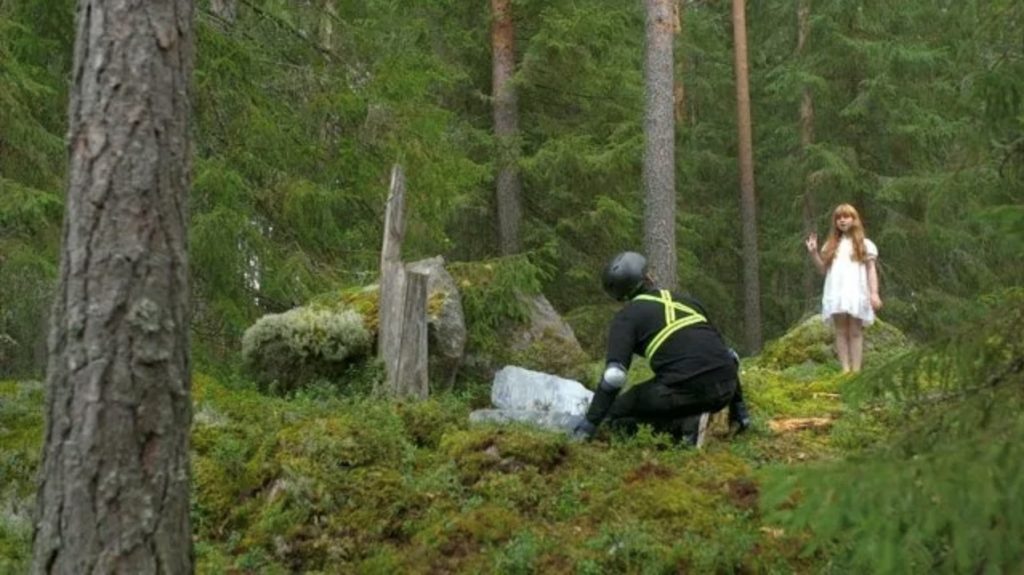
Some stories are so good that it is probably best not to check the details or facts too closely. In a way, the same can be said of the poetic work of Dutch video artist Guido van der Werve. His work is well worth the effort, but as soon as you try to explain what you are seeing, it eludes you. Five years after a serious traffic accident, he is back with his first feature film. At Art Rotterdam, Grimm Gallery will be presenting part of it: Act 10 – spice of life, death drive.
In his films, Van der Werve explores the limits of the physically possible. He has run several marathons around his house in Finland, completed a triathlon of more than 1,700 kilometres in order to bring soil from the garden of his childhood home to the final resting place of Chopin, his favourite composer, in Paris, and in a single day, ran from New York to Valhalla (NY) where Rachmaninov is buried. He also ran a marathon in under three hours – a major achievement. Until 2016, Van der Werve was able to incorporate all his interests in his films. But that spring, he was involved in a serious traffic accident in Berlin.
After a month, Van der Werve (NL, 1977) awoke from a coma and the long recovery process began. Unwittingly, he had trained himself to withstand the impact of such a blow. The artist vanished from the public eye for five years while working on his first feature film. Nummer achttien – the breath of life is about the rehabilitation process in which he had to relearn everything – from walking to talking and from playing chess to playing the piano – but above all, had to become reacquainted with himself.
The full-length feature film will premiere in theatres in early September and will consist of 12 self-contained musical video artworks. At Art Rotterdam, Grimm Gallery is showing Act 10 – spice of life / death drive in which the artist contemplates suicide, mourns the death of his father and reflects on the loss of the planet. While looking for mushrooms in the woods around his house in the Finnish countryside, Van der Werve finds two flat stones on which he engraves his own Ten Commandments. For example, every race and sexual orientation are equal, education, sports and culture must be freely accessible to everyone, people have no ownership rights over flora and fauna and happiness is overrated. He places the stones on the grave of his father, who passed away in 2013.
Van der Werve gained international fame with films in which he records his performances. In them, he addresses themes such as loneliness, uprooting and homesickness, the futility of existence and the insignificance of man in relation to nature. Nummer achttien is a highly personal project, but considering Act 10, it is also typically Van der Werve, with music performed on the spot by an orchestra and choir, gallows humour and themes such as our relationship to nature and death.
The Icebreaker
In 2007, Van der Werve made his breakthrough with Nummer acht – everything is going to be alright. This ten-minute film is about an icebreaker approaching us from the distance on an endless expanse of ice. Van der Werve walks right in front of it with a stoic look. You can hear the ice breaking and the ship’s engine roaring, but the lack of further reference points makes it difficult for the viewer to determine exactly how many meters are between Van der Werve and the bow of the icebreaker.
It is an iconic image that makes you watch with bated breath. Behind Van der Werve, the world collapses and if he does not keep moving, he is bound to collapse with it. Add to this the extremely austere camerawork, consisting of a single shot that only registers what is happening at a great distance, so that you immediately realise that Van der Werve is facing this ordeal all alone – and by extension, the rest of us.
A five-second idea
The ideas for his films often come to him out of nowhere and from a certain state of mind. So, don’t expect a conclusive argument or iron-clad logic from Van der Werve. On the contrary, his work can best be described as romantic or poetic: if you try to fully understand it, it will elude you and you’ll ruin it. In a recent interview with the Dutch daily newspaper NRC, he said, “I am not a verbal person, but I am conceptual. And by conceptual I mean apophenia, which means that I see parallels or patterns between things that aren’t there. Often a simple five-second idea underlies a work. Such an idea originates from a certain intuitive state of mind. In Finland, I once hung over the edge of a ferry and saw the ice break. It was not the best time in my life and I was in a dystopic mood. I wondered what it would be like to walk on that breaking ice. That’s how Nummer acht was born.”
Although the ideas for his films arise in a few seconds, their implementation often takes quite a lot of time. To settle the eternal question once and for all of whether his work is performance or video art, he decided from his very first film to hire a professional film crew. This is part of the reason why this film is still rock solid 20 years later.
Another constant in his films is the use of classical music. Orchestras are regularly featured in his work, which not only stems from his love of music from the Romantic era, but also because, according to Van der Werve, music has a more direct emotional effect on the audience than images. “To me, music is a way to make my work poetic. I want to create an atmosphere and I absolutely do not want to verbally explain what my work is about. It’s not rational decisions I make, but something intuitive. I consider it the artist’s job to raise things to a higher intuitive level.” Van der Werve has been composing the musical scores for his films since 2007.
Nummer twee
Van der Werve’s films are certainly not all doom and gloom because they also rely on irony and gallows humour, such as the small advertising plane trailing a banner with the text It was not enough in Nummer vier or the monotonously recited short text at the start of Nummer twee: In the morning I can’t get up, in the afternoon I am bored, in the evening I am tired and at night I can’t sleep.
Van der Werve wrote the text while studying Russian in Saint Petersburg. For a homework assignment, he had to write a personal ad. The result was not very appealing. That afternoon, he witnessed a fatal car accident, and in the evening, he attended a ballet performance. He incorporated these events into a film that takes place at a single location: the street in which he grew up.
For Dutch viewers, the contrast between the fatal accident, classical ballet and completely interchangeable street with buildings from the 1970s is immediately clear. There’s something absurdist, magically realistic, about it. A traffic fatality and a ballet, death and beauty in a place where nothing seems to ever happen, a place synonymous with predictability and boredom.
During Art Rotterdam, you will see the work of hundreds of artists from all over the world. In this series, we highlight a number of artists who will show remarkable work during the fair.
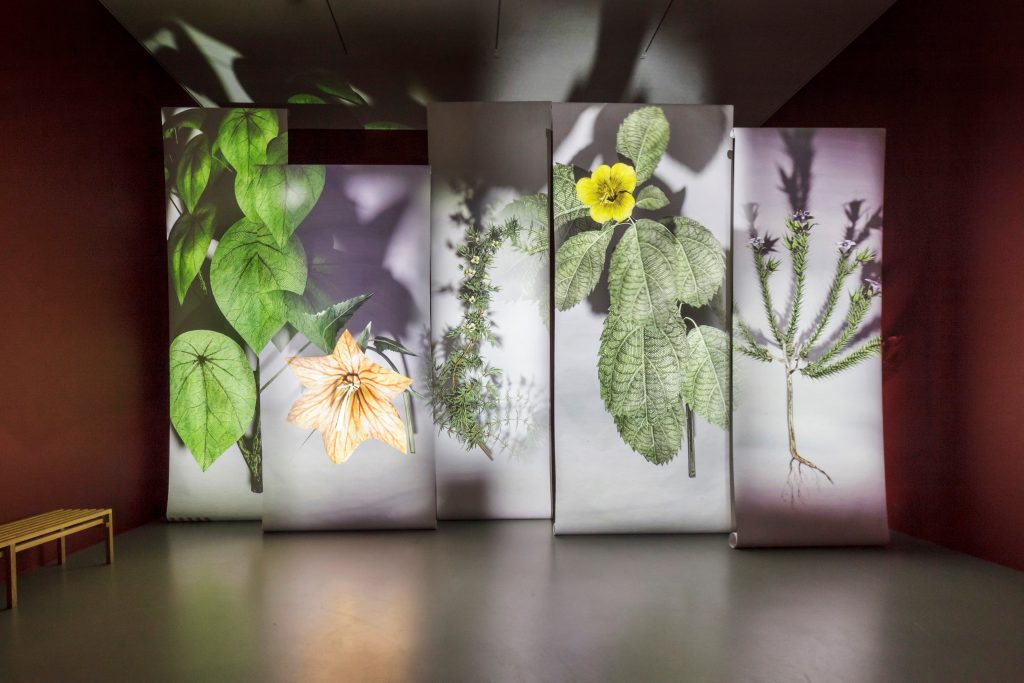
The much-loved video section Projections is being transformed this year: instead of one room with video presentations, you will now find these works spread over the fair, in dedicated video rooms in the booths of different galleries. AKINCI will show an exciting video artwork by the artist duo Margit Lukács & Persijn Broersen: “Fix the Variable, Exclude the Accidental, Eliminate the Impure, Unravel the Tangled, Discover the Unknown” (2021).
For this work, the Dutch artist duo took inspiration from the famous Swedish naturalist Carl Linnaeus, the first scientist to devise a unified system for classifying living organisms like plants and animals — essentially a new way of exercising control over nature. Linnaeus had a special bond with the Dutch Republic, where he completed his medical studies and wrote several books and articles, including his famous ‘Systema Naturae’ (1735-). He was also the personal physician to the wealthy banker and Dutch East India Company director George Clifford III, a job that Linnaeus combined with a role as supervisor of Clifford’s botanical garden and zoo. During his many travels, Clifford had collected hundreds of plant species, as well as tigers, monkeys, various bird species and Indian deer. Linnaeus was particularly fascinated by the foreign plants in the collection and classified them in his ‘Hortus Cliffortianus’ (1937). Of course, if you look at Linnaeus’s classification system with contemporary eyes, that system isn’t that objective at all, for instance when you read how he described human “varieties” — he didn’t use the word race. But also if you look at his representations of tropical plant species, which he did not describe in a neutral fashion, but rather as an idealised version. And this is remarkable because Linnaeus regarded his rigid system as the pinnacle of objectivity.
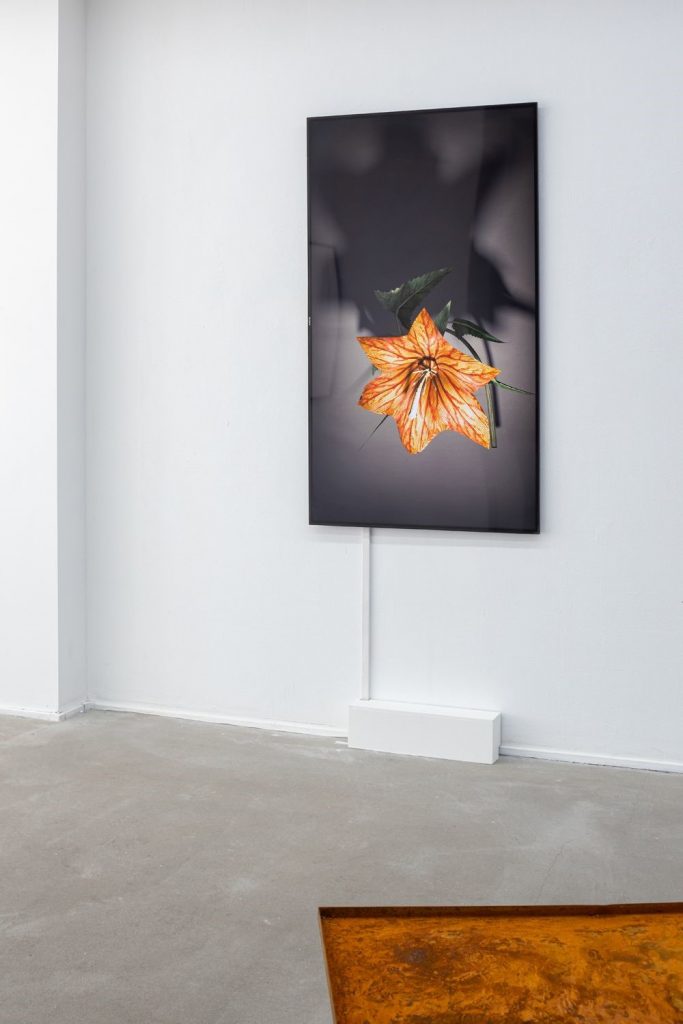
In the video work by Lukács & Broersen, we see a series of hyper-realistic, virtual, dancing plants, inspired by Linnaeus’ rendering of George Clifford III’s tropical plant collection. Yet the animated plants in this video artwork do not appear 100% real. As a viewer, you experience a certain alienation that might be related to the uncanny valley effect — that uneasy feeling we get when a robot looks too much like a human being, but also not quite enough. In this work, the natural and the virtual enter into a relationship that the viewer experiences as unnatural. The flowers and plants move gently at first, as if they are moved by a gentle breeze. After a while, the movements become increasingly fierce and menacing, as if the plants are trying to escape from their imposed straitjacket. The choreography isn’t coincidental and was programmed based on the movements of rebellious crowds and forces of nature. These movements contrast with the static representations that Linnaeus immortalised in his ‘Hortus Cliffortianus’. The compelling piano music of concert pianist Daria van den Bercken is abruptly followed by protest music by the American revolutionary and composer Frederic Rzewski, who passed away last year. The chosen compositions border on the atonal, which we tend to experience as unnatural. Moreover, the music is not synchronised with the video, so every time you watch the work, you will see a different combination of visuals and sound.
In their work, Margit Lukács & Persijn Broersen play with different fields of tension. On the one hand, they are concerned with the ways in which fiction dictates reality, and vice versa. On the other hand, they look at the relationship between people and their immediate environment: nature, but also society at large. How is this relationship influenced by the large amount of media that we consume on a daily basis, consciously and unconsciously? The artists want to show how reality, fiction and (mass) media are intrinsically intertwined. They emphasise this by combining filmed or photographed footage with digital animation and images from the media. Their works often function as parallel worlds, that tend to reflect our society and visual culture. Lukács & Broersen are particularly interested in the ways in which people experience and construct nature. They refer to subjects like endless reproduction and our focus on the ornamental and the superficial. Because although our screens are borderless and timeless, they also offer a flattened reality. And we are spending more and more time in our virtual worlds, which in turn affects the way we relate to nature.
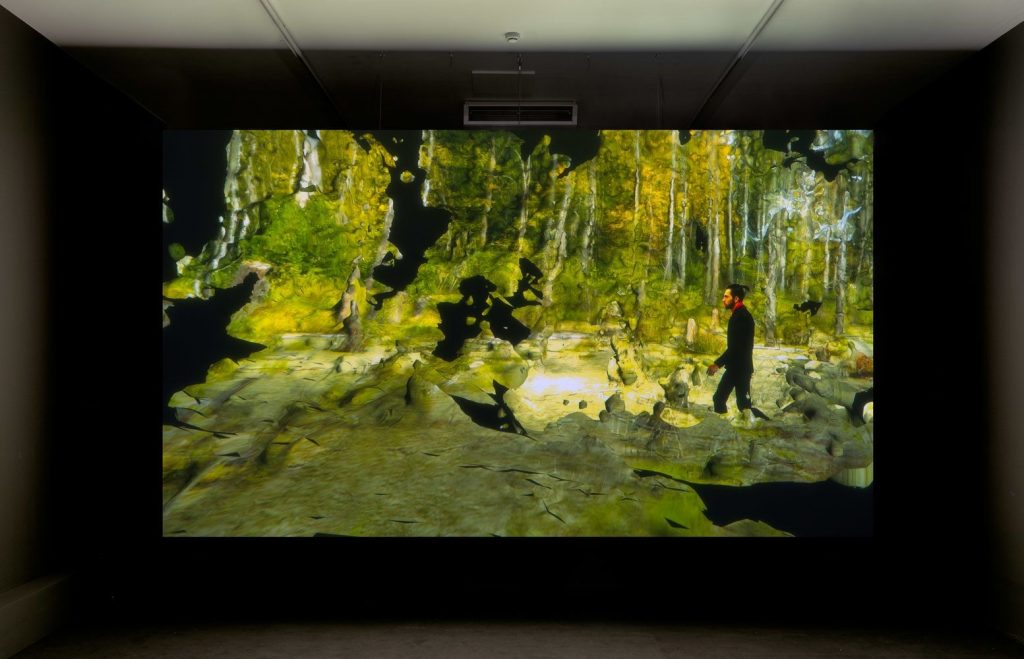
Our disturbed relationship with nature also emerges in an interesting way in their earlier video artwork “Forest on Location” (2018). For this work, the artists traveled to the 11,800-year-old Białowieża Forest on the border of Poland and Belarus. The forest is classified as UNESCO World Heritage and it has been a source of inspiration for myths, legends and fairy tales for centuries now. However, due to large-scale logging, the forest is becoming significantly smaller. Lukács & Broersen shot footage on location and then created a kind of digital “backup”. They subsequently transformed the 2D photo images into a 3D experience that almost resembles a computer game. They added a performance by the Iranian opera singer Shahram Yazdani, who tells of a wise tree addressing a lost boy. The video work offers a stark contrast to our real relationship with nature, in which humans claim all of the power, in which nature is primarily seen as a commodity. As the film progresses, the magical and mysterious forest gradually turns into a more deconstructed and fragmented digital representation.
Lukács & Broersen have been collaborating since 2001. They both studied graphic design at the Gerrit Rietveld Academy, followed by a study in Fine Arts and Design at the Sandberg Institute. The duo then completed residencies at the Chinese European Art Center, The International Artists Studio Program in Stockholm, the Rijksakademie van Beeldende Kunsten in Amsterdam and Künstlerhaus Bethanien in Berlin, among others. Their work has been shown in various museums, (film) festivals and television broadcasts all over the world, from Centre Pompidou, Foam, IFFR, the New York Film Festival and Lowlands to the World Expo Shanghai, Rencontres d’Arles and the Sydney Biennale. Lukács & Broersen created a site-specific work for the elevator of the Stedelijk Museum as well as a work for the North-South subway line in Amsterdam. In addition to films, animations and videos, the artist duo also makes photographs, screen prints and murals.
During Art Rotterdam, the work of Margit Lukács & Persijn Broersen will be on show in the Projections presentation in the AKINCI booth.
The video artwork ‘Fix the Variable, Exclude the Accidental, Eliminate the Impure, Unravel the Tangled, Discover the Unknown’ was commissioned by the Centraal Museum and is also part of the museum’s collection. The work will also be on show in the exhibition ‘The Botanical Revolution’ until 1 May. The title of the work refers to a quote by Johann Wolfgang von Goethe and is part of his search of the essence of the pure phenomenon.
During Art Rotterdam, you will see the work of hundreds of artists from all over the world. In this series, we highlight a number of artists who will show remarkable work during the fair.
Dutch artist and photographer Viviane Sassen was born in Amsterdam, but she spent three years in Kenya before she was six years old. It explains why Africa has long been a recurring element in her work, in particular the work she created before 2018. Sassen did not express herself in Western stereotypes about Africa, rather she emphasised contemporary elements from African culture. She usually works with sharp silhouettes, lots of shadows and saturated colours and her characters almost always remain anonymous. In the past few years, Sassen created two new series: “Venus & Mercury” (2019-2020) and “Paint Studies” (2021).
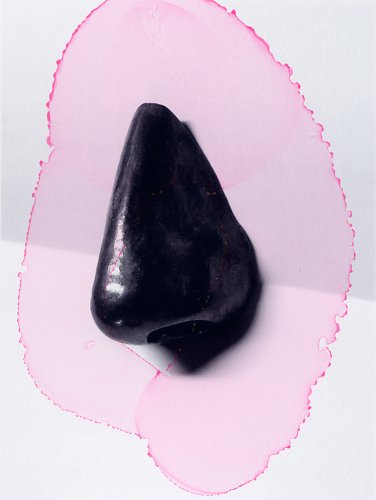
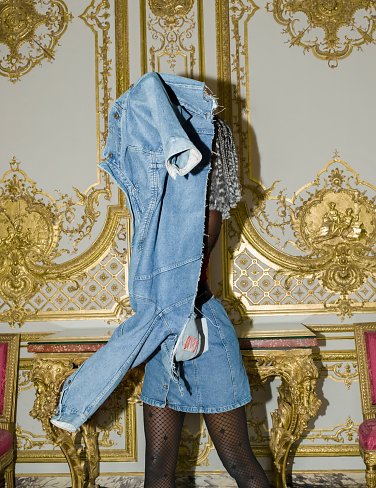
For “Venus & Mercury”, the artist found a surprising source of inspiration: the French court in Versailles, commissioned by the famous palace that has assumed near-mythical proportions in our collective imagination. Every year since 2008, Versailles has invited a contemporary artist to comment on the palace and the surrounding gardens. These artists include Anish Kapoor, Olafur Eliasson, Guiseppe Penone and Jeff Koons. In 2019, the honour was awarded to five photographers, including Nan Goldin and Martin Parr. Sassen was one of these five photographers and she was given access to Versailles for six months. She made use of the palace’s archives, as well as the architecture and artifacts of the palace. Sassen expressed a particular interest in the invisible stories, the scandals and the excess of sex, symbolised by Venus: the goddess of love. The result is a series of works in which old and new elements are combined. The artist collaborated with a group of young women who grew up in the Versailles area. They are depicted in contemporary clothing, while they seem to (literally) disappear in the opulence of the palace. Occasionally, the works represent personal details, including letters from Marie-Antoinette and references to prosthetic noses — since syphilis, a widespread disease, caused severe deformities of aristocratic noses. The name ‘Mercury’ in the title of the series therefore refers both to the Roman god Mercury and the poisonous substance mercury that was used to treat syphilis.
Sassen’s visual language recently underwent a transformation when she worked on her latest series “Paint Studies”. In it, she explored new combinations of ink, paint and collage. Because her work is still characterised by sculptural representations of bodies, her pieces are still quite recognisable. But the bodies are more surreal, more fragmented and the end result more abstract, due to the addition of intense and unnatural areas of colour and concealing brushstrokes. Her characters remain anonymous.
Sassen initially studied fashion design, followed by a degree in photography at the HKU and a master’s degree at Ateliers Arnhem. Sassen works both as a fashion photographer — for companies like Miu Miu, Stella McCartney and Louis Vuitton and magazines like i-D and Dazed & Confused — and as a visual artist. In 2007, Sassen won the prestigious Prix de Rome, followed by an Infinity Award from the International Center of Photography in New York in 2011. In 2015 she also received the David Octavius Hill Medal from the Deutsche Fotografische Akademie and in the same year she was nominated for the Deutsche Börse Photography Prize.
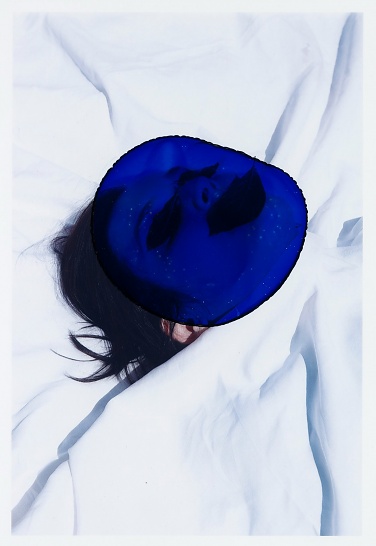
Sassen’s work has previously been shown in the main exhibition of the Venice Biennale (2013), at the MoMA in New York, The Photographers’ Gallery in London, the Museum of Contemporary Photography in Chicago, The Central Academy of Fine Arts in Beijing, Fotografiska in Stockholm, the Scottish National Portrait Gallery, Huis Marseille, the Nederlands Fotomuseum and Rencontres d’Arles. Her work is currently on show in a solo exhibition at Fotomuseum Winterthur in Switzerland (until 29 May).
During Art Rotterdam, Viviane Sassen’s work will be on display in the booth of STEVENSON.
During Art Rotterdam, you will see the work of hundreds of artists from all over the world. In this series, we highlight a number of artists who will show remarkable work during the fair.
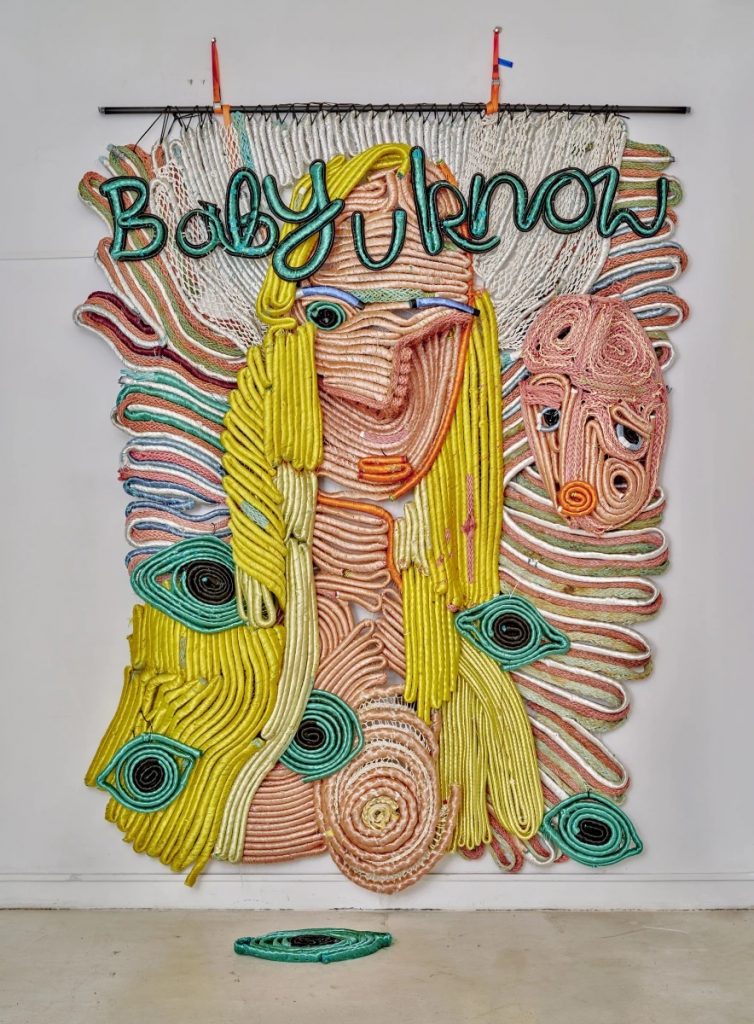
When the German artist Joana Schneider moved from Munich to The Hague, she immediately fell in love with the sea, purely because she had rarely seen it before then. She started studying fashion at the Royal Academy of Art, but she wasn’t sure yet where she wanted to end up. When she discovered the ‘Textile and Fashion’ department at the same institute, the pieces started to fall into place and in 2018, Schneider graduated as a textile designer. In the harbour, she became more familiar with the nets that were being used by the fishermen. She was surprised to find that these ropes and nets are only in use for two weeks, only to be thrown away. She decided to specialise in processing the heavy, stiff material and has since developed various techniques for that. She enlisted the help of fishermen and craftsmen in Scheveningen and Katwijk, who introduced her to their unique knotting and weaving techniques. She then combines these techniques with contemporary techniques and other crafts such as traditional roofing with thatch. For her graduation project at the KABK, Schneider received the Keep an Eye Textile & Fashion Award.
Schneider’s work conveys a deep appreciation for craftsmanship, for the creativity of people who work with their hands. Indirectly, she also plays with gender norms, by combining “feminine” materials (textiles) and physically demanding “masculine” crafts. The raw yet flexible material is a guiding factor within the work. She makes large works of rope and recycled yarn, a labour-intensive process. Some works require as many as thirty thousand stitches! When Schneider edits the material, her background in textile design comes to the fore. She’ll use techniques such as embroidery, passementerie and weaving tapestries. Her practice is also developing in a technical sense: Schneider has been experimenting with special machines for years. Within the artistic process, there is enough room for a certain spontaneity and intuition.
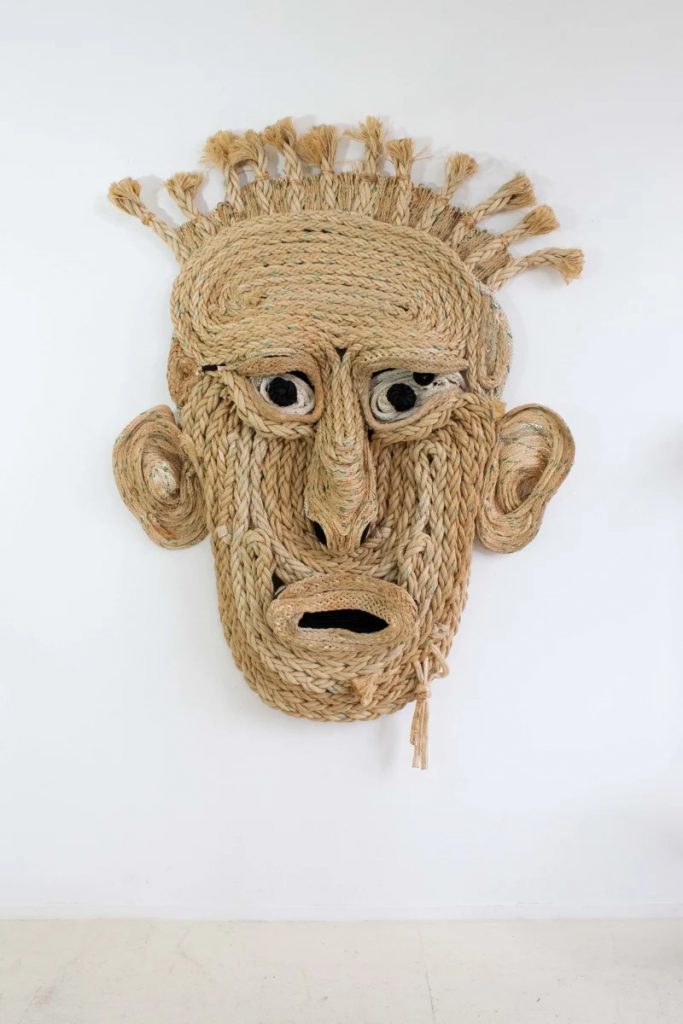
Schneider’s brightly coloured, theatrical and occasionally eery faces immediately evoke a reaction in the viewer. Sustainability is a keyword in her practice, and she makes a concerted effort to keep her ecological footprint as small as possible, while also taking the transport of the large-scale installations into account. The fragrant material of her works still bears the traces of the sea. That way, the artist is able to ask questions about environmental pollution and our own ecological footprint. By reusing the nets and ropes, she ensures that there is less waste in the sea, waste that could otherwise pose a danger to the marine animals that could get entangled in them.
For her newer work, Schneider is inspired by a multitude of sources. During Art Rotterdam, she shows a work in which she speaks out about the motherhood style of certain influencers in the digital age, while she is visually stimulated by the paintings from a church in Munich. Sometimes, Joana’s work is combined with that of her sister Leonie Schneider, who is also represented by Rademakers Gallery. For some works they were both inspired by the same subject: their grandmother’s house in Bavaria.
Schneider’s work has been included in the collections of Deloitte, the Stedelijk Museum Amsterdam, Museum Aalborg in Denmark and the Lakeside Art Collection, a collection that is currently on display (in part) in a rented compartment in the depot of Museum Boijmans van Beuningen. During Art Rotterdam, Joana Schneider’s will be shown in the booth of Rademakers Gallery and in the Prospects exhibition of the Mondriaan Fund. For the 10th time in a row, the Mondriaan Fund presents the work of 88 emerging artists here. In 2020, all of these artists received a financial contribution from the Mondriaan Fund to make a start in their career.
During Art Rotterdam you can see the work of hundreds of artists from all over the world. In this series, we highlight a number of artists who will show remarkable work during the fair.
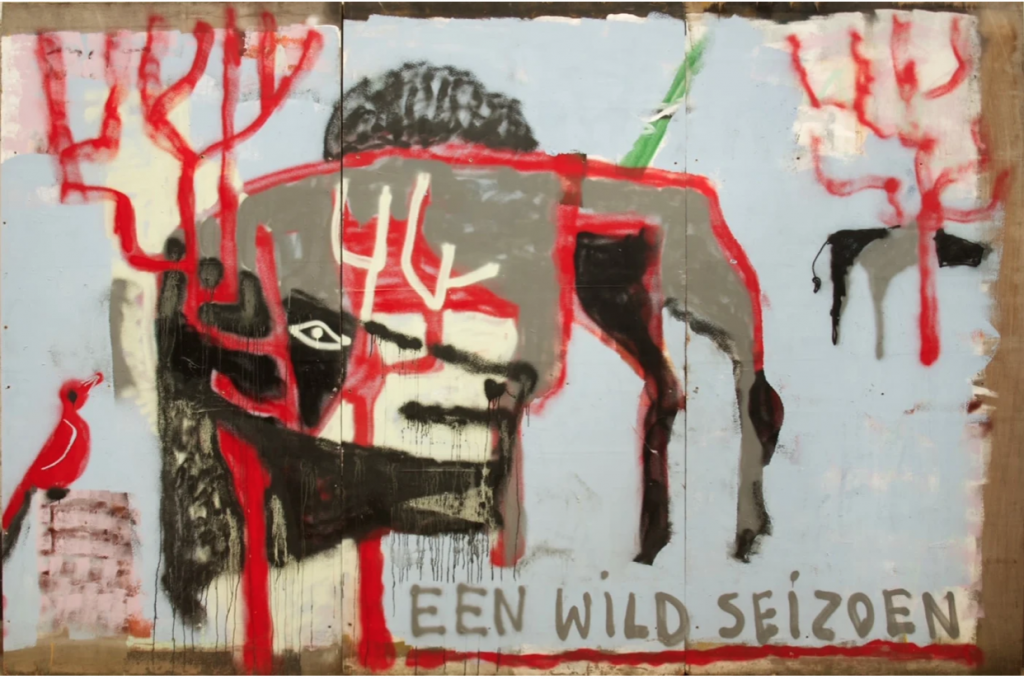
Not all artists thrive on a structured artist’s existence, in which the studio serves as a nearly magical safe haven, in which all of it has to take place. The Belgian artist Frederik Lizen, who has been working under the synonym En plein public since 2010, prefers to work outside. Usually in an urban context in Antwerp, where he lives and works. Within the city, he is mainly interested in the non-spaces and other types of grey public spaces. He prefers to paint his colourful works on the wooden fences that shield construction sites from the outside world, basically the opposite of a blank canvas. Sometimes Lizen takes the concept of ‘en plein air’ more literally, when he flees to the countryside. There, he exchanges his usual modus operandi — the use of spray paint, ink, collage and acrylic on monumental panels — for the more classical and small-scale use of watercolour and crayon on paper. The artist does have a studio, but he considers it more as a laboratory for experimentation, the place where he stores his materials. Perhaps his real studio is the gigantic building site on the Pelikaanstraat in Antwerp, where he came to an agreement with the project developer. It means that he is able to paint a hundred and fifty meter long wall of plywood panels.
As an artist, Lizen moves between two worlds, neither of which really feel like home: the world of contemporary painting and the world of graffiti. He prefers working in the public space because it literally brings his works to life. And it is precisely this changeability and spontaneity that are an essential part of the work. As soon as a work is left in the open air, Lizen loses control over it. The work is not only subject to weather conditions, but also to (street) artists and drunken students who paint over his work, or the police who sandblast or remove his work — as was the case when he made a critical work on the tragic fate of George Floyd, in which he also added references to the Belgian police, to indicate that it is not just an American problem. This socially critical approach is characteristic of his work, often executed with a good dose of humour. And it is precisely the limitations of working in the city that force the artist to work quickly with a limited number of materials. As a result, he developed a specific visual language.
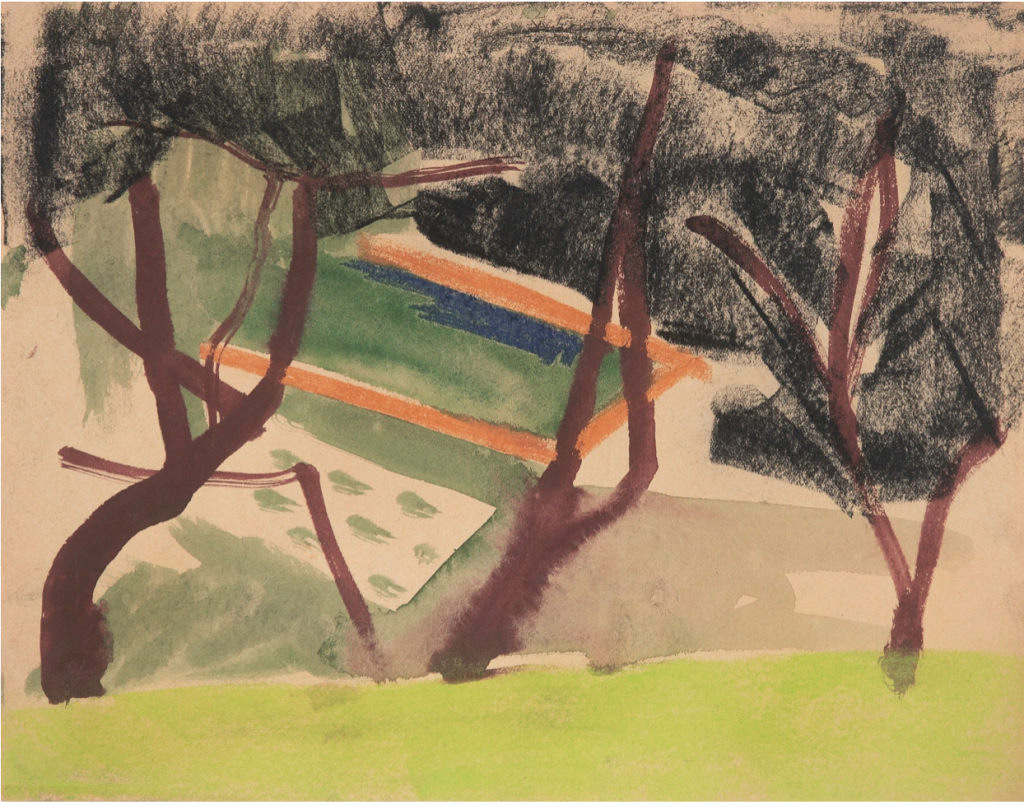
The conscious and unconscious adjustments to his work are an essential part of his working process. In many cases, Lizen returns to a particular work after a while, to continue working on it. Little remained of the work that read ‘I can’t breathe’ after the intervention of the police, but the remaining layers of paint suddenly imbued the panel with an abstract quality. Lizen then sold the work to a collector. Lifting the work from the public space to a white cube immediately provides it with a new context. But the artist himself determines which works are given an art context and which works end up in a waste container. Lizen’s work actually represents a certain democratic ideal: he invites people to intervene and that doesn’t stop with the creative process. In an interview with the Royal Museum of Fine Arts Antwerp, he noted that any buyer of his work has the freedom to continue working with it at will. Lizen: “If a work is sold, the owner can do what he wants with it: turn it into a cabinet or something… So the exhibition is not a final stage for me.”
Among other things, Lizen completed an Arteventura residency in Andalusia and he showed his work at SMAK during the Biennale Van België and in the Vebeke Foundation.
During Art Rotterdam, Frederik Lizen’s work will be shown in the Solo/Duo Section, presented by Geukens & De Vil.
During the May edition of Art Rotterdam, the NN Art Award will be presented for the sixth time: to a contemporary art talent with an authentic visual language and an innovative angle. NN Group has been a partner of Art Rotterdam since 2017 and has been awarding an incentive prize every year since then. An annually changing jury of art professionals makes a selection of four promising talents, from which a winner is ultimately chosen. Since last year, these four nominees also have a chance to win a public choice award, so that regular visitors to the fair can also cast their votes. The conditions are clear: the nominated artists have all been trained in the Netherlands and all show their work during Art Rotterdam. Each year, NN Group buys one or more works from the four nominees for its corporate collection. Last year, the NN Art Award (worth €10,000) and the NN Art Award Public Choice (worth €5,000) were both won by the Dutch artist Erik Mattijssen, who is represented by Cokkie Snoei. We interview him to find out what the prize has meant to him and how he has experienced the past period.
How did it feel like to win the NN Art Award?
Actually, the nomination that preceded it was the most exciting. Knowing that your work has been noticed, in the midst of so many colleagues, was flattering and uplifting. By now, I know what I’m worth, but it remains a strange profession that is accompanied by many uncertainties. These are often questions that I tend to ask myself in the studio: are the steps that I take exciting enough, is it not too indebted to other people’s work, or is it perhaps too careful? When you get this kind of recognition, some of that melts away. Moreover, I was in good company with the three other nominees: Priscila Fernandes, Lilian Kreutzberger and Claudia Martinez Garay. Perhaps the greatest luxury is the spacious, tall and well-designed NN Art Award stand, right in the middle of the fair, as well as the opportunity that this presented: to create a beautiful exhibition together. I am grateful to Cokkie Snoei, who had the courage to nominate me while I had become accustomed that such an award was more for young and up-and-coming talent. I found that encouraged colleagues of my age; that your work can also be valued on other grounds. When I also received the audience award on top of the NN Art Award, that was almost too much of a good thing, but of course I was very happy with it.
What has the past year been like for you, in terms of all the lockdowns? Do you notice that it influences your mood and/or your work in a substantive way?
I felt especially privileged that I have a job that I can continue, independently of others. Imagine playing in a band or making theater or having four school-aged children. Initially, it increased my focus, without any temptations to distract me. But I have to say that after the last lockdown in December, I noticed that I was suffering from the lack of shine to our lives. Amsterdam, the city I live in, is duller without all the hustle and bustle you were used to. Everyone is doing their best, but it’s still sad, all those cafe chairs on top of the tables, windows taped up and deserted streets. In my work, I have always wanted to offer a counterbalance, but there is undeniably a greater melancholy creeping in.
How did the works you showed during Art Rotterdam come about? Are you following a specific process?
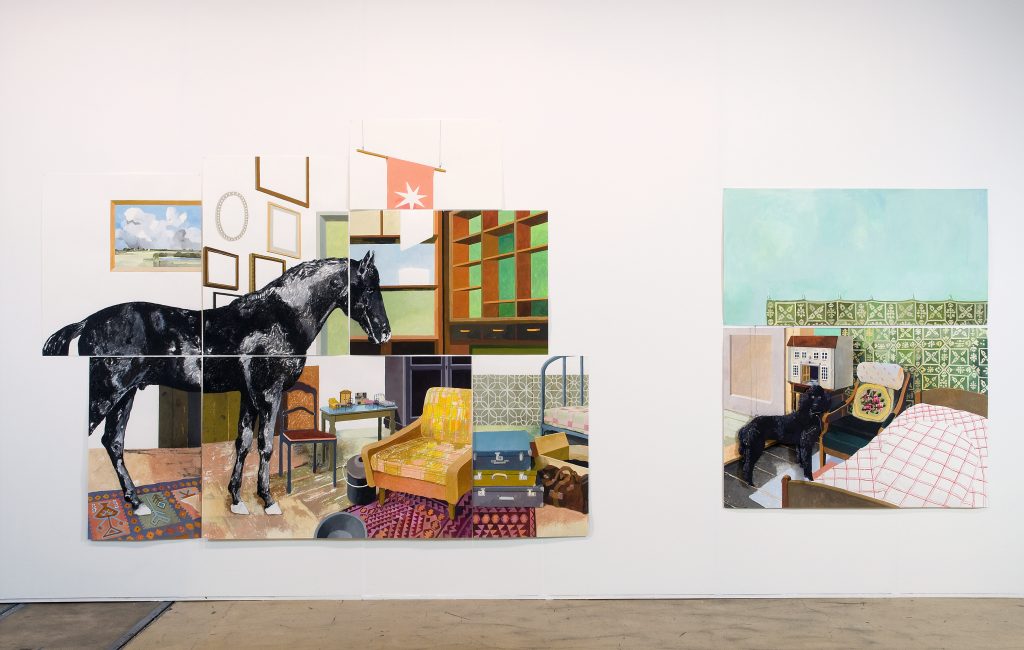
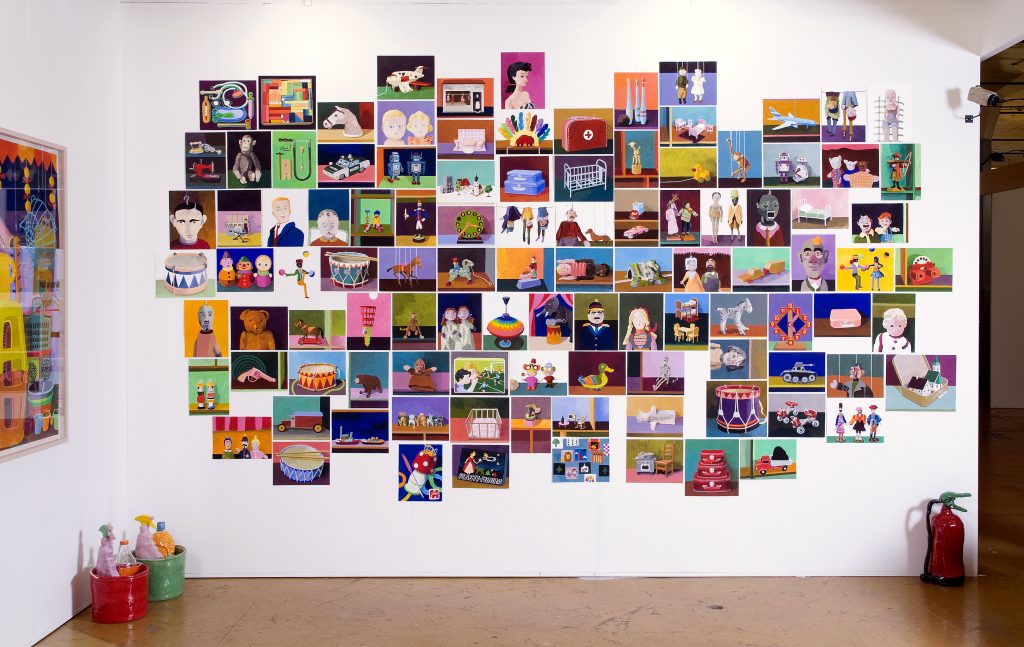
During the six months prior to the fair, I was able to work in a pleasant studio in Berlin, from Livingstone Gallery Projects. That city was also locked down, so I had to come up with my own kind of rhythm. That is how I got to start every morning by painting a small gouache that had to be finished before noon. It turned out to be toys, not too complicated, a subject I had initially saved for the establishment of a large, overcrowded toy store. I made over a hundred, which we exhibited on a signle wall in Cokkie Snoei’s gallery booth. I also continue to work on large, composite scenes, interiors in which something takes place that you can’t quite get a grip on. There were two: Zum Abschied, based on a text by writer Judith Herzberg and Des Pudels Kern, inspired by Goethe’s bedroom in his house in Weimar. The fact that both new works were immediately shown to a large audience in the NN Art Award booth was a great encouragement and a nice addition to what we were able to show in the gallery’s stand.
Are there any particular things that you have been able to achieve thanks to the prize money? What did winning the prizes mean to you in concrete terms?
It often happens that I spend money that actually isn’t there yet, with full confidence that things will work out. In Berlin, for example, I already decided that the toy series could become a nice book, and that was ultimately financed for a large part with the prize money. Receiving the prize in the Art Rotterdam week also led to an interview on NPO radio 1 in the program Kunststof and I immediately saw my followers on Instagram increase in number after that! All in all, I felt like I was floating a bit that week.
What is your ultimate advice for young artists?
That may sound obvious, but it isn’t: I would advise them not to chase anything: to make sure that the work you create is truly yours. That you don’t care too much about the criticism of others, or about what happens to be fashionable at that point in time. It’s important that you are the only one who decides which way to go. I would also like to recommend that they take the initiative themselves, to make sure that they exhibit their work somewhere and not just wait for gallery owners to start moving.But above all: the most important thing is to keep working, to take good care of yourself, to isolate yourself. I have seen too many former students of the Rietveld Academy — where I taught for a long time — who let other things take precedence. That their drive and passion disappeared and that the pleasure diminished simultaneously. And that’s a real shame.
As the winner of the previous edition, you can take a seat in the jury during this edition. What is it like as an artist to judge the work of other artists?
It was particularly nice to be part of such a competent and passionate jury, who made a point of careful viewing and speaking. After much deliberating and weighing, we came to a beautiful, diverse group of four nominees. It remains quite arbitrary of course, comparing apples and oranges. Winners and losers are uncomfortable categories in art.
During Art Rotterdam, you can spot the work of hundreds of artists from all over the world. In this series we highlight a number of artists who will show remarkable work during the fair.
Otobong Nkanga wrote a poem for her last solo exhibition in Bregenz, Austria. She performed it as a clay tablet. In keeping with an exhibition that revolves, among other things, on the different manifestations of water and earth.
The reason Nkanga wrote a poem is that she doesn’t like writing texts explaining her work. “I don’t normally like writing texts about my work, but if you’d want me to explain my work then read a poem. What poetry does is to activate the emotions. To amplify the thoughts and to go beyond the language of politics and economy.”
Beyond the political and economic
Bypassing the political and economic language in order to address the viewer directly on an emotional level, that is in a nutshell what the multidisciplinary artist Otobong Nkanga (1974) aims at with her work. Through her wall hangings, drawings, video works, photography, installations and performances, she discusses almost every major topic of our time: think of the climate crisis, the extraction and distribution of raw materials and sustainability.
In doing so, she has an eye for both the places where the raw materials end up and the places that usually remain out of the picture: the parts of the world where raw materials are mined. The latter areas often coincide with former colonies, such as in West Africa, where the consequences of the colonial and current Western presence continue to affect societies to this day. “It’s important for me to work on the correlation of worlds that are visible to worlds that are not. My works move between the non-visible and the nontangible to places that are concrete, places that awaken the senses: touch, smell, sight, sound.”
Nkanga is considered one of the most important contemporary artists of African origin. Born in Kano, Nigeria, she grew up in France and lives and works in Antwerp. Her work was shown at the Venice Biennale (2019), documenta 14 (2017), and 14 Rooms in Basel (2014). In recent years, Nkanga has exhibited at the Gropius Bau in Berlin, Tate St Ives, Castello di Rivoli, and Kunsthaus Bregenz, among others.
Illustrative of her thinking is the answer she gave when asked what motivation means to her: “When you have a storm in Mozambique, that cleanses up a whole place. While some places are very turbulent, in others places it’s very calm, so you’re able to work and continue your life for 60 years. So to be able to be motivated is not entirely up to you. It is in the kind of environment and support that you get from people, places, landscape, weather, temperatures. All that makes it possible. I’ve been fortunate to have been in places where all those things align.” Where in the Western narrative everything begins and ends with the individual, Nkanga starts by taking into account environmental factors.
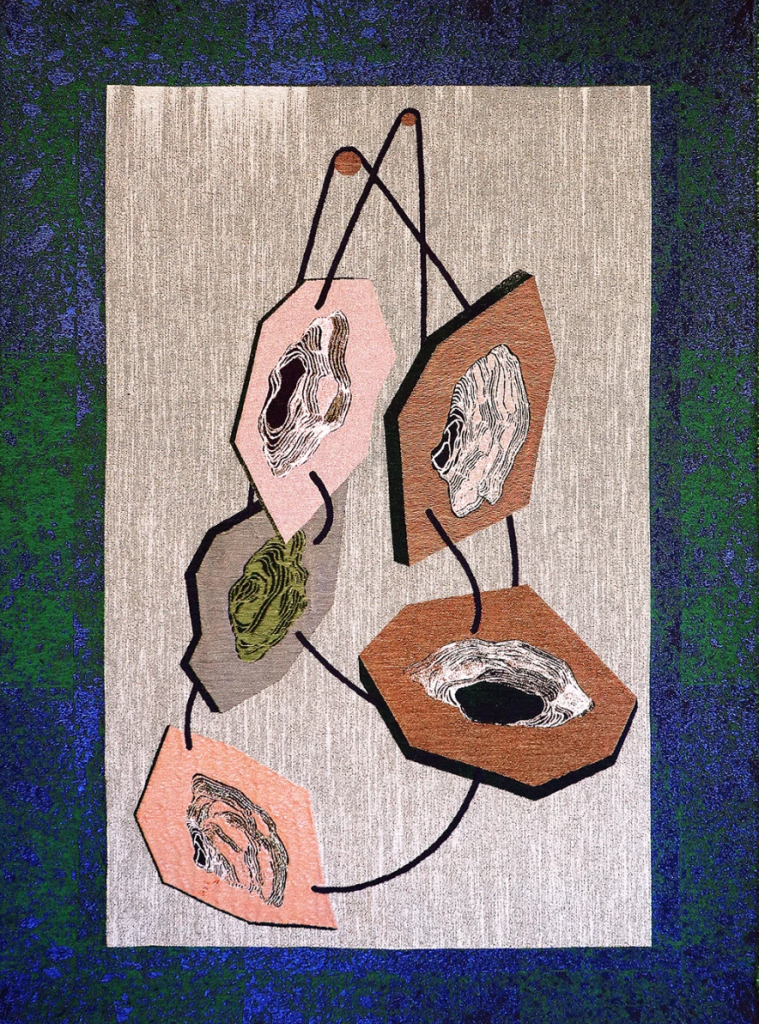
The Weight of Scars
In her work she shows the global interaction between these variables. You could therefore regard Nkanga’s work as a poetic system analysis – one with a glimmer of hope. A recurring theme in her work is the extraction of raw materials – such as mica, a raw material that is used in make-up, among other things – and its worldwide implications.
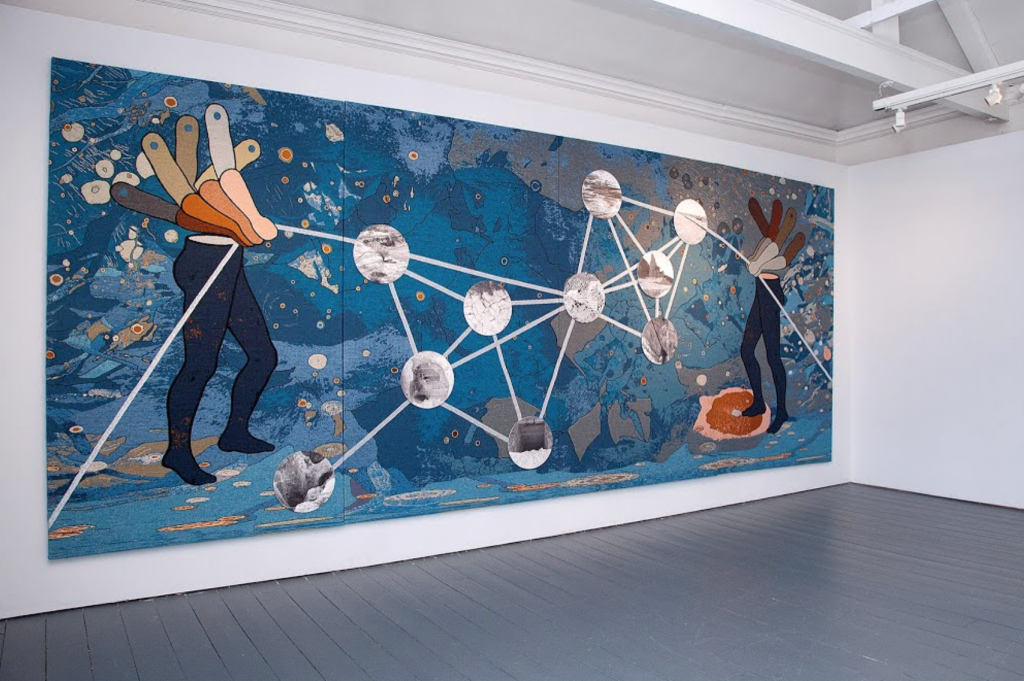
Nkanga made the tapestry The Weight of Scars in 2015 after a visit to the Tsumeb mines in Namibia. On the installation you see two headless figures on either side who seem to have a sticks in their hands connected to 9 photos of mine shafts, holes, pipelines and explosions.
Nkanga found it difficult to look at the gaps in the landscape. As she walked into the old mine shafts, she thought of the scars and trauma people must have suffered here and the wounds in the landscape the mine caused. “While I was there, I realized that Tsumeb looked like this due to the use of explosives by the German colonial overlords. By doing so they have not only accelerated the method of mining, but also permanently changed the fabric of society.”
According to Nkanga, our insatiable appetite for consumer goods such as telephones, computers and make-up has made us addicted to raw materials such as copper, gold and mica. Yet, if we realize that we are all connected through these raw materials, we can interact with our landscape and each other in a different way, according to Nkanga.
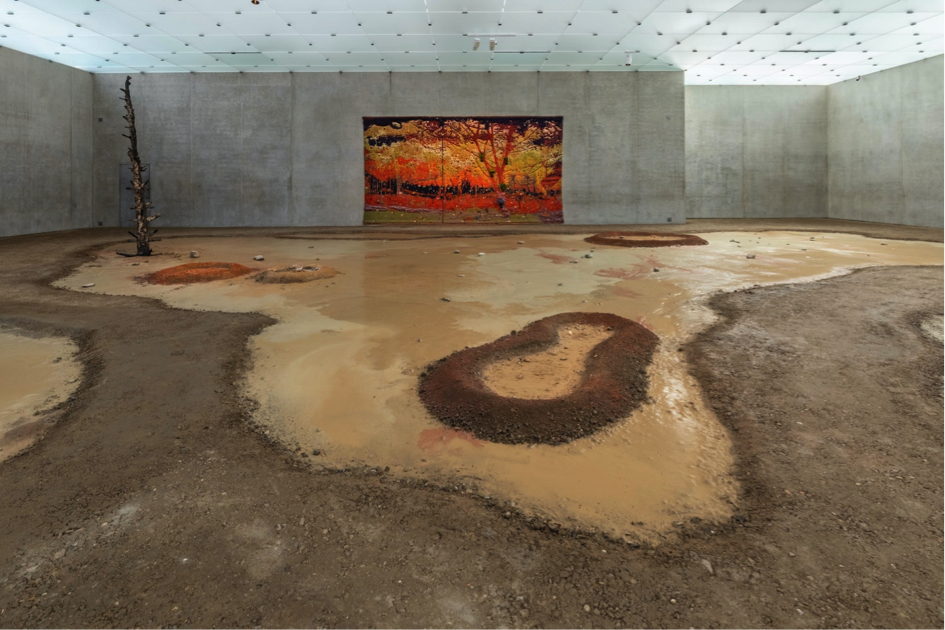
Unearthed
For Unearthed, the solo exhibition at Kunsthaus Bregenz last winter, Nkanga was given access to all 4 floors of the museum. She installed a tapestry on each floor of the museum showing one of the ways earth and water are intertwined. From the depths of the ocean, to the seasons, and the scorching heat of the sunlight in the desert, where plants grow despite the heat. As if nature always finds a way to carry on.
In addition, she had a tree stump installed on every floor between the floor and the ceiling. The slowly drying tree stump represents the gradual change. You cannot see the gradual but certain death of the tree, but there are signs from which the visitor can infer this. Call it an incentive to critically reflect on how we deal with our planet.
On the third floor, cables run from the dying stump to three glass capsules containing cuttings. In an interview, Nkanga says that tree was already nominated to be cut down, because it overshadowed other trees, preventing them from growing. Sometimes leaving a hole isn’t bad. Still, one Nkanga decided to plant new trees elsewhere so as not to burden the local ecosystem too much.
To celebrate the Kunsthaus’s 25th anniversary, the museum has rented the 16th-century Scuola di San Pasquale during the Venice Biennale to draw attention to its forward-thinking exhibition program. In addition to a presentation of work by Anna Boghiguian, the Kunsthaus shows work by Otobong Nkanga.
Tied to the other side
At the upcoming edition of Art Rotterdam, the Lumen Travo gallery will show a new tapestry that has never been on display before. Tied to the other side measures 3.5 x 6.5 meters and was woven according to Nkanga’s specifications and drawings by the Tilburg Textile Lab on the recently purchased Dornier loom. This is a state-of-the-art loom that can handle complex patterns and structures and can weave rugs up to three and a half meters wide.
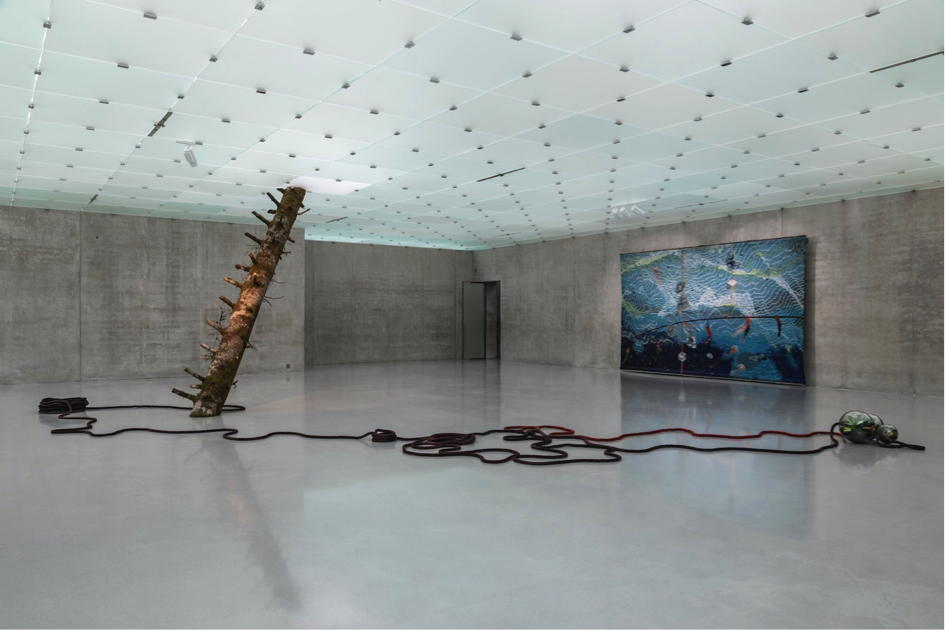
Tied to the other Side is about how we deal with the elements of earth and water. Our appetite for raw materials has taken on such forms that drilling is also taking place in deeper places in the sea. On the blue tapestry we see this craving take on the shape of a scaffold-like structure with arms, plants and a container attached to it, and in the shape of a needle that pricks a human body. The needle represents the machinery and system that exploits people, land and sea. On the left you see a number of staffs. One of those staffs emits bright rays that indicate as yet unknown possibilities. Rays projecting into the future.


