Coming soon
Coming soon
Select type
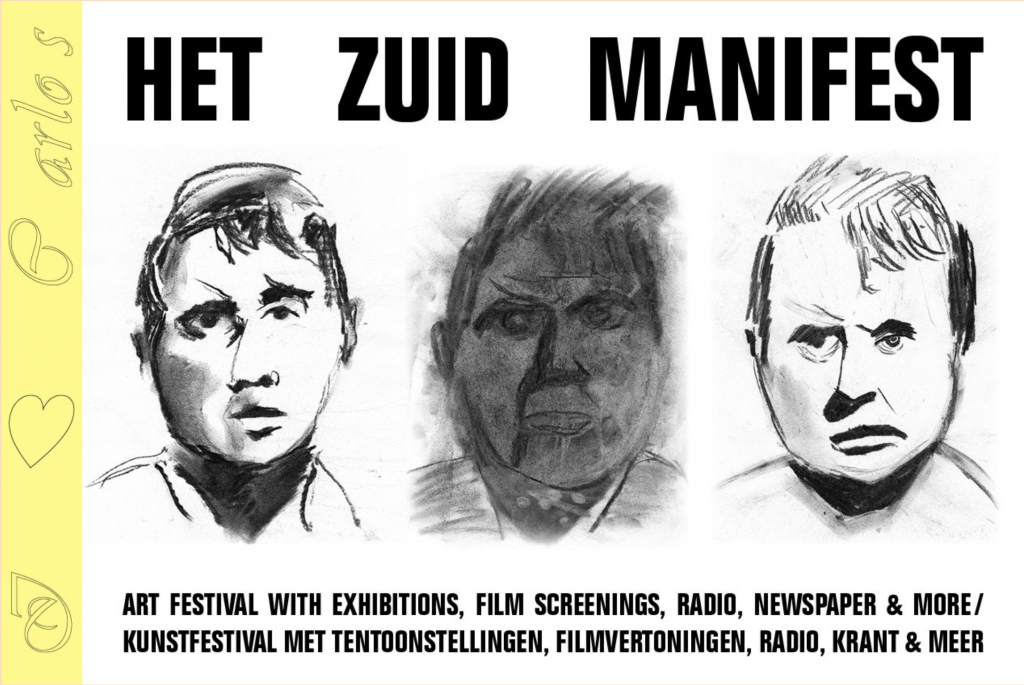
As part of Het Zuid Manifest: I Love Carlos, Rib is launching its own radio station together with residents and partners called The Last Terminal radio, which will be broadcast live from Intersections at Art Rotterdam from 27 to 30 March, daily between 11:00 and 19:00.
After 19:00 there will be a program of music, stories, and other contributions by artists such as Peter Fengler, Daniel Gustav Cramer, Michèle Matyn, Hedvig Koertz and Dieter Roth.
During the three days of the festival in Charlois, there will be artworks and performances to discover at various locations and you can participate in guided tours.
For the complete programming and participating artists: https://www.ribrib.nl/het-zuid-manifest
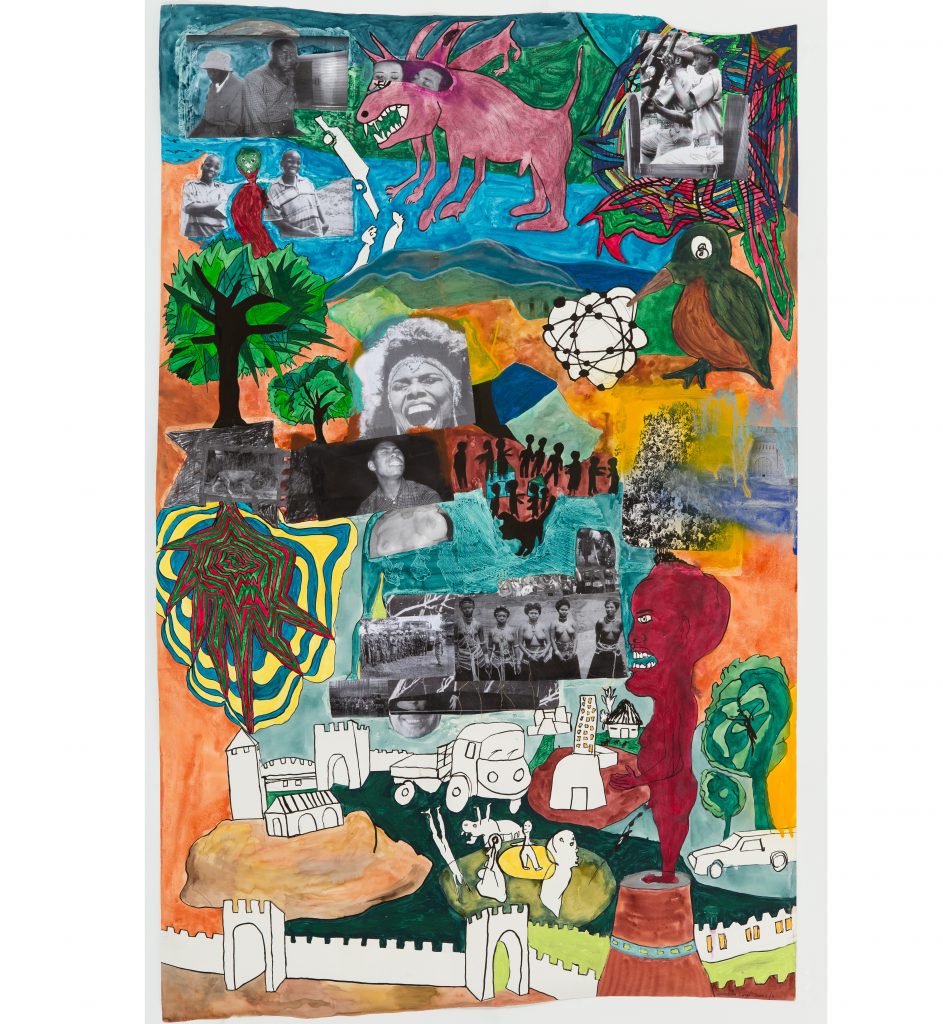
At Art Rotterdam, Stevenson presents an overview of work that Moshekwa Langa has created over the past 20 years, complemented by recent pieces. The South African artist’s work revolves around themes such as travel, belonging, displacement, memories, movement, and borders. Gallery owner Joost Bosland describes it as unique that so much work by an artist of Langa’s stature is still available. Next year, Langa will have a major exhibition at Melly that surveys his entire career.
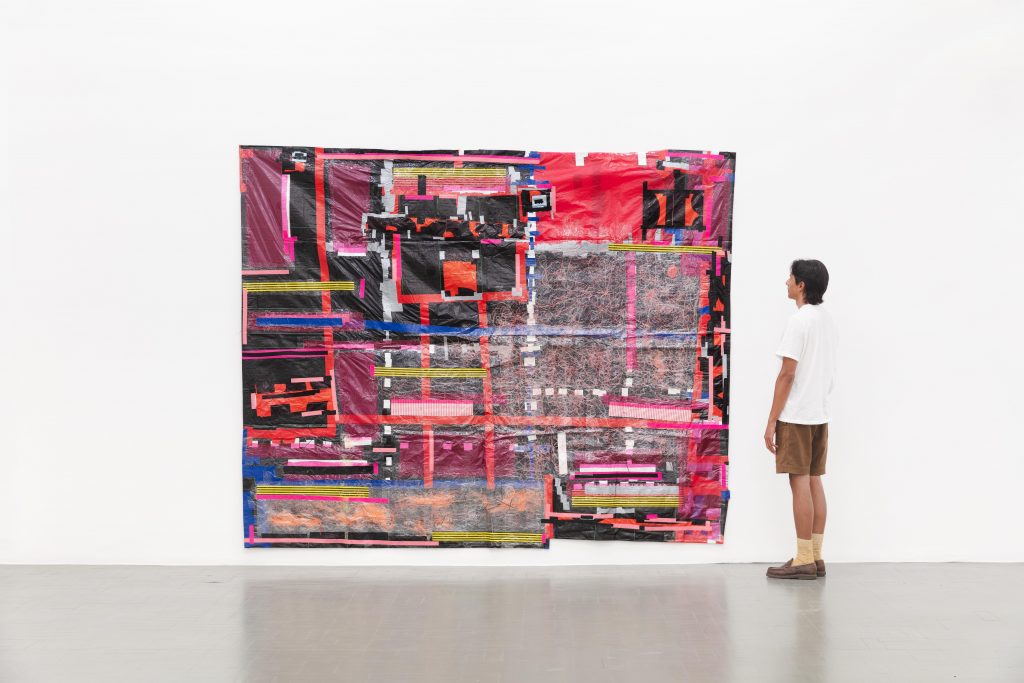
That Moshekwa Langa addresses themes such as displacement, identity and inclusion/exclusion in his work is hardly surprising. These themes run like a thread through his life. Langa was born in 1975 in a place that did not officially exist. Bakenberg, a small village in northern South Africa, did not appear on any maps during Apartheid (1948–1994).
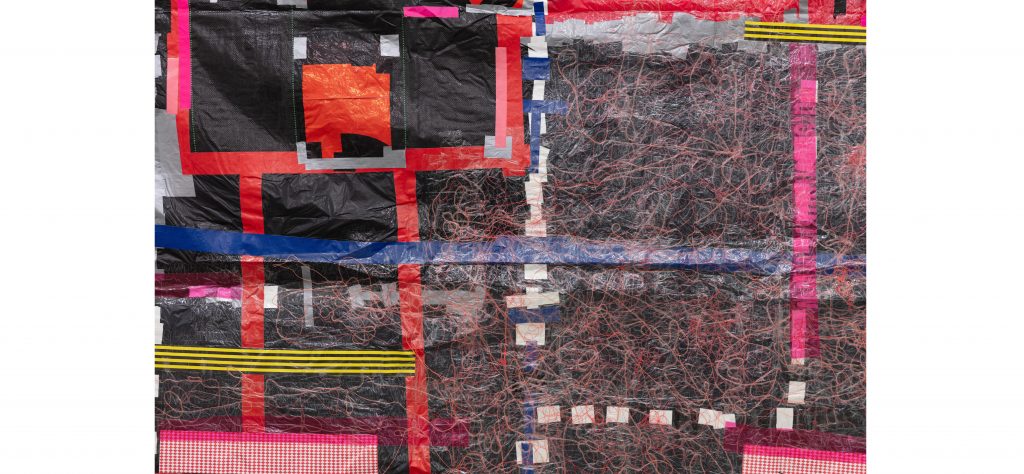
Bakenberg was part of Lebowa, one of ten so-called homelands whose maps only indicated the outer borders, while places within them were left blank. When Langa discovered this, it confused him, he says from his studio in central Amsterdam. So, it is no coincidence that fictional and incomplete maps frequently appear in his work.
His birthplace also plays a central role in his seminal work Where do I begin? from 2001. In the four-minute video, we see people boarding a bus along a dusty road from the perspective of a small child. Langa maintains a clear narrative: we see only a series of anonymous legs. Yet the images are rich in detail: a perfectly ironed pair of trousers next to worn-out shoes, a floral skirt, an umbrella, an overstuffed bag, stained clothes, a missing sock.
The phrase Where do I begin, taken from the song of the same name by Shirley Bassey, of which a fragment can be heard, suggests the start of a journey or a story. Combined with the repetitive movement, it reflects themes that frequently appear in Langa’s practice and life: travel, belonging, displacement, memory, identity, inclusion and exclusion, movement and borders. Where do I begin was acquired by Tate Modern in 2018.
International recognition
Due to the themes Langa explores in his work, he has long been in the international spotlight. His work has been featured at the Venice Biennale (2003 and 2009) and São Paulo Biennale (1998 and 2010), as well as biennales in Johannesburg, Istanbul and Havana (all in 1997), Gwangju (2000) and Berlin (2018). It is also part of collections at institutions like MoMA in New York and MHKA in Antwerp. Langa has also exhibited at Fondation Louis Vuitton and Fondation Kadist in Paris, MAXXI in Rome, the New Museum and International Center of Photography in New York, Kunsthalle Bern and the Walker Art Center in Minneapolis. In the Netherlands, Langa has had exhibitions at Museum Boijmans Van Beuningen (1998) and in 2022, at The Hague’s KM21 with the telling title Omweg (Detour). Next year, Kunstinstituut Melly in Rotterdam will be joining this list. Despite this, Langa remains somewhat of an outsider in the Dutch art scene. “Who is this man who keeps showing up at openings?” asks Langa, jokingly downplaying his status.
A game of chance and texture
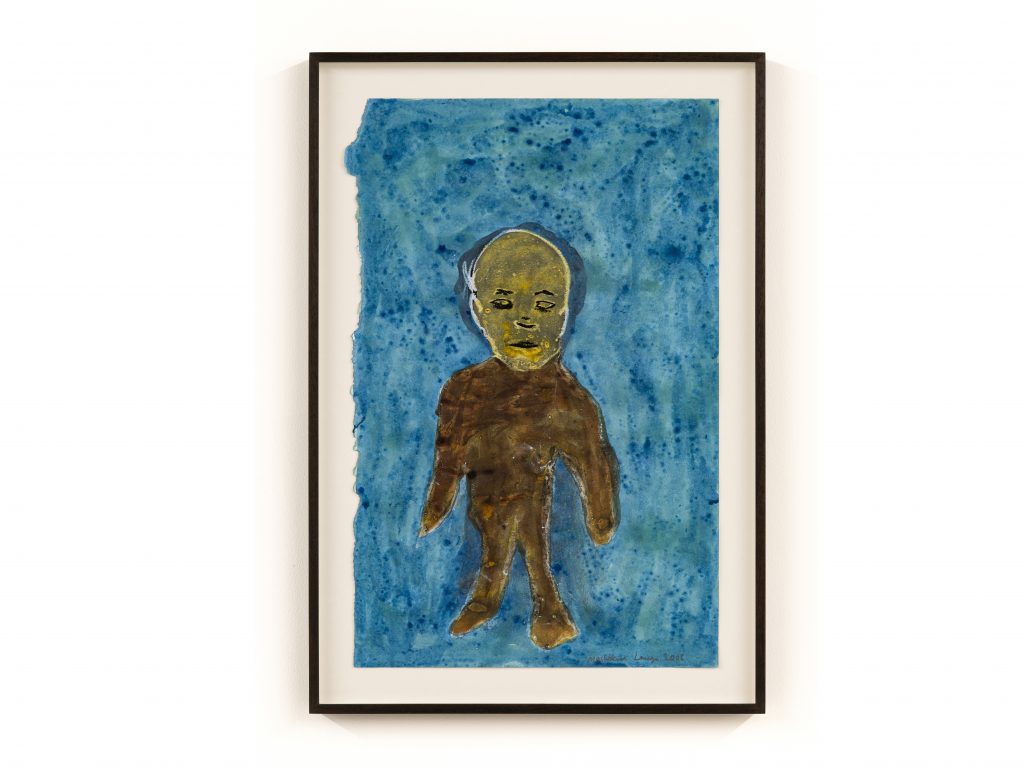
In addition to videos, Langa also works in different types of media, from drawings to photography and from collages to installations. He enjoys experimenting with simple materials such as salt, coffee, receipts, bubble wrap, pigments, cigarette butts, tape, Vaseline, maps, bleach, advertisements, corrugated iron, lacquer, plastic and charcoal.
Most of his work is done on paper. He creates them on the floor of his studio by applying paint in puddles, which extends the drying time and allows room for chance. The texture of his typically abstract works is therefore often thick. Langa layers materials in much the same way he layers meaning in his work.
Langa first came to the Netherlands in 1997 to participate in the Rijksakademie residency programme in Amsterdam. He stood out with work that combined text, sculpture and sound recordings. He initially planned to stay for three more months, but ended up returning to South Africa only intermittently. He had changed and no longer fit into Bakenberg. Amsterdam became his base, though he frequently worked in Paris, Berlin and London.
Missed rent
In 2017, Langa had two exhibitions in Paris, one at Fondation Louis Vuitton and the other at Fondation Kadist. He spent several months in the French capital setting up these exhibitions. This stay ultimately led to the loss of his Amsterdam studio—and with it, all the work he had created since first arriving in the Netherlands.
“I wasn’t earning much at the time, but what I always did was pay my rent in advance. For example, I would pay for the coming year, so I wouldn’t have to worry about it. Even when I left for Paris, I had paid in advance. But as it turned out, I had underpaid by one month. When I returned, I saw my entire studio in a container.” The container had been stored by Langa’s Belgian gallerists. Eventually, Stevenson managed to transfer the collection to Johannesburg. Gallery owner Bosland also recovered other lost work from Athens and London.
Now supplemented with new works, an initial selection from 1997–2017 is on display at Art Rotterdam in Stevenson’s booth. A Langa installation is also on view at the Kunstmuseum in The Hague as part of the New New Babylon: Visions for Another Tomorrow exhibition. It is the first Langa installation acquired by a Dutch museum. A broader overview of Langa’s work will follow in 2026 at Kunstinstituut Melly in Rotterdam.
Written by Wouter van den Eijkel
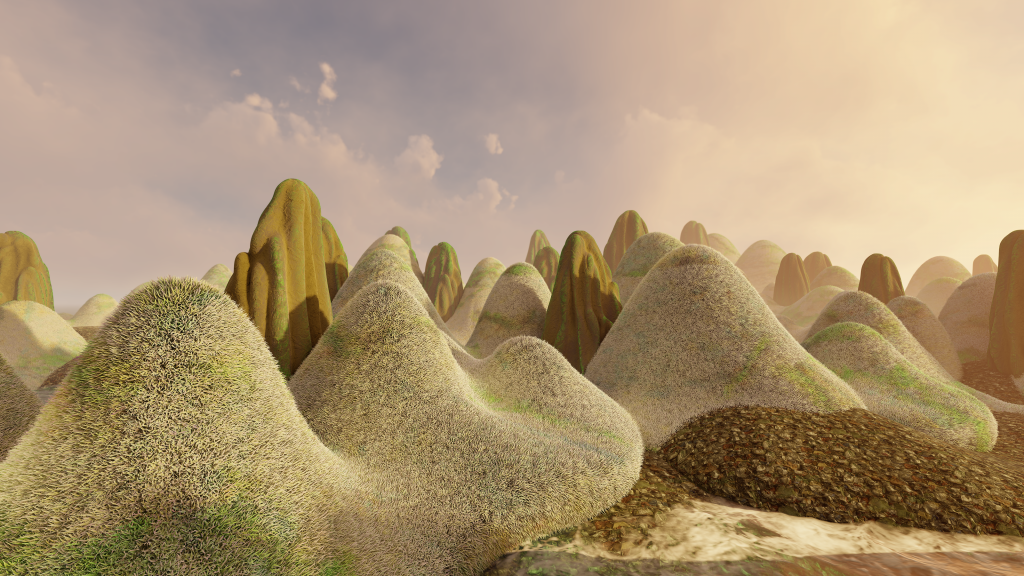
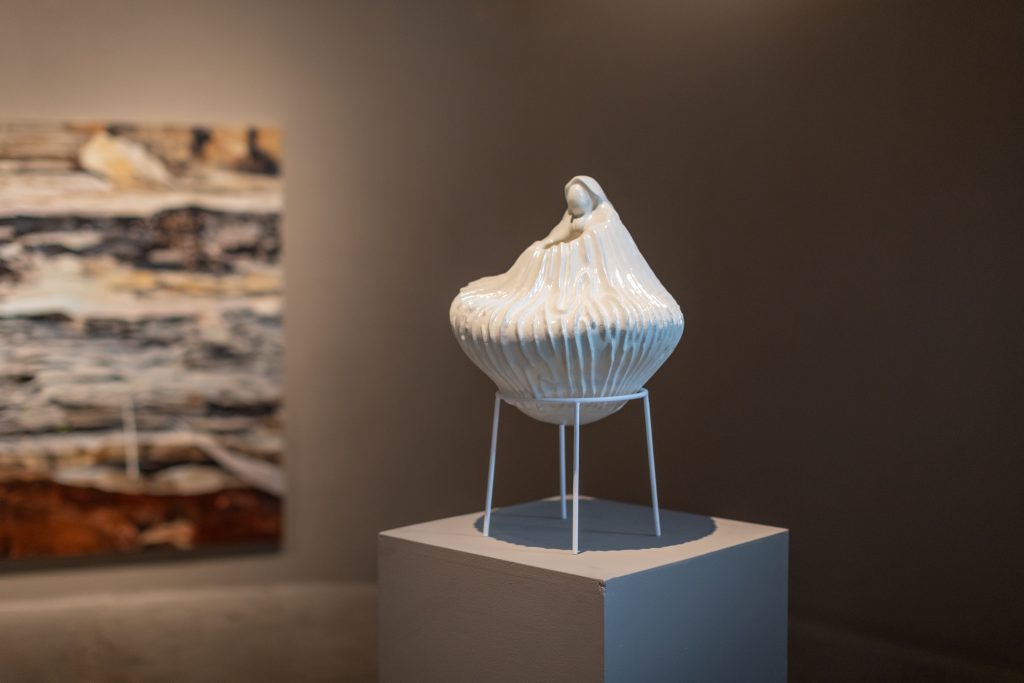
At Art Rotterdam’s Prospects section, Bianca Carague (b.1995, The Philippines) presents the sculpture, Ilog Maria Vessel (2023) and video Maria Islands (2023) from her immersive world Maria Islands (2023), a speculative future where the Philippines expands its territory using imported plastic waste. She creates immersive worlds that feel both serene and unsettling. Her work is dystopian in concept, yet visually soft and spiritual. “Even when I work with critical subjects, like climate change, power imbalance, or mental health, there’s always this softness in how I approach it. That’s just who I am,” she explains
What is the common thread in your practice?
Bianca’s work spans different media – gaming environments, video, sculpture- yet the core remains the same: storytelling through immersive, speculative futures. Her artistic journey began in furniture and interior design in the Philippines, but her desire to create socially engaged work led her to study Social Design at Design Academy Eindhoven. “I started my Master’s thinking I’d be designing things that help people and solve problems. But I quickly realised design isn’t always about fixing things, it can also be about questioning and reshaping narratives,” she says.
Her early projects focused on digital storytelling and interactive environments, but over time, she also felt the urge to bring those fictional worlds into a more tangible, physical dimension. “I think starting with digital made me crave something physical. First, I wanted to touch things. Then, I wanted to smell them. I kept expanding beyond the screen.”
How did you start exploring digital worlds?
During the COVID-19 pandemic, as lockdowns pushed interactions online, Bianca became fascinated with gaming as a space for mental health, emotional care, and spiritual connection. “I had no business playing Minecraft,” she laughs. “But I thought, what if therapy could happen inside a video game? What would that even look like?”
What started as an experiment quickly grew into something much larger and now is a virtual landscape of 3M+ sqm. She built a Minecraft server, Bump Galaxy (2020-2023), for mental health where different environments emerged in response to conversations with players and professionals. “There is a meditation forest where you could plant a tree and watch it grow while meditating, an underwater temple for hypnotherapy, even a snowfield with floating questions about love and relationships.”
While the project began as a response to practical constraints and isolation, it ultimately reshaped the way Bianca thinks about how digital worlds can influence human experience, a perspective that continues to inform her work today.
Your work is very participatory, not just in creation, but also in how it’s experienced. How do you approach that?
“I consider myself an introvert, but I love connecting with people through my work,” she says. Bianca’s work is constantly shaped by the people who interact with it. Whether through community-driven storytelling, gaming collaborations, or audience participation.
One of her participatory projects, Gen C: Children of 2050 (2022), invited young audiences to imagine future societies shaped by environmental change. Over three months, Bianca incorporated ideas from visitors into her work, evolving the exhibition through interactive workshops. In one session, participants entered a virtual simulation where they had to find creative ways to survive in an ocean full of plastic. Most of them immediately thought, ‘We could turn it into islands!’ That idea stuck with her and later became the foundation for Maria Islands. She first presented Maria Islands in 2023 at Nieuwe Instituut in Rotterdam.
When she decided to bring the project to the Philippines, it felt like a natural continuation, as it aligned with real issues the country struggles with. In Manila, she collaborated with fellow artist and studiomate Erik Peters, as well as other Filipino artists, to further develop its world and narrative in two more exhibitions
This participatory ethos extends beyond storytelling into multi-sensory experiences. “For Maria Islands, I also created a fragrance that mimicked what these plastic islands might smell like: ocean, salt, soil, burning tar, and artificial flowers. It was definitely interesting!,” she laughs.
Rather than simply observing, audiences become co-creators of the speculative futures she envisions. “Often, solutions are dictated from the top down. The people most affected by these issues rarely get a say in shaping their own futures. That’s where imagination becomes powerful.”
What will you be showing at Art Rotterdam?
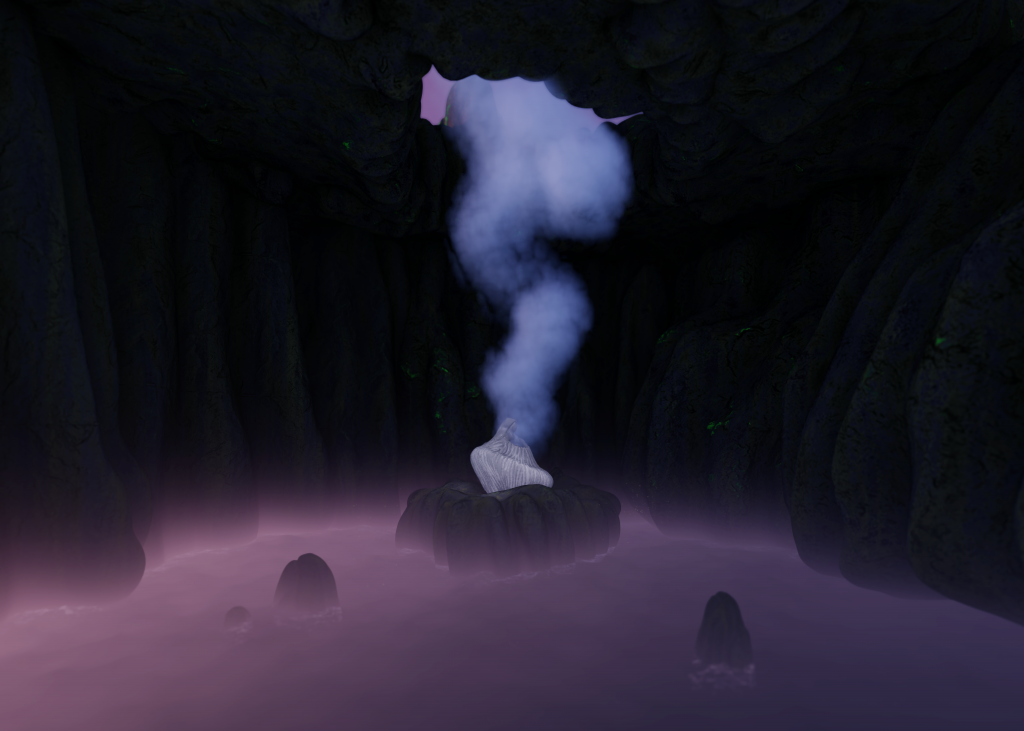
At Prospects, Bianca presents a sculpture and a video from Maria Islands (2023), a project that reflects her personal connection between the Philippines and the Netherlands while addressing global power imbalances in waste distribution. “I’m from the Philippines, but I’ve spent years studying and working in the Netherlands. I wanted to create a project that resonates between these two places, not just personally, but in how they are connected through systems of consumption and waste.”
The video, Maria Islands (2023), speculates on a future where the Philippines expands its territory using imported plastic waste, referencing the real-world practice of Western nations offloading their waste onto the Global South. The Philippines, one of the largest recipients of plastic waste – much of it from the Netherlands – lacks the infrastructure to process the volumes it receives. “It makes no sense because, at the end of the day, waste doesn’t disappear, it becomes everyone’s problem. But in these global power structures, it’s the wealthier nations that get to dictate who bears that burden.”
Rather than simply exposing this imbalance, Maria Islands flips the power dynamic, imagining a future in a video where plastic becomes the foundation for nation-building. “What if, instead of being a symbol of environmental collapse, plastic waste became a resource? What if the Philippines, rather than being forced to absorb waste it can’t process, turned that into power, literally reshaping its territory, its economy, and its future?”
The sculpture, Ilog Maria Vessel (2023), brings this imagined world into physical form, allowing visitors to tangibly engage with her speculative landscape. The Mondrian Fund grant was instrumental in developing Maria Islands. “The grant gave me the opportunity to explore the geopolitical, cultural, and spiritual dimensions of what this speculative future could mean in greater depth.”
Written by Emily Van Driessen
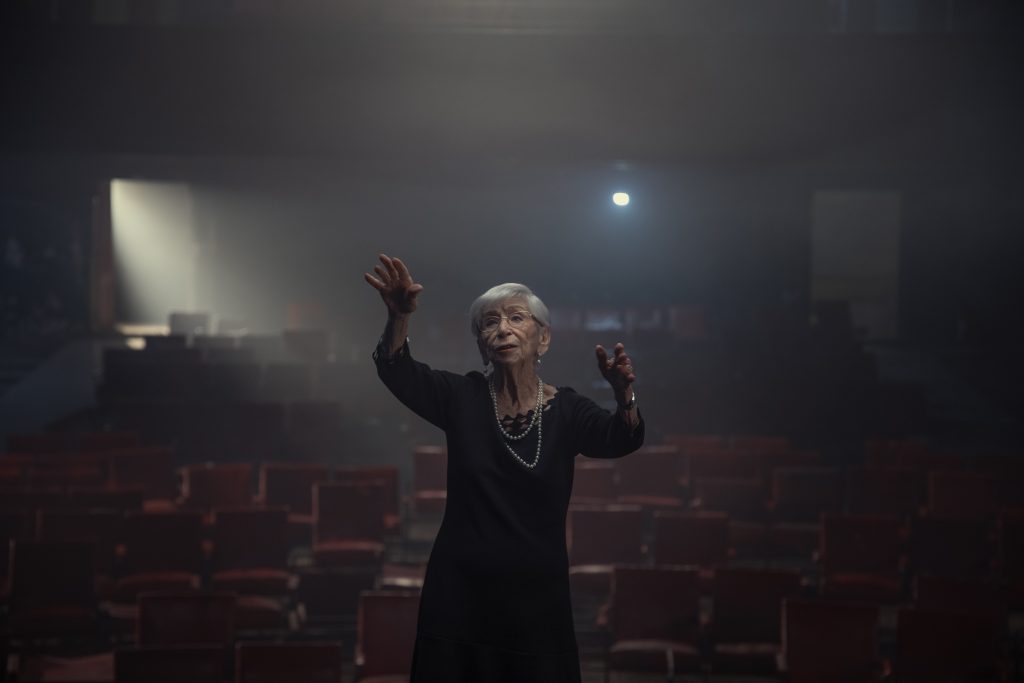
With an uncertain gait, an elderly woman walks down stairs. She is holding onto the banister with her right hand. In the background, a text is shown in a language similar to German and Dutch, but which you cannot quite understand. The lady shuffles to the stage, turns to the empty hall and bows. For a few more seconds, there is silence, followed by music.
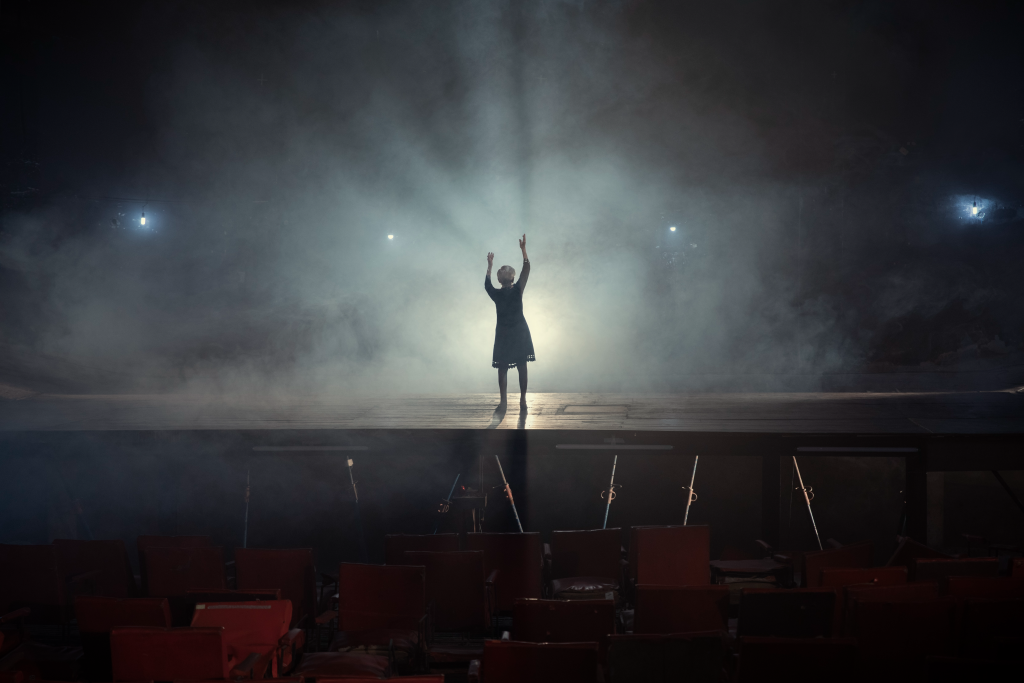
It is the opening scene of Mir Zaynen Do! (We are here!), a new film by Israeli artist Yael Bartana. The film, commissioned by Jewish art space Casa do Povo from São Paulo, Brazil, is on display at Art Rotterdam in the Projections section. A sculpture by Bartana is also on display in Sculpture Park and a solo show of Bartana’s work is on view at the Amsterdam gallery. The artist has been represented by Annet Gelink for more than 20 years. It is her seventh solo exhibition at the gallery and the first since 2020.
Yael Bartana represented Germany at last year’s Venice Biennale with an impressive installation in the German Pavilion as part of a duo presentation with Ersan Mondtag. Her presentation was complex and extensive, covering three rooms of the pavilion and marked by contrasts: optimism and pessimism, utopia and dystopia, sci-fi and age-old traditions.
In the first, green-lit room was a seven-meter-long scale model of a spaceship. The other rooms included the film Farewell, drawings and a 3D model of the spaceship. In those spaces, it became clear what the spaceship was referring to: offering visitors a way out from a world on the brink of ecological and political destruction somewhere in the near or not-so-distant future.
The press hailed the German pavilion as one of the highlights of the Biennale. The New York Times included it as one of the ‘8 Hits of the Venice Biennale’. Other leading publications mentioned the German pavilion among their highlights, including The Art Newspaper and ARTnews.
Yael Bartana (Israel, 1970) studied at the Bezalel Academy in Jerusalem and came to Amsterdam in 2001 to participate in the Rijksakademie residency programme. Her work has been exhibited at numerous locations around the world and is included in the collections of the Centre Pompidou, Guggenheim, MoMA, Tate and Walker Art Center in Minneapolis. In the Netherlands, her work has been acquired by the Stedelijk Museum Amsterdam, Kunstmuseum and Van Abbemuseum. Bartana lives and works in Amsterdam and Berlin. In her films, installations, photography and performances, she explores issues of national identity, trauma and displacement, often through ceremonies, memorials and public rituals.
Mir Zayen Do! is no exception. Many of these elements are covered in the 11 minutes of the film. For example, the language we hear is Yiddish and the theatre where it is filmed is Casa do Povo’s auditorium, which was one of the strongholds of resistance to Brazilian dictatorship in the 70s. The older lady – dressed in black with a pearl necklace – is the conductor of Coral Tradição, a Yiddish choir from Casa do Povo that has been singing lullabies and protest songs for decades.
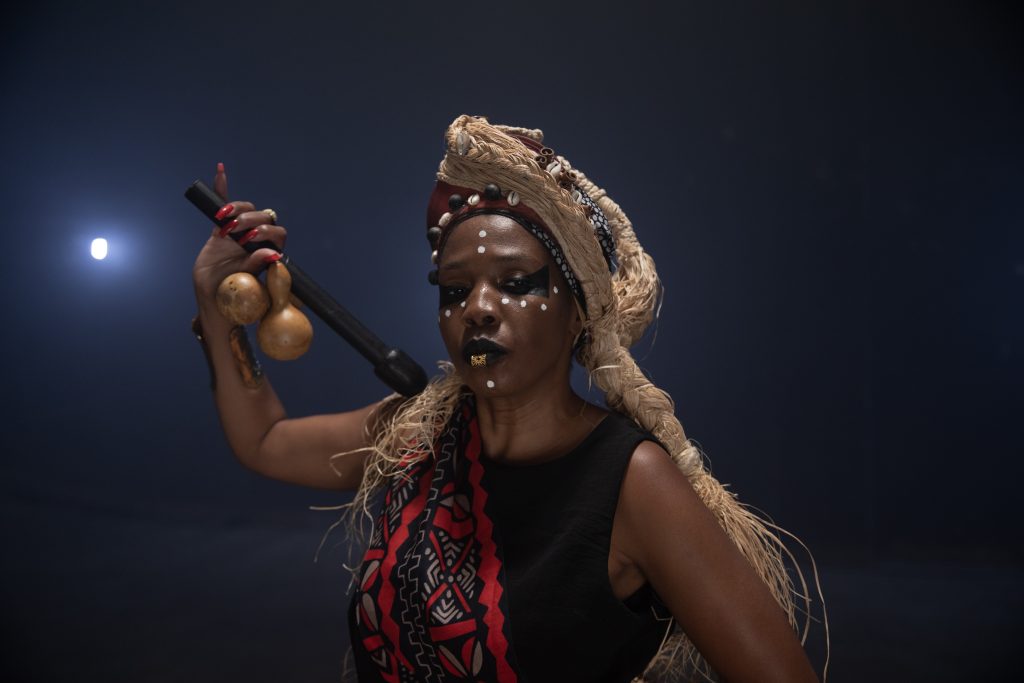
After a few minutes, other people appear in the doorway: someone wearing a halo made of branches, a black man with a bare torso and long skirt and a woman who appears to be wearing a traditional West African robe. They are members of llú Obá De Min, a women-led Afro-Brazilian percussion group that plays music connected with their ancestry. They sit down in the dilapidated theatre seats.
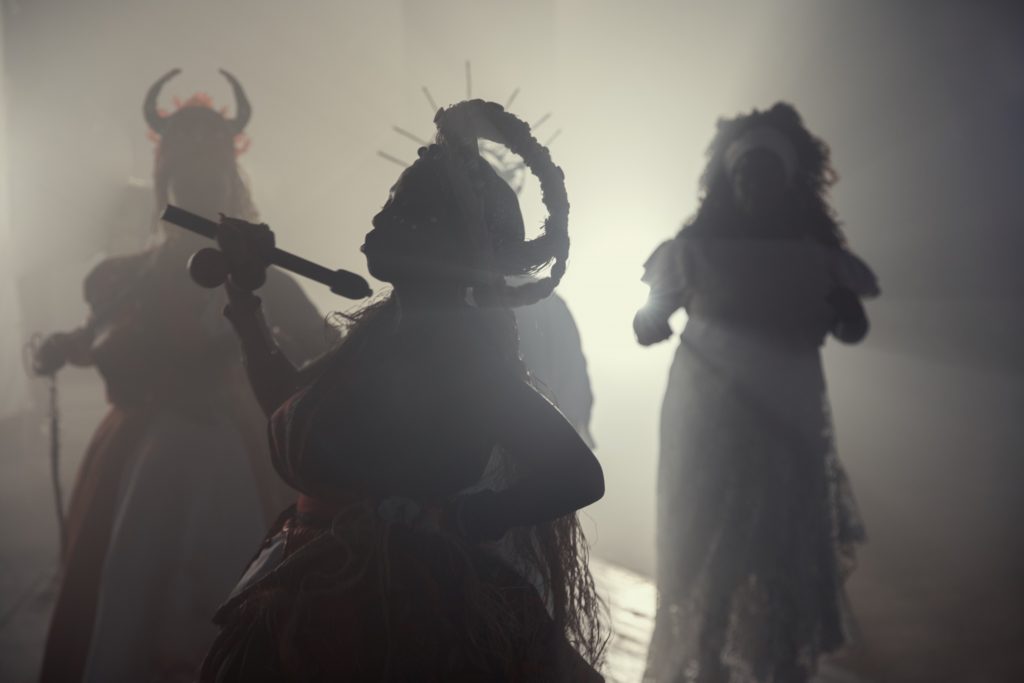
The film introduces us to two groups that share a common diasporic identity, even though we know they have very different histories and realities. They were both displaced (or forced to move from their home countries), but managed through collective singing and music to preserve their culture, beliefs and rituals to continue to survive.
The title is a direct quote from a Yiddish poem known as the Hymn of Partisans (Hirsch Glik, 1943). It can also be understood as an appeal to those left behind. But given how the film ends, this title can also be considered encouragement to develop new identities – on top of the old ones – in a relatively new environment. During the second half of the film, a hybrid of Ilú’s drumming and the choral singing of Coral Tradição is heard and the boundaries between the two are blurred.
– Mir Zaynen Do! by Yael Bartana can be seen at Art Rotterdam from 27-30 March in the Projections section.
– The gallery exhibition will be on view from 15 March to 10 May at the Annet Gelink Gallery in Amsterdam.
Geschreven door Wouter van den Eijkel
At Intersections during Art Rotterdam, Ellen de Bruijne PROJECTS presents Le Lente Passioni (2023) by Pauline Curnier Jardin (b. 1980, France). It’s a theatrical and immersive installation that dissects the spectacle of belief. Part confessional, part campsite, part domestic space, the work explores how Catholic rituals persist, evolve, and adapt – particularly when displaced into digital space.
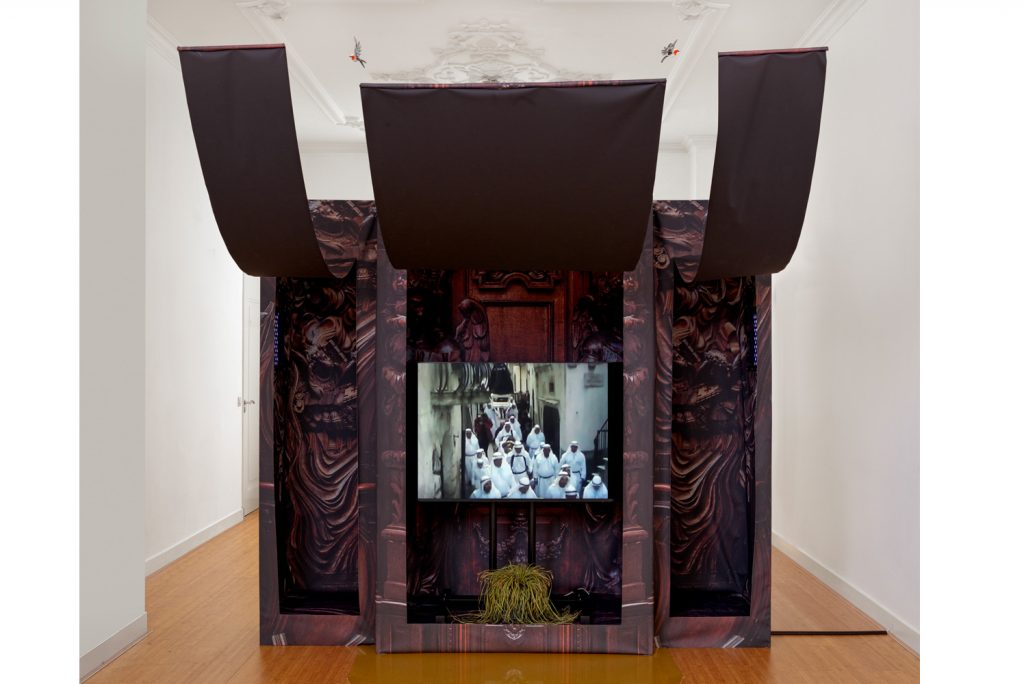
For over 15 years, Pauline Curnier Jardin has built a practice shaped by theatricality, excess, and transformation, moving fluidly between film, performance, and installation. “It’s always been about what is staged and who is the spectator of that spectacle,” notes Sergi Rusca, gallery curator at Ellen de Bruijne PROJECTS. Born in Southern France and having lived in Italy for many years, her work is infused with the ritualistic intensity of Catholicism, the theatricality of devotion, and the ways in which faith is both deeply personal and inherently performative.
For Le Lente Passioni, Pauline assembled video footage from ethnomusicologists’ archives, capturing Easter processions across Catholic Europe. These rituals were forced onto screens during the first Italian lockdown. Worshippers, unable to gather, adapted: kneeling before televisions, singing alone in their homes, sharing recordings online. These images of faith, fragmented yet enduring, show how devotion is mediated through technology, while still demanding bodily endurance and presence.
Women in Rituals
Curnier Jardin has long been drawn to female archetypes, particularly those at the intersection of power, devotion, and marginalisation: the nun, the virgin, the witch. These figures, deeply embedded in pagan mythology and Christian iconography, have been both revered and feared, often as a means of controlling the female body.
“You see this synchronism of references in her work,” says Rusca. “Pagan elements merge with Christian icons, creating these out-of-this-world characters that sit between the divine and the profane.” Her work revisits these figures, the saint, the martyr, the accused witch, to see how their narratives can be retold, and how they can break out of the roles assigned to them.
This interest in the female body’s suffering and devotion is particularly visible in Fat to Ashes (2019), an earlier work in which Pauline intertwined three ritualistic events: a Catholic festival honouring Saint Agatha, the slaughter of a pig, and Cologne’s Carnival. “Saints are venerated through their pain, Saint Lucia, whose eyes were removed; Saint Agatha, whose breasts were cut off.” In Sicily, Agatha is still remembered through the ritual consumption of breast-shaped pastries.
These acts – sacrifice, transformation, and excess – connect bodily endurance, ritualistic repetition, and the boundaries between the sacred and the grotesque. Le Lente Passioni continues this inquiry, shifting the focus from physical rites to their fragmented digital afterlives, where devotion persists even when bodies are absent.
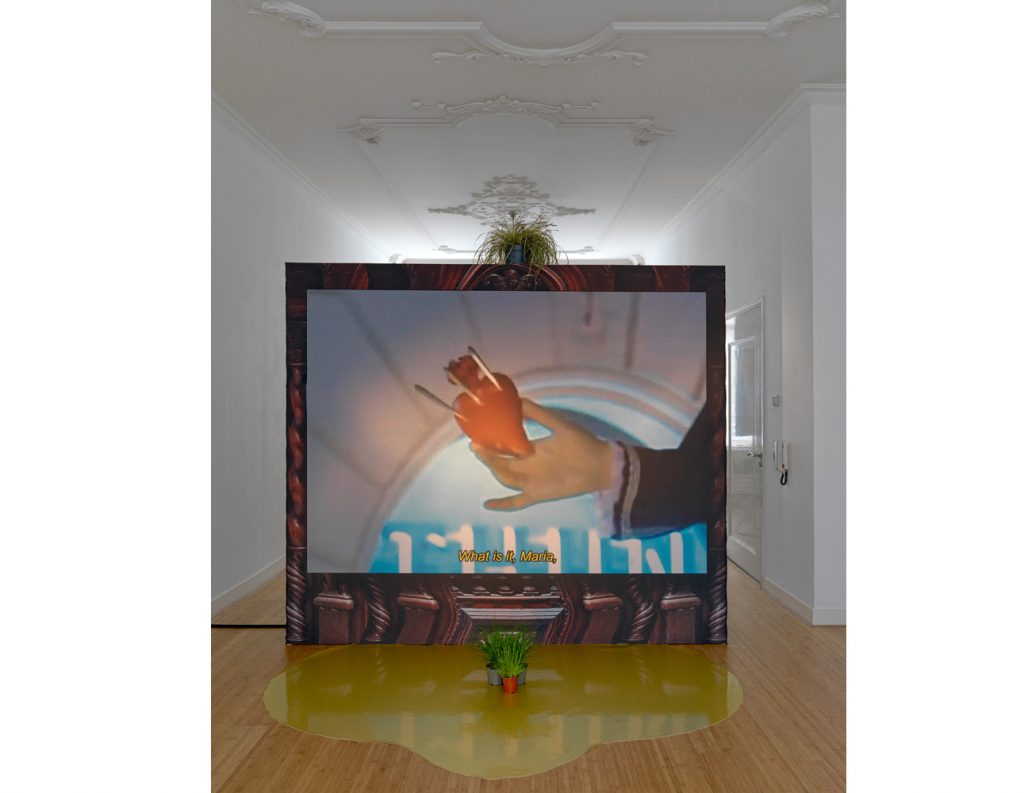
Flesh and Faith
“Christian imagery constantly returns to the aching body, the wounded flesh,” Rusca explains. Catholicism is a faith of the body, where martyrdom and devotion trough pain are integral to its rituals. This is not just theological but theatrical; the blood, the wounds, the endurance of the flesh are spectacles in themselves.
In Le Lente Passioni, these elements manifest in bodies crawling on their knees, rhythmic chanting, and the visceral presence of suffering. “Even in digital form, these rituals still involve endurance, still demand something of the body,” notes Rusca.
The installation itself echoes this tension between intimacy and spectacle. The pierced heart-shaped confessional window disrupts the traditional division between priest and believer, observer and participant. The heart at the centre of the installation reinforces the tripartite and is a direct reference to Christ’s crucifixion.
Triptych Structure: Confessional, Campsite, Domestic Space
Le Lente Passioni’s tripartite structure reflects Christian numerology. “The number three is crucial in Christianity,” says Rusca. “The Holy Trinity, the three days between death and resurrection, even the medieval belief in three nails used to crucify Christ.”
In Le Lente Passioni, this sacred structure is reinterpreted. At the front, the installation resembles a campsite, a space where absurdity collides with the weight of the religious imagery inside. Moving inward, a confessional window with a baroque altar print opens onto a television screen, where devotion plays out on-screen. At its core, a glowing TV replaces the altar, reflecting the replacement of physical rituals with digital participation.
Within the film itself, this layering continues. “Inside the video, it’s a TV within a TV,” Rusca notes, referring to believers watching mass online, their faith refracted through screens. The installation asks: what happens when faith is displaced? How does it endure when stripped of its collective, embodied experience?
The wounded heart, a site of devotion and suffering, endures, even as the rituals around it shift.
Written by Emily Van Driessen
For the ninth consecutive year, the NN Art Award will be presented in 2025 to a promising artist showcasing their work at Art Rotterdam. This year’s nominees are Diana Scherer (andriesse eyck galerie), Marcos Kueh (Prospects section of the Mondriaan Fund, courtesy of Galerie Ron Mandos), Pris Roos (Mini Galerie) and Bodil Ouédraogo (Prospects section of the Mondriaan Fund). The work of the four nominees will be on view at Kunsthal Rotterdam from 15 March until 11 May 2025.
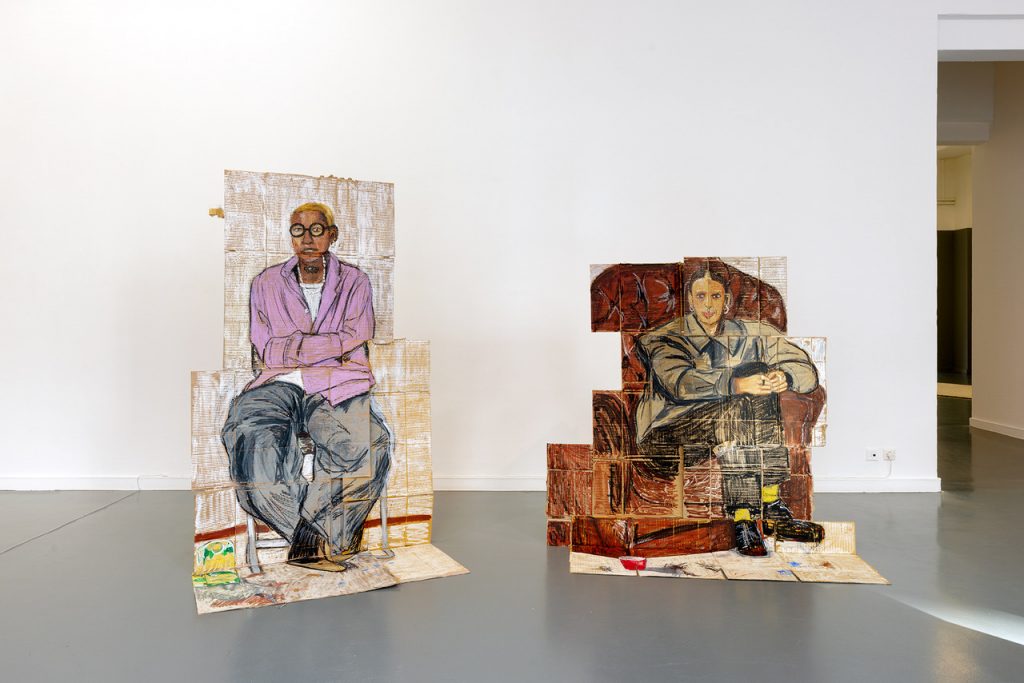
Pris Roos (1984) is a multidisciplinary artist, researcher and storyteller. Her practice moves between painting, spoken word, video, performance and installation. She explores themes like identity — including her own lived experience as a queer woman with a bicultural background — migration, (chosen) family and memory. Weaving together personal narratives with those of others, she amplifies voices of people who, like herself, navigate multiple cultures and identities. In doing so, her work forms a bridge between individual histories and a shared collective memory.
A key source of inspiration is her childhood spent in her family’s toko, a small Indonesian grocery store run by her relatives who emigrated from Indonesia to the Netherlands. For Roos, the toko is more than just a store; it is a piece of Indonesian heritage, a meeting place where different cultures converge, and where scents and colours blend. To this day, she regularly helps out in the store, both to support her parents and to remain connected to these communities. This notion of shared stories and social networks is a recurring theme in her work, where close observation and deep listening skills become essential tools. Roos works with remarkable intimacy, which is particularly striking given that she finds it more difficult to have these kinds of conversations with her own parents, who rarely speak about their family history.
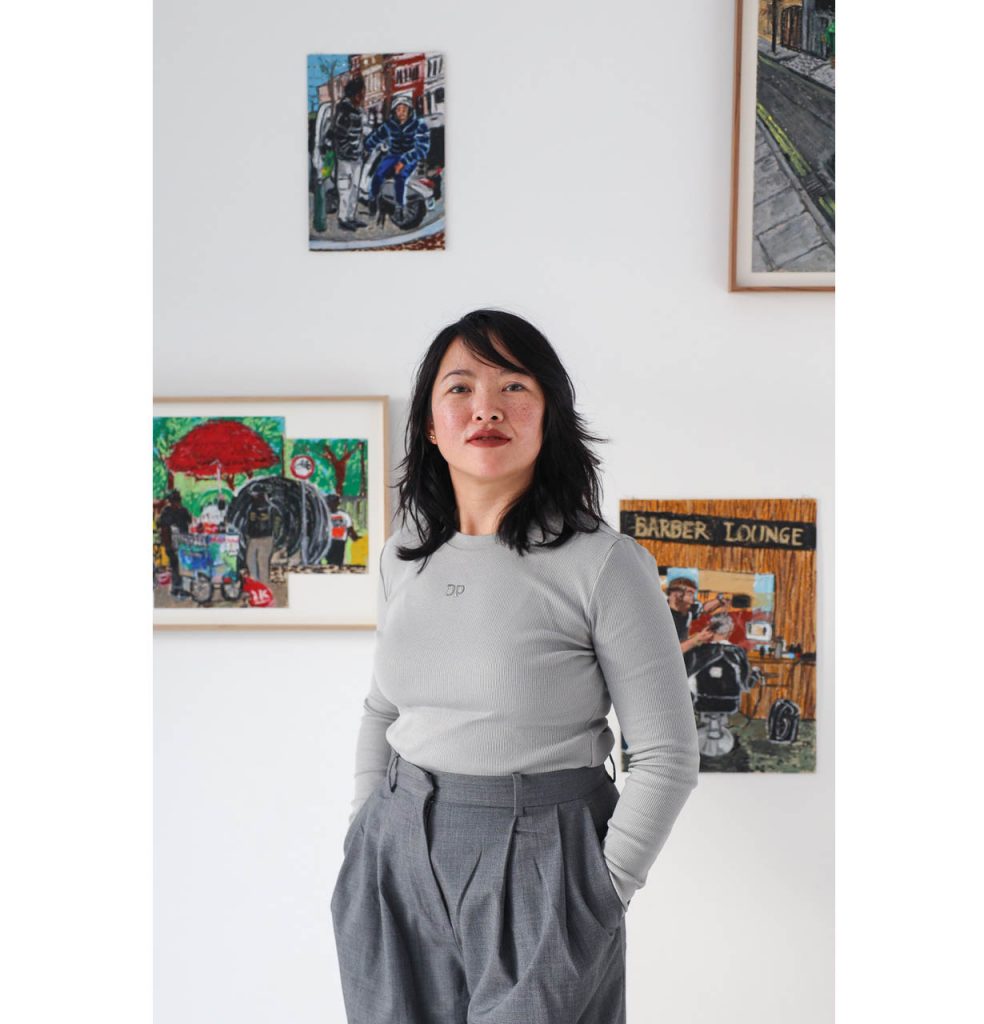
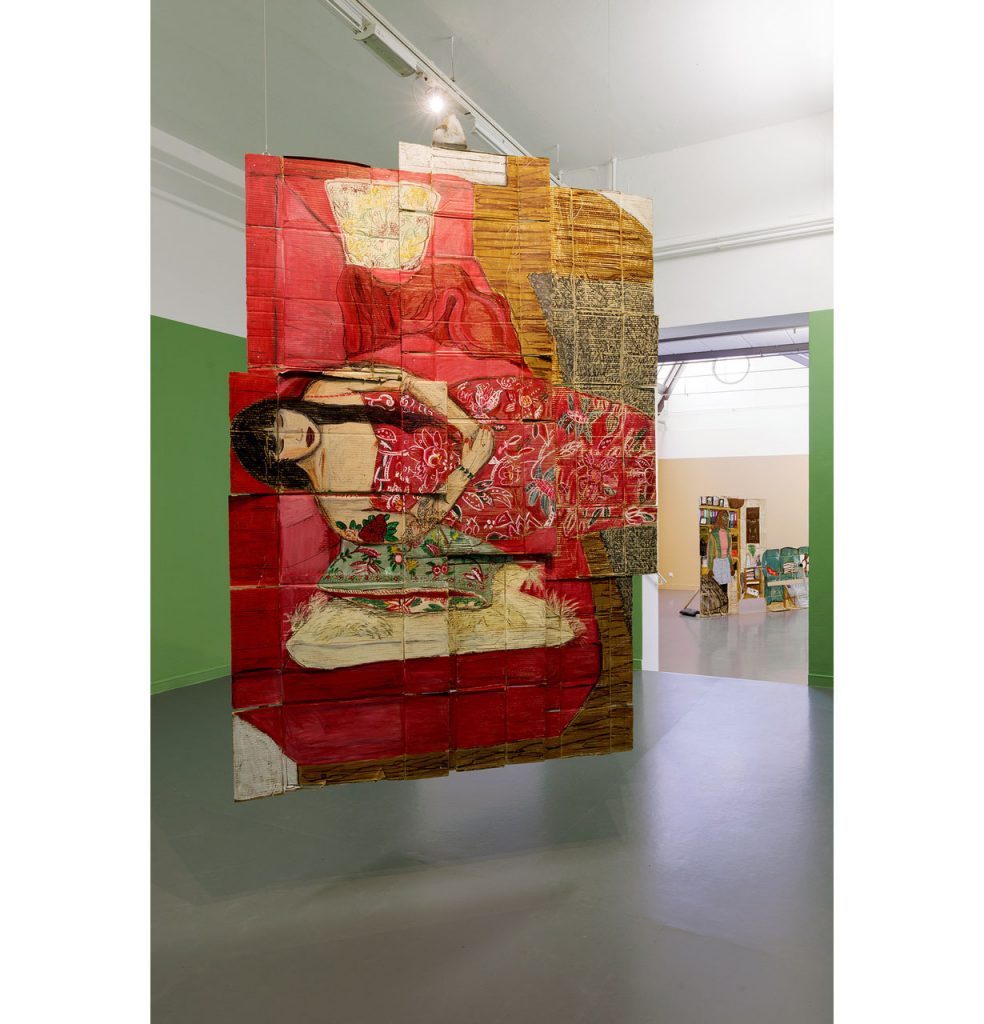
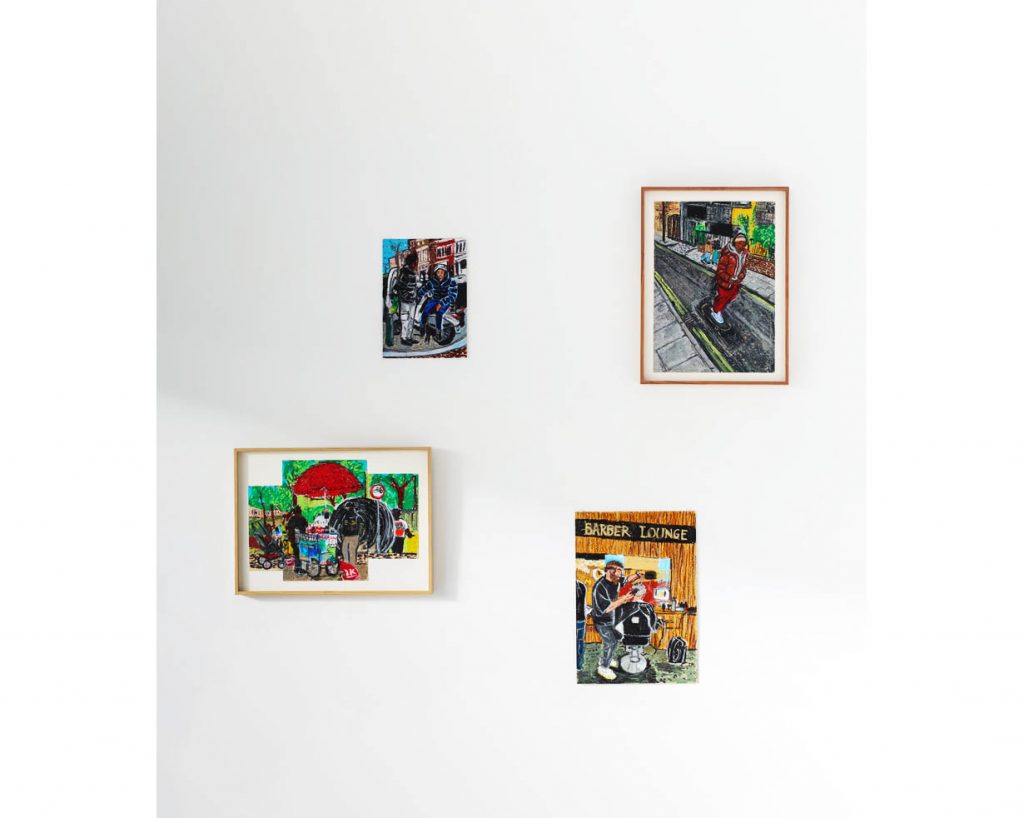
Roos’ work is deeply social and narrative-driven. Her portraits and installations are not distant or detached; they are intimate reflections of the people she encounters. She frequently works with everyday materials such as cardboard, brown canvas and kraft paper, layering them in ways that lend her work a raw, textured quality, echoing the dynamic nature of the stories she tells. She combines traditional techniques with elements of street culture, pop culture and activism. Spoken word and sound also play a role in her installations, which brings them alive in a vivid way.
Can you tell us more about the work you are presenting at Art Rotterdam and Kunsthal?
The works I am presenting at Art Rotterdam and Kunsthal explore representation, gathering and everyday life. At Kunsthal, I will showcase large-scale cardboard installations depicting people in their own living spaces — individuals the audience may not know but whom I have come to know intimately through conversations and regular meetings. Together, we spoke about family, identity and key moments in their lives. To me, they are role models, the unsung heroes of the world. At Art Rotterdam, in Mini Galerie’s booth, I will present smaller works featuring various street scenes. The street has always felt like home to me — a space where so many different people come together. It reflects the everyday. In that sense, my work is quite direct and straightforward.
What are your plans for 2025?
In 2025, I plan to create my own picture book about my parents’ toko. [This year, Roos’ first children’s book PRIS – De Toko will be published by Uitgeverij de Harmonie, ed]. The story follows my mother, who suddenly disappears from the toko, prompting a search for her through a fantasy world in which the shop is transformed. The illustrations depict products from the store, such as yardlong beans, turmeric and bami soup. My work is often rooted in portraiture and my surroundings, but this time I am embracing imagination and constructing my own worlds, which feels both exciting and challenging. I also want to create life-sized installations based on these illustrations and develop an accompanying exhibition. Additionally, I have exhibitions planned in Zaandam and Paris, a visit to the Liverpool Biennial, and I will also take some time to rest.
How did you feel when you heard you were nominated for the NN Art Award?
I was surprised and honoured to be nominated alongside such incredible artists.
If you won the award, what project would you pursue immediately?
With the prize money, I would further explore my family history. Like many children of immigrants, I am deeply interested in my family’s background and stories, but these are rarely spoken about. This would be an opportunity to delve deeper into that history and discover it, along with father. I would travel across Java, observing people and street scenes, engaging in conversations, and creating portraits — in the country that carries the history of my ancestors.
Pris Roos earned her Bachelor of Fine Arts from the Royal Academy of Art in The Hague, including an exchange programme in Bremen, and completed her Master’s degree at the Hochschule für bildende Künste in Hamburg. In 2020, she was appointed City Illustrator of Rotterdam. Her work is part of the collections of Stedelijk Museum Schiedam, the Dutch Government, and the Rotterdam City Archives. From 21 February until 11 May, her work will be featured in the exhibition ‘Collective Joy – Learning Flamboyance!’ at the prestigious Palais de Tokyo in Paris. Previously, she has exhibited at institutions such as Kunsthal Rotterdam, the Van Abbemuseum, TENT Rotterdam, Framer Framed, MAMA Rotterdam and the Amsterdam Museum.
Beyond her artistic practice, Roos is also active as a curator, activist and educator. She initiates art projects that connect communities and engages young people in her work, encouraging them to reflect on their own position and identity. Together with Hannah Jacques, she founded a travelling children’s library that has been stationed at various locations in Rotterdam and The Hague. This library is filled with books and graphic novels that allow children to see themselves reflected in stories. This book collection features works on topics such as identity, gender, sexuality and climate — offering an important alternative to the predominantly white and heteronormative perspectives children are often exposed to. This not only provides them with more choice but also fosters greater awareness of themselves and the world around them.
The winner of the NN Art Award 2025 will be announced on Friday 28 March at 20:00 in Kunsthal Rotterdam. During this celebratory evening, all exhibitions, including the NN Art Award exhibition, will be freely accessible to attending guests.
Written by Flor Linckens
For the ninth consecutive year, the NN Art Award will be presented in 2025 to a promising artist showcasing their work at Art Rotterdam. This year’s nominees are Diana Scherer (andriesse eyck galerie), Marcos Kueh (Prospects section of the Mondriaan Fund, courtesy of Galerie Ron Mandos), Pris Roos (Mini Galerie) and Bodil Ouédraogo (Prospects section of the Mondriaan Fund). The work of the four nominees will be on view at Kunsthal Rotterdam from 15 March until 11 May 2025.
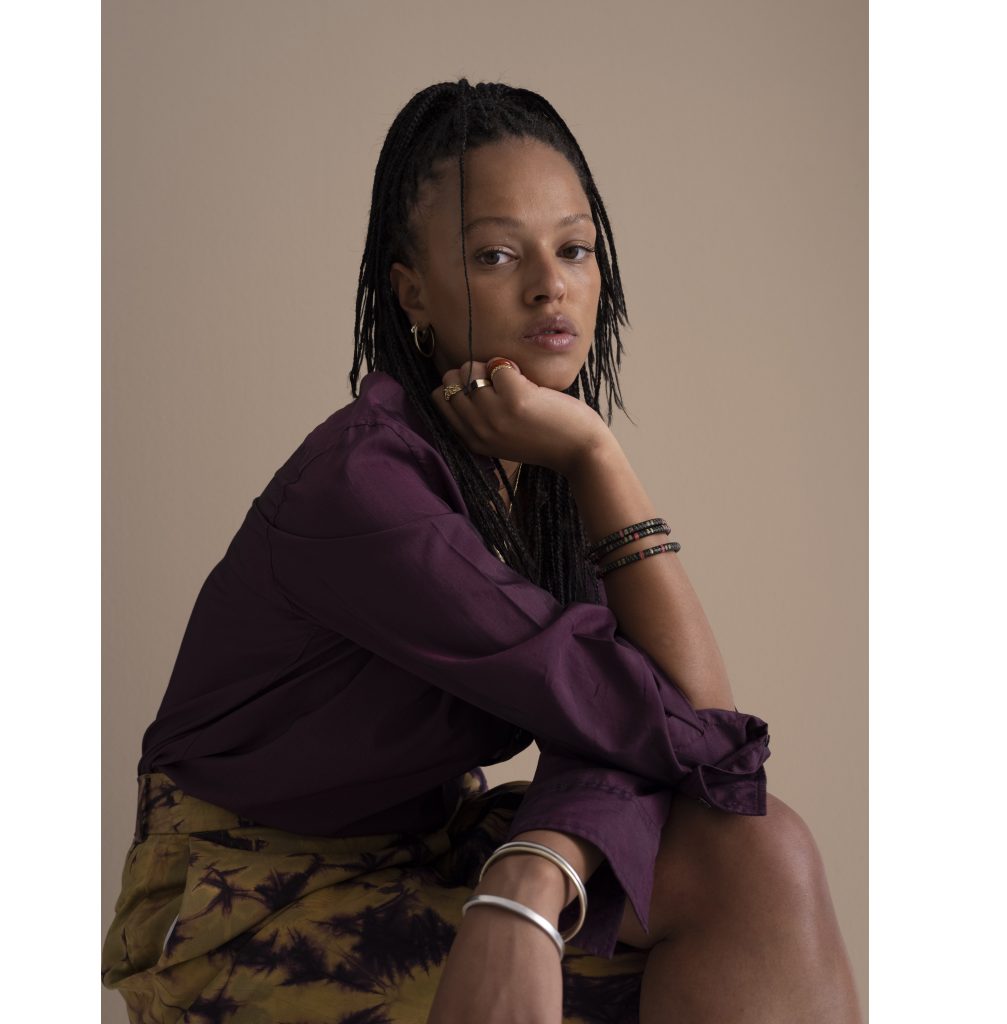
Bodil Ouédraogo (1995) is an interdisciplinary visual artist with a focus on the art of dressing up. Her layered work explores how we assign value and status to objects or people. She examines different ‘cultural tools’ that assign value or legitimacy to objects or people such as framing, preserving, distancing. She tries to dissect these tools, and reuse them to create movement in how we experience fixed ideas about people or objects. For Ouédraogo, the art of dressing up is far more than just clothing — it is a cultural context, a language that intertwines historical and social meanings. Drawing from her bicultural background, with roots in both the Netherlands and Burkina Faso, she weaves together materials, techniques and cultural references from West Africa and Europe into sculptural objects and installation created not only to be seen but also to be experienced. She approaches her practice in distinct artistic chapters, each investigating different aspects, while often combining cultural elements that may initially seem worlds apart.
A recurring thread in her work is the way we present ourselves in spaces, with clothing serving as an archive of heritage and identity. Ouédraogo seeks ways to honour all parts of the self, with a particular interest in those who came before us. Her installations and performances — where textiles, dance, photography, video, sound and sculpture come together — give rise to new narratives. They become innovative, hybrid forms, in which fashion operates as a conceptual and critical medium.
Ouédraogo does not view identity as a collection of isolated elements, but rather as a network of interconnected stories that form a whole, effectively seeking connections. Through her work, she seeks to render this complexity visible, while rediscovering aspects of identity that have been forgotten or overlooked. She examines the interplay between various cultural aspects within Black culture and the European Afro-diaspora. Her multidisciplinary practice generates a rich, layered materiality in which the art of dressing up comes to life. Moreover, when her work becomes part of a shared reality, it creates a collective experience.
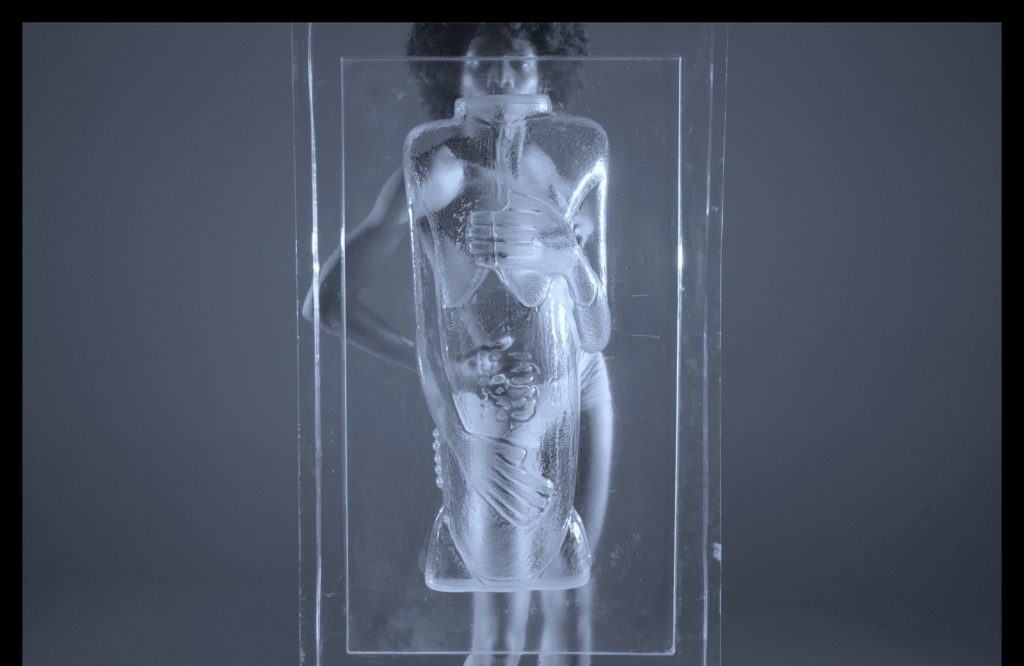
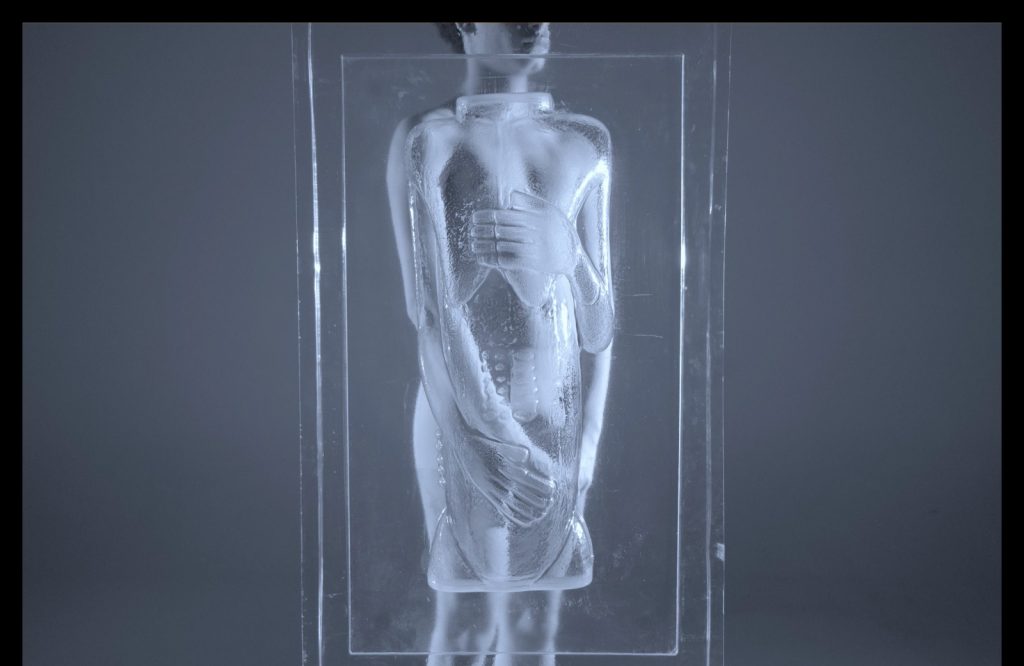
In her latest research she is fascinated by traditional West-African sculptures and ways of posing, bearing and positioning the self. Many of these artworks were taken to Europe as looted art and contain details that inspire her. At Art Rotterdam, Ouédraogo will present 3D-printed sculptures in PLA (a biodegradable plastic), cast aluminium and coloured glass, in collaboration with professional studios such as Audrey Large, Studio Lemarez, and Van Tetterode Glass Studio. These objects explore the relationships between bodies and show how materiality can contribute to a new meaningful connections with who went before us. For these pieces, Ouédraogo translates West African traditional wooden sculptures from the private collection of her father Mamadou Ouédraogo into a contemporary context, where she delves deeper into the boundary between human and sculpture.
Movement plays a crucial role in her installations. During Amsterdam Fashion Week and at the Stedelijk Museum, she presented performances in which dancers wore semi transparent grand-boubou, a three piece suit onto which projections were staged. Here, the body acts as a living archive, engaging in dialogue with fabric, movement and form. Fashion thus becomes a dynamic medium, continually taking on new meanings.
Ouédraogo’s practice is rooted in intensive research into the history of the self, and ways of self presenting. She is informed by research about the art of dressing up in the Afro diaspora as well as in West Africa, where she combines family visits with research on the art of dressing up in Burkina Faso, as well as in Mali, Ghana and Nigeria. She translates this knowledge into a visual language that is both deeply personal and universally resonant.
At Art Rotterdam, her work will be on view in the 13th edition of Prospects, an initiative by the Mondriaan Fund. This exhibition presents work by 116 artists who received financial support in 2023 to aid them in the start of their careers. The section is curated by Johan Gustavsson and Louise Bjeldbak Henriksen. Explore all Prospects artists here.
Can you tell us more about the work you are presenting at Art Rotterdam and Kunsthal?
In my work, I aim to find connections in different cultural ways of ‘self presenting’. I examine different ‘cultural tools’ that assign value or legitimacy to objects or people. I try to dissect these tools, and reuse them to create movement in how we experience fixed ideas about people or objects. I try to shuffle the environment by presenting an alternative that allows another perspective. I try to show an alternative hierarchy than the one usually presented. I’m doing this by combining styles that uplift and question each other. Together they give me a broader, more grounded vision on how to be rooted.
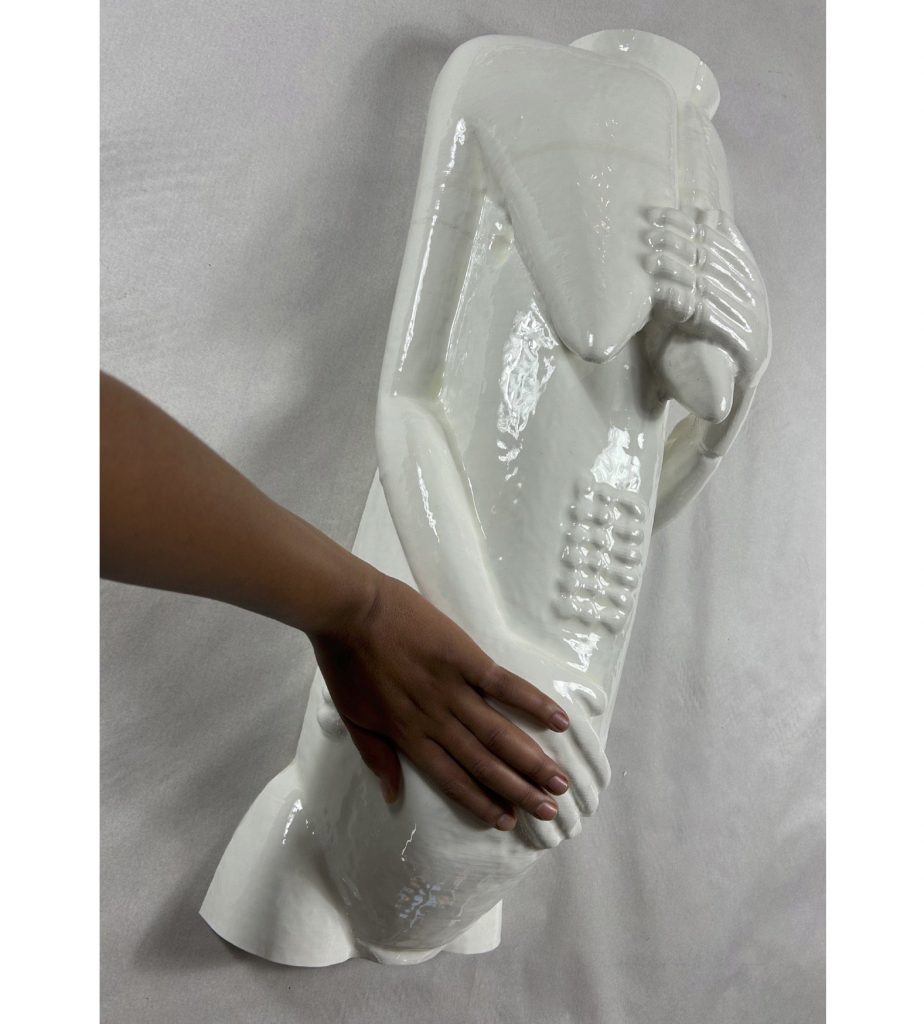
For the works that I’ll show at Kunsthal and Art Rotterdam, I do that by embodying African wooden art from the personal collection of my father, Mamadou Ouédraogo. In these pieces, parts of our heritage, you see how the people who went before us used to present bodiesthroughsculptures. What can I learn from the way these bodies pose? How can we stand in line with those who went before us? How do you visualise an imagination where all these parts are layered and transparent? I think that trying to portray all these parts of the self and giving light to forgotten or neglected parts of the self, asks for radical imagination. It’s a matter of taking up space, by presenting an alternative where you show that you are overly connected.
My work is an exploration of posing, bearing and positioning yourself. A longing for those who lived before us. Longing to express togetherness through material heirlooms. I try to capture the human intimacy of West African traditional sculptural wooden art. Expressing the generational connection by enlarging different intimate poses to human size. I propose to give them space in the present.
What are your plans for 2025?
I would like to delve deeper into the boundary between human and sculpture, how can I bestow these sculptures with an equal sense of dignity? I look forward to developing new techniques and challenging myself in the workshop. My aim is to create a visual experience where I can portray an alternative reality. To create something that cannot be placed in a particular category. An unfamiliar, science fiction reality. In October, my work will be shown in a solo exhibition at Melkweg Expo in Amsterdam.
How did you feel when you heard you were nominated for the NN Art Award?
It is special to experience that people see what you do and believe in it. I feel blessed to be able to achieve this trust. I would like to thank the NN Art Award for the special opportunity. The fact that we will also exhibit our work in Kunsthal Rotterdam is wonderful.
If you won the award, what project would you pursue immediately?
I would love to explore and develop glass and aluminum casting techniques, as these are valuable materials. Winning would grant me the freedom to fully develop my ideas.
Bodil Ouédraogo studied Fashion at ArtEZ and the Gerrit Rietveld Academie in Amsterdam, where she still lives and works. In 2019, she won the Dutch Design Award in the Young Designer category, and in 2022, she received the Amsterdam Prize for the Arts. Her work “My Hair, a Border” is part of the collection of the Stedelijk Museum, where it is currently on view in the permanent collection display ‘NOW – 1980’. Her work has also been presented at the Gwangju Biennale 2024, Dutch Design Week, the TextielMuseum, Het Nieuwe Instituut and Framer Framed. Additionally, Ouédraogo designed a collection for fashion house Patta. In 2023, she was named one of the fifty FD Talents of the Year by Het Financieele Dagblad.
The winner of the NN Art Award 2025 will be announced on Friday 28 March at 20:00 in Kunsthal Rotterdam. During this celebratory evening, all exhibitions, including the NN Art Award exhibition, will be freely accessible to attending guests.
Geschreven door Flor Linckens
Ivan Gallery from Bucharest will present the work of Shahin Sharafaldin at Art Rotterdam (28-30 March 2025). His work will be shown in the New Art Section, which was curated by Övül Ö. Durmuşoğlu. In his paintings, Sharafaldin explores representations of masculinity and queer identity, deliberately challenging overly homogeneous and simplistic depictions. His figurative practice navigates the space between intimacy and monumentality, with a focus on the physical and the imaginary.
Sharafaldin’s sensitive and layered work delves into themes of friendship, homosexuality, connection, desire and utopian ideals, while also offering a critical reflection on the ways in which identity is shaped and perceived. His approach to queerness is distinctly intersectional: he is fascinated by its nuances, depth and complexity, viewing it through the lens of class, race, gender and nationality. This perspective also compels him to examine broader societal structures, such as heteronormativity and patriarchal power dynamics.
Sharafaldin’s vivid oil paintings are composed with a carefully calibrated palette, creating a sensuous tension that balances strength and vulnerability. His figurative canvases depict both idealised and everyday scenes: a dreamlike figure reclining on a rock, an unguarded moment in a bedroom, or an explicitly erotic encounter between two bodies.
The setting often plays a crucial role in his work. Sharafaldin deliberately pushes the boundaries between private and public spheres, sometimes allowing the background to take centre stage. In some paintings, the viewer is offered a still, intimate glimpse into shadow-filled rooms. Melancholic, sometimes even oppressive interiors, where absence becomes a palpable presence. Tattered curtains rippling in soft light, beds that seem to carry the weight of memory — these are recurring motifs in his paintings.
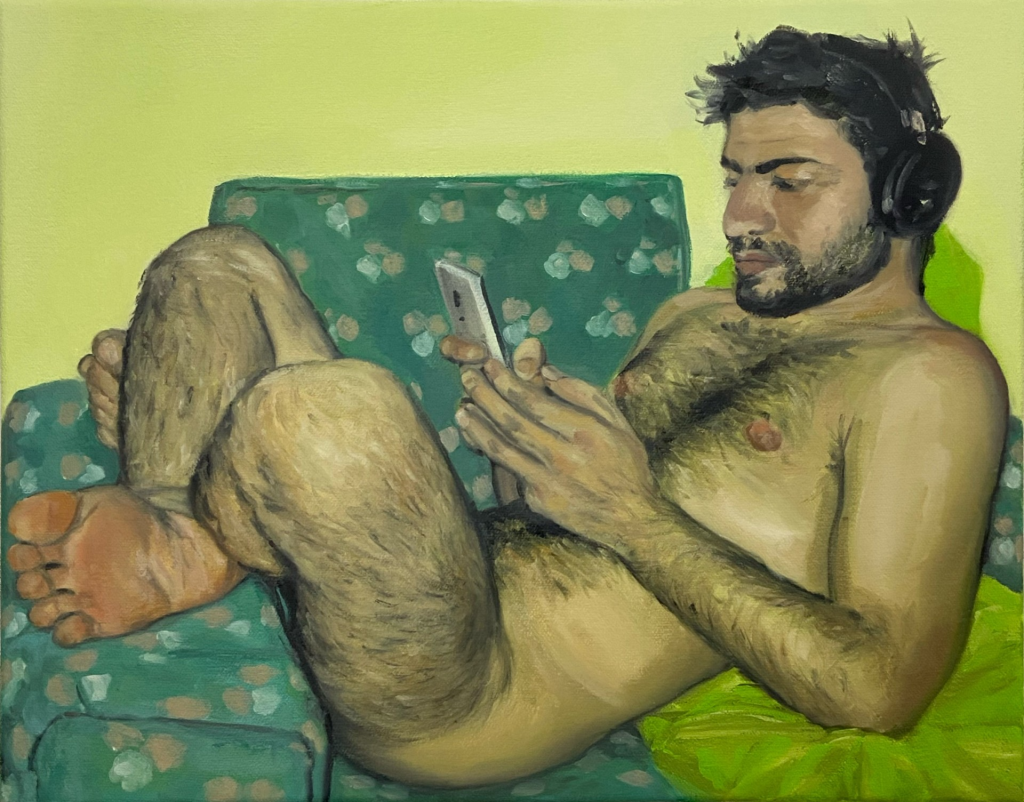
Sharafaldin also portrays homosexual bodies that simply exist. In “Heatwave” (2023), a work that will be exhibited at Art Rotterdam, he presents a nude figure that isn’t posing for the gaze of another but is just existing in a moment of repose — a subtle yet resonant expression of queer representation. The composition shows a nude male figure reclining in a lounge chair, immersed in complete relaxation. The scene exudes an air of nonchalance and self-contentment, with the figure entirely turned inward. The way Sharafaldin renders the body — hairy, at ease, in an unselfconscious pose — stands in stark contrast to traditional representations of masculinity in art history. This is not a heroic or idealised nude but rather a candid moment of contemporary life.
Sharafaldin’s painterly technique accentuates the interplay between realism and expressivity. Loose, visible brushstrokes add texture to skin and fabric, while the contours of the body are rendered with meticulous precision. The surrounding green tones in the background and upholstery envelop the figure, creating a sense of unity with the space. The smartphone in his hands and the headphones on his head anchor the work firmly in the present, reinforcing a sense of introspection and isolation.
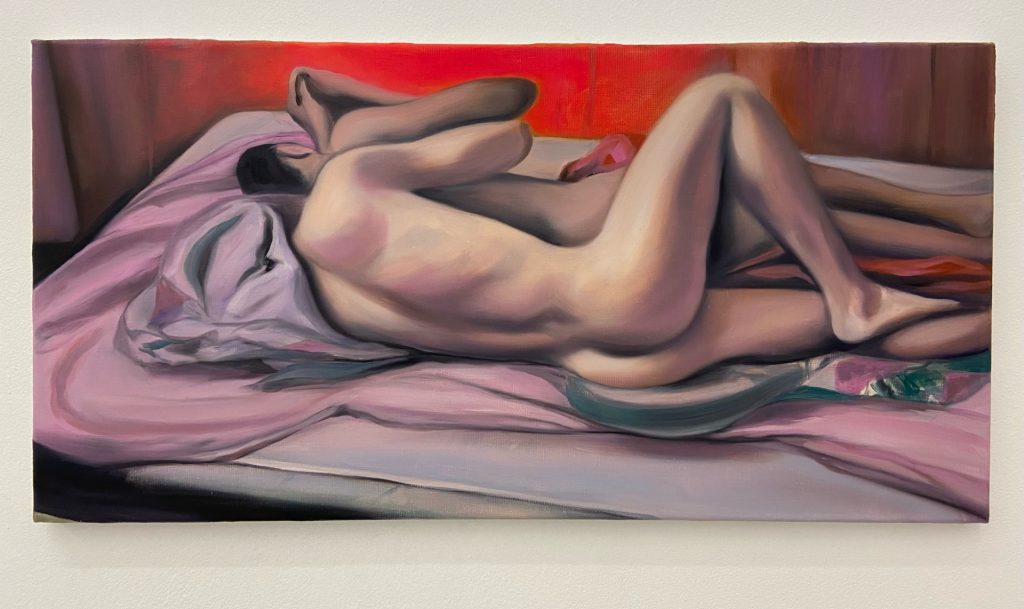
At times, Sharafaldin’s work evokes echoes of classical painting traditions — baroque chiaroscuro, symbolist undertones, a vitalist energy — while simultaneously integrating contemporary queer perspectives. Through this layered approach, he challenges both the conventions of art history and the norms of queer representation.
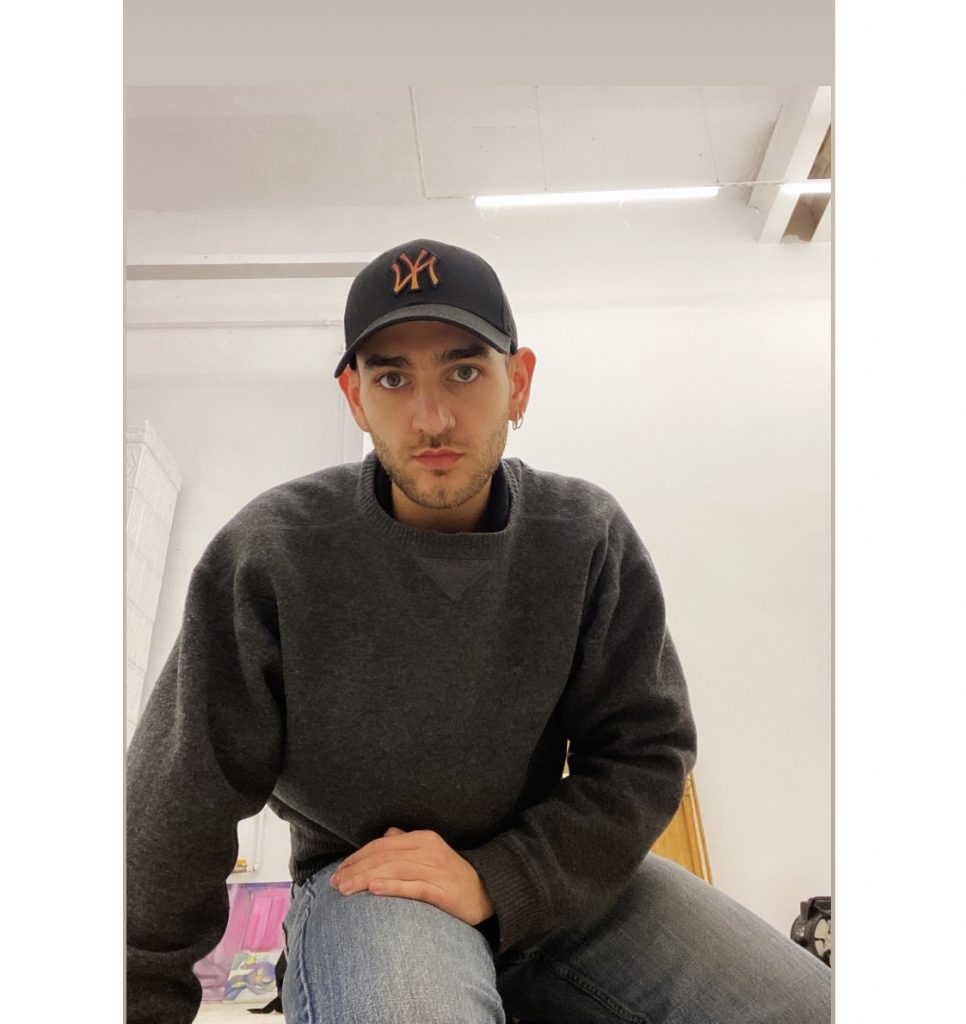
Shahin Sharafaldin was born in Vancouver in 1995. He lived in Montreal until recently: he relocated to London last summer. He studied Fine Arts and Curatorial Practice at Emily Carr University of Art + Design in Vancouver and in 2016, he spent a period at the Willem de Kooning Academy in Rotterdam. His work has been exhibited in Canada and the United States, and in 2021 he completed a residency at Céline Bureau in Montreal. With his participation in Art Rotterdam, he makes his debut in the Netherlands, placing his work within a broader European context.
Shahin Sharafaldin’s work will be presented by Ivan Gallery in the New Art Section at Art Rotterdam.
Written by Flor Linckens
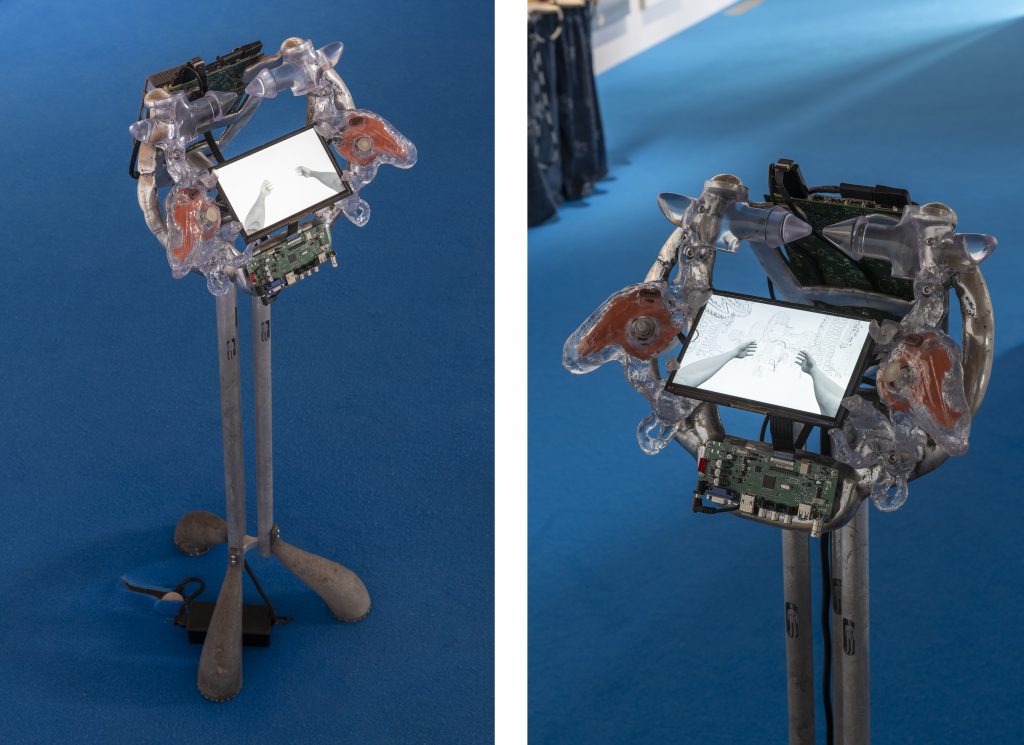
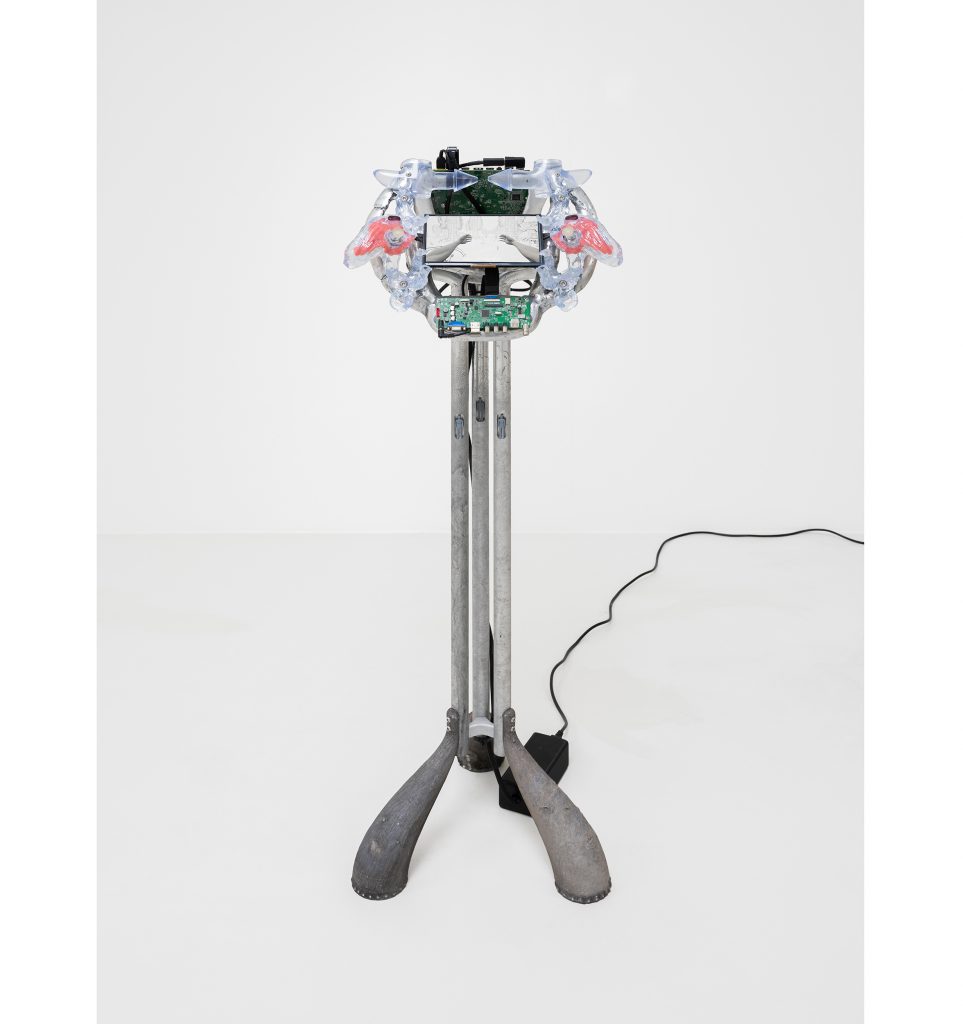
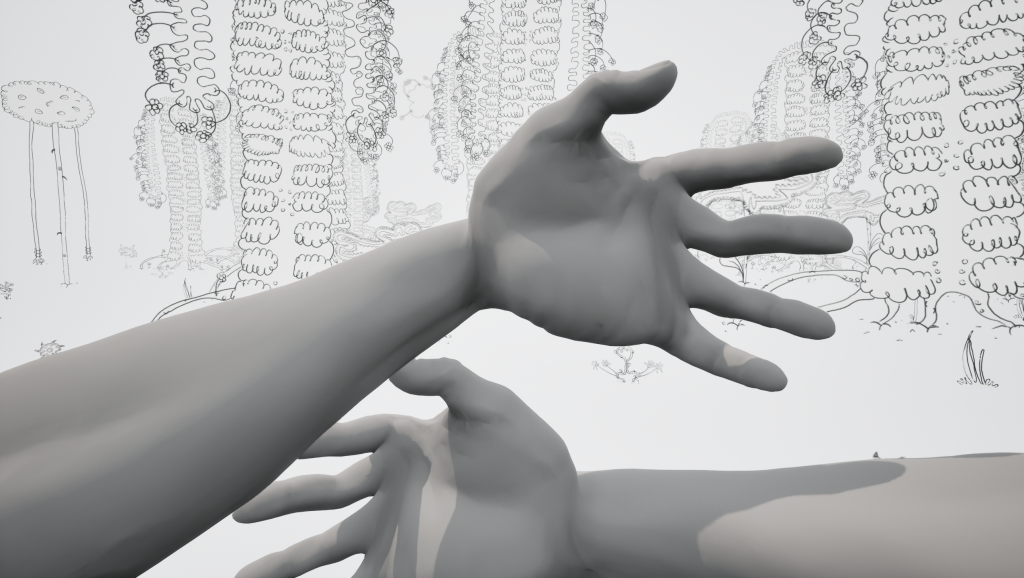
Through his work, artist Janne Schimmel (b. 1993, The Netherlands) bridges the digital and physical worlds, exploring gaming and technology from a fresh perspective. This year, he is presenting Between Modder and Mud (2024) in the Prospects section of Art Rotterdam, a gaming sculpture featuring a self-designed game that invites interaction and reflection.
What is the common thread in your work?
“Gaming has always played a role in my work,” Janne explains. “What fascinates me is the contrast between how game worlds are designed and how gamers shape their physical spaces. Take World of Warcraft, for example: a richly detailed, magical world filled with crystals and spiritual elements. Yet, the typical gamer’s room is often minimalist and sleek, with LED lighting, streamlined furniture, and cold, industrial consoles. These two worlds are in stark contrast, and in my work, I aim to bring them together.”
His sculptures expose this tension and challenge the conventional design of gaming hardware. “The devices we rely on to connect with the digital world are often designed to convey power and speed, while softer, more emotional qualities are rarely considered. I want to change that narrative.”
Why is gaming hardware and design often so limited aesthetically?
“I think it stems from our performance culture,” says Janne. “In the 1990s, during LAN parties—gatherings for computer enthusiasts—gamers would come together to showcase the fastest and most powerful computers. They would open the side panels of their cases to proudly display the hardware inside. This led to an aesthetic centred around components that exude strength and speed.”
In his sculptures, he literally exposes these components—motherboards, processors, and graphics cards—but contrasts them with materials such as crystals, jewellery, and stones. “By placing these opposing elements side by side, I want to highlight how narrow the aesthetics of gaming hardware have become and create space for something softer, something less rational.”
He also sees the influence of patriarchal structures in this. “The idea that hardware must be powerful and masculine leaves little room for emotions and softer aesthetics. A lot of these traditional ideas are still deeply ingrained.
Gaming is often seen as a solitary activity, but in your work, you highlight the power of gaming communities and user-generated content. Can you elaborate?
“Gaming is much more than an individual experience,” Janne emphasises. “The strength of communities lies in the sharing of knowledge and creativity. A great example is the modding community, where gamers modify existing games. This started in 1993 when the developers of Doom made their code public, allowing players to make their own modifications. That moment changed the industry forever.”
Janne also speaks highly of the homebrew community, where people create entirely new games for old consoles like the Game Boy or Nintendo DS. “What I find so inspiring about this is how the community reactivates outdated technology and challenges the commercial gaming industry. But perhaps even more importantly, they create space for their own stories. The mainstream gaming industry is still dominated by white men, who tend to tell a very singular type of narrative. Homebrew creators break through that. In doing so, they rewrite and repair the stories that are being told.”
These communities are a direct source of inspiration for Janne. He also incorporates their shared techniques and code into his own games. On his sculptural consoles, visitors can not only play his self-made games but also games created by others in these communities, such as LesbiAnts, Toni Catino, a game about lesbian ants. “Just the title alone is genius,” he laughs. “It’s the perfect example of a story that would never emerge from the mainstream industry. These kinds of games show why these communities are so important.”
How has the Mondriaan Fonds grant influenced your work?
“The grant gave me the freedom to explore my creative processes in greater depth,” says Janne. A significant part of the funding was used to invest in a CNC machine, which allows him to cut digital designs with organic shapes into wood and other robust materials with extreme precision. But what fascinates him most is that the process does not end with the physical form.
“I first turn my digital designs into physical 3D objects. Then, I scan those objects back into a digital model and share them with the community. They can integrate these models into their own designs or 3D print them, bringing them back into the physical world. This creates a continuous exchange between the digital and the physical.”
This principle of reuse is also reflected in his design pieces. “One of my sculptures started with an IKEA chair I’ve had since I was 11 years old. When the armrest broke, I repaired it by casting a new one in aluminium. That repair later inspired the sculptural forms of my design chairs and benches.”
What will you be showing at Art Rotterdam?
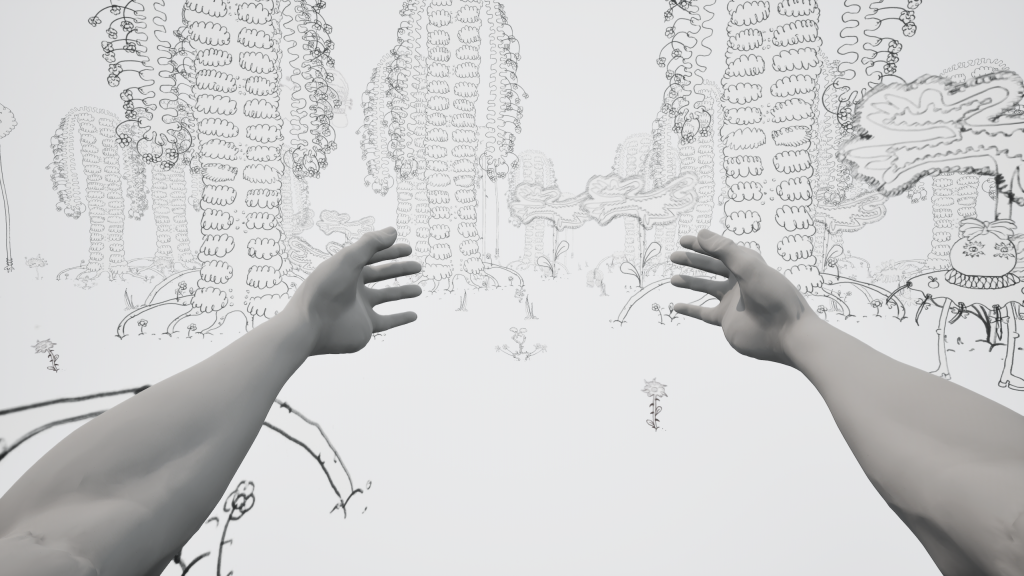
At the Prospects section of Art Rotterdam, Janne is presenting Between Modder and Mud (2024), a gaming sculpture where visitors can play his self-developed game First Person Hugger (2024).
“I wanted to create a game where compassion takes centre stage. In many commercial games, violence is a central element, and I don’t think that’s necessarily a bad thing,” Janne says. “I grew up with it too, but if I were to create the same thing now, it wouldn’t add anything new. In First Person Hugger, you don’t see the world through the barrel of a gun, as in a traditional first-person shooter, but through open arms. Instead of shooting, the player’s main interactions are hugging and talking.”
This idea was sparked by a moment that has always stayed with him. “I was gaming as a teenager when my mother walked in. She saw a bouquet of flowers in the game and said, ‘Give those flowers to a woman.’ But the only thing I could do was use them as a weapon. That made me realise how limited in-game interactions often are. I want to create something that offers a completely different perspective.”
Written by Emily Van Driessen
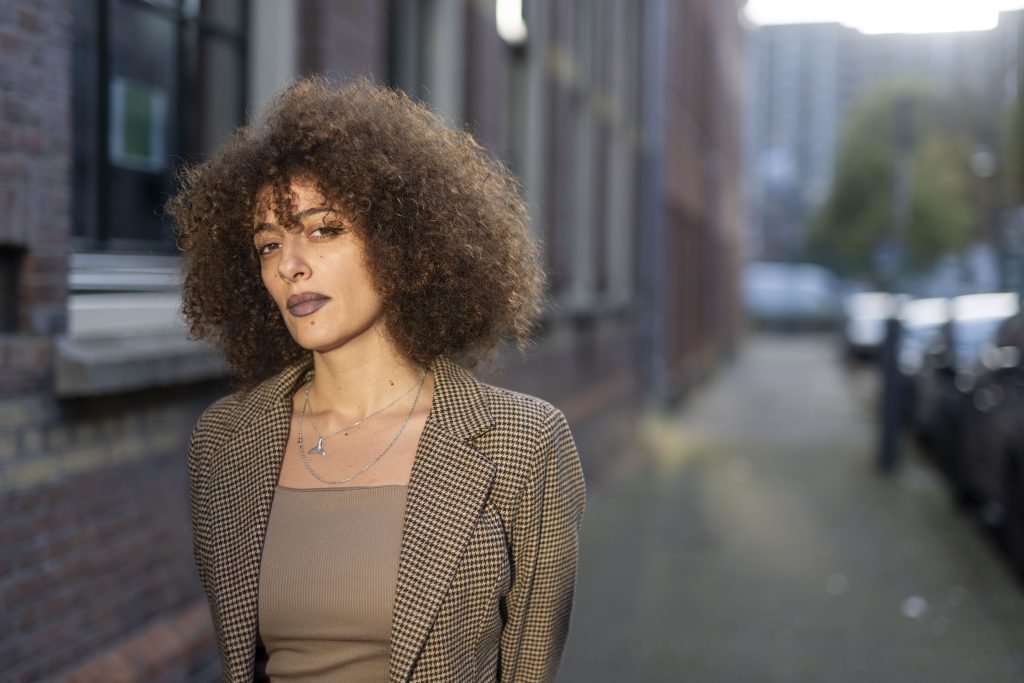
The work of Diana Al-Halabi (1990, Lebanon) is deeply personal and political. She speaks about hunger, war, and dehumanisation with clarity and urgency, her voice unwavering. Her latest works at Art Rotterdam Prospects, Clean Cut (2024) and Blow Up (2025), confront themes of power, oppression, and the ways in which violence is sanitised and dismissed.
Throughout the interview, a small, fluffy green parakeet called Bubu flutters around her, chirping, pressing tiny, tender kisses to her lips – bringing a fleeting lightness to the conversation.
What is the common thread in your work?
“My practice is interdisciplinary; I can’t call myself only a filmmaker or only a painter,” Diana explains. The medium she chooses is always dictated by the urgency of the subject matter. “If I’m speaking about something that is happening right now, I have to respond differently than when I’m dealing with something from the past.”
Diana’s work critically examines power structures rooted in verticality; systems where power is imposed from above. “I work against anything that comes top-down. That means oppressed versus oppressor, colonised versus coloniser,” she says. This tension is central to her practice, where she usually moves from the deeply personal to the larger political framework in which these dynamics play out.
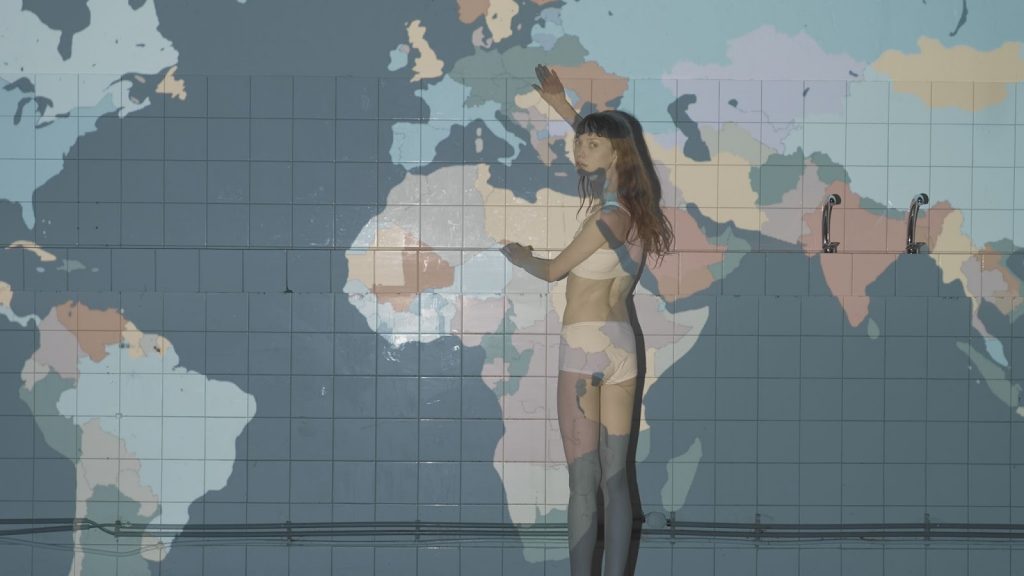
But in her film The Battle of Empty Stomachs, the process was reversed. “I had been researching this project since 2021, trying to juxtapose two types of political hunger,” she explains. “Famine is a top-down mechanism, it comes from the government, imposed on the people. Hunger strikes, on the other hand, move in the opposite direction, from the individual prisoner up, as an act of resistance.”
But as she worked on the film, reality caught up with her. “I asked myself, what do I actually know about hunger? Nothing, right? The biggest thing I knew was fasting. That’s it.” Then, starvation in Gaza escalated. “Witnessing a genocide with political starvation while making a film about hunger was overwhelming. It was happening in real time.”
The grant by Mondrian Fund supported the creation of that film, right?
“Yes, The Battle of Empty Stomachs was supported by both Mondrian Fund and the IFFR RTM Pitch Award. The award money was strictly for production costs, so Mondrian Fund personally helped me during the creation process,” Diana notes.
Her research spanned two years, while the film itself took about six to seven months to make. But after its completion, she found herself needing to shift mediums. “I write everything in my films, even the poetic texts. But at some point, language started to feel too constrained. Words were too small, too narrow for what I was witnessing.”
This return to painting resulted in Clean Cut, 2024, a work that she will show at Art Rotterdam Prospects.
What influenced the creation of Clean Cut?
“As I was reading Bertolt Brecht’s 1935 essay Writing the Truth, Five Difficulties, there was a passage that captivated me about people wanting to critique fascism but not capitalism,” Diana says. “Brecht compares it to wanting to eat veal without seeing the calf being butchered, and being satisfied as long as the butcher washes his hands. That struck me deeply.”
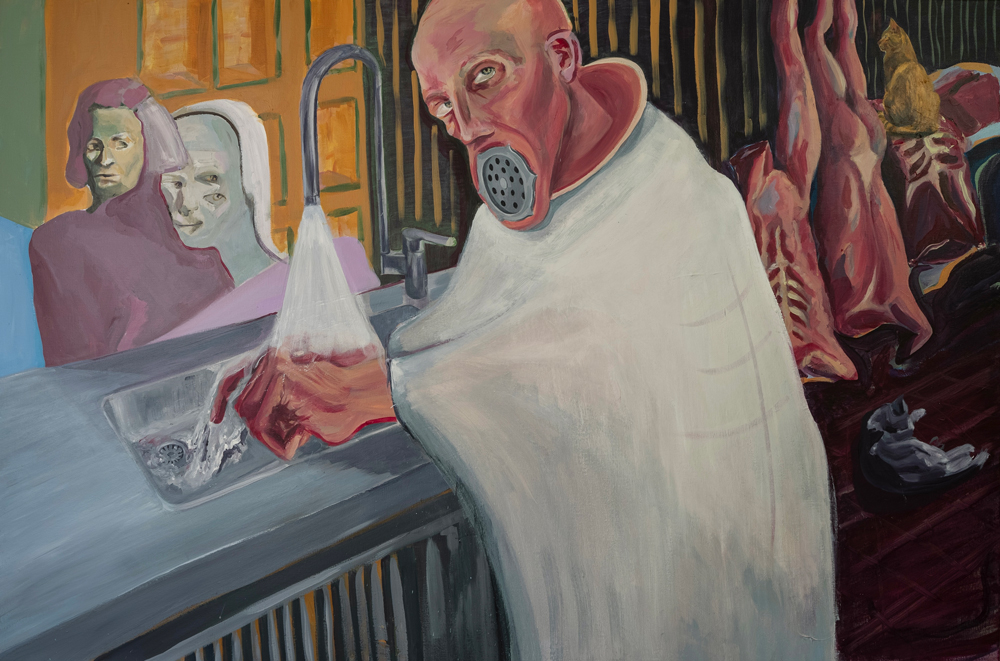
This idea is at the core of Clean Cut, 2024. In the painting, a butcher is depicted washing his hands, while a meat grinder emerges from his mouth. Two women look on with suspicion. “Having lived in the West for five years, I experience these double standards firsthand. People scrutinize others with suspicion, yet there’s an implicit hierarchy in who is allowed to critique violence. When someone says, ‘Oh no, those poor Israelis,’ they refuse to acknowledge the root of the problem and that’s exactly what Brecht wrote back then. People are willing to critique fascism, but not capitalism. The same pattern repeats today: they condemn violence but won’t critique Zionism. Or they denounce Nazi fascism but refuse to question Zionism. It’s guilt-washing, just like the butcher washing his hands of the blood.”
The title Clean Cut references how modern warfare sanitizes violence. “Israel bombs Gaza in a ‘clean’ way. It’s vertical violence – detached, almost invisible. A missile drops from the sky and erases the act of killing. But a knife moves horizontally, close and direct. One is considered clean, the other dirty”.
The bodies in the painting are not animals; they are humans. “This is also a direct response to Zionist rhetoric that calls Palestinians and Lebanese ‘human animals.’ But historically, Jewish victims of the Holocaust were called the same by Nazis. It’s a cycle of dehumanisation.”
Why does the medium of painting resonate so strongly with your work right now?
“I think no medium can amount to the disastrous reality,” she says, reflecting on the overwhelming violence and suffering that images of the war in Gaza attempt to capture. Yet, what troubles her just as much is how quickly these images vanish. “Nowadays, images disappear so fast, lost in the abyss of the internet. I think we must not allow scroll amnesia to erase the vastness of what we have witnessed. Before the internet, images documenting war remained in people’s eyes. Look at the Vietnam War, some images remain iconic for the resistance and suffering they hold.”
Painting is a way to hold onto images that have unsettled her. “I saw a picture of a pile of brutally butchered Palestinian bodies, with cats sitting on top of them and I kept wondering: Are the cats starving and looking for food? Are they grieving? Or are they warming up the bodies because they feel the coldness of their deaths?”
She also recalls seeing photos of children and celebrities writing messages on missiles, missiles that would later be dropped on Palestinians. They directly influenced Blow Up, the triptych she is currently painting and will be revealed at Art Rotterdam Prospects. “This act of genocide is framed as something patriotic, but it’s a form of brainwashing, indoctrinating people into horrific violence when they don’t even understand what they are part of.”
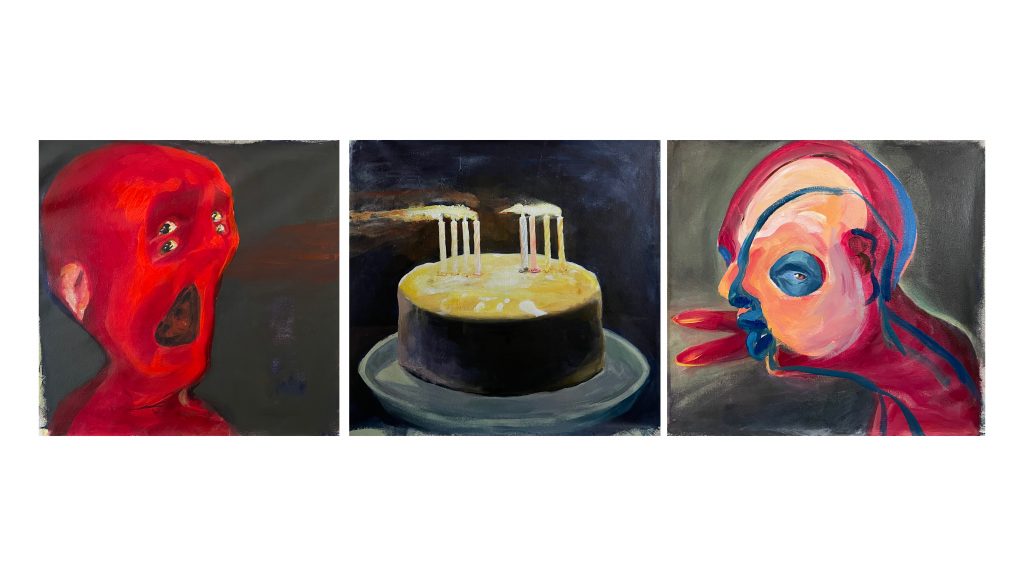
The weight of such imagery demands permanence. She turns to painting precisely because it resists this cycle. “I felt the ethical responsibility not to reproduce those images but to at least find a way to talk about them through art. Painting is about ensuring that such moments are not just a scroll, but they are here to stay – because forgetting is too easy, and denial even easier.”
With firm persistence, Bubu breaks through the heaviness of the conversation, pressing soft kisses to Diana’s lips – as if trying to comfort her. She kisses him back and whispers softly, “Habibi Bubu, I love you too.”
It’s an interruption so absurd that Bertolt Brecht himself might have written it, a moment of tenderness breaking through the weight of war, pulling us, if only for an instant, out of the frame.
Written by Emily Van Driessen


