Coming soon
Coming soon
Select type
In conversation with Diego Diez about his gallery, ambitions and presentation at Art Rotterdam
Diez Gallery participates in Art Rotterdam for the second time. The young Amsterdam gallery is making a name for itself with its program and daring presentations at major international fairs. This year, Diez Gallery is part of the Main Section. We spoke with founder Diego Diez about his gallery, his ambitions, and his plans for the upcoming edition of Art Rotterdam.
“We will soon celebrate our third anniversary,” says Diego Diez in the back room of his gallery in Amsterdam West. “I saw opportunities for my gallery because there wasn’t a gallery in Amsterdam with the same ambition or projects that I want to show in my gallery.” In a relatively short time, he managed to build a reputation—not so much in the Netherlands, as Diez mainly programs with artists who are more renowned abroad.
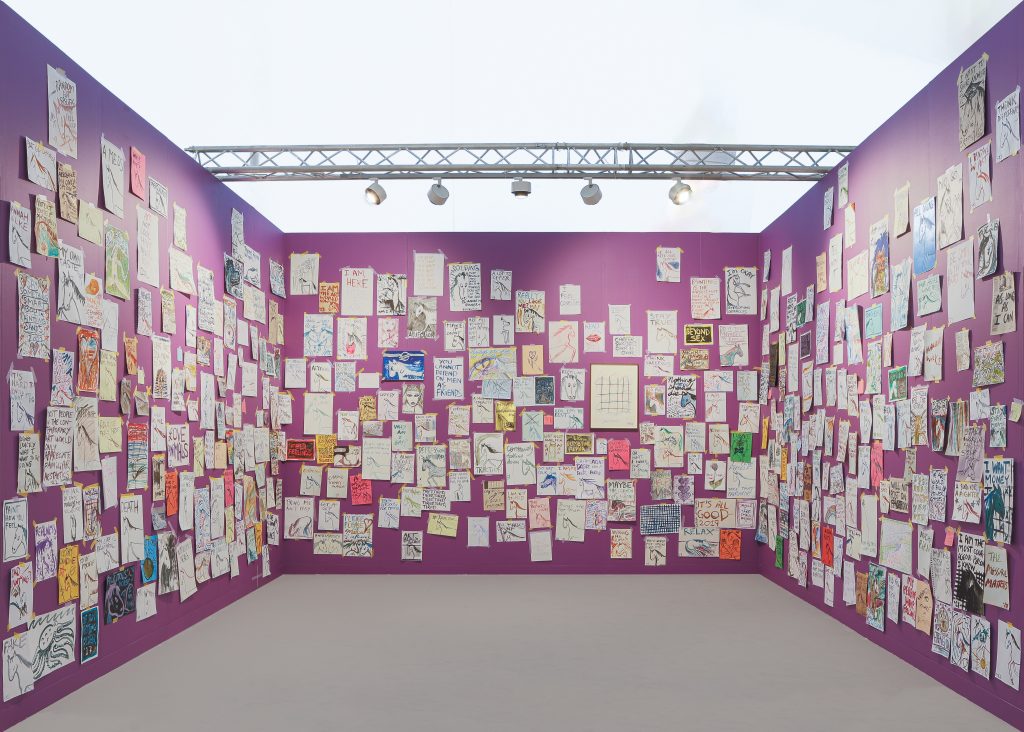
The Spanish Rietveld alumnus has participated in prestigious fairs such as Frieze, Liste, and ARCO. There, he stood out with bold presentations. For example, with Sands Murray-Wassink, he showed a selection of 365 drawings in his booth and captured attention; at Liste with Ian Waelder’s presentation, incorporating an architectural intervention to transform it into a small museum exhibit.
Money or financial gain is not the main focus for Diez, who articulates his plans with great clarity. “The art fairs I do and the steps I take need to serve a purpose. Doing an art fair just for the sake of it is simply a waste of time and energy.” Diez’s goal is to increase the visibility of his gallery and place works in major private or public collections.
A Leap of Faith
Art Rotterdam is scheduled for late March. While Diez had a booth in the New Art Section last year, this time he will participate in the Main Section. Because the previous edition was commercially successful—Diez sold all the works he brought—he is excited to return to Rotterdam and continue to show the different aspects of his program from the main section.
“I am not yet well-known among a larger group of collectors, curators, and corporate collections in The Netherlands. My goal is to show my commitment to this scene, city, and country and to demonstrate that I am truly convinced that Amsterdam is a good place for my gallery. For that, I want to show my vision and the vision of my artists to the local audience. Art Rotterdam is the best place to gain that recognition. That’s why I decided to take a leap of faith and participate in the Main Section this year.”
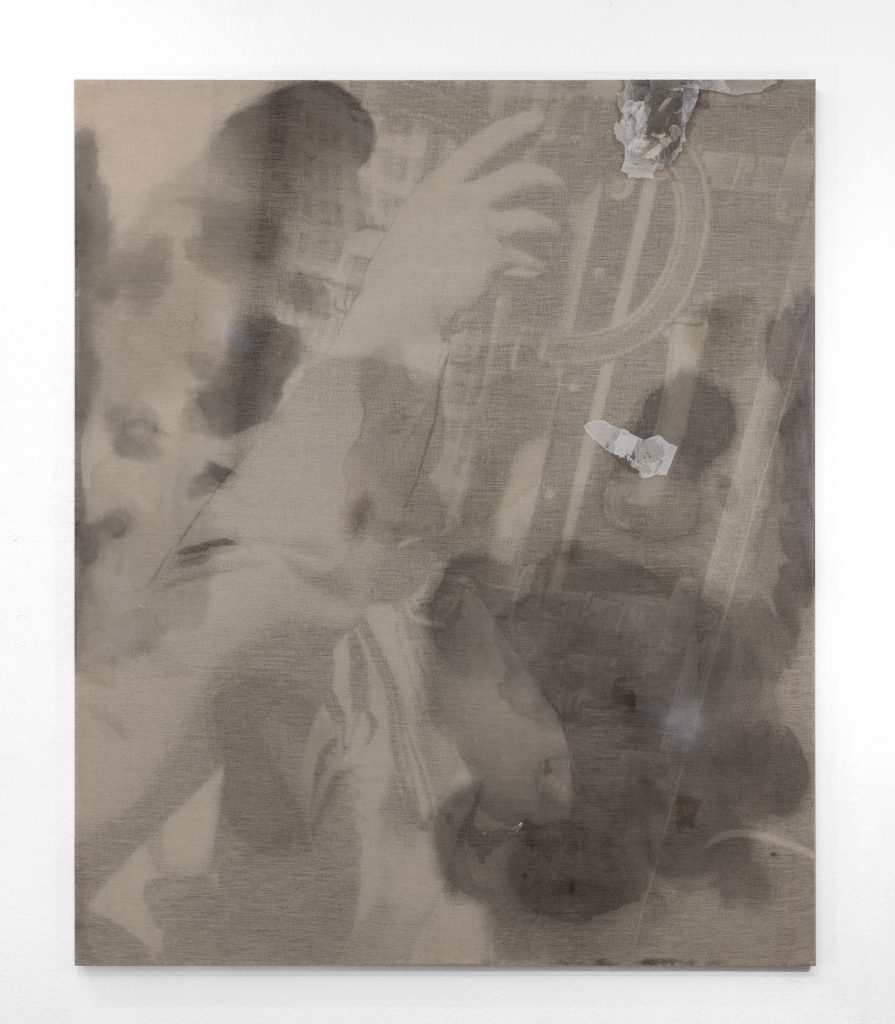
To make his plan succeed, Diez aims to secure the best work from his best artists for Art Rotterdam. This might seem obvious, but for instance, Ian Waelder has a solo exhibition at Carlier | Gebauer in Berlin just before the fair. Securing new work requires some persuasion on Diez’s part. “I approach my artists and explain the importance of this step for me. I need to show people in the Netherlands that I can bring the best of one of my most important artists. Most of the works I receive will be new works made specifically for the fair.”
Tilde
Diez’s approach to his craft stems from his previous role as the leader of the non-profit art space Tilde, which he ran from 2019 to 2022. For his projects, he showed well-known names such as Francisco de Goya y Lucientes, Laure Prouvost, and Moyra Davey. “More is possible when you have a non-profit space instead of a gallery, even with well-known artists, as there are no conflicting commercial interests,” Diez explains. At the same time, it allowed him to build a vast network of artists and curators.
Tilde was housed in Diez’s two-room apartment in Amsterdam. This meant that collaborations were highly personal, with ongoing consultations with artists that, metaphorically speaking, began at breakfast. “All the artists I work with are passionate about art, its creation, and art history. The work I show must have a certain political or social relevance or a connection to art history.”
Diez was inspired to adopt this organic way of working by his friend Marja Bloem, the partner of the late Seth Siegelaub, one of the key figures in early conceptual art. Siegelaub had a gallery in New York in the late 1960s that stood out for its groundbreaking presentation methods. The 2015 retrospective on Siegelaub at the Stedelijk Museum was a revelation for Diez: “He did things with passion. He quickly realized that the contemporary art world wasn’t for him, so he stopped his gallery. His approach felt very natural to me, especially for work that wasn’t in vogue at the time.”
Art Rotterdam
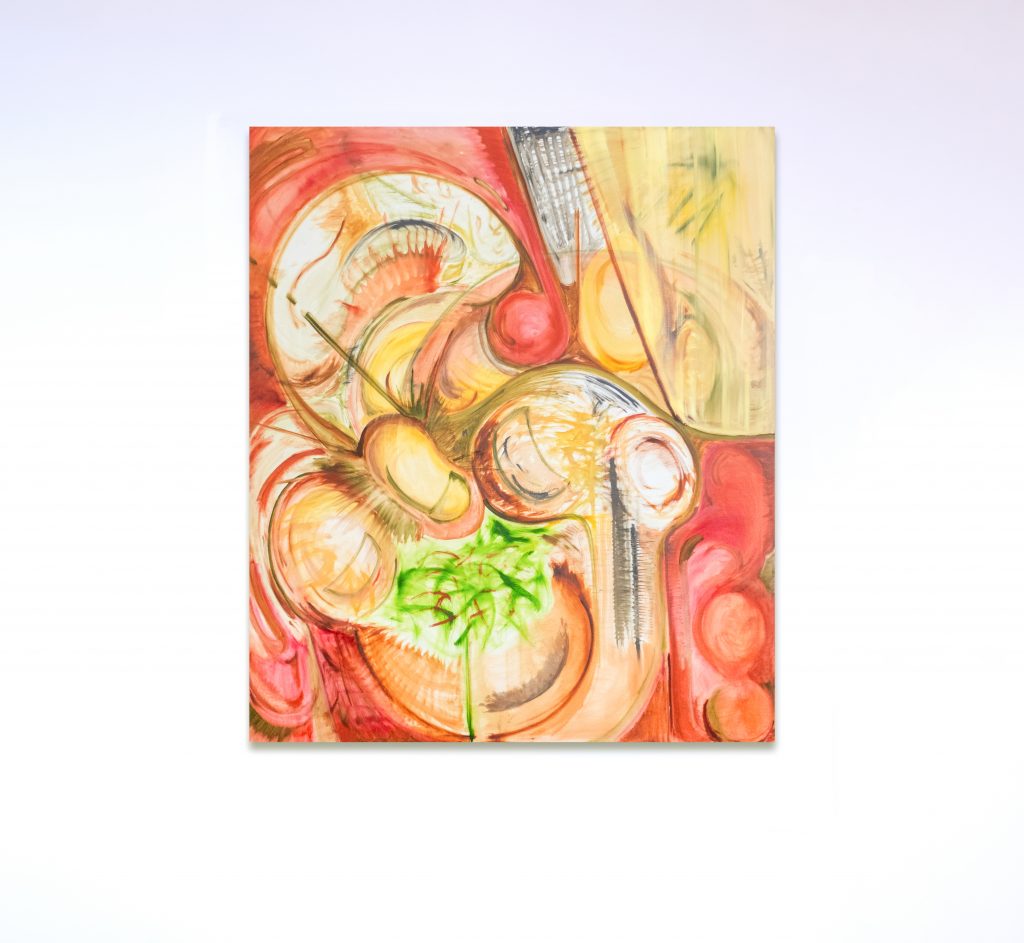
One notable aspect of Tilde’s programming was the combination of contemporary artists with established names, such as pairing the young Nora Turato with Lilly van der Stokker. Diez plans to do something similar at Art Rotterdam. This time, there won’t be an architectural intervention but an elegant interplay of high-quality secondary market works, sourced together with Paul van Esch, and contemporary pieces by Ian Waelder, Jessica Wilson or Rasoul Ashtary. Diez plans to group them around three major themes in art history: history and identity, portraiture, and abstraction.
“Because of the importance of art history for my artists , it’s very good to place them in context. Many people don’t know my artists yet because they don’t exhibit in the Netherlands. That’s why I’m showing them alongside an established name.”
Diez can already reveal a glimpse: for the theme of history, he plans to present a work by Anselm Kiefer, who will have exhibitions at both the Stedelijk Museum and the Van Gogh Museum at that time, alongside works by Ian Waelder.
Written by Wouter van den Eijkel
Rotterdam Art Week takes place at the same time as Art Rotterdam; from 26 to 30 March 2025, Rotterdam will be all about art. At 50 locations throughout the city, you will discover fairs, exhibitions, open studios, tours, artist talks and more. From sensational openings to surprising pop-up shows, art can be seen, experienced and enjoyed everywhere for five days.
For the complete Rotterdam Art Week programming: www.rotterdamartweek.nl/programma
Fons Hof, Director Art Rotterdam
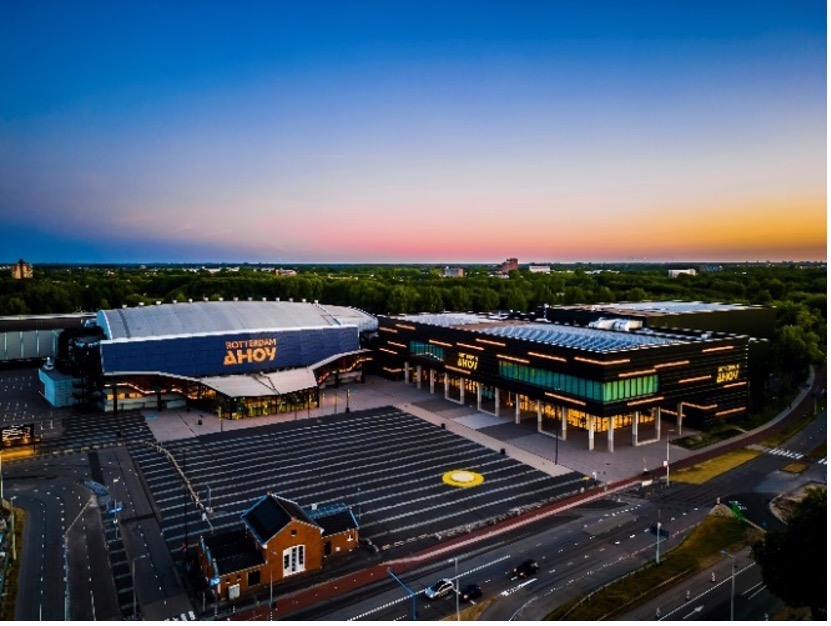
“The first edition at the new location Rotterdam Ahoy will be a special experience for international collectors, art professionals, and art enthusiasts. The fair will feature a grid of galleries interspersed with large curated spaces for video, sculpture, installations and performance. Here galleries can showcase their most daring and outspoken artists. In addition, Prospects, the Mondriaan Fund exhibition for emerging talent, will return in an extra large format. This combination creates a rich, diverse, and inspiring visitor experience, ensuring that Art Rotterdam remains future-proof.”
Edo Dijksterhuis in Dutch newspaper Het Parool, February 1, 2024
The fact that the Prospects exhibition of the Mondriaan Fund could no longer be housed at Art Rotterdam, prompted the entire fair to move to the new venue Rotterdam Ahoy.
A nice side effect of this solidarity action, is that Art Rotterdam can bring back much beloved sections from the past 25 years that were lost due to a lack of space, such as Sculpture Park, Intersections and of course the Projections video section. Something to look forward to.”
Art Rotterdam in Rotterdam Ahoy
Talk hosted by Art Rotterdam – ‘The Influence of Digital Technology on Architecture, Fashion, Art and Design’
Thursday February 1, 17.00 – 18.00 hrs
Location: Reflections Room, on the first floor, next to booth 30
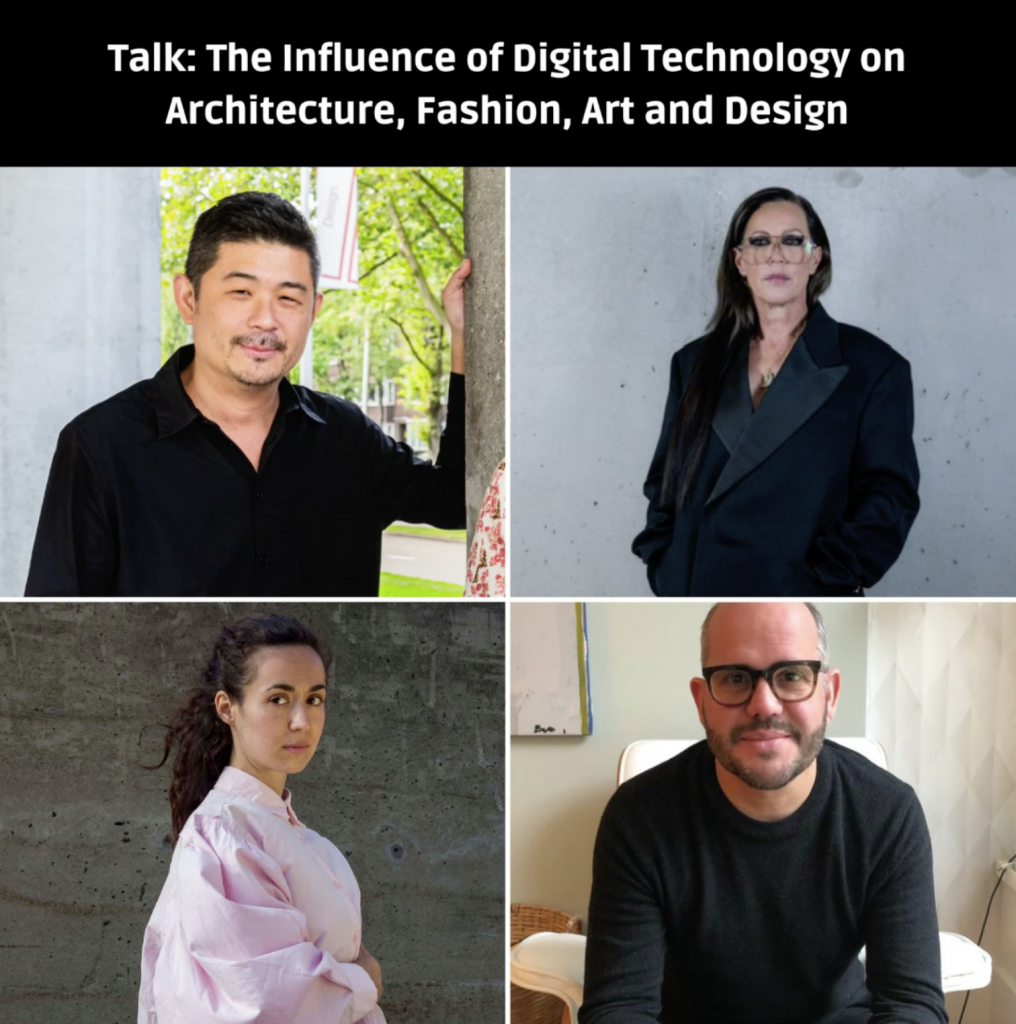
Four experts in the fields of architecture (Aric Chen, director of Nieuwe Instituut), art (Nieck de Bruijn, founding director of Upstream Gallery), fashion (Margreeth Olsthoorn, owner of her eponymous fashion store, curator and stylist), and design (Audrey Jane, interdisciplinary designer using analogue and digital methods) will share their perspectives on this issue in a panel discussion moderated by art historian Manuela Klerkx. Note: This is an English spoken event.
Talk hosted by BK-Information – ‘Marilyn Douala Bell: The Art Practice and the Practice of Public Art in Douala, Cameroon’
Sunday February 4, 11.30 – 12.30 hrs
Location: Reflections Room, on the first floor, next to booth 30
BK-Information hosts the lecture ‘The Art Practice and the Practice of Public Art in Douala, Cameroon’. In an interview with Marilyn Douala Bell, artist Liesbeth Bik will discuss Douala Bell’s role as a commissioner of exhibitions and art in the public space of the city of Douala in Cameroon. Note: This is an English spoken event.
Free guided tours with Young Collector’s Circle
Saturday February 3, 13.00 & 15.00 hrs
Sunday February 4, 13.00 & 15.00 hrs
Registration and staring point : entrance of the fair
Want to join a tour of the fair, led by a passionate art lover from the Young Collectors Circle? The Young Collectors Circle opens up the art world to art lovers with collecting ambitions. Meet other starting collectors, get acquainted with all aspects of collecting and develop your own taste and style.
For further questions, please visit the Info Desk at the entrance of the fair.
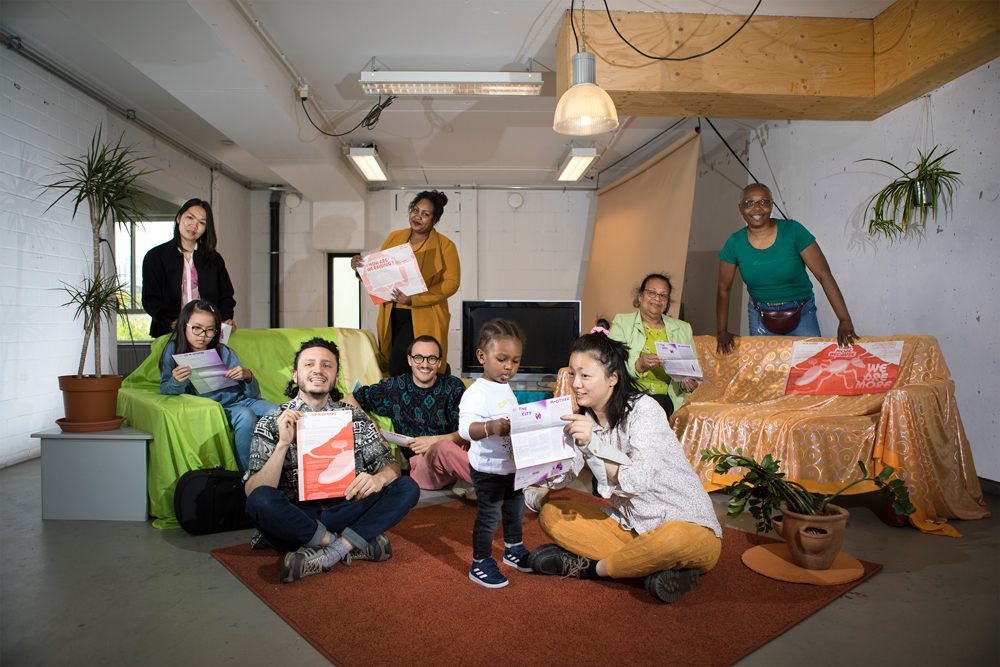
After graduating from art schools in Wuhan and London, Sun Chang (1994) attended ‘The Dirty Art Appartment’ course at the Sandberg Institute in Amsterdam from 2017-2019. Rather than training artists to practise a craft, it invites them to research our everyday social dynamics and the meanings we assign to social roles. Chang therefore describes herself as a ‘community-based and social artist’. In 2020, she initiated to M•Others (2020-present), an exploration of what motherhood means through interviews, discussions and workshops. In doing so, the artist builds a community that anyone can join. At ‘Prospects’ at Art Rotterdam, she gives insight into her process and shows a recent collaborative artwork.
The idea for the to M•Others project (2020-present) emerged during the covid pandemic. Chang shares: “Lockdown made another thing apparent: much of the work around the house is done by women. This is no news, but it made clear that even when everyone is at home, most chores still end up on the plates of women. Gender plays a role in the home. This was the starting point of my project to M•Others, in which I examine M(other)ing: mothering, taking care of another, the home, and oneself. I started examining motherhood as an action, not as a state of being. In the end motherhood, the act of mothering, is a sort of taking care of one another that can be performed by anyone, regardless of gender identity.” The artist thus uses a broad definition of motherhood, as ‘caring for another’, to include fathers, people without children and queers.
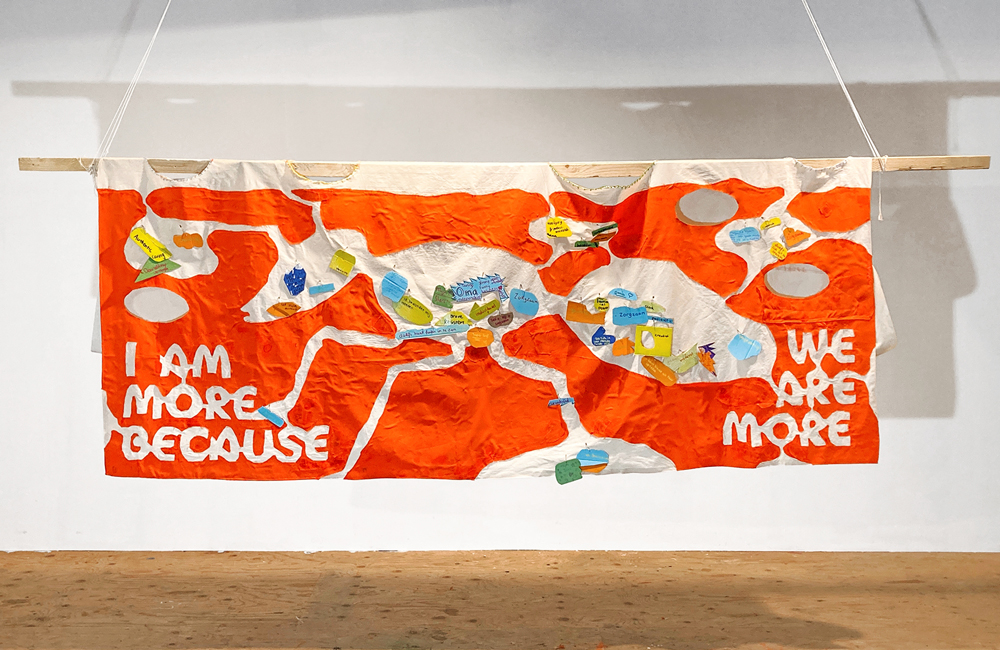
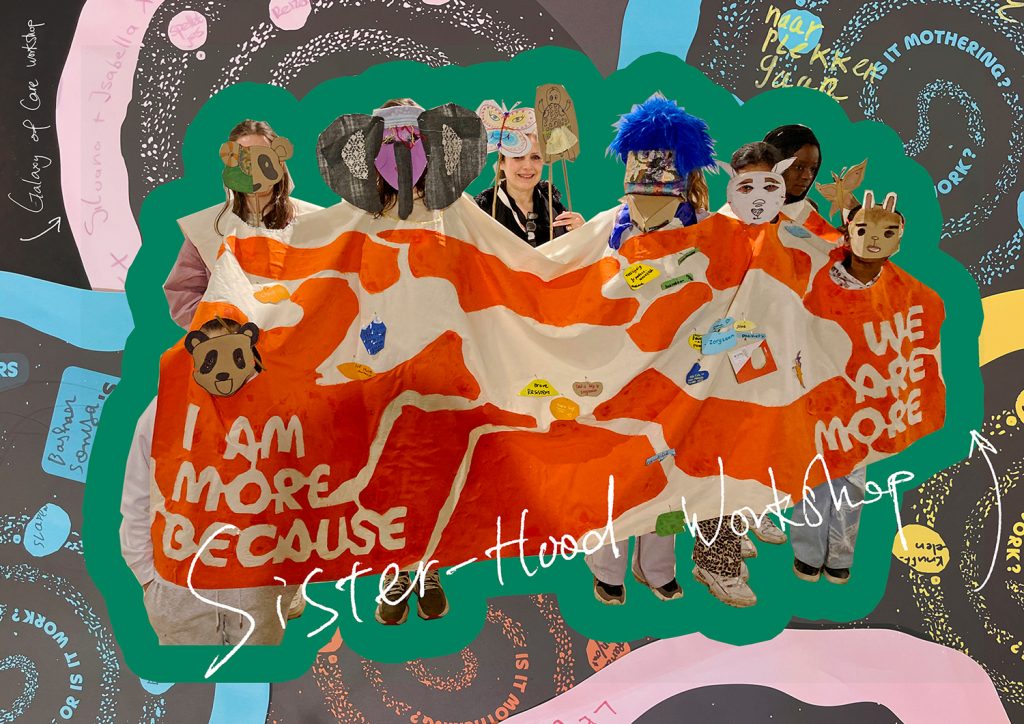
Through dinners, letters, pamphlets, interviews, discussions and collective design workshops, Chang explores what motherhood entails. One example is Sisther-Hood (2023), a large canvas designed with mothers from the Bijlmer and cardboard tags written by girls from womxn’s Mill neighbourhood. This textile work acts as a manifesto with the words ‘I am more because we are more’. The ‘I’ and ‘we’ are connected like veins of life. In the spirit of: ‘another’s beauty and strength does not mean the absence of your own.’ This project was organised during International Women’s Day together with Buurtzus. The children and adults reflected on their female role models and women/girl power in others and themselves. In addition, participants created spirit masks, inspired by a hybrid creature from Greek mythology, to represent symbols of domesticity and threats towards women.
At Prospects, the artist shows this 3-metre-long cloth with an ant-shaped anthill, in response to the question of which animal best represents motherhood. According to Chang, the ant is like a cloak that radiates the strength and connection of its creators. In times when we risk losing sight of connection, Chang uses her artistry to connect people of diverse cultural backgrounds and ages. In her words, “In the end, everyone can be a mother, regardless of gender or sex. M(other)ing [ed. mothering] is a verb, an intention.” As such, her art practices contribute to emancipation, resilience and self-awareness.
Sun Chang (1994) is a social artist, independent publisher and educational designer based in Amsterdam. From 2012 to 2019, she pursued art studies in Wuhan, Beijing, New York, London and Amsterdam. Chang is artistic director of to M-Others and co-founder of Lost Dad Publishing. She was granted several residencies, including from Guangdong Times Museum (2022-2023), Witte Rook (2022) and CBK Zuidoost (2021).
Between 2022-2023, Chang received talent support from the Mondriaan Fund. Therefore, she is one of the participating artists of the ‘Prospects’ exhibition at Art Rotterdam.
Written by Pienk de Gaay Fortman
Hanane El Ouardani’s work stands out for her unique ability to interweave intimate and personal narratives and perspectives with broader societal and cultural themes. El Ouardani’s subjective documentary photography projects are not only aesthetically captivating but also prompt questions about identity, exotism, contradictions and social status. She challenges the viewer to contemplate the complexity of these themes. With her camera, she ventures to public spaces where men play a prominent role and she actively engages in interaction there.
The Dutch-Moroccan photographer was born in the Netherlands with bicultural roots, and her practice reflects a recurring duality: on one hand, an unwavering desire to truly feel at home somewhere, and on the other, embracing her status as an ‘outsider’ due to the unique perspective it offers her, allowing her to keenly observe differences from a distance. In 2018, she published the photo book ‘The Skies are Blue, The Walls are Red’, a visual diary that explores the various layers of a diasporic identity. The book raises questions about representing one’s roots without feeling estranged from one’s own culture.
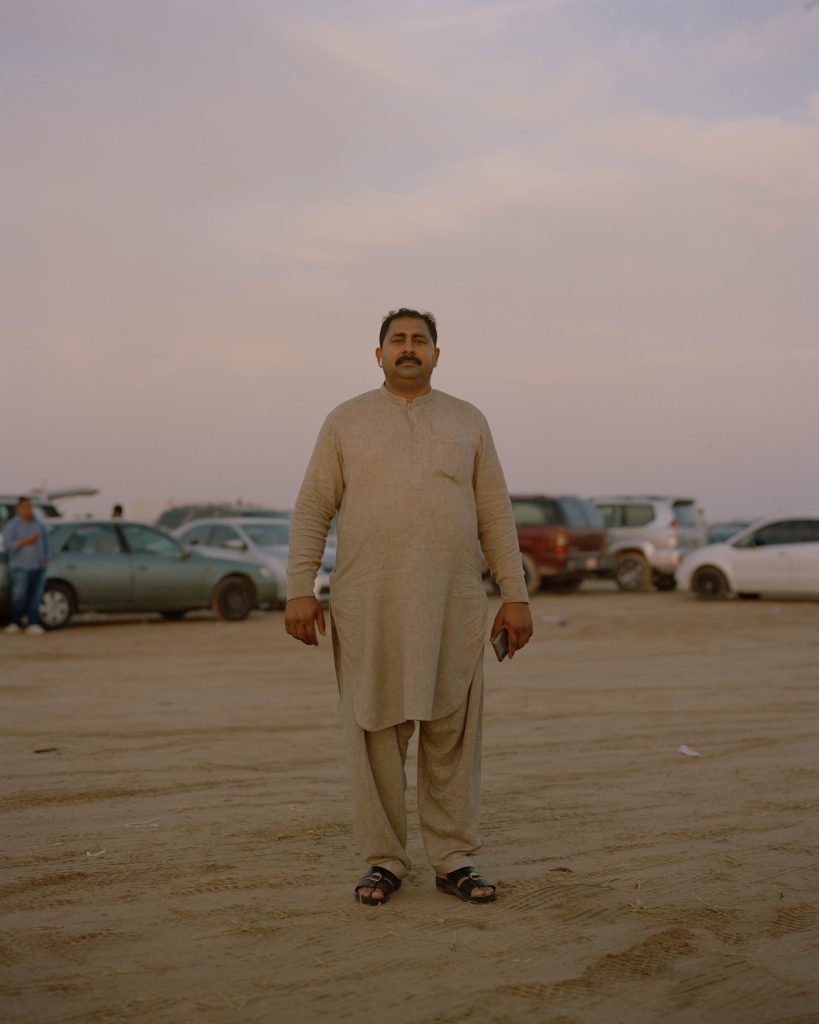
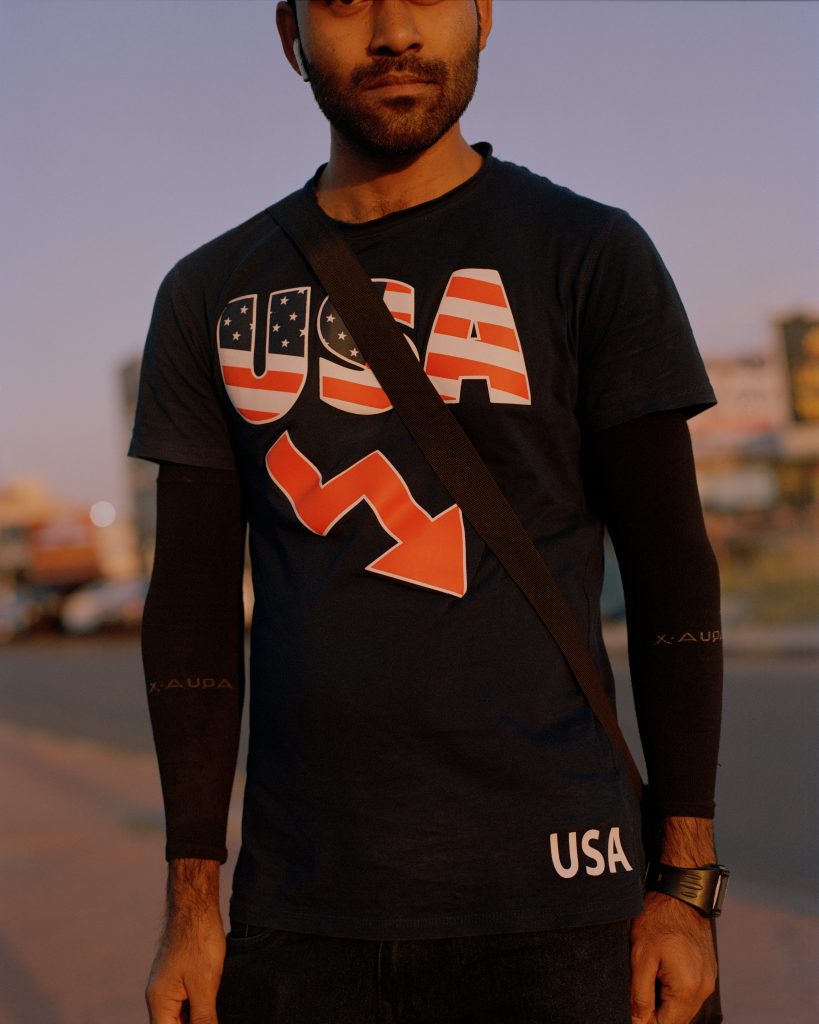
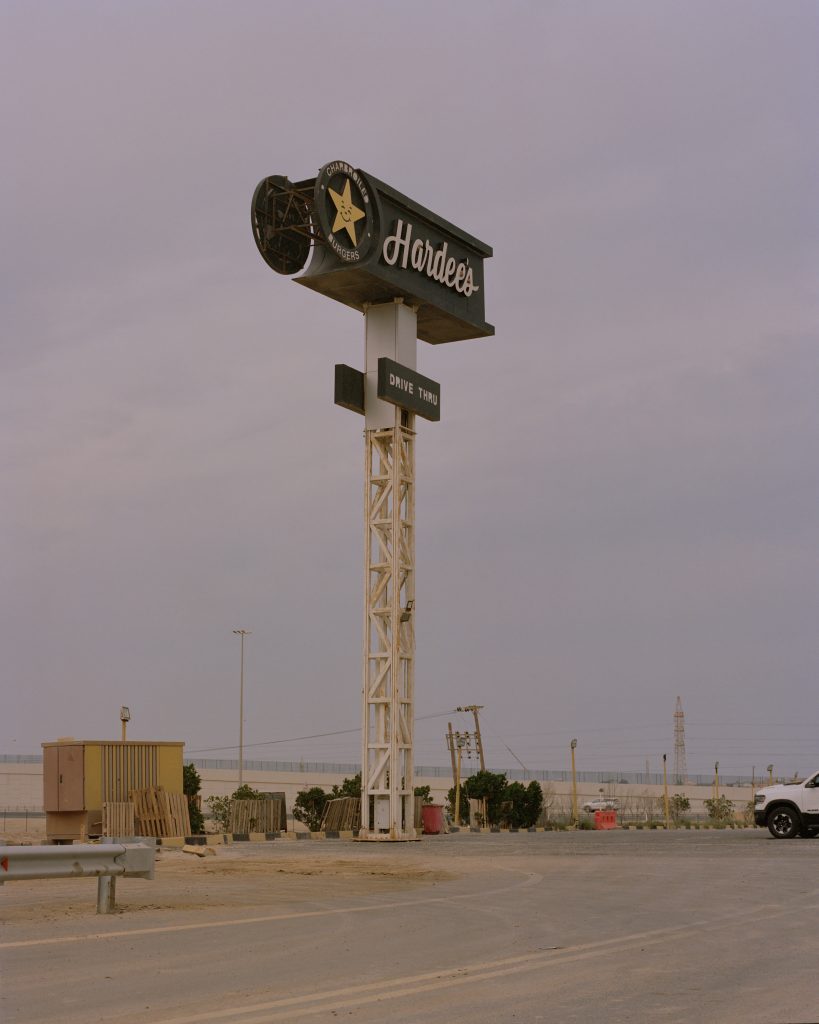
During Art Rotterdam, El Ouardani will showcase her work at Prospects: an initiative of the Mondriaan Fonds that showcases work by 86 artists who received financial support in 2022 to launch their careers. The work on display ranges from photography to textile works, video to paintings and performances to sculptures. The exhibition is curated by Johan Gustavsson in collaboration with curator Louise Bjeldbak Henriksen. El Ouardani will present three works there that she created in Kuwait, an introduction to her ongoing research that is currently taking shape. So far, the photographer has captured migrants working in American fast-food chains in Kuwait, which have proliferated since 1991 in the aftermath of the First Gulf War. In doing so, El Ouardani is exploring how cultural exchange translates into the complexities of overconsumption.
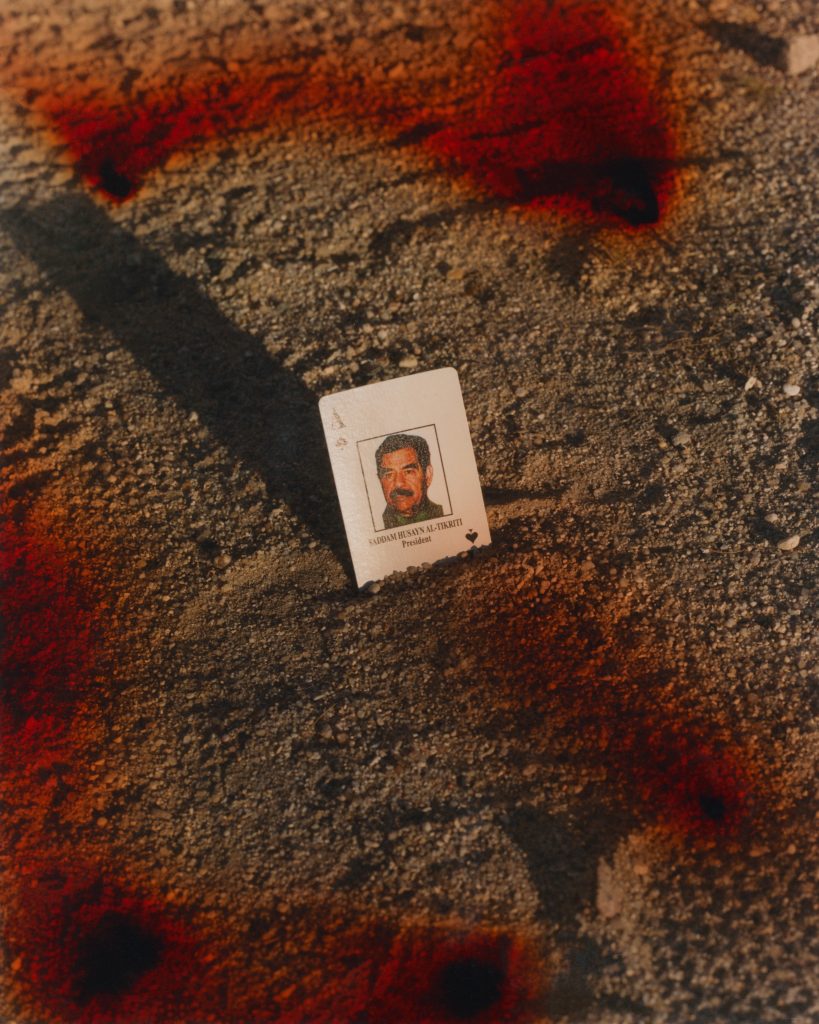
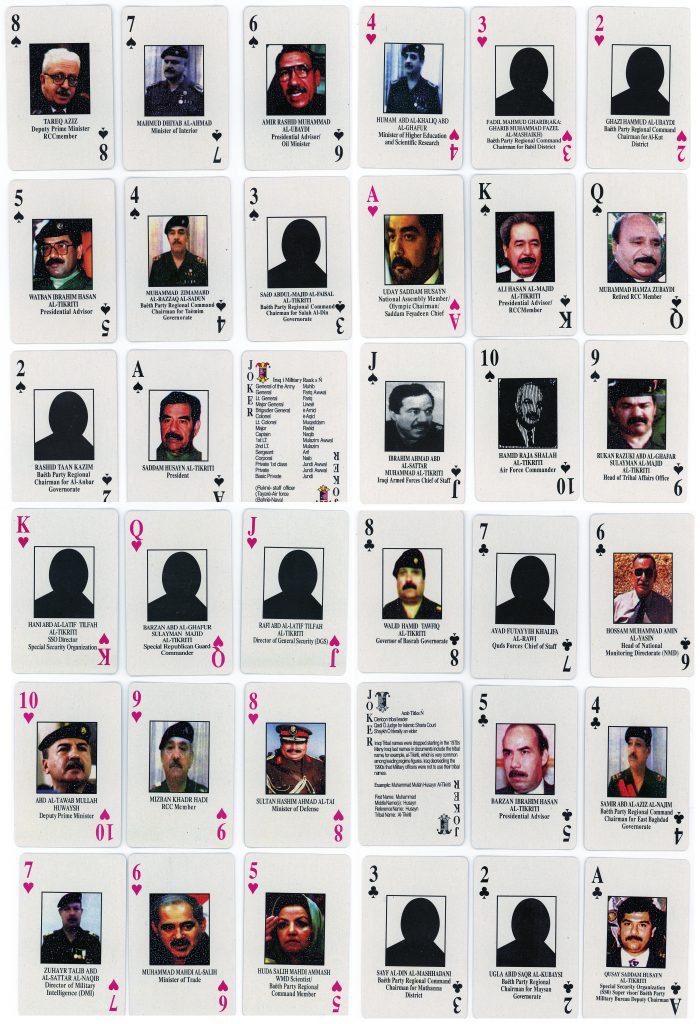
Additionally, she draws inspiration from a set of playing cards developed by the U.S. military during the 2003 invasion of Iraq, to help soldiers identify the most wanted members of Saddam Hussein’s regime. The cards were considered provocative and trivializing, and at the same time, they represented a bizarre Americanization of the war — a war whose legitimacy, the ‘weapons of mass destruction’, was later found to be unfounded. By 2021, nearly all of the 52 most wanted individuals on the cards had died or been captured, with eleven of them subsequently released.
El Ouardani was born in 1994 and lives and works in Amsterdam. She studied Photography and Design at the Royal Academy of Art in The Hague and her work has been exhibited at notable venues, including the Van Gogh Museum, Unseen Amsterdam, Foto Tallinn and Paris Photo.
During Art Rotterdam, Hanane El Ouardani’s work will be on display in the Prospects section of the Mondriaan Fonds.
Written by Flor Linckens
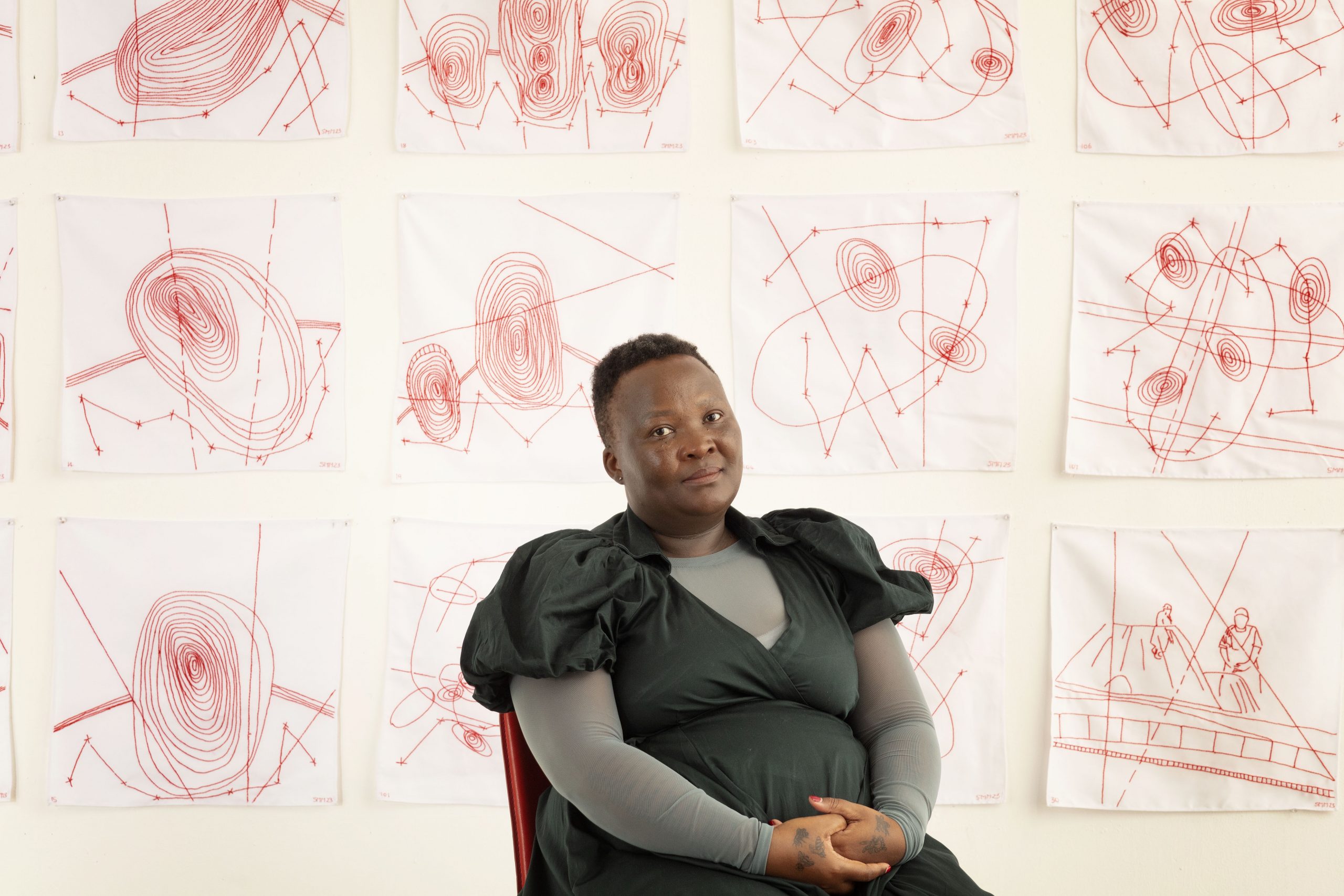
This edition, Art Rotterdam welcomes several new exhibitors including the Johannesburg based Kalashnikovv Gallery. The gallery is dedicated to providing a platform to both emerging and established South African artists. One of them is the interdisciplinary artist Senzeni Marasela (1977, South Africa) who explores photography, video, prints and mixed-medium installations involving textiles and embroidery. Her work deals with history, memory, and personal narrative, emphasising historical gaps and overlooked figures. Although Marasela exhibits around the globe, it is the first time her work is shown at a Dutch art fair.
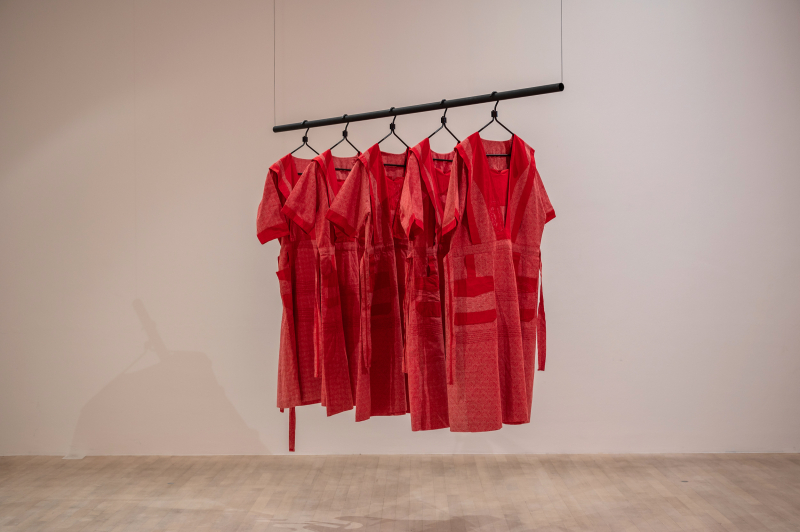
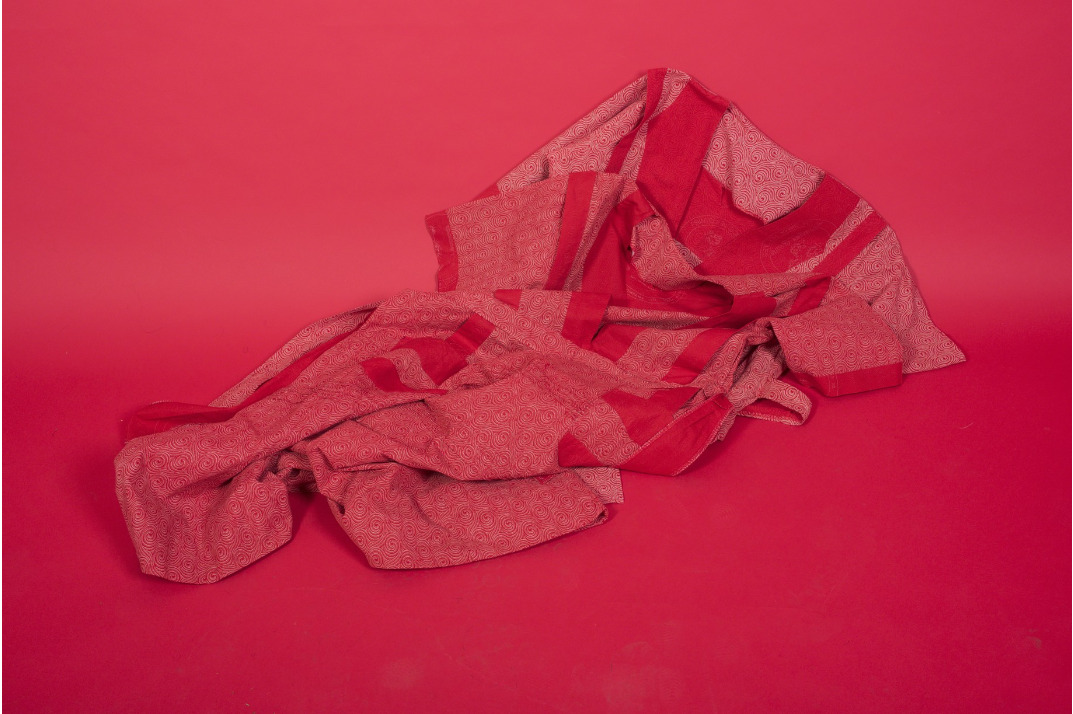
In her performance titled Waiting for Gebane (2013-2019), Marasela delves into the life of her alter-ego Theodora (named after her mother) and fictional husband Gebane who abandons her in a village in the Eastern Cape and travels to Johannesburg. The story starts with a modest red dress which she receives as a gift before he leaves. The ornamentally printed Iseshweshwe dress is worn by married women in Xhosa culture and is widely worn by the rural population. Marasela wears the garment daily for six years in a row, a powerful statement woven into the encounters she has. She also performed this project at the 56th Venice Biennale in 2015.
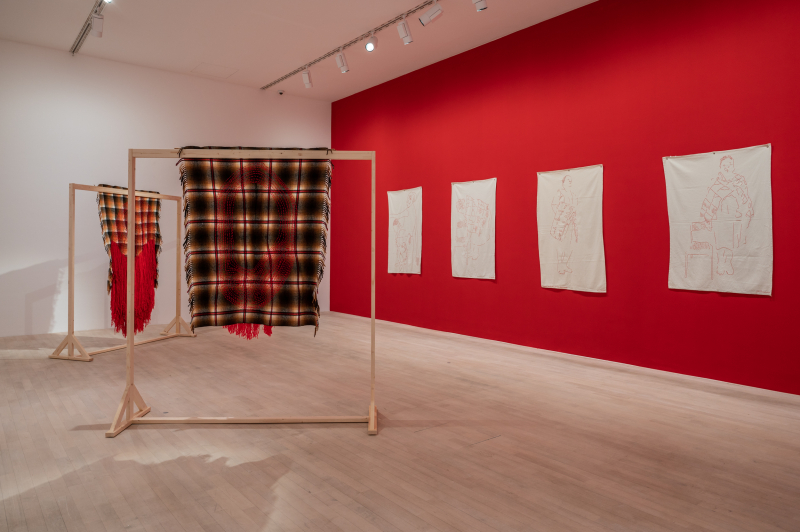
As the artist explains: “A large part of my work is concerned about covering Theodora. It is the hardships that she had to go through living in Johannesburg and probably also the hardships that women like me now are struggling with now. Because it’s a place with a lot of violence.” As such, Theodora remains not only a fictional character but also a way of giving voice to the traumas of Marasela’s mother and other black women, to this day.
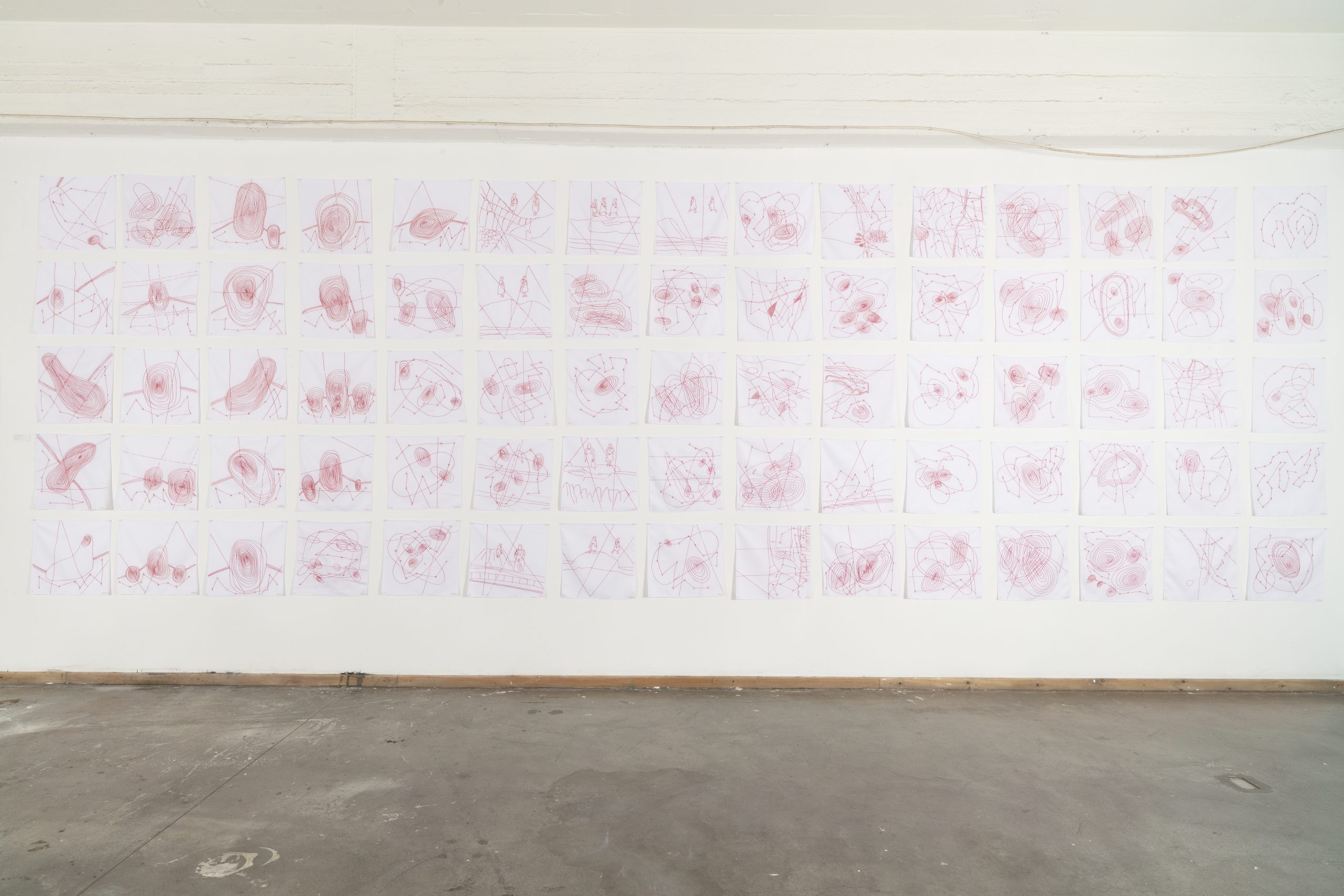
There is literally and figuratively a common thread in her work. The frequent use of the colour red in her embroidered works and watercolours, can be interpreted as a reference to the blood and evil behind colonial practices. Thematically, the artist makes invisible stories of oppressed black women visible. In her most recent series Last Known Location (2023), which the artist presents at Art Rotterdam, she uses topography to string together the story of Theodora in search of Gebane’s footprints.
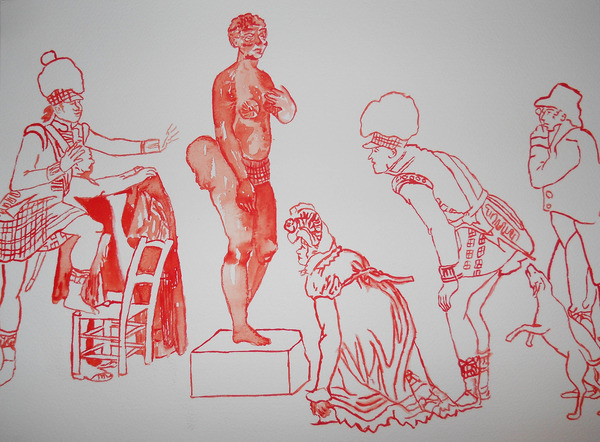
In earlier work Covering Sarah (2011), consisting of watercolours of red outlines in front of a white background, Sarah Baartman (1789-1815) is the main character. Baartman was a South African Khoikhoi woman who was required to perform in London and Paris in the 19th century. Tragically, she was used by Europeans to exhibit at rich people’s parties and private salons.
That her art has remained relevant and impactful for almost 30 years of artistry is reflected in the recent award Marasela received. In 2023, the artist won the first K21 Global Art Award, an initiative from the Friends of Kunstsammlung Nordrhein-Westfalen which celebrates the vision and courage of emerging and mid-career artists. She responds: “I hope that this is the beginning of great discussions and cooperations. I also hope that this is a journey that will inspire young artists around the world, especially in Africa.” Determined to address inequality resulting from apartheid, the artist deconstructs practices of colonialism and racism in order to reconstruct a world of equality for generations to come.
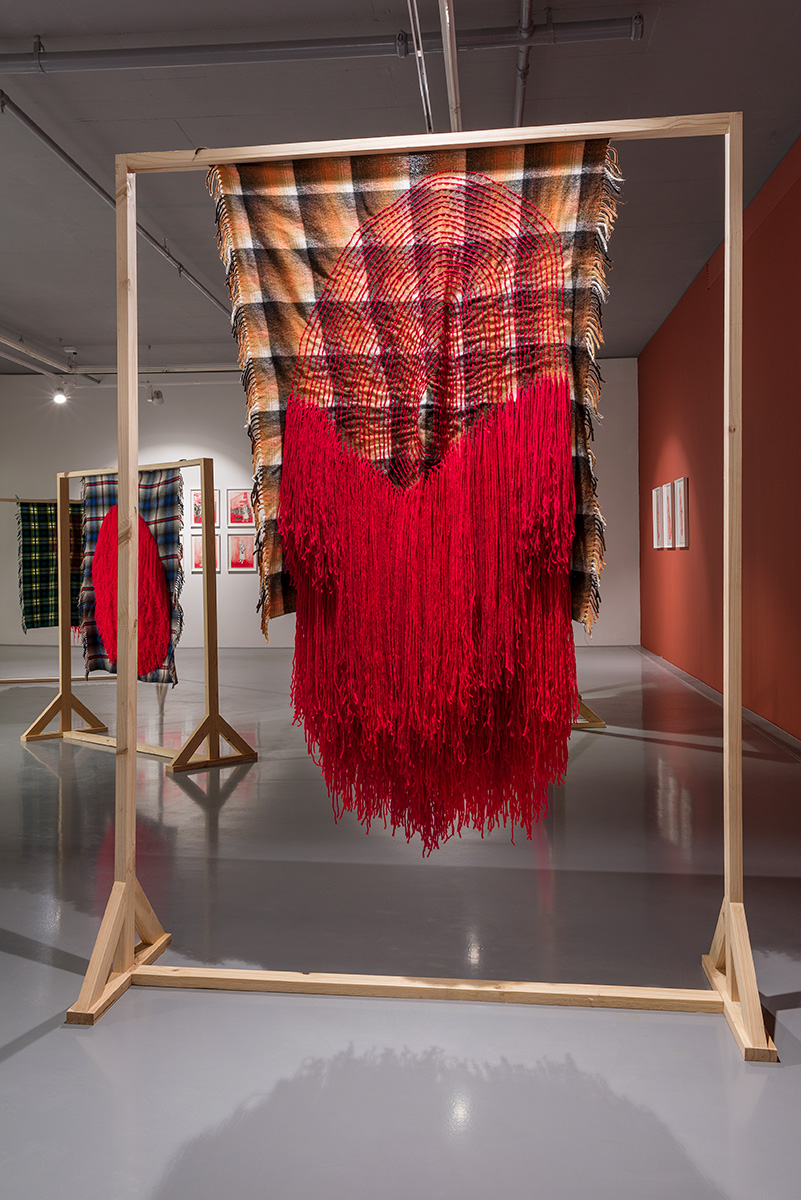
Senzeni Marasela (1977, South Africa) graduated from the University of the Witswatersrand in Johannesburg (1998) and shortly thereafter completed a residency at the South African National Gallery. Some of her career highlights include exhibitions at the South African Pavillion during the 56th Venice Biennale (2015), Zeitz Mocaa in Cape Town (2020) and the Museum of Modern Art in Paris (2021). Her work is represented in several collections such as Smithsonian Museum (USA), MoMA (USA) and Harry David Collection (GRE). She lives and works in Soweto.
During Art Rotterdam, Senzeni Marasela exhibits her art at Kalashnikovv Gallery from Johannesburg (Solo/Duo, booth 22).
Written by Pienk de Gaay Fortman
Interview with Shani Leseman about her presentation at Prospects, witchcraft and magic
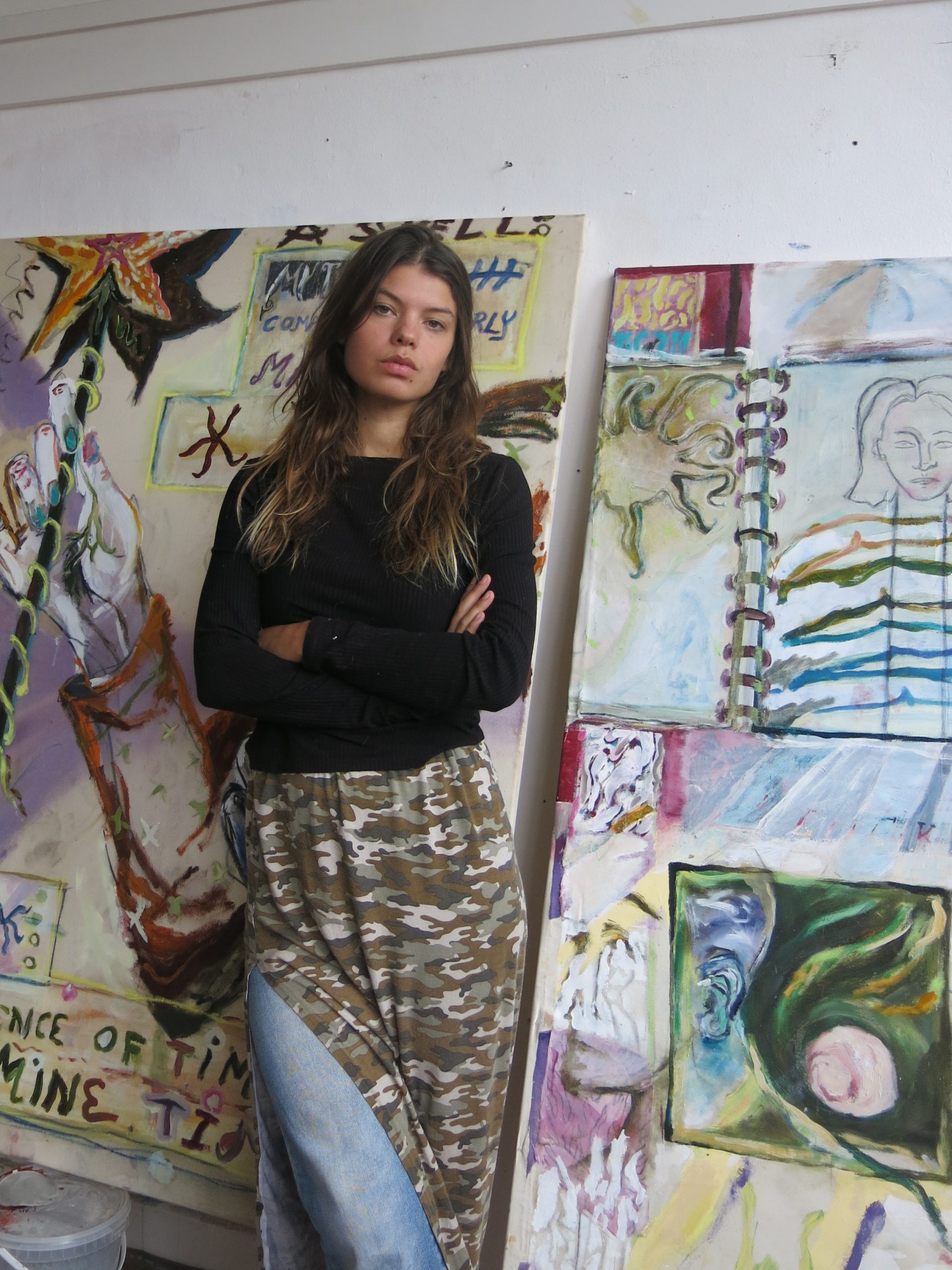
More than ever before, we have structured our world in line with scientific insights and technological discoveries. From the invention of the microscope to the smartwatch, everything is geared towards rationality and efficiency. But not everything is immediately explainable. There is still room for magic. This is the subject of Shani Leseman’s paintings. Her work is filled with spiritual and magical practices, symbolism, rituals and talismans.
Leseman has an eye for what cannot immediately be seen but can be felt. “Often, I only discover what the painting wants to tell me after I’m finished. I consider the process of painting a way to access the subconscious. Visual art often communicates in the language of dreams, symbols and rituals.”
Shani Leseman (Curaçao, 1996) lives and works in The Hague, where she studied at the Royal Academy of Art (KABK). Currently, she is enrolled in a course to become a witch, or to put it in more friendly terms, a practitioner of magic, which involves dealing with forms of energy and connecting with the inner world. This aligns well with her artistry, as both practices, Leseman claims, focus on intuition and intention. At Art Rotterdam, Shani Leseman’s work can be seen in the Prospects exhibition.
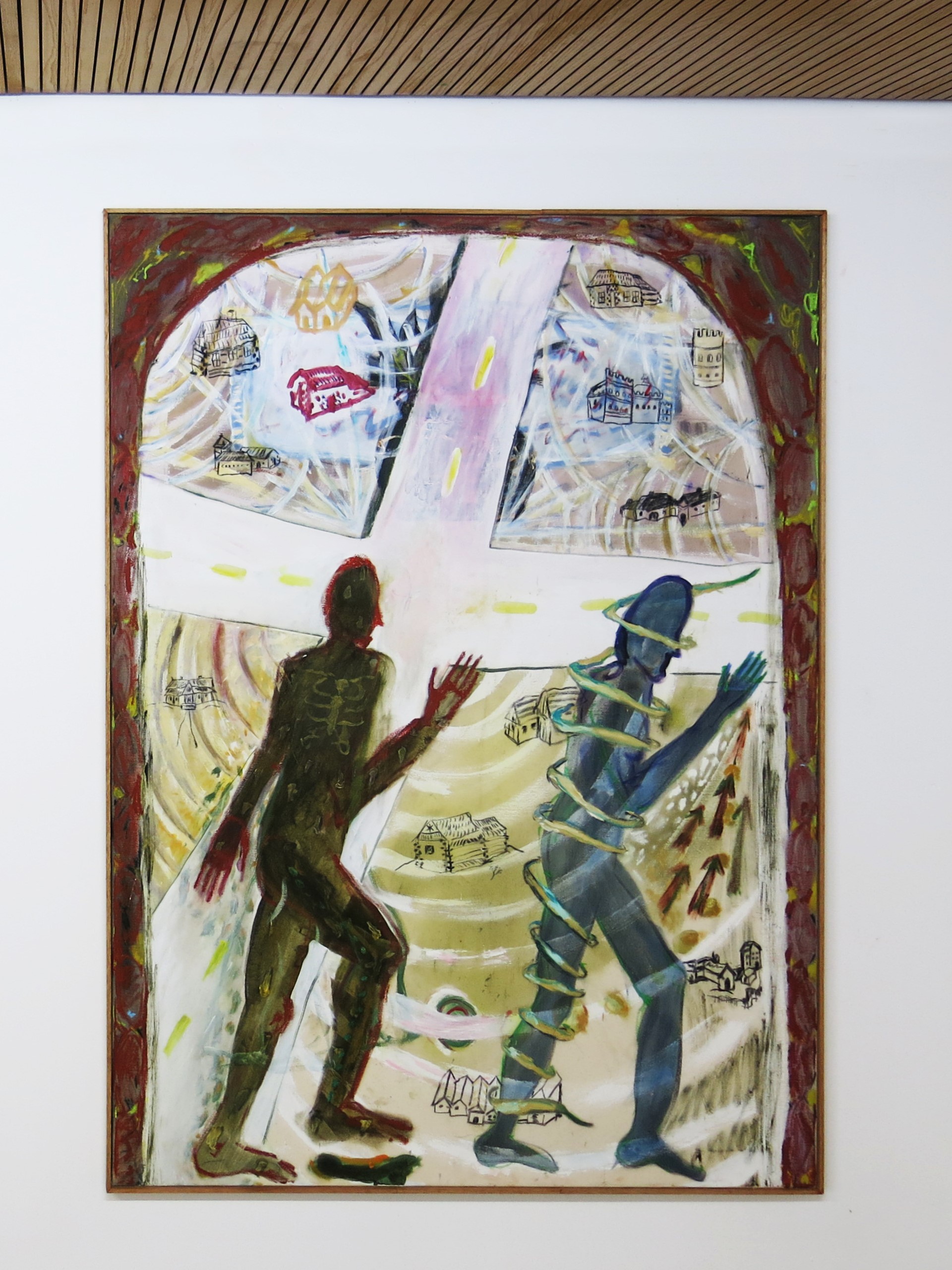
Congratulations on your presentation at Prospects. What can we expect to see?
Thank you! At Prospects, I am presenting five canvas paintings that I created over the past year. They touch on various topics within the overall theme of magic, such as spells, magical objects and places.
You mention magic as the overall theme of the Prospects presentation. Is magic also the general theme of your work?
My work is about the invisible and unexplainable, that which cannot immediately be seen but can be felt. It revolves around spiritual and magical practices, symbolism, intuition, rituals and objects as carriers of meaning.
You spent part of your childhood on Curaçao. Throughout the Caribbean region, magic plays a more significant role in daily life than here. Did your fascination with magic in an everyday context originate there?
Yes, I believe I encountered a naturalness in the belief and use of magic during my childhood on Curaçao. At the same time, magic is something universal and can be found everywhere in the world, in different times and forms. Europe also has rich spiritual roots.
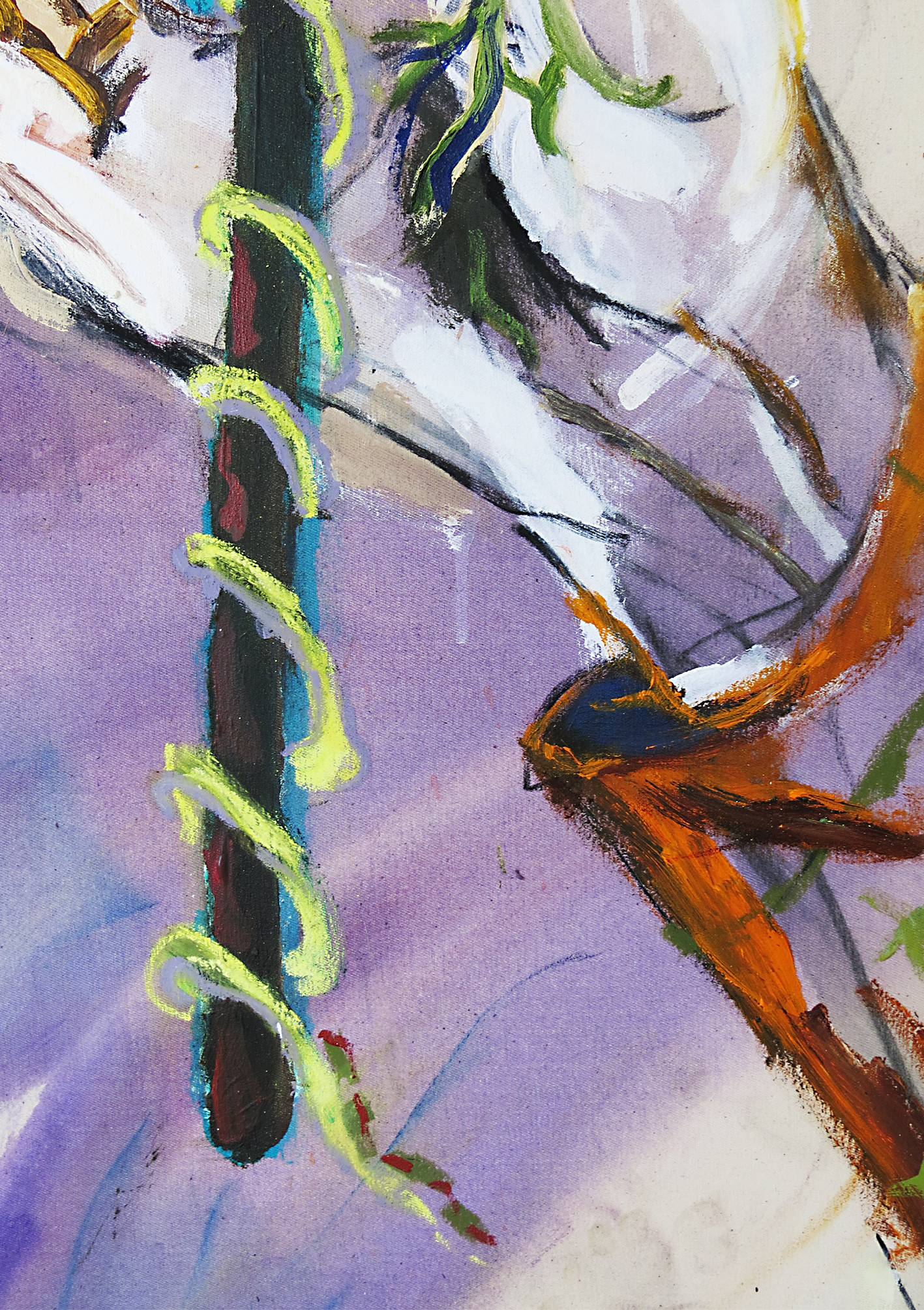
In addition to being an artist, you are a practicing witch. What does that entail?
Witchcraft is not an organised religion and has no fixed rules or frameworks; there are many different styles and practices. What a witch does varies from person to person. In general, a witch, or practitioner of magic (a less loaded term), focuses on the inner world and its connection to the living world around us. Living because the basis of magic is the idea that everything is energy or contains energy. Rivers, plants, humans and other animals, but also things unseen, like feelings and thoughts, consist of energy. Working with magic is consciously noticing, changing or guiding this energy. The practice and philosophy of witchcraft arises from a sense of kinship and focus on protecting life forms that need our support. It has an ecological and activist character.
I read that you are undergoing training for this. What does that training involve?
I am apprenticing with a witch who practices traditional Dutch witchcraft. During my training, she is teaching me about various practices within witchcraft and how to perform them, such as creating rituals, charging magical objects, divination and talismans. The foundation is to develop a strong connection with your intuition through daily exercises.
Is it something you can incorporate into your artistic practice?
Yes, I see many similarities between the practice of a witch and that of an artist. In both practices, intuition and intention are central (for me). An example of how both practices are intertwined can be seen in the work Talismagic, for which I made 100 ceramic talismans. These objects are not references to talismans; they are the magical objects themselves. During the creation of the sculptures, I charged each object with a specific intention. For example, there is a talisman for setting boundaries, one to counter gossip and one for better sleep.
The first time I saw your work was when you were nominated for the Royal Award for Modern Painting. You had submitted the work An altar for dogs. Is such an altar piece typical of your work?
That work is based on an altar piece I encountered on the street while traveling. I was struck by this spontaneous encounter with something magical – I suddenly found myself standing before a carefully assembled whole, consisting of emotionally charged objects. I consider this found altar a physical expression of a feeling that perhaps had nowhere else to go. In such an altar piece, I see the human urge for rituals, for practicing magic. I cannot know the specific intention of the creator with certainty, but I can feel or guess it. I called it An altar for dogs perhaps for the maker’s dogs or for dogs in general. I also recognised my own dog and altars I had made for him in this.
Dogs are a recurring element in my work: this refers to the bond between humans and other animals. As mentioned earlier, the foundation of witchcraft lies in connecting the inner world with all living things around us. I think witchcraft is currently experiencing a revival because it is crucial for the way people interact with other animals and plants to change. The vision within witchcraft calls for a re-evaluation of the environment, an awareness that we share the world with other beings. I find it important to speak out about animal rights and advocate for those without a voice, both in altars and on the street.
I consider the assembly of my paintings in general as the creation of an altar piece, where various elements with symbolic meaning (both personal and universal symbolism) come together for a specific purpose or intention. Sometimes the intention is clear beforehand, such as expressing gratitude or creating an ode, but often I only discover what the painting wants to tell me after I am finished. I consider the process of painting a way to access the subconscious. Visual art often communicates in the language of dreams, symbols and rituals.
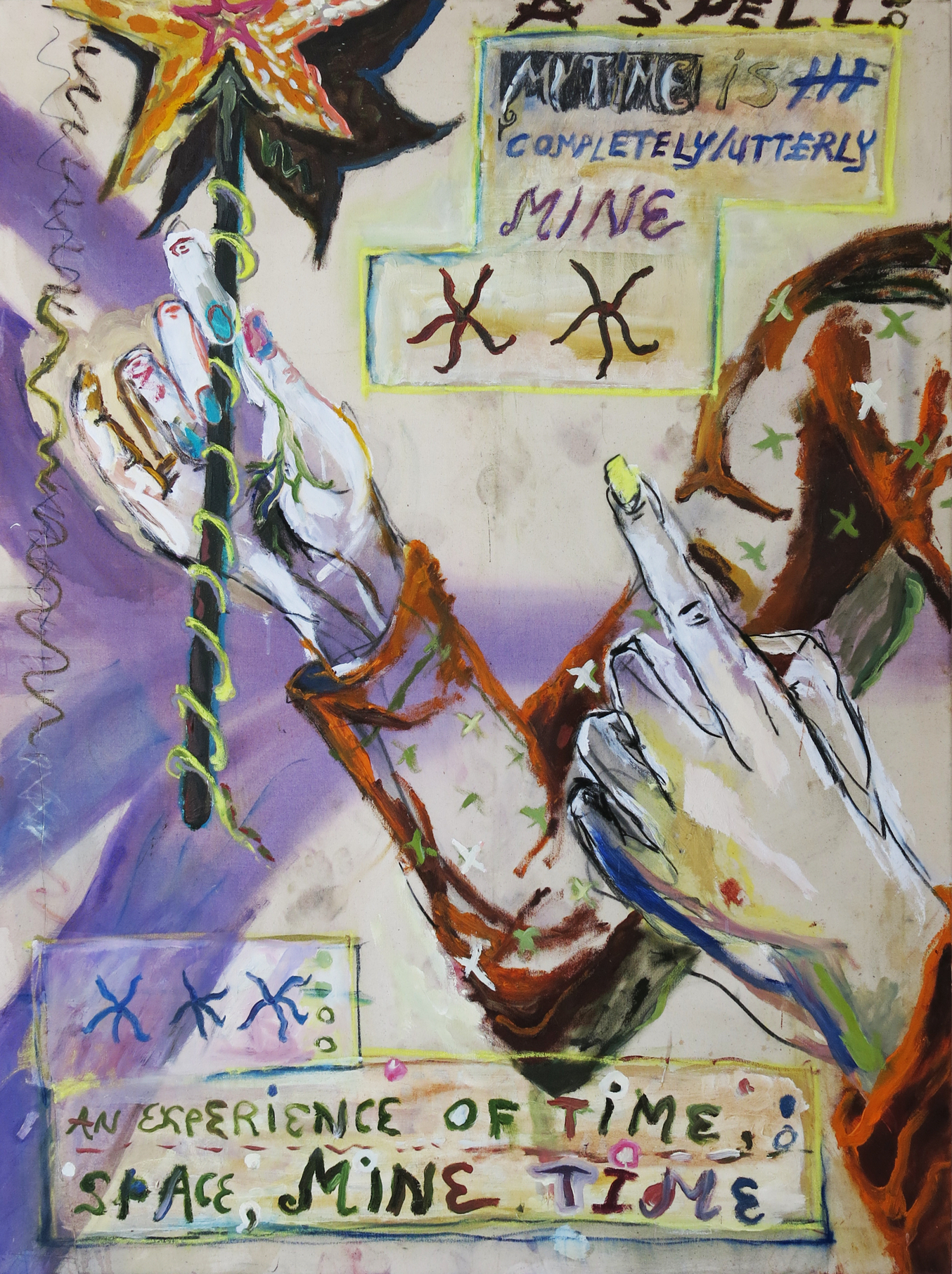
Another recurring element in your work is the hand. Hands have a symbolic function in multiple cultures and religions, so I wondered what the hand represents in your work?
In my work process, there is a lot of room for intuitive, quick drawings, often with charcoal. I make many of these, almost like automatic writing, and then I use a selection as the basis for paintings. The hand does indeed appear frequently, without me knowing in advance why or what it represents exactly. Often, I only later discover the personal meaning of these symbols, as with the hand. In my work, it often stands for humanity. Where religion places a god at the centre, within magic, it’s the human and the ability to effect change. Through our hands, we create, connect and heal. When I imagine where energy leaves my body, it is also through the hand.
Last year, you received a grant from the Mondriaan Fund. Is there a project you were able to execute with the grant that you wouldn’t have been able to otherwise?
In addition to various investments in my practice, the Mondriaan Fund grant allowed me to carry out the production of the previously mentioned work, Talismagic, both in terms of material costs and the time invested in each object. The contribution was also crucial for creating the paintings shown at Prospects: the most valuable aspect is having the peace of mind to spend a lot of time in my studio with the canvases.
What are you currently working on?
I am starting a collaboration with Isabel Cavenecia soon. We have a duo show in March at POST as part of the Symbiosis Series. We were put into touch with each other by curator Fenne Saedt due to our shared interest in witchcraft. Another ongoing collaboration is with Trees Heil, under the name My Guides and Me, where we explore spirituality and magic in video and music. Our first songs and performance were created with Piyoyo (Rik Mohlmann). I am also interested in working with glass. I had a small preview of that during my residency on Aruba last November.
Written by Wouter van den Eijkel
Adriano Amaral’s hybrid world
Those who missed the first solo exhibition of work by Brazilian artist Adriano Amaral at Galerie Fons Welters at the end of last year are in luck: Prole is being revived at Art Rotterdam. In part, that is. The gallery will be showcasing some of Amaral’s Prosthetic Paintings that were featured in Prole. For this series of paintings, Amaral used photographs taken with his smartphone as a starting point and then produced them in the same silicone as used for prosthetics.
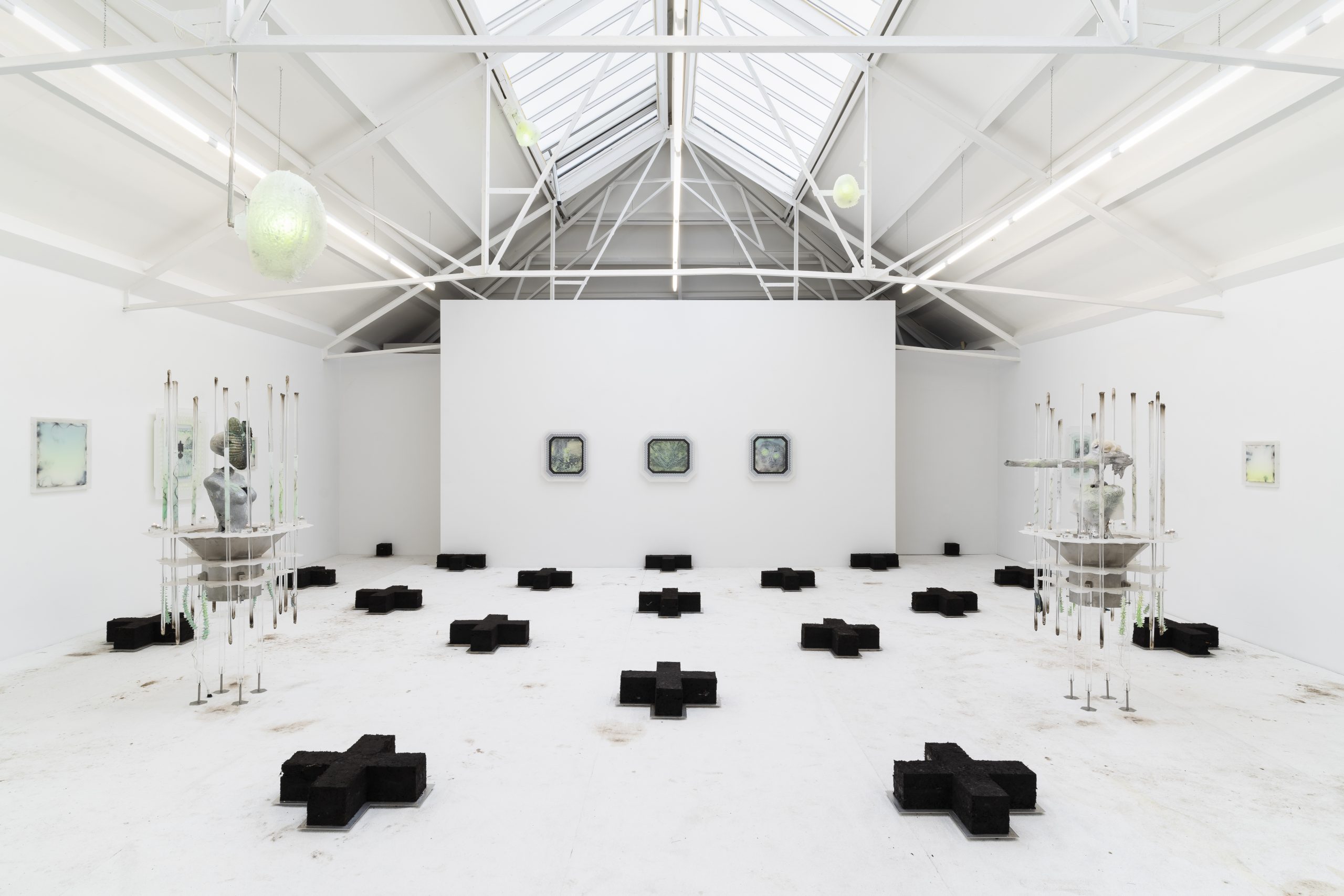
Describing the content of the work of this alumnus of De Ateliers is much more challenging than the type of silicone he uses. The press release for Prole, which means ‘offspring’ in Portuguese, describes Amaral’s work as an exploration of the materiality and content of everything surrounding us and how things gradually change over time. If we take the title literally, it is about over-evolved offspring. Amaral (Brazil, 1982) experiments with contrasts both conceptually and in terms of materials – living-dead, organic-digital, ecological-technological, but also tangible-ephemeral – to arrive at hybrid forms of those contrasts, which can be so confusing that you are forced to rethink the concepts.
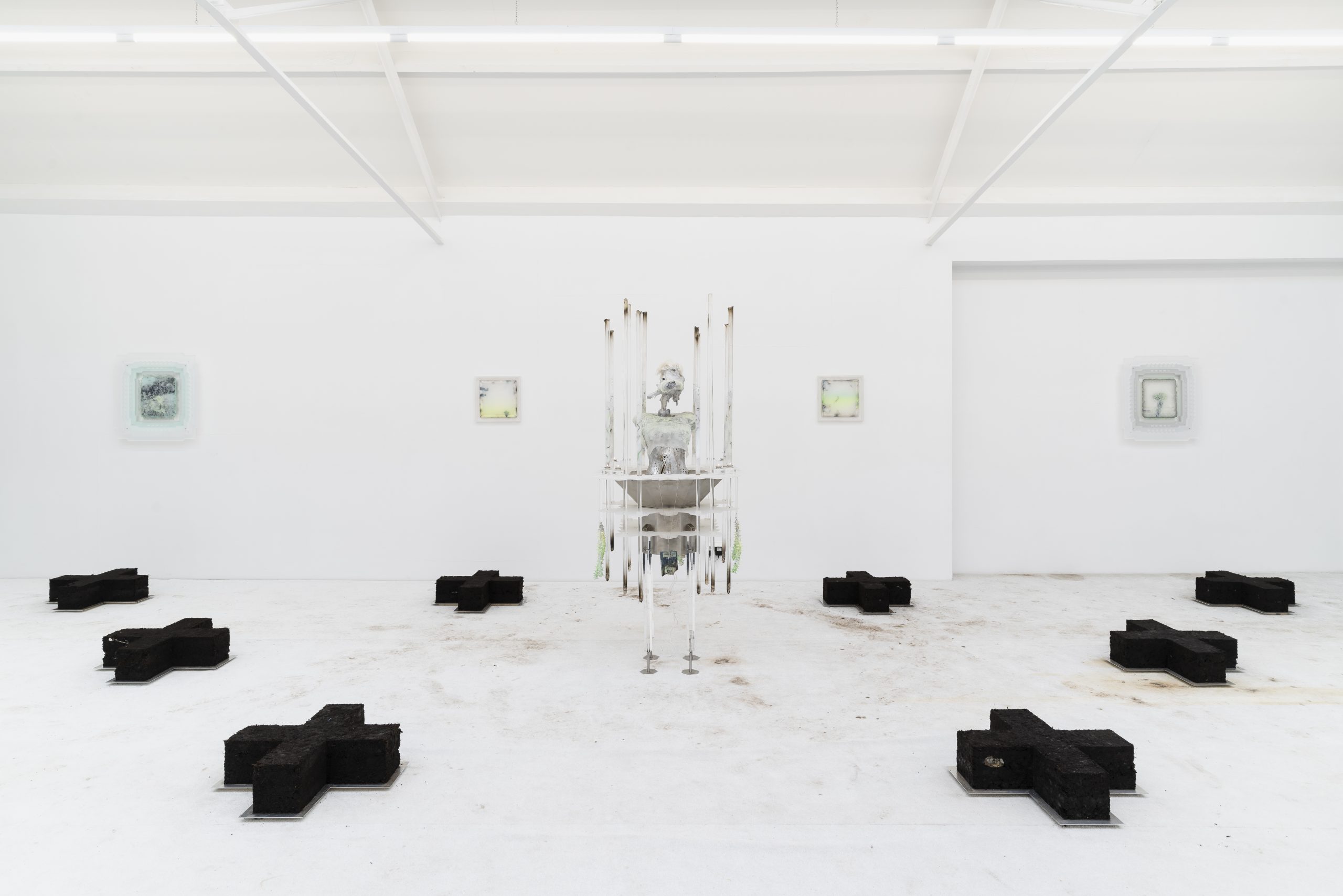
A space with its own logic
Those who came to see Prole had to step through a number of plastic flaps, as if entering a walk-in cooler, a symbolic gateway to a space with its own visual language and corresponding logic. On the floor of the entirely white gallery were 32 crosses made of dirt, each on its own aluminium platform. During the exhibition, the dirt continuously dried out, causing the crosses to become brittle and eventually fall apart.
The gradual transition from life to death is a fairly obvious contrast. The cross shape is a clearly religious symbol, combined with the slowly drying dirt, which may be interpreted as crumbling religious awareness, but Amaral takes it even further. The crosses extend all the way to the walls of the gallery, where half crosses are displayed. This creates the suggestion that the crosses continue endlessly outside the gallery, as if you’ve entered a kind of digital mesh where an organic and a digital world merge.
“My ultimate goal is a hybrid between something organic like dirt and the digital domain,” says Amaral, who worked on the installation for over a year. “At the beginning of my career, I mainly created site-specific installations, but nowadays also more autonomous work, like the Pinturas Protéticas (Prosthetic Paintings). But I still want visitors to see something everywhere and connect with other objects in the space. I also want my work to be open to interpretation so that visitors can make their own connections.”
Amaral describes his approach as intuitive. “Initially, I combined things I found, such as a branch with a cap from a PET bottle. Only after a few years did I realise that the things I combined carried a duality in them on many different levels. In a show like this, I start intuitively, but at a certain point, I know what I want to create and it becomes more conceptual.”
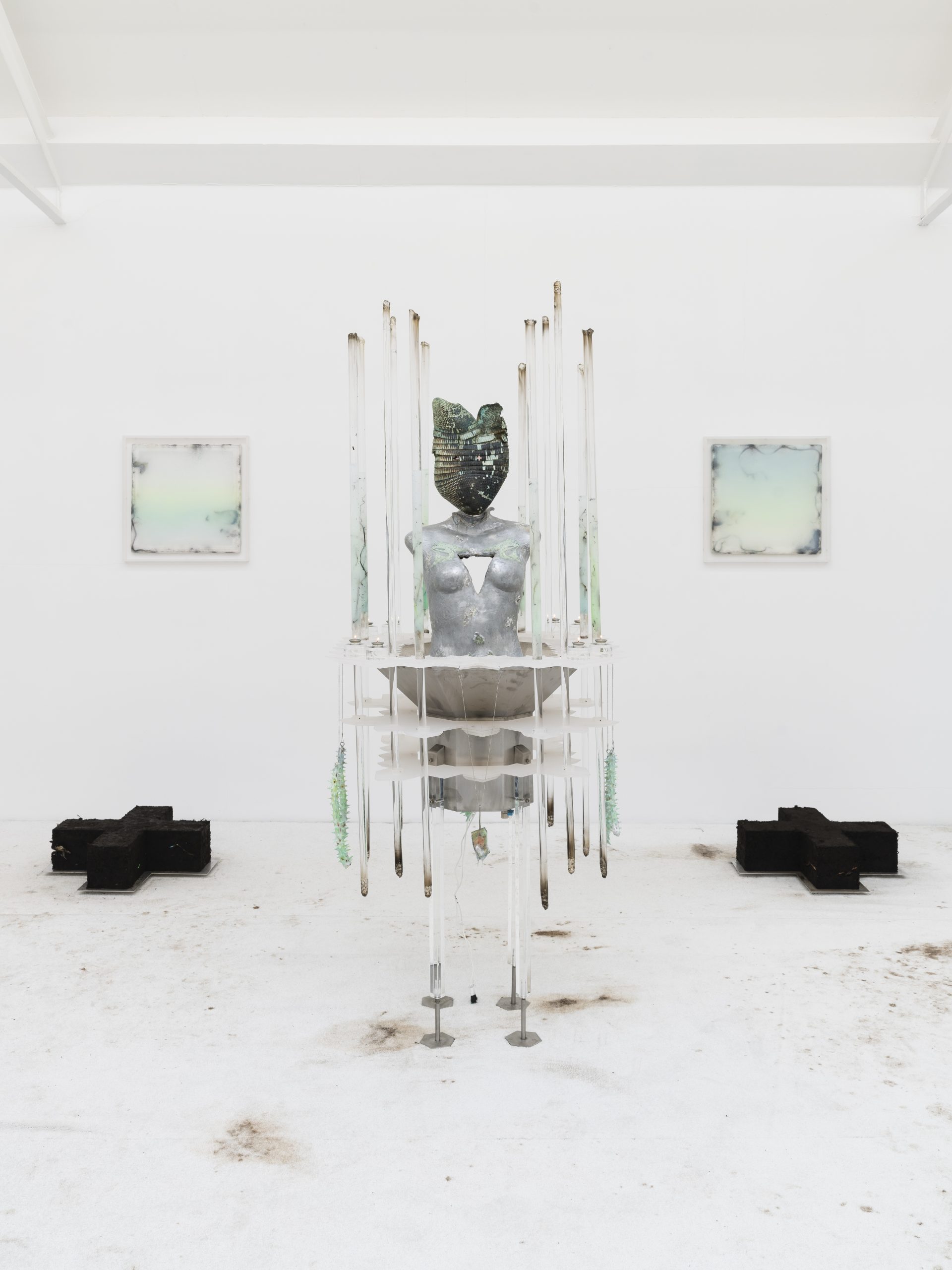
Pinturas Protéticas
On the walls hung the Pinturas Protéticas, made of silicone used in prosthetics for people who have lost a limb. Touching is rarely allowed in art, but with Amaral’s works the skin-like structure makes it difficult to suppress that tendency. “It feels soft, like human skin,” says Amaral. He has been working with silicone since 2015 but only developed this complex application last year.
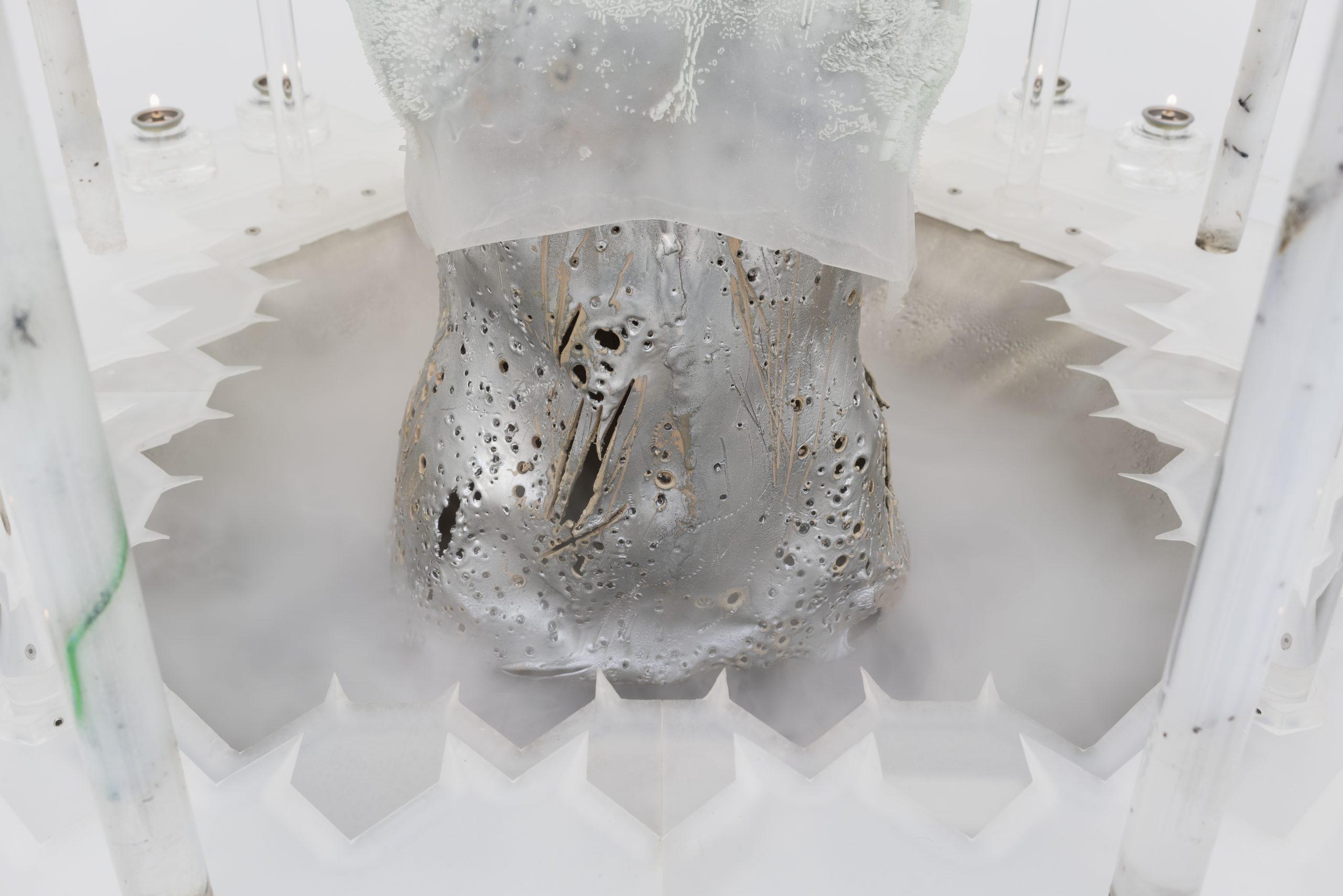
With the Pinturas, there is also a hybrid aspect. Although the works have an almost skin-like quality, they were 3D printed. Because the works are recessed in a kind of membrane-like frame, you view them from closer by. For Amaral, it’s about the effect of experiencing something made with a printer as human and intimate. The depictions in turn have an artificial, futuristic citrus or lime green colour, making the animal scenes appear somewhat unnatural.
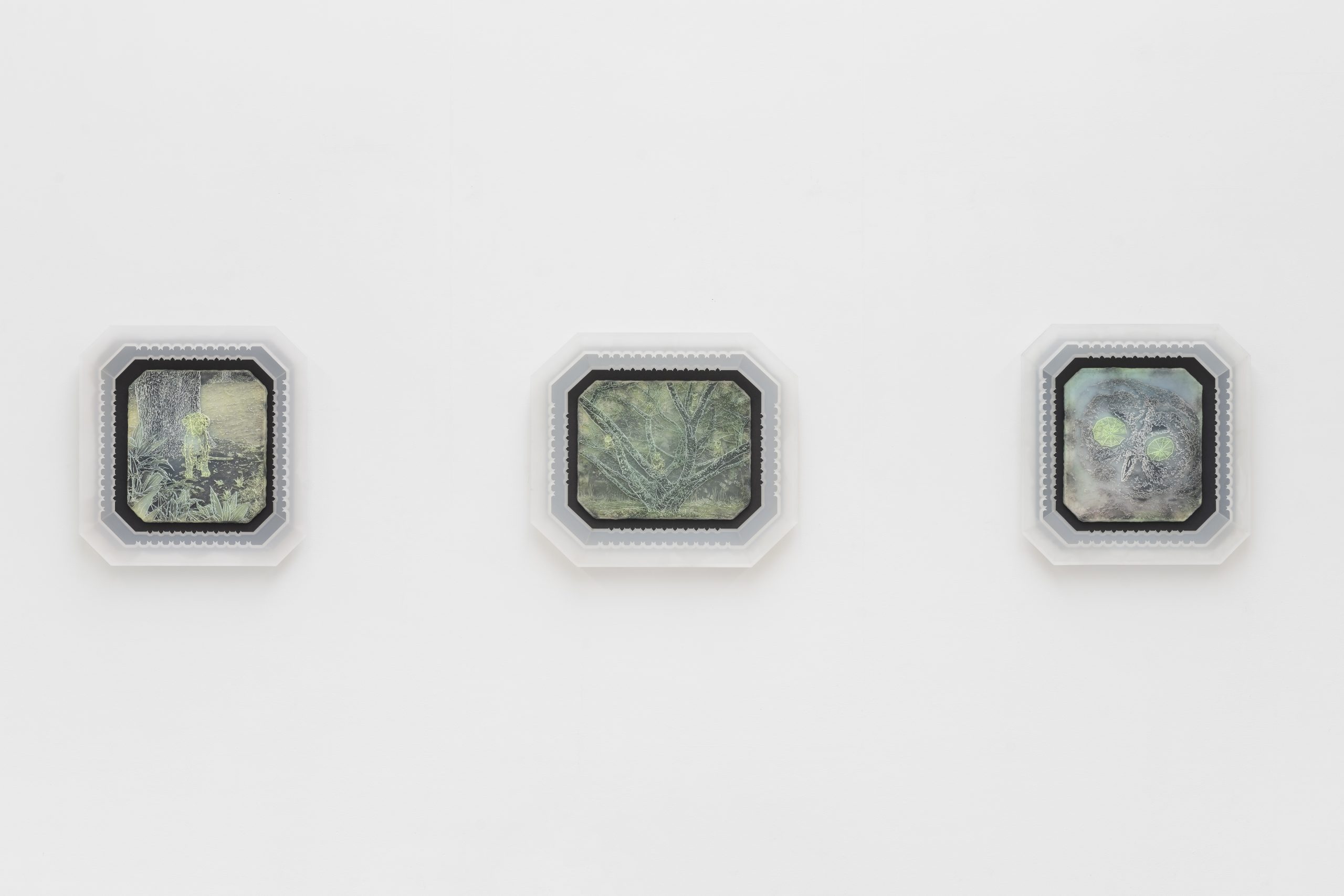
The photos that served as a starting point were taken by Amaral in his immediate surroundings with his mobile phone. “In past work, my environment was an integral part of the work in the form of the materials used,” says Amaral, who now lives on his family’s farm three hours from São Paulo. “This time, I also wanted to show images of my environment, so I’ve occasionally added something I like or found online, like the man in the frog suit.”
Written by Wouter van den Eijkel
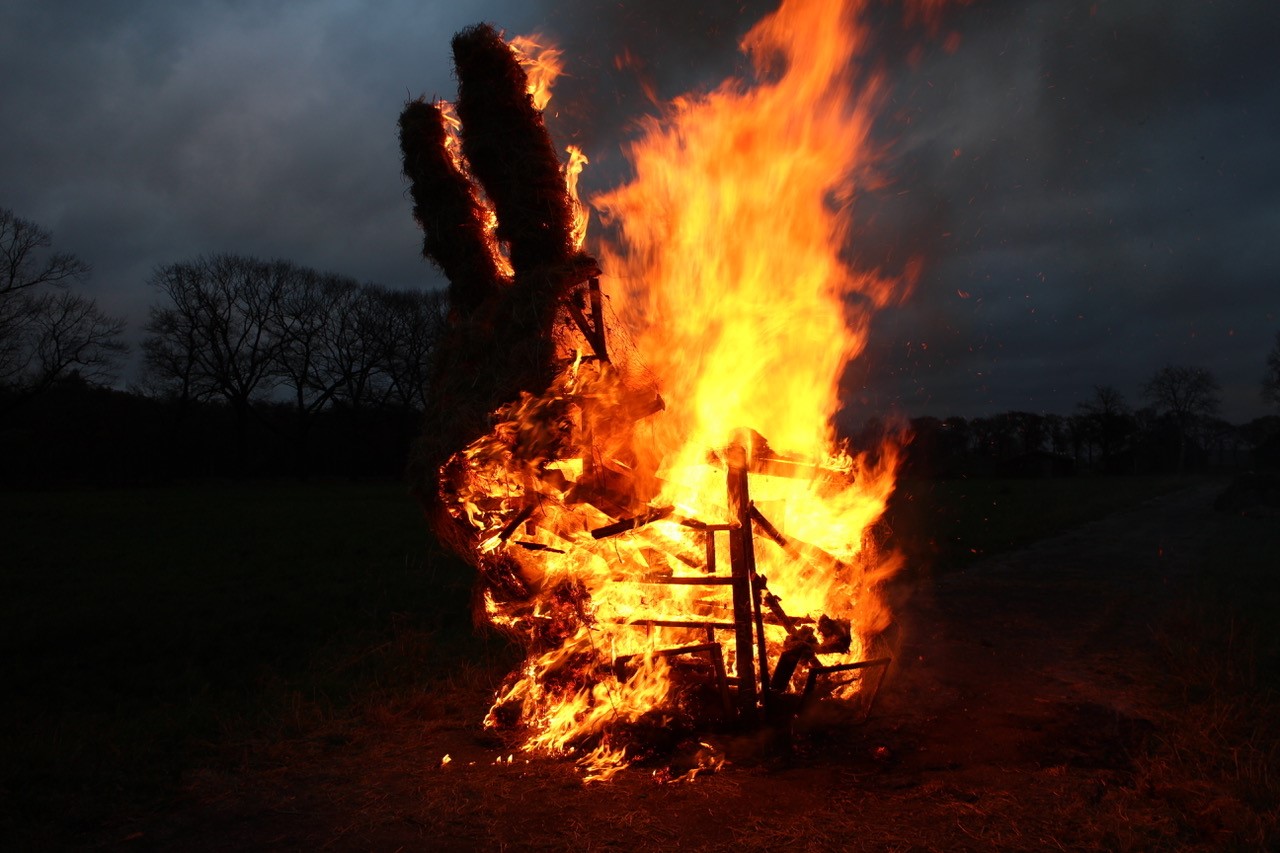
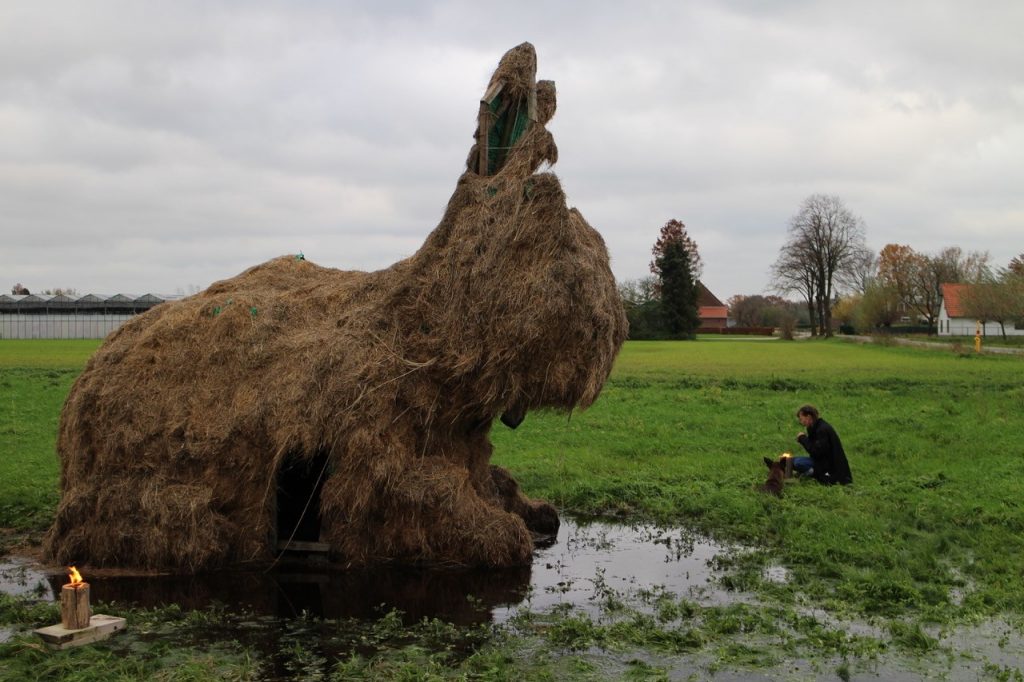
Undoubtedly, the most striking booth at Art Rotterdam will be that of the Annet Gelink Gallery. No one will be able to casually pass by a 3½-meter-high rabbit made of hay. For his new project, tentatively entitled De Gloeiige, Erik van Lieshout temporarily traded his residence and workspace in Rotterdam for his hometown of Deurne, an agricultural village on the Brabant side of the Peel that has become a focal point in the resistance against nitrogen policies in recent years. Van Lieshout spent a year there capturing footage for a new film, creating sculptures of eggs and the hay rabbit. Handmade T-shirts, crafted by Van Lieshout in collaboration with Rotterdam fashion designer Jeroen van Tuyl, are also available for purchase.
“Have you ever stood in a barn with a thousand pigs?” Erik van Lieshout asks somewhere in the middle of our conversation. There is a brief silence. “See, that’s the point; the city and the countryside are two worlds that don’t often interact.” That is precisely what Van Lieshout aims to do with his project: bring these two worlds into contact with each other, even if it means causing a bit of friction.
De Gloeiige
Erik van Lieshout’s latest project takes its working title from the regional myth of a ghostly apparition observed at night in marshes and marshy heathlands. In one version of the legend, the ghost is a farmer who had tampered with boundary markers. After their death, the spirits roam around, trying to reconcile before finding peace.
While De Gloeiige (which translates as ‘the glowing one’) closely follows political events, Van Lieshout has previously created works about farmer protests. The unruly demonstration in front of the Friesland provincial government building in 2019 was the subject of a large collage made from coloured vinyl, just like the tractor protests in The Hague the following year. Protests and challenging the status quo are recurring themes in Van Lieshout’s work. This traces back in part to his upbringing in Deurne, where village politics have been traditionally dominated by the interests of pig and chicken farmers. Van Lieshout’s parents were not farmers, making him an outsider and giving him a love-hate relationship with the local farmers.
Very positive
“It’s a really hardcore industry and the farmers know that something has to change,” Van Lieshout summarises the situation, “because we’re up to our ears in manure here.” With the film he is currently editing, he hopes to bring about sustainable change in the region. Apart from farming, there is little to do in the Peel, according to Van Lieshout. “There are no bike paths, beautiful walking routes or coffee bars, and aside from the Wieger, no museums. I want to change and transform the area into something enjoyable.” For this reason, Van Lieshout refers to his project as “very positive for farmers”. But this is not as straightforward as it may sound because the farmers were not initially open to an exchange with an artist. “Farmers tend to keep to themselves and nowadays, they are especially wary of the media and animal rights activists,” says Van Lieshout. For De Gloeiige, it helped that he came from Deurne and spoke the language. Van Lieshout was transparent about his intentions – “they know I’m a left-wing activist” – and thus gained their trust. He gradually earned their trust and permission to film everywhere. What also helped is that, according to Van Lieshout, the region has a lot of humour. Despite the serious message, humour is not lacking in Van Lieshout’s work or in the film. At the festive conclusion of the project the day after the parliamentary elections – one of the hay rabbits was to be burned while everyone enjoyed a bowl of pea soup and beer – everyone who contributed to the project from the neighbourhood showed up, much to Van Lieshout’s surprise.
While occasional friction is only natural, it enhances the film. Van Lieshout welcomes collectors and museum delegations, bringing them into contact with the farmers. An uncomfortable gathering, not least because some urbanites are vegetarians. This underscores Van Lieshout’s point that urbanites and farmers rarely encounter or know each other.
A towering rabbit
Van Lieshout not only addresses the separate worlds of the city and countryside, but also poses the questions of who owns the land and what can be done with it. He gained access to the ruins of a farmhouse, owned by a veterinarian who, like Van Lieshout, left the region to study. The veterinarian now wants to return to start a laboratory developing a serum for snakebites. This would involve testing on laboratory rabbits. The plan faces strong opposition, not only from activists, but also local farmers. In response, Van Lieshout decided to build a towering rabbit made of salvaged wood covered in hay on the veterinarian’s land, a provocative imitation of the hay structures that farmers set up along the road in protest against nitrogen policies.
Another location that plays a prominent role in the film is the area behind the ruins: a vacant 250-hectare terrain. Originally intended for greenhouse development, the financial crisis of 2008-2013 prevented any progress. The development of this area is a hot topic in the municipality. Some residents want nothing to be done with it, while local farmers would prefer a manure fermentation factory, allowing everything to remain the same.
Farmers’ art and T-shirts
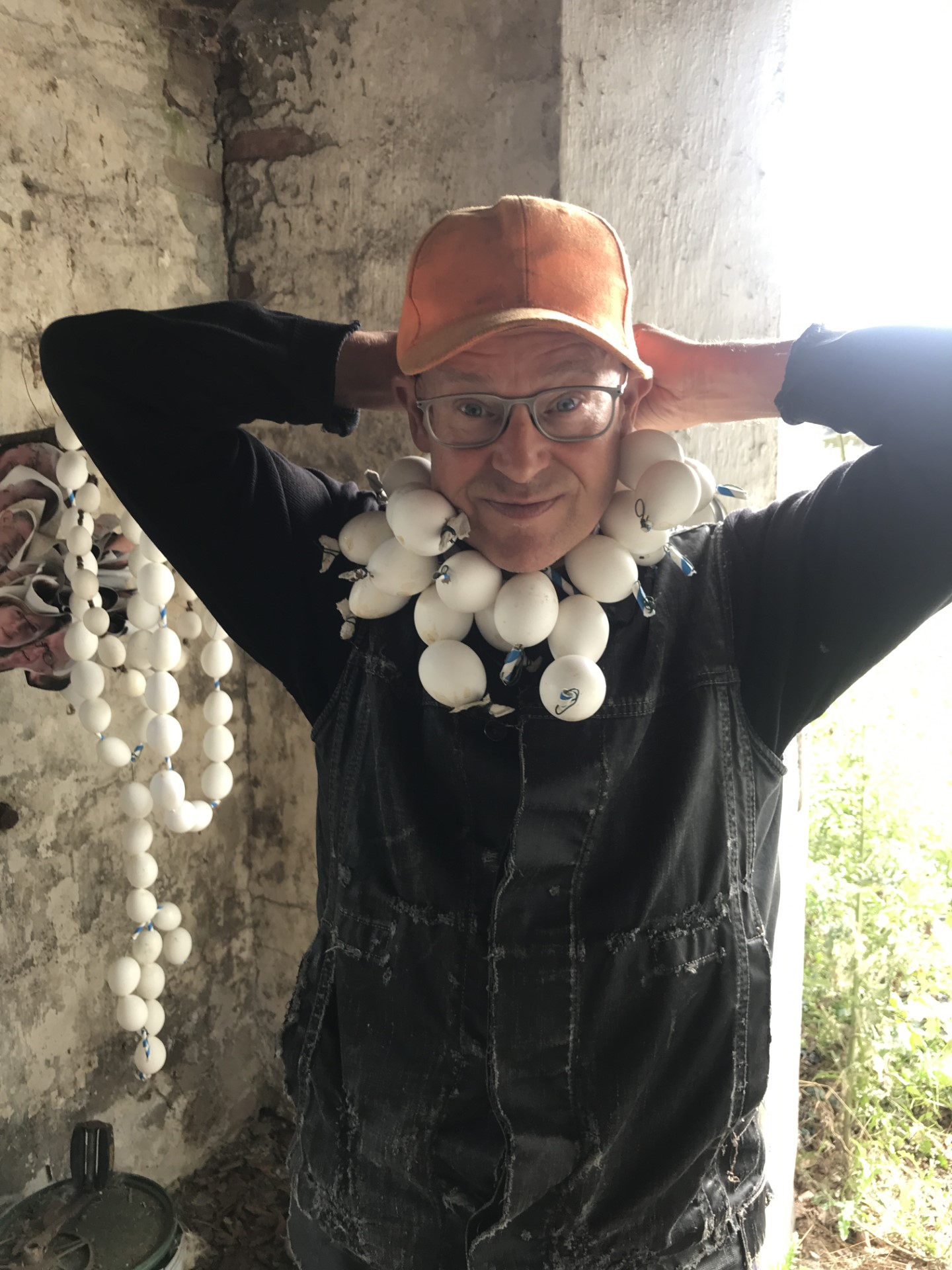
The veterinarian allowed Van Lieshout to use everything he found in the ruins for his work. Planks, belts, pitchforks and spades were all incorporated into sculptures. But the main component is the white eggshells. Van Lieshout purchased the eggs from a local farmer. Using a needle, Van Lieshout pierced a hole and blew out the contents. He used the empty eggs in a series of sculptures that might be called farmers’ art. The imagery refers to farm life and Catholicism – the comparison to a rosary is easily made with a chain of eggshells – two pillars that shaped and continue to shape life in the region. Some of these sculptures will be exhibited at Art Rotterdam at the Annet Gelink Gallery booth.
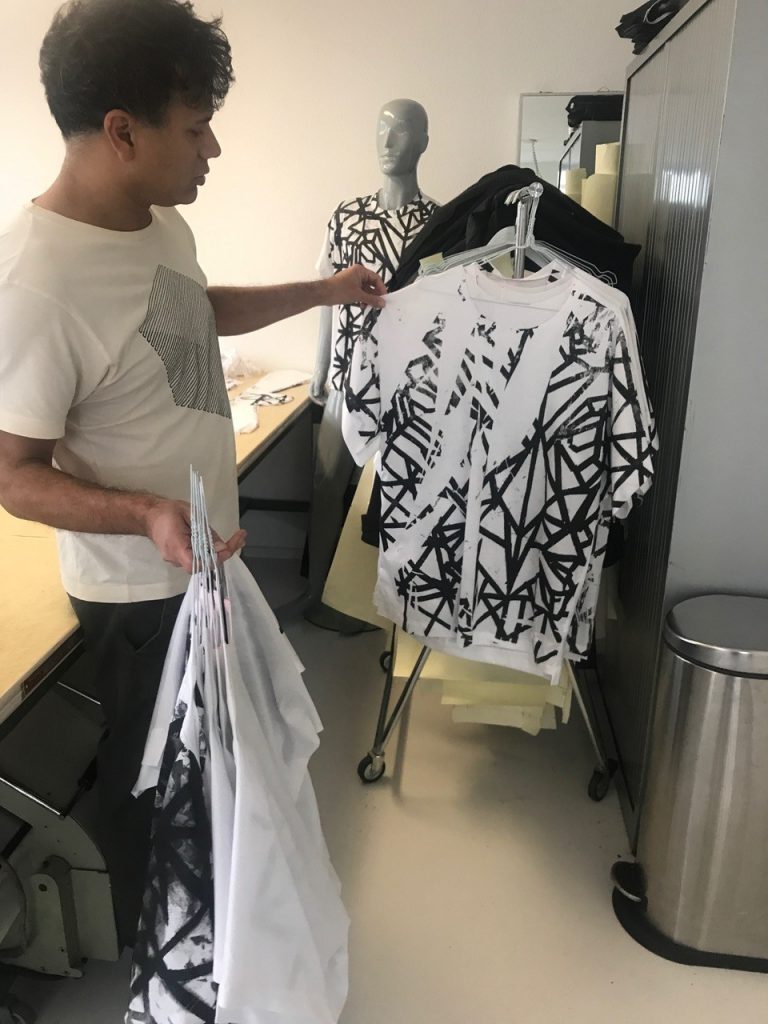
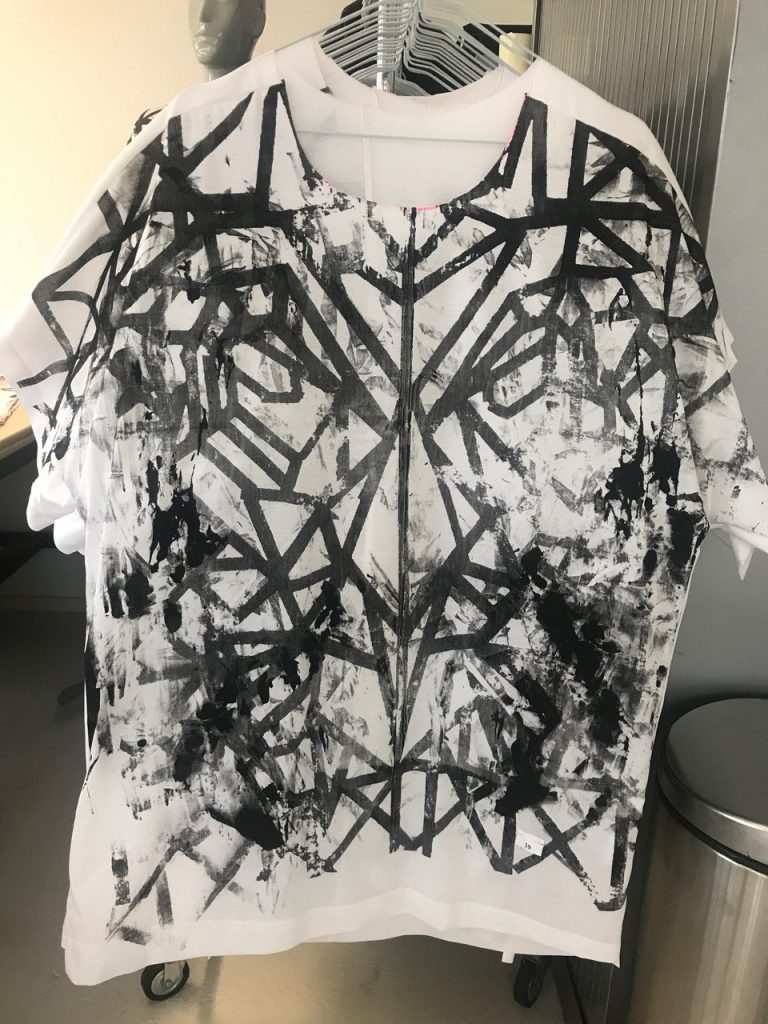
A self-made T-shirt is also available for purchase in a limited edition of 50, resulting from Van Lieshout’s collaboration with Rotterdam fashion designer Jeroen van Tuyl. Van Lieshout used Van Tuyl’s logo, a kind of mask, as inspiration for a sketch, which ended up as a Mondrian-like drawing with sleek vinyl lines. Van Lieshout and Van Tuyl screen-printed an enlarged version of it on white cotton. Each shirt has its own – often double – print in typical raw Van Lieshout style. Van Tuyl created the design. “Putting it together is meticulous work; the entire family has been involved and we’re still working on it,” says Van Lieshout, who hopes to have the 50 shirts ready for Art Rotterdam.
Written by Wouter van den Eijkel


