Coming soon
Coming soon
Select type
For the eighth year in a row, the NN Art Award will be awarded to a promising artist who completed their studies at an art academy in the Netherlands and is exhibiting at Art Rotterdam. This year, for the first time, the nominees will exhibit their work in the prestigious Kunsthal Rotterdam, from 1 February to 14 April 2024. The nominated artists for the NN Art Award 2024 are Maaike Kramer (Art Gallery O-68), Mónica Mays (Prospects section of the Mondriaan Fund), Jan van der Pol (CREMAN & DE ROOIJ) and Peim van der Sloot (Brinkman & Bergsma).
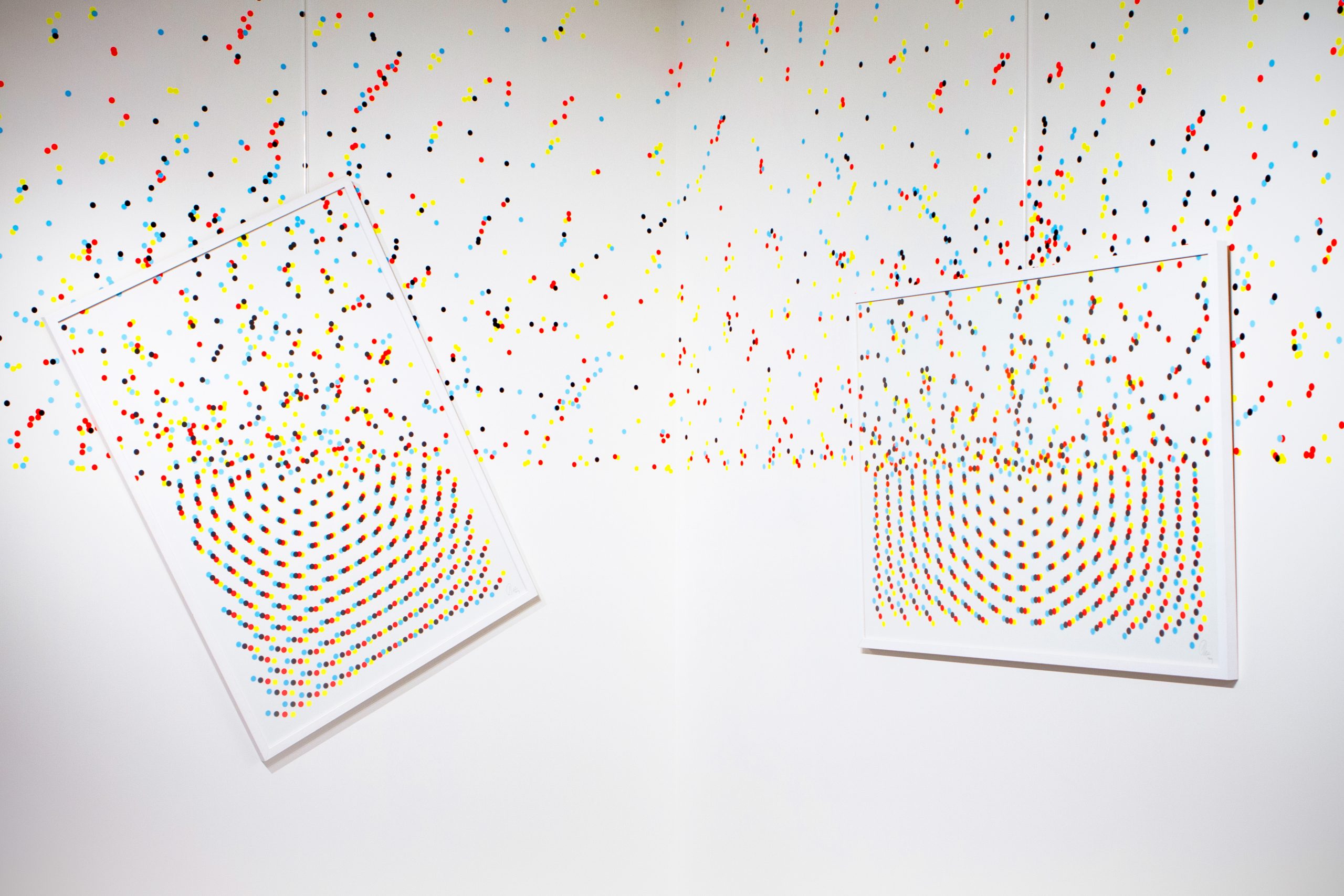
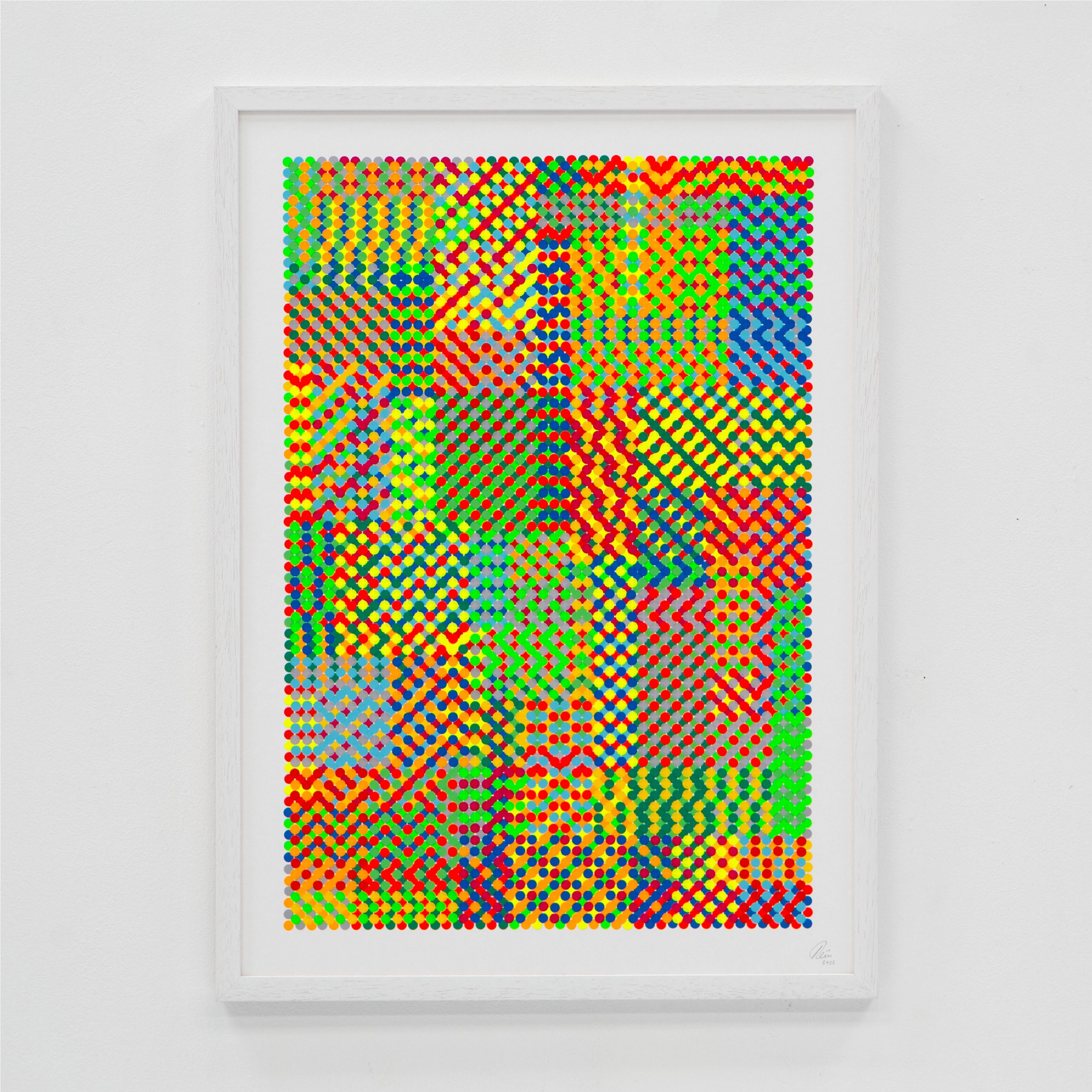
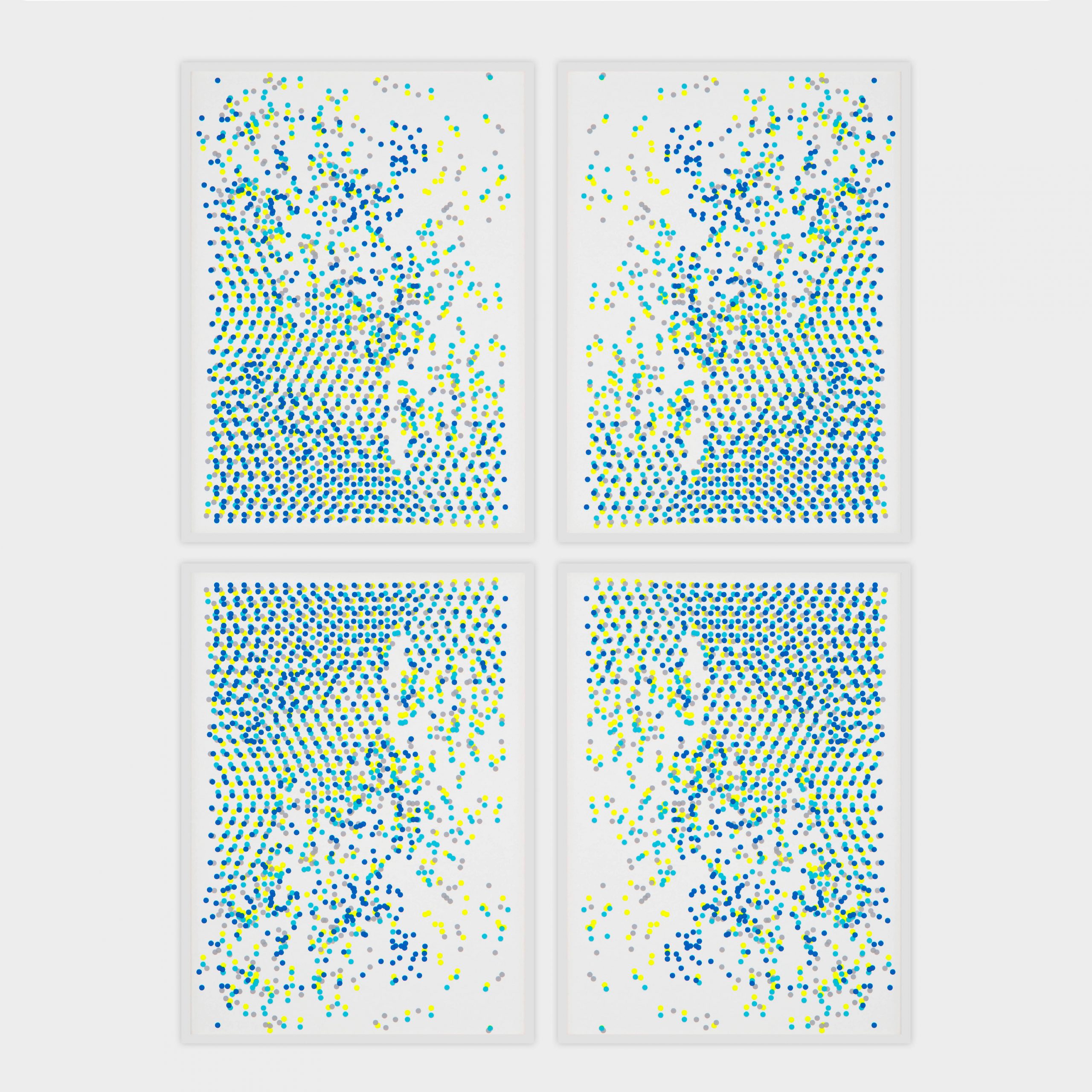
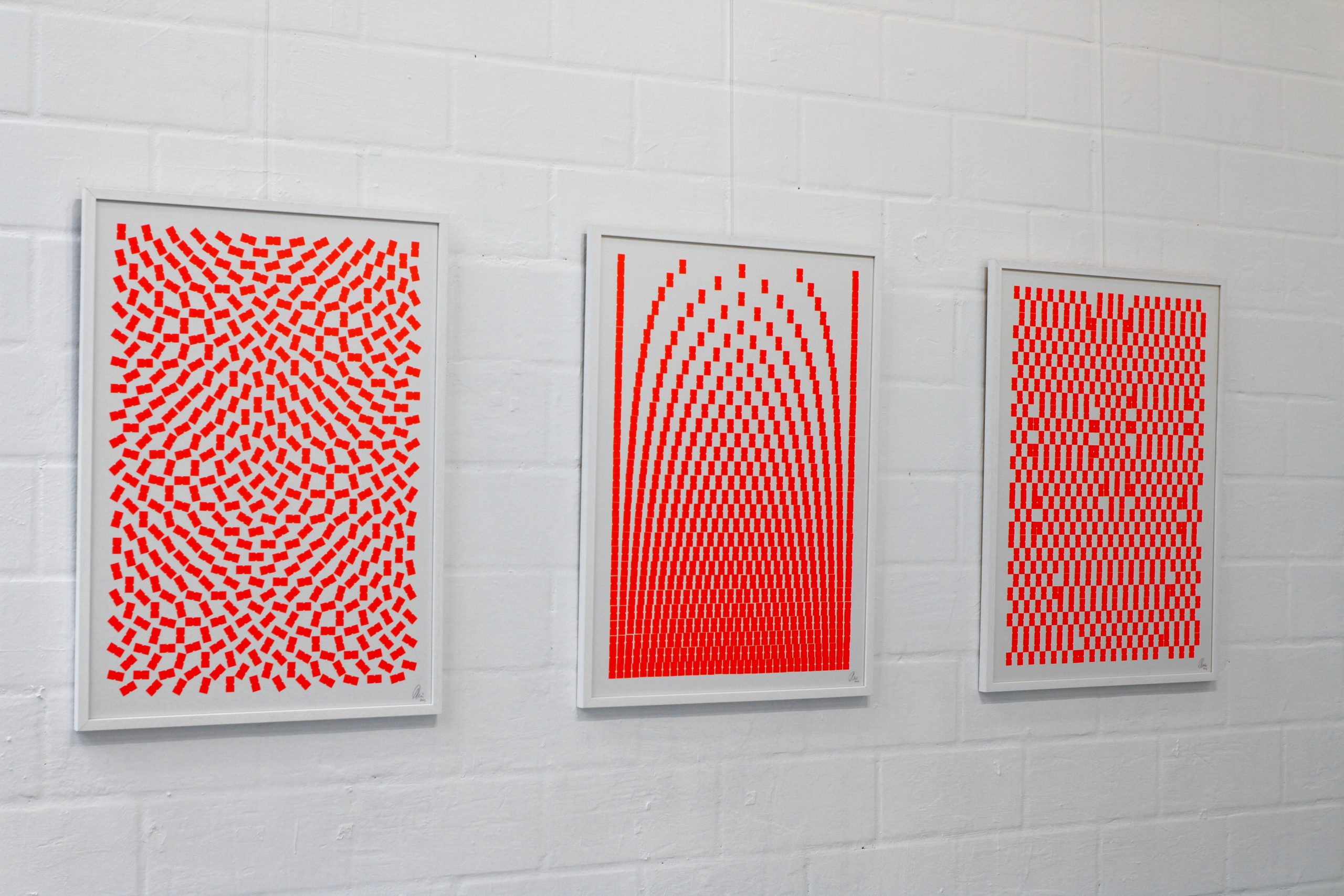
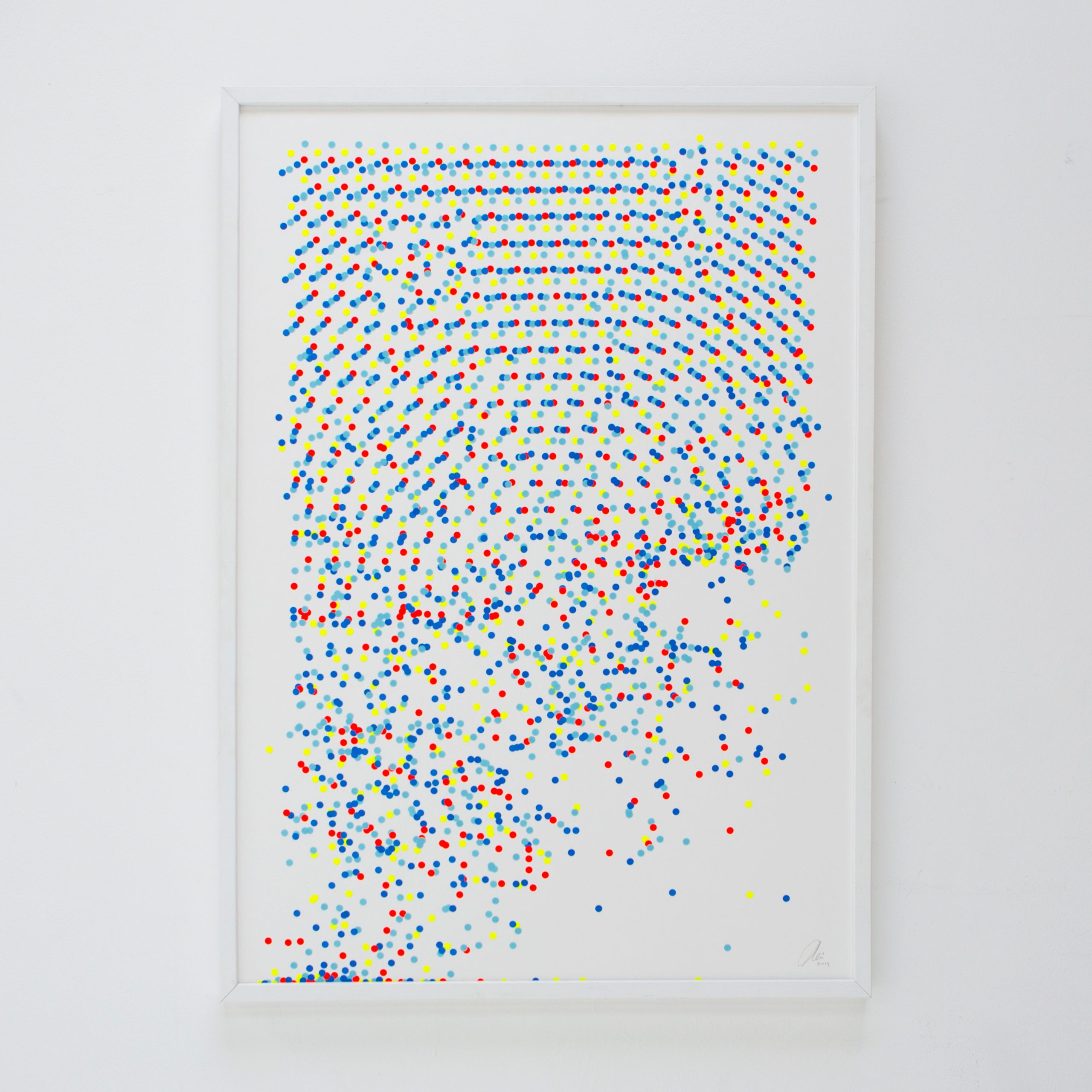
Peim van der Sloot’s abstract work is immediately captivating for its use of familiar round stickers: a familiar sight at art fairs, where they signify whether an artwork has been reserved or sold. In his practice, Van der Sloot critically examines economic systems. He questions concepts of value, scarcity and ownership, reflecting on the complex relationship between capitalism and the art world. The artist introduces alternative pricing systems and experiments with seriality, challenging conventional economic norms and assumptions, and inviting viewers to do the same. This questioning of the established order is also evident in his visual style, characterized by optical illusions, playful and dynamic compositions, vibrant colours, and a hint of chaos and anarchy. Van der Sloot grew up in Argentina and studied at HKU (University of the Arts Utrecht). His works are included in the collections of the LAM and the KPMG Art Collection and in 2021, he received the LAM Art Entrepreneur Award.
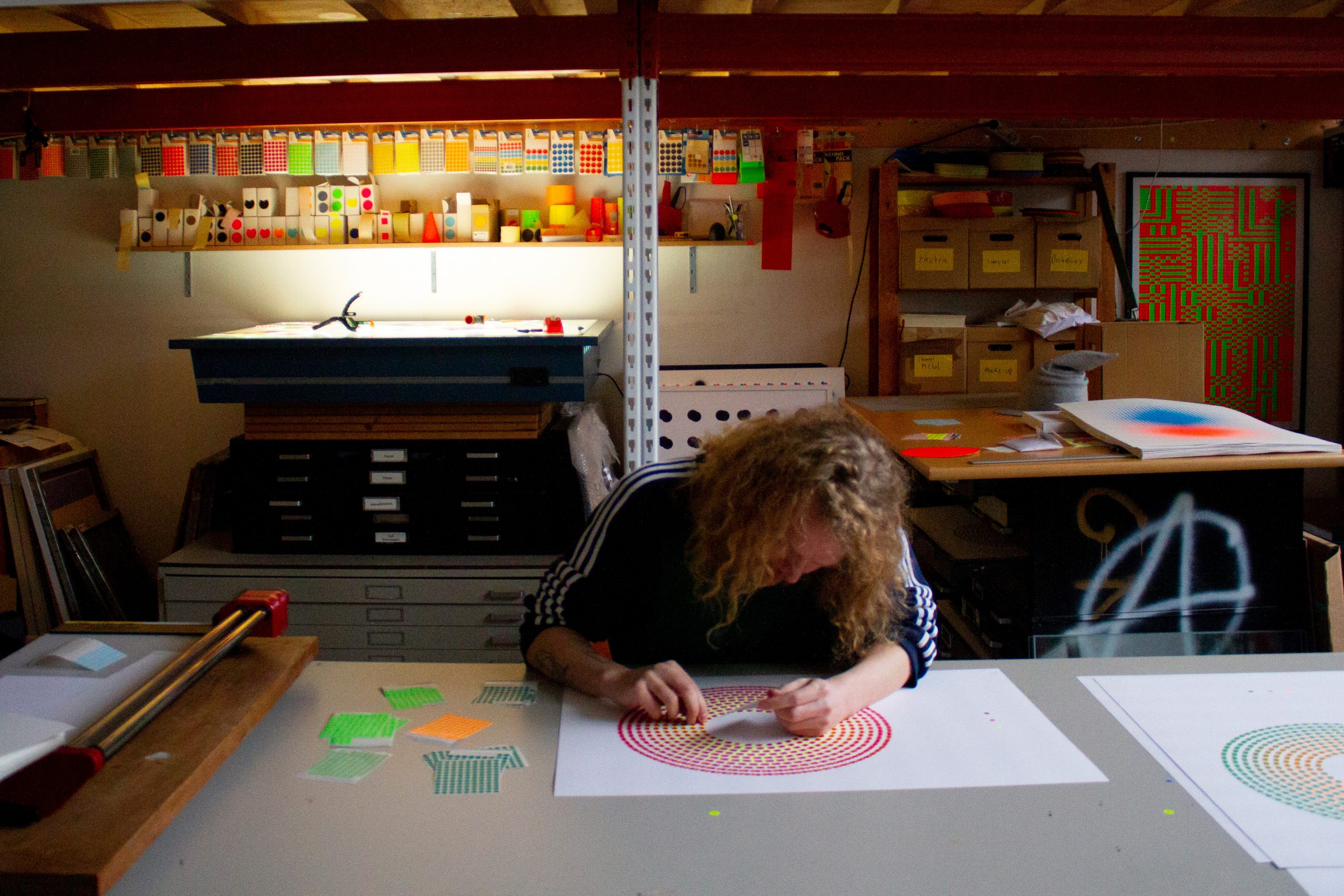
Can you tell us more about the work you are presenting at Art Rotterdam and in the Kunsthal?
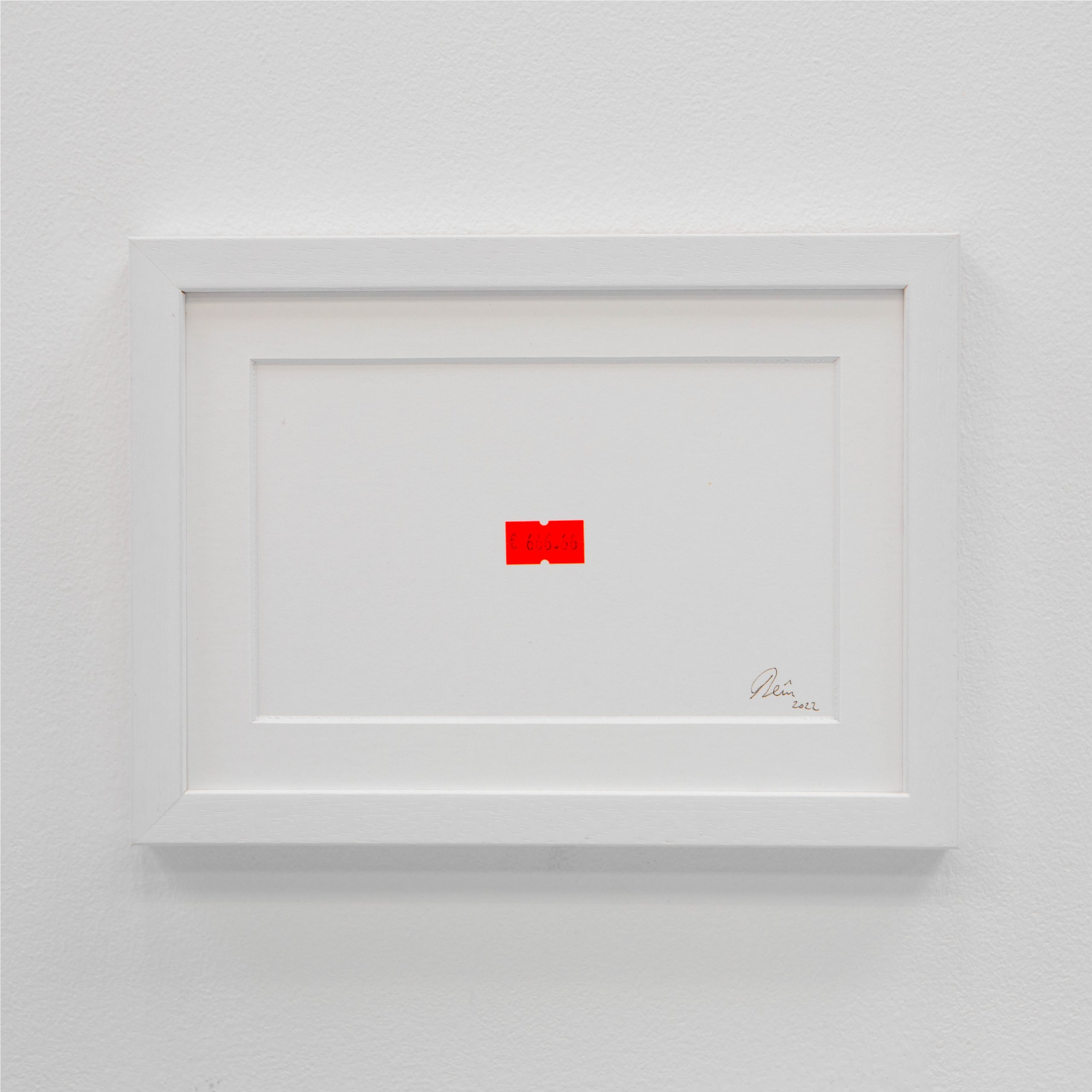
“At Art Rotterdam, I will offer a diverse overview of my body of work to date. Starting with the conceptual approach to art sales, all the way to the latest works that are poised like magical incantations, ready to enchant the viewer. Some of the most prominent pieces I will display during the fair include ‘It Has To Start Somewhere’, a series consisting of 3479 pieces, each gradually missing a sticker that the buyer receives to stick next to the artwork on the wall, and ‘The Most Expensive Piece’, which will be the most expensive artwork for sale at Art Rotterdam 2024.
For the exhibition in the Kunsthal, I am creating a site-specific installation, in which I treat the museum walls as a canvas. In the work ‘Peim was here’, the red sold sticker will, of course, have a prominent place as well.”
What are your plans for 2024?
“Besides ensuring that my work ‘Works I Have Sold In My Life So Far’ continues to grow, 2024 is going to be a year for experimenting with new materials and techniques. For instance, I want to dedicate time to explore the animation of my artworks in film format. I am also currently working on a collection of ‘digital artifacts’, artworks engraved on Bitcoin coins. It’s a bit of a technical story, but you can see it as putting digital graffiti on crypto currency. As long as two computers on earth are connected, these works will exist for eternity.”
Could you describe how you felt when you heard that you were nominated for the NN Art Award? What project would you start if you were to win the award?
“It was a very special feeling. I remember thinking: ‘the circle is complete’. In 2015, I won the ‘Keith Haring art-challenge’ at the Kunsthal, and subsequently made an artwork at Lowlands with the festival visitors. This was the start of my art practice. The opportunity to exhibit my work in the museum now, after all these years, holds added significance for me. I would also like to publish my own book, so perhaps I can realize that dream this year.”
How do you view the role of economic systems in the contemporary art world? How do you try to find your own place in it?
“Art is often sold as an exclusive luxury product. The art market is full of written and unwritten rules. But what a work costs and what it’s actually worth are two different things for me. In my work, I engage with these rules in various ways — sometimes by disregarding them, at other times by adopting and then subverting them, or by approaching them with a sense of playful skepticism. In doing so, I aim to actively involve the buyer in contemplating these underlying questions. Money has become an abstract concept, while ideally, the sale of art is about human contact. Fortunately, I see more and more artists engaging with this, and I am very grateful that at my gallery Brinkman & Bergsma, I get the space to experiment with this.”
What is the best advice you’ve ever received?
“‘Do it yourself’ was the guiding principle when a group of friends and I formed a collective during our time at the art academy. We took the initiative to organize movie nights, create protest stickers, and set up exhibitions and festivals. With the collective power of a community, you can make anything possible. It also liberates us from reliance on established institutions and organizations. This led Marnix Postma and me to establish De Bouwput, an inclusive art space in Amsterdam that everyone can use. We embrace a non-selective, non-curatorial approach, pre-approving all proposals, embodying the concept of ‘Anarchy in a white cube’.”
The winner of the NN Art Award will be announced in the Kunsthal Rotterdam on Thursday 1 February at 20:00 CET. The work of the nominees will be on display there until 14 April 2024. During Art Rotterdam, the work of Peim van der Sloot will also be shown in the booth of Brinkman & Bergsma.
By Flor Linckens
For the eighth year in a row, the NN Art Award will be awarded to a promising artist who completed their studies at an art academy in the Netherlands and is exhibiting at Art Rotterdam. This year, for the first time, the nominees will exhibit their work in the leading Kunsthal Rotterdam, from 1 February to 14 April 2024. The nominated artists for the NN Art Award 2024 are Maaike Kramer (Art Gallery O-68), Mónica Mays (Prospects section of the Mondriaan Fund), Jan van der Pol (CREMAN & DE ROOIJ) and Peim van der Sloot (Brinkman & Bergsma).
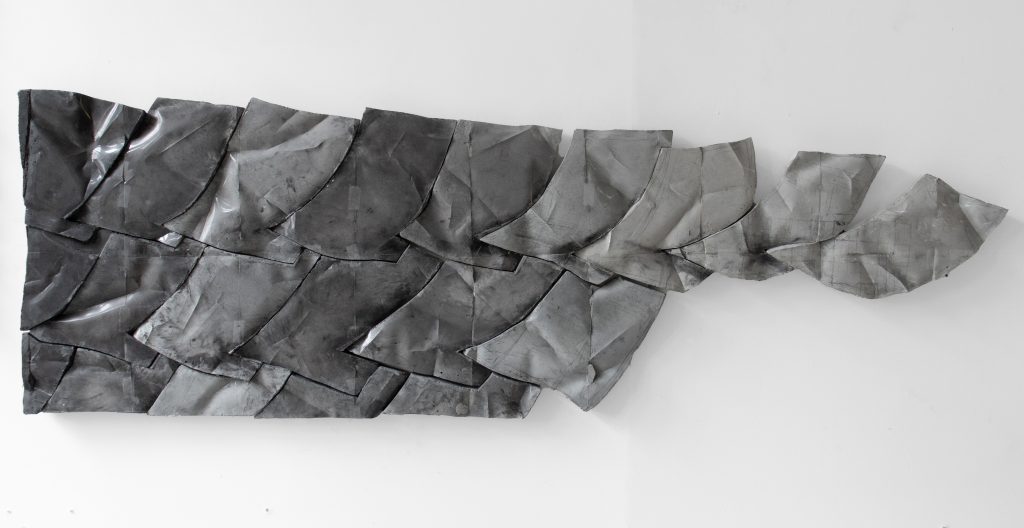
Maaike Kramer’s oeuvre stands out because of her diverse use of materials, including concrete, metal, graphite, paper, stone and wood. In her practice, Kramer combines robust, architectural elements with more sketch-like materials. This results in works that are often heavy, massive, and monumental, but also light, fragile and unstable. Sometimes these works also exhibit trompe-l’oeil effects. Kramer explores the dynamic interaction between these diverse and, at first glance, contradictory materials: can they learn from or borrow from each other? And what relationships do the works enter into with the spaces in which they are shown?
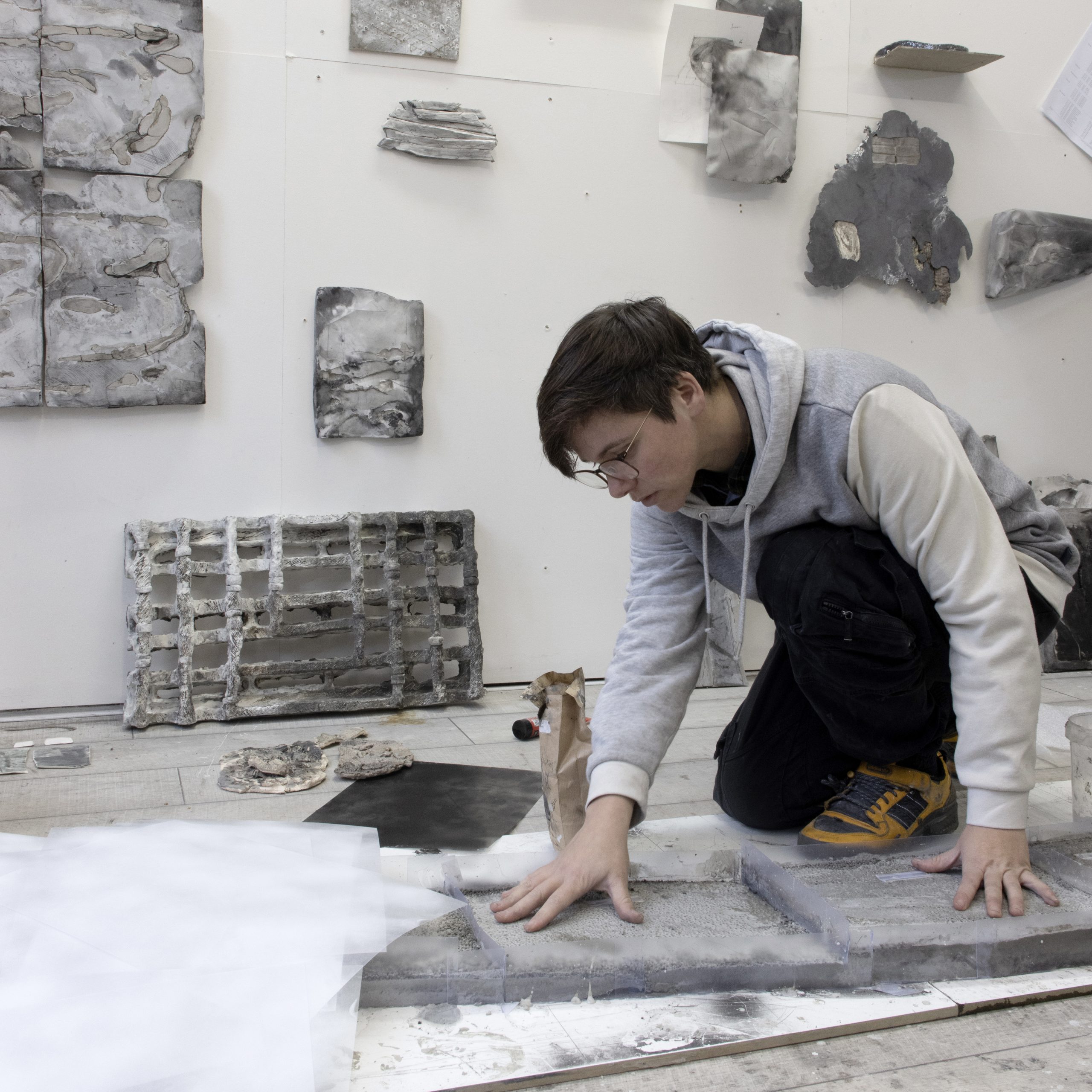
Kramer’s art tells stories about the creative process and reflects on the spaces we create and inhabit. They invite contemplation on the nature of construction, the role of humans in shaping their environment, and the contrast between the transience of ideas and the durability of materials. Kramer emphasizes this: “Ideas are not as durable as the material in which they are captured.” In some cases, this line of thinking is reflected in her practice, for example when sketches are literally integrated into the work. Kramer: “I incorporate different stages of the creating process into my work; from the monumentality of the final work, to the materials and methods that lead up to it. Examples include sketches, documentary photography, and scale models in combination with concrete, steel, and scaling up. During the creating process, the work goes through various phase transitions, dictated by the materials and the methods. Sketches are given a sculptural translation, are photographed, printed, enlarged, cast and copied.”
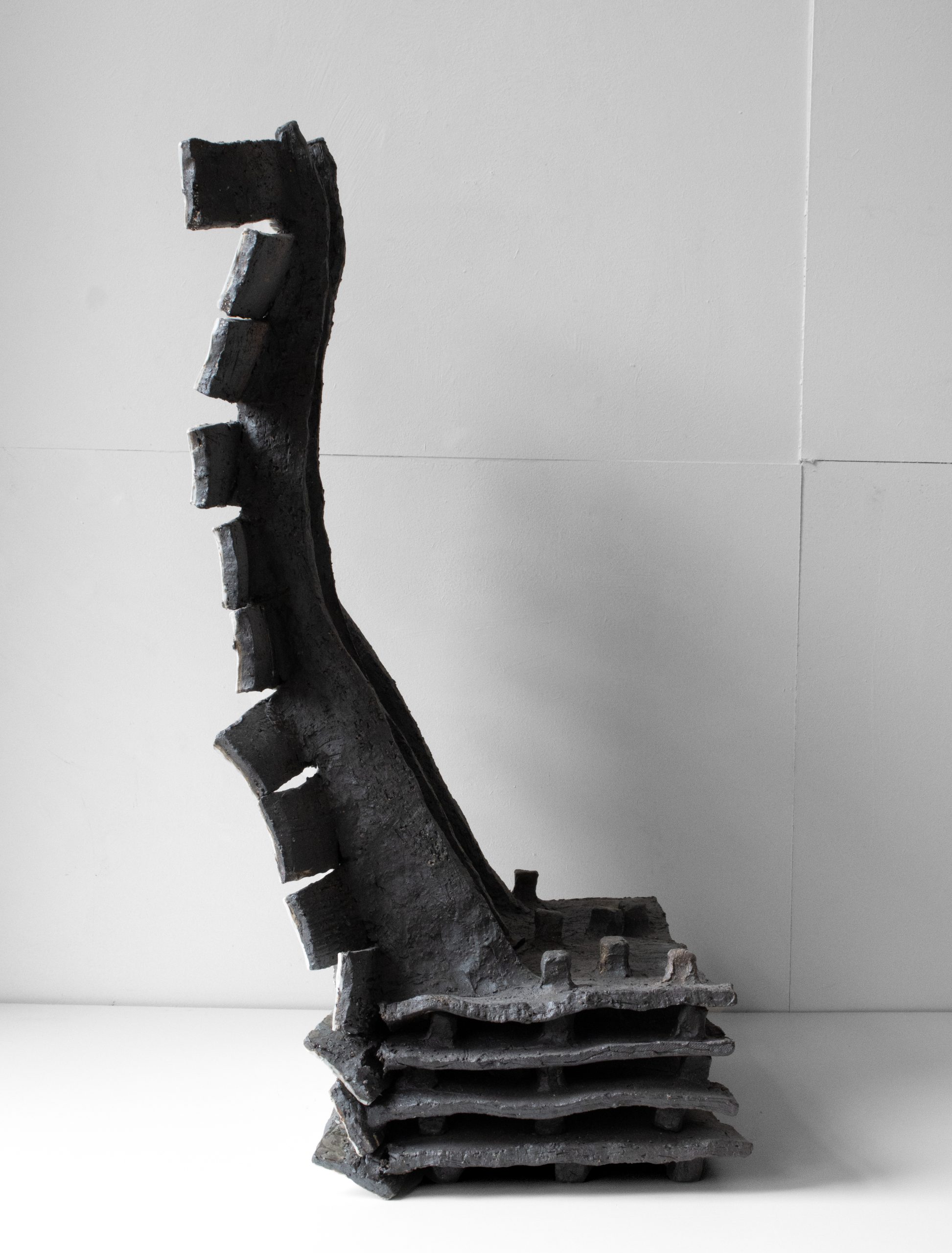
Could you tell us a bit more about the work you are presenting at Art Rotterdam and in the Kunsthal? What led you to focus on ceramics in your newer works?
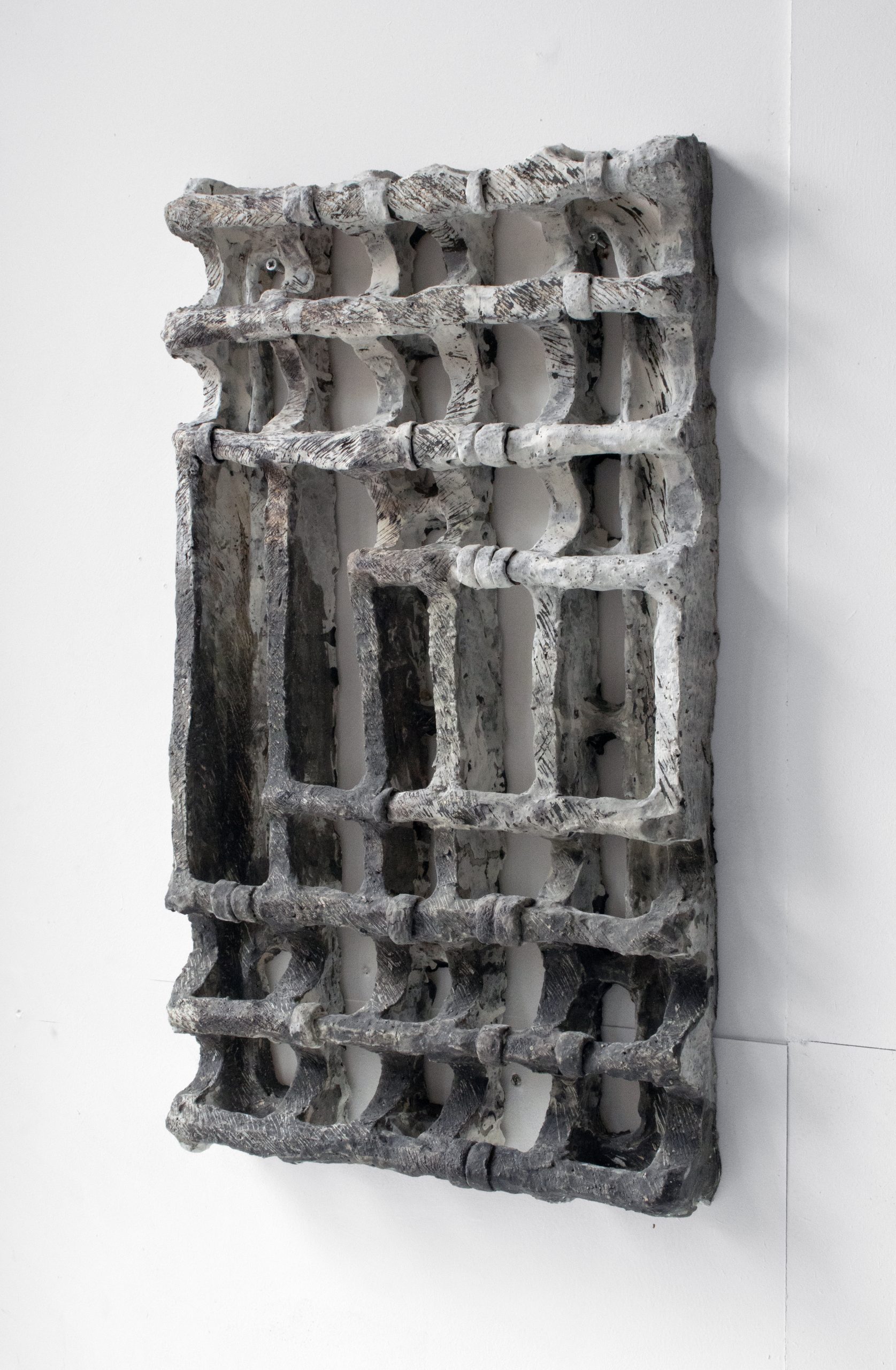
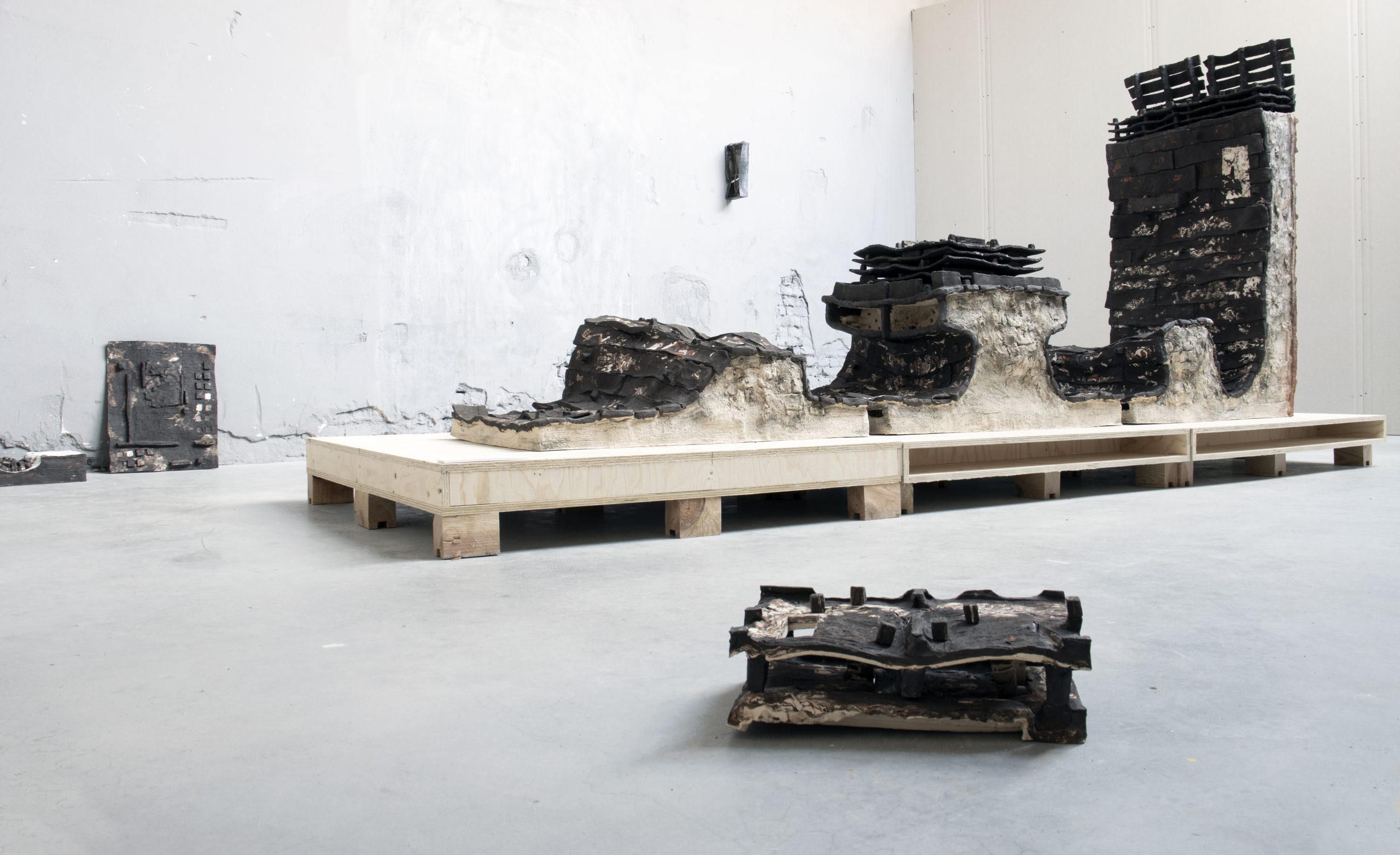
My work is about spaces, about architectural spaces as a metaphor for spaces in one’s mind. I also wanted to explore the space we inhabit more and felt that this required a new material. For this reason, I applied to the EKWC [European Ceramic Work Centre], where I completed a three-month residency program last year. There, I worked with ceramics for the first time and built spaces by hand, seeking ways in which form and material could give new meaning to space. For me, material is an active part of my story. It undergoes a transformation that allows a story to be told. At the EKWC, I ended up working with different types of clay with different levels of shrinkage, causing deformations and cracks during the process of drying and in the kiln. These works reflect on the space indoors. Some works are about the separation between the indoor and the outdoor. These are works I call ‘luxaflex’. I will show some of these luxaflex sculptures at Art Rotterdam. Here, porcelain is connected to coarse black clay. This creates a side that faces outward, made of porcelain with a celadon glaze, and a side that faces inward. These parts influence each other. The coarse inner part causes the smooth porcelain outer part to deform. In the Kunsthal, I will present a large sculpture, made at the EKWC. This sculpture also represents a space, actually a ‘slice’ of a space. It’s a place in which room has been created for a game of sorts. I searched for a space in my own house that felt the most free and experimental, and ended up choosing my shed. In this fictional shed, game boards are stacked where strategies can be thought out, to possibly place them outdoors, in the world. However, the space is also very isolated. So will these ideas actually come out, and if so: how?
What are your plans for 2024? What are you currently working on?
I’m not done exploring ceramics and the various meanings that clay carries. I am also working on making combination works, in which different materials come together. The step to work spatially is still relatively new to me. Until recently I made primarily flat reliefs, folded sheets or flat stacked works. For my exhibition ‘The Unbalancing Act’ at Drawing Centre Diepenheim in 2022, I started making sculptures with a front, side, and back side for the first time.
Could you describe how you felt when you heard that you were nominated for the NN Art Award? What project would you immediately tackle if you were to win the award?
I was incredibly happy and surprised. This is actually the first time my work is being shown at Art Rotterdam — as well as the Kunsthal. If I were to actually win the award, I would invest in my studio. At this moment, my studio is not quite on par with my practice, which is progressively shifting towards sculpture. This requires more space, but also materials and tools. I would really love to have a ceramic kiln, for example.
What is the best advice you have ever received?
Maybe not advice per se, but rather something I have experienced myself. That making visual work is not about tomorrow’s success or that one particular exhibition. But that you must feel that you need to make the work, for whatever reason. For many years I made work that no one saw. My work was first exhibited around 2017, when I had already been working for a few years. But that in fact gives me strength now, knowing that my inner creative engine will keep running.
What is the most remarkable compliment you have ever received about your work?
That it touches people without them being able to put their finger on why exactly. My work is not always immediately graspable or understandable in a single glance, but there is a kind of gut feeling to it, I hope. It feels like a great compliment when that happens.
The winner of the NN Art Award will be announced in the Kunsthal Rotterdam on Thursday 1 February at 20:00 CET. The work of the nominees will be on display there until 14 April 2024. At Art Rotterdam, Maaike Kramer’s work will also be on display in the booth of Art Gallery O-68.
Written by Flor Linckens
During Art Rotterdam, NN group will present the NN Art Award for the eighth time: to a contemporary art talent with an authentic visual language and an innovative approach. NN Group has been a partner of Art Rotterdam since 2017 and has been awarding an incentive award every year since then. An annually changing jury of art professionals makes a selection of four promising talents, from which a winner is ultimately chosen. The conditions are clear: it concerns artists who have been trained in the Netherlands and who show their work during Art Rotterdam. NN Group will purchase one or more works from the nominees for its corporate collection. Last year, the NN Art Award (worth €10,000) was awarded to Monali Meher, who is represented by Lumen Travo Gallery. Art Rotterdam interviewed her to find out what winning the prize has meant to her and what her best advice is for young artists. Read more about here work here.
How did it feel to win the NN Art Award? Are there any particular things you were able to achieve thanks to the prize money?
“In December 2022, I had just arrived in Pune, India, visiting my mother and the family when I heard about the nomination. Marianne, my gallerist from Lumen Travo Gallery, called and gave me this fantastic news that I was one of the nominated artists for the NN Art Award. I was really happily surprised to hear the news amongst my family. It was a double joy! In the two following months, I settled with this news within me and felt very grateful and grounded. The actual announcement of winning the award at Art Rotterdam 2023 brought tears, not only to my eyes but to many who were present there. The tears of joy, wisdom, acknowledgment and freedom. I felt great honor, enthusiasm and gratitude. Since winning the award, I have been experimenting with new materials and processes. And I published my first book, ‘Unknown Landscape’ in October 2023. Of course, big thanks to the sponsors but also the prize money of the NN Art Award. It’s been greatly appreciated. You can find more information about the book on my social media.”
How did the works that you showed during Art Rotterdam come about? Do you follow a specific process? Has that process changed in any way since?
“The selected mixed media works (intricate drawings with black Japan ink and threads on digital photos) were from the time of pandemic, in the intense and unprecedented sequence of lockdowns the world has recently experienced. Through a new series of mixed media drawings and assemblages, I reflected on the pandemic period just gone by, highlighting the relentless cycle of ‘multiple beginnings’ we, as humans, are enduring in the hope to find a renewed and positive perspective for the world.
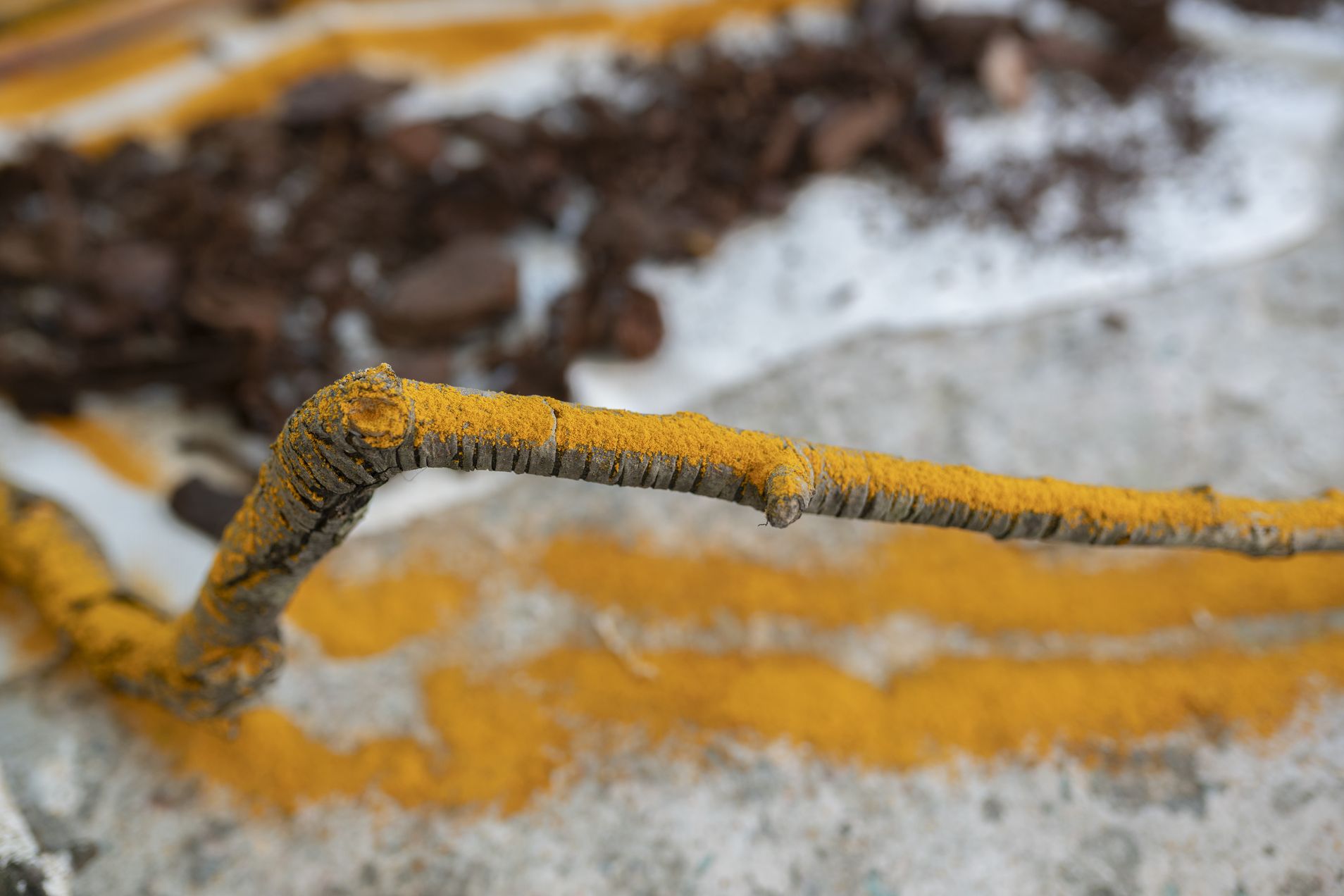
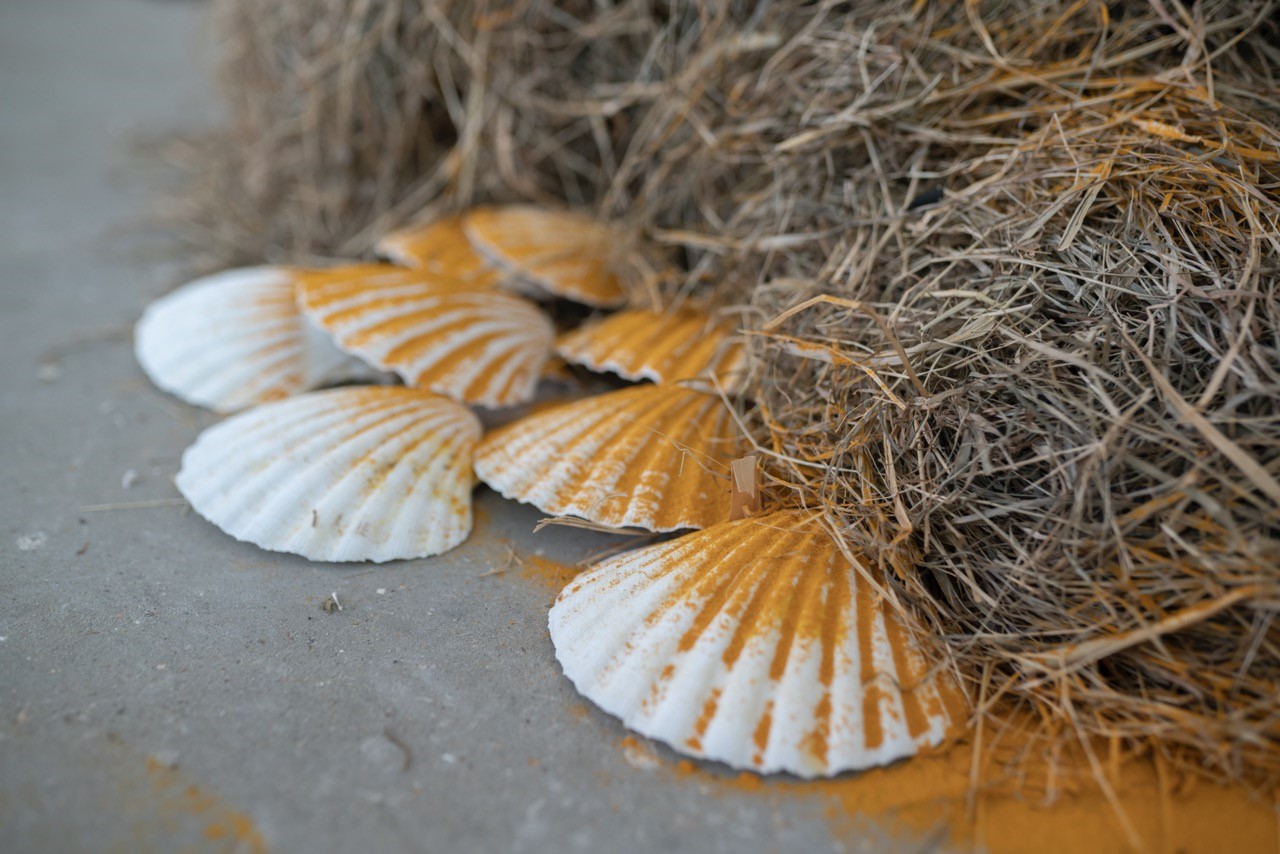
The other glass assemblages and recent new body of site-specific installation with soil, sand, hay, bark, coal, shells, dry plants, branches, turmeric, food colors, natural pigments, copper and glass has been developed since my residency at ‘Gent-Glas’, Ghent, Belgium in 2018/19 where I first time experimented with glass. But I could only create this site-specific installation, ’Unknown Landscape’ after the pandemic in 2022 in ‘Het Atelier’ residency in Brugge. Since then it has been continuously evolving. Then in a group show at Lumen Travo gallery, followed by Art Rotterdam 2023 and soon this site-specific installation will be viewed in the group show ‘NICC x 25’, at museum SMAK in Ghent. This exhibition was on view until 28 December 2023.”
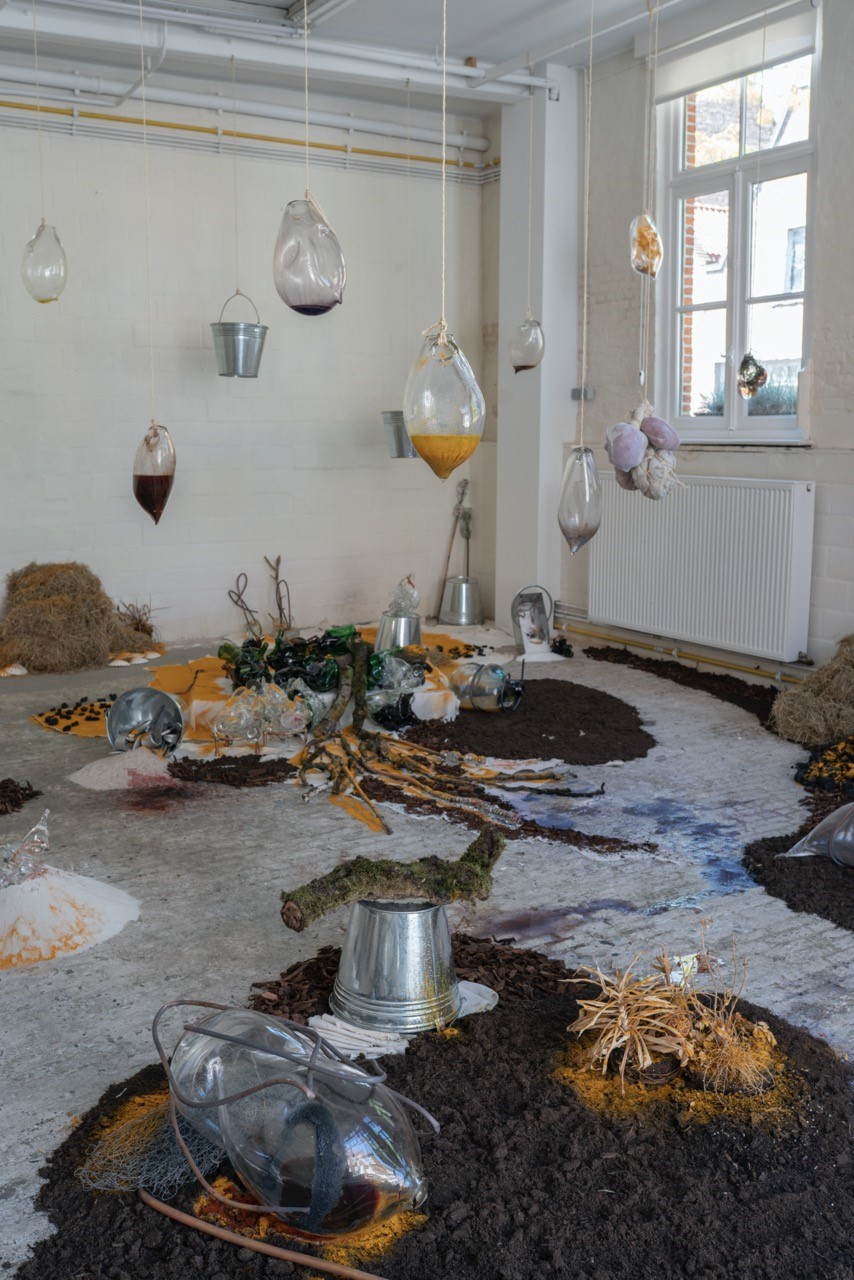
“My ongoing research-oriented installation ‘Unknown Landscape’ (2019-2023) contains several natural elements. They are combined together with the glass works created during the artist’s residency at Gent-Glas. The result is colorful & dynamic assemblage which is laid on the floor. Like the natural landscape, this installation is alive, evolving silently but persistently. The materiality of the soil, pigmented fluids and other unique textural properties of the landscape emerge in each aspect of the installation. This hybrid installation is a sort of spread out terrain of various combined components and blended elements. I juxtapose the materials from my earlier body of works with new recycled glass objects, to create a new/ transformed identity by re-shaping, re-arranging, re-cycling, re- assembling various materials, that keep the process of transition growing in the space. This diversified, surreal installation of solid, fluid, cracked, repaired, fragile structures of melted glass forms, that serve as a multi-layered ambiguous landscape, an immersive, extended, breathing field to interact, to observe and to explore the changes it went through. This hypnogogic installation explores the geological observation of nature’s traces, its ruins, mutating landscapes and the survival of holding onto what’s left to protect.
‘Unknown Landscape’ stimulates questions about sustainability, identity, migration, boarders, barriers, loss, and the endless cycle of exploitation of natural resources. At the same time, paradoxically, this installation takes us through organic, peaceful and healing trail that is interventive & interactive where people can walk through to approach different areas of the installation closely and observe details. The smell of natural materials as well as the aroma of strong yellow turmeric spice punctuates the exhibition space.”
Do you have any specific rituals or routines that you follow to stay creative?
“I think ‘creativity’ or ‘being creative’ lies in every aspect of our life, our surroundings and daily life rituals and its nature. For example, when cooking I don’t follow a standard recipe but my own way of mixing a combination of spices. There is no such thing as ‘the best creative routine’. It is a journey of self-discovery, following your instinct, taking risks and being open to changes. It is necessary to have a specific rhythm, balance and discipline in life, forming our own routine or ritual. We are human beings and we all lose it once in a while but to bring back that balance is being creative too.”
As the winner of the previous edition, you get to join the jury for this year’s edition. What is it like as an artist to ‘judge’ the work of other artists?
“Every process is an interesting and learning journey. I would say it is more like ‘reviewing’ the works of artists than ‘judging’. It is about carefully seeing, discussing and observing with other juries who are part of this process. To experience the ‘other side’ or ‘back stage’ is important in life.”
What is your ultimate piece of advice for young artists?
“Follow your heart, keep the balance! Stay focused, curious, true to yourself and to your creativity. Persistence and discipline are important. There is no beginning or end to this creative journey. It’s about life and death and everything in between.”
By Flor Linckens
For the eighth year in a row, the NN Art Award will be awarded to a promising artist who completed their studies at an art academy in the Netherlands and is exhibiting at Art Rotterdam. This year, for the first time, the nominees will exhibit their work in the prestigious Kunsthal Rotterdam, from 1 February to 14 April 2024. The nominated artists for the NN Art Award 2024 are Maaike Kramer (Art Gallery O-68), Mónica Mays (Prospects section of the Mondriaan Fund), Jan van der Pol (CREMAN & DE ROOIJ) and Peim van der Sloot (Brinkman & Bergsma).
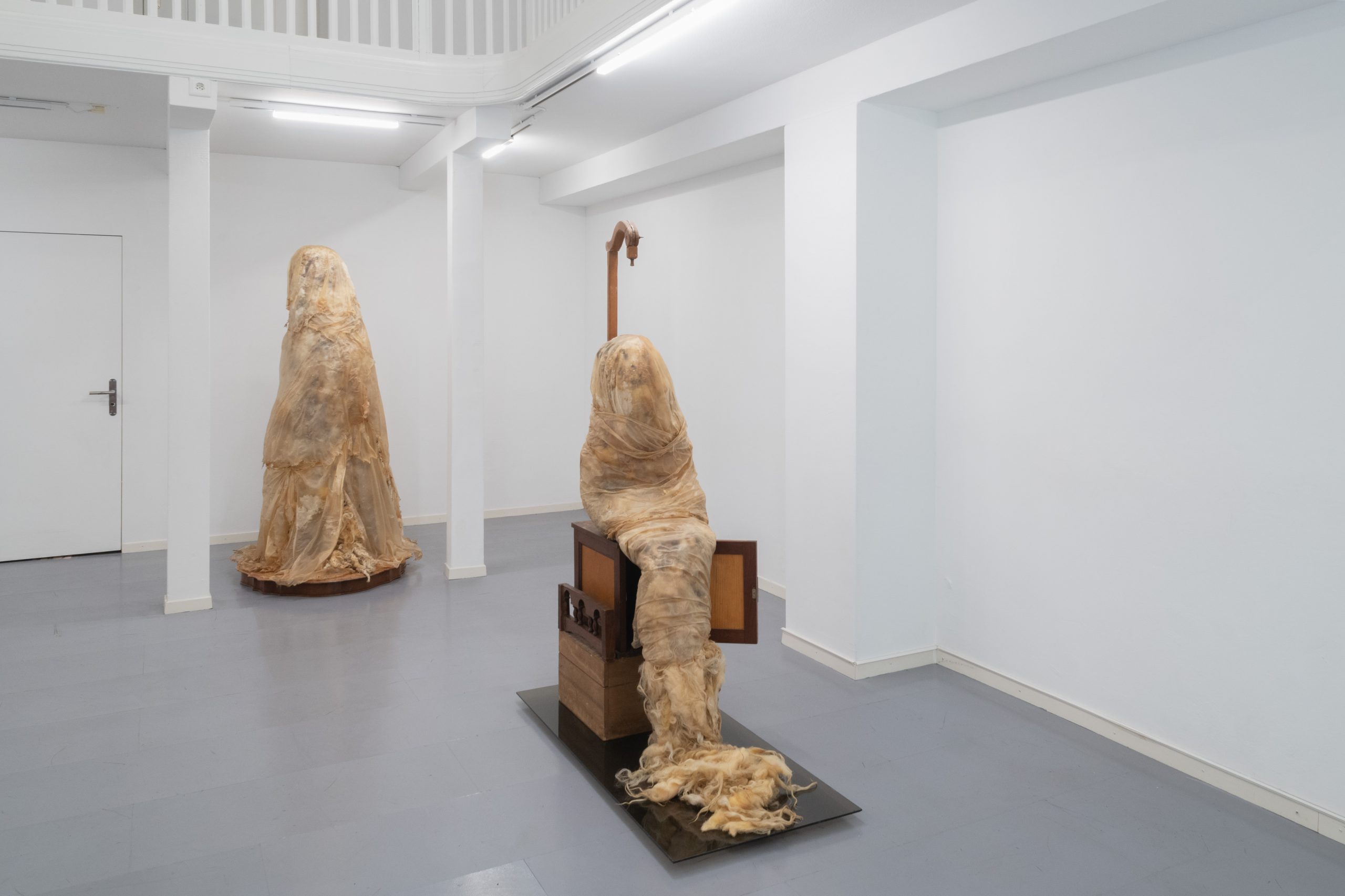
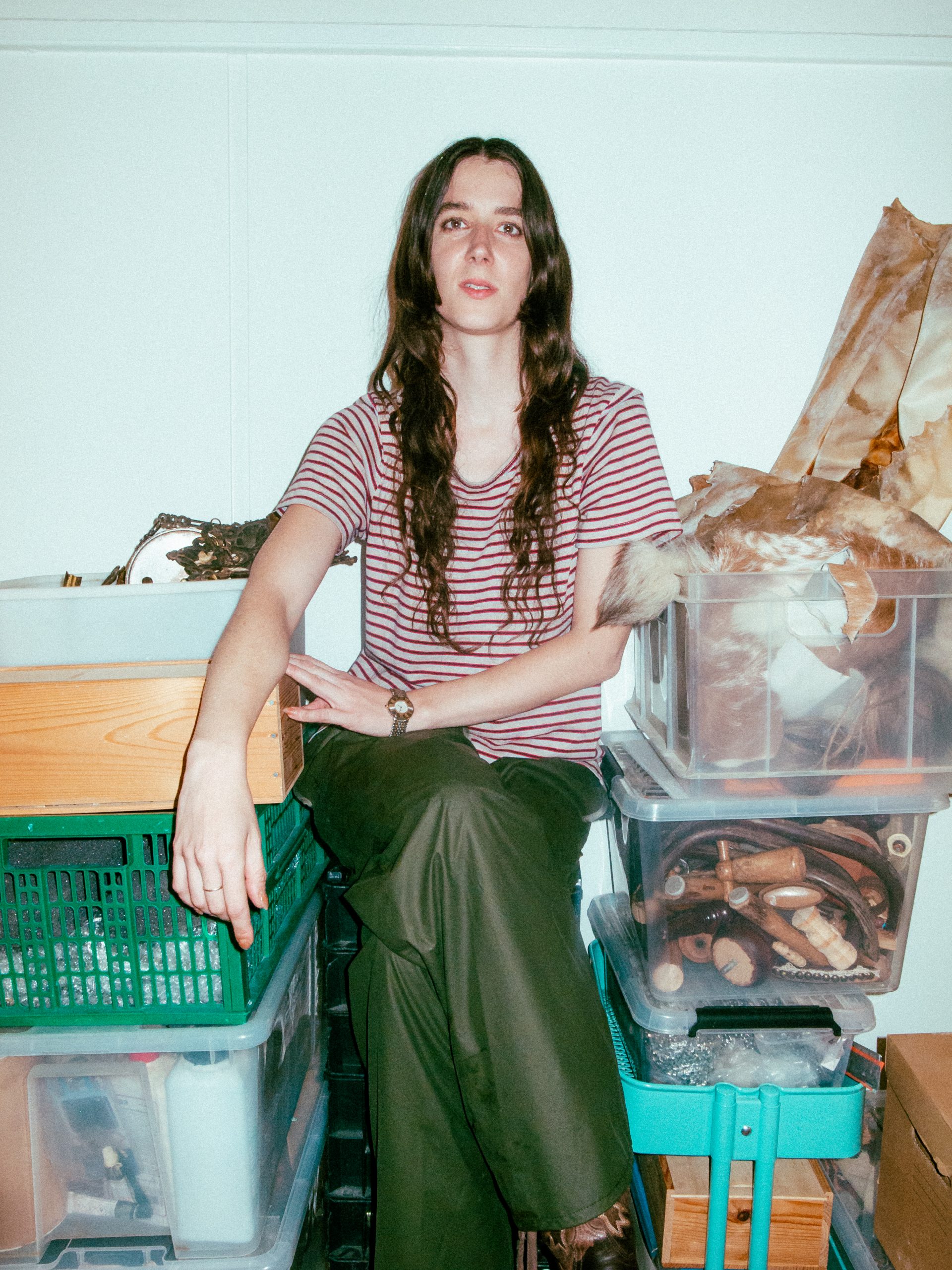
Mays’ sculptural practice combines autobiography, material process and historical archive. Her pieces are composed of assemblages taking the shape of animated domestic objects that are spilling over, distorted or in a process of transmutation. Drawing from catholic body horror and baroque iconography she has been working with excess, ornamentation and exuberance. From the depiction of maladie and magical thinking in female figurines, to colonial representations of nature, dominance, desire and control, the baroque is deployed by Mays to create works that exist in a tension of fragility and violence.
After having studied Cultural Anthropology at the University of New Orleans, she graduated from the École Supérieure des Arts Décoratifs in Strasbourg in 2015 and received an MA from the Sandberg Instituut in Amsterdam in 2017. She has developed projects in artistic residencies such as Rupert (Vilnius, Lithuania), Fundación Bilbao Arte (Bilbao, Spain), Matadero (Madrid, Spain) and Cemeti Institut for Art and Society (Yogyakarta, Indonesia). Mays’ works have been exhibited in spaces including the Frascati Theater (Amsterdam), Tallinn Art Hall (Tallinn), Punt WG (Amsterdam), Blue Velvet Projects (Zurich), Centro Centro (Madrid), KUBUS (Hannover), La Casa Encendida (Madrid), Industra (Brno) and Atelier Chiffonier (Dijon). She has been awarded the 3PD prize bestowed by the Amsterdam Fund for the Arts 2022, the Mondriaan Fund Young Artist Stipendium 2023 and the Generation 2022 prize from the Montemadrid Foundation.
Could you tell us a bit more about the work you are presenting at Art Rotterdam and in the Kunsthal?
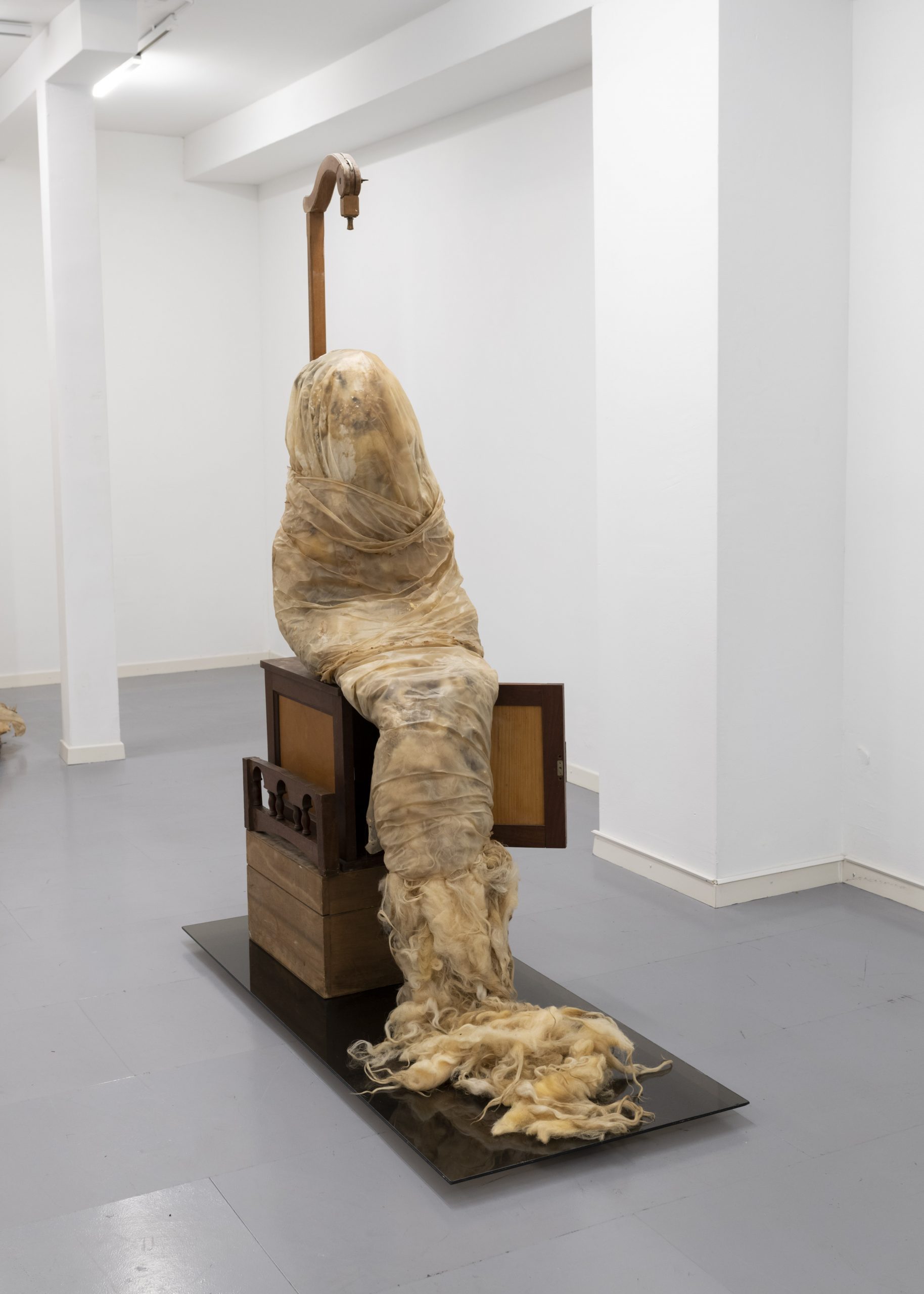
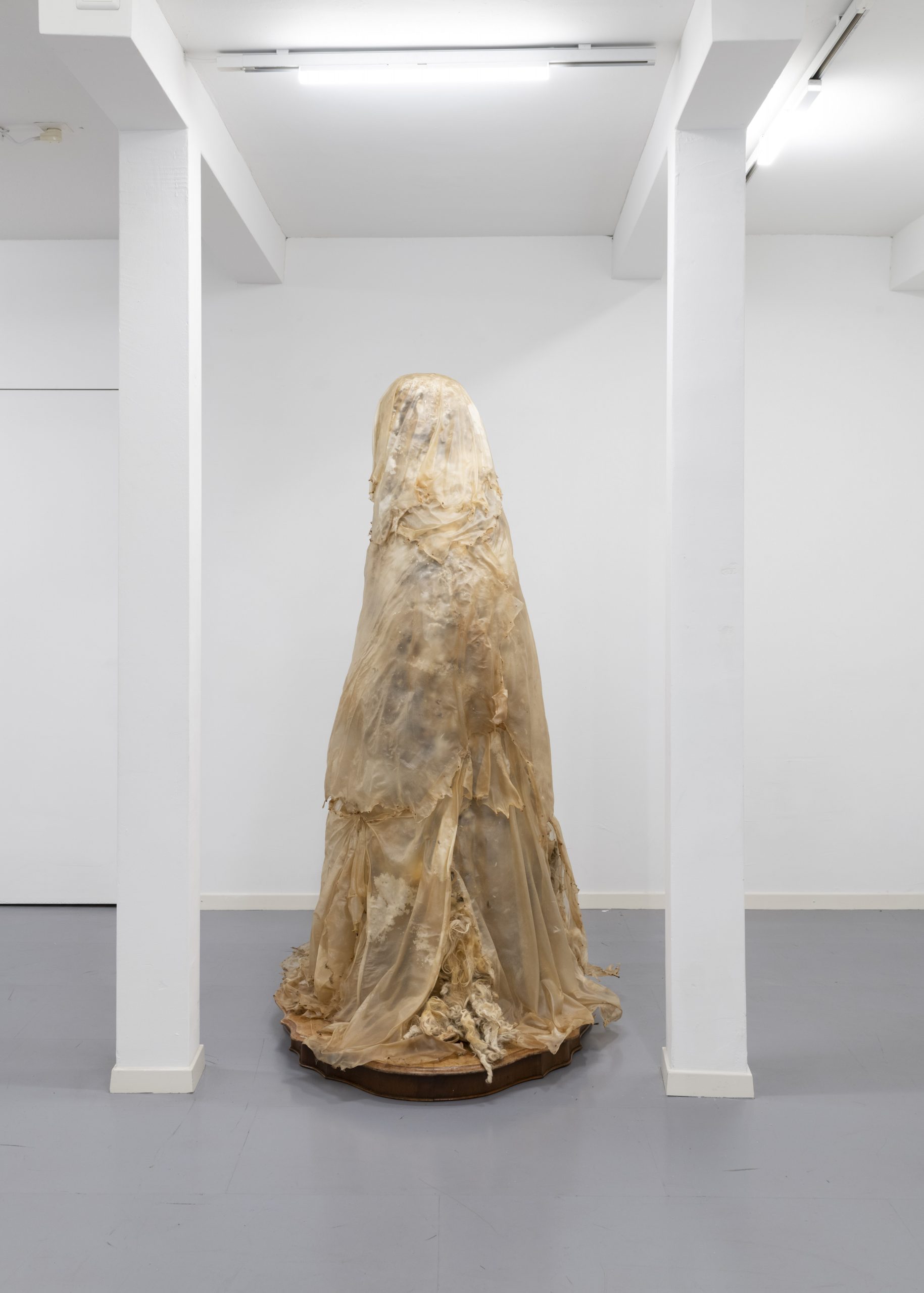
“I present a series of sculptures and boxes that I’ve been working on over the past two years. With these pieces, I aimed to cultivate and explore forms of reproduction that might sit outside of patriarchal structures, industrial means of production, efficiency and futurity, and the violence that these logics impose on different bodies. I’ve been exploring these ideas through a close engagement with the life cycle of the bombyx mori silk moth — an organic reproductive process that has been irrevocably altered by human intervention, domestication and industrialisation. In order to fully extract a silk thread for use in textiles, silk moth cocoons must be steamed to kill the grub inside before it can hatch and break through the single line of silk it used to create its cocoon. Those moths that are allowed to hatch do so only to breed and die shortly after; thousands of years of production-oriented domestication have rendered the moth blind, albino and flightless, with a vestigial mouth that cannot feed. The silk moth cocoon, for me, contains a multitude of semiotic and biological meanings — both those of extractive violence, biopower and heteropessimism, but also the potential for the breaking of linear logics, the refusal of reproduction, and the embracing of mutation.
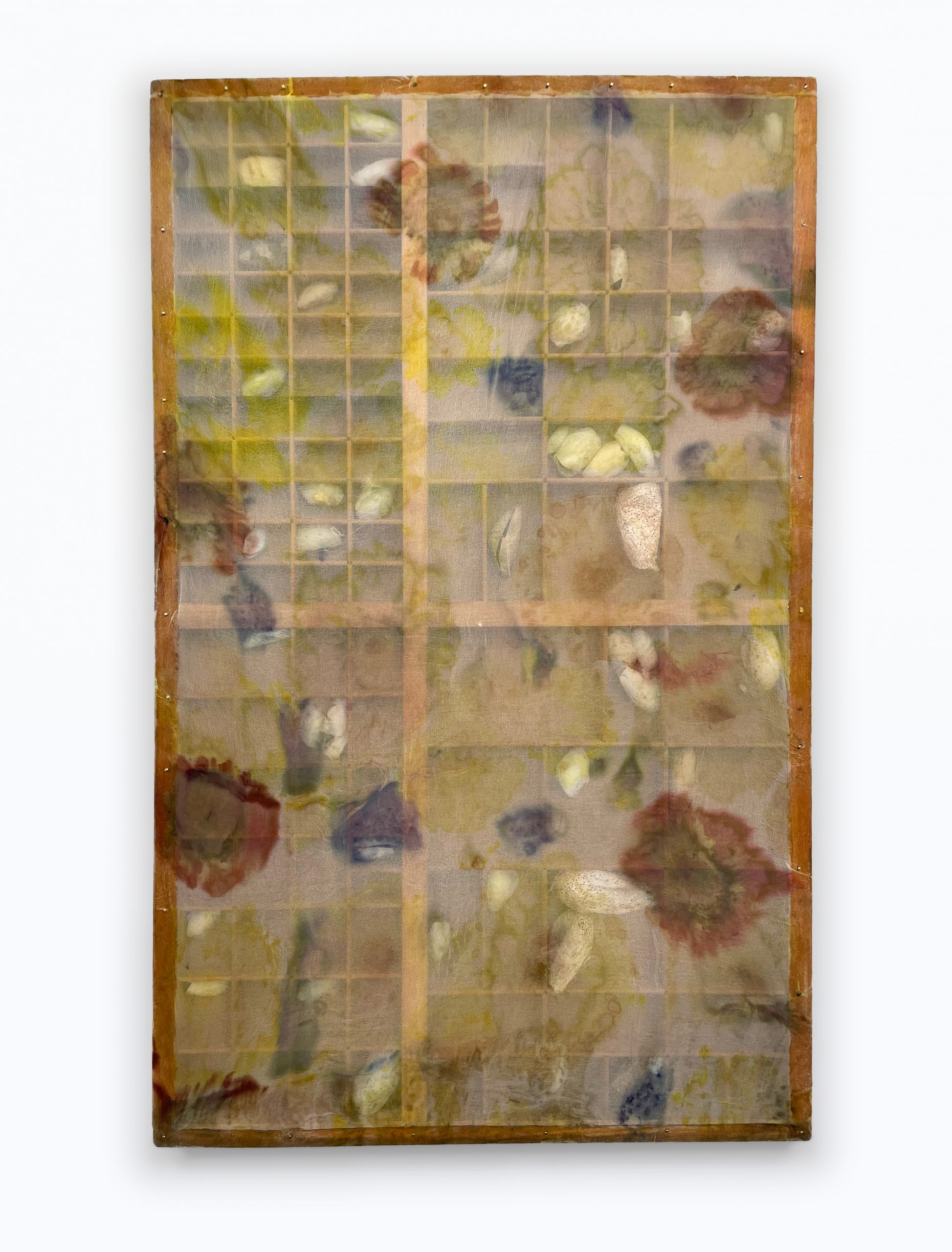
Last year I cultivated the bombyx mori, accompanying them through them their reproductive cycle, allowing them to all hatch, and working with them and their products towards a series of assemblages, collages and sculptures. These assemblages are composed of a combination of found anachronistic domestic objects that are interrupted by the excess of other bodies: wool, feathers, vellum, cocoons come together to make a body out of bodies. In addition I present “Shadow Boxes”, wooden gridded objects that are employed for scientific categorization, division and taxonomical separation in the drawers of archives and museums. Discarded ones are often used by individuals for collecting small memorabilia, appropriating the grid as a subjective and personal mechanism. In a similar way, I have been collaborating with the bombix mori and their products to parasite the boxes, preserving their cocoons intact by covering the boxes with silk and botanical imprints that interfere with the grid’s structure.”
What are your plans for 2024?
“In March, I will be going on a three month residency at the Cemeti Institute for Art and Society in Yogyakarta with the support of the Mondriaan Fund, where I will be continuing a project I recently started at the Mediterranean coast of Spain. Throughout my projects I lean on certain examples as containers of both violence and fragility. In this case, I have been looking at the iconography and symbolism of the palm plant through its paradisiac, biblical and industrial imaginaries. The project began by looking at the ornamental function of the plant to gentrify coastlines in Southern Europe in contrast with its exploitation in other regions, Indonesia being one of the largest producers of this plant for the fabrication of palm oil. I am considering palm oil as an ubiquitous material, present in almost all of our bodies through our consumables, and drawing a parallelism with the religious concept of omnipresence often used in biblical depictions of palm plants. So far this has materialized through a series of clay pieces fired with the combustion of palm leaves and creating assemblages with found factory objects. I don’t really know how this will continue to materialize as I feel quite in the middle of the process, but throughout the year I will be presenting some of the pieces in Art Basel, in Arco Madrid and in several galleries in New York, Basque Country and Bucharest for example.”
Could you describe how you felt when you heard that you were nominated for the NN Art Award?
“I was very happy of course. It is a really nice feeling when the work comes across and is recognized amongst so many of the beautiful projects that a lot of my colleagues and peers are presenting at Prospects. I have been living in Amsterdam for eight years, making work in all sorts of studios throughout the city, but it has always been quite hard to present the work locally, partially because of the lack of spaces, but also because of a lack of visibility. I have mostly had invitations to present work abroad so for me, this is a really nice opportunity to share my work with the context that has helped me incubate most of my works.”
What project would you immediately tackle if you were to win the award?
“There are always more projects to work on. If I was to receive the award I would like to make a work that is no longer at the scale of my own body, that is not so conditioned by practicality. When I talk about my pieces, I often say that they are animated domestic objects because I imagine them moving, opening, closing, extending their arms, but in the end their forms are static. I think I would use the opportunity to engage with the necessary engineering requirements to make them performative. Maybe, but it feels very uncertain, I would finally make the film about a specific crying statue that I have been talking about for five years now.”
How would you explain your work to someone who might not be as well-versed in the art world? What should their most important take-away be?
“It is my hope that the pieces I make don’t need a very eloquent verbal explanation and that they can narratively or affectively communicate themselves. Most of the work is process, materials and forms coming together in the studio, which is actually the hardest part to talk about. I can always tell stories, give analogies, introduce some of my chaotic referential framework, but ultimately, I would like them to not need a well-versed explanation and to speak autonomously through eroticism, tactility and tension.”
What is the most rewarding compliment you have ever received about your work?
“That it moves somebody.”
The winner of the NN Art Award will be announced in the Kunsthal Rotterdam on Thursday 1 February at 20:00 CET. The work of the nominees will be on display there until 14 April 2024. During Art Rotterdam, Mónica Mays’ work will also be exhibited at the Prospects section of the Mondriaan Fund.
Written by Flor Linckens
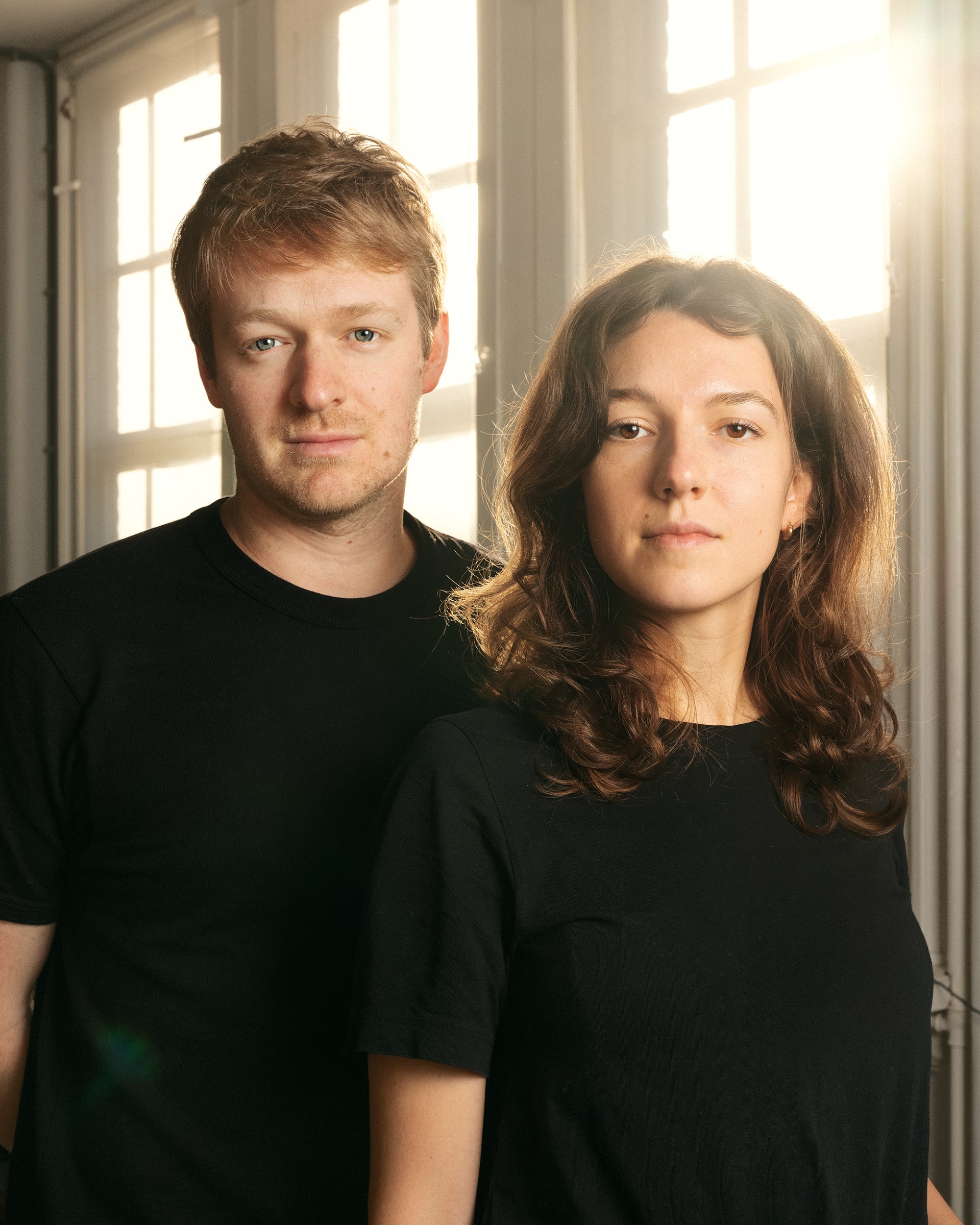
In their long-term project “Fault Line”, Ana Zibelnik and Jakob Ganslmeier focus on the social consequences of the climate crisis. Launched in 2023, the project explores the profound impact of climate change on individual lives in Europe, ranging from climate anxiety and activism to populist denial of the issue. By capturing portraits of individuals, the photographers give a human face to a problem that often feels quite abstract. In the first part of the project, the artists specifically address the psychological phenomenon of climate anxiety, which is particularly prevalent among young people as they are confronted with an uncertain future. “Fault Line” is currently on display at the Fotomuseum Den Haag (until 31 March 2024).
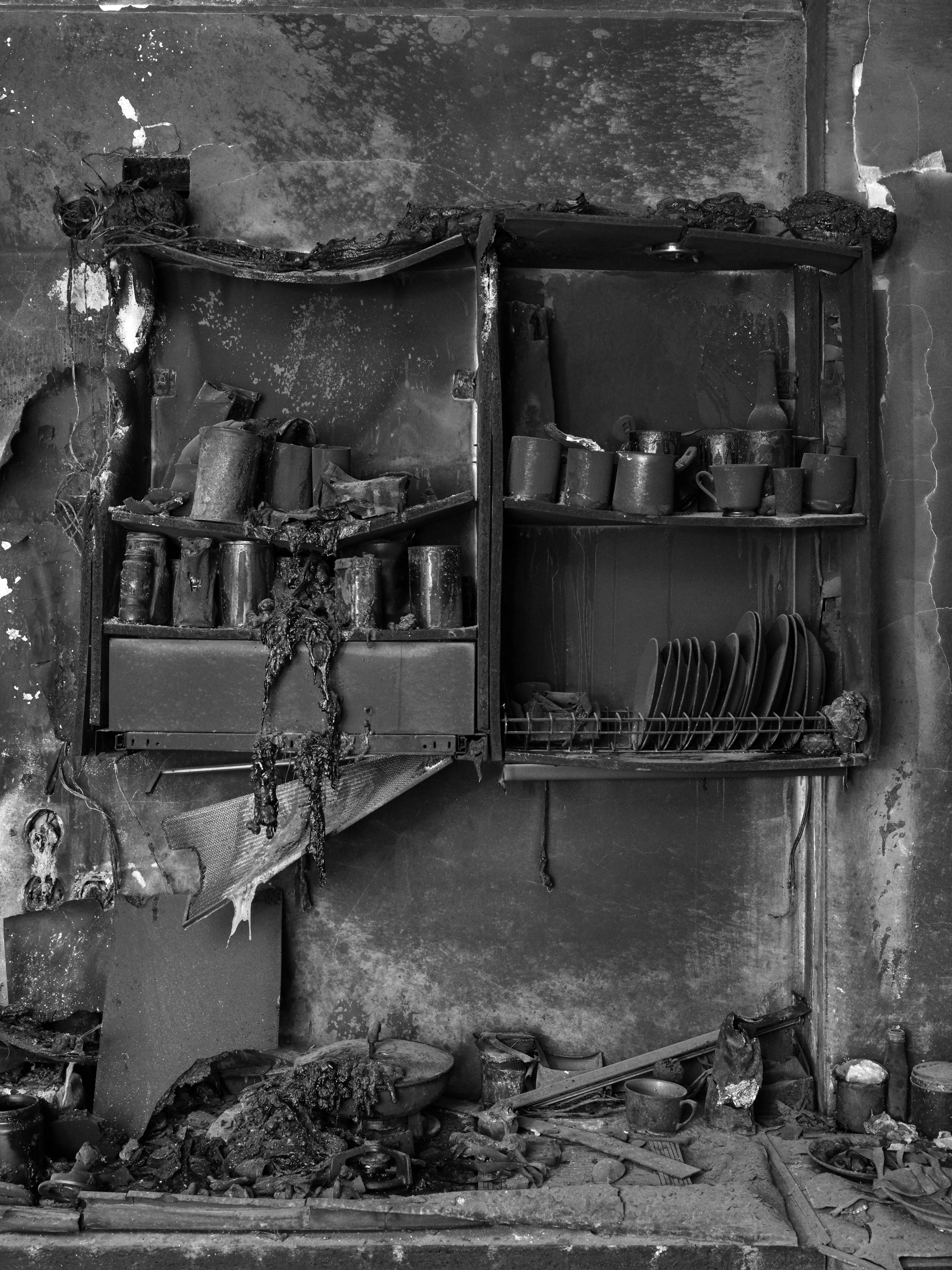
Ana Zibelnik and Jakob Ganslmeier will also present the project at Prospects: an initiative of the Mondriaan Fund that showcases work by 86 artists who received financial support in 2022 to launch their careers. The work on display ranges from photography to textile works, video to paintings and performances to sculptures. The exhibition is curated by Johan Gustavsson in collaboration with curator Louise Bjeldbak Henriksen.
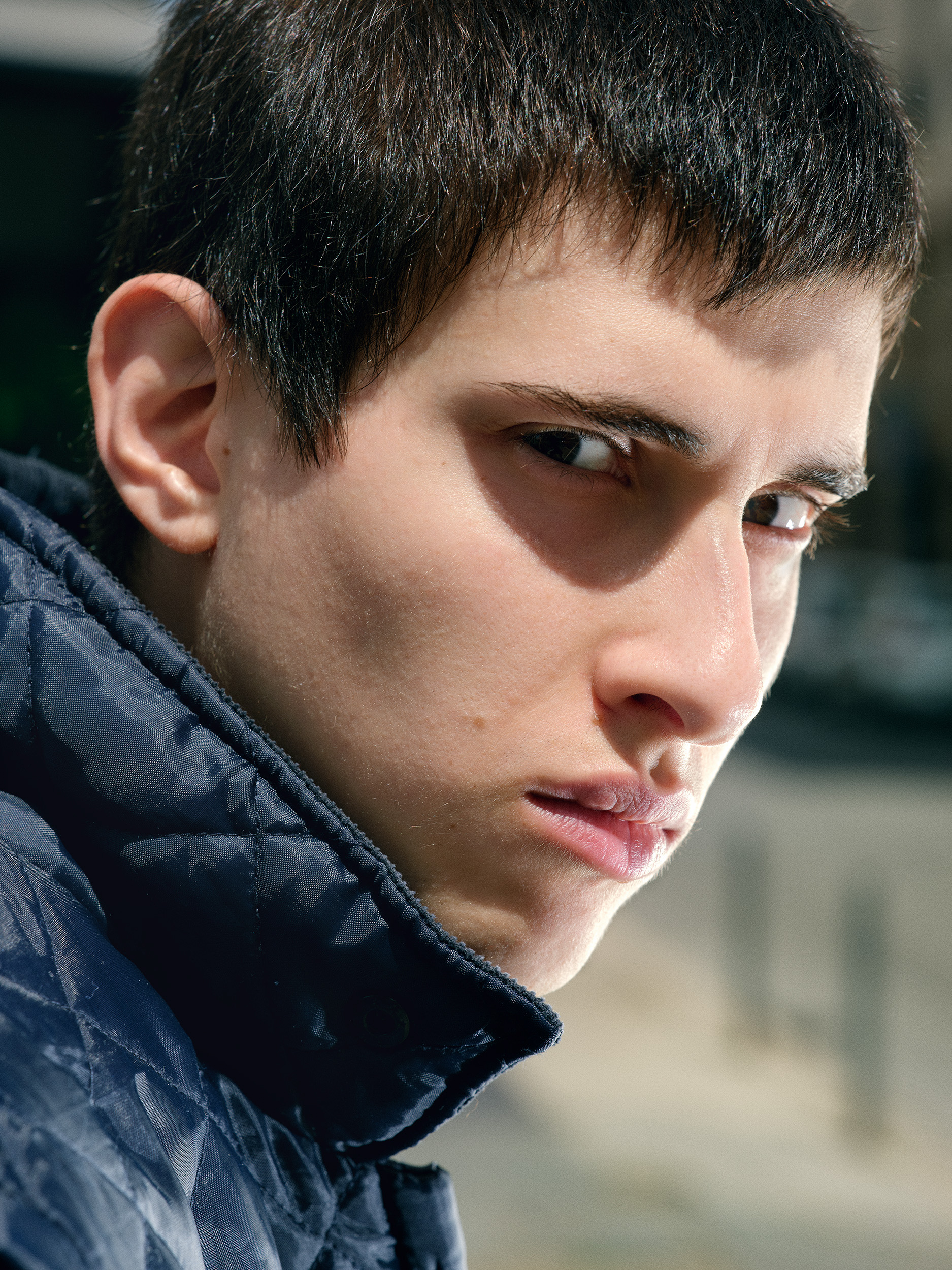
When we think about climate change, we often fall into one of two extremes: either being too optimistic, assuming that technology will save us in the end, or too pessimistic, pained by the idea that every piece of plastic we’ve ever used is still out there somewhere. In the latter case, we become paralysed and distance ourselves from the problem, thinking that we’re unable to bring about change. Many of us are dissatisfied with the minimal effect of our individual actions (such as recycling or not using a car) on the bigger picture, as well as the reluctance of powerful politicians to implement meaningful changes and a political shift to the right in many countries. The problem feels too big, too abstract. But artists have the ability to shape and influence our imagination and offer us something concrete.
The artists Ana Zibelnik and Jakob Ganslmeier state that, “Images affect the way people think about societal issues. They have an emotional impact and can prompt us to form opinions and take action. Images of environmental devastation, in particular, are often captured from a distance — by drones or focused on the overall scope of natural and infrastructural damage. What interests us is a closer examination of such situations — how do extreme climate events impact individuals? How does the fear arising from such situations contribute to the emergence of hateful ideologies?”
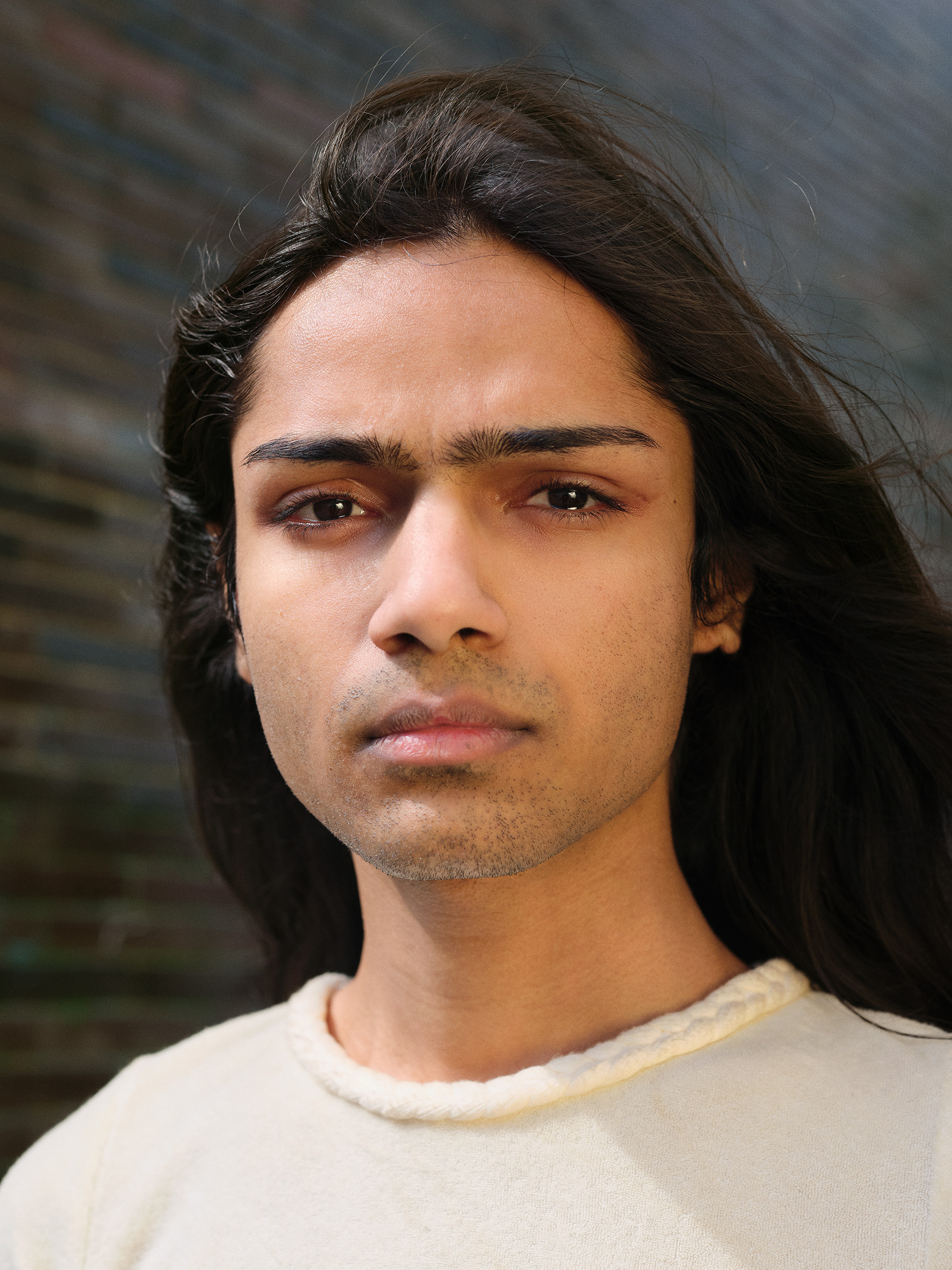
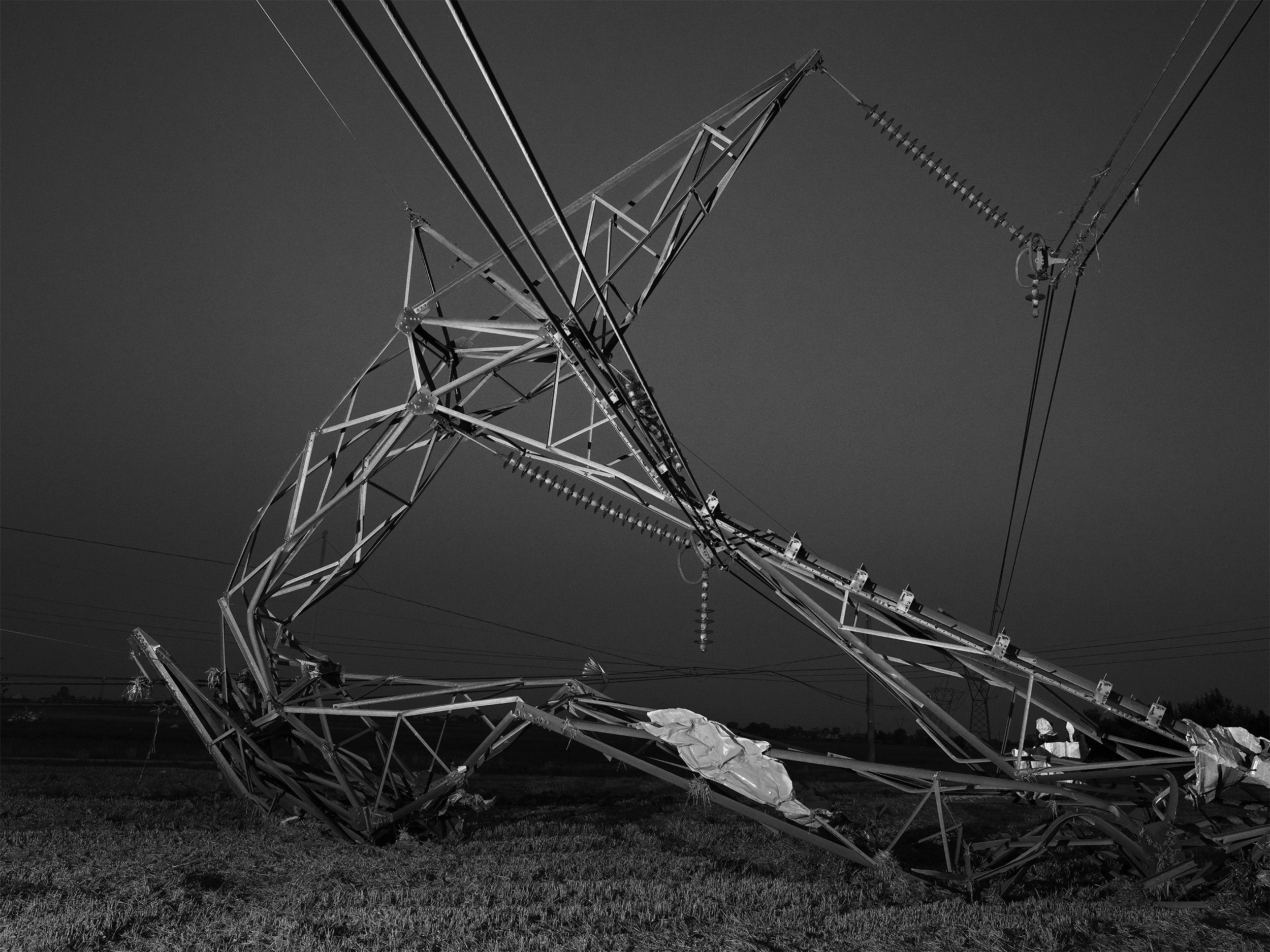
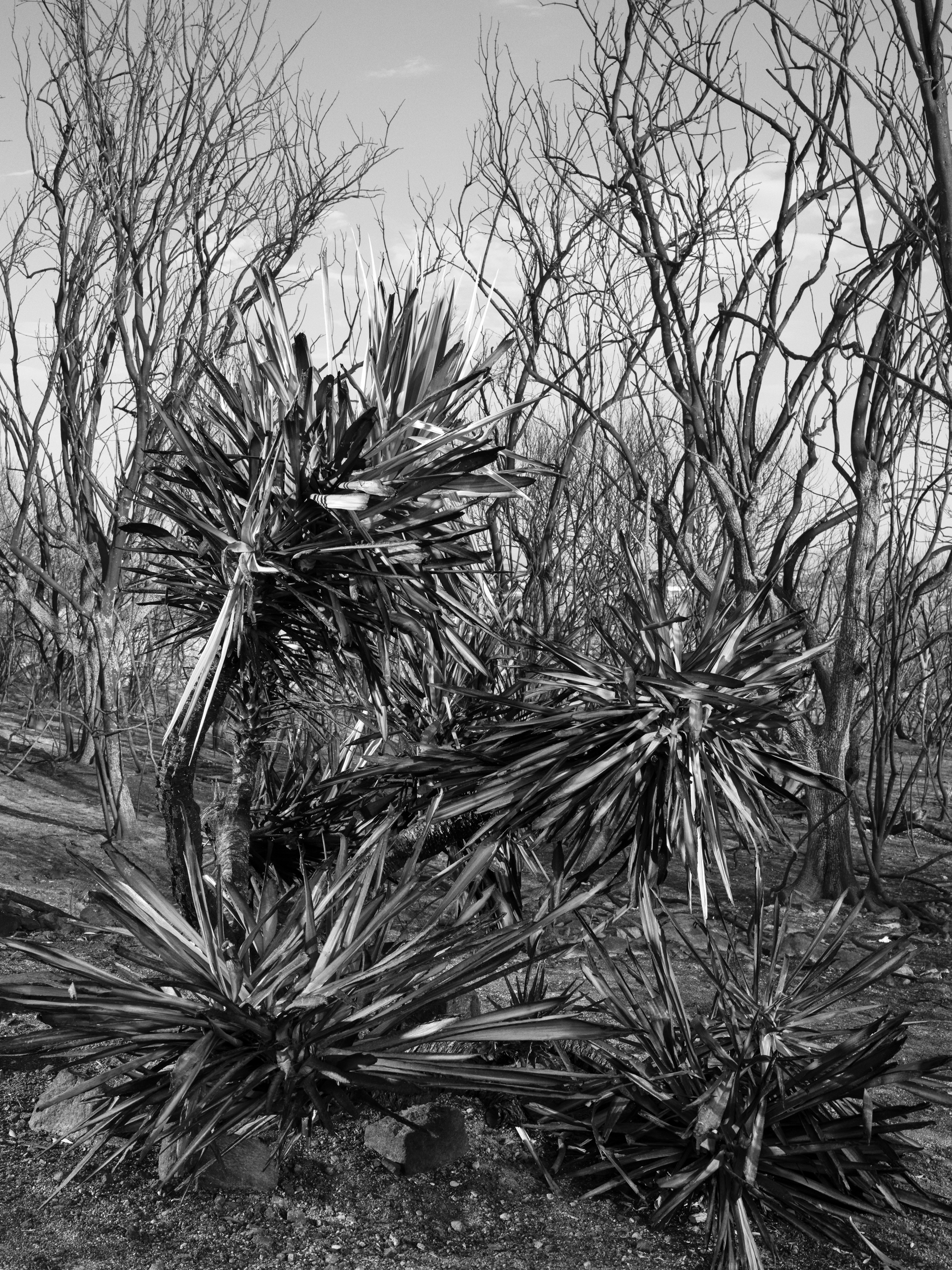
In “Fault Line”, the artists highlight how climate anxiety can be paralysing, but also a stimulus to take action. Their work includes collaborations with young climate activists in Italy and confrontations with Italian policymakers who deny climate change. During their travels through Italy, they documented the consequences of heavy rainfall and flooding, as well as the severe wildfires at the Greek border with Turkey, the largest wildfire Europe has ever known so far. They also spoke with climate refugees and with David Yambio, a human rights activist and founder of Refugees in Libya.
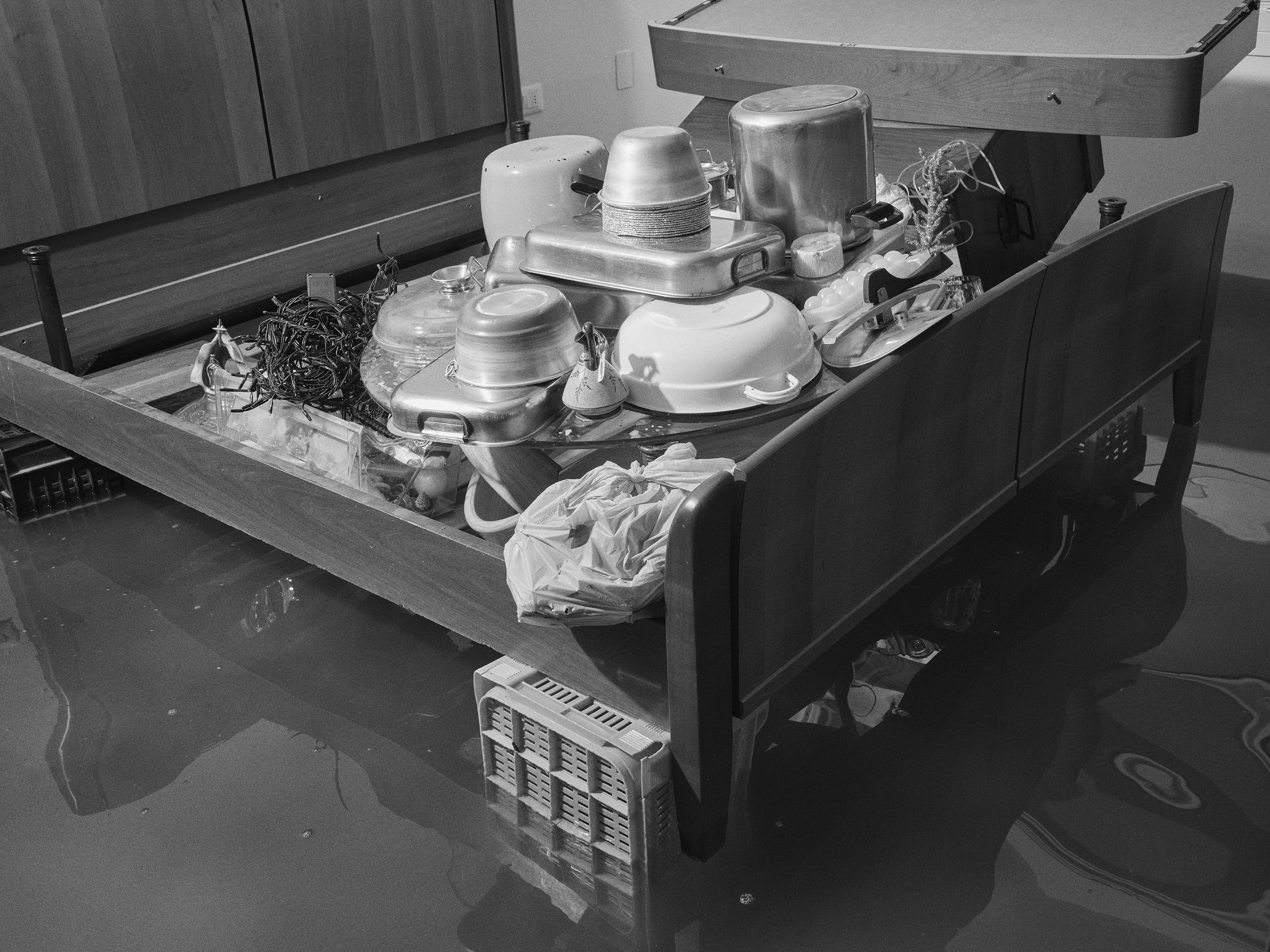
“Fault Line” offers an in-depth exploration of the climate crisis and its social impact. It’s an artistic project, but also a statement. It emphasises the need for action and awareness in a time when the consequences of the climate crisis are becoming increasingly tangible. Zibelnik and Ganslmeier ask critical questions about how the climate crisis — and the accelerating series of disasters — affects individual lives and how this contributes to the exacerbation of social and political polarization.
Ana Zibelnik, born in 1995 in Ljubljana, Slovenia, focuses in her work on themes such as global warming, climate anxiety, and its social implications. And what role does white supremacy play in the climate crisis? German artist Jakob Ganslmeier (1990) is interested in the visualisation of radical ideologies and the ways in which visual arts can be a means to counteract radical ideas and start conversations about societal issues with conflicting perspectives.
“Fault Line” by Ana Zibelnik and Jakob Ganslmeier will be on display in the Prospects section during Art Rotterdam.
Written by Flor Linckens
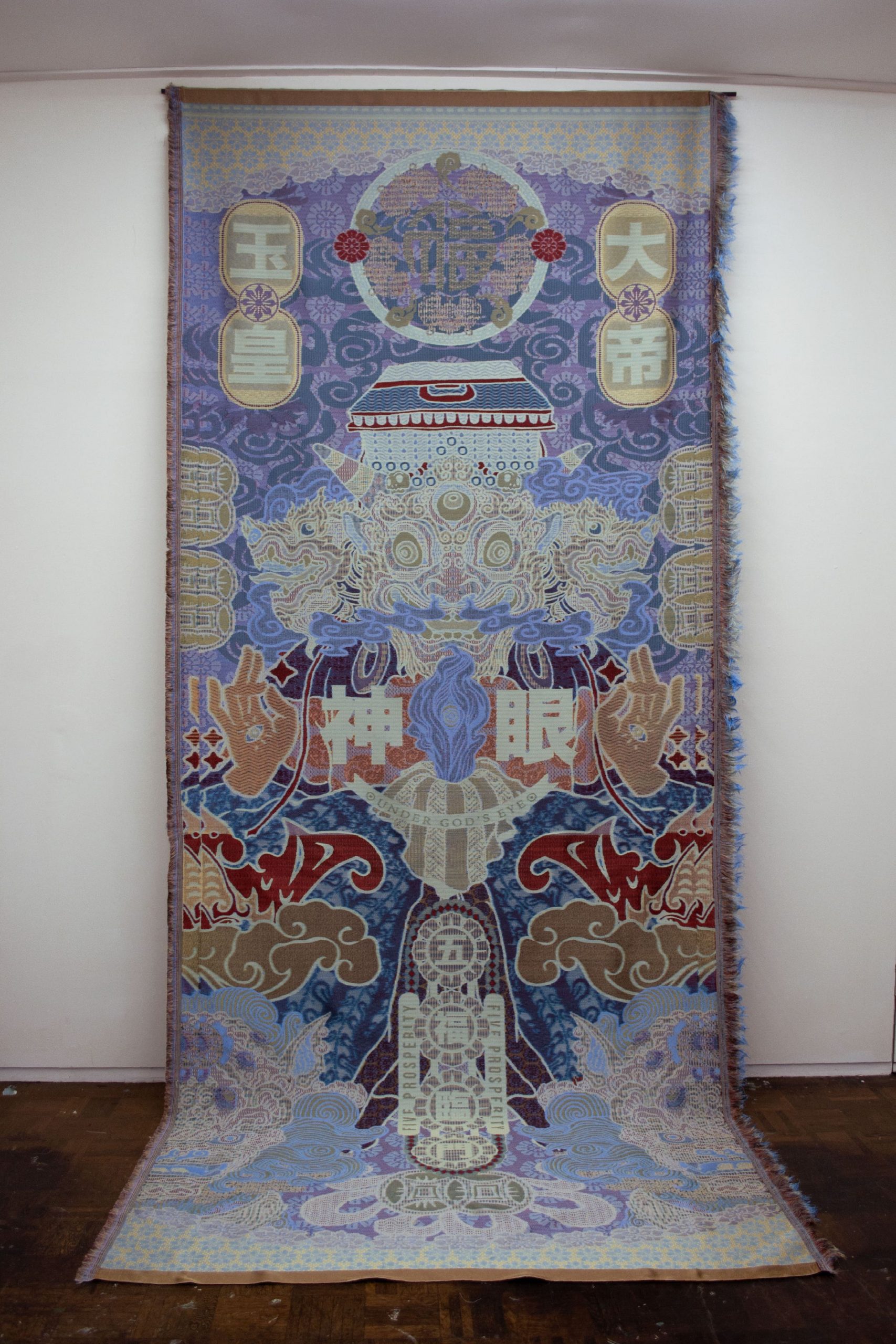
Galerie Ron Mandos is celebrating its 25th anniversary at Art Rotterdam 2024 and sparing no expenses with Best of Graduates Legacy – 25 Years of Galerie Ron Mandos, showcasing 25 young artists who have participated in the Best of Graduates programme at the gallery over the past five years. In addition to serving as a springboard for emerging talent, Galerie Ron Mandos represents over 30 renowned artists, including Isaac Julien, Hans Op de Beeck, Esiri Erheriene-Essi, Mohau Modisakeng and Atelier van Lieshout. Together with the founder and driving force behind the gallery, Ron Mandos, Art Rotterdam is highlighting this milestone achievement. We also look forward to the large-scale booth that will be on display during Art Rotterdam, featuring a special design by Tom Postma Design. Mandos comments, “The art world has no future without young talent. This is why I think that fostering the career development of young artists is so important.”
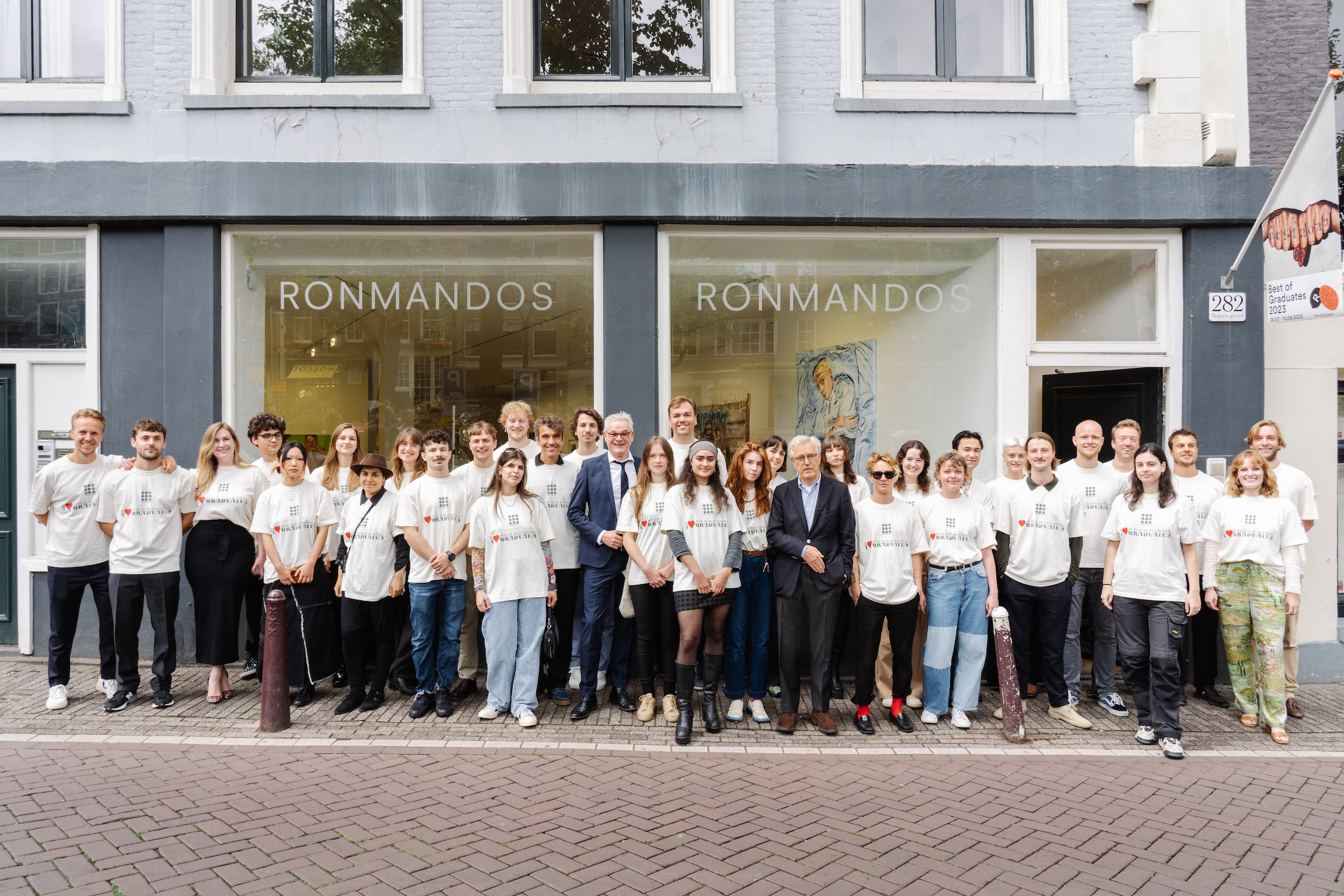
It’s been 25 years since you started Galerie Ron Mandos. Congratulations on this impressive milestone. The gallery is now internationally recognised. What, in your opinion, is the formula for success?
The key to success lies in my complete dedication to art, something I personally believe in wholeheartedly. I don’t let trends or famous names influence me. My approach involves showcasing an engaging mix of established artists and emerging talent. Even the renowned artists I represent, such as Hans Op de Beeck and Isaac Julien, appreciate that I actively invest in emerging artists. Perhaps because they also teach at academies.
From the moment someone enters my gallery to when the artwork is delivered to the buyer’s home, excellent service is paramount. Presentation and content also take centre stage because buyers need the space to emotionally connect with an artwork.
Perhaps most importantly, my artists always come first. I work day and night for them. Throughout the year, we participate in seven to eight international fairs, providing them with a global platform and constantly challenging them to create their best work. At the same time, I give them the freedom to develop special presentations. My gallery began in Rotterdam as a project space, inspired by the Chambre d’Amis of the renowned Belgian curator and museum director Jan Hoet, who invited artists to present art in a domestic setting. This inspiration continues to guide me in giving artists the freedom to fully transform my gallery into their artistic world.
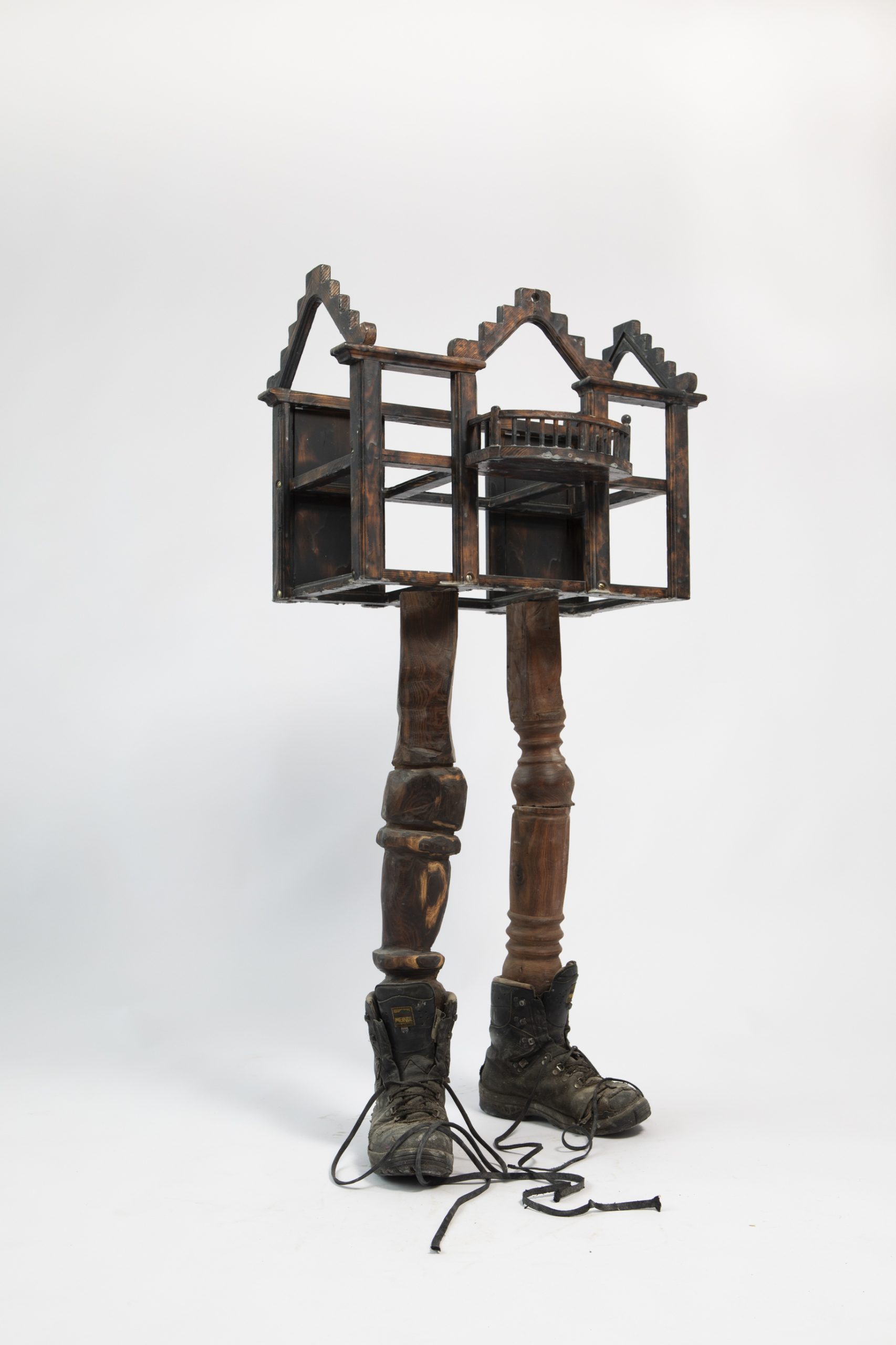
What was your goal in establishing the Best of Graduates in 2008?
The primary goal is to provide a platform for young artistic talent to develop further. The art world has no future without young talent. This is why I think that fostering the career development of young artists is so important. Since 2008, my gallery team and curator Radek Vana have travelled to all art academies in the Netherlands to view graduation projects. We bring the most innovative presentations from Groningen to Maastricht to Amsterdam to showcase to a wide audience. That’s why I founded the Young Blood Foundation in 2018, so we can continue the development of young artists. Every year, Joop van Caldenborgh, founder of Museum Voorlinden, presents the Young Blood Award to an artist whose work becomes part of the permanent collection.
During Art Rotterdam 2024, you are putting 25 artists from the Best of Graduates of the past five years in the spotlight. Can you elaborate on all or a few of these artists and their work?
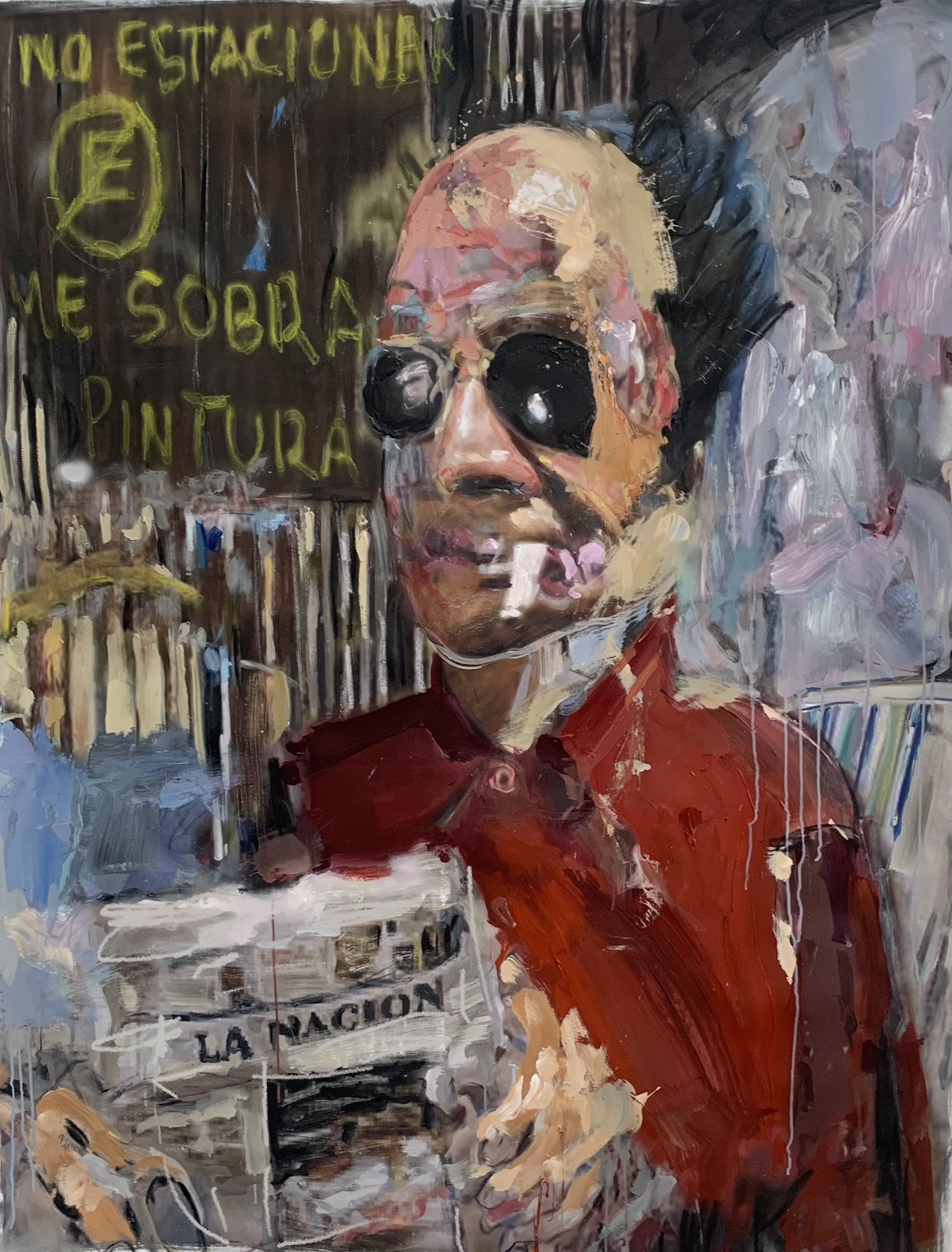
Our Best of Graduates Legacy at Art Rotterdam includes a diverse mix of artists, as is customary in a Best of Graduates presentation. We are showcasing, among other things, new paintings by Matias Salgado (Young Blood Award winner in 2023), sculptures by Bart Pols (Best of Graduates 2021), video artwork by Thom van Rijckevorsel (Best of Graduates 2019), textile work by Marcos Kueh (Young Blood Award winner in 2022) and ceramic work by Anni Mertens (Best of Graduates 2019). I would like to emphasise the versatility of these artists. It inspires me every day how these artists can be so innovative with different techniques.
Can you give us a sneak peek of the booth presentation during Art Rotterdam?
It promises to be a surprising presentation. Together with the director, Fons Hof, we have decided on a special booth that is larger than usual. We plan to create a booth measuring 100 square metres, a real gift for the young artists we are spotlighting. The design is by Tom Postma and his fantastic team, who always create stunning designs for leading fairs such as Art Basel and Tefaf. The booth clearly reflects Postma’s high-quality design and the varied art of the young creators.
What sets Art Rotterdam apart from other fairs that Galerie Ron Mandos participates in? What developments have you noticed in the Rotterdam art scene?
Rotterdam is my hometown, so to me, Art Rotterdam feels like coming home. My gallery opened 25 years ago in Rotterdam and from the very beginning, we have been closely affiliated to this fair. It is sometimes said that Rotterdam works hard while Amsterdam spends money, but fortunately, we are seeing a change here. Over the years, beautiful new initiatives have emerged, such as BRUTUS, where art creators get carte blanche to experiment. For a few years now, there has been a collaboration with the Ron Mandos Young Blood Foundation, which selects an artist every year who can then work in this fascinating art setting. Also, the various initiatives at Art Rotterdam, such as Prospects, which annually showcases over 80 artists who have received financial support from the Mondriaan Fund, are a beautiful example of a platform for emerging talent during the fair. And new galleries will be participating in the New Art Section, which spotlights young artists. Through such initiatives, Rotterdam continues to position itself as a vibrant creative city that is continuously evolving. Art Rotterdam makes an essential contribution to this.
Best of Graduates Legacy – 25 Years of Galerie Ron Mandos will be on display during Art Rotterdam at the Van Nelle Factory from 1-4 February 2024, with a private preview on 31 January.
Best of Graduates Legacy is generously supported by Art Rotterdam, Vormmakers, Tom Postma and the VandenEnde Foundation.
Written by Pienk de Gaay Fortman
Pipeline from London will present a series of new works by Callum Harvey in the New Art Section at Art Rotterdam.
This British artist has a keen interest in transitional environments. His practice straddles the line between the natural and the constructed, drawing inspiration from architectural details and repeated ornamental patterns, both the extraordinary and the mundane. In his work, he delves into spatial environments, raising questions about how we construct, perceive, and utilize spaces. What role do botanical motifs and symbols of nature play in this context?
Harvey’s paintings are characterized by flowing, organic forms and repeated patterns, often magnified in scale and flattened in character. He employs a soft colour palette of natural and pastel hues, applying paint in transparent, thin layers. This technique gives his paintings a ‘backlit glow’, a background radiance that appears both artificial and natural. This juxtaposition of the artificial and organic is a recurring theme in his work.
Nature serves as a significant source of inspiration for the artist, including decorative motifs from Art Nouveau and the British Arts and Crafts movements — a series of artistic and social movements from the late 19th and early 20th centuries that advocated for a revaluation of handcrafts and traditional crafts as a form of resistance against industrial mass production. Harvey reflects on the social history and ideas behind these decorative elements and their relevance to our contemporary life, as well as the status and class they often represent. Moreover, Art Nouveau and the Arts and Crafts movements present idealized depictions of nature, forming an intriguing subject of study for Harvey: how are these elements designed, and how do they enable us to experience nature and spaces in new ways?
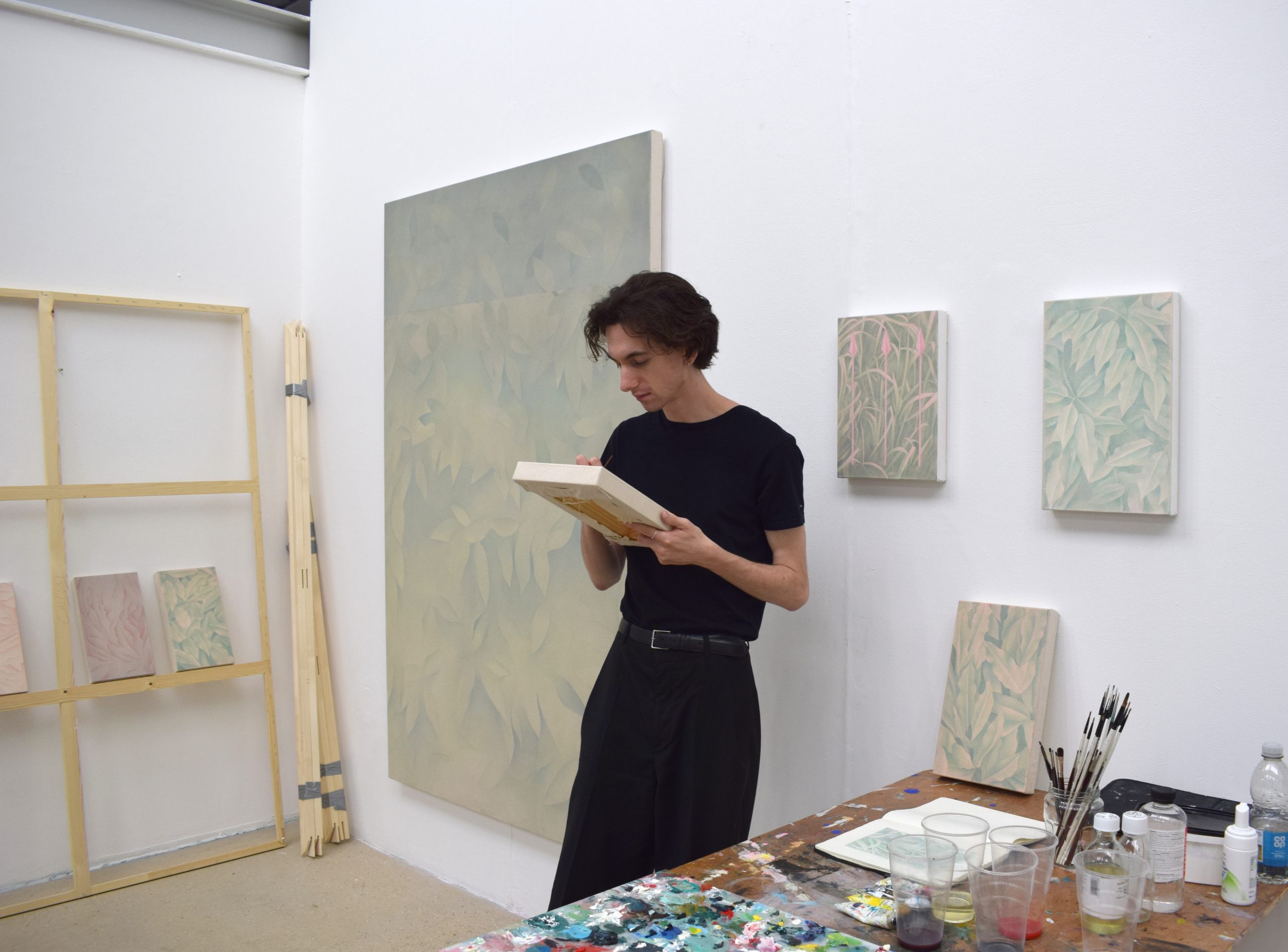
For Art Rotterdam, Harvey engages with a unique artificial space: a fair booth. He’ll present two large paintings with flattened portrayals that were stripped of spatial depth, alongside four smaller works in carved wooden frames, effectively integrating domestic and design elements. The paintings contain interior motifs that are common in wallpaper, contrasting with the space in which they are displayed.
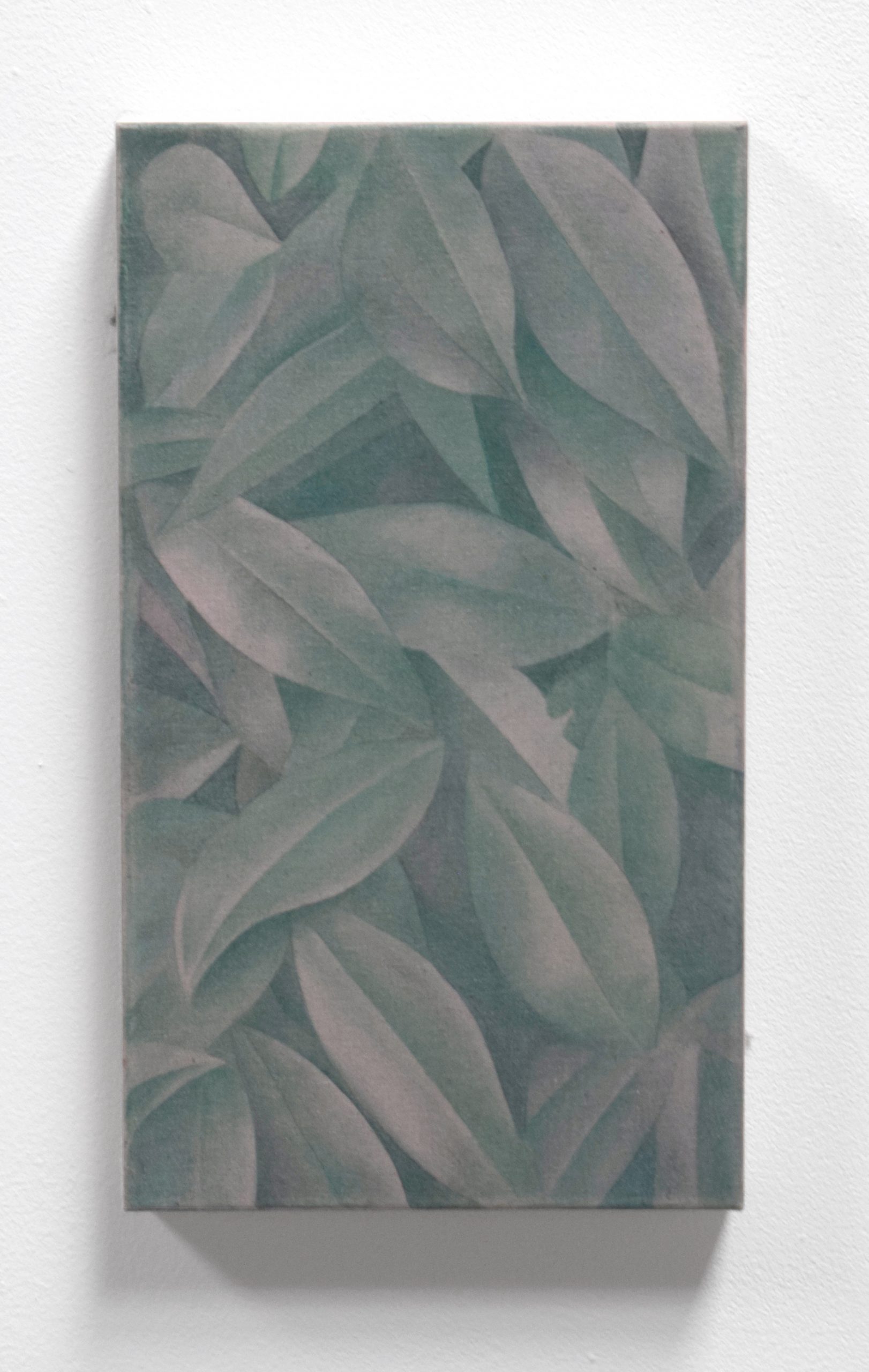
Callum Harvey was born in 1998 and lives and works in London. He studied Fine Arts at Falmouth University, followed by a master’s degree at The Royal College of Art, where he graduated in 2023. He has received multiple scholarships and awards, including the Radcliffe Trust Craft Scholarship in 2022, and completed a residency program at Porthmeor Studios in St Ives in 2019. Last fall, his work was featured in a solo exhibition at Pipeline and his work was also showcased in Kingsgate Project Space and Safehouse in London, Centre Space Gallery in Bristol, and Huxley-Parlour in New York.
During Art Rotterdam, Callum Harvey’s work will be on display in the New Art Section, presented by Pipeline.
Written by Flor Linckens
Art is often displayed and experienced in a similar context: the distinctive white walls of a gallery or museum. The iconic Van Nelle Factory, part of the UNESCO World Heritage List, already stands out from this traditional white cube concept due to its unique architectural character. Moreover, the fair offers an additional way to experience art: outdoors. Around this historic building, more than 20 (often large-scale) artworks are exhibited during Art Rotterdam. Free from the confines of walls, these works become part of their environment and gain new meanings in the process.
Atelier Van Lieshout (presented by Galerie Ron Mandos)
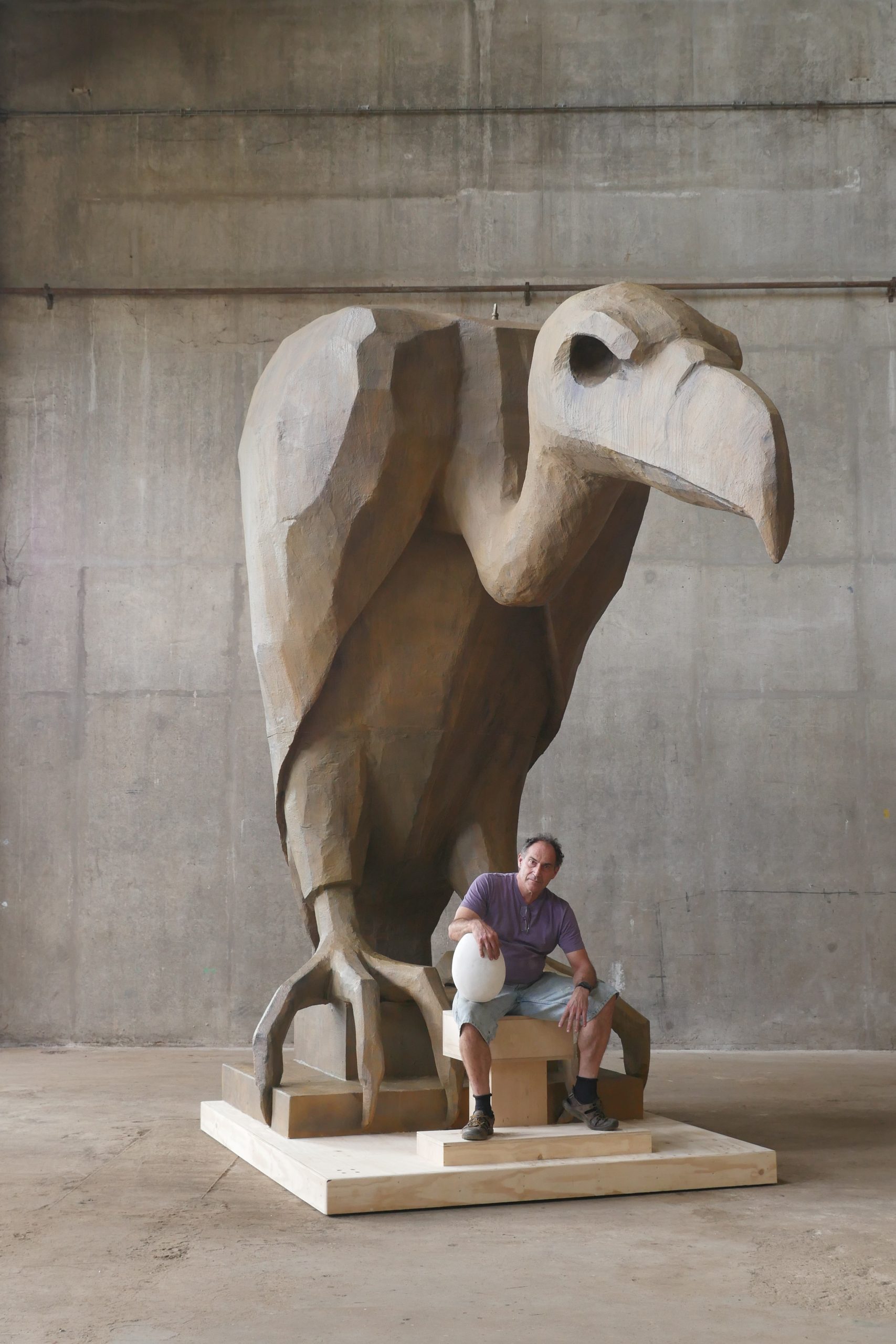
Atelier Van Lieshout is known for its multidisciplinary practice that straddles the boundaries of art, design, and architecture. Joep van Lieshout often uses industrial materials to explore socio-critical and provocative themes. At Art Rotterdam, he presents the work “Vulture” (2022). Vultures are as imposing as they are repulsive. Death is near when this scavenger arrives. However, vultures are also resourceful, persistent and an indispensable link in many ecosystems. According to Van Lieshout, artists are comparable to vultures. They devour everything that might serve as inspiration, old and new, and are viewed with suspicion. Van Lieshout would have preferred to see collectors viewed as vultures: as they hungrily circle vulnerable art. Van Lieshout’s works have been featured at the biennials of Gwangju, Venice, and São Paulo and are part of the collections of Fondation Prada, FNAC, Museum Boijmans Van Beuningen and the Stedelijk Museum.
Baoyang Zhao (presented by Josilda da Conceição Gallery)In Baoyang Zhao’s work, intangible phenomena often take on a tangible charge. A scent, or a memory. The artist graduated from the HKU last summer and will present the work “The Trace of a Ghost Walking along the River” (2023-2024). How can you not wet your shoes when you walk along the river? This project talks about the bodily pleasure with the absence of the body. The artist explore the topic under the context of their experience as non-binary person. The liminality of their body aligns with the key experience with pleasure which dwells only on the border of land and water, indulgence and restriction. We hear the whisper of the pleasure under the water meanwhile we know the land is where we can stand on. We wet our shoes. We linger and we walk along the river. But what will be wet when a ghost floating along the river? What will be left in he bodily pleasure when the body is missing?
Jonas Dehnen (presented by Pizza Gallery)
With the work “Pterion shelter, oder die dünnste Stelle des Schädels” (2023), Jonas Dehnen plays with the genre of the sculptural garden folly. A folly, in architecture, is a primarily decorative garden building, which through its appearance suggests a fictional history (for example a fake ruined castle or grotto). Dehnen’s work can be read as a sculptural proposal for a dilettante park folly in the shape of a tin-foil hat, a homemade protective device, and a symbol of paranoia and conspiratorial thinking. It expands on the visual language of the artist’s paintings and drawings, which for several years have integrated themes such as the painterly landscape, maps of historical garden designs, automata, and hermitages. These undergo a subjective examination led by the (im-)possibilities and the ‘cultural memory’ of the material. The sculpture is partly made of the plates used to print the book.
Joeri Woudstra (presented by Nest)
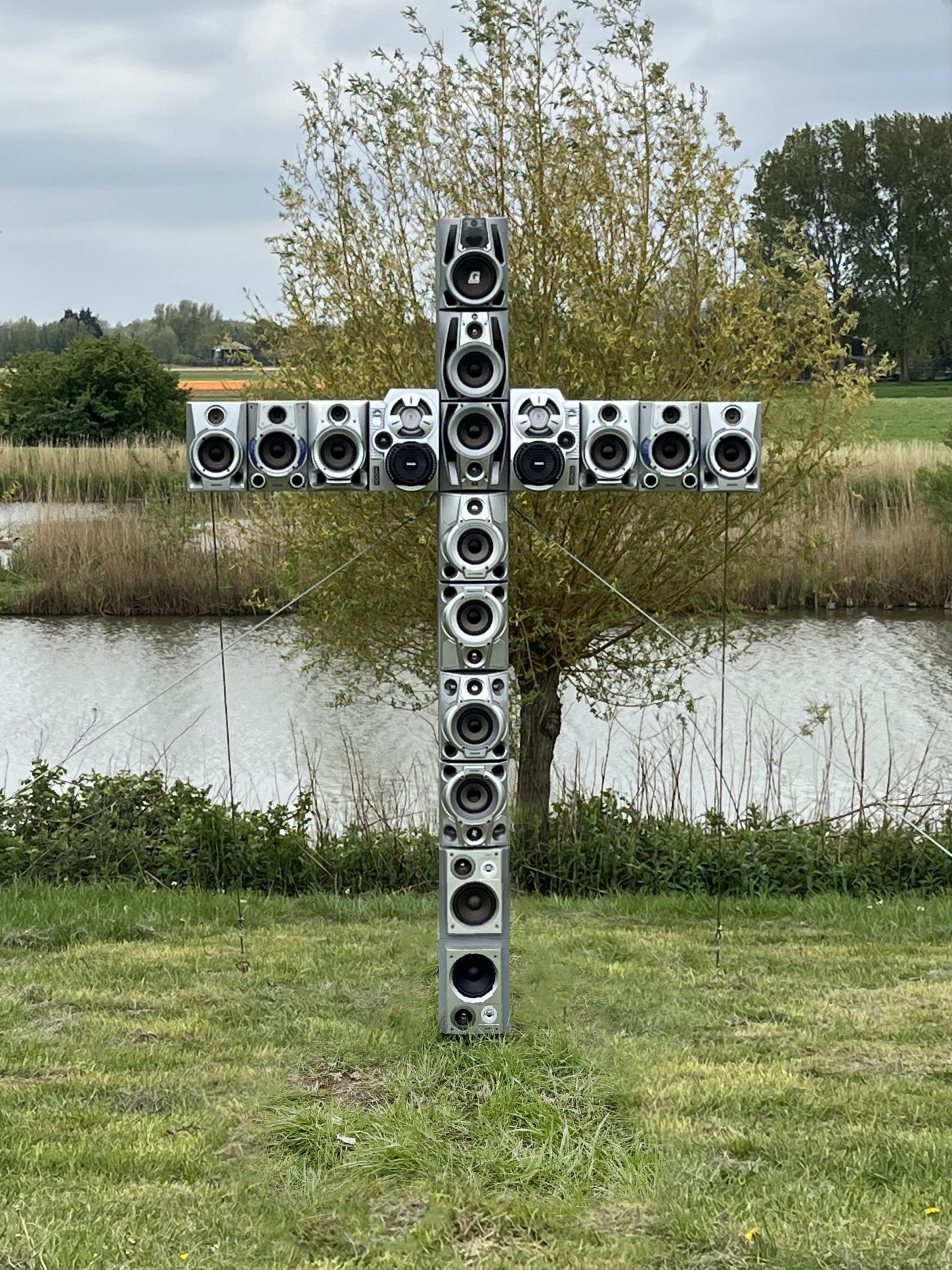
As the February sun traces its short arch over Rotterdam, sounds of Joeri Woudstra’s work will echo over the terrain of the Van Nelle Factory. Woudstra, a multidisciplinary visual artist and composer, presents work from his series “Radiate” during Art Rotterdam. For this giant cross made of speakers, Woudstra mixed echoes, samples, and loops from pop music with iPhone recordings and live performances recorded during sunsets.
Karin Kytökangas (part of the Prospects exhibition organised by the Mondriaan Fund)
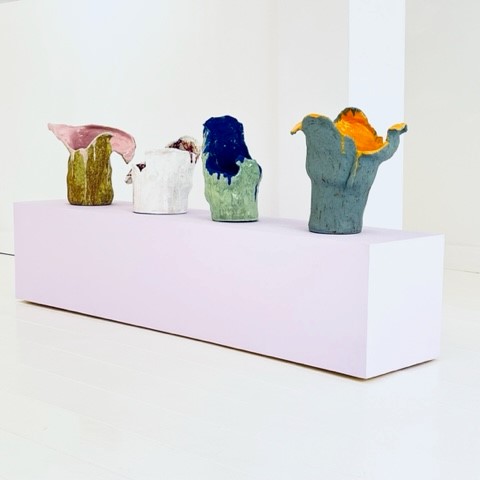
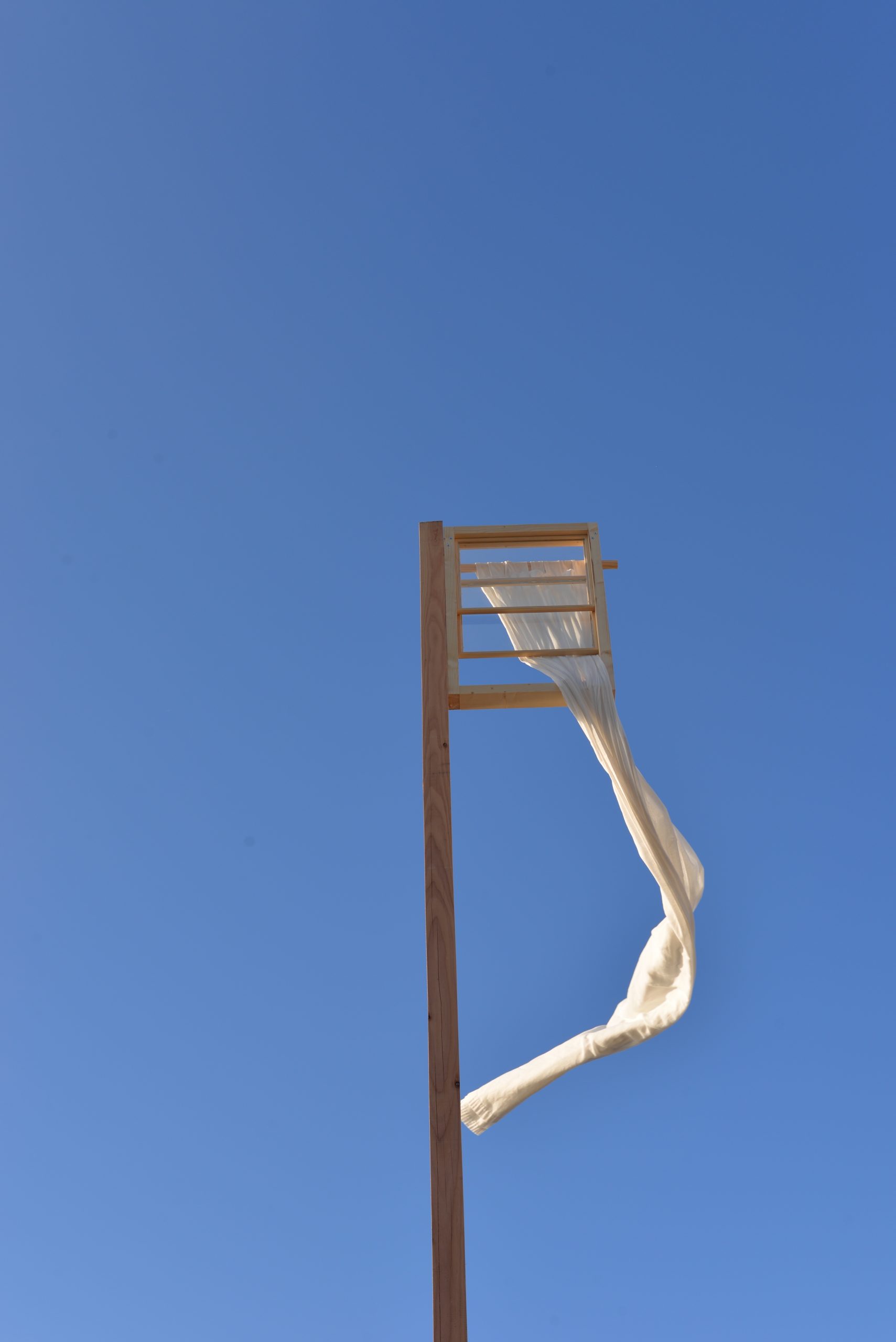
“I wish the world were softer,” Karin Kytökangas (1991) confesses. With paintings and sculptures executed in a dreamlike visual language, the artist challenges painful power structures. She is especially interested in the tension between power on the one hand and vulnerability on the other. In order to depict this tension she uses the contrasts between soft and hard. The vulnerable, soft medium of painting, for instance, can simultaneously be hard when using a powerful visual language or making a strong substantive statement. The sculpture “The Long Haul” (2023), standing outside the Van Nelle Factory, is literally a soft object that is now hard: a fixated white flag eternally billowing in the wind. For the artist, this work is about a desire for peace. By creating contrasts between shape and content, Kytökangas encourages us to surrender to reality and argues in favour of innovation.
Dré Wapenaar (presented by NL=US Gallery)
The oeuvre of the Dutch sculptor Dré Wapenaar is closely linked to architecture. Monumental tent constructions are a recurring form in his practice, often as a reaction to the urban space. His ecological works often have a very specific purpose and offer space for the human dimension. For example, he designed a tent for sellers of street newspapers and tents that involve death and birth. How do people use the public space and does that space reflect those same people? Wapenaar hopes to start a dialogue between citizens and their city. During Art Rotterdam, he presents “TENTVILLAGE REVISITED” (2007), a microcosm of society. Wapenaar says: “You can see this work as my proposal for urbanization.”
Oscar Peters (presented by C.o.C.A.)
Oscar Peters predominantly creates large-scale kinetic sculptures. In his latest works, he explores encompassing themes such as loss, grief and fury. At Art Rotterdam, he exhibits “The Gift of Fury” (2024), in which he investigates collective grief, joy and the need for hope in the face of contemporary alienation. This is achieved by integrating elements from other cultures and rituals, as well as cinematic traditions of world building. Like walking into an alternate universe, the installation evokes strong feelings, like those inspired by the romantic, almost sentimental depictions in pre-raphaelite paintings of death, loss, grief, and mourning. Fury, born from these emotions, is not necessarily blind anger but rather a directed or guided rage, with a potent goal, either to destroy or create. Upon entering the work, you are no longer just an observer, but a participant in the creation of the ritual; stepping into a shared place of mourning, a contributor to collective healing. The Collectors of Contemporary Art (C.o.C.A.) foundation consists of a group of eight collectors of contemporary art, united with the goal of supporting the work of young, promising artists in the Netherlands by providing an annual grant.

Marcel Mrejen (part of the Prospects exhibition organised by the Mondriaan Fund)
Greenhouse cultivation enables new landscapes to exist within established ones, as a greenhouse set up in the polder, for instance, can accommodate a different climate for growing crops. Marcel Mrejen (1994) collected greenhouse sounds, such as the buzzing and droning of ventilators, pumps, and neon lights. He then fed hours of these audio recordings to an artificial intelligence that transformed them into a soundscape. Placed outside the Van Nelle Factory, the installation “Cottagecore (Paradise Haunts Growth)” (2022) is playing this soundscape with the help of nine speakers. The artist is no longer in control of what the installation allows the public to hear, while its duration is undetermined as well. Apart from being a spatial entity, the sculpture thus also extends over a period of time. Occasionally, the installation produces the sound of a voice. According to Mrejen this is the algorithm’s consciousness contemplating the costs of growth: How can we use technology to restore non-exploitative relationships with the planet?
Geraldo Dos Santos (presented by Josilda da Conceição Gallery)
Geraldo Dos Santos, known for his affinity for narrative complexities, introduces “La Santeria de Mama” (2023-2024) as a profound endeavor in cultural decolonization. By centering on the symbolic significance of candles, meticulously deconstructs hierarchical systems associated with the persuasion of these ritual objects. This prompts thought-provoking inquiries about the multi-emigrated identity. “La Santeria de Mama” manifests as an installation of stories, with each candle representing a chapter in the ongoing narrative of cultural resilience. Specifically chosen for their tenacious spirit, the candles transform into a powerful metaphor symbolizing the enduring strength of cultural identities from Latin America. This hegemonic phenomenon transcends conventional art boundaries, acting as a catalyst for a parafiction. The vibrant colours of the sculptures disrupt monochromatic narratives, creating space for nuanced perspectives. Uncomfortable truths embedded in migration narratives are exposed as preconceived notions are dismantled, prompting a collective reexamination of societal structures that perpetuate hierarchies based on origin and heritage.
Adriaan Rees (presented by Livingstone Gallery)
High in the air, at over 4 meters, stands a striking lilac sculpture on a metal pole. The polyester figure is a woman bent over with a bucket in her hands. Her head, covered with long hair, is largely hidden in the bucket. The title of the work, “Screaming in a Bucket” (2023/2024), is evocative and originates from a dream. At their booth on the fair floor, Livingstone Gallery will present a special edition of this work in porcelain with silver. Rees, known for his versatility in materials, splits his time between Amsterdam and his own studio in Jingdezhen, China. He creates sculptures and installations and works on large-scale projects, performances, and sculptures for public spaces.
John M. Robinson (presented by A Modest Show)
British artist John M. Robinson is known for his performance paintings. During tarot readings and other occult or spiritual events, the artist embodies new personas, which become the documented paintings. At Art Rotterdam, Robinson will perform in a modest garden shed outside the Van Nelle Factory, adorned with images and equipped with spy holes. At scheduled times, he will perform a number of durational works there.
Marieke Bolhuis (presented by NQ Gallery)
Marieke Bolhuis exhibits an installation of three sculptures: “Starting point, YOU ARE HERE” (2023). The artist works intuitively, in continuation of her interest in emotions, psychic states, awareness. In a constant dialogue with shape and material, she thinks through doing. These three sculptures can be seen as individual sculptures, but together form a powerful installation. Bolhuis: ”A life with and in nature, sprouting from the dark earth. The miracle that the most beautiful shapes and colors come to life from that nutrient-rich organic earth’s crust. Life forms, organisms, plants and animals, working together to create an incredibly diverse and rich landscape.” The work is a continuation of “If we would all be plant”, which was on display at the fair last year.
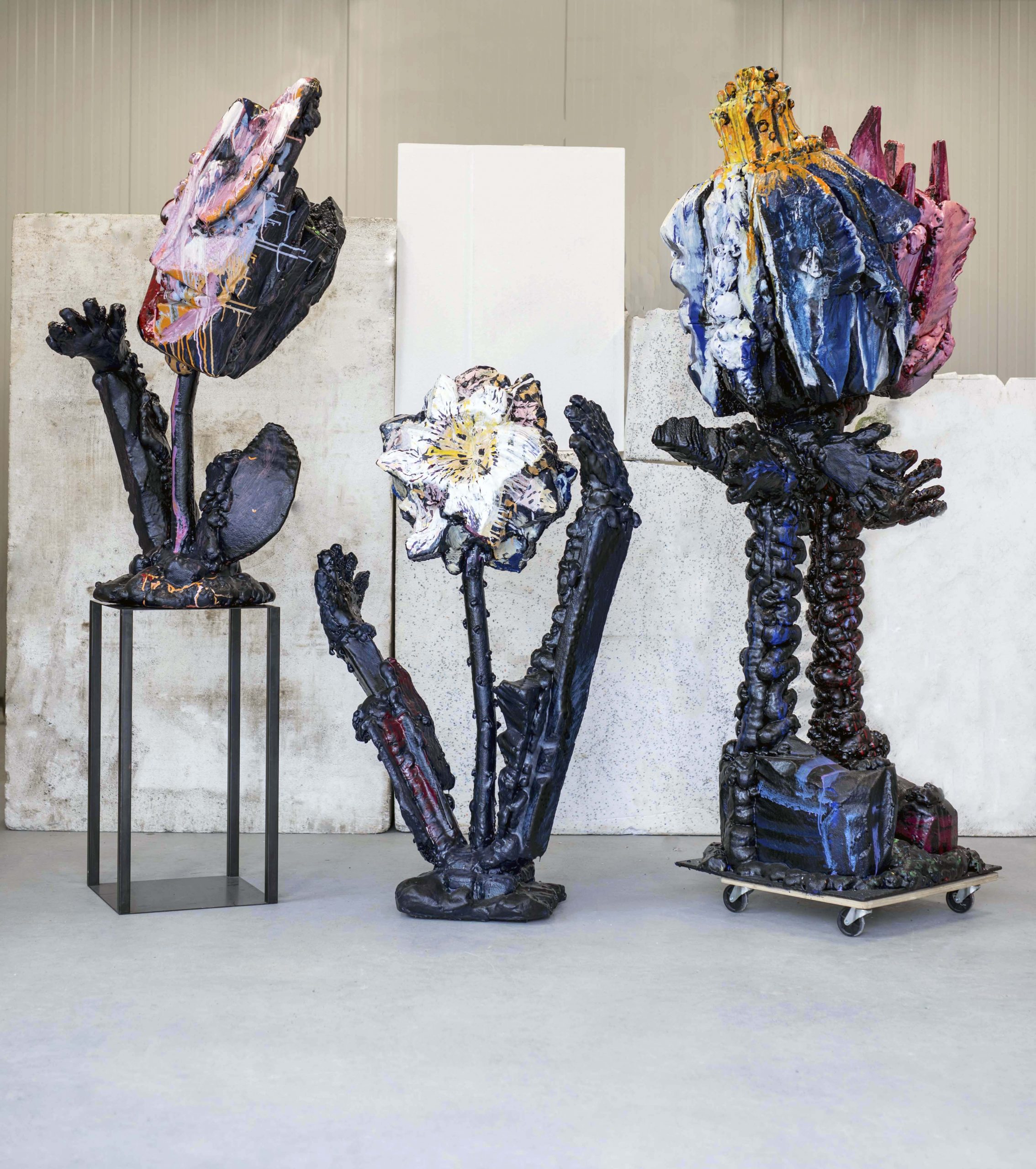
Cecilia Bjartmar Hylta (part of the Prospects exhibition organised by the Mondriaan Fund, courtesy diez gallery)
Cecilia Bjartmar Hylta (1992) often takes themes like infrastructure and urban planning as points of departure for new work. She is interested in how we move though the outside space, in the demands placed on us by structures, and in the reactions these evoke. In her work she tries to mimic public situations in order to visualize their underlying, often invisible, forms and ideas. For the sculpture “Van Nellefabriek” (2023), the artist collected dust from the Distribution Centre which she compressed to form a miniature version of the building. With this sculpture Bjartmar Hylta is thus inverting content and form.
Art van Triest (presented by MPV Gallery)
Control is a recurring theme in the work of Art van Triest: “Central to my work is the human tendency to fight our fundamental fear with a system, to get a grip on the world around us and satisfy our need for control. My work is a visual investigation, in which I question how this system relates to the physical reality of the world around us. With my work I want to offer a visual counterbalance to the simplification and standardization of our environment. I would like to strive for a more realistic positioning of man, in which we can relate to reality in a more complete way”. “Lines” (2023) is a sculptural installation, it explores a balance between systems. It attempts to portray contrasts between possible ways of relating to our environment. Focusing on strength and calculating reliability or arising from a development process it portrays various ways of working and thinking.
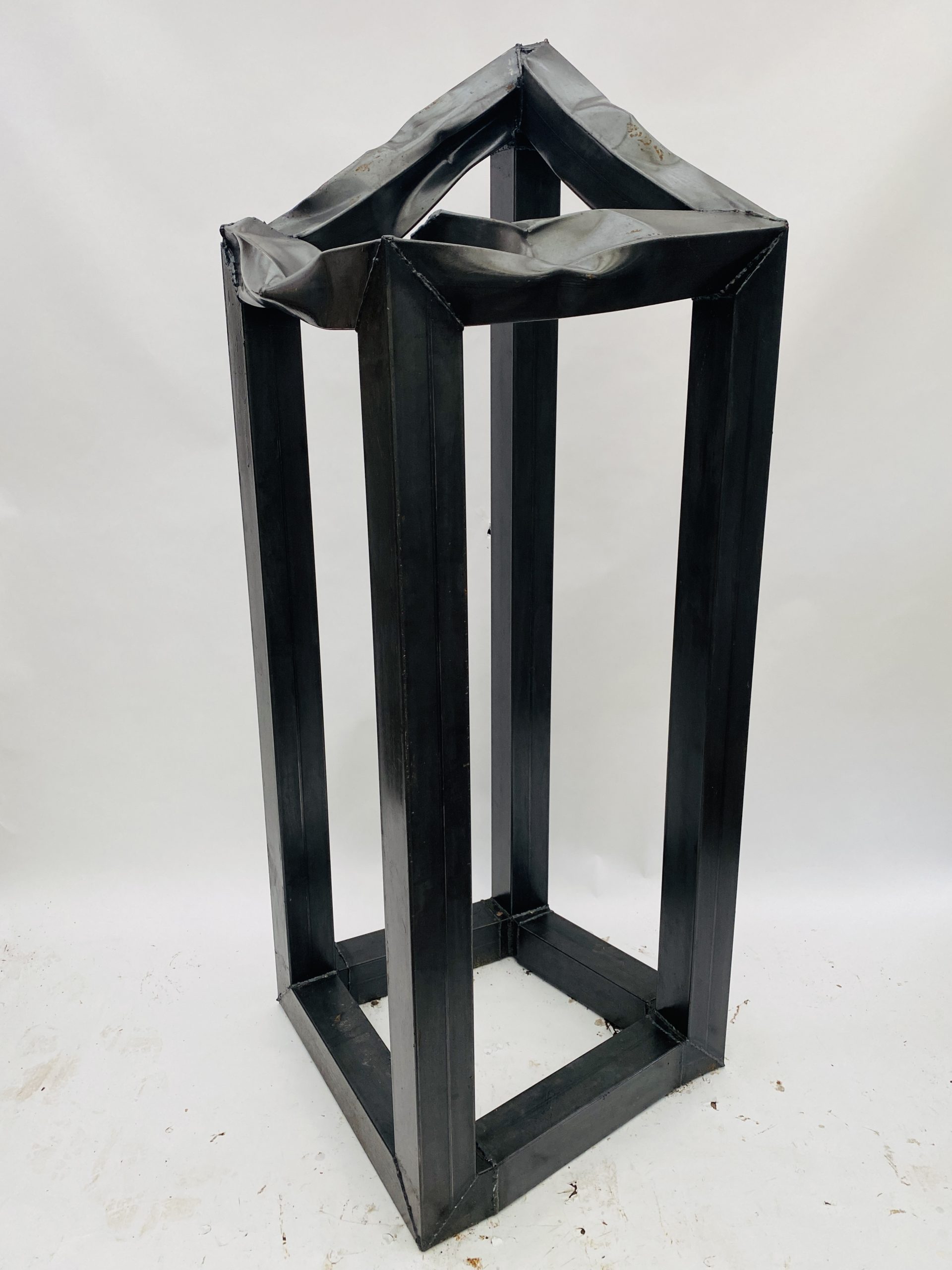
André Kruysen (presented by NL=US gallery)
André Kruysen presents ‘Dependent perspective (whale’s eye)’ (2023). Kruysen’s work relates to daylight and the structure of the architecture around him. He makes interventions in spaces that influence these aspects. These interventions can result in both freestanding and space-merging sculptures. His more complex and chaotic language of form in recent years stems from the increasingly complex (visual) culture in which we live. The search for a personal balance in it finds its form in his work. In the midst of his disruptive spatial interventions, Kruysen seek silence: the stillness that occurs due to the sacred effect of daylight. This contradiction is the basis of his sculptures.
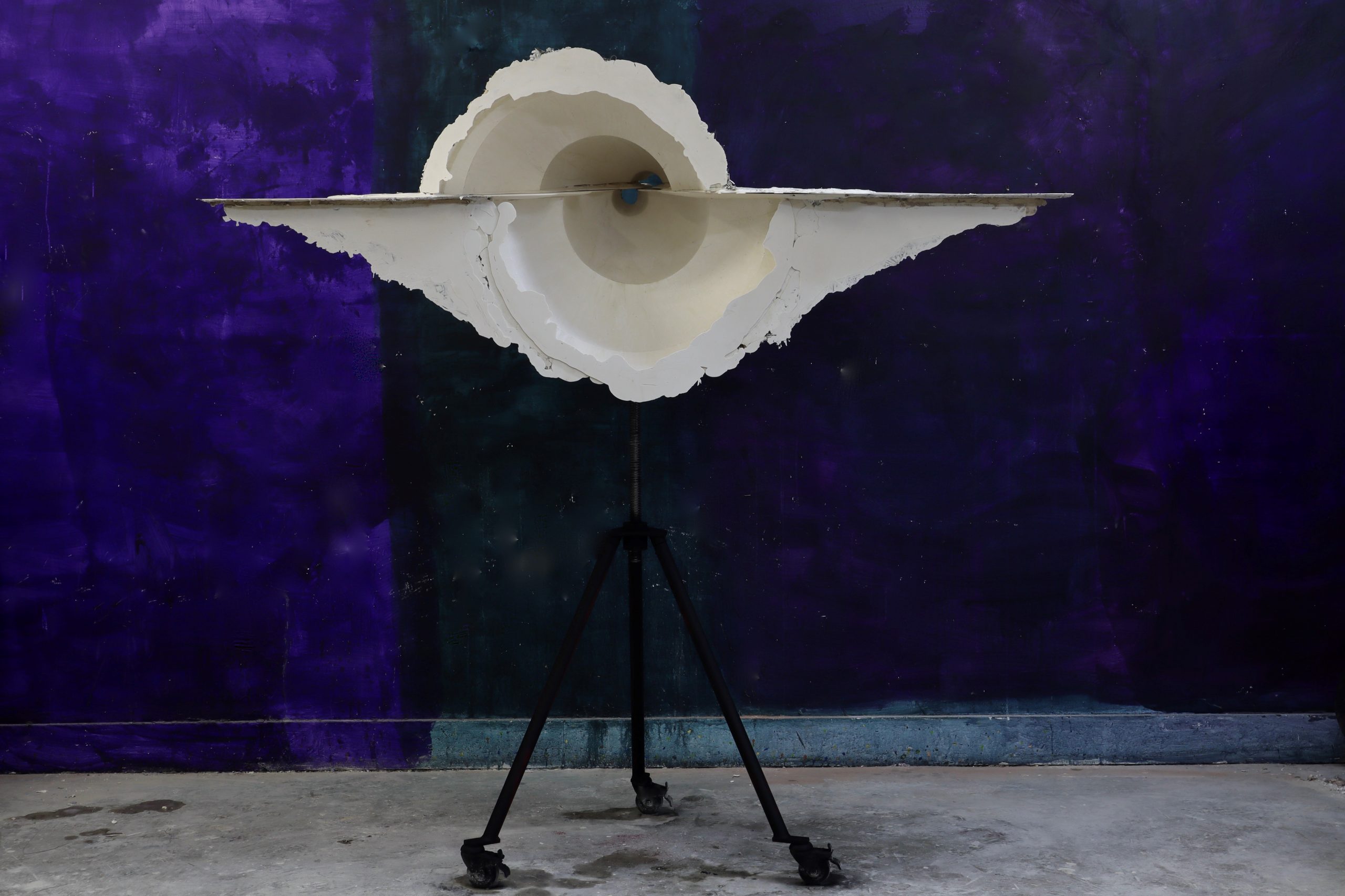
Olaf Mooij
Rotterdam-based artist Olaf Mooij has gained particular renown for his car sculptures in public spaces. At Art Rotterdam, he presents “The Church of our Unbelieving Faith” in a mysterious, chapel-like structure. In this beautiful chapel you fall from one surprise to the next. Having entered you have to let your eyes do the work. “What should I believe?” And “What do I want to believe?” Are questions that stay with you after seeing all those special objects. Do you believe in the sacredness of the technology? Or do you believe that the holy cow is alive and created from an auto-spermatozoid? Is our car such a great invention? Isn’t it better to continue electrically? And to whom do we prefer to leave our fate: the human driver or the self-thinking machine? These kinds of aspects are highlighted in this ‘church’.
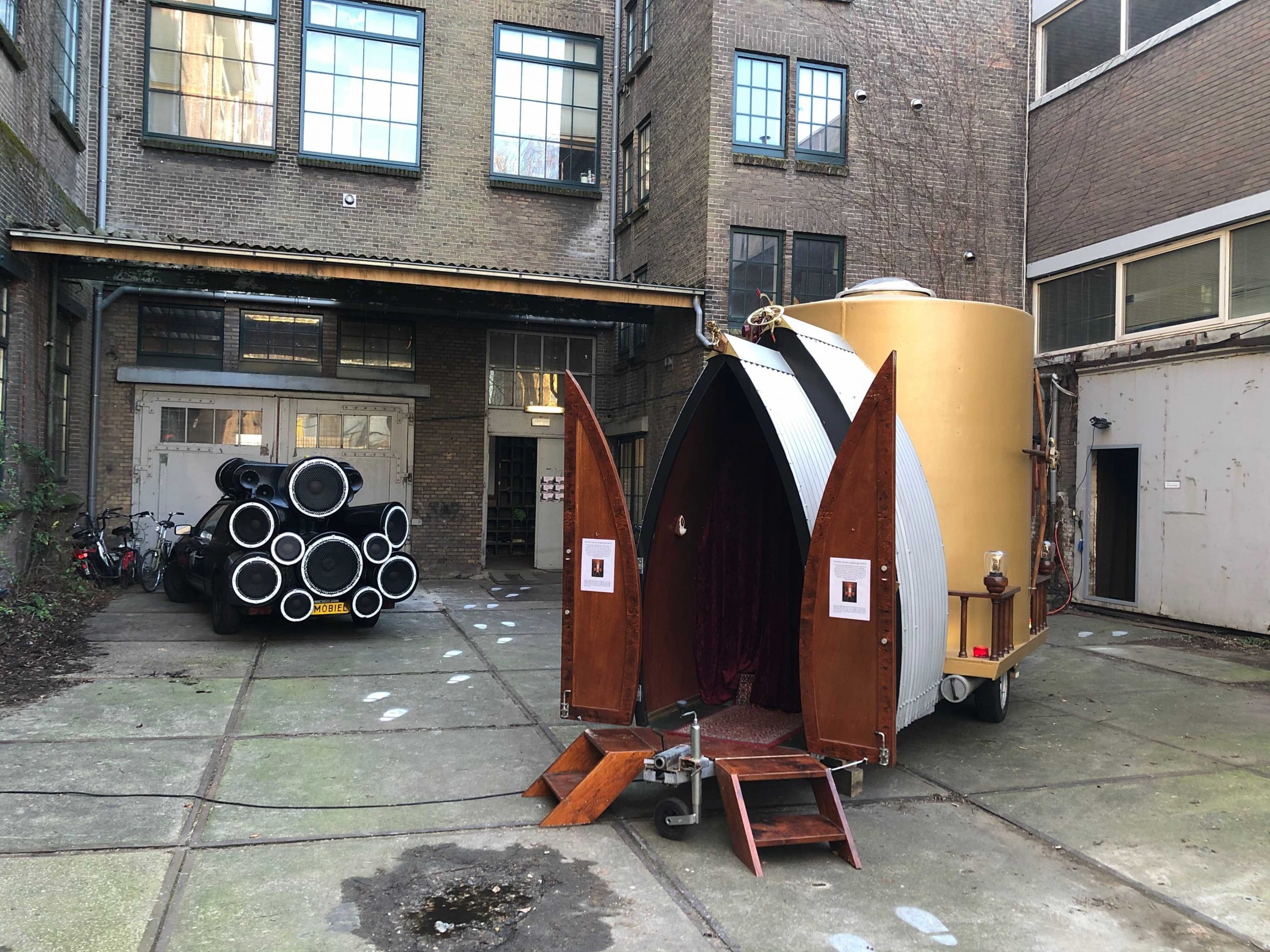
Thordur Hans (presented by Rademakers Gallery)
It is often the familiar and mundane that takes centre stage in the work of Icelandic artist Thordur Hans. His practice revolves around being perceptive of interesting gestures that one might come across in their everyday life. These gestures then develop into artworks in the form of recognisable, slightly modified objects or activities that brings a new perspective to their existence. “Window I” (2021) is a monument to everyday forgetfulness and casual apathy.
Ruud Kuijer (presented by Slewe Gallery)
Ruud Kuijer is a Dutch sculptor known for his series of large abstract concrete constructions along the quay of the Amsterdam-Rhine Canal near Utrecht, the so-called “Waterworks”. Over the years, Ruud Kuijer has made several large sculptures with flat plates of concrete or iron that hang, lean, lie or stand upright. In “Large Standing Plate” from 2022, a box section and a pipe protrude through a monumental iron plate and keep it visually balanced. The flat surface of a plate is made part of a three-dimensional whole. The front and back of the plate get their own identity. You can walk around it to experience its sculptural character.
Willem Besselink (presented by OMI Rotterdam and NL=US gallery)
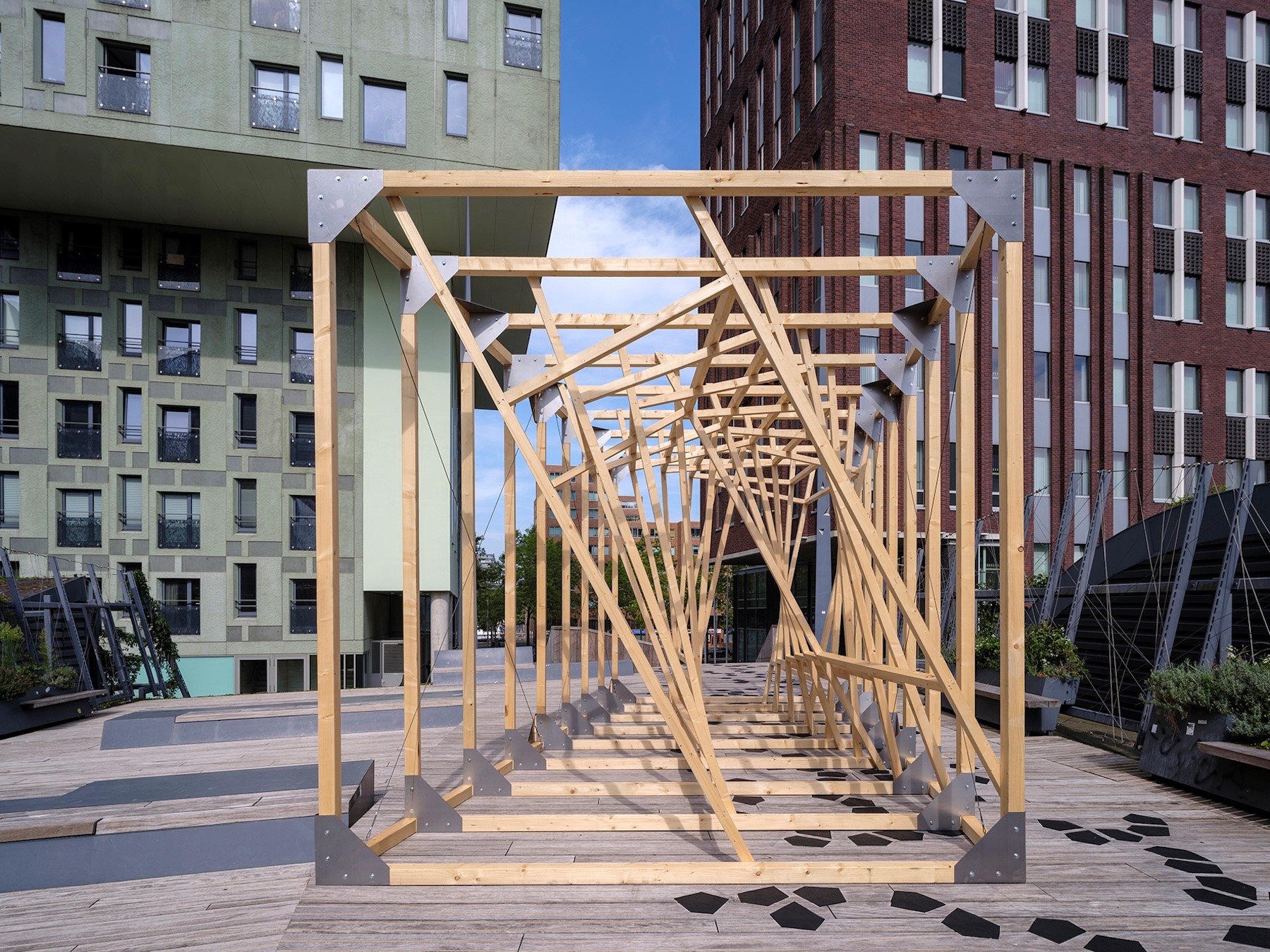
The built environment of the city, and the Van Nelle building in particular, consists of an almost infinite number of structures and systems. Willem Besselink is fascinated by the interference patterns that arise in the process, which he visualises in his work. Interference patterns occur when two or more waves, such as light, sound, or water waves, meet and combine. The sculpture “See Through” (2023) is one of the many possible visualisations of the many structures and at the same time contributes to the further accumulation, and its interference patterns.
Martinus Papilaja (part of the Prospects exhibition organised by the Mondriaan Fund)
For graffiti artists it is crucial to use a recognizable tag that cannot be traced back to them. This is important because the application of graffiti is forbidden in most places. Martinus Papilaja (1988) considers it a sign of recognition for the specific craft of graffiti that his work is now presented to the public explicitly under his own name. Papilaja studied what the graffiti artist’s need or urge to write is, and how this affects their personal handwriting. He thinks of graffiti as a craft that can be perfected through practice and studying the work of others. For his work at Prospects, Papilaja consciously chose to experiment with form. Rather than spray painting a flat surface, he presents three sculptures outside the Van Nelle Factory that establish his tag spatially.
Sanne van Balen (part of the Prospects exhibition organised by the Mondriaan Fund)
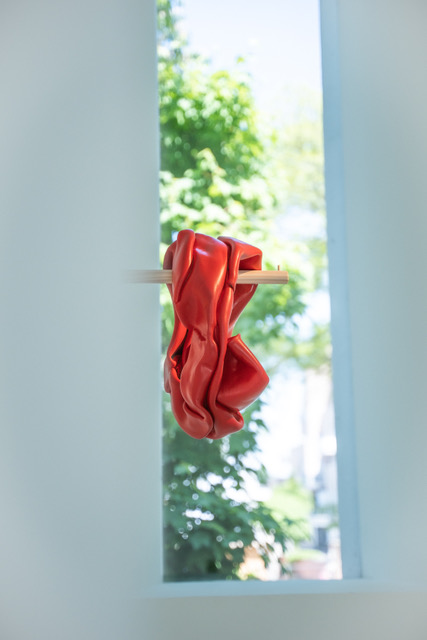
Can language present itself in a different guise? This question is a common thread in the work of Sanne van Balen (1994). After graduating in Dutch language and literature, she went on to study Image & Language at the Gerrit Rietveld Academie. Her artworks focus on the visual experience of language, while her writings give images a voice. For her work at Prospects, Van Balen is zooming in on the tongue. On the one hand, the tongue is a muscle that shapes and literally creates language. On the other, ‘tongue’ also refers to the language we speak, the language of a people. This duality is a recurring feature in her work. Lying in the grass outside of the Van Nelle Factory is the work “Stem” (2024), a red, meandering sculpture somewhat resembling a physical tongue. To Van Balen, the landscape is a linguistic site that both contains and conveys the environment’s meanings.
Erik Buijs (presented by Rutger Brandt Gallery)
Erik Buijs sculpts animated figures from clay or wax, deliberately leaving traces of the sculpting process. His artworks serve as a thought-provoking commentary, stirring curiosity and inviting contemplation. Through the intriguing blend of his figures whimsical and childlike appearance combined with somber undertones, Buijs sculptures embody a peculiar yet powerful presence. These figures, seemingly playful yet oddly peculiar, offer a unique perspective on the human condition. Within their seemingly simple forms lie layers of depth, revealing both sensitivity and idiosyncrasy. Buijs intertwines the weighty aspects of human emotion with the innocent essence of childhood, creating sculptures that emotionally resonate with viewers.
Compiled by Flor Linckens
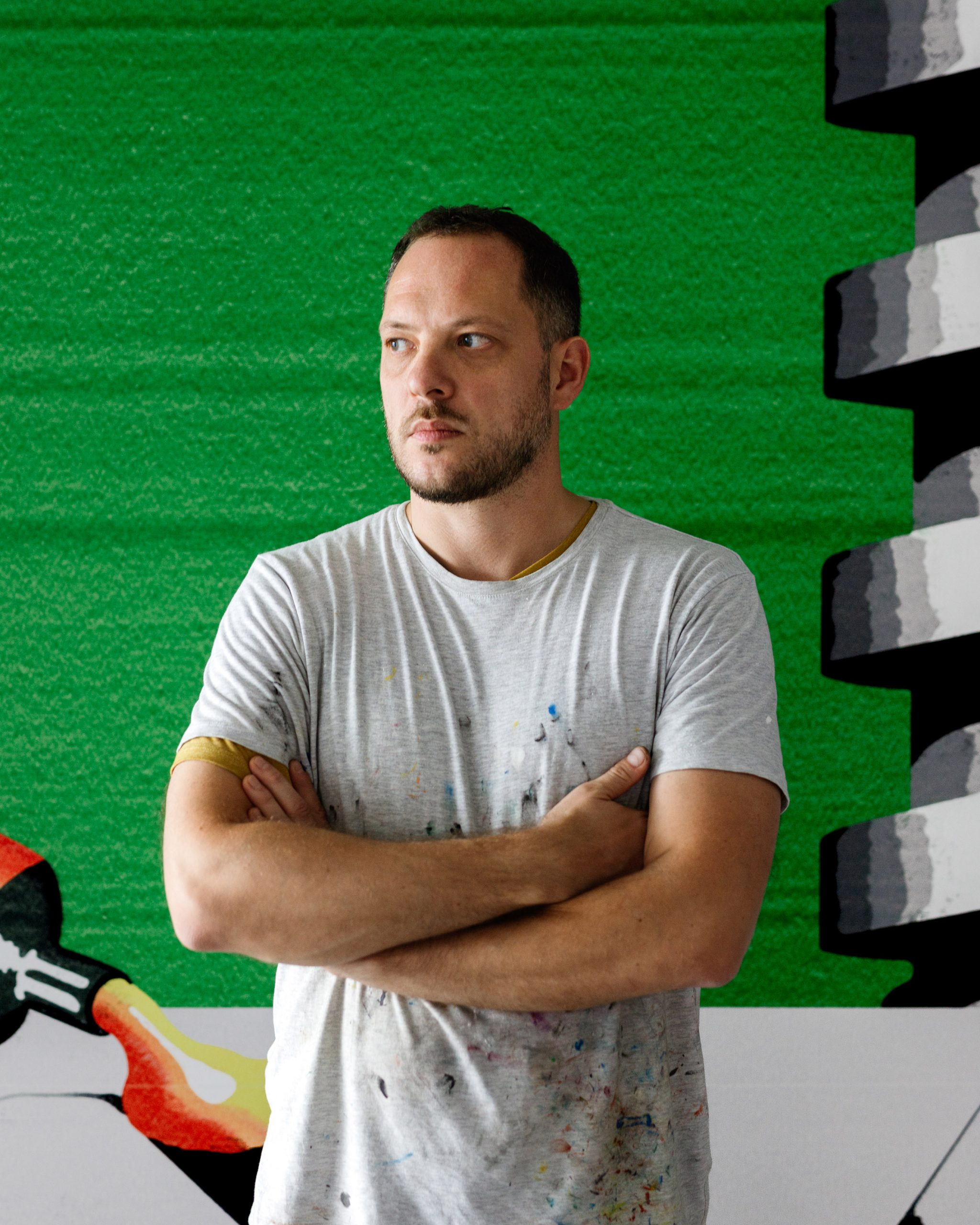
At Art Rotterdam, acb Gallery from Budapest will presents the work of Hungarian artist Róbert Batykó in the New Art Section. There, the artist will exhibit his latest series of oil paintings and collages, some of which he created during a residency program in gastatelier Doc4 in Haarlem.
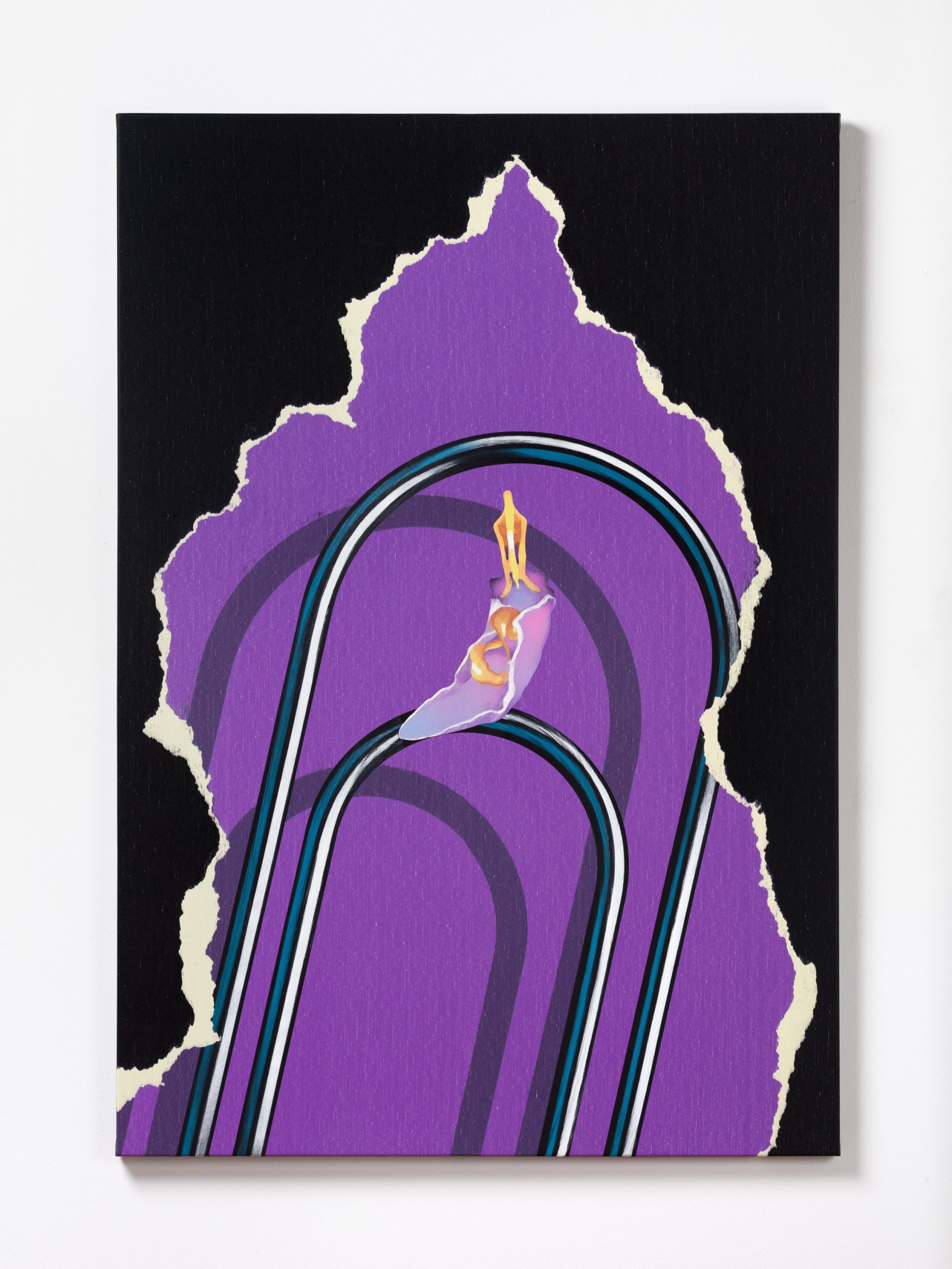
In his practice, Róbert Batykó blends traditional techniques with digital influences. His style is characterised by the mechanical scraping of paint over the canvas in the final stage of the process, resulting in an ultra-thin layer of paint. For this, the artist uses a self-built machine, a combination of a press and a blade. He’ll find himself surprised by the final outcome, over which he has only partial control.
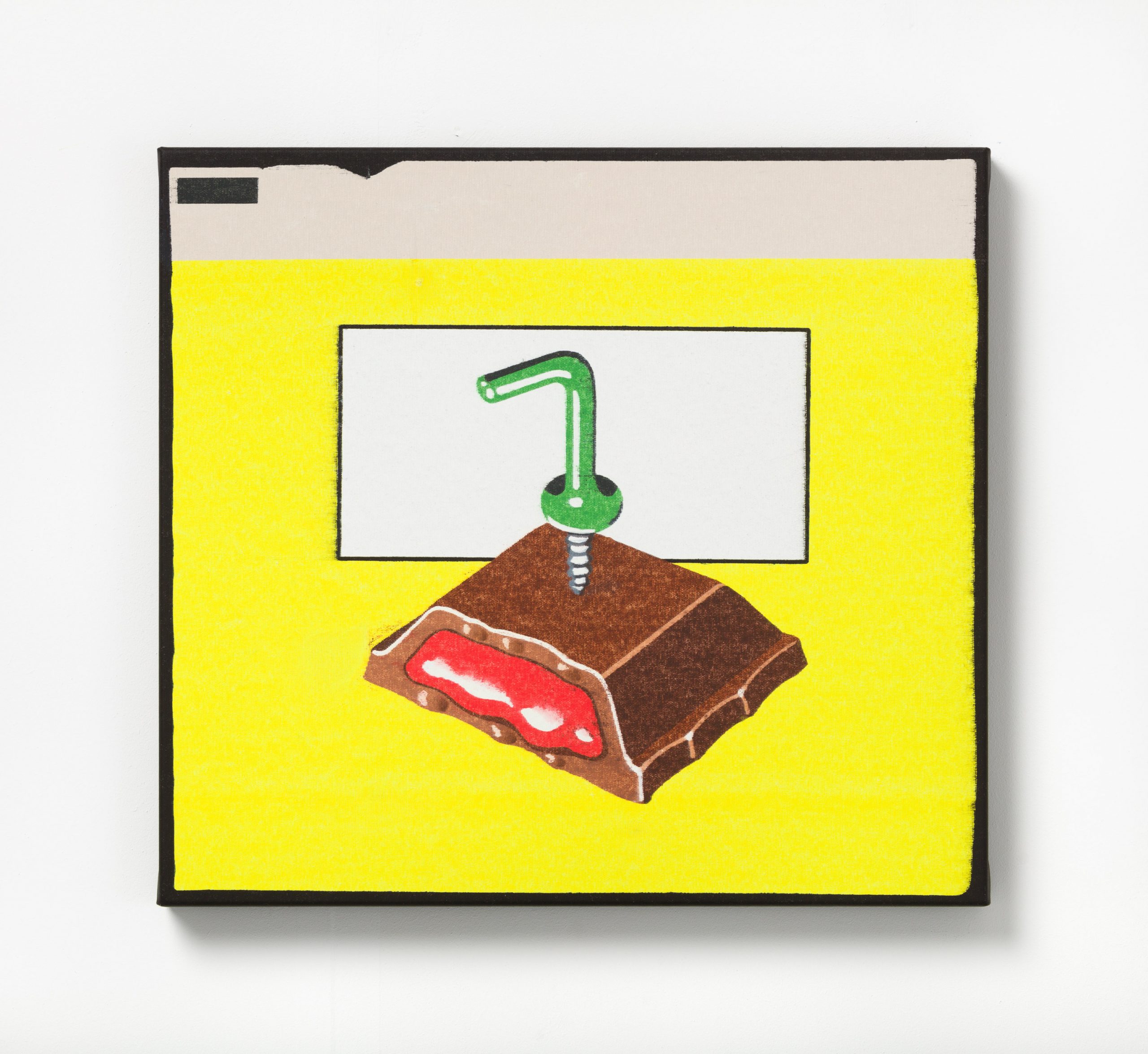
Batykó’s practice lies at the intersection of abstraction and realism, between the digital and the physical. He transforms digital images into often large-scale paintings, that are occasionally reminiscent of software interfaces. The artist utilises found objects such as packaging materials, old VHS tapes and magazines, as well as step-by-step illustrations from vector drawing manuals. He is particularly interested in shapes and transforms these materials by removing them from their original context. For this part of the process, he uses stencils and cutting plotters.
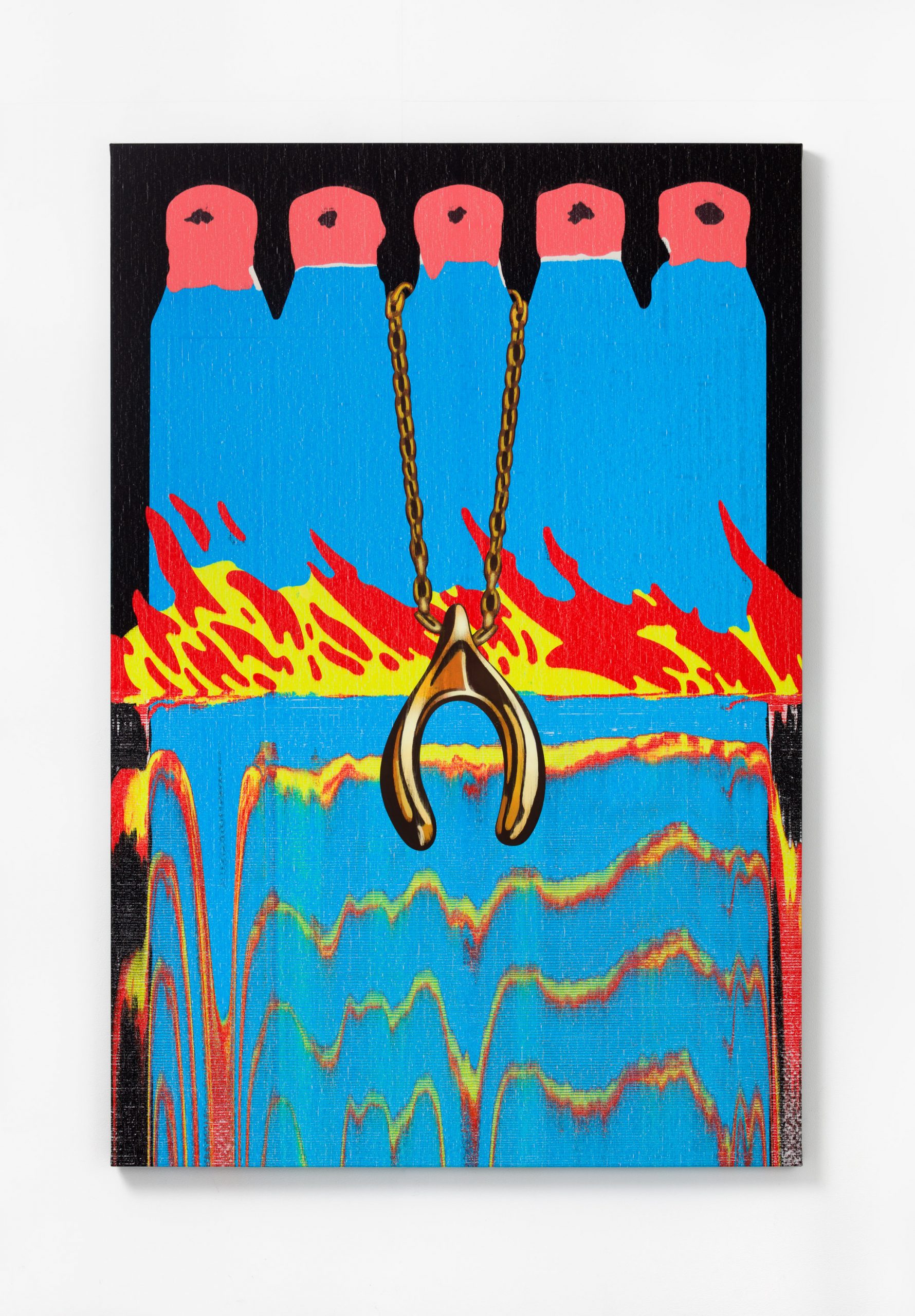
The resulting compositions sometimes appear strange and somewhat surreal, yet they are generally also quite recognisable. The figures in his latest works are not human, but seem to possess anthropomorphic qualities nonetheless. They have a certain degree of abstraction but are, at the same time, clearly figurative. This gives viewers the freedom to offer their own interpretations.
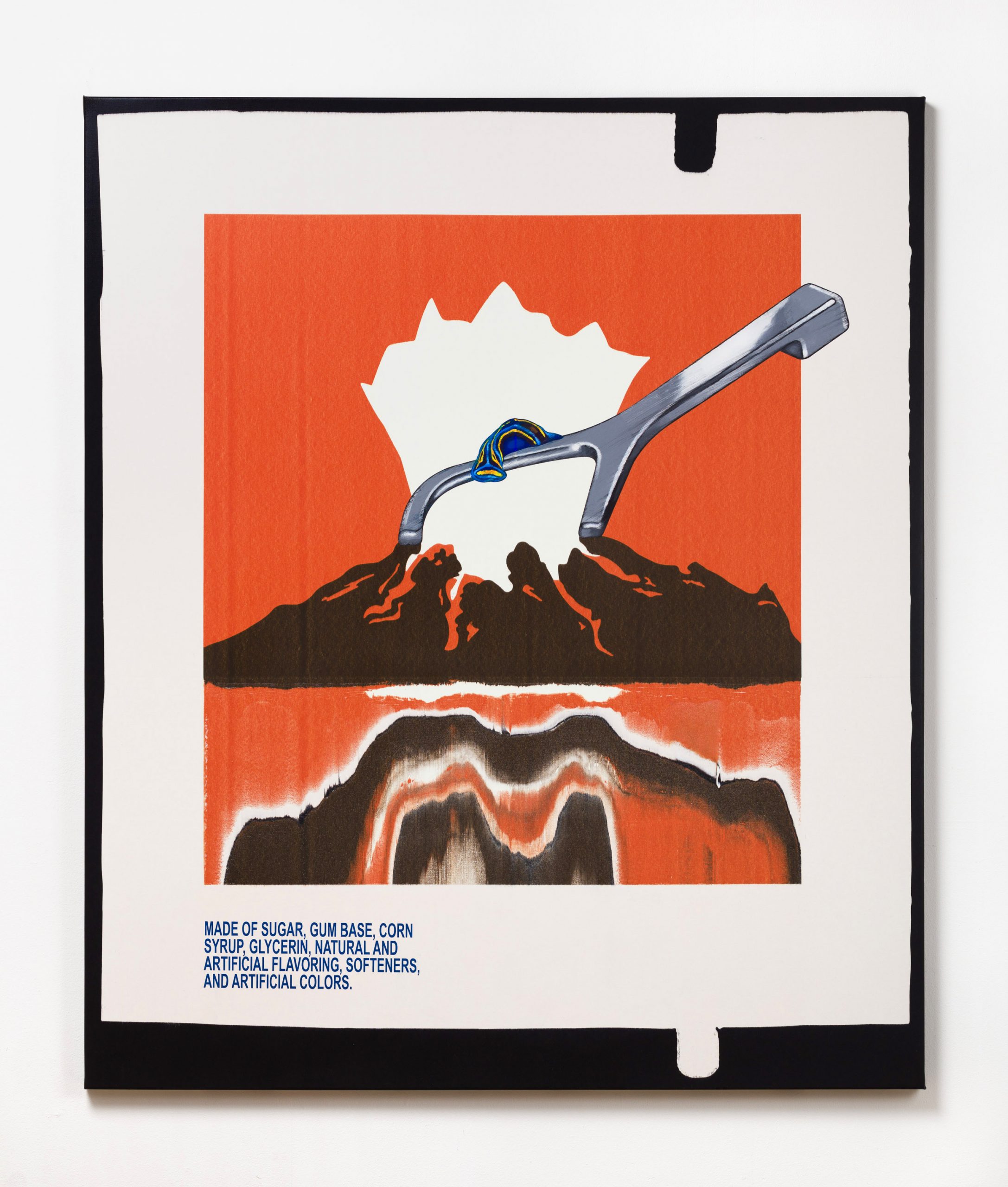
The artist’s practice is informed by themes such as our consumer culture — and its visual appeal —, the production and manipulation of digital images and the so-called ‘technological subconscious’.
Batykó obtained a Master’s degree in Painting at the Hungarian University of Fine Arts in Budapest, followed by a DLA (Doctor of Liberal Arts) program at the University of Pécs. His work has been included in the collections of the Hungarian National Gallery (Magyar Nemzeti Galéria) and the contemporary Ludwig Museum in Budapest. In 2022, his work was featured in a group exhibition at MODEM (Centre for Modern and Contemporary Arts) in the Hungarian city of Debrecen. He received several awards, including a Strabag Art Award (2007), a Leopold Bloom Art Award (2011) and a Hungary Emerging Prize (2018). The artist has lived and worked in the Netherlands for several years.
The work of Róbert Batykó will be on display in the New Art Section during Art Rotterdam, presented by acb Gallery from Budapest.
Written by Flor Linckens
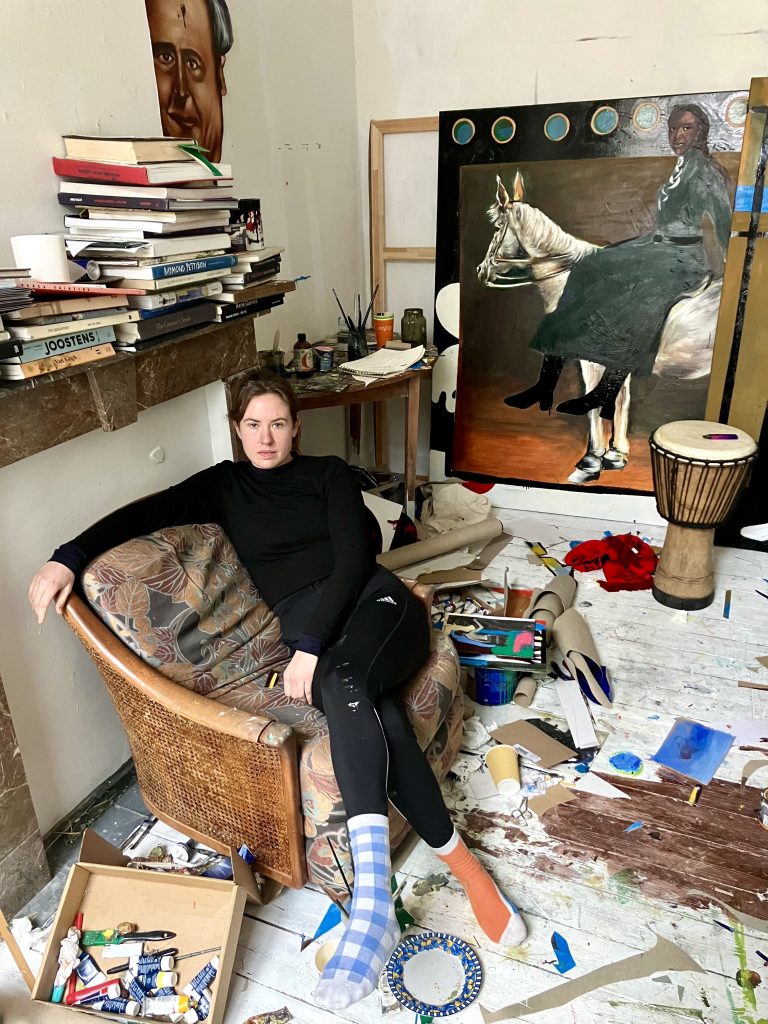
Interview with Louise Delanghe
“If painting is the sea, I want to be the ultimate surfer.” Every decision and consideration must be visible to Belgian artist Louise Delanghe (BE, 1994), as she believes that therein lies the poetry of a work of art.
Delanghe is considered a great painting talent, and in her work, she leaps from genre to genre: from full-length portraits to work on cardboard and from classical nudes to textual work. Pizza Gallery is presenting an overview at Art Rotterdam of the work Delanghe has created so far, in addition to work from her newest series, Weeping Wham, which she describes as “the elusive beauty of the cherry on an overly sweet whipped cream cake.”
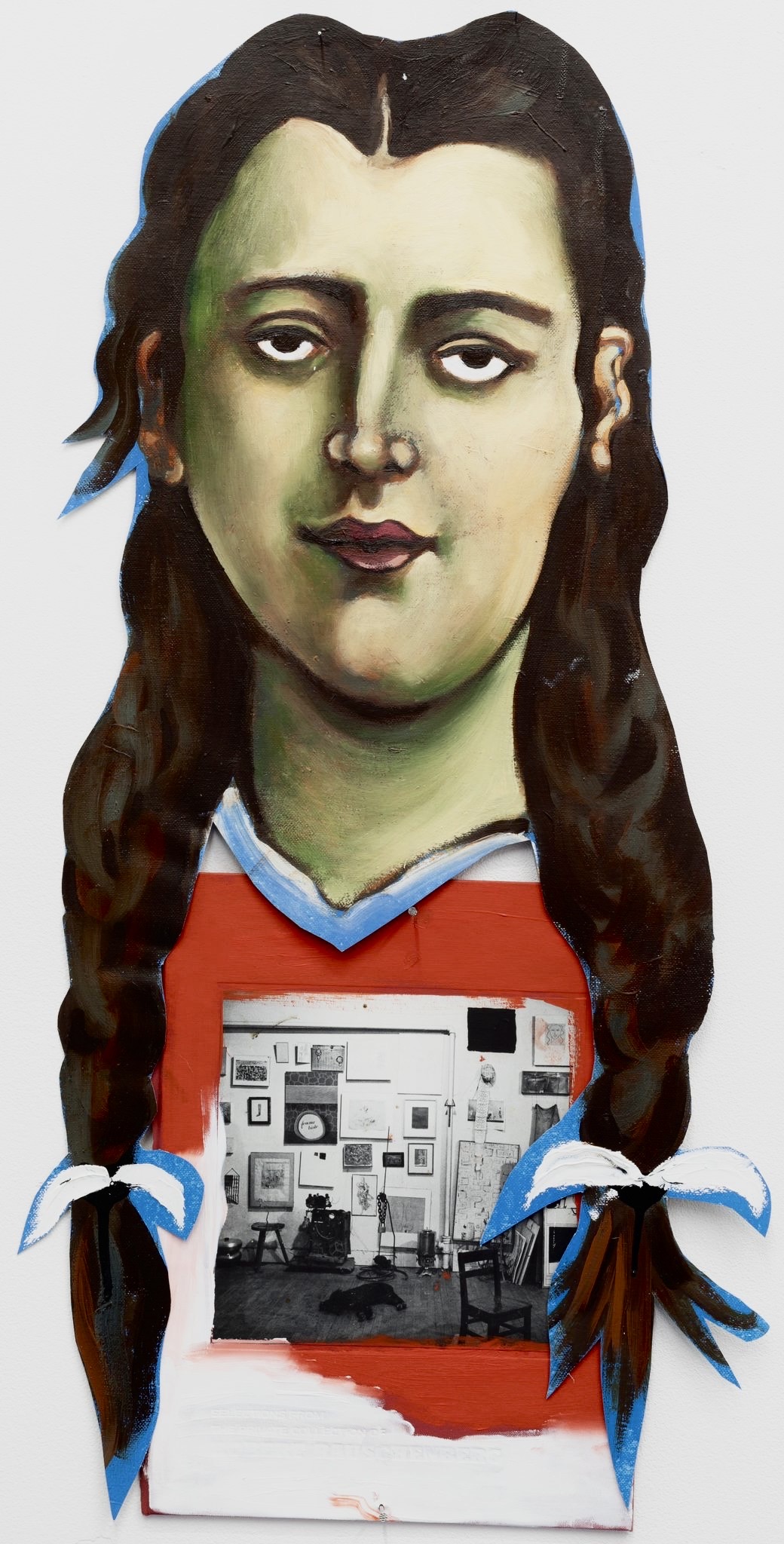
Congratulations on your presentation at Art Rotterdam! What can we expect?
Thank you! Color is the workhorse in my art, an obsession, joy and tribulation all at the same time. It is the binding agent that connects the layers of stories and characters in my paintings. At Art Rotterdam, I want to emphasise this with an eclectic mix from different periods in my journey. For many visitors, it will be their first encounter with my work and my intention is to create an exciting ‘totality’ at the fair.
Is it a logical continuation of Boulevard Angel, your exhibition earlier this year at Pizza Gallery, or have you started a new project?
I am mostly showing recent work. The series embodies a succession of standing figures and busts with a penetrating yet tender gaze. Some time ago, a painting by William-Adolphe Bouguereau that I found online, entitled The Little Shepherdess, really caught my eye. In addition to his less interesting biblical scenes, he also devoted a lifetime to painting female figures, all with a certain aura about them, with an extraordinarily vulnerable, romantic, contemplative, melancholic and sometimes spellbinding expression. A kind of rom-com avant la lettre, a feeling that sometimes overcomes me in everyday life. It moved me. The Little Shepherdesswas the torch that brought a whole range of other examples to light, resulting in a new series of paintings entitled Weeping Wham. The elusive beauty of the cherry on an overly too sweet whipped cream cake may best describe what the viewer can expect to see. I hope my work evokes a certain witty fragility people can identify with.
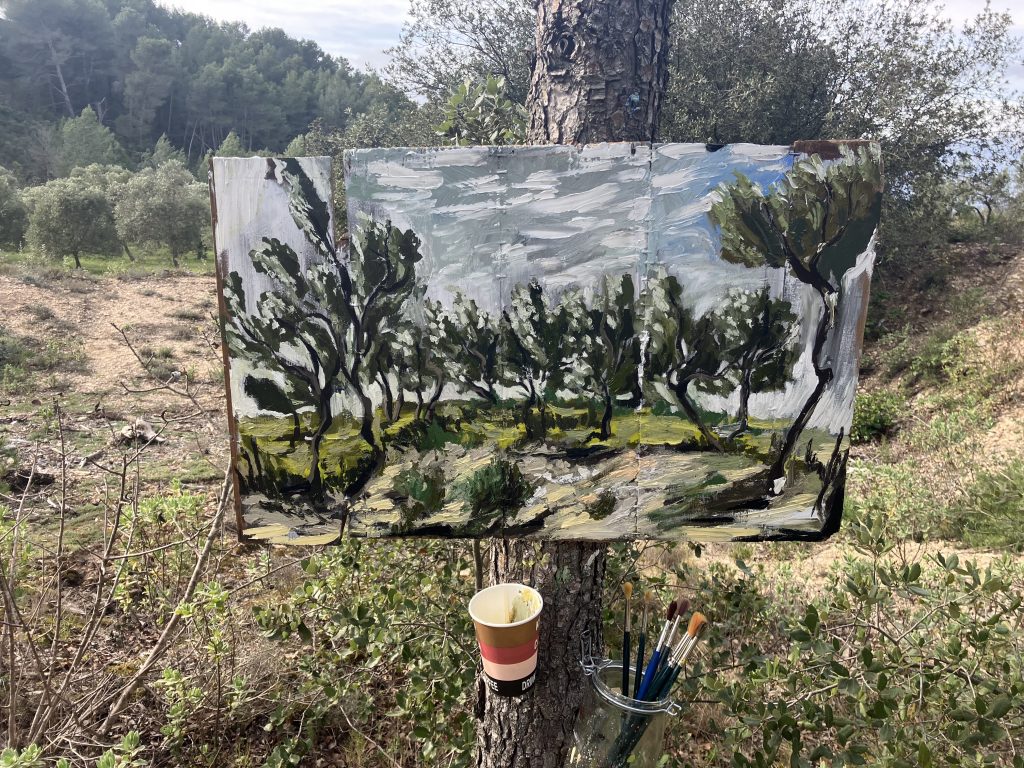
For Boulevard Angel, you created smaller paintings on reclaimed wood. Why did you want to use reclaimed wood and is experimenting with different mediums something you enjoy?
The paintings in the Boulevard Angel show were created in three different places in Southern France. Painting in the open air was a revelation for me. As a child, I lived near Nuenen, the village where Vincent van Gogh painted his famous Potato Eaters. Vincent was my first encounter with painting, so it was particularly special to work in the region around Arles and follow in his southern footsteps. Nature makes you think and act differently. It didn’t feel right to buy prefab canvases. The medium had to be something with a past. I found a dealer in Saint-Andiol, a rather rough type. He bought lots in India, the contents of which were always a gamble. Some of them were handmade furniture, objects and curiosities with a colonial past, and the rest were wood from demolished dilapidated buildings, some with beautifully hand-painted motifs. The pieces of wood were selected based on the size of my easel and their weight, as everything had to be carried with me outdoors. After a bit of negotiation, cash in hand and being a bit taken advantage of, I was on my way.
My thoughts often went to all the impressionists who painted outdoors. You are at the mercy of the weather, especially the mistral wind that sweeps through the landscape in this region, which determined the direction of my work several times in an amusing way. I had to paint faster and differently than in a studio, in a single motion like a snapshot. Coincidence brought me to the medium – or vice versa, as is usually the case.
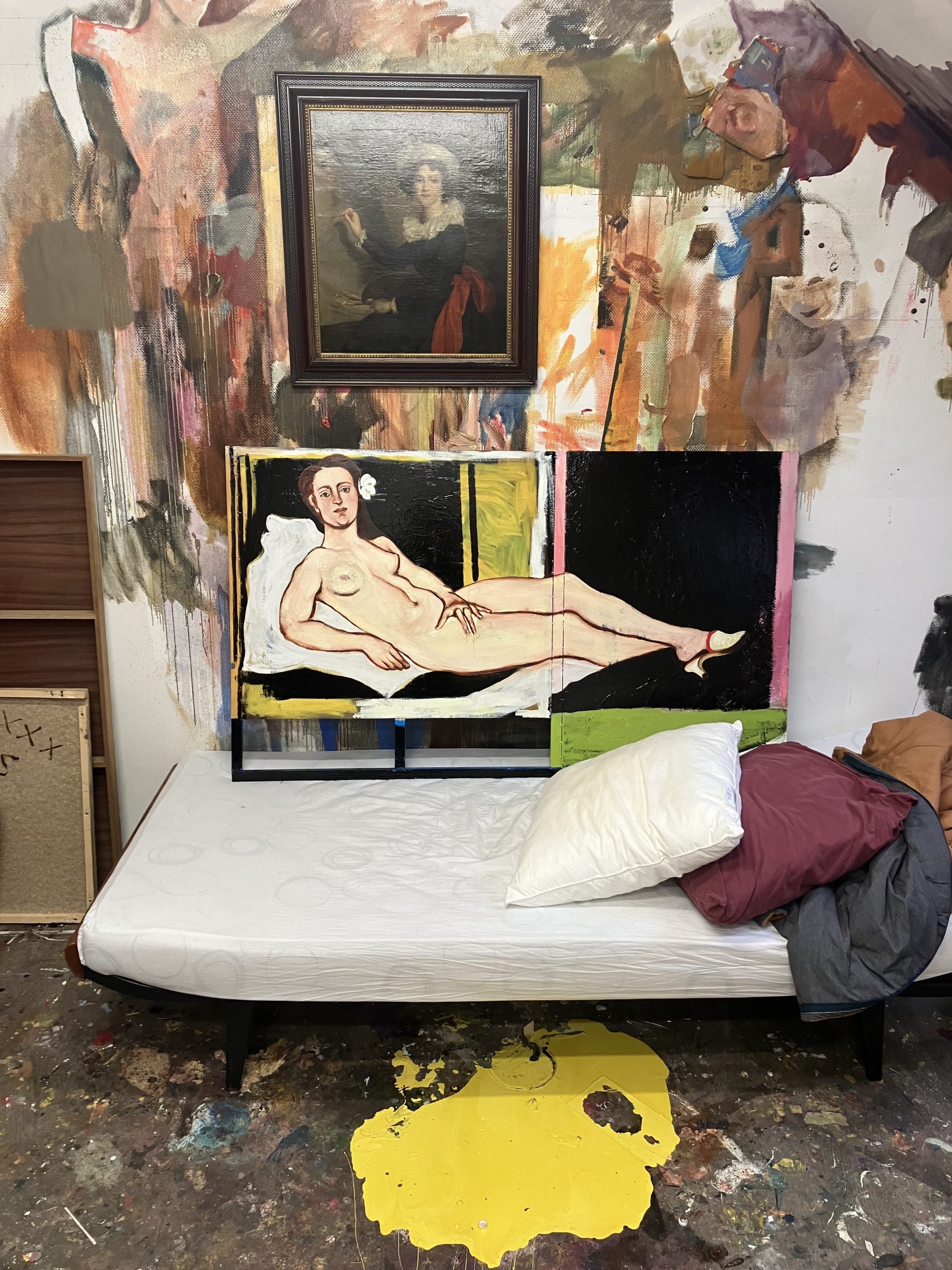
Looking at your Instagram account, your work seems to go in all directions, from full-length portraits to work on cardboard and from classical nudes to textual work. Do you think there is a common thread in your work?
I suspect that such switching is rooted in my character, a ‘hopper‘ as they say. I become restless if I follow the same path visually and verbally for too long, a healthy dose of chaos then takes over me when I’m working. If painting is the sea, I want to be the ultimate surfer, always looking for the right wave in time and space. I want every gesture and moment of decision to be palpable in my paintings.
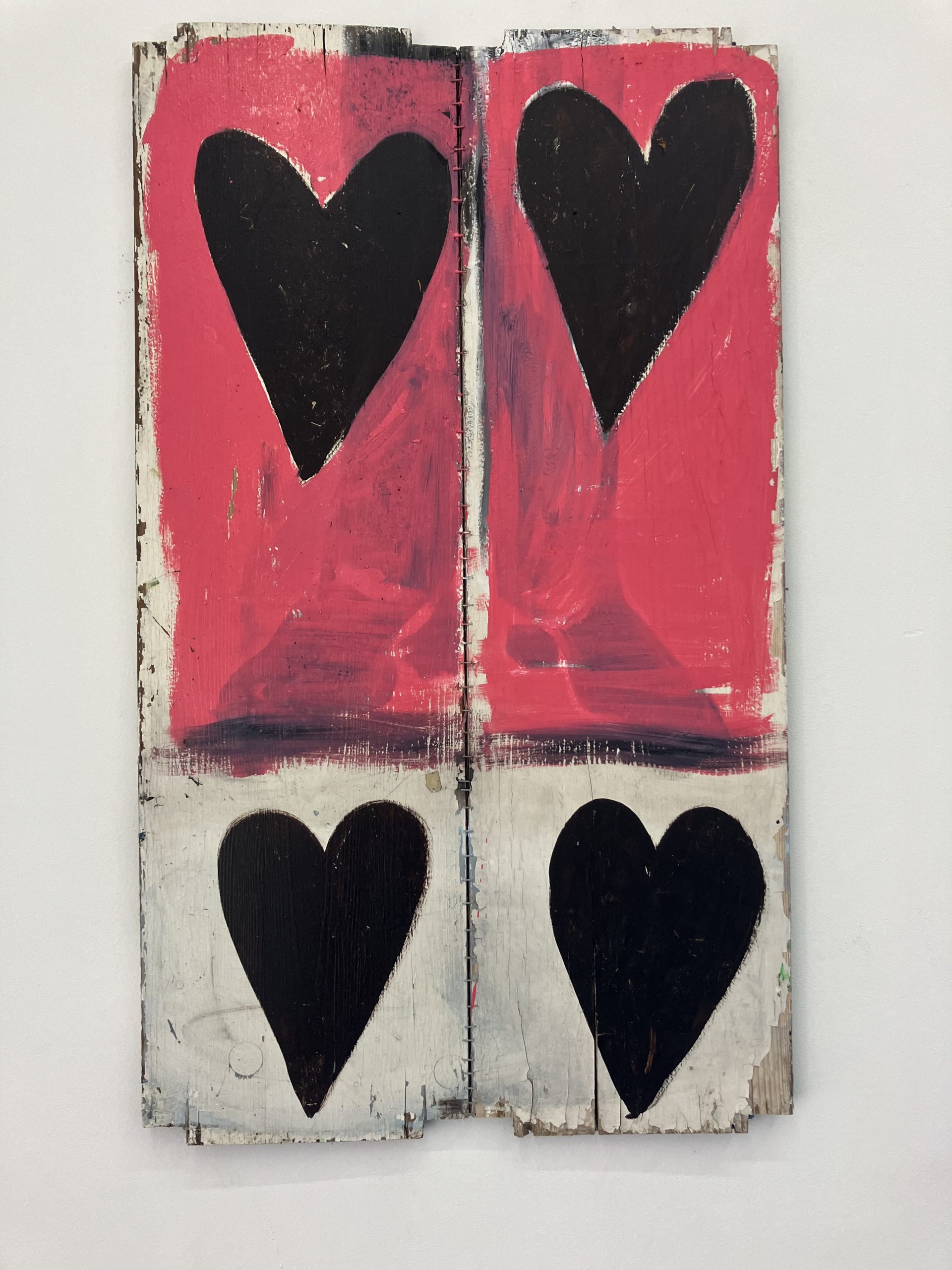
Why is that important to you?
It is a feeling I am also looking for when I stand in front of a work of art, an inextricable finishing touch that makes an image unique and where I believe the poetry lies.
You are now 29 and still at the beginning of your career. What do you hope to achieve in the next five years?
I am convinced that if you do something with passion, things will always cross your path at the right time. Over the next five years, I want to mainly continue to follow my own course, wherever the wind may blow it.
Written by Wouter van den Eijkel


